stop GMC ENVOY DENALI 2007 Manual Online
[x] Cancel search | Manufacturer: GMC, Model Year: 2007, Model line: ENVOY DENALI, Model: GMC ENVOY DENALI 2007Pages: 562, PDF Size: 2.87 MB
Page 345 of 562
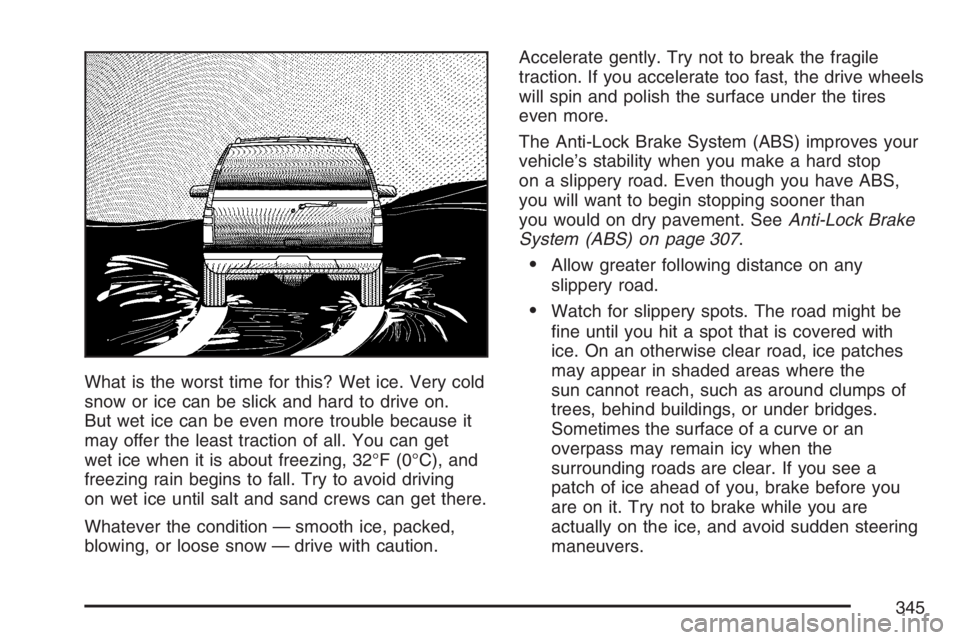
What is the worst time for this? Wet ice. Very cold
snow or ice can be slick and hard to drive on.
But wet ice can be even more trouble because it
may offer the least traction of all. You can get
wet ice when it is about freezing, 32°F (0°C), and
freezing rain begins to fall. Try to avoid driving
on wet ice until salt and sand crews can get there.
Whatever the condition — smooth ice, packed,
blowing, or loose snow — drive with caution.Accelerate gently. Try not to break the fragile
traction. If you accelerate too fast, the drive wheels
will spin and polish the surface under the tires
even more.
The Anti-Lock Brake System (ABS) improves your
vehicle’s stability when you make a hard stop
on a slippery road. Even though you have ABS,
you will want to begin stopping sooner than
you would on dry pavement. SeeAnti-Lock Brake
System (ABS) on page 307.
Allow greater following distance on any
slippery road.
Watch for slippery spots. The road might be
ne until you hit a spot that is covered with
ice. On an otherwise clear road, ice patches
may appear in shaded areas where the
sun cannot reach, such as around clumps of
trees, behind buildings, or under bridges.
Sometimes the surface of a curve or an
overpass may remain icy when the
surrounding roads are clear. If you see a
patch of ice ahead of you, brake before you
are on it. Try not to brake while you are
actually on the ice, and avoid sudden steering
maneuvers.
345
Page 346 of 562

If You Are Caught in a Blizzard
If you are stopped by heavy snow, you could be in
a serious situation. You should probably stay
with your vehicle unless you know for sure that you
are near help and you can hike through the
snow. Here are some things to do to summon
help and keep yourself and your passengers safe:
Turn on your hazard ashers.
Tie a red cloth to your vehicle to alert police
that you have been stopped by the snow.
Put on extra clothing or wrap a blanket around
you. If you do not have blankets or extra
clothing, make body insulators from
newspapers, burlap bags, rags, oor
mats — anything you can wrap around yourself
or tuck under your clothing to keep warm.You can run the engine to keep warm, but be
careful.
346
Page 354 of 562
If you put things inside your vehicle — like
suitcases, tools, packages, or anything
else — they will go as fast as the vehicle goes.
If you have to stop or turn quickly, or if there is a
crash, they will keep going.
{CAUTION:
Things you put inside your vehicle can
strike and injure people in a sudden stop
or turn, or in a crash.
Put things in the cargo area of your
vehicle. Try to spread the weight
evenly.
Never stack heavier things, like
suitcases, inside the vehicle so that
some of them are above the tops of
the seats.
Do not leave an unsecured child
restraint in your vehicle.
When you carry something inside the
vehicle, secure it whenever you can.
Do not leave a seat folded down
unless you need to.There is also important loading information for
off-road driving in this manual. See “Loading Your
Vehicle for Off-Road Driving” underOff-Road
Driving on page 319.
Adding a Snow Plow or Similar
Equipment
Your vehicle was neither designed nor intended
for a snow plow.
Notice:Adding a snow plow or similar
equipment to your vehicle can damage it, and
the repairs would not be covered by warranty.
Do not install a snow plow or similar
equipment on your vehicle.
Towing
Towing Your Vehicle
Consult your dealer or a professional towing
service if you need to have your disabled vehicle
towed. SeeRoadside Assistance Program on
page 532.
354
Page 360 of 562
Electronically Controlled Air
Suspension System
Your vehicle may be equipped with an electronically
controlled air suspension system that automatically
keeps your vehicle level as you load and unload.
The system includes a compressor, two height
sensors and two air springs supporting the
rear axle.
The system also has an internal clock to prevent
overheating if the inator is used for prolonged
periods. If the system overheats, all leveling
function stops until the system cools down.
During this time, the indicator light on the air
inator switch will be ashing.The ignition has to be on for the system to inate,
in order to raise the vehicle to the standard ride
height after loading. The system can lower
the vehicle to the standard ride height after
unloading with the ignition on and also for up to
30 minutes after the ignition has been turned off.
You may hear the compressor operating when you
load your vehicle, and periodically as the system
adjusts the vehicle to the standard ride height.
Load leveling will not function normally with the
inator hose attached to the inator outlet. Remove
the inator hose from the outlet during loading
and unloading.
If the vehicle is parked for an extended period of
time, some bleed down of the suspension is
normal. Upon starting the vehicle, proper height
will be achieved.
360
Page 372 of 562
Turn Signals When Towing a Trailer
The arrows on your instrument panel will
ash whenever you signal a turn or lane change.
Properly hooked up, the trailer lamps will also
ash, telling other drivers you’re about to
turn, change lanes or stop.
When towing a trailer, the arrows on your
instrument panel will ash for turns even if the
bulbs on the trailer are burned out. Thus, you may
think drivers behind you are seeing your signal
when they are not. It’s important to check
occasionally to be sure the trailer bulbs are
still working.
Driving On Grades
Reduce speed and shift to a lower gearbefore
you start down a long or steep downgrade. If you
don’t shift down, you might have to use your
brakes so much that they would get hot and no
longer work well.
You can tow in DRIVE (D). You may want to shift
the transmission to THIRD (3) or a lower gear,
under heavy loads or hilly conditions.
When towing at high altitude on steep uphill
grades, consider the following: Engine coolant will
boil at a lower temperature than at normal
altitudes. If you turn your engine off immediately
after towing at high altitude on steep uphill grades,
your vehicle may show signs similar to engine
overheating. To avoid this, let the engine run while
parked (preferably on level ground) with the
automatic transmission in PARK (P) for a few
minutes before turning the engine off. If you do get
the overheat warning, seeEngine Overheating
on page 408.
372
Page 374 of 562
When You Are Ready to Leave After
Parking on a Hill
1. Apply your regular brakes and hold the pedal
down while you:
start your engine,
shift into a gear, and
release the parking brake.
2. Let up on the brake pedal.
3. Drive slowly until the trailer is clear of the
chocks.
4. Stop and have someone pick up and store
the chocks.
Maintenance When Trailer Towing
Your vehicle will need service more often when
you’re pulling a trailer. See the Maintenance
Schedule for more on this. Things that are
especially important in trailer operation are
automatic transmission uid (don’t overll), engine
oil, axle lubricant, belt(s), cooling system and
brake system. Each of these is covered in
this manual, and the Index will help you nd them
quickly. If you’re trailering, it’s a good idea to
review these sections before you start your trip.
Check periodically to see that all hitch nuts
and bolts are tight.
374
Page 375 of 562
Trailer Wiring Harness
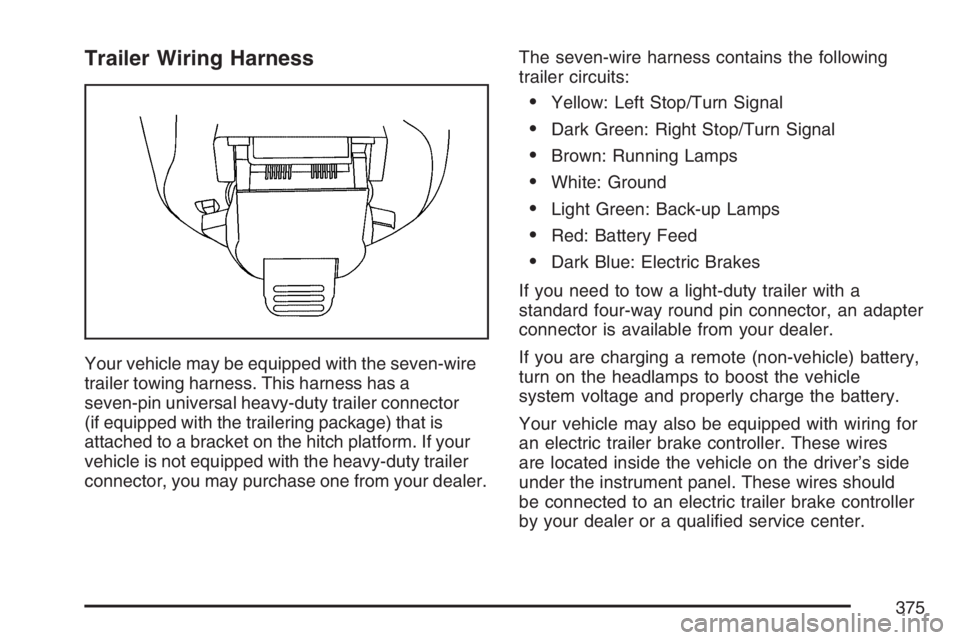
Your vehicle may be equipped with the seven-wire
trailer towing harness. This harness has a
seven-pin universal heavy-duty trailer connector
(if equipped with the trailering package) that is
attached to a bracket on the hitch platform. If your
vehicle is not equipped with the heavy-duty trailer
connector, you may purchase one from your dealer.The seven-wire harness contains the following
trailer circuits:
Yellow: Left Stop/Turn Signal
Dark Green: Right Stop/Turn Signal
Brown: Running Lamps
White: Ground
Light Green: Back-up Lamps
Red: Battery Feed
Dark Blue: Electric Brakes
If you need to tow a light-duty trailer with a
standard four-way round pin connector, an adapter
connector is available from your dealer.
If you are charging a remote (non-vehicle) battery,
turn on the headlamps to boost the vehicle
system voltage and properly charge the battery.
Your vehicle may also be equipped with wiring for
an electric trailer brake controller. These wires
are located inside the vehicle on the driver’s side
under the instrument panel. These wires should
be connected to an electric trailer brake controller
by your dealer or a qualied service center.
375
Page 377 of 562
Service........................................................ 380
Accessories and Modications................... 380
California Proposition 65 Warning.............. 381
Doing Your Own Service Work.................. 381
Adding Equipment to the Outside of
Your Vehicle.......................................... 382
Fuel............................................................. 382
Gasoline Octane........................................ 382
Gasoline Specications.............................. 383
California Fuel........................................... 383
Additives................................................... 383
Fuels in Foreign Countries........................ 384
Filling the Tank......................................... 385
Filling a Portable Fuel Container............... 387
Checking Things Under the Hood.............. 388
Hood Release........................................... 388
Engine Compartment Overview.................. 390
Engine Oil................................................. 394
Engine Oil Life System.............................. 398
Engine Air Cleaner/Filter............................ 400
Automatic Transmission Fluid.................... 401
Engine Coolant.......................................... 405Radiator Pressure Cap.............................. 408
Engine Overheating................................... 408
Cooling System......................................... 411
Engine Fan Noise..................................... 416
Power Steering Fluid ................................. 417
Windshield Washer Fluid........................... 418
Brakes...................................................... 419
Battery...................................................... 422
Jump Starting............................................ 423
Rear Axle.................................................... 428
Four-Wheel Drive........................................ 428
Front Axle................................................... 429
Bulb Replacement....................................... 430
Halogen Bulbs........................................... 430
Headlamps................................................ 431
Front Turn Signal, Sidemarker and
Parking Lamps....................................... 432
Taillamps, Turn Signal, and Stoplamps...... 432
Back-Up Lamps......................................... 434
License Plate Lamp................................... 435
Replacement Bulbs................................... 435
Section 5 Service and Appearance Care
377
Page 386 of 562
{CAUTION:
If you spill fuel and then something
ignites it, you could be badly burned. Fuel
can spray out on you if you open the fuel
cap too quickly. This spray can happen if
your tank is nearly full, and is more likely
in hot weather. Open the fuel cap slowly
and wait for any hiss noise to stop. Then
unscrew the cap all the way.Be careful not to spill fuel. Do not top off or overll
the tank and wait a few seconds after you have
nished pumping before removing the nozzle.
Clean fuel from painted surfaces as soon
as possible. SeeWashing Your Vehicle on
page 486.
When replacing the fuel cap, turn it clockwise until
it clicks. Make sure the cap is fully installed.
The diagnostic system can determine if the fuel
cap has been left off or improperly installed.
This would allow fuel to evaporate into the
atmosphere. SeeMalfunction Indicator Lamp on
page 210.
There may also be a light that comes on in the
instrument panel to let you know if your gas cap is
not properly installed. SeeCheck Gas Cap
Light on page 217for more information.
386
Page 399 of 562

To reset the Engine Oil Life System, do the
following:
1. Turn the ignition key to RUN with the
engine off.
2. Fully press and release the accelerator pedal
slowly three times within ve seconds.
The change engine oil light will ash while the
system is resetting.
3. When the light stops ashing, turn the key
to LOCK.
If the light/message comes back on when you
start the vehicle, the engine oil life system has not
reset. Repeat the procedure.What to Do with Used Oil
Used engine oil contains certain elements that may
be unhealthy for your skin and could even cause
cancer. Do not let used oil stay on your skin for very
long. Clean your skin and nails with soap and
water, or a good hand cleaner. Wash or properly
dispose of clothing or rags containing used engine
oil. See the manufacturer’s warnings about the use
and disposal of oil products.
Used oil can be a threat to the environment. If you
change your own oil, be sure to drain all the oil
from the lter before disposal. Never dispose of oil
by putting it in the trash, pouring it on the
ground, into sewers, or into streams or bodies of
water. Instead, recycle it by taking it to a place
that collects used oil. If you have a problem
properly disposing of your used oil, ask your
dealer, a service station, or a local recycling center
for help.
399