fuel GMC JIMMY 1997 Owner's Guide
[x] Cancel search | Manufacturer: GMC, Model Year: 1997, Model line: JIMMY, Model: GMC JIMMY 1997Pages: 410, PDF Size: 20.03 MB
Page 268 of 410
Before closing the hood, be sure all the filler caps are on
properly. Then lift the hood to relieve pressure on the
hood prop.
Remove the hood prop from the slot in the hood and
return the prop to its retainer.
Then just pull the hood down firmly to close. It will
latch when dropped from
10 to12 inches (25 to 30 cm)
without pressing on the hood.
Engine Oil
It’s a good idea to check your engine oil every time you
get fuel.
In order to get an accurate reading, the oil must
be warm and the vehicle must be on level ground.
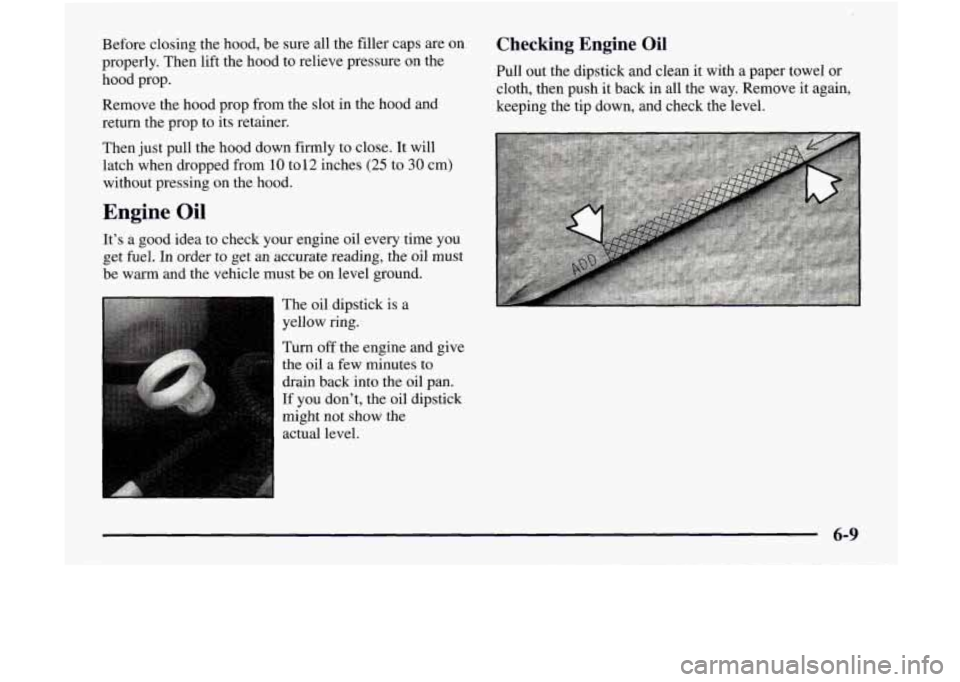
The oil dipstick is a
yellow ring.
Turn
off the engine and give
the oil
a few minutes to
drain back into the oil pan.
If you don’t, the oil dipstick
might not show the
actual level.
Checking Engine Oil
Pull out the dipstick and clean it with a paper towel or
cloth, then push it back in
all the way. Remove it again,
keeping the tip down, and check the level.
6-9
Page 270 of 410
L
HOT
WEATHER
FiI 'C
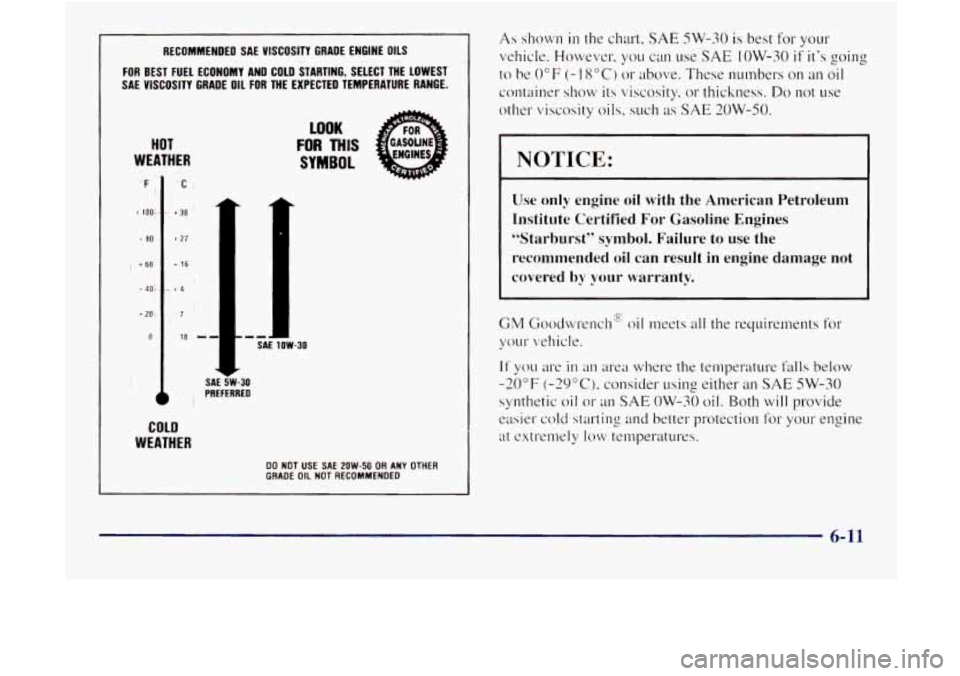
RECOMMENDED SAE VlSCOSlTV GRADE ENGlNE OILS
FOR BEST FUEL ECONOMY AND COLD STARTING, SELECT THE LOWEST
SAE
VISCOSITY GRADE OIL FOR THE EXPECTED TEMPERATURE RANGE.
~~
SA€ 1OW-30
SAE SW-30 PREFERRED
LOOK
FOR THIS
SYMBOL
COLD
WEATHER
DO NOT USE SAE 2OW-50 OR ANY OTHER
GRADE OIL NOT RECOMMENDED
I NOTICE:
Use only engine oil with the American Petroleum
Institute
Certified For Gasoline Engines
"Starburst" symbol. Failure to use the
reconmended
oil can result in engine damage not
covered
by your warranty.
6-11
Page 300 of 410

A CAUTION:
Poorly maintained and improperly used tires
are dangerous.
0
0
0
0
Overloading your tires can cause
overheating
as a result of too much friction.
You could have an air-out and a serious
accident. See “1,oading Your Vehicle” in
the Index.
Underinflated tires pose the same danger as
overloaded tires. The resulting accident
could cause serious injury. Check
all tires
frequently to maintain the recommended
pressure. Tire pressure should be checked
when your tires are cold.
Overinflated tires are more likely to be
cut, punctured or broken by a sudden
impact
-- such as when you hit a pothole.
Keep tires at the recommended pressure.
Worn, old tires can cause accidents. If your
tread
is badly worn, or if‘ your tires have
been damaged, replace them.
Inflation -- Tire Pressure
The Cel-tification/Tire label. which is 011 the driver‘s
door edge, above the door latch. shows the correct
inflation
pressures for your tires when they’re cold.
“Cold“ lneans your vehicle has been sitting for at least
three hours or driven no more than 1 mile ( 1 .6 km).
NOTICE:
Don’t let anyone tell you that underinflation or
overinflation is all right. It’s not.
If‘ your tires
don’t have enough air (underinflation), you can
get the following:
Too much flexing
Too much heat
0 Tire overloading
Bad wear
0 Bad handling
0 Bad fuel economy.
NOTICE: (Continued)
6-4 1
Page 315 of 410

Finish Damage
Any stone chips. fractures or deep scratches in the finish
should be repaired right away. Bare
metal will corrode
quickly and may develop into
a major repair expense.
Minor chips and scratches can be repaired with touch-up
materials available from your dealer or other service
outlets. Larger areas of finish damage can
be corrected
in your dealer’s body and paint shop.
Underbody Maintenance
Chemicals used for ice and snow removal and dust conh-01
can collect on the underbody. If these xe not removed,
accelerated corrosion (rust) can oxcur
on the underbody
parts such as fuel lines, frame, floor pan and exhaust system
even though they have corrosion protection.
At least every spring, flush these materials from the
underbody
with plain water. Clean any areas where mud
and other debris
can collect. Dirt packed in closed areas
of the frame should be loosened before being flushed.
Your dealer or an underbody car washing system can do
this for you.
Chemical Paint Spotting
Some weather and atmospheric conditions can create a
chemical fallout. Airborne pollutants can fall upon and
attack painted surfaces
on your vehicle. This damage
can take two
forms: blotchy, ringlet-shaped
discolorations, and small irregular dark spots etched into
the paint surface.
Although no defect
in the paintjob causes this, CM will
repair. at no charge to the owner. the surfaces of new
vehicles damaged by this fallout condition
within
I2 months or 12,000 miles (20 000 km) of purchase.
whichever occurs
first.
6-56
Page 319 of 410
,I,, WDO >- ACCY
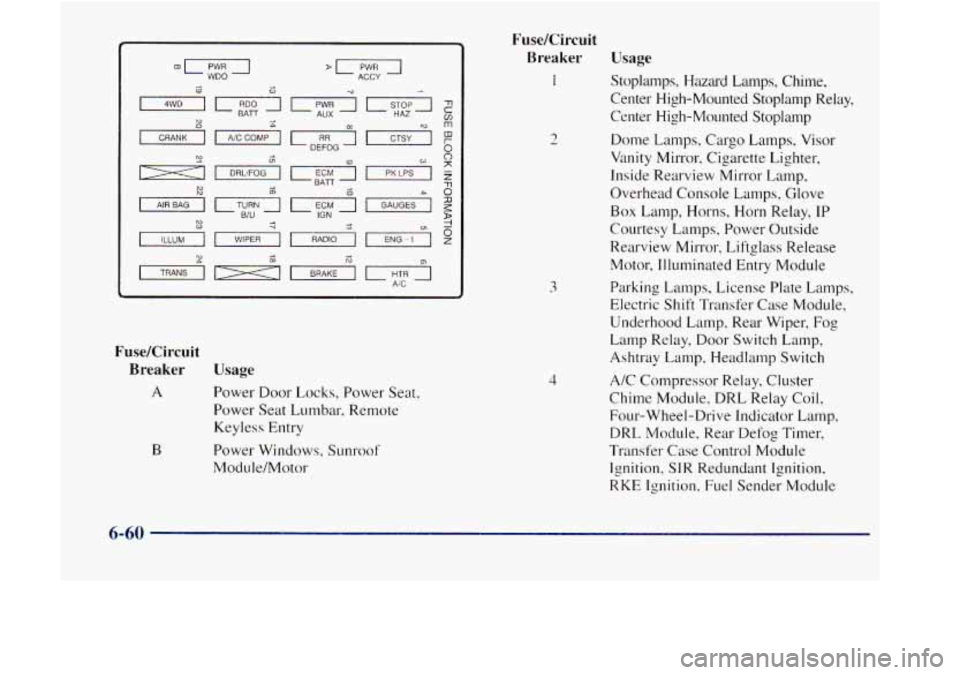
Fuse/Circuit Breaker
Usage
A Power Door Locks, Power Seat,
Power Seat Lumbar, Remote Keyless Entry
Power Windows, Sunroof
Modde/Motor
B
Fuse/Circuit
Breaker Usage
1
2
3
4
Stoplamps, Hazard Lamps, Chime,
Center High-Mounted Stoplamp Relay,
Center High-Mounted Stoplamp
Dome Lamps, Cargo Lamps, Visor
Vanity Mirror, Cigarette Lighter,
Inside Rearview Mirror Lamp,
Overhead Console L,amps, Glove
Box Lamp, Horns, Horn Relay, IP
Courtesy Lamps, Power Outside
Rearview Mirror, Liftglass Release
Motor, Illuminated Entry Module
Parking Lamps, License Plate Lamps,
Electric Shift Transfer Case Module,
Underhood Lamp, Rear Wiper,
Fog
Lamp Relay, Door Switch Lamp,
Ashtray Lamp, Headlamp Switch
A/C Compressor Relay, Cluster
Chime Module. DRL Relay Coil,
Four-Wheel-Drive Indicator Lamp,
DRL Module, Rear
Defog Timer,
Transfer Case Control Module
Ignition, SIR Redundant Ignition,
RKE Ignition. Fuel Sender Module
6-60
Page 320 of 410

Fuse/Circuit Breaker Usage
5
6
7
8
9
10
11
12
13
14
1s
Oxygen Sensor Heater, Exhaust Gas
Recirculation, Cam Sensor, CANN.
Purge. Canister Vent Solenoid. Mass
Airflow Sensor,
Cam Shaft Sensor
Blower Motor, Temperature Door Motor.
HI Blower Relay Coil
Power Auxiliary Outlets, Assembly
Line Diagnostic
Link
Rear Window Defogger
PCM/VCM Battery. Fuel Pump
PCM/VCM Ignition, Injectors. Crank
Sensor. Coil Driver Module
Radio, Inside Rearview Mirror Map
Lamp, Overhead Console Reading
Lamps. Rear Wiper, Rear Washer.
Overhead Console Display
Anti-Lock Braking System. VCM
IGN-3
Clock. Radio Battery, CD Player
A/C Compressor Battery Feed
Daytime Running Lamps, Fog
Lamps,
Fog Lamp Relay
17
18
19
20
21
22
23
Fuse/Circuit
Breaker Usage
16 Turn Signals and Back-up Lamps,
Brake-Transmission Shift Interlock
Solenoid
Windshield Washer, Windshield Wiper Motor
Not Used
Electric Shift Transfer Case
Crank Relay,
Air Bag Module
Not Used
Air Bag Module
Cluster Hlumination, Radio
Illu~nination. He.ater Lamp.
4WD
Illumination, Chime Module, Fog
Lam13 Illumination, Rear Wiper
Switch Illumination, Rear Defogger
Switch Illumination, Liftglass
Release Switch Illumination,
Overhead Console Illutnination
PRNDL Power. 4L60E Automatic
Transmission
24
6-61
Page 322 of 410
Capacities and Specifications
Engine Description ............ “VORTEC” 4300
Type .................................... V6
VINCode ................................. W
Firing Order ...................... 1-6-5-4-3-2
Horsepower
................... 190 at 4,400 rpm
Thermostat Specification ........... I95 OF (9 I “C)
Spark Plug Gap .......... 0.045 inches (0. I 14 cm)
Wheels and Tires
Wheel Nut Torque ............ 95 lb-ft ( 130 N-m)
Tire Pressure ...... See the Certification/Tire label.
See ”Loading Your
Vehicle”
in the Index.
Normal Maintenance Replacement Parts
Replacement part numbers listed in this section are
based on the latest information available at the time
of
printing, and are subject to change. If a part listed in this
manual is not the same
as the part used in your vehicle
when
it was built, or if you have any questions, please
contact your
GM truck dealer.
Thermostat
......................... 12551472
Oil Filter.. ............................. PF52
Air Cleaner Filter
...................... A 1 163C
PCV Valve
.......................... CV746C
Automatic Transmission Filter
Kit ...... 24200796
Spark Plugs
........................... 4 1-932
Fuel Filter. ............................ GF481
Front Windshield
Wiper Blade
.......... Trico (20 inchedS0.8 cm)
Backglass Wiper Blade
... Trico (14 inched35.6 cm)
6-63
Page 323 of 410
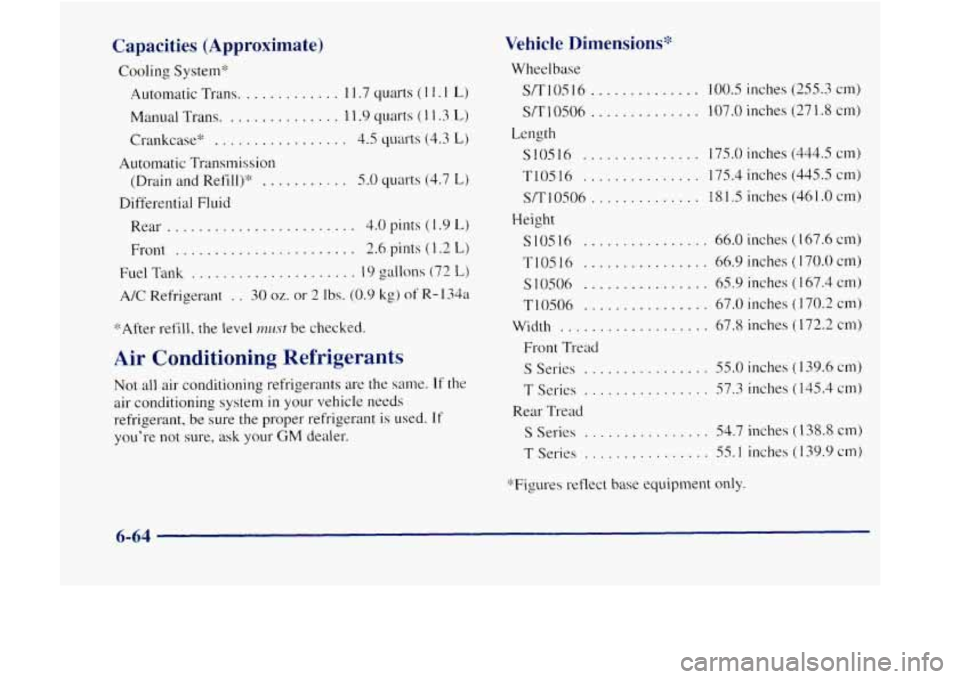
Capacities (Approximate)
Cooling System"
Automatic Trans.
............ 1 1.7 quarts (
Manual Trans. .............. 1 1.9 quarts (
Crankcase"' ......... . . 4.5 quarts
Automatic Transmission
11.1 L)
1 I .3 L)
(4.3 L)
. . 5.0 quarts (4.7 L) (Drain and Refill)* .......
Differential Fluid
Rear ........................ 4.0 pints ( I .9 L)
Front ....................... 2.6 pints ( 1.2 L)
Fuel Tank ..................... IC) gallons (72 L)
A/C Refrigerant . . 30 oz. or 2 Ibs. (0.9 kg) of R- 1341
:%After refill. the level Inust be checked.
Air Conditioning Refrigerants
Not all air conditioning refrigerants are the same. If the
air conditioning system in your vehicle needs
refrigerant,
be sure the proper refrigerant is used. If
you're not sure, ask your GM dealer.
Vehicle Dimensions*
Wheelbase
S/TlOSIb
.............. 100.5 inches (255.3 cm)
S/T10506 .............. 107.0 inches (27 I .8 crn)
Length
S 105 I6 ............... 175.0 inches (444.5 cm)
TI0516 ............... 175.4 inches (445.5 cm)
S/T 1 OS06 .............. 18 1 .S inches (46 1 .O cm)
SI0516 .... ........ 66.0 inches (167.6 cm)
T 1 OS 16 ................ 66.9 inches ( 170.0 cm)
SI0506 ................ 65.9 inches (167.4 cm)
TI0506
................ 67.0 inches (170.2 cm)
Width ................... 67.8 inches (172.2 cm)
Front Tread
S Series ................ 55.0 inches ( 139.6 cm)
T Series ................ 57.3 inches (145.4 cm)
S Series ................ 54.7 inches ( 138.8 an)
T Series ................ 55.1 inches (139.9 cm)
Height
Rear Tread
'%Figures retlect base equipment only.
6-64
Page 327 of 410

Part A: Scheduled Maintenance
Services
Using Your Mair mce Schedule A - --
We at General Motors want to help you keep your
vehicle
in good working condition. But we don't know
exactly how
you'll drive it. You may drive very short
distances only a few times a week. Or you may drive
long distances all
the time in very hot, dusty weather.
You may use your vehicle in making deliveries. Or
you may drive it to work, to do errands or in many
other ways.
Because
of all the different ways people LIS~ their GM
vehicles, maintenance needs vary. You may even need
more frequent checks and replacements
than you'll find
in the schedules in this section. So please read this
section and note
how you drive. If you have any
questions on how
to keep your vehicle in good
condition, see your GM dealer.
This part tells
you the maintenance services YOLI should
have done and when
you should schedule them. If you
go to your dealer for your service needs, you'll know
that GM-trained
and supported service people will
perform the work using genuine
GM parts. The
proper tluids and lubricants
to use are listed in Part D.
Make sure whoever services your vehicle uses these. All
parts should be replaced and all necessary repairs done
before
you or anyone else drives the vehicle.
These schedules are
for vehicles that:
a
a
e
a
carry passengers and cargo within reconmended
limits. You
will find these limits on your vehicle's
Certification/Tire label. See "Loading Your Vehicle"
in the Index.
are driven on reasonable road surfaces within legal
dri\:ing limits.
are driven off-road
in the recommended manner. See
"Off-Road Driving With YOLIT Four-Wheel-Drive
Vehicle"
in the Index.
LIS~ the reconmended fuel. See "Fuel" in the Index.
Selecting the Right Schedule
First you'll need to decide which of the two schedules is
right for your vehicle. Here's how
to decide which
schedule to follow:
7-4
Page 328 of 410
Maintenance Schedule
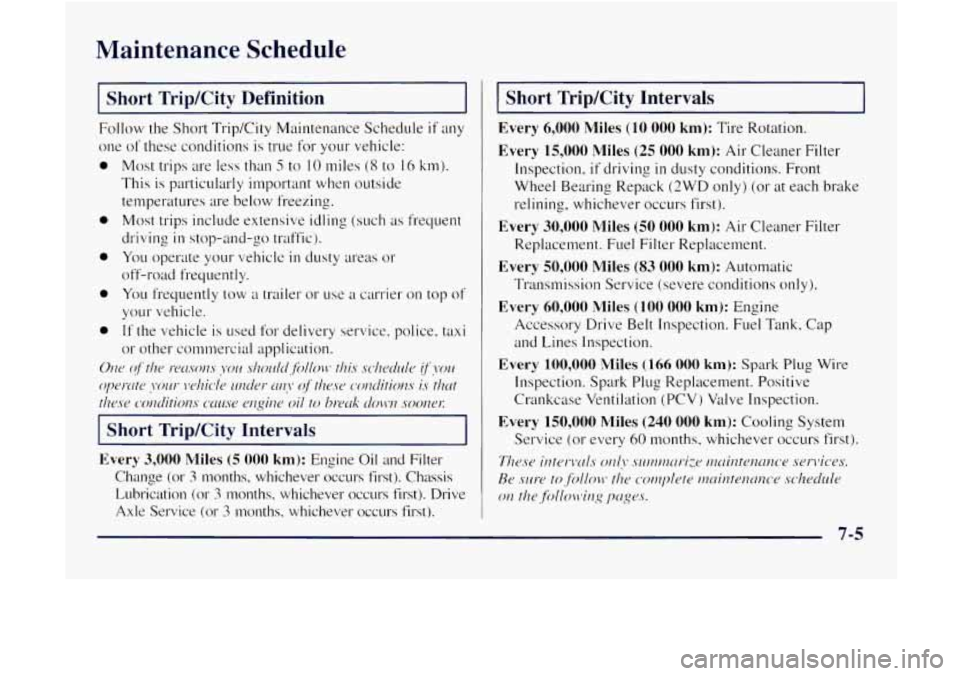
Short TripKity Definition
Follow the Short Trip/City Maintenance Schedule if any
one
of' these conditions is true for your
ehick:
0 Most trips are less than 5 to 10 miles (8 to 16 km).
This is particularly important when outside
temperatures are below freezing.
driving
in stop-and-go traffic).
off-road frequently.
your vehicle.
or other comnwcial application.
0 Most trips include extensive idling (such as frequent
0 You operate your vehicle in dusty areas or
0 You I-'recluently tow a trailer or use a carrier on top of
0 If the vehicle is used for delivery service, police, taxi
OII~? of'the 1-ec1,son.s !*OLL .sho~rl~l,fi,ll~~t~~ this .sc*Iwdulc~ if you
optute !mrr \vl?ic*le L~OI- elq* of' thesc c-oditiorzs is tlwt
those cwclitior1.v
(YILIS~ e~lgiw oil to h~wk lloc
SOOIIOK
Short Trip/City Intervals
Every 3,000 Miles (5 000 km): Engine Oil and Filter
Change
(or 3 months, whichever occurs first). Chassis
Lubrication (or
3 months. whichever occurs first). Drive
Axle Service (or 3 months, whichever occurs first).
Short TripKity Intervals
Every 6,000 Miles (10 000 km): Tire Rotation.
Every 15,000 Miles (25 000 km): Air Cleaner Filter
Inspection.
if' driving in dusty conditions. Front
Wheel Bearing Repack (2WD only) (or at each brake
relining, whichever occurs
first).
Every 30,000 Miles (50 000 km): Air Cleaner Filter
Replacement. Fuel Filter Replacement.
Every 50,000 Miles (83 000 km): Automatic
Transmission Service (severe conditions only).
Every 60,000 Miles (100 000 km): Engine
Accessory Drive Belt Inspection. Fuel Tank, Cap
and Lines Inspection.
Every 100,000 Miles (166 000 km): Spark Plug Wire
Inspection. Spark Plug Replacement. Positive
Crankcase Ventilation (PCV
j Valve Inspection.
Every 150,000 Miles (240 000 km): Cooling System
Service (or every
60 months. whichever occ~lrs first).
Thc>,vt> if?ter~ul.s o~l~- .swwncrri:o 1uc1intemtlce ser\!ic:t>s.
He ,s11t-~3 to folloct- the c-omplote mrlirztencrnc'cJ .sc*he,dult?
on tl~~~.~~)ll~)~~,i~l~~ pclgr.s.
7-5