fuel GMC JIMMY 1997 User Guide
[x] Cancel search | Manufacturer: GMC, Model Year: 1997, Model line: JIMMY, Model: GMC JIMMY 1997Pages: 410, PDF Size: 20.03 MB
Page 142 of 410

Gate Ajar Light
GATE
AJAR
This light will come on
briefly when you are
starting
the engine. If' it
stays on, your liftgate is
ajar.
Try closing the liftgate
again. Never drive
with the
liftgate even partially open.
Fuel Gage
E-
When the ignition is on,
the fuel
gage tells you
about how much fuel you
11ave remaining.
0 It takes a little more or less file1 to fill up than the gage
inclicated. For example. the gage may have indicated
the tank was
half full, but it actually took a little more
or
less than half the tank's capacity to fill the tank.
0 The gage moves a little when you turn a corner or
speed up.
Page 192 of 410
If the water isn't too deep, then drive through it slowly.
At fast speeds, water splashes on your ignition system
and
your vehicle can stall. Stalling can dso occur if you
tailpipe is under water, yo~l*II never be able to start your
engine. When
you go through water. remember that
when your brakes get
wet. it nay take you longer
to stop.
2 wt your tailpipe under water. And. as long as your
Driving through rushing water can be dangerous. Deep water can sweep your vehicle downstream
and
you and your passengers could drown. If it's
only shallow water, it can still wash away the
ground from under your tires, and you could lose
traction and roll the vehicle over. Don't drive
through rushing water.
After Off-Road Driving
Relmove any brush or debris that has collected on the
underbody. chassis or 11nder the hood. These
accumulations CUI be a fire hazard.
After operation
in mud or sand. have the brake linings
cleaned and checked. These substances can C~LIS~
glazing and 1111even braking. Check the body structure.
steering. suspension. wheels, tires and exlxwst system
for damage.
Also. check the fuel lines and cooling
system for any leakage.
Your
vehicle will require more frequent service due to
off-road use. Refer to the Maintenance Schedule for
additional information.
4-27
Page 205 of 410

Snow can trap exhaust gases under your vehicle.
This can cause deadly
CO (carbon monoxide) gas
to get inside.
CO could overcome you and kill
you. You can’t see it or smell it,
so you might not
know it is in your vehicle. Clear away snow from
around the base of your vehicle, especially any
that is blocking your exhaust pipe. And check
around again from time to time to be sure snow
doesn’t collect there.
Open a window just a little on the side of the
vehicle that’s away from the wind. This will help
keep
CO out.
Run your engine only as long as you must. This saves
fuel. When
you run the engine, make it go a little faster
than just idle. That is, push the accelerator slightly.
This
uses less fuel for the heat that you get and it keeps the
battery charged.
You will need a well-charged battery to
restart the vehicle. and possibly for signaling later on
with your headlamps. Let the heater run for a while.
Then, shut the engine
off and close the window almost
all the way
to preserve the heat. Start the engine again
and repeat this only when you feel really uncomfortable
from the cold.
But do it as little as possible. Preserve the
fuel as long
as you can. To help keep warm, you can get
out of the vehicle and
do some hirly vigorous exercises
every half
hour or so until help comes.
4-40
Page 207 of 410
Recreational Vehicle Towing (Except Four-wheel Drive With
Manual Shift Transfer Case) Loading Your Vehicle
Vehicles with
two-wheel drive or the optional electronic
shift transfer case require special modifications before
they can be towed
in this manner. Please contact your
dealer for the towing information that
is appropriate for
your particular vehicle.
Vehicles
with all-wheel drive (AWD) can not be towed
in this manner.
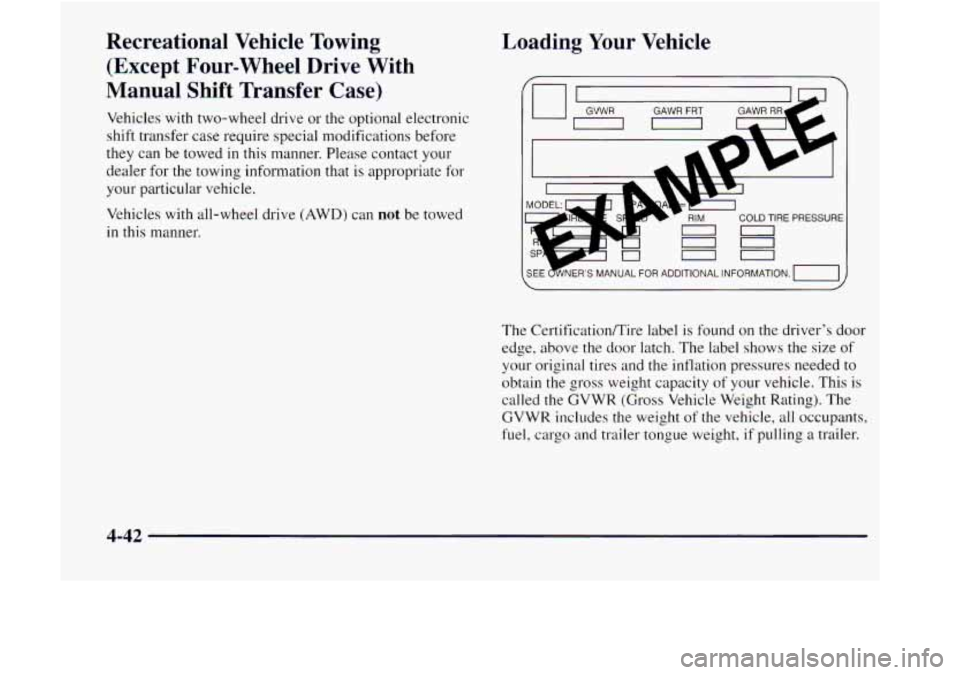
The Certification/Tire label is found on the driver’s door
edge, above the door latch. The label shows the size
of
your original tires and the inflation pressures needed to
obtain the gross weight capacity of your vehicle. This is
called the GVWR (Gross Vehicle Weight Rating). The
GVWR includes the weight
of the vehicle, all occupants,
fuel, cargo and trailer tongue weight,
if pulling a trailer.
4-42
Page 210 of 410

Towing a Trailer
If you don’t use the correct equipment and drive
properly, you can lose control when you pull a
trailer. For example, if the trailer
is too heavy, the
brakes may not work well
-- or even at all. You
and your passengers could be seriously in.jured.
Pull a trailer only
if you have followed all the
steps in this section.
Ask your GR/I dealer for
advice and information about towing a trailer with vour vehicle.
I NOTICE:
Pulling a trailer improperly can damage your
vehicle and result in costly repairs not covered
by
your warranty. To pull a trailer correctly, follow
the advice in this part, and see your
GM dealer
for important information about towing
a trailer
with your vehicle.
Every vehicle
is ready for some trailer towing. If yours
was built
with trailering options, as many are. it‘s ready
for heavier trailers.
But trailering is different than just
driving your vehicle by itself. Trailering means changes
in handling, durability and fuel economy. Successful,
safe trailering takes correct equipment, and
it has to be
used properly.
That’s the reason for this part. In
it are many
time-tested, important trailering tips and safety rules.
Many
of these are important for your safety and that of
your passengers.
So please read this section carefully
before you pull a trailer.
4-45
Page 243 of 410

Engine Fan Noise If a Tire Goes Flat
This vehicle has a clutched engine cooling fan. When
the clutch is engaged,
the fan spins faster to provide
more air to cool the engine.
In most everyday driving
conditions, the clutch
is not engaged. This improves
fuel economy and reduces
fan noise. Under heavy
vehicle loading, trailer towing and/or high outside
temperatures, the
fan speed increases when the clutch
engages.
So you may hear an increase in fan noise. This
is normal and should not be mistaken as the
transmission slipping
or making extra shifts. It is merely
the cooling system functioning properly. The fan will
slow down when additional cooling is not required and
the clutch disengages.
You
may also hear this fan noise when you start he
engine.
It will go away as the fan clutch disengages. It's
unusual
for a tire to "blow out" while you're driving,
especially
if you maintain your tires properly. If air goes
out of
a tire, it's muc11 more likely to leak out slowly.
But if you should ever have a "blowout." here are a few
tips about what
to expect and what to do:
If a front tire fails, the flat tire will create a drag that
pulls the vehicle toward that side. Take your foot off the
accelerator pedal and grip the steering wheel firmly.
Steer to ~naintain lane position, and then gently brake to
a stop well out of the traffic lane.
A rear blowout. particularly on a curve, acts much like a
skid and may require the same correction you'd use in a
skid. In any rear blowout, remove yo~~r foot from the
accelerator pedal. Get the c.ehicle under control
by
steering the way ~OLI want the vehicle to go. It may be
very bumpy
and noisy. but you can still steer. Gently
brake to
a stop -- well off the road if possible.
5-22
Page 262 of 410

Adding Equipment to the Outside of
Your Vehicle
Fuel
6-3
Page 263 of 410
Some gasolines that are not reformulated for low
emissions contain an octane-enhancing additive called
methylcyclopentadienyl manganese tricarbonyl
(MMT):
ask your service station operator whether or not his fuel
contains MMT. General Motors does not recommend the
use
of such gasolines. If fuels containing MMT are used,
spark plug life may be reduced and your emission
control system performance
may be affected. The
malfunction indicator lamp on your instrument panel
may turn on.
If this occurs, return to your authorized
GM dealer for service.
To provide cleaner ail-, all gasolines in the United States
are now required
to contain additives that will help
prevent deposits from forming
in your engine and fuel
system, allowing; your emission control system to
function properly. Therefore, you should not have
to add
anything
to the fuel. In addition, gasolines containing
oxygenates, such as ethers and ethanol, and
reformulated gasolines may be available
in your area to
help clean the air. General Motors recommends that you
use these gasolines if they comply with the
specifications described earlier.
I NOTICE:
Your vehicle was not designed for fuel that
contains methanol. Don’t use it. It can corrode
metal parts in your fuel system and also damage
plastic and rubber parts. That damage wouldn’t
be covered under your warranty.
Fuels in Foreign Countries
If you plan on driving in another country outside the United
States or Canada, the proper fuel may be hard to find. Never
use leaded gnsooline or any other fuel not recommended
in the
previous text on fuel. Costly repairs caused by use of
improper fuel wouldn’t be covered by your warranty.
To check on ~w1 availability, ask an auto club, or
contact a nlajor oil company that does business in the
country where you’ll be driving.
You can also write us at the following address for
advice. Just tell us where you-re going and give your
Vehicle Identil’ication Number
(VIN).
General Motors International Product Center
1908 Colonel Sam Drive
Osha~/a. Ontario
L 1 H 8P7
6-4
Page 264 of 410

Filling Your Tank
The fuel cap is behind
a hinged door on the
driver’s side
of
your vehicle.
Gasoline vapor is highly flammable. It burns violently, and that can cause very bad injuries.
Don’t smoke if you’re near gasoline or refueling
your vehicle. Keep sparks, flames and smoking
materials away from gasoline.
To take off the cap, turn
it slowly to the left
(counterclockwise). The
cap has a spring in it: if
you let go of the cap
too soon, it will spring
back to the right.
A CAUTION:
I
If you get gasoline on yourself and then
something ignites it, you could be
badly burned.
Gasoline can spray out on you if you open
the
fuel filler cap too quickly. This spray can happen
if your tank
is nearly full, and is more likely in
hot weather. Open the fuel filler cap slowly and
wait for any “hiss” noise to stop. Then unscrew
the cap
all the way.
6-5
Page 265 of 410

Be careful not to spill gasoline. Clean gasoline from
painted surfaces as soon as possible. See “Cleaning the
Outside of Your Vehicle” in the Index.
When you put the cap back on, turn it to the right
(clockwise) until you hear a clicking sound. Make sure
you fully install the cap. The diagnostic system can
determine if the fuel cap has been left off or improperly
installed. This would allow fuel to evaporate into the
atmosphere. See “Malfunction Indicator Lamp’’ in
the Index.
______
NOTICE:
If you need a new cap, be sure to get the right
type. Your dealer can get one for you.
If you get
the wrong type, it may not fit properly. This may
cause your malfunction indicator lamp to light
and your fuel tank and emissions system may be
damaged. See “Malfunction Indicator Lamp” in
the Index.
Checking Things Under the Hood
To open the hood, first pull
the handle inside the vehicle
on the lower driver’s side of
the instrument panel.
Then go to the front of
the vehicle and release the
secondary hood release.
6-6 I I I