air condition GMC SAVANA 1996 User Guide
[x] Cancel search | Manufacturer: GMC, Model Year: 1996, Model line: SAVANA, Model: GMC SAVANA 1996Pages: 372, PDF Size: 18.81 MB
Page 123 of 372
Air Conditioning
Before using your vehicle’s air conditioning, open the
windows to clear
the vehicle of hot air. This reduces the
time it takes for your vehicle
to cool down. Then keep
your windows closed
for the air conditioner to work at
its best.
You can use MAX A/C
with the temperature knob in the
blue area, when
it’s really hot outside and you need to
cool the inside air quickly. MAX A/C lets in only a little
air from the outside.
If you first use MAX A/C, you can then use A/C with
the temperature knob
in the blue area, as soon as the
vehicle has cooled down,
so outside air will be going
through your vehicle.
If your vehicle has rear air conditioning, setting it on LO
may enhance front A/C perfor~nance by allowing
trapped refrigerant
in rear lines to circulate.
When the air conditioning,
DEFROST or BLEND is on,
you may notice a slight increase or decrease in engine
speed, due to compressor operation. This is normal
because the system is designed
to cycle the compressor
on and off to keep the desired temperature.
Heating
On cold days, use HEATER with the temperature knob
in the red area. Outside air will be brought in. through
the floor outlets. The heater works best if you keep your
windows closed while using
it.
If you use the optional engine coolant heater before
starting your engine, your heating system will produce
warmer air faster
to heat the passenger compartment in
cold weather. See ”Engine Coolant Heater”
in the Index.
3-7
ProCarManuals.com
Page 161 of 372
If your vehicle starts to slide, ease your foot off the
accelerator pedal and quickly steer the way you want the
vehicle to
go- If you start steering quickly enough, your
vehicle may straighten out. Always be ready for-
a
second skid if it occurs.
Of course, traction is reduced when water, snow, ice,
gravel or other material is on the road. For safety,
you’ll
want to slow down and adjust your driving to these
conditions.
It is important to slow down on slippery
surfaces because stopping distance will be longer and
vehicle control more limited.
While driving on
a surface with reduced traction. try
your best to avoid sudden steering, acceleration or
braking (including engine braking by shifting to a
lower gear).
Any sudden changes could cause the tires
to slide.
You may not realize the surfxe is slippery
until your vehicle is skidding. Learn to recognize
warning clues
-- such as enough water, ice or packed
snow on the road to make a “mirrored surfdce” -- and
slow down when you have any doubt.
Remember: Any anti-lock brake system
(ABS) helps
avoid only the braking skid.
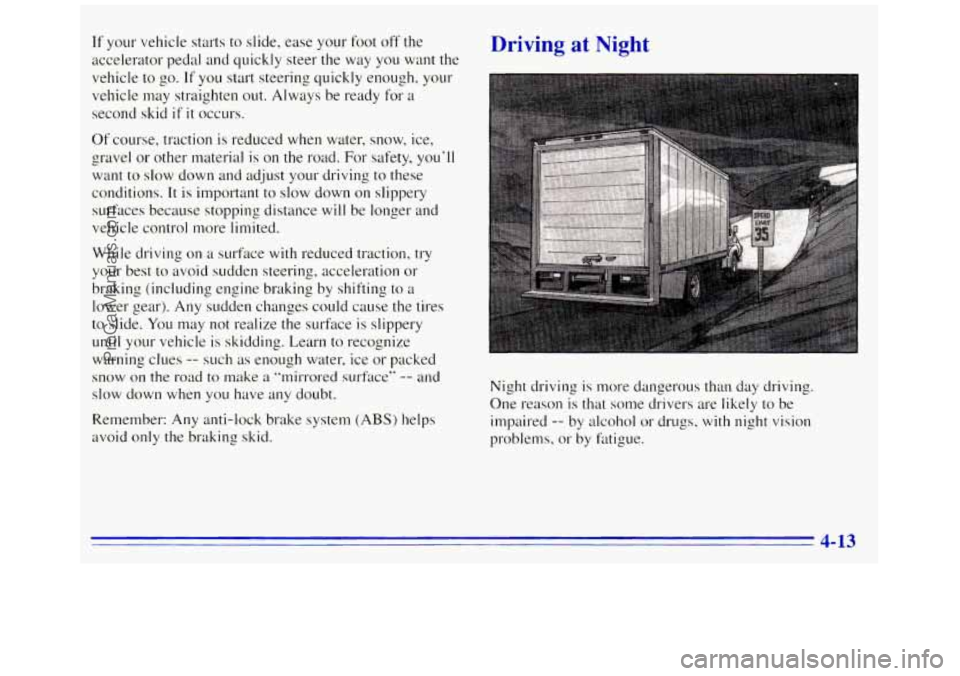
Driving at Night
Night driving is more dangerous than day driving,
One reason
is that so111e drivers are likely to be
impaired
-- by alcohol or drugs, with night vision
problems,
or by fatigue.
4-13
ProCarManuals.com
Page 199 of 372
If No Steam Is Coming From Your Engine
If you get the overheat warning but see or hear no
steam, the problem may not be too serious. Sometimes
the engine can get a little too hot when you:
Climb a long hill on a hot day.
Stop after high-speed driving.
Idle for long periods in traffic.
Tow a trailer. See “Driving on Grades’’ in the Index.
If you get
the overheat warning with no sign of steam,
try this for a minute or
so:
1. If you have an air conditioner, turn it off.
2. Turn on your heater to full hot at the highest fan
speed and open the window as necessary.
3. If you’re in a traffic jam, shift to NEUTRAL (N);
otherwise, shift to the highest gear while
driving
-- DRIVE (D).
If you no longer have the overheat warning, you can
drive. Just to be safe, drive slower for about
10 minutes.
If the warning doesn’t come back on, you can
drive normally.
If the warning continues, pull over, stop, and park your
vehicle right away.
If there’s still no sign of steam, you can idle the engine
for two or three minutes while you’re parked, to push
the accelerator
until the engine speed is about twice as
fast as normal idle speed. Bring the engine speed back to
normal idle speed after two or three minutes. Now see if
the warning stops. But then, if you still have the
warning,
tLtrn off the engine atzd get everyone out ofthe
vehicle until it cools down.
You may decide not
to lift the hood but to get service
help right away.
5-11
ProCarManuals.com
Page 227 of 372
If your vehicle is certified to meet California Emission
Standards (inciicatecl on the underhood tune-up label),
it
is designed to operate on fuels that meet California
specifications.
If such fuels are not available in states
adopting California emissions standards,
your vehicle
will operate satisfactorily on fuels meeting federal
specifications. but emission control system performance
may be affected. The malfunction indicator lamp on
Y~LII' instrument panel may turn on and/or your vehicle
may fail a smog-check test.
If this OCCLII-S, return to YOLK
authorized GM dealer for diagnosis to determine the
cause of failure.
In the event it is cletermined that the
ca~~se
of the condition is the type of fuels used, repairs
may not be covered
by your warranty.
In Canada, some gasolines contain an octane-enhancing
additive crdled MMT.
IF you LIS~ such f~~els. your
emission control system performance may deteriorate
and the malfunction indicator lamp on your instrument
panel may turn on.
If this happens, return to YOLII'
authorized GM dealer for service.
To provide cleaner air, all gasolines are now required to
contain additives that
will help prevent deposits from
forming
in your engine and fuel system. allowing your
emission control system to function properly. Therefore,
you should not have
to add anything to the fuel. In
addition, gasolines containing oxygenates. such as ethers
and ethanol, and reforn~~lated gasolines may
be
available in your area to help clean the air. General
Motors recmnlnends that you use these gasolines ilthey
comply
with the specifications described earlier.
NOTICE:
Your vehicle was not designed for fuel that
contains methanol. Don't
use it. It can corrode
metal parts in your fuel system and
also damage
plastic and rubber parts. That damage wouldn't
be covered under your warranty.
6-3
ProCarManuals.com
Page 233 of 372
If your vehicle has a 7.4L engine and air conditioning,
your vehicle will have a auxiliary engine fan
in addition
to the belt driven
fdn.
If your vehicle has air conditioning, the auxiliary
engine fan under the hood can start up and
injure you even when the engine is not running.
Keep hands, clothing and tools away from any
underhood electric fan.
~ Things that burn can get on hot engine parts and
start a
fire. These include liquids like gasoline,
~ oil, coolant, brake fluid, windshield washer and
~ other fluids, and plastic or rubber. You or others
could be burned. Be careful not to drop or spill
things that
will burn onto a hot engine. Before closing
the hood, be sure
all the filler caps are
on properly.
Then
lift the hood to relieve pressure on the hood prop.
Remove the hood prop from the slot
in the hood and
return the prop to
its retainer. Then just let the hood
down and close
it firmly.
Noise Control System
The following information relates to compliance with
Federal noise emission standards for vehicles with a
Gross Vehicle Weight Rating (GVWR) of more than
10,000 lbs. (4 536 kg). The Maintenance Schedule
booklet provides information on maintaining the noise
control system to minimize degradation of the noise
emission control system during the life of your vehicle.
The noise control system warranty is given
in your
Warranty booklet.
These standards apply only
to vehicles sold in the
United States.
6-9
ProCarManuals.com
Page 269 of 372
Dual Tire Operation
When the vehicle is new, or whenever a wheel, wheel
bolt or wheel
nut is replaced, check the wheel nut torque
after
100, 1,000 and 6,000 miles ( 160, 1 600 and
10 000 km) of driving. For proper torque, see “Wheel
Nut Torque”
in the Index.
The outer tire
on a dual wheel setup generally wears
faster than
the inner tire. Your tires will wear more
evenly and last longer if
you rotate the tires periodically.
If you’re going to be doing a lot of driving on
high-crown roads, you can reduce tire wear by adding
5 psi (35 kPa) to the tire pressure in the outer tires. Be
sure to return
to the recommended pressures when no
longer driving under those conditions. See “Changing a
Flat Tire” in the Index for more information.
A CAUTION:
If you operate your vehicle with a tire that is
badly underinflated, the tire can overheat. An
overheated tire can lose air suddenly
or catch
fire. You or others could be injured. Be sure all
tires (including the spare) are properly inflated.
Buying New Tires
To find out what kind and size of tires you need, look at
the Certification/Tire label.
The tires installed on your vehicle when
it was new had
a Tire Performance Criteria Specification (TPC Spec)
number
on each tire’s sidewall. When you get new tires,
get ones
with that same TPC Spec number. That way
your vehicle will continue to have tires that are designed
to give proper endurance, handling, speed rating,
traction, ride and other things during normal service
on
your vehicle. If your tires have an all-season tread
design, the TPC number will be followed by an
“MS”
(for mud and snow).
If you ever replace your tires with those not having a
TPC Spec number, make sure they are the same size,
load range, speed rating and construction type (bias,
bias-belted or radial) as your original tires.
ProCarManuals.com
Page 272 of 372
Wheel Alignment and Tire Balance
The wheels on your vehicle were aligned and balanced
carefully at the factory to give you the longest tire life
and best overall performance.
In most cases, you will
not need to have your wheels
aligned again. However,
if you notice unusual tire wear
or your vehicle pulling one way or the other, the
alignment may need
to be reset. If you notice your
vehicle vibrating when driving on a smooth road, your
wheels may need to be rebalanced.
Wheel Replacement
Replace any wheel that is bent, cracked, or badly rusted
or corroded.
If wheel nuts keep coming loose, the wheel,
wheel bolts and wheel nuts should be replaced. If the
wheel leaks air, replace it (except some aluminum
wheels, which can sometimes be repaired). See your
GM dealer if any of these conditions exist.
Your dealer will know the kind of wheel
you need. Each new
wheel should have the same load-carrying
capacity, diameter, width, offset and be mounted the
same way
as the one it replaces.
If you need to replace
any of your wheels, wheel bolts
or wheel nuts, replace them only with new GM original
equipment parts. This way,
you will be sure to have the
right wheel, wheel bolts and wheel nuts for your vehicle.
4 CAUTION:
r-
Using the wrong replacement wheels, wheel bolts
or wheel nuts on your vehicle can be dangerous.
It could affect the braking and handling
of your
vehicle, make your tires lose air and make you
lose control. You could have a collision
in which
you
or others could be injured. Always use the
correct wheel, wheel bolts and wheel nuts
for replacement.
6-48
ProCarManuals.com
Page 282 of 372
Underbody Maintenance
Chemicals used for ice and snow removal and dust control
can collect on
the underbody. If these are not removed,
accelerated corrosion (rust) can occur on
the underbody
parts such
as fuel lines, frame, floor pan and exhaust
system even though they have corrosion protection.
At least every spring,
flush these materials from the
underbody with plain water. Clean any areas where mud
and other debris can collect. Dirt packed in closed areas
of t.he frame should be loosened before being flushed.
Your dealer
or an underbody vehicle washing system
can do this for you.
Chemical Paint Spotting
Some weather and atmospheric conditions can create a
chemical fallout. Airborne pollutants can fall upon and
attack painted surfaces
on your vehicle. This damage
can take two forms: blotchy, ringlet-shaped
discolorations, and small irregular dark spots etched
into the paint surface.
Although no defect in
the paint job causes this, GM will
repair, at no charge to the owner, the surfaces of new
vehicles damaged by this fallout condition within
12 months or 12,000 miles (20 000 km) of purchase,
whichever occurs first.
This applies only to materials manufactured and sold by
General Motors. Bodies,
body conversions or equipment
not made or sold by General Motors are not covered.
ProCarManuals.com
Page 291 of 372

Fuel Tank Capacity
TYPE
Standard Tank
Cutaway Standard Tdnk
Cutaway Optional Tank
All quantities are approximate.
QUANTITY
3 I gallons (I 17.3 L)
35 gallons (132 L)
55 gallons (208.2 L)
Normal Rc --' :ermt Parts
Engine "VORTEC" 4300
VIN W
Oil Filter PFS2
Air Cleaner Filter'l'
A9 17C
PCV Valve CV789C
Spark Plugs
4 1-932
Fuel Filter GF48 1
Radiator Cap RC36 VORTEC"
5000
M
PF1218
A9 17C
cv774c
4 1-932
CF48
1
RC36
'"For severe dusty conditions, use AC Air Filter, Part No. 1236C. "VORTEC"
5700 "VORTEC" 7400
R J
PF1218
PF1218
A9 17C A917C
cv774c cv774c
4 1-932 4 1-932
GF48
1 GF48 I
RC36 RC36
6-67
ProCarManuals.com
Page 292 of 372
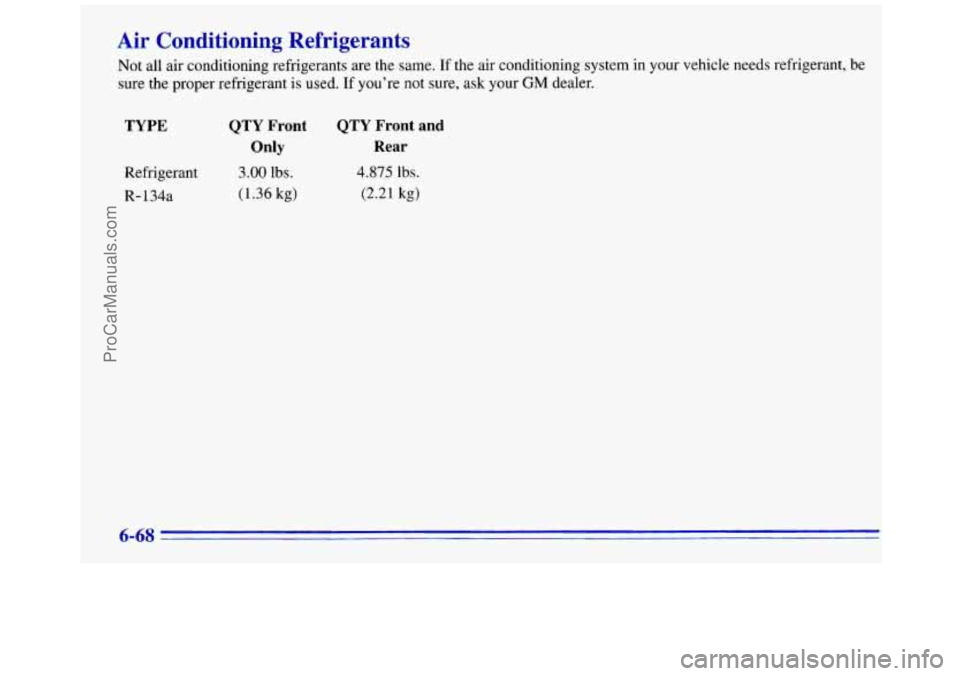
Air Conditioning Refrigerants
Not all air conditioning refrigerants are the same. If the air conditioning system in your vehicle needs refrigerant, be
sure the proper refrigerant
is used. If you’re not sure, ask your GM dealer.
TYPE
Refrigerant
R- 134a
QTY Front QTY Front and
Only Rear
3.00 Ibs. 4.875 lbs.
(1.36 kg) (2.21 kg)
6-68
ProCarManuals.com