engine overheat GMC SAVANA 1998 User Guide
[x] Cancel search | Manufacturer: GMC, Model Year: 1998, Model line: SAVANA, Model: GMC SAVANA 1998Pages: 388, PDF Size: 20.04 MB
Page 218 of 388
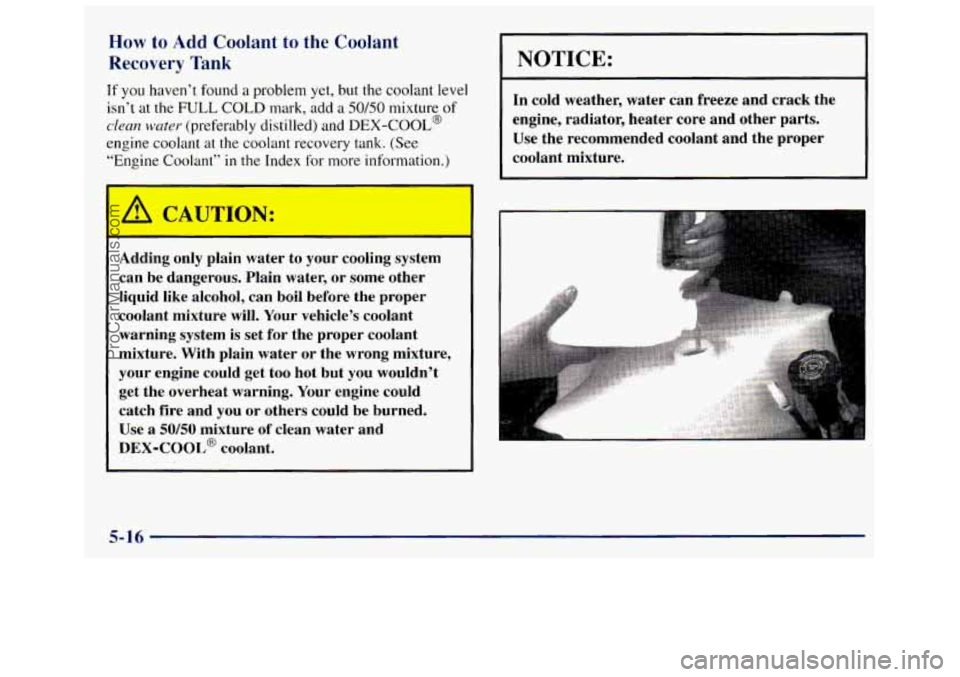
How to Add Coolant to the Coolant
Recovery
Tank
If you haven’t found a problem yet, but the coolant level
isn’t
at the FULL COLD mark, add a 50/50 mixture of
clean water (preferably distilled) and DEX-COOL@
engine coolant at the coolant recovery tank. (See
“Engine Coolant“
in the Index for more information.)
A C”UT1 )N:
Adding only plain water to your cooling system
can be dangerous. Plain water, or some other
liquid like alcohol, can boil before the proper
coolant mixture will. Your vehicle’s coolant
warning system is set for the proper coolant
mixture. With plain water or the wrong mixture,
your engine could get too hot but you wouldn’t
get the overheat warning. Your engine could
catch fire and you or others could be burned.
Use a
50/50 mixture of clean water and
DEX-COOL@ coolant.
I NOTICE:
In cold weather, water can freeze and crack the
engine, radiator, heater core and other parts.
Use the recommended coolant and the proper
coolant mixture.
5-16
ProCarManuals.com
Page 219 of 388
A CAUTION:
You can be burned if you spill coolant on hot
engine parts. Coolant contains ethylene glycol
and
it will burn if the engine parts are hot
enough. Don’t spill coolant on a hot engine.
When the coolant in the coolant recovery tank is at the
FULL COLD mark, start your vehicle.
If the overheat warning continues, there’s one more
thing you can try.
You can add the proper coolant
mixture directly to the radiator, but be sure the cooling
system is cool before you
do it.
-
A CAUTION:
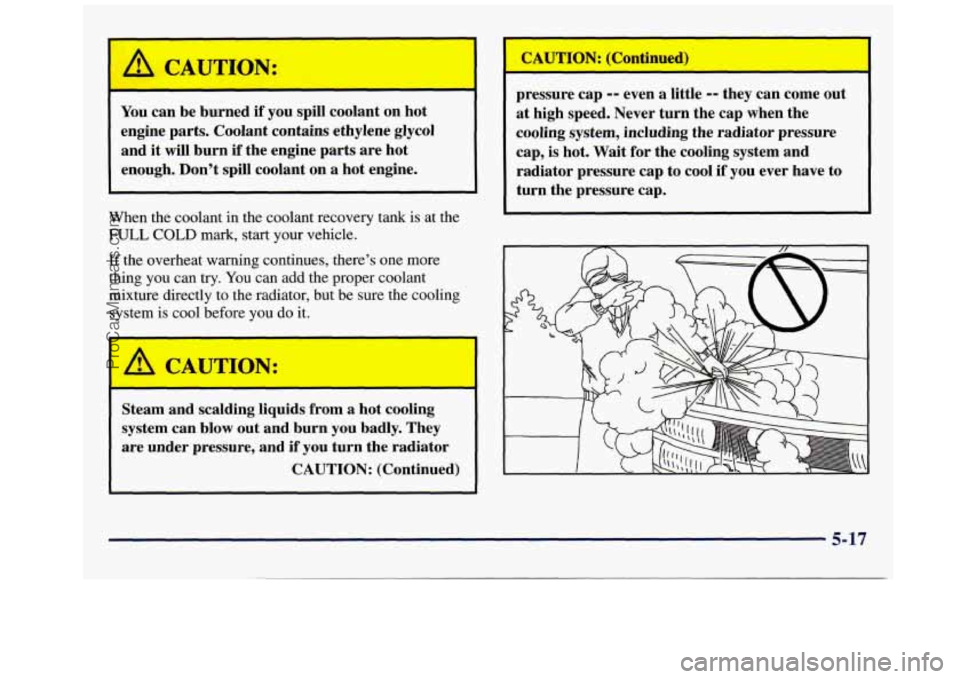
Steam and scalding liquids from a hot cooling
system can blow out and burn you badly. They
are under pressure, and if you turn the radiator
CAUTION: (Continued) CAUTION: (Continued)
pressure cap
-- even a little -- they can come out
at high speed. Never turn the cap when the
cooling system, including the radiator pressure
cap, is hot. Wait for the cooling system and
radiator pressure cap to cool
if you ever have to
turn the pressure cap.
5-17
ProCarManuals.com
Page 238 of 388
If You’re Stuck: In Sand, Mud, Ice
or
Snow
What you don’t want to do when your vehicle is stuck is
to spin your wheels too fast. The method known as
“rocking” can help you get out when you’re stuck, but
you must use caution.
‘I 1
If you let your tires spin at high speed, they can
explode, and you or others could be injured. And,
the transmission or other parts of the vehicle can
overheat. That could cause an engine
compartment fire
or other damage. When you’re
stuck, spin the wheels
as little as possible. Don’t
spin the wheels above
35 mph ‘(55 kmh) as shown
on the speedometer.
I NOTICE:
Spinning your wheels can destroy parts of your
vehicle
as well as the tires. If you spin the wheels
too fast while shifting your transmission back
and forth, you can destroy your transmission.
For information about using tire chains on your vehicle,
see “Tire Chains” in the Index.
Rocking Your Vehicle To Get It Out
First, turn your steering wheel left and right. That will
clear the area around your front wheels. Then shift back
and forth between REVERSE (R) and a forward gear,
spinning the wheels as little as possible. Release the
accelerator pedal while you shift, and press lightly on
the accelerator pedal when the transmission is in gear.
If
that doesn’t get you out after a few tries, you may need
to be towed out.
If you do need to be towed out, see
“Towing Your Vehicle” in the Index.
5-36
ProCarManuals.com
Page 261 of 388
Rear Axle What to Use
When to Check and Change Lubricant
Refer to the Maintenance Schedule to determine how
often to check the lubricant and when to change it. See
“Scheduled Maintenance Services” in the Index.
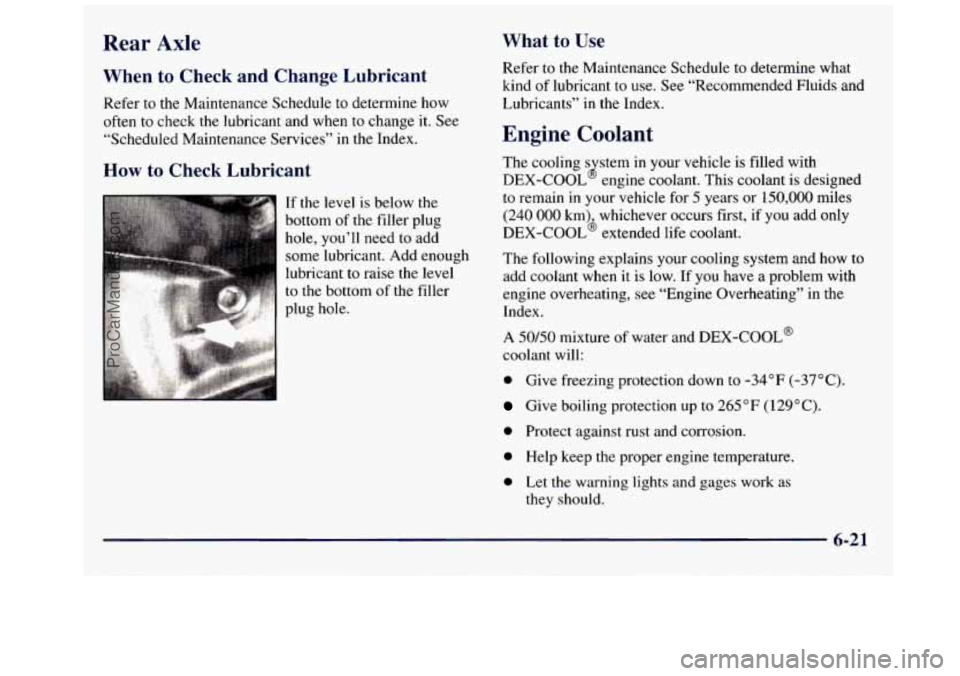
How to Check Lu’_ -~I
If the level is below the
bottom of the filler plug
hole, you’ll need
to add
some lubricant. Add enough
lubricant to raise the level
to the bottom of the filler
plug hole. Refer
to the Maintenance Schedule to determine what
kind of lubricant to use. See “Recommended Fluids and
Lubricants”
in the Index.
Engine Coolant
The cooling s stem in your vehicle is filled with
DEX-COOL engine coolant. This coolant is designea
to remain
in your vehicle for 5 years or 150,000 miles
(240 000 km) whichever occurs first, if you add only
DEX-COOL6 extended life coolant.
The following explains your cooling system and how to
add coolant when it is low. If you have
a problem with
engine overheating, see “Engine Overheating” in the
Index.
A 50/50 mixture of water and DEX-COOL@
coolant will:
2
0 Give freezing protection down to -34°F (-37°C).
Give boiling protection up to 265 “F (129” C).
0 Protect against rust and corrosion.
0 Help keep the proper engine temperature.
0 Let the warning lights and gages work as
they should.
6-21
ProCarManuals.com
Page 262 of 388
NOTICE:
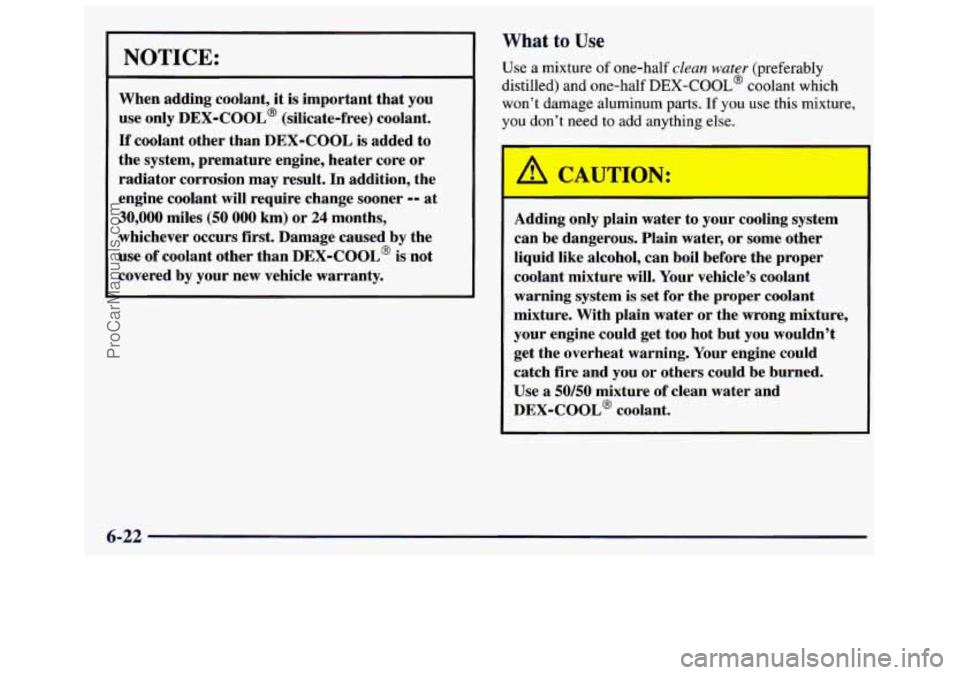
When adding coolant, it is important that you
use only
DEX-COOL@ (silicate-free) coolant.
If coolant other than DEX-COOL is added to
the system, premature engine, heater core or
radiator corrosion may result. In addition, the
engine coolant will require change sooner
-- at
30,000 miles (50 000 km) or 24 months,
whichever occurs
first. Damage caused by the
use of coolant other than DEX-COOL@ is not
covered by your new vehicle warranty.
What to Use
Use a mixture of one-half clean water (preferably
distilled) and one-half
DEX-COOL@ coolant which
won’t damage aluminum parts. If you
use this mixture,
you don’t need
to add anything else.
I
A CAC LILA:
Adding only plain water to your cooling system
can be dangerous. Plain water, or some other
liquid like alcohol, can boil before the proper
coolant mixture will. Your vehicle’s coolant
warning system
is set for the proper coolant
mixture. With plain water or the wrong mixture,
your engine could get too hot but you wouldn’t
get the overheat warning. Your engine could
catch fire and you or others could be burned.
Use
a 50/50 mixture of clean water and
DEX-COOL@ coolant.
6-22
ProCarManuals.com
Page 263 of 388
NOTICE:
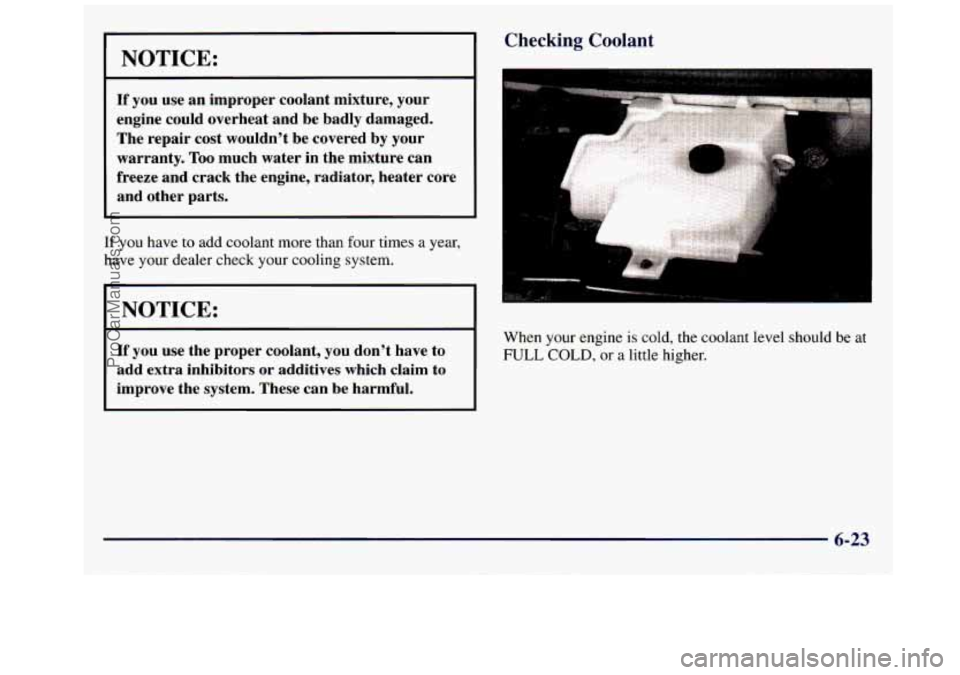
If you use an improper coolant mixture, your
engine could overheat and be badly damaged.
The repair cost wouldn’t be covered by your
warranty.
Too much water in the mixture can
freeze and crack the engine, radiator, heater core
and other parts.
If you have to add coolant more than four times a year,
have your dealer check your cooling system.
NOTICE:
If you use the proper coolant, you don’t have to
add extra inhibitors or additives which claim to
improve the system. These can be harmful.
Checking Coolant
When your engine is cold, the coolant level should be at
FULL COLD, or a little higher.
6-23
ProCarManuals.com
Page 264 of 388
Adding Coolant
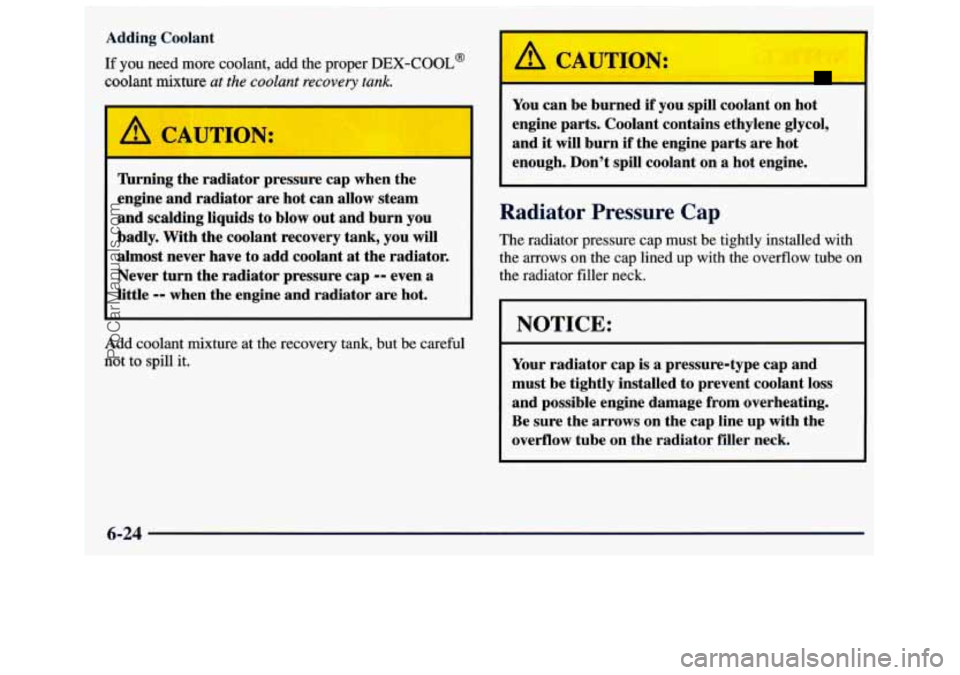
If you need more coolant, add the proper DEX-COOL@
coolant mixture at the coolant recovery tank. 1
lbrning me radiator pressure cap when the
engine and radiator are hot can allow steam
and scalding liquids to blow out and burn you
badly. With the coolant recovery tank, you will
almost never have to add coolant at the radiator.
Never turn the radiator pressure cap
-- even a
little
-- when the engine and radiator are hot.
I
e I.
Add coolant mixture at the recovery tank, but be careful
not to spill it.
You can be burned if you spill coolant on hot
engine parts. Coolant contains ethylene glycol,
and
it will burn if the engine parts are hot
enough. Don’t spill coolant on
a hot engine.
Radiator Pressure Cap
The radiator pressure cap must be tightly installed with
the arrows on the cap lined up with the ovefflow tube on
the radiator filler neck.
NOTICE:
Your radiator cap is a pressure-type cap and
must be tightly installed to prevent coolant loss
and possible engine damage from overheating.
Be sure the arrows on the cap line up with the
overflow tube on the radiator filler neck.
6-24
ProCarManuals.com
Page 378 of 388
Engine ....................................... 6-10
Coolant ..................................... 6-21
Coolant Level Check
.......................... 7-38
Cooling System
.............................. 5-14
Exhaust
...................... 2.29.2.30.2.33. 4.26
FuseBlock
.................................. 6-65
Identification
........................... 6.60. 6.67
OilLevelCheck
.............................. 7-38
Overheating
................................. 5-11
Running While Parked
......................... 2-30
Starting Your
................................ 2- 18
Engine Coolant Heater ........................... 2-20
Engineoil
.................................... 6-12
Adding
..................................... 6-13
Additives
................................... 6-15
Checking
................................... 6-13
Pressure Gage ................................ 2-60
Used ....................................... 6-16
Whentochange
.............................. 6-15
Exhaust, Engine
................. 2-29,2-30.2-33, 4-26
Exterior Lamps
................................. 2-40
Coolant Temperature
Gage
..................... 2-57
Engine Oil (Continued)
Fabric Cleaning
............................... 6-52
Filling
a Portable Fuel Container .................... 6-7
Filling Your Tank
................................ 6-5
Filter. Air ..................................... 6-16
Finish Care
.................................... 6-55
Finish Damage
................................. 6-57 First Gear. Automatic Transmission
................ 2-23
Flashers. Hazard Warning
......................... 5-2
Flat Tire. Changing
............................. 5-22
Fluids and Lubricants
............................ 7-44
Foreign Countries. Fuel
........................... 6-5
French Language Manual 11
Front Parkingmurn Signal Lamp Bulb Replacement .... 6-35
Front Storage Area
.............................. 2-48
FrontTowing
.................................. 5-10
Fuel
.......................................... 6-3
Canada
...................................... 6-3
Filling
a Portable Container ...................... 6-7
Gage
....................................... 2-63
In Foreign Countries ........................... 6-5
Tank Capacity
............................... 6-69
Fuses and Circuit Breakers
....................... 6-61
.. ...........................
Filling Your Tank .............................. 6-5
Gages Engine Coolant Temperature
.................... 2-57
Engine Oil Pressure
........................... 2-60
Fuel
....................................... 2-63
Speedometer
................................. 2-52
Voltmeter
................................... 2-55
Gear Positions. Automatic Transmission
............. 2-21
Gross Axle Weight Rating
........................ 4-27
Gross Vehicle Weight Rating
...................... 4-27
Guide en Franpis
11
GAWR ....................................... 4-27
.. .................................
GVWR ....................................... 4-27
9-4
ProCarManuals.com
Page 381 of 388
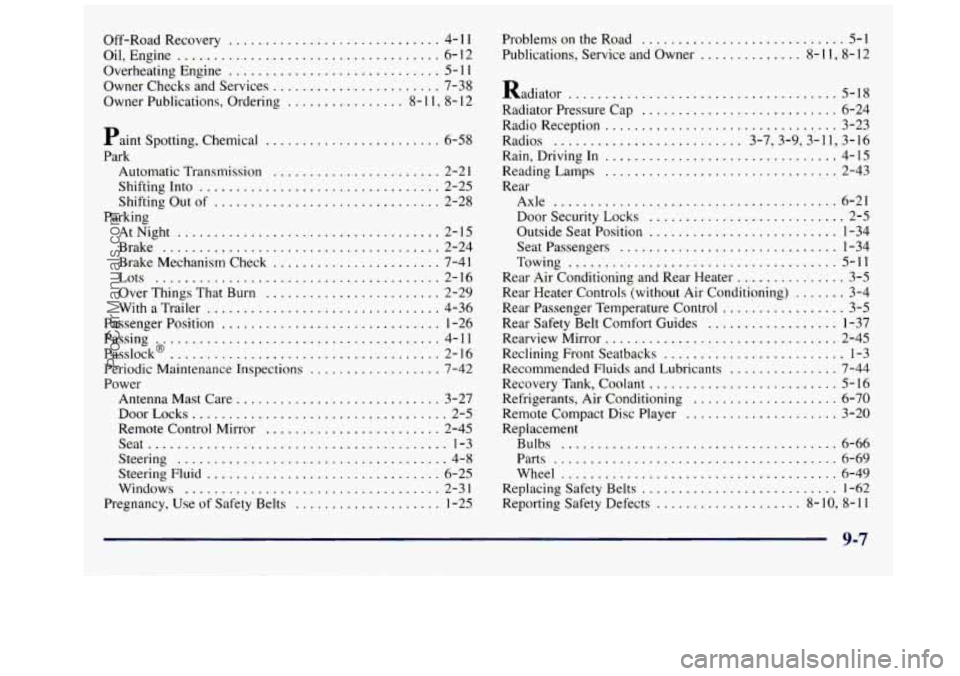
OH-Road Recovery ............................. 4- 1 1
Oil. Engine .................................... 6-12
Overheating Engine
............................. 5- 1 1
Owner Checks and Services ....................... 7-38
Owner Publications. Ordering
................ 8- 1 1. 8- I2
Paint Spotting. Chemical
........................ 6-58
Park
Automatic Transmission
....................... 2-21
Shifting Into
................................. 2-25
Shifting Out of
............................... 2-28
AtNight
.................................... 2-15
Brake
...................................... 2-24
Brake Mechanism Check
....................... 7-41
Over Things That Burn
........................ 2-29
With
a Trailer ................................ 4-36
Passenger Position
.............................. 1-26
Passing
.................................. 4-11
Passlock
..................................... 2-16
Periodic Maintenance Inspections
.................. 7-42
Power Antenna Mast Care
............................ 3-27
DoorLocks
................................... 2-5
Remote Control Mirror
........................ 2-45
Seat
......................................... 1-3
Steering
..................................... 4-8
Steering Fluid
................................ 6-25
Windows
................................... 2-31
Pregnancy. Use of Safety Belts
.................... 1-25
Parking
Lots
....................................... 2-16 Problems
on the Road
............................ 5-1
Publications. Service and Owner .............. 8- 1 1. 8- 12
Radiator
..................................... 5-18
Radiator Pressure Cap
........................... 6-24
Radio Reception
................................ 3-23
Radios
.......................... 3.7.3.9.3.11. 3.16
Rain. Driving In
................................ 4-15
Reading Lamps
................................ 2-43
Rear
Axle
....................................... 6-21
Door Security Locks
........................... 2-5
Outside Seat Position
.......................... 1-34
Towing
..................................... 5-11
Rear Air Conditioning and Rear Heater
............... 3-5
Rear Heater Controls (without Air Conditioning)
....... 3-4
Rear Passenger Temperature Control
................. 3-5
Rear Safety Belt Comfort Guides .................. 1-37
Rearview Mirror
................................ 2-45
Reclining Front Seatbacks
......................... 1-3
Recommended
Fluids and Lubricants ............... 7-44
Recovery Tank. Coolant
.......................... 5-16
Refrigerants. Air Conditioning
.................... 6-70
Remote Compact Disc Player
..................... 3-20
Replacement SeatPassengers
.............................. 1-34
Bulbs
...................................... 6-66
Parts
....................................... 6-69
Wheel
...................................... 6-49
Replacing Safety Belts
........................... 1-62
Reporting Safety Defects .................... 8- 10. 8-11
9-7
. ~ ...
ProCarManuals.com