wheel GMC SAVANA 2007 Owner's Guide
[x] Cancel search | Manufacturer: GMC, Model Year: 2007, Model line: SAVANA, Model: GMC SAVANA 2007Pages: 452, PDF Size: 2.68 MB
Page 258 of 452
If Your Vehicle is Stuck in Sand,
Mud, Ice, or Snow
In order to free your vehicle when it is stuck,
you will need to spin the wheels, but you do not
want to spin your wheels too fast. The method
known as rocking can help you get out when you
are stuck, but you must use caution.
{CAUTION:
If you let your vehicle’s tires spin at high
speed, they can explode, and you or others
could be injured. And, the transmission or
other parts of the vehicle can overheat.
That could cause an engine compartment
re or other damage. When you are stuck,
spin the wheels as little as possible. Do not
spin the wheels above 35 mph (55 km/h) as
shown on the speedometer.Notice:Spinning the wheels can destroy
parts of your vehicle as well as the tires. If
you spin the wheels too fast while shifting the
transmission back and forth, you can destroy
the transmission.
For information about using tire chains on your
vehicle, seeTire Chains on page 359.
Rocking Your Vehicle to Get It Out
First, turn the steering wheel left and right.
That will clear the area around the front wheels.
Then shift back and forth between REVERSE (R)
and a forward gear, spinning the wheels as
little as possible. Release the accelerator pedal
while you shift, and press lightly on the accelerator
pedal when the transmission is in gear. By
slowly spinning the wheels in the forward and
reverse directions, you will cause a rocking motion
that may free your vehicle. If that does not get
your vehicle out after a few tries, it may need to be
towed out. If your vehicle does need to be
towed out, seeTowing Your Vehicle on page 264.
258
Page 264 of 452
Towing
Towing Your Vehicle
Consult your dealer or a professional towing
service if you need to have your disabled vehicle
towed. SeeRoadside Assistance Program on
page 424.
If you want to tow your vehicle behind another
vehicle for recreational purposes (such as behind
a motorhome), see “Recreational Vehicle
Towing” following.
Recreational Vehicle Towing
Recreational vehicle towing means towing your
vehicle behind another vehicle — such as behind
a motorhome. The two most common types of
recreational vehicle towing are known as “dinghy”
(towing your vehicle with all four wheels on the
ground) and “dolly” (towing your vehicle with
two wheels on the ground and two wheels up on a
device known as a “dolly”).With the proper preparation and equipment, many
vehicles can be towed in these ways. See “Dinghy
Towing” and “Dolly Towing” following.
Here are some important things to consider before
you do recreational vehicle towing:
•What’s the towing capacity of the towing
vehicle? Be sure you read the tow vehicle
manufacturer’s recommendations.
•How far will you tow? Some vehicles have
restrictions on how far and how long they
can tow.
•Do you have the proper towing equipment?
See your dealer or trailering professional
for additional advice and equipment
recommendations.
•Is your vehicle ready to be towed? Just as
you would prepare your vehicle for a long
trip, you’ll want to make sure your vehicle is
prepared to be towed.
264
Page 265 of 452
Dinghy Towing
Two-Wheel-Drive Vehicles
Notice:If you tow your vehicle with all
four wheels on the ground, the drivetrain
components could be damaged. The repairs
would not be covered by your warranty.
Do not tow your vehicle with all four wheels
on the ground.
Two-wheel-drive vehicles should not be towed
with all four wheels on the ground.
Two-wheel-drive transmissions have no provisions
for internal lubrication while being towed.
All-Wheel-Drive Vehicles
Your vehicle was not designed to be towed with
all four wheels on the ground. To properly
tow these vehicles, they should be placed on a
platform trailer with all four wheels off the ground.
Notice:Towing an all-wheel-drive vehicle
with all four wheels on the ground, or even
with only two of its wheels on the ground, will
damage drivetrain components. Do not tow
an all-wheel-drive vehicle if any of its wheels
will be on the ground.
Dolly Towing
Rear Towing (Rear Wheels Off the Ground)
Two-Wheel-Drive Vehicles
Use the following procedure to tow your vehicle
from the rear:
1. Drive the vehicle onto the dolly.
2. Firmly set the parking brake. SeeParking
Brake on page 128for more information.
3. Put the automatic transmission in PARK (P).
4. Follow the dolly manufacturer’s instructions
to attach and secure the vehicle being
towed to the dolly and then the loaded dolly to
the tow vehicle. Make sure the wheels are
straight before towing.
Use an adequate clamping device to ensure
that the front wheels are locked into the
straight position.
265
Page 266 of 452
5. Release the parking brake only after the
vehicle being towed is firmly attached to
the tow vehicle.
6. Turn the ignition to LOCK.
If the tow vehicle will not be started or driven
for six weeks or more, remove the battery
cable from the negative terminal (post) of the
battery to prevent your battery from draining
while towing.
All-Wheel-Drive Vehicles
Your vehicle was not designed to be towed with
two wheels on the ground. To properly tow
these vehicles, they should be placed on a
platform trailer with all four wheels off the ground.
Notice:Towing an all-wheel-drive vehicle
with all four wheels on the ground, or even
with only two of its wheels on the ground, will
damage drivetrain components. Do not tow
an all-wheel-drive vehicle if any of its wheels
will be on the ground.
Towing a Trailer
{CAUTION:
If you do not use the correct equipment
and drive properly, you can lose control
when you pull a trailer. For example, if the
trailer is too heavy, the brakes may not
work well — or even at all. You and your
passengers could be seriously injured.
Pull a trailer only if you have followed all
the steps in this section. Ask your dealer
for advice and information about towing a
trailer with your vehicle.
Notice:Pulling a trailer improperly can
damage your vehicle and result in costly
repairs that would not be covered by your
warranty. Always follow the instructions in this
section and check with your dealer for more
information about towing a trailer with
your vehicle.
266
Page 268 of 452
Tow/Haul Mode
Tow/haul is designed to assist while your vehicle
is pulling a large or heavy load or trailer.
Tow/haul is most useful while pulling such a load
in rolling terrain, in stop-and-go traffic, or when
you need improved low-speed control, such
as when parking. The purpose of the tow/haul
mode is to:
•Reduce the frequency and improve the
predictability of transmission shifts,
•provide the same solid shift feel when pulling
a heavy load as when the vehicle is unloaded,
•improve control of vehicle speed while
requiring less throttle pedal activity.
Press this button
located to the right of
the steering wheel
on the instrument panel
to turn tow/haul
mode on and off.While activated, the
indicator light on the
instrument panel
will be on.
Tow/haul mode will turn off automatically when the
ignition is turned off. SeeTow/Haul Mode Light
on page 185.
Tow/haul is most effective when the vehicle and
trailer combined weight is at least 75 percent of the
vehicle’s Gross Combined Weight Rating
(GCWR). See “Weight of the Trailer” later in this
section.
Driving with tow/haul activated without a heavy
load will cause reduced fuel economy and
unpleasant engine and transmission driving
characteristics, but will not cause damage.
268
Page 270 of 452
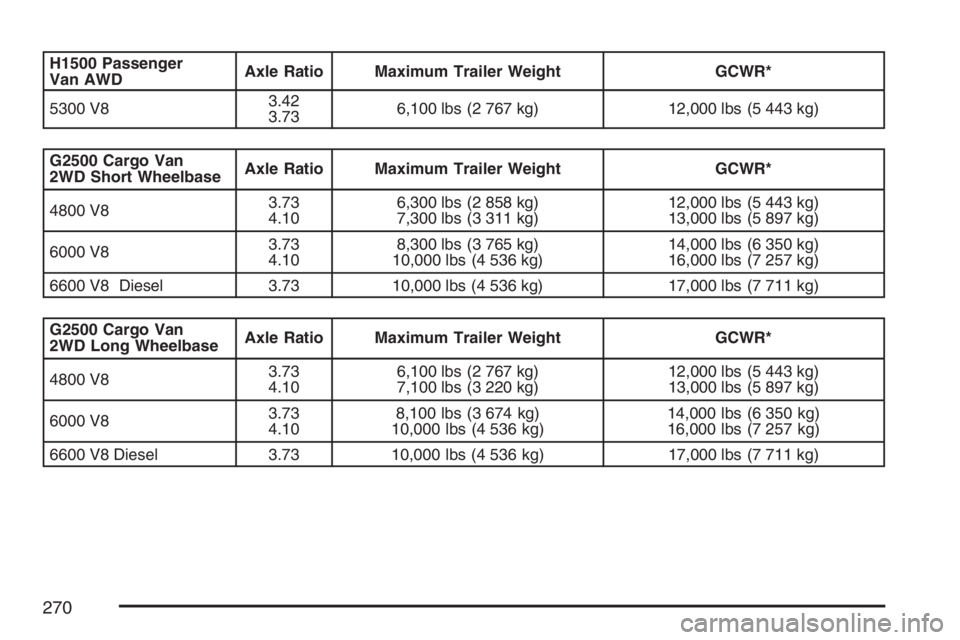
H1500 Passenger
Van AWDAxle Ratio Maximum Trailer Weight GCWR*
5300 V83.42
3.736,100 lbs (2 767 kg) 12,000 lbs (5 443 kg)
G2500 Cargo Van
2WD Short WheelbaseAxle Ratio Maximum Trailer Weight GCWR*
4800 V83.73
4.106,300 lbs (2 858 kg)
7,300 lbs (3 311 kg)12,000 lbs (5 443 kg)
13,000 lbs (5 897 kg)
6000 V83.73
4.108,300 lbs (3 765 kg)
10,000 lbs (4 536 kg)14,000 lbs (6 350 kg)
16,000 lbs (7 257 kg)
6600 V8 Diesel 3.73 10,000 lbs (4 536 kg) 17,000 lbs (7 711 kg)
G2500 Cargo Van
2WD Long WheelbaseAxle Ratio Maximum Trailer Weight GCWR*
4800 V83.73
4.106,100 lbs (2 767 kg)
7,100 lbs (3 220 kg)12,000 lbs (5 443 kg)
13,000 lbs (5 897 kg)
6000 V83.73
4.108,100 lbs (3 674 kg)
10,000 lbs (4 536 kg)14,000 lbs (6 350 kg)
16,000 lbs (7 257 kg)
6600 V8 Diesel 3.73 10,000 lbs (4 536 kg) 17,000 lbs (7 711 kg)
270
Page 271 of 452
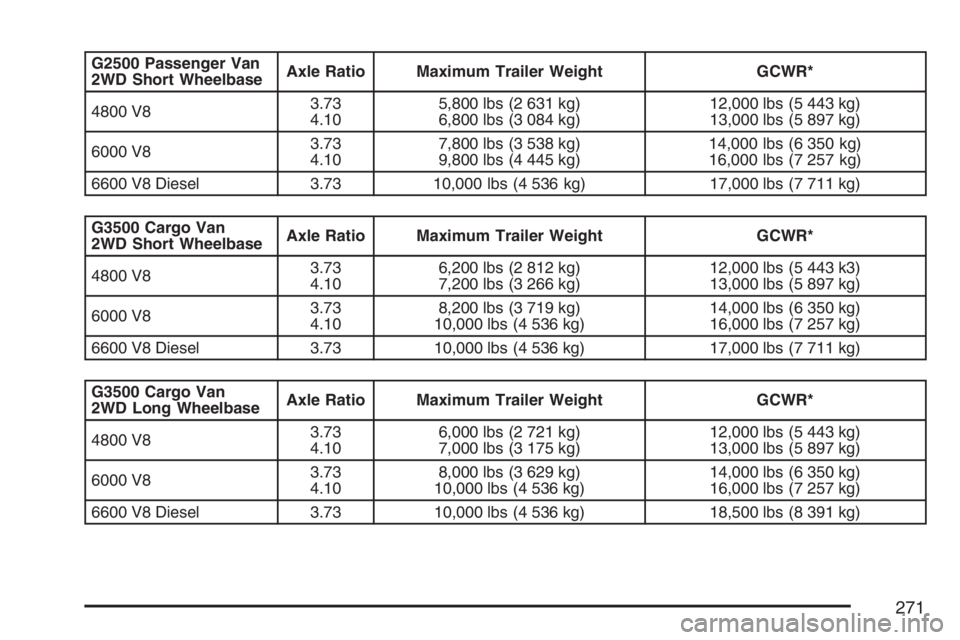
G2500 Passenger Van
2WD Short WheelbaseAxle Ratio Maximum Trailer Weight GCWR*
4800 V83.73
4.105,800 lbs (2 631 kg)
6,800 lbs (3 084 kg)12,000 lbs (5 443 kg)
13,000 lbs (5 897 kg)
6000 V83.73
4.107,800 lbs (3 538 kg)
9,800 lbs (4 445 kg)14,000 lbs (6 350 kg)
16,000 lbs (7 257 kg)
6600 V8 Diesel 3.73 10,000 lbs (4 536 kg) 17,000 lbs (7 711 kg)
G3500 Cargo Van
2WD Short WheelbaseAxle Ratio Maximum Trailer Weight GCWR*
4800 V83.73
4.106,200 lbs (2 812 kg)
7,200 lbs (3 266 kg)12,000 lbs (5 443 k3)
13,000 lbs (5 897 kg)
6000 V83.73
4.108,200 lbs (3 719 kg)
10,000 lbs (4 536 kg)14,000 lbs (6 350 kg)
16,000 lbs (7 257 kg)
6600 V8 Diesel 3.73 10,000 lbs (4 536 kg) 17,000 lbs (7 711 kg)
G3500 Cargo Van
2WD Long WheelbaseAxle Ratio Maximum Trailer Weight GCWR*
4800 V83.73
4.106,000 lbs (2 721 kg)
7,000 lbs (3 175 kg)12,000 lbs (5 443 kg)
13,000 lbs (5 897 kg)
6000 V83.73
4.108,000 lbs (3 629 kg)
10,000 lbs (4 536 kg)14,000 lbs (6 350 kg)
16,000 lbs (7 257 kg)
6600 V8 Diesel 3.73 10,000 lbs (4 536 kg) 18,500 lbs (8 391 kg)
271
Page 272 of 452
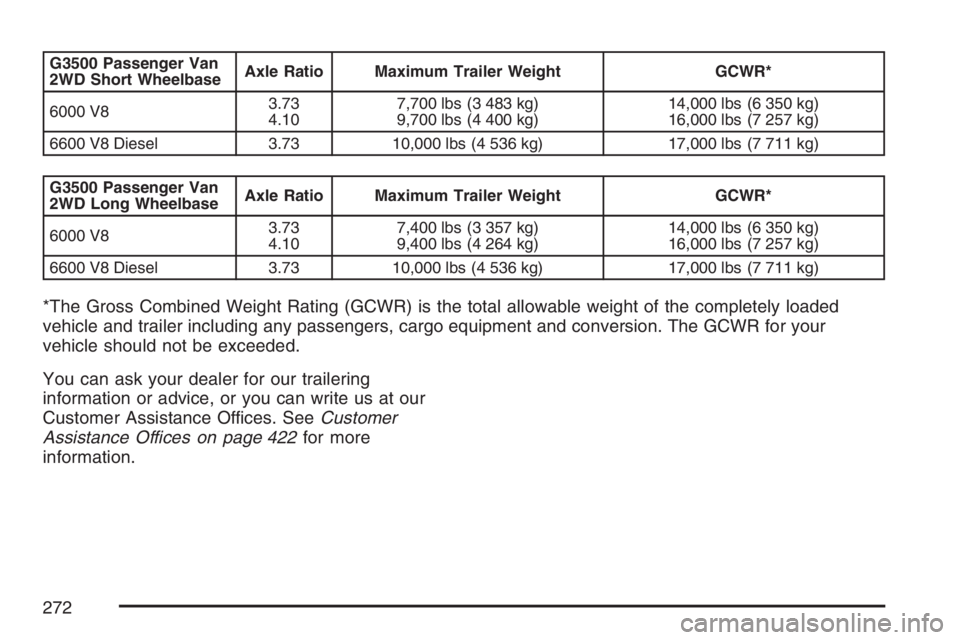
G3500 Passenger Van
2WD Short WheelbaseAxle Ratio Maximum Trailer Weight GCWR*
6000 V83.73
4.107,700 lbs (3 483 kg)
9,700 lbs (4 400 kg)14,000 lbs (6 350 kg)
16,000 lbs (7 257 kg)
6600 V8 Diesel 3.73 10,000 lbs (4 536 kg) 17,000 lbs (7 711 kg)
G3500 Passenger Van
2WD Long WheelbaseAxle Ratio Maximum Trailer Weight GCWR*
6000 V83.73
4.107,400 lbs (3 357 kg)
9,400 lbs (4 264 kg)14,000 lbs (6 350 kg)
16,000 lbs (7 257 kg)
6600 V8 Diesel 3.73 10,000 lbs (4 536 kg) 17,000 lbs (7 711 kg)
*The Gross Combined Weight Rating (GCWR) is the total allowable weight of the completely loaded
vehicle and trailer including any passengers, cargo equipment and conversion. The GCWR for your
vehicle should not be exceeded.
You can ask your dealer for our trailering
information or advice, or you can write us at our
Customer Assistance Offices. SeeCustomer
Assistance Offices on page 422for more
information.
272
Page 279 of 452
During your trip, check occasionally to be sure
that the load is secure, and that the lamps and any
trailer brakes are still working.
Following Distance
Stay at least twice as far behind the vehicle ahead
as you would when driving your vehicle without
a trailer. This can help you avoid situations
that require heavy braking and sudden turns.
Passing
You’ll need more passing distance up ahead when
you’re towing a trailer. And, because you’re a
good deal longer, you’ll need to go much farther
beyond the passed vehicle before you can
return to your lane.
Backing Up
Hold the bottom of the steering wheel with
one hand. Then, to move the trailer to the left, just
move that hand to the left. To move the trailer
to the right, move your hand to the right. Always
back up slowly and, if possible, have someone
guide you.
Making Turns
Notice:Making very sharp turns while
trailering could cause the trailer to come in
contact with the vehicle. Your vehicle could be
damaged. Avoid making very sharp turns
while trailering.
When you’re turning with a trailer, make wider
turns than normal. Do this so your trailer
won’t strike soft shoulders, curbs, road signs,
trees or other objects. Avoid jerky or sudden
maneuvers. Signal well in advance.
279
Page 281 of 452
Parking on Hills
{CAUTION:
You really should not park your vehicle,
with a trailer attached, on a hill.
If something goes wrong, your rig could
start to move. People can be injured, and
both your vehicle and the trailer can be
damaged.
But if you ever have to park your rig on a hill,
here’s how to do it:
1. Apply your regular brakes, but don’t shift into
PARK (P) yet. Then turn your wheels into the
curb if facing downhill or into traffic if facing
uphill.
2. Have someone place chocks under the trailer
wheels.3. When the wheel chocks are in place, release
the regular brakes until the chocks absorb
the load.
4. Reapply the regular brakes. Then apply your
parking brake and then shift to PARK (P).
5. Release the regular brakes.
When You Are Ready to Leave After
Parking on a Hill
1. Apply your regular brakes and hold the pedal
down while you:
•start your engine,
•shift into a gear, and
•release the parking brake.
2. Let up on the brake pedal.
3. Drive slowly until the trailer is clear of the
chocks.
4. Stop and have someone pick up and store
the chocks.
281