wheel GMC SAVANA 2007 Repair Manual
[x] Cancel search | Manufacturer: GMC, Model Year: 2007, Model line: SAVANA, Model: GMC SAVANA 2007Pages: 452, PDF Size: 2.68 MB
Page 370 of 452
{CAUTION:
Never use oil or grease on studs or nuts.
If you do, the nuts might come loose.
Your wheel could fall off, causing a
serious accident.
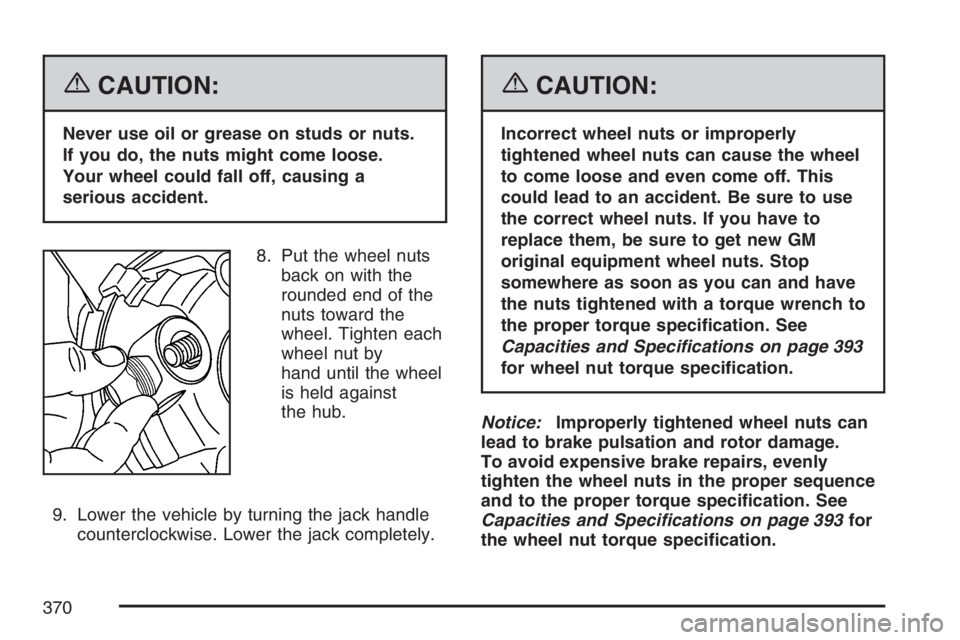
8. Put the wheel nuts
back on with the
rounded end of the
nuts toward the
wheel. Tighten each
wheel nut by
hand until the wheel
is held against
the hub.
9. Lower the vehicle by turning the jack handle
counterclockwise. Lower the jack completely.
{CAUTION:
Incorrect wheel nuts or improperly
tightened wheel nuts can cause the wheel
to come loose and even come off. This
could lead to an accident. Be sure to use
the correct wheel nuts. If you have to
replace them, be sure to get new GM
original equipment wheel nuts. Stop
somewhere as soon as you can and have
the nuts tightened with a torque wrench to
the proper torque specication. See
Capacities and Specifications on page 393
for wheel nut torque specication.
Notice:Improperly tightened wheel nuts can
lead to brake pulsation and rotor damage.
To avoid expensive brake repairs, evenly
tighten the wheel nuts in the proper sequence
and to the proper torque specication. See
Capacities and Specifications on page 393for
the wheel nut torque specication.
370
Page 371 of 452
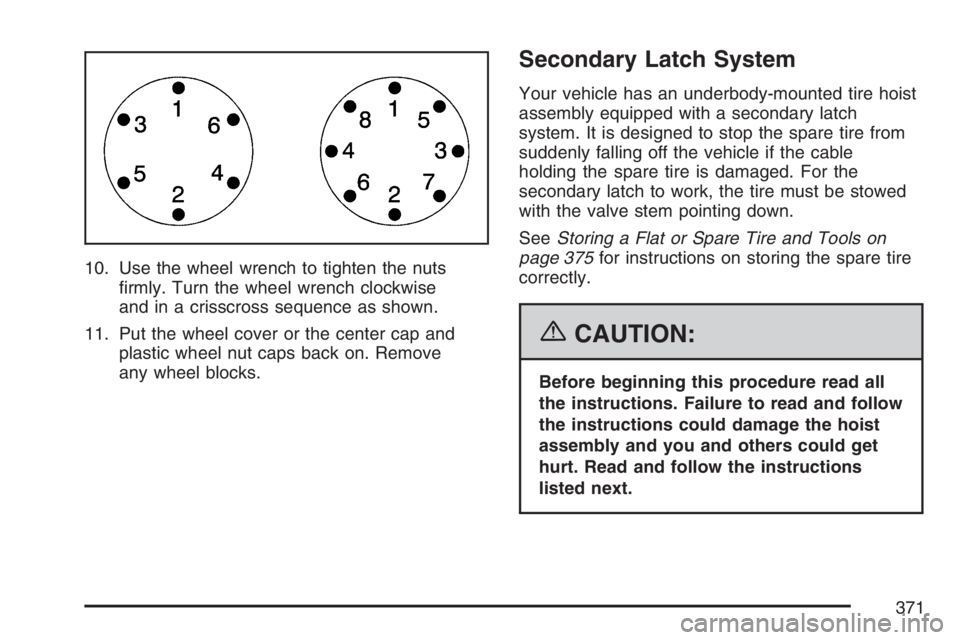
10. Use the wheel wrench to tighten the nuts
firmly. Turn the wheel wrench clockwise
and in a crisscross sequence as shown.
11. Put the wheel cover or the center cap and
plastic wheel nut caps back on. Remove
any wheel blocks.
Secondary Latch System
Your vehicle has an underbody-mounted tire hoist
assembly equipped with a secondary latch
system. It is designed to stop the spare tire from
suddenly falling off the vehicle if the cable
holding the spare tire is damaged. For the
secondary latch to work, the tire must be stowed
with the valve stem pointing down.
SeeStoring a Flat or Spare Tire and Tools on
page 375for instructions on storing the spare tire
correctly.
{CAUTION:
Before beginning this procedure read all
the instructions. Failure to read and follow
the instructions could damage the hoist
assembly and you and others could get
hurt. Read and follow the instructions
listed next.
371
Page 374 of 452
7. Lower the jack by turning the ratchet
counterclockwise. Keep lowering the jack
until the spare tire slides off the jack or
is hanging by the cable.
8. Disconnect the jack handle from the jack and
carefully remove the jack. Use one hand to
push against the spare while firmly pulling the
jack out from under the spare tire with the
other hand.
If the spare tire is hanging from the cable,
slide the ratchet onto the wheel wrench and
insert the wheel wrench into the hoist
shaft hole above the bumper. Turn the wheel
wrench counterclockwise to lower the spare
the rest of the way. Be sure the DOWN mark
on the ratchet is facing you.
9. Tilt the retainer at the end of the cable and
pull it through the wheel opening. Pull the
tire out from under the vehicle.Notice:If you drive away before the spare
tire or secondary latch system cable has been
reinstalled, you could damage your vehicle.
Always reinstall this cable before driving
your vehicle.
10. If the cable is hanging under the vehicle, turn
the wheel wrench in the hoist shaft hole in the
bumper clockwise to raise the cable back up.
Have the hoist assembly inspected as soon as
you can. You will not be able to store a spare or
flat tire using the hoist assembly until it has
been repaired or replaced.
To continue changing the flat tire, return to Step 4
ofRemoving the Flat Tire and Installing the
Spare Tire on page 365.
374
Page 375 of 452
Storing a Flat or Spare Tire
and Tools
{CAUTION:
Storing a jack, a tire, or other equipment
in the passenger compartment of the
vehicle could cause injury. In a sudden
stop or collision, loose equipment could
strike someone. Store all these in the
proper place.
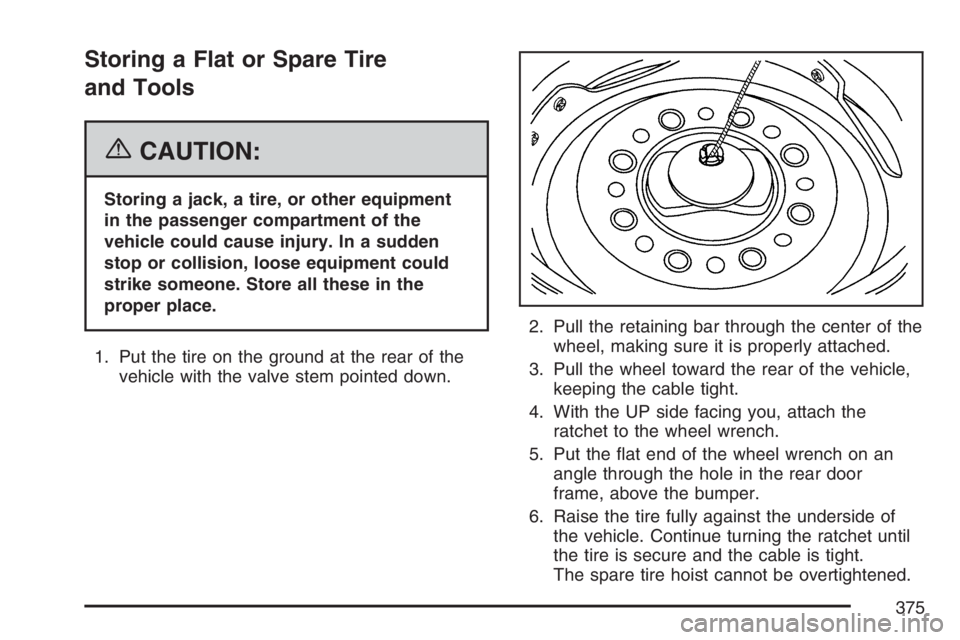
1. Put the tire on the ground at the rear of the
vehicle with the valve stem pointed down.2. Pull the retaining bar through the center of the
wheel, making sure it is properly attached.
3. Pull the wheel toward the rear of the vehicle,
keeping the cable tight.
4. With the UP side facing you, attach the
ratchet to the wheel wrench.
5. Put the flat end of the wheel wrench on an
angle through the hole in the rear door
frame, above the bumper.
6. Raise the tire fully against the underside of
the vehicle. Continue turning the ratchet until
the tire is secure and the cable is tight.
The spare tire hoist cannot be overtightened.
375
Page 377 of 452
Do not mix tires and wheels of different sizes,
because they will not fit. Keep your spare tire and
its wheel together. If your vehicle has a spare
tire that does not match your vehicle’s original road
tires and wheels in size and type, do not include
the spare tire in the tire rotation.
Appearance Care
Cleaning the Inside of Your Vehicle
Your vehicle’s interior will continue to look its
best if it is cleaned often. Although not always
visible, dust and dirt can accumulate on your
upholstery. Dirt can damage carpet, fabric, leather,
and plastic surfaces. Regular vacuuming is
recommended to remove particles from your
upholstery. It is important to keep your upholstery
from becoming and remaining heavily soiled.
Soils should be removed as quickly as possible.
Your vehicle’s interior may experience extremes of
heat that could cause stains to set rapidly.
Lighter colored interiors may require more frequent
cleaning. Use care because newspapers and
garments that transfer color to your home
furnishings may also transfer color to your
vehicle’s interior.When cleaning your vehicle’s interior, only use
cleaners specifically designed for the surfaces
being cleaned. Permanent damage may result
from using cleaners on surfaces for which
they were not intended. Use glass cleaner only on
glass. Remove any accidental over-spray from
other surfaces immediately. To prevent over-spray,
apply cleaner directly to the cleaning cloth.
Notice:If you use abrasive cleaners when
cleaning glass surfaces on your vehicle, you
could scratch the glass and/or cause damage
to the rear window defogger. When cleaning
the glass on your vehicle, use only a soft cloth
and glass cleaner.
Many cleaners contain solvents that may become
concentrated in your vehicle’s breathing space.
Before using cleaners, read and adhere to all safety
instructions on the label. While cleaning your
vehicle’s interior, maintain adequate ventilation by
opening your vehicle’s doors and windows.
Dust may be removed from small buttons and
knobs using a small brush with soft bristles.
377
Page 382 of 452
Windshield and Wiper Blades
If the windshield is not clear after using the
windshield washer, or if the wiper blade chatters
when running, wax, sap, or other material may
be on the blade or windshield.
Clean the outside of the windshield with a glass
cleaning liquid or powder and water solution.
The windshield is clean if beads do not form when
it is rinsed with water.
Grime from the windshield will stick to the wiper
blades and affect their performance. Clean
the blade by wiping vigorously with a cloth soaked
in full-strength windshield washer solvent. Then
rinse the blade with water.
Check the wiper blades and clean them as
necessary; replace blades that look worn.
Aluminum Wheels
Notice:If you use strong soaps, chemicals,
abrasive polishes, cleaners, brushes, or
cleaners that contain acid on aluminum or
chrome-plated wheels, you could damage the
surface of the wheel(s). The repairs would
not be covered by your warranty. Use
only GM-approved cleaners on aluminum or
chrome-plated wheels.
Keep the wheels clean using a soft clean cloth
with mild soap and water. Rinse with clean water.
After rinsing thoroughly, dry with a soft clean
towel. A wax may then be applied.
Notice:Using chrome polish on aluminum
wheels could damage the wheels. The repairs
would not be covered by your warranty.
Use chrome polish on chrome wheels only.
The surface of these wheels is similar to the
painted surface of the vehicle. Do not use strong
soaps, chemicals, abrasive polishes, abrasive
cleaners, cleaners with acid, or abrasive cleaning
brushes on them because the surface could
be damaged. Do not use chrome polish on
aluminum wheels.
382
Page 383 of 452
Notice:If you drive your vehicle through an
automatic car wash that has silicone carbide
tire cleaning brushes, you could damage the
aluminum or chrome-plated wheels. The repairs
would not be covered by your warranty. Never
drive a vehicle equipped with aluminum or
chrome-plated wheels through an automatic
car wash that uses silicone carbide tire
cleaning brushes.
Do not take the vehicle through an automatic car
wash that has silicone carbide tire cleaning
brushes. These brushes can also damage the
surface of these wheels.
Tires
To clean the tires, use a stiff brush with tire
cleaner.
Notice:Using petroleum-based tire dressing
products on your vehicle may damage the
paint nish and/or tires. When applying a tire
dressing, always wipe off any overspray
from all painted surfaces on your vehicle.
Sheet Metal Damage
If the vehicle is damaged and requires sheet metal
repair or replacement, make sure the body repair
shop applies anti-corrosion material to parts
repaired or replaced to restore corrosion protection.
Original manufacturer replacement parts will
provide the corrosion protection while maintaining
the warranty.
Finish Damage
Any stone chips, fractures or deep scratches in
the finish should be repaired right away. Bare
metal will corrode quickly and may develop into
major repair expense.
Minor chips and scratches can be repaired with
touch-up materials available from your dealer.
Larger areas of finish damage can be corrected in
your dealer’s body and paint shop.
383
Page 385 of 452
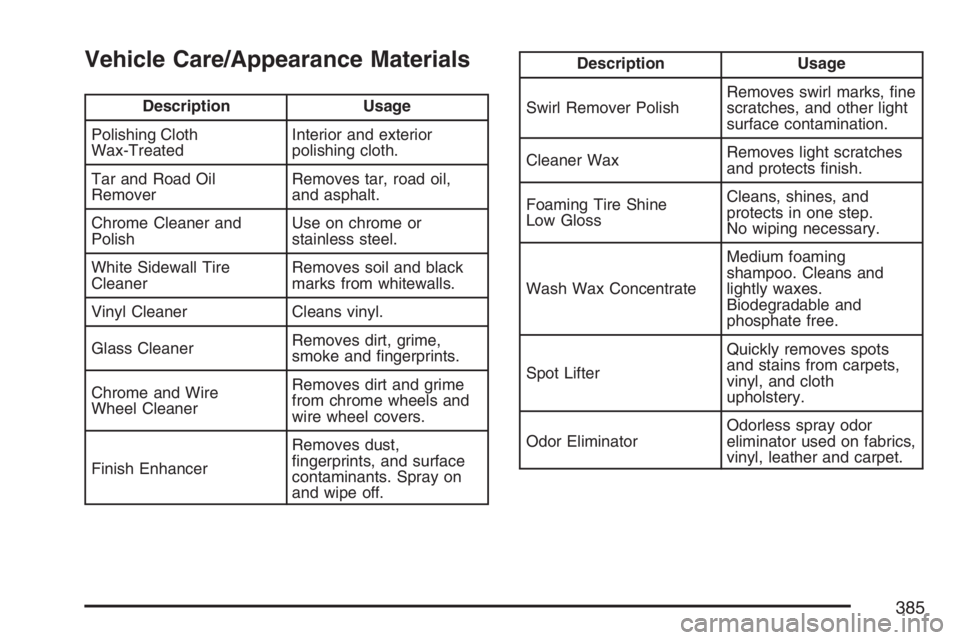
Vehicle Care/Appearance Materials
Description Usage
Polishing Cloth
Wax-TreatedInterior and exterior
polishing cloth.
Tar and Road Oil
RemoverRemoves tar, road oil,
and asphalt.
Chrome Cleaner and
PolishUse on chrome or
stainless steel.
White Sidewall Tire
CleanerRemoves soil and black
marks from whitewalls.
Vinyl Cleaner Cleans vinyl.
Glass CleanerRemoves dirt, grime,
smoke and fingerprints.
Chrome and Wire
Wheel CleanerRemoves dirt and grime
from chrome wheels and
wire wheel covers.
Finish EnhancerRemoves dust,
fingerprints, and surface
contaminants. Spray on
and wipe off.
Description Usage
Swirl Remover PolishRemoves swirl marks, fine
scratches, and other light
surface contamination.
Cleaner WaxRemoves light scratches
and protects finish.
Foaming Tire Shine
Low GlossCleans, shines, and
protects in one step.
No wiping necessary.
Wash Wax ConcentrateMedium foaming
shampoo. Cleans and
lightly waxes.
Biodegradable and
phosphate free.
Spot LifterQuickly removes spots
and stains from carpets,
vinyl, and cloth
upholstery.
Odor EliminatorOdorless spray odor
eliminator used on fabrics,
vinyl, leather and carpet.
385
Page 394 of 452
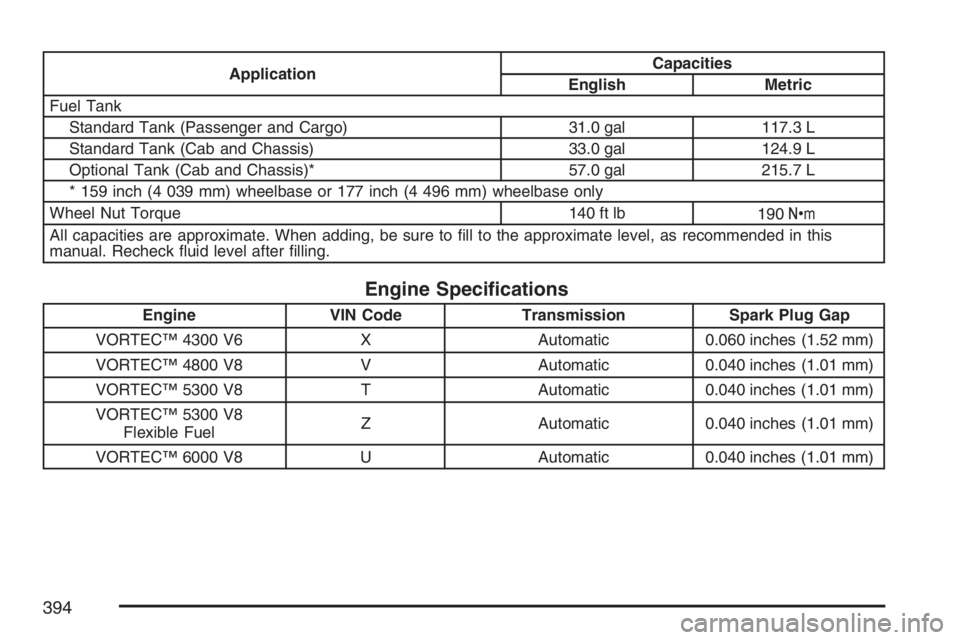
ApplicationCapacities
English Metric
Fuel Tank
Standard Tank (Passenger and Cargo) 31.0 gal 117.3 L
Standard Tank (Cab and Chassis) 33.0 gal 124.9 L
Optional Tank (Cab and Chassis)* 57.0 gal 215.7 L
* 159 inch (4 039 mm) wheelbase or 177 inch (4 496 mm) wheelbase only
Wheel Nut Torque 140 ft lb
190Y
All capacities are approximate. When adding, be sure to fill to the approximate level, as recommended in this
manual. Recheck fluid level after filling.
Engine Specications
Engine VIN Code Transmission Spark Plug Gap
VORTEC™ 4300 V6 X Automatic 0.060 inches (1.52 mm)
VORTEC™ 4800 V8 V Automatic 0.040 inches (1.01 mm)
VORTEC™ 5300 V8 T Automatic 0.040 inches (1.01 mm)
VORTEC™ 5300 V8
Flexible FuelZ Automatic 0.040 inches (1.01 mm)
VORTEC™ 6000 V8 U Automatic 0.040 inches (1.01 mm)
394
Page 406 of 452
At the First 100, 1,000 and
6,000 Miles (160, 1 600 and
10 000 km)
For vehicles with dual wheels, check dual wheel
nut torque. For proper torque, seeCapacities
and Specications on page 393.
At Each Fuel Fill
It is important to perform these underhood checks
at each fuel ll.
Engine Oil Level Check
Check the engine oil level and add the proper oil
if necessary. SeeEngine Oil (Gasoline Engine)
on page 297for further details.
Notice:It is important to check your oil
regularly and keep it at the proper level.
Failure to keep your engine oil at the proper
level can cause damage to your engine
not covered by your warranty.
Engine Coolant Level Check
Check the engine coolant level and add
DEX-COOL®coolant mixture if necessary. See
Engine Coolant on page 306for further details.
Windshield Washer Fluid Level Check
Check the windshield washer fluid level in
the windshield washer fluid reservoir and add
the proper fluid if necessary.
At Least Once a Month
Tire Ination Check
Visually inspect your vehicle’s tires and make sure
they are inflated to the correct pressures. Do not
forget to check the spare tire. SeeInation - Tire
Pressure on page 348. Check to make sure the
spare tire is stored securely. SeeChanging a Flat
Tire on page 360.
Tire Wear Inspection
Tire rotation may be required for high mileage
highway drivers prior to the Engine Oil Life System
service notification. Check the tires for wear
and, if necessary, rotate the tires. SeeTire
Inspection and Rotation on page 351.
406