fuel GMC SAVANA 2009 Workshop Manual
[x] Cancel search | Manufacturer: GMC, Model Year: 2009, Model line: SAVANA, Model: GMC SAVANA 2009Pages: 404, PDF Size: 2.35 MB
Page 355 of 404
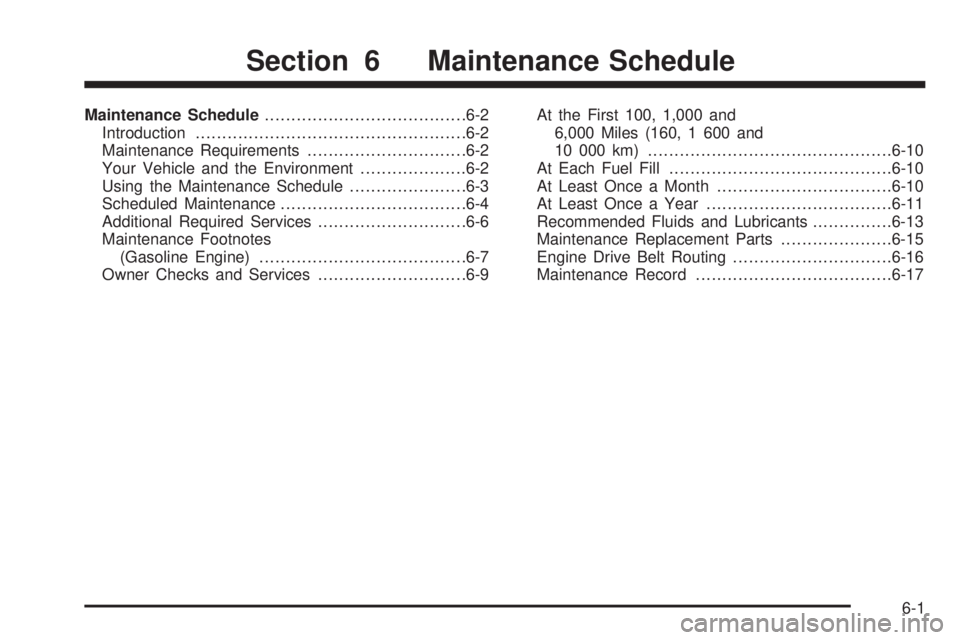
Maintenance Schedule......................................6-2
Introduction...................................................6-2
Maintenance Requirements..............................6-2
Your Vehicle and the Environment....................6-2
Using the Maintenance Schedule......................6-3
Scheduled Maintenance...................................6-4
Additional Required Services............................6-6
Maintenance Footnotes
(Gasoline Engine).......................................6-7
Owner Checks and Services............................6-9At the First 100, 1,000 and
6,000 Miles (160, 1 600 and
10 000 km) ..............................................6-10
At Each Fuel Fill..........................................6-10
At Least Once a Month.................................6-10
At Least Once a Year...................................6-11
Recommended Fluids and Lubricants...............6-13
Maintenance Replacement Parts.....................6-15
Engine Drive Belt Routing..............................6-16
Maintenance Record.....................................6-17
Section 6 Maintenance Schedule
6-1
Page 357 of 404
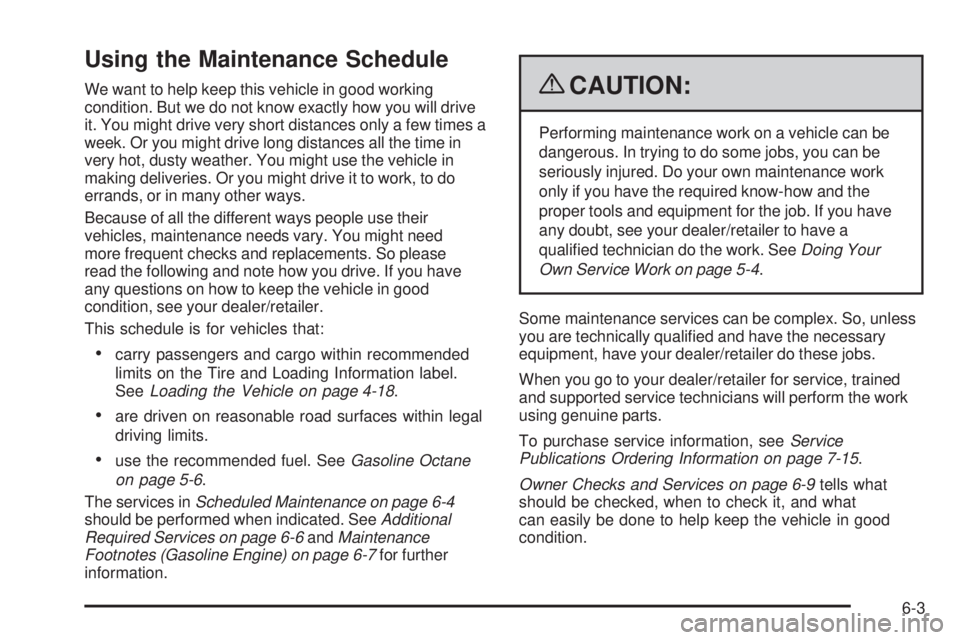
Using the Maintenance Schedule
We want to help keep this vehicle in good working
condition. But we do not know exactly how you will drive
it. You might drive very short distances only a few times a
week. Or you might drive long distances all the time in
very hot, dusty weather. You might use the vehicle in
making deliveries. Or you might drive it to work, to do
errands, or in many other ways.
Because of all the different ways people use their
vehicles, maintenance needs vary. You might need
more frequent checks and replacements. So please
read the following and note how you drive. If you have
any questions on how to keep the vehicle in good
condition, see your dealer/retailer.
This schedule is for vehicles that:
•carry passengers and cargo within recommended
limits on the Tire and Loading Information label.
SeeLoading the Vehicle on page 4-18.
•are driven on reasonable road surfaces within legal
driving limits.
•use the recommended fuel. SeeGasoline Octane
on page 5-6.
The services inScheduled Maintenance on page 6-4
should be performed when indicated. SeeAdditional
Required Services on page 6-6andMaintenance
Footnotes (Gasoline Engine) on page 6-7for further
information.
{CAUTION:
Performing maintenance work on a vehicle can be
dangerous. In trying to do some jobs, you can be
seriously injured. Do your own maintenance work
only if you have the required know-how and the
proper tools and equipment for the job. If you have
any doubt, see your dealer/retailer to have a
qualified technician do the work. SeeDoing Your
Own Service Work on page 5-4.
Some maintenance services can be complex. So, unless
you are technically qualified and have the necessary
equipment, have your dealer/retailer do these jobs.
When you go to your dealer/retailer for service, trained
and supported service technicians will perform the work
using genuine parts.
To purchase service information, seeService
Publications Ordering Information on page 7-15.
Owner Checks and Services on page 6-9tells what
should be checked, when to check it, and what
can easily be done to help keep the vehicle in good
condition.
6-3
Page 360 of 404
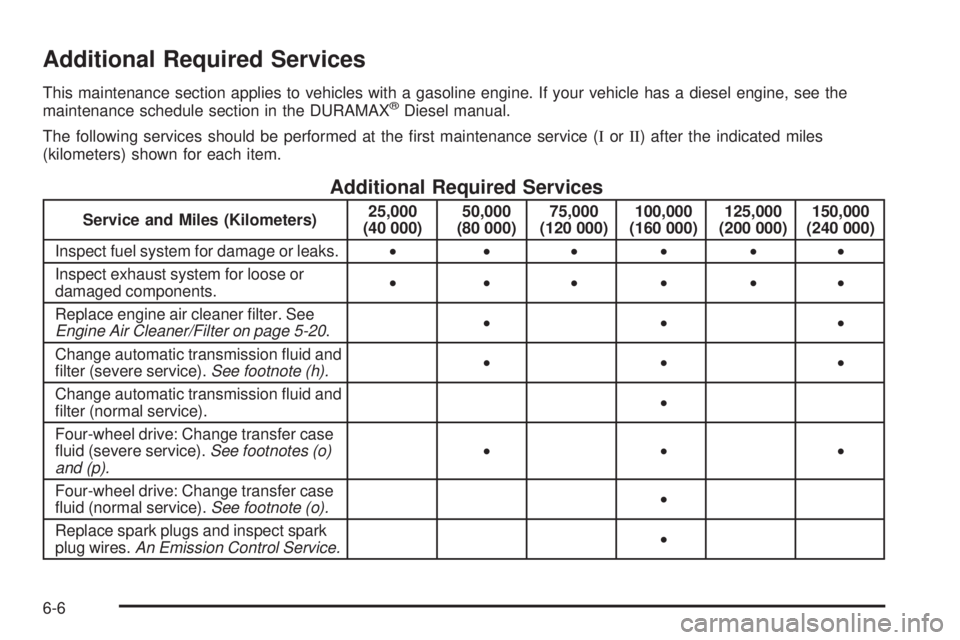
Additional Required Services
This maintenance section applies to vehicles with a gasoline engine. If your vehicle has a diesel engine, see the
maintenance schedule section in the DURAMAX®Diesel manual.
The following services should be performed at the first maintenance service (IorII) after the indicated miles
(kilometers) shown for each item.
Additional Required Services
Service and Miles (Kilometers)25,000
(40 000)50,000
(80 000)75,000
(120 000)100,000
(160 000)125,000
(200 000)150,000
(240 000)
Inspect fuel system for damage or leaks.• •••••
Inspect exhaust system for loose or
damaged components.• •••••
Replace engine air cleaner filter. See
Engine Air Cleaner/Filter on page 5-20.•••
Change automatic transmission fluid and
filter (severe service).See footnote (h).•••
Change automatic transmission fluid and
filter (normal service).•
Four-wheel drive: Change transfer case
fluid (severe service).See footnotes (o)
and (p).•••
Four-wheel drive: Change transfer case
fluid (normal service).See footnote (o).•
Replace spark plugs and inspect spark
plug wires.An Emission Control Service.•
6-6
Page 362 of 404
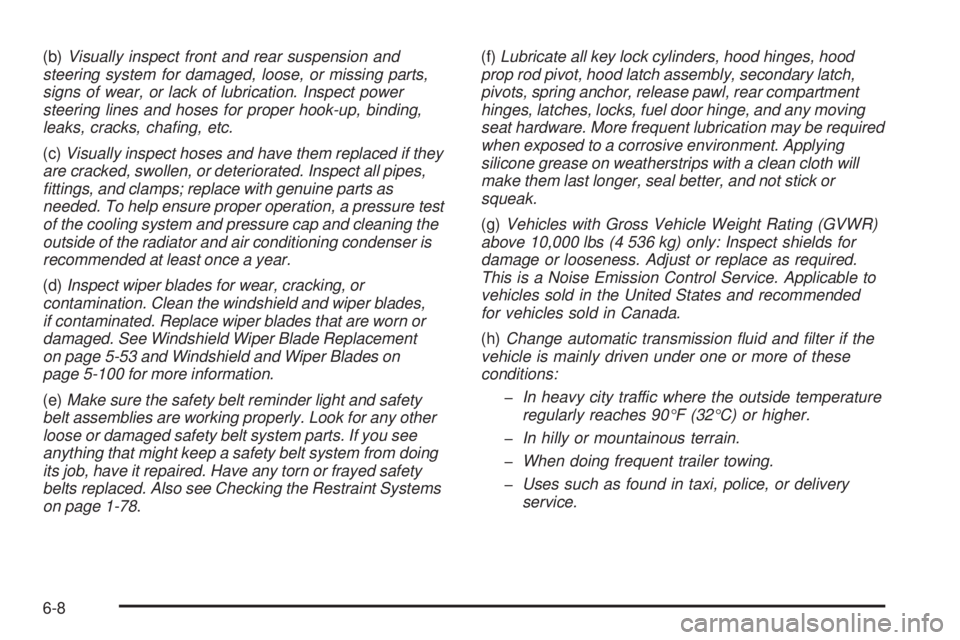
(b)Visually inspect front and rear suspension and
steering system for damaged, loose, or missing parts,
signs of wear, or lack of lubrication. Inspect power
steering lines and hoses for proper hook-up, binding,
leaks, cracks, chafing, etc.
(c)Visually inspect hoses and have them replaced if they
are cracked, swollen, or deteriorated. Inspect all pipes,
fittings, and clamps; replace with genuine parts as
needed. To help ensure proper operation, a pressure test
of the cooling system and pressure cap and cleaning the
outside of the radiator and air conditioning condenser is
recommended at least once a year.
(d)Inspect wiper blades for wear, cracking, or
contamination. Clean the windshield and wiper blades,
if contaminated. Replace wiper blades that are worn or
damaged. See Windshield Wiper Blade Replacement
on page 5-53 and Windshield and Wiper Blades on
page 5-100 for more information.
(e)Make sure the safety belt reminder light and safety
belt assemblies are working properly. Look for any other
loose or damaged safety belt system parts. If you see
anything that might keep a safety belt system from doing
its job, have it repaired. Have any torn or frayed safety
belts replaced. Also see Checking the Restraint Systems
on page 1-78.(f)Lubricate all key lock cylinders, hood hinges, hood
prop rod pivot, hood latch assembly, secondary latch,
pivots, spring anchor, release pawl, rear compartment
hinges, latches, locks, fuel door hinge, and any moving
seat hardware. More frequent lubrication may be required
when exposed to a corrosive environment. Applying
silicone grease on weatherstrips with a clean cloth will
make them last longer, seal better, and not stick or
squeak.
(g)Vehicles with Gross Vehicle Weight Rating (GVWR)
above 10,000 lbs (4 536 kg) only: Inspect shields for
damage or looseness. Adjust or replace as required.
This is a Noise Emission Control Service. Applicable to
vehicles sold in the United States and recommended
for vehicles sold in Canada.
(h)Change automatic transmission fluid and filter if the
vehicle is mainly driven under one or more of these
conditions:
-In heavy city traffic where the outside temperature
regularly reaches 90°F (32°C) or higher.
-In hilly or mountainous terrain.
-When doing frequent trailer towing.
-Uses such as found in taxi, police, or delivery
service.
6-8
Page 363 of 404
(i)Drain, flush, and refill cooling system. This service
can be complex; you should have your dealer/retailer
perform this service. See Engine Coolant on page 5-25
for what to use. Inspect hoses. Clean radiator,
condenser, pressure cap, and filler neck. Pressure
test the cooling system and pressure cap.
(j)A fluid loss in any vehicle system could indicate a
problem. Have the system inspected and repaired and
the fluid level checked. Add fluid if needed.
(k)Inspect system. Check all fuel and vapor lines and
hoses for proper hook-up, routing, and condition. Check
that the purge valve works properly, if equipped.
Replace as needed.
(l)If driving regularly under dusty conditions, inspect the
filter at each engine oil change.
(m)Check system for interference or binding and for
damaged or missing parts. Replace parts as needed.
Replace any components that have high effort or
excessive wear. Do not lubricate accelerator or cruise
control cables.
(n)Visually inspect belt for fraying, excessive cracks, or
obvious damage. Replace belt if necessary.(o)Check vent hose at transfer case for kinks and
proper installation. Check to be sure vent hose
is unobstructed, clear, and free of debris. During any
maintenance, if a power washer is used to clean
mud and dirt from the underbody, care should be taken
to not directly spray the transfer case output seals.
High pressure water can overcome the seals and
contaminate the transfer case fluid. Contaminated fluid
will decrease the life of the transfer case and should
be replaced.
(p)Severe Service: Change transfer case fluid if the
vehicle is mainly used for trailer towing or driven in city
traffic, wet environment, or high ambient temperatures.
Owner Checks and Services
These owner checks and services should be performed
at the intervals specified to help ensure vehicle safety,
dependability, and emission control performance. Your
dealer/retailer can assist with these checks and services.
Be sure any necessary repairs are completed at once.
Whenever any fluids or lubricants are added to the
vehicle, make sure they are the proper ones, as shown
inRecommended Fluids and Lubricants on page 6-13.
6-9
Page 364 of 404
At the First 100, 1,000 and
6,000 Miles (160, 1 600 and
10 000 km)
For vehicles with dual wheels, check dual wheel nut
torque. For proper torque, seeCapacities and
Specifications on page 5-110.
At Each Fuel Fill
It is important to perform these underhood checks at
each fuel fill.
Engine Oil Level Check
Notice:It is important to check the engine oil
regularly and keep it at the proper level. Failure to
keep the engine oil at the proper level can cause
damage to the engine not covered by the vehicle
warranty.
Check the engine oil level and add the proper oil if
necessary. SeeEngine Oil on page 5-15.
Engine Coolant Level Check
Check the engine coolant level and add DEX-COOL®
coolant mixture if necessary. SeeEngine Coolant
on page 5-25.
Windshield Washer Fluid Level Check
Check the windshield washer fluid level in the windshield
washer fluid reservoir and add the proper fluid if
necessary.
At Least Once a Month
Tire Ination Check
Inspect the vehicle’s tires and make sure they are inflated
to the correct pressures. Do not forget to check the spare
tire. SeeInflation - Tire Pressure on page 5-62. Check to
make sure the spare tire is stored securely. See
Changing a Flat Tire on page 5-80.
Tire Wear Inspection
Tire rotation may be required for high mileage highway
drivers prior to the Engine Oil Life System service
notification. Check the tires for wear and, if necessary,
rotate the tires. SeeTire Inspection and Rotation on
page 5-69.
6-10
Page 382 of 404
Calling for Assistance
When calling Roadside Assistance, have the following
information ready:
•Your name, home address, and home telephone
number
•Telephone number of your location
•Location of the vehicle
•Model, year, color, and license plate number of the
vehicle
•Odometer reading, Vehicle Identification
Number (VIN), and delivery date of the vehicle
•Description of the problem
Coverage
Services are provided up to 5 years/100,000 miles
(160 000 km), whichever comes first.
In the U.S., anyone driving the vehicle is covered.
In Canada, a person driving the vehicle without
permission from the owner is not covered.
Roadside Assistance is not a part of the New Vehicle
Limited Warranty. GMC and General Motors of Canada
Limited reserve the right to make any changes or
discontinue the Roadside Assistance program at any
time without notification.GMC and General Motors of Canada Limited reserve the
right to limit services or payment to an owner or driver if
they decide the claims are made too often, or the same
type of claim is made many times.
Services Provided
•Emergency Fuel Delivery:Delivery of enough fuel
for the vehicle to get to the nearest service station.
•Lock-Out Service:Service is provided to unlock the
vehicle if you are locked out. A remote unlock may be
available if you have OnStar
®. For security reasons,
the driver must present identification before this
service is given.
•Emergency Tow From a Public Road or Highway:
Tow to the nearest GMC dealer for warranty service,
or if the vehicle was in a crash and cannot be driven.
Assistance is also given when the vehicle is stuck in
the sand, mud, or snow.
•Flat Tire Change:Service is provided to change a
flat tire with the spare tire. The spare tire, if equipped,
must be in good condition and properly inflated.
It is the owner’s responsibility for the repair or
replacement of the tire if it is not covered by the
warranty.
•Battery Jump Start:Service is provided to jump
start a dead battery.
7-8
Page 383 of 404
•Trip Routing Service:Detailed maps of
North America are provided when requested
either with the most direct route or the most
scenic route. Additional travel information is
also available. Allow three weeks for delivery.
•Trip Interruption Benets and Assistance:
If your trip is interrupted due to a warranty failure,
incidental expenses may be reimbursed during the
5 years/100,000 miles (160 000 km) Powertrain
warranty period. Items considered are hotel, meals,
and rental car.
Services Not Included in Roadside
Assistance
•Impound towing caused by violation of any laws.
•Legal fines.
•Mounting, dismounting or changing of snow tires,
chains, or other traction devices.
•Towing or services for vehicles driven on a
non-public road or highway.
Services Specic to Canadian
Purchased Vehicles
•Fuel delivery:Reimbursement is approximately
$5 Canadian. Diesel fuel delivery may be
restricted. Propane and other fuels are not
provided through this service.
•Lock-Out Service:Vehicle registration is required.
•Trip Routing Service:Limit of six requests
per year.
•Trip Interruption Benets and Assistance:Must
be over 250 kilometres from where your trip was
started to qualify. General Motors of Canada Limited
requires pre-authorization, original detailed receipts,
and a copy of the repair orders. Once authorization
has been received, the Roadside Assistance advisor
will help you make arrangements and explain how to
receive payment.
•Alternative Service:If assistance cannot be
provided right away, the Roadside Assistance
advisor may give you permission to get local
emergency road service. You will receive payment,
up to $100, after sending the original receipt to
Roadside Assistance. Mechanical failures may be
covered, however any cost for parts and labor for
repairs not covered by the warranty are the owner
responsibility.
7-9
Page 385 of 404
Public Transportation or Fuel
Reimbursement
If your vehicle requires overnight warranty repairs, and
public transportation is used instead of the dealer’s
shuttle service, the expense must be supported by
original receipts and can only be up to the maximum
amount allowed by GM for shuttle service. In addition,
for U.S. customers, should you arrange transportation
through a friend or relative, limited reimbursement for
reasonable fuel expenses may be available. Claim
amounts should reflect actual costs and be supported
by original receipts. See your dealer for information
regarding the allowance amounts for reimbursement
of fuel or other transportation costs.
Courtesy Rental Vehicle
Your dealer may arrange to provide you with a courtesy
rental vehicle or reimburse you for a rental vehicle
that you obtain if your vehicle is kept for an overnight
warranty repair. Rental reimbursement will be limited
and must be supported by original receipts. This
requires that you sign and complete a rental agreement
and meet state/provincial, local, and rental vehicle
provider requirements. Requirements vary and may
include minimum age requirements, insurance coverage,credit card, etc. You are responsible for fuel usage
charges and may also be responsible for taxes, levies,
usage fees, excessive mileage, or rental usage
beyond the completion of the repair.
It may not be possible to provide a like-vehicle as a
courtesy rental.
Additional Program Information
All program options, such as shuttle service, may not be
available at every dealer. Please contact your dealer for
specific information about availability. All Courtesy
Transportation arrangements will be administered by
appropriate dealer personnel.
General Motors reserves the right to unilaterally modify,
change or discontinue Courtesy Transportation at any
time and to resolve all questions of claim eligibility
pursuant to the terms and conditions described herein
at its sole discretion.
Collision Damage Repair
If your vehicle is involved in a collision and it is damaged,
have the damage repaired by a qualified technician using
the proper equipment and quality replacement parts.
Poorly performed collision repairs diminish your vehicle’s
resale value, and safety performance can be
compromised in subsequent collisions.
7-11
Page 390 of 404
Current and Past Model Order Forms
Technical Service Bulletins and Manuals are available
for current and past model GM vehicles. To request
an order form, specify year and model name of
the vehicle.
ORDER TOLL FREE: 1-800-551-4123
Monday-Friday 8:00 AM - 6:00 PM
Eastern Time
For Credit Card Orders Only
(VISA-MasterCard-Discover), visit Helm, Inc.
on the World Wide Web at: helminc.com
Or you can write to:
Helm, Incorporated
P.O. Box 07130
Detroit, MI 48207
Prices are subject to change without notice and without
incurring obligation. Allow ample time for delivery.
Note to Canadian Customers: All listed prices are
quoted in U.S. funds. Canadian residents are to make
checks payable in U.S. funds.
Vehicle Data Recording and
Privacy
Your GM vehicle has a number of sophisticated
computers that record information about the vehicle’s
performance and how it is driven. For example, your
vehicle uses computer modules to monitor and control
engine and transmission performance, to monitor the
conditions for airbag deployment and deploy airbags in a
crash and, if so equipped, to provide antilock braking to
help the driver control the vehicle. These modules may
store data to help your dealer/retailer technician service
your vehicle. Some modules may also store data about
how you operate the vehicle, such as rate of fuel
consumption or average speed. These modules may also
retain the owner’s personal preferences, such as radio
pre-sets, seat positions, and temperature settings.
7-16