service GMC SAVANA 2011 Workshop Manual
[x] Cancel search | Manufacturer: GMC, Model Year: 2011, Model line: SAVANA, Model: GMC SAVANA 2011Pages: 414, PDF Size: 5.27 MB
Page 274 of 414
Black plate (2,1)GMC Savana Owner Manual - 2011
10-2 Vehicle Care
When It Is Time for NewTires . . . . . . . . . . . . . . . . . . . . . . 10-65
Buying New Tires . . . . . . . . . . . 10-66
Different Size Tires and Wheels . . . . . . . . . . . . . . . . . . . 10-67
Uniform Tire Quality Grading . . . . . . . . . . . . . . . . . . . 10-68
Wheel Alignment and Tire Balance . . . . . . . . . . . . . . . . . . . 10-69
Wheel Replacement . . . . . . . . 10-70
Tire Chains . . . . . . . . . . . . . . . . . 10-71
If a Tire Goes Flat . . . . . . . . . . 10-71
Tire Changing . . . . . . . . . . . . . . 10-73
Secondary Latch System . . . 10-81
Full-Size Spare Tire . . . . . . . . 10-83
Jump Starting
Jump Starting . . . . . . . . . . . . . . 10-84
Towing
Towing the Vehicle . . . . . . . . . 10-88
Recreational Vehicle Towing . . . . . . . . . . . . . . . . . . . . 10-88
Appearance Care
Exterior Care . . . . . . . . . . . . . . . 10-91
Interior Care . . . . . . . . . . . . . . . . 10-95
Floor Mats . . . . . . . . . . . . . . . . . . 10-98
General Information
For service and parts needs, visit
your dealer. You will receive
genuine GM parts and GM-trained
and supported service people.
Genuine GM parts have one of
these marks:
California Proposition
65 Warning
Most motor vehicles, including this
one, contain and/or emit chemicals
known to the State of California to
cause cancer and birth defects or
other reproductive harm. Engine
exhaust, many parts and systems,
many fluids, and some component
wear by-products contain and/or
emit these chemicals.
Page 275 of 414
Black plate (3,1)GMC Savana Owner Manual - 2011
Vehicle Care 10-3
California Perchlorate
Materials Requirements
Certain types of automotive
applications, such as airbag
initiators, seat belt pretensioners,
and lithium batteries contained in
Remote Keyless Entry transmitters,
may contain perchlorate materials.
Special handling may be necessary.
For additional information, see
www.dtsc.ca.gov/hazardouswaste/
perchlorate.
Accessories and
Modifications
Adding non‐dealer accessories or
making modifications to the vehicle
can affect vehicle performance and
safety, including such things as
airbags, braking, stability, ride and
handling, emissions systems,
aerodynamics, durability, and
electronic systems like antilock
brakes, traction control, and stability
control. These accessories or
modifications could even cause
malfunction or damage not covered
by the vehicle warranty.
Damage to vehicle components
resulting from modifications or the
installation or use of non‐GM
certified parts, including control
module or software modifications, is
not covered under the terms of the
vehicle warranty and may affect
remaining warranty coverage for
affected parts.GM Accessories are designed to
complement and function with other
systems on the vehicle. Your GM
dealer can accessorize the vehicle
using genuine GM Accessories.
When you go to your GM dealer
and ask for GM Accessories, you
will know that GM-trained and
supported service technicians will
perform the work using genuine GM
Accessories.
Also, see
Adding Equipment to the
Airbag-Equipped Vehicle on
page 3‑42.
Page 276 of 414
Black plate (4,1)GMC Savana Owner Manual - 2011
10-4 Vehicle Care
Vehicle Checks
Doing Your Own
Service Work
{WARNING
You can be injured and the
vehicle could be damaged if you
try to do service work on a vehicle
without knowing enough about it.
.Be sure you have sufficient
knowledge, experience,
the proper replacement
parts, and tools before
attempting any vehicle
maintenance task.
.Be sure to use the proper
nuts, bolts, and other
fasteners. Metric and English
fasteners can be easily
confused. If the wrong
fasteners are used, parts can
later break or fall off. You
could be hurt.If doing some of your own service
work, use the proper service
manual. It tells you much more
about how to service the vehicle
than this manual can. To order the
proper service manual, see
Service
Publications Ordering Information
on page 13‑12.
This vehicle has an airbag system.
Before attempting to do your own
service work, see Servicing the
Airbag-Equipped Vehicle on
page 3‑41.
Keep a record with all parts receipts
and list the mileage and the date of
any service work performed. See
Maintenance Records on
page 11‑10.
Hood
To open the hood:
1. Pull the handle with this symbol on it. It is located in front of the
driver side door frame near the
floor.
Page 280 of 414
Black plate (8,1)GMC Savana Owner Manual - 2011
10-8 Vehicle Care
Checking Engine Oil
It is a good idea to check the engine
oil level at each fuel fill. In order to
get an accurate reading, the vehicle
must be on level ground. The
engine oil dipstick handle is a yellow
loop. SeeEngine Compartment
Overview on page 10‑6 for the
location of the engine oil dipstick.
Obtaining an accurate oil level
reading is essential:
1. If the engine has been running recently, turn off the engine and
allow several minutes for the oil
to drain back into the oil pan.
Checking the oil level too soon
after engine shutoff will not
provide an accurate oil level
reading.
2. Pull out the dipstick and clean it with a paper towel or cloth, then
push it back in all the way.
Remove it again, keeping the tip
down, and check the level.
When to Add Engine Oil
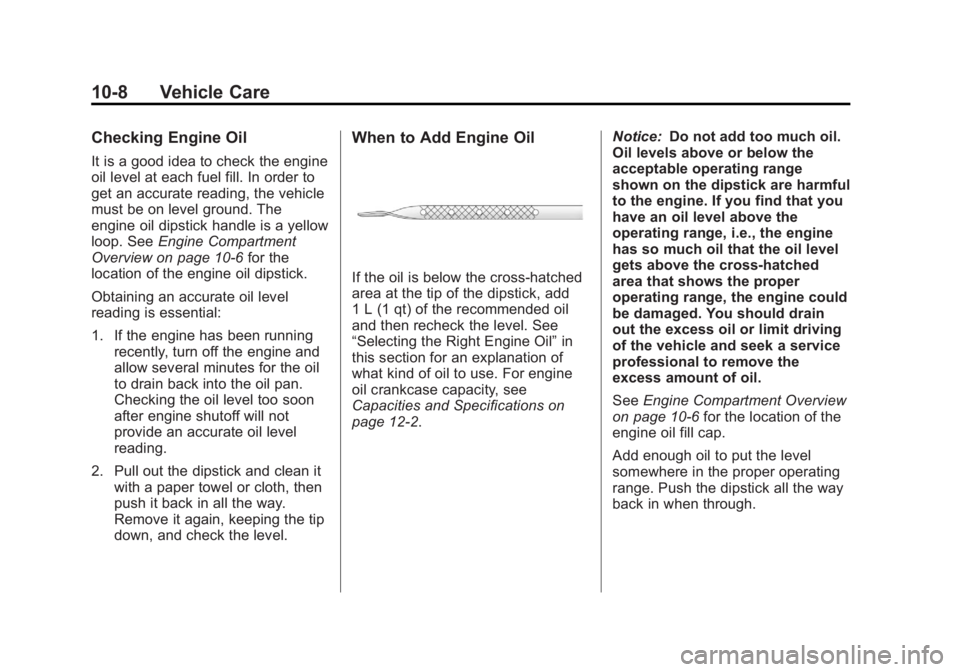
If the oil is below the cross-hatched
area at the tip of the dipstick, add
1 L (1 qt) of the recommended oil
and then recheck the level. See
“Selecting the Right Engine Oil” in
this section for an explanation of
what kind of oil to use. For engine
oil crankcase capacity, see
Capacities and Specifications on
page 12‑2. Notice:
Do not add too much oil.
Oil levels above or below the
acceptable operating range
shown on the dipstick are harmful
to the engine. If you find that you
have an oil level above the
operating range, i.e., the engine
has so much oil that the oil level
gets above the cross-hatched
area that shows the proper
operating range, the engine could
be damaged. You should drain
out the excess oil or limit driving
of the vehicle and seek a service
professional to remove the
excess amount of oil.
See Engine Compartment Overview
on page 10‑6 for the location of the
engine oil fill cap.
Add enough oil to put the level
somewhere in the proper operating
range. Push the dipstick all the way
back in when through.
Page 281 of 414
Black plate (9,1)GMC Savana Owner Manual - 2011
Vehicle Care 10-9
Selecting the Right Engine Oil
Selecting the right engine oil
depends on both the proper oil
specification and viscosity grade:
Specification
Use and ask for engine oils with the
dexos™certification mark. Oils
meeting the requirements of the
vehicle should have the dexos
certification mark on the container.
This certification mark indicates that
the oil has been approved to the
dexos specification.
This vehicle was filled at the factory
with dexos‐approved engine oil.
Notice: Use only engine oil
that is approved to the dexos
specification or an equivalent
engine oil of the appropriate
viscosity grade. Engine oils
approved to the dexos
specification will show the dexos
symbol on the container. Failure
to use the recommended engine
oil or equivalent can result in
engine damage not covered by
the vehicle warranty. If you are
unsure whether the oil is
approved to the dexos
specification, ask your service
provider. Use of Substitute Engine Oils if
dexos is unavailable: In the event
that dexos‐approved engine oil is
not available at an oil change or for
maintaining proper oil level, you
may use substitute engine oil
displaying the API Starburst symbol
and of SAE 5W-30 viscosity grade.
Use of oils that do not meet the
dexos specification, however, may
result in reduced performance under
certain circumstances.
Viscosity Grade
SAE 5W-30 is the best viscosity
grade for the vehicle. Do not use
other viscosity oils such as
SAE 10W‐30, 10W‐40, or 20W-50.
Page 283 of 414
Black plate (11,1)GMC Savana Owner Manual - 2011
Vehicle Care 10-11
Engine Oil Life System
When to Change Engine Oil
This vehicle has a computer system
that indicates when to change the
engine oil and filter. This is based
on a combination of factors which
include engine revolutions, engine
temperature, and miles driven.
Based on driving conditions, the
mileage at which an oil change is
indicated can vary considerably. For
the oil life system to work properly,
the system must be reset every time
the oil is changed.
When the system has calculated
that oil life has been diminished, it
indicates that an oil change is
necessary. A CHANGE ENGINE
OIL SOON message comes on. See
Engine Oil Messages on page 5‑34.
Change the oil as soon as possible
within the next 1 000 km (600 mi).It is possible that, if driving under
the best conditions, the oil life
system might indicate that an oil
change is not necessary for up to a
year. The engine oil and filter must
be changed at least once a year
and, at this time, the system must
be reset. Your dealer has trained
service people who will perform this
work and reset the system. It is also
important to check the oil regularly
over the course of an oil drain
interval and keep it at the proper
level.
If the system is ever reset
accidentally, the oil must be
changed at 5 000 km (3,000 mi)
since the last oil change.
Remember to reset the oil life
system whenever the oil is changed.
How to Reset the Engine Oil
Life System
Reset the system whenever the
engine oil is changed so that the
system can calculate the next
engine oil change. To reset the
system:
1. Turn the ignition key to ON/RUN
with the engine off.
2. Fully press and release the accelerator pedal slowly three
times within five seconds.
3. Turn the key to LOCK/OFF.
If the CHANGE ENGINE OIL SOON
message comes back on when the
vehicle is started, the engine oil life
system has not reset. Repeat the
procedure.
Page 284 of 414
Black plate (12,1)GMC Savana Owner Manual - 2011
10-12 Vehicle Care
Automatic Transmission
Fluid (4-Speed
Transmission)
If the vehicle has a diesel engine,
see the Duramax diesel supplement
for more information.
When to Check and Change
Automatic Transmission Fluid
A good time to check the automatic
transmission fluid level is when the
engine oil is changed.
Change the fluid and filter at the
intervals listed inScheduled
Maintenance on page 11‑3 and be
sure to use the transmission fluid
listed in Recommended Fluids and
Lubricants on page 11‑7.
How to Check Automatic
Transmission Fluid
Because this operation can be a
little difficult, it may be decided to
have this done at the dealer service
department.
If not taken to the dealer, be sure to
follow all the instructions here or a
false reading on the dipstick could
result.
Notice: Too much or too
little fluid can damage the
transmission. Too much can
mean that some of the fluid could
come out and fall on hot engine
parts or exhaust system parts,
starting a fire. Too little fluid
could cause the transmission to
overheat. Be sure to get an
accurate reading if checking the
transmission fluid. Wait at least 30 minutes before
checking the transmission fluid level
if you have been driving:.When outside temperatures are
above 32°C (90°F).
.At high speed for quite a while.
.In heavy traffic
—especially in
hot weather.
.While pulling a trailer.
To get the right reading, the fluid
should be at normal operating
temperature, which is 82°C to 93°C
(180°F to 200°F).
Get the vehicle warmed up by
driving about 24 km (15 mi) when
outside temperatures are above
10°C (50°F). If it is colder than 10°C
(50°F), drive the vehicle in 3 (Third)
until the engine temperature gauge
moves and then remains steady for
10 minutes.
Page 286 of 414
Black plate (14,1)GMC Savana Owner Manual - 2011
10-14 Vehicle Care
How to Add Automatic
Transmission Fluid
Refer toRecommended Fluids and
Lubricants on page 11‑7 to
determine what kind of transmission
fluid to use.
Using a funnel, add fluid down the
transmission dipstick tube only after
checking the transmission fluid
while it is hot. A cold check is used
only as a reference. If the fluid level
is low, add only enough of the
proper fluid to bring the level up to
the HOT area for a hot check.
It does not take much fluid,
generally less than 0.5 L (1 pt). Do
not overfill. Notice:
Use of the incorrect
automatic transmission fluid may
damage the vehicle, and the
damages may not be covered by
the vehicle warranty. Always use
the automatic transmission fluid
listed in Recommended Fluids
and Lubricants on page 11‑7.
.After adding fluid, recheck the
fluid level as described under
“How to Check Automatic
Transmission Fluid,” earlier in
this section.
.When the correct fluid level is
obtained, push the dipstick back
in all the way; then flip the
handle down to lock the dipstick
in place.
Automatic Transmission
Fluid (6-Speed
Transmission)
When to Check and Change
Automatic Transmission Fluid
It is usually not necessary to
check the transmission fluid level.
The only reason for fluid loss is a
transmission leak or overheating the
transmission. If a small leak is
suspected, use the following
procedures to check the fluid level.
However, if there is a large leak,
then it may be necessary to have
the vehicle towed to a dealer
service department and have it
repaired before driving the vehicle
further.
Change the fluid and filter at the
intervals listed in Scheduled
Maintenance on page 11‑3, and be
sure to use the transmission fluid
listed in Recommended Fluids and
Lubricants on page 11‑7.
Page 287 of 414
Black plate (15,1)GMC Savana Owner Manual - 2011
Vehicle Care 10-15
How to Check Automatic
Transmission Fluid
Because this operation can be
difficult, it is recommended to have
this check done at the dealer
service department, which can
monitor the transmission
temperature. The transmission
fluid level increases with
temperature. To obtain a highly
accurate fluid level check, the
transmission temperature must be
measured.
If it is decided to check the fluid
level, be sure to follow all the
instructions here, or a false reading
on the dipstick may occur.
Notice:Too much or too
little fluid can damage the
transmission. Too much can
mean that some of the fluid could
come out and fall on hot engine
parts or exhaust system parts,
starting a fire. Too little fluid
could cause the transmission to overheat. Be sure to get an
accurate reading if checking the
transmission fluid.
Wait at least 30 minutes with the
engine Off, before checking the
transmission fluid level if the vehicle
has been driven:
.In hot weather, when outside
temperatures are above
32°C (90°F).
.The vehicle is heavily loaded.
.At high speed for quite a while in
hot weather.
.In heavy traffic and hot weather.
.While pulling a trailer.
After driving under these conditions,
a hot check can be performed. The
fluid should be Hot, which is 71°C to
93°C (160°F to 200°F).
A cold fluid level check can be
performed after the vehicle has
been sitting for eight hours or more
with the engine off, but this is used
only as a reference. Let the engine
run at idle for five minutes if outside temperatures is between 15°C to
32°C (60°F to 90°F). Should the
fluid level be low during this cold
check, the fluid must be checked
Warm or Hot before adding fluid.
If the outside temperature is colder
than 15°C (60°F) or hotter than
32°C (90°F), a cold check cannot be
performed.
A warm fluid level check can be
performed by driving the vehicle
under lightly loaded conditions and
outside temperatures between 10°C
to 27°C (50°F to 80°F). The vehicle
should be driven for at least 24 km
(15 mi) before performing a warm
check. Checking the fluid Warm or
Hot will give a more accurate
reading of the fluid level than a cold
check.
Because the vehicle is equipped
with a high-efficiency air-to-oil
cooler, the transmission fluid
temperature may not reach the
required Hot fluid level checking
temperature under normal lightly
loaded driving vehicle conditions.
Page 293 of 414
Black plate (21,1)GMC Savana Owner Manual - 2011
Vehicle Care 10-21
Never dispose of engine coolant by
putting it in the trash, pouring it on
the ground, or into sewers, streams,
or bodies of water. Have the coolant
changed by an authorized service
center, familiar with legal
requirements regarding used
coolant disposal. This will help
protect the environment and your
health.
Checking Coolant
The vehicle must be on a level
surface when checking the coolant
level.
Check to see if coolant is visible in
the coolant recovery tank. If the
coolant inside the coolant recovery
tank is boiling, do not do anything
else until it cools down. If coolant is
visible but the coolant level is not at
or above the COLD FILL mark, add
a 50/50 mixture of clean, drinkable
water and DEX-COOL coolant at the
coolant recovery tank, but be sure
the cooling system is cool before
this is done.
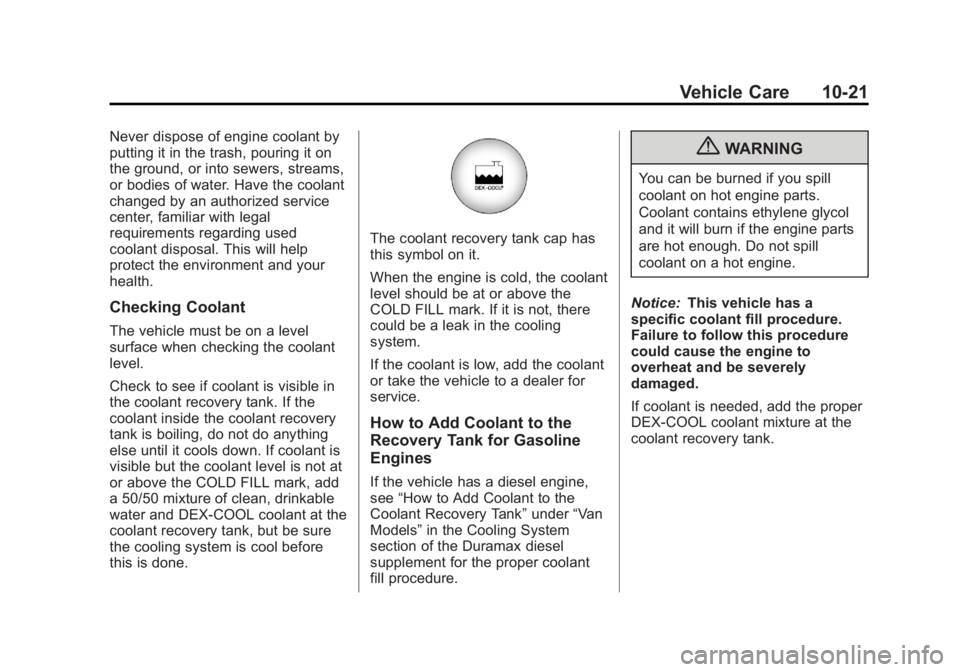
The coolant recovery tank cap has
this symbol on it.
When the engine is cold, the coolant
level should be at or above the
COLD FILL mark. If it is not, there
could be a leak in the cooling
system.
If the coolant is low, add the coolant
or take the vehicle to a dealer for
service.
How to Add Coolant to the
Recovery Tank for Gasoline
Engines
If the vehicle has a diesel engine,
see“How to Add Coolant to the
Coolant Recovery Tank” under“Van
Models” in the Cooling System
section of the Duramax diesel
supplement for the proper coolant
fill procedure.
{WARNING
You can be burned if you spill
coolant on hot engine parts.
Coolant contains ethylene glycol
and it will burn if the engine parts
are hot enough. Do not spill
coolant on a hot engine.
Notice: This vehicle has a
specific coolant fill procedure.
Failure to follow this procedure
could cause the engine to
overheat and be severely
damaged.
If coolant is needed, add the proper
DEX-COOL coolant mixture at the
coolant recovery tank.