airbag GMC SAVANA PASSENGER 2009 Owners Manual
[x] Cancel search | Manufacturer: GMC, Model Year: 2009, Model line: SAVANA PASSENGER, Model: GMC SAVANA PASSENGER 2009Pages: 406, PDF Size: 2.34 MB
Page 1 of 406
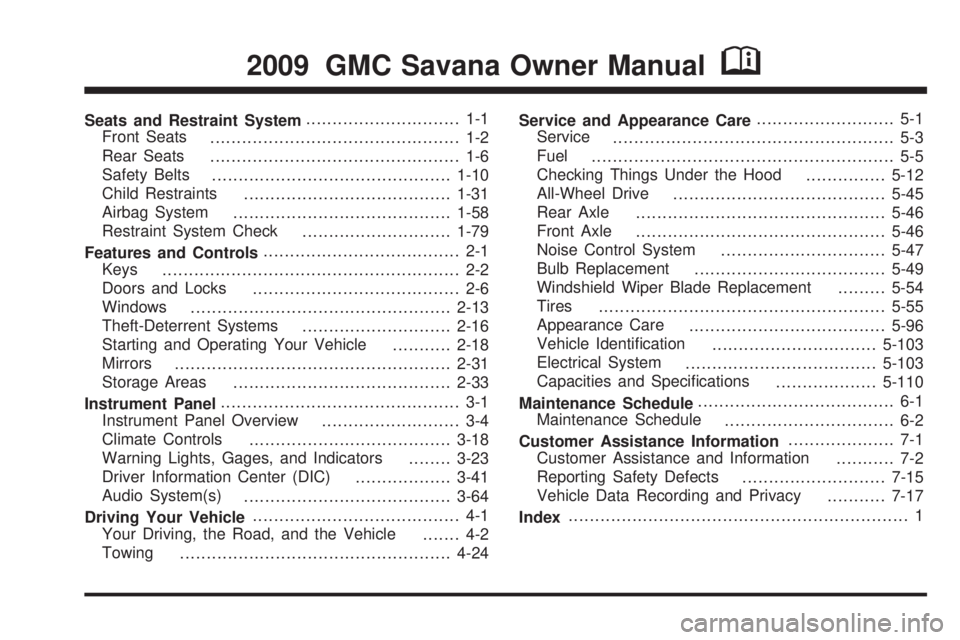
Seats and Restraint System............................. 1-1
Front Seats
............................................... 1-2
Rear Seats
............................................... 1-6
Safety Belts
.............................................1-10
Child Restraints
.......................................1-31
Airbag System
.........................................1-58
Restraint System Check
............................1-79
Features and Controls..................................... 2-1
Keys
........................................................ 2-2
Doors and Locks
....................................... 2-6
Windows
.................................................2-13
Theft-Deterrent Systems
............................2-16
Starting and Operating Your Vehicle
...........2-18
Mirrors
....................................................2-31
Storage Areas
.........................................2-33
Instrument Panel............................................. 3-1
Instrument Panel Overview
.......................... 3-4
Climate Controls
......................................3-18
Warning Lights, Gages, and Indicators
........3-23
Driver Information Center (DIC)
..................3-41
Audio System(s)
.......................................3-64
Driving Your Vehicle....................................... 4-1
Your Driving, the Road, and the Vehicle
....... 4-2
Towing
...................................................4-24Service and Appearance Care.......................... 5-1
Service
..................................................... 5-3
Fuel
......................................................... 5-5
Checking Things Under the Hood
...............5-12
All-Wheel Drive
........................................5-45
Rear Axle
...............................................5-46
Front Axle
...............................................5-46
Noise Control System
...............................5-47
Bulb Replacement
....................................5-49
Windshield Wiper Blade Replacement
.........5-54
Tires
......................................................5-55
Appearance Care
.....................................5-96
Vehicle Identification
...............................5-103
Electrical System
....................................5-103
Capacities and Specifications
...................5-110
Maintenance Schedule..................................... 6-1
Maintenance Schedule
................................ 6-2
Customer Assistance Information.................... 7-1
Customer Assistance and Information
........... 7-2
Reporting Safety Defects
...........................7-15
Vehicle Data Recording and Privacy
...........7-17
Index................................................................ 1
2009 GMC Savana Owner ManualM
Page 4 of 406
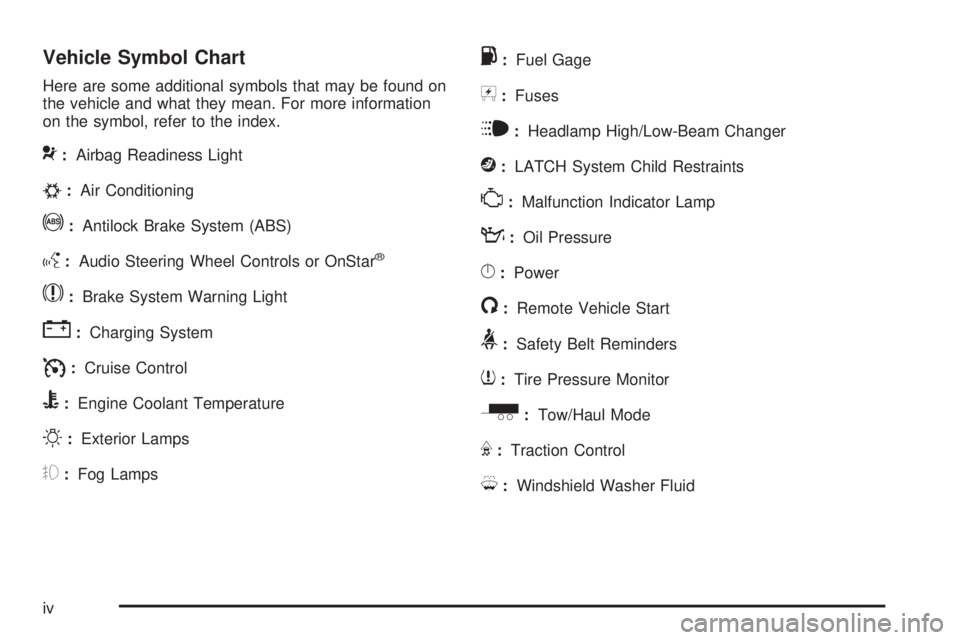
Vehicle Symbol Chart
Here are some additional symbols that may be found on
the vehicle and what they mean. For more information
on the symbol, refer to the index.
9:Airbag Readiness Light
#:Air Conditioning
!:Antilock Brake System (ABS)
g:Audio Steering Wheel Controls or OnStar®
$:Brake System Warning Light
":Charging System
I:Cruise Control
B:Engine Coolant Temperature
O:Exterior Lamps
#:Fog Lamps
.:Fuel Gage
+:Fuses
i:Headlamp High/Low-Beam Changer
j:LATCH System Child Restraints
*:Malfunction Indicator Lamp
::Oil Pressure
}:Power
/:Remote Vehicle Start
>:Safety Belt Reminders
7:Tire Pressure Monitor
_:Tow/Haul Mode
F:Traction Control
M:Windshield Washer Fluid
iv
Page 5 of 406
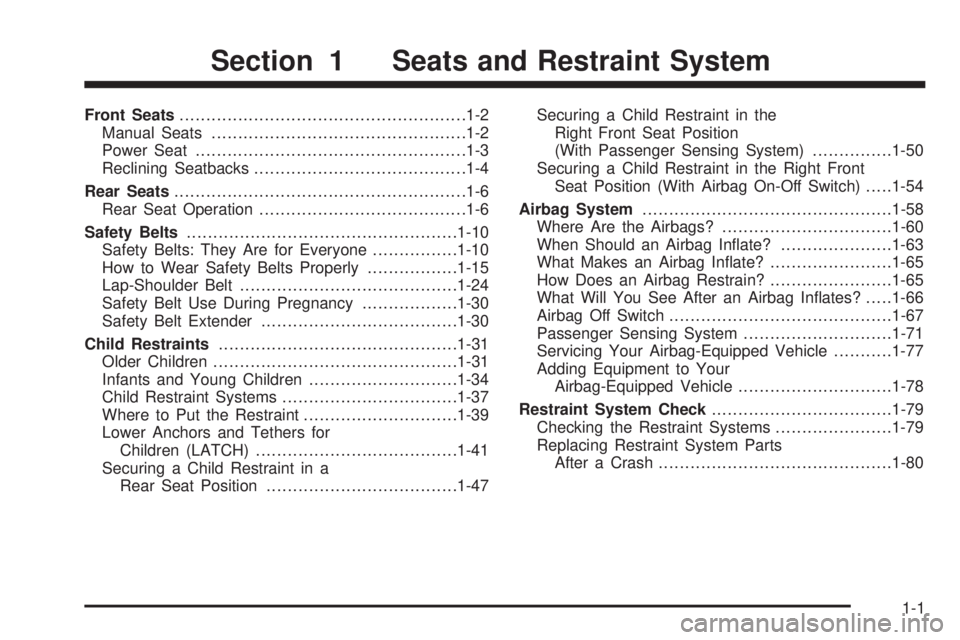
Front Seats......................................................1-2
Manual Seats................................................1-2
Power Seat...................................................1-3
Reclining Seatbacks........................................1-4
Rear Seats.......................................................1-6
Rear Seat Operation.......................................1-6
Safety Belts...................................................1-10
Safety Belts: They Are for Everyone................1-10
How to Wear Safety Belts Properly.................1-15
Lap-Shoulder Belt.........................................1-24
Safety Belt Use During Pregnancy..................1-30
Safety Belt Extender.....................................1-30
Child Restraints.............................................1-31
Older Children..............................................1-31
Infants and Young Children............................1-34
Child Restraint Systems.................................1-37
Where to Put the Restraint.............................1-39
Lower Anchors and Tethers for
Children (LATCH)......................................1-41
Securing a Child Restraint in a
Rear Seat Position....................................1-47Securing a Child Restraint in the
Right Front Seat Position
(With Passenger Sensing System)...............1-50
Securing a Child Restraint in the Right Front
Seat Position (With Airbag On-Off Switch).....1-54
Airbag System...............................................1-58
Where Are the Airbags?................................1-60
When Should an Airbag Inflate?.....................1-63
What Makes an Airbag Inflate?.......................1-65
How Does an Airbag Restrain?.......................1-65
What Will You See After an Airbag Inflates?.....1-66
Airbag Off Switch..........................................1-67
Passenger Sensing System............................1-71
Servicing Your Airbag-Equipped Vehicle...........1-77
Adding Equipment to Your
Airbag-Equipped Vehicle.............................1-78
Restraint System Check..................................1-79
Checking the Restraint Systems......................1-79
Replacing Restraint System Parts
After a Crash............................................1-80
Section 1 Seats and Restraint System
1-1
Page 18 of 406
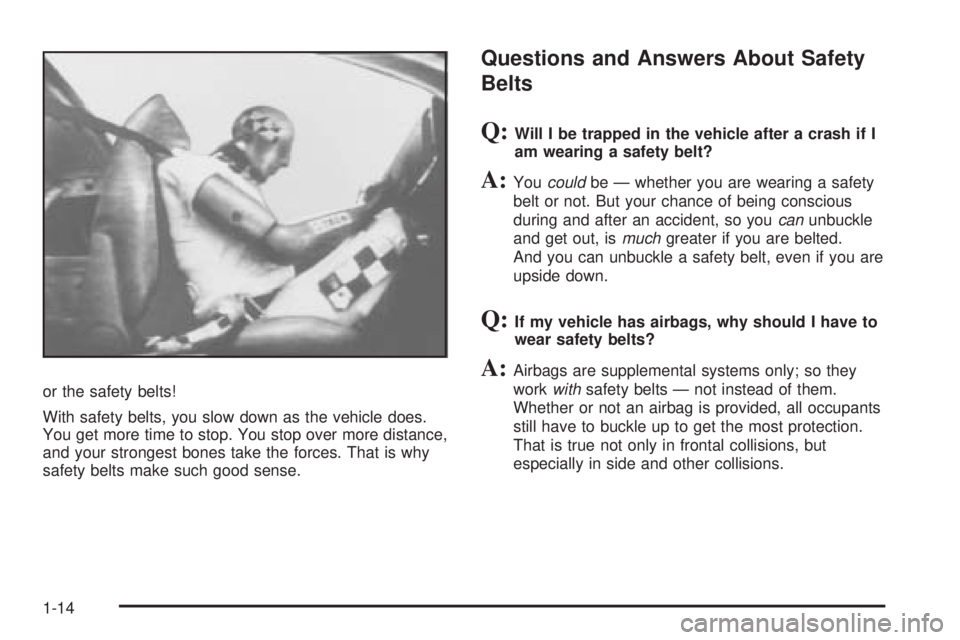
or the safety belts!
With safety belts, you slow down as the vehicle does.
You get more time to stop. You stop over more distance,
and your strongest bones take the forces. That is why
safety belts make such good sense.
Questions and Answers About Safety
Belts
Q:Will I be trapped in the vehicle after a crash if I
am wearing a safety belt?
A:Youcouldbe — whether you are wearing a safety
belt or not. But your chance of being conscious
during and after an accident, so youcanunbuckle
and get out, ismuchgreater if you are belted.
And you can unbuckle a safety belt, even if you are
upside down.
Q:If my vehicle has airbags, why should I have to
wear safety belts?
A:Airbags are supplemental systems only; so they
workwithsafety belts — not instead of them.
Whether or not an airbag is provided, all occupants
still have to buckle up to get the most protection.
That is true not only in frontal collisions, but
especially in side and other collisions.
1-14
Page 30 of 406
Shoulder Belt Height Adjuster
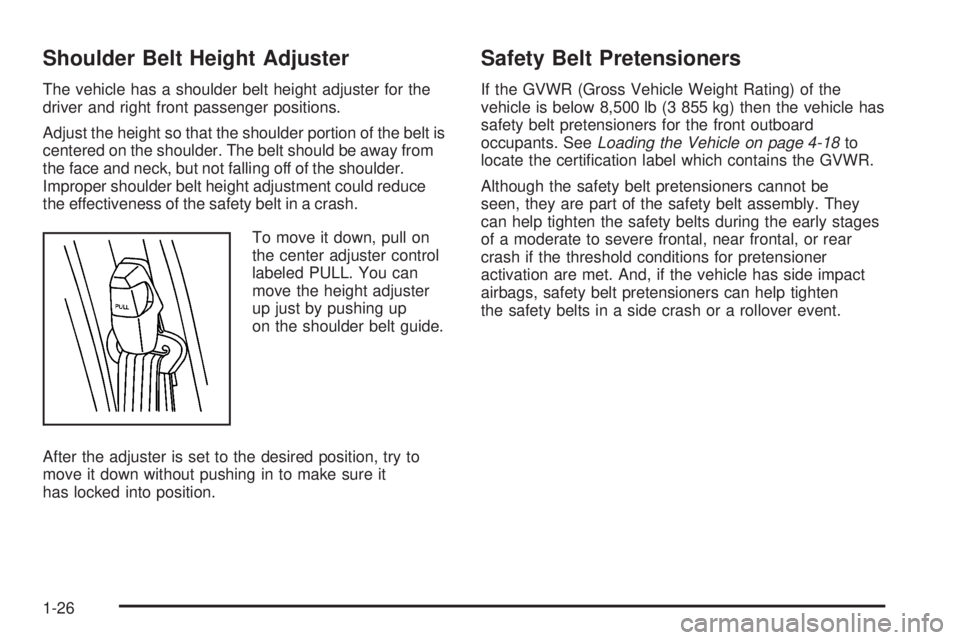
The vehicle has a shoulder belt height adjuster for the
driver and right front passenger positions.
Adjust the height so that the shoulder portion of the belt is
centered on the shoulder. The belt should be away from
the face and neck, but not falling off of the shoulder.
Improper shoulder belt height adjustment could reduce
the effectiveness of the safety belt in a crash.
To move it down, pull on
the center adjuster control
labeled PULL. You can
move the height adjuster
up just by pushing up
on the shoulder belt guide.
After the adjuster is set to the desired position, try to
move it down without pushing in to make sure it
has locked into position.
Safety Belt Pretensioners
If the GVWR (Gross Vehicle Weight Rating) of the
vehicle is below 8,500 lb (3 855 kg) then the vehicle has
safety belt pretensioners for the front outboard
occupants. SeeLoading the Vehicle on page 4-18to
locate the certification label which contains the GVWR.
Although the safety belt pretensioners cannot be
seen, they are part of the safety belt assembly. They
can help tighten the safety belts during the early stages
of a moderate to severe frontal, near frontal, or rear
crash if the threshold conditions for pretensioner
activation are met. And, if the vehicle has side impact
airbags, safety belt pretensioners can help tighten
the safety belts in a side crash or a rollover event.
1-26
Page 38 of 406
Infants and Young Children
Everyone in a vehicle needs protection! This includes
infants and all other children. Neither the distance
traveled nor the age and size of the traveler changes
the need, for everyone, to use safety restraints. In fact,
the law in every state in the United States and in
every Canadian province says children up to some age
must be restrained while in a vehicle.
{CAUTION:
Children can be seriously injured or strangled if a
shoulder belt is wrapped around their neck and
the safety belt continues to tighten. Never leave
children unattended in a vehicle and never allow
children to play with the safety belts.
Airbags plus lap-shoulder belts offer protection for adults
and older children, but not for young children and infants.
Neither the vehicle’s safety belt system nor its airbagsystem is designed for them. Every time infants and
young children ride in vehicles, they should have the
protection provided by appropriate child restraints.
Children who are not restrained properly can strike other
people, or can be thrown out of the vehicle.
{CAUTION:
Never do this.
Never hold an infant or a child while riding in a
vehicle. Due to crash forces, an infant or a child
will become so heavy it is not possible to hold it
during a crash. For example, in a crash at only
25 mph (40 km/h), a 12 lb (5.5 kg) infant will
suddenly become a 240 lb (110 kg) force on a
person’s arms. An infant should be secured in an
appropriate restraint.
1-34
Page 39 of 406
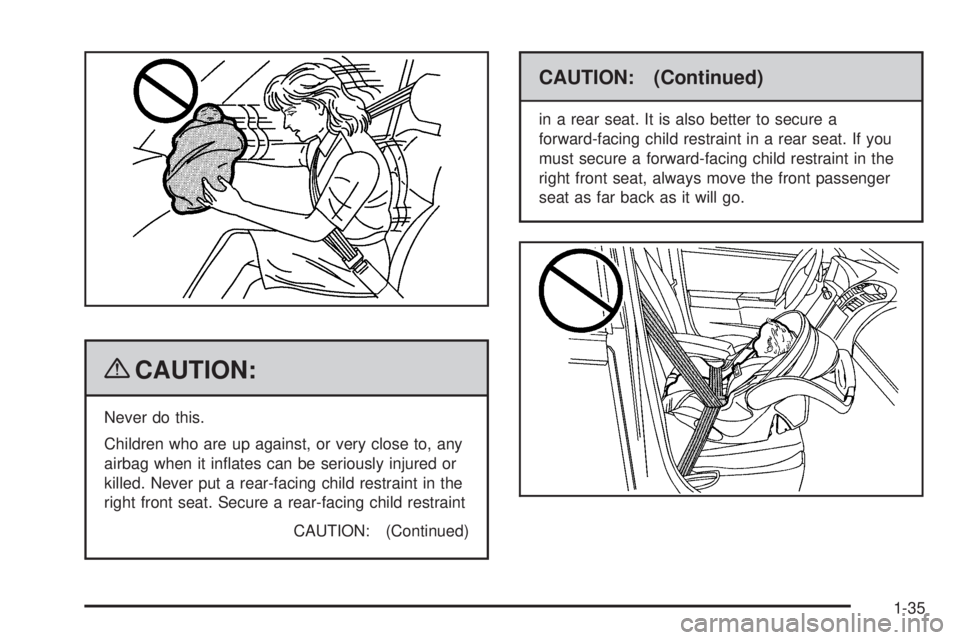
{CAUTION:
Never do this.
Children who are up against, or very close to, any
airbag when it inflates can be seriously injured or
killed. Never put a rear-facing child restraint in the
right front seat. Secure a rear-facing child restraint
CAUTION: (Continued)
CAUTION: (Continued)
in a rear seat. It is also better to secure a
forward-facing child restraint in a rear seat. If you
must secure a forward-facing child restraint in the
right front seat, always move the front passenger
seat as far back as it will go.
1-35
Page 43 of 406
When securing an add-on child restraint, refer to the
instructions that come with the restraint which may be on
the restraint itself or in a booklet, or both, and to this
manual. The child restraint instructions are important, so
if they are not available, obtain a replacement copy
from the manufacturer.
Keep in mind that an unsecured child restraint can move
around in a collision or sudden stop and injure people in
the vehicle. Be sure to properly secure any child restraint
in the vehicle — even when no child is in it.
Securing the Child Within the Child
Restraint
{CAUTION:
A child can be seriously injured or killed in a crash
if the child is not properly secured in the child
restraint. Secure the child properly following the
instructions that came with that child restraint.
Where to Put the Restraint
According to accident statistics, children and infants are
safer when properly restrained in a child restraint
system or infant restraint system secured in a rear
seating position.
We recommend that children and child restraints be
secured in a rear seat, including: an infant or a
child riding in a rear-facing child restraint; a child riding
in a forward-facing child seat; an older child riding in
a booster seat; and children, who are large enough,
using safety belts.
If a child restraint is secured in the right front passenger
seat, there may be a switch on the instrument panel
to manually turn off the right front passenger airbag. See
Airbag Off Switch on page 1-67andSecuring a Child
Restraint in the Right Front Seat Position (With
Passenger Sensing System) on page 1-50orSecuring
a Child Restraint in the Right Front Seat Position
(With Airbag On-Off Switch) on page 1-54for more
information, including important safety information.
1-39
Page 44 of 406
A label on the sun visor says, “Never put a rear-facing
child seat in the front.” This is because the risk to
the rear-facing child is so great, if the airbag deploys.
{CAUTION:
A child in a rear-facing child restraint can be
seriously injured or killed if the right front
passenger airbag inflates. This is because the
back of the rear-facing child restraint would be
very close to the inflating airbag. A child in a
forward-facing child restraint can be seriously
injured or killed if the right front passenger airbag
inflates and the passenger seat is in a forward
position.
Even if the passenger sensing system or airbag
switch has turned off the right front passenger
frontal airbag, no system is fail-safe. No one can
guarantee that an airbag will not deploy under
some unusual circumstance, even though it is
turned off.
CAUTION: (Continued)
CAUTION: (Continued)
Secure rear-facing child restraints in a rear seat,
even if the airbag is off. If you secure a
forward-facing child restraint in the right front seat,
always move the front passenger seat as far back
as it will go. It is better to secure the child restraint
in a rear seat.
When securing a child restraint in a rear seating position,
study the instructions that came with the child restraint to
make sure it is compatible with this vehicle.
If the vehicle does not have a rear seat that will
accommodate a rear-facing child restraint, a rear-facing
child restraint should not be installed in the vehicle,
even if the airbag is off.
Wherever a child restraint is installed, be sure to secure
the child restraint properly.
Keep in mind that an unsecured child restraint can move
around in a collision or sudden stop and injure people in
the vehicle. Be sure to properly secure any child restraint
in the vehicle — even when no child is in it.
1-40
Page 54 of 406
Securing a Child Restraint in the
Right Front Seat Position (With
Passenger Sensing System)
Your vehicle has airbags. A rear seat is a safer place to
secure a forward-facing child restraint. SeeWhere to
Put the Restraint on page 1-39.
In addition, the vehicle has a passenger sensing system
which is designed to turn off the right front passenger
frontal airbag under certain conditions. SeePassenger
Sensing System on page 1-71andPassenger Airbag
Status Indicator on page 3-29for more information,
including important safety information.
A label on the sun visor says, “Never put a rear-facing
child seat in the front.” This is because the risk to
the rear-facing child is so great, if the airbag deploys.
{CAUTION:
A child in a rear-facing child restraint can be
seriously injured or killed if the right front
passenger airbag inflates. This is because the
back of the rear-facing child restraint would be
very close to the inflating airbag. A child in a
forward-facing child restraint can be seriously
injured or killed if the right front passenger airbag
inflates and the passenger seat is in a forward
position.
Even if the passenger sensing system has turned
off the right front passenger frontal airbag, no
system is fail-safe. No one can guarantee that an
airbag will not deploy under some unusual
circumstance, even though it is turned off.
CAUTION: (Continued)
1-50