brake GMC SIERRA 1993 User Guide
[x] Cancel search | Manufacturer: GMC, Model Year: 1993, Model line: SIERRA, Model: GMC SIERRA 1993Pages: 436, PDF Size: 23.88 MB
Page 99 of 436
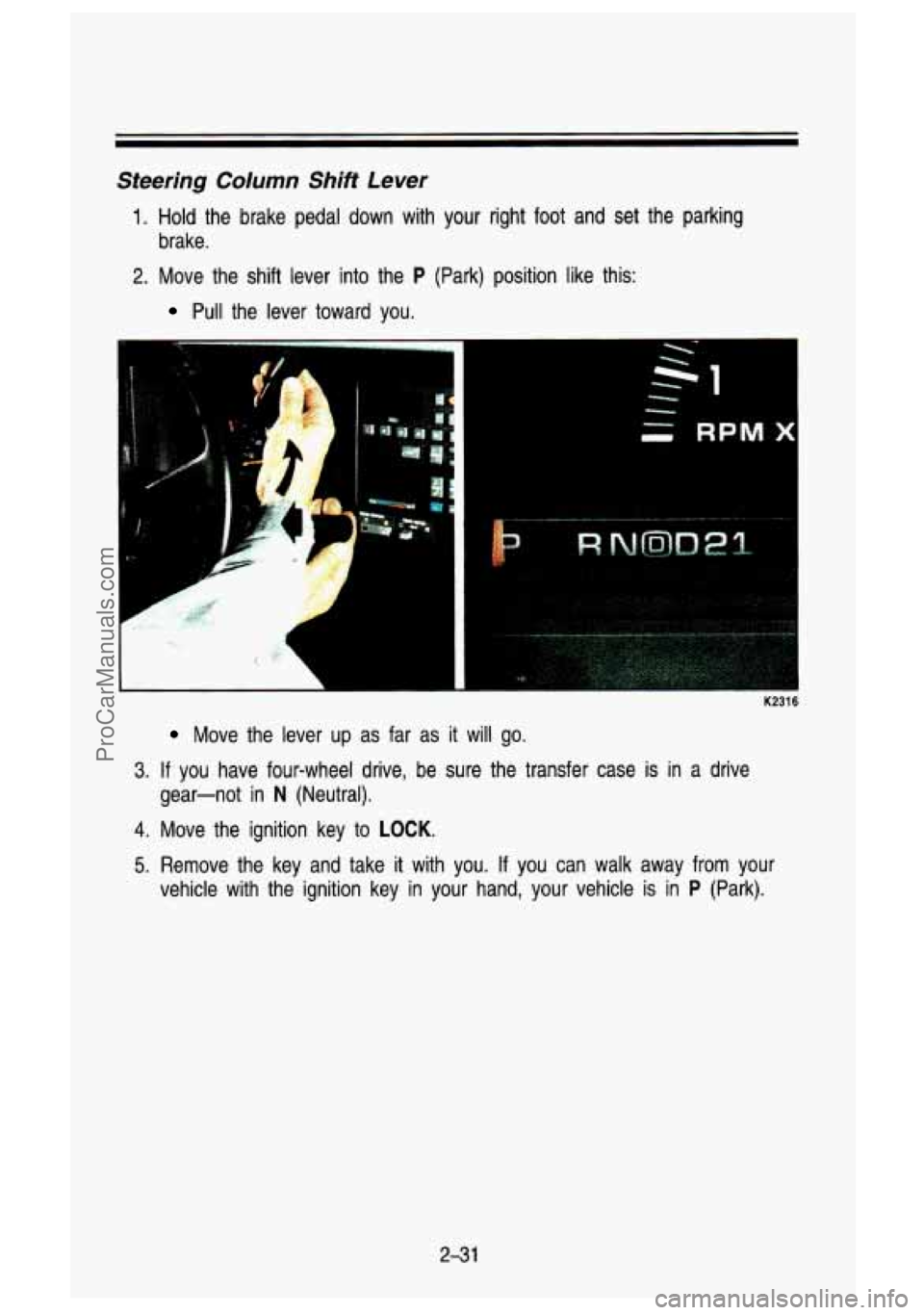
Steering Column Shift Lever
1. Hold the brake pedal down with your right foot and set the parking
brake.
2. Move the shift lever into the P (Park) position like this:
Pull the lever toward you.
~- - --
w KL" I"
Move the lever up as far as it will go.
3. If you have four-wheel drive, be sure the transfer case is in a drive
4. Move the ignition key to LOCK.
5. Remove the key and take it with you. If you can walk away from your
vehicle with the ignition key
in your hand, your vehicle is in P (Park).
gear-not
in N (Neutral).
2-31
ProCarManuals.com
Page 100 of 436
Leaving Your Vehicle With the Engine Running (Automatic
Transmission Models Only)
I CAUTION
A It can be dangerous to leave your vehicle with the engine running. 1
1 Your vehicle could move suddenly if the shift lever is not fully in P
(Park) with the parking brake firmly set.
If you have a four-wheel drive with a manual transfer case sh\
ift lever
and your transfer case
is in N (Neutral), your vehicle will be free to
roll, even
if your shift lever is in P (Park). So be sure the transfer
case is in a drive gear-not in
N (Neutral).
And,
if you leave the vehicle with the engine running, it could
overheat and even catch fire. You or others could be injured. Don’t
leave your vehicle with the engine running unless you have to.\
If you have to leave your vehicle with the engine running, be su\
re your
vehicle
is in P (Park) and your parking brake is firmly set, before you leav\
e
it. If you have a four-wheel drive, be sure that the transfer case i\
s in a drive
gear-not in
N (Neutral).
After you’ve moved the shift lever into the
P (Park) position, hold the regular
brake pedal down. Then, see
if you can move the shift lever away from P
(Park) without first pulling it toward you.
If you can, it means that the shift lever wasn’t fully locked into
P (Park).
Parking Your Vehicle (Manual Transmission Models Only)
Before you get out of your vehicle, put your manual transmission in R
(Reverse) and firmly apply the parking brake.
If you have four-wheel drive, be sure your transfer case is in a\
drive gear.
Your vehicle could roll
if it isn’t.
If you are parking on a hill, or if your vehicle is equipped to tow a trailer,
see “Parking on Hills” or “Towing a Trailer” in the\
Index.
2-32
ProCarManuals.com
Page 103 of 436
Running Your Engine While You%
Parked [Automatic mansmission)
It’s better not to park with the engine running. But if you ever have to, here
are some things
to know.
1 CAUTION I
* Idling the engine with the air system control off could allow
‘ jangerous exhaust into your vehicle. (See the earlier Caution under
**A :E ..:i *; !.< .. 5;:. ::.; ,$+ : ‘Engine Exhaust”.) ~~-?~c-~~~~~=~~:-
Also, Idling in a closed-in place can let deadly oxide (CO)
nto your vehicle, even if the fan switch is at the highest setting. One
place this can happen
is a garage. Exhaust-with co--( -% -c ?& 2asily. NEVER park in a garage with the engine runni
?-! 4nother ,I: -‘i closed-in place can be a blizzard. (See “Blizzard“ in th
Index.)
CAUTION
It can be dangerous to get out of your vehicle if the shift lever is not
L fully in P (Park) with the parking brake firmly set. Your vehicle can
roll. Don’t leave your vehicle when the engine is running unless
you
have to. If you’ve left the engine running, the vehicle can move
suddenly. You
or others could be injured. To be sure your vehicle
won’t move, even when you’re on fairly level ground,, alw\
ays
set your
parking brake and move the shift lever to
P (Park).
I
If you have four-wheel drive and your transfer case is in N (Neutral},
your vehicle
will be free to roll, even if your shift lever is in P (Park),
So, be sure the transfer case is in a drive gear-not in N (Neutral).
Foliow the proper -steps to be sure your vehicle won’t move. -See
“Shifting Into P (Park)” in the Index.
If you are parking on a hill, or if you’re pulling- -a- trailer, also see
“Parking on Hilis”-.or “Towing -a Trailer”‘ in the Index.
235
ProCarManuals.com
Page 104 of 436
Features & Contmls
Four- Wheel Drive
CAUTION I
It can be dangerous to get out of your vehicle if the shift lever -is not
fully in
P (Park) with the parking brake firmly set. Your vehicle can
roll. Don’t leave your vehicle when the engine is running unless you
have
to. If you’ve left the engine running, the vehicle can ‘move
suddenly. You or -others could be injured.
To be sure your vehicle
won’t move, even when you’re on fairly level ground, always
set your
parking brake and move the shift lever
to P (Park).
If you have four-wheel drive and your transfer case is in N (Neutral),
your vehicle
will be free to roll, even if your shift lever is in P’(Park).
So, be sure the transfer case is in a drive gear-not in N (Neutral).
Follow the proper steps
to be suce your vehicle won’t move. See
“Shifting Into
P (Park)” in the Index.
If you are parking on a hill, or if you’re pulling a trailer, also see
“Parking ‘on Hills’’ or “Towing a Trailer” in this section.
I
If your vehicle has four-wheel drive, you can send your engine’\
s driving power
to all four wheels for extra traction. To get the most satisfaction out of
four-wheel drive, you must be familiar with it’s operation. \
Read the part that
follows before using four-wheel drive. You should use
2H for most normal
driving conditions.
Rear-wheel antilock brakes
do not work when you shift into four-wheel drive.
Your regular brakes will still work. When you shift back into two-w\
heel drive,
your rear-wheel antilock brakes will take over again.
I NOTICE
Driving in the 4H or 4L positions for a long time on dry or wet pavement
could shorten the life
of your vehicle’s drivetrain.
2-36
ProCarManuals.com
Page 107 of 436

Whenever you are in four wheel-drive, the rear wheel anti-lock brake system
does not operate. The regular brake system operates normally. W\
hen you shift back into two-wheel drive, the anti-lock brake system will operate.
Windows
To open your manual windows, turn the hand crank on each door to raise or
lower your side door windows.
If you have the optional power windows, the controls are on each
of the side
doors.
The driver's door has a switch for the passenger windows as well. Your
power windows will work when the ignition has been turned to
ACC or Run.
Push the switch with the down pointing arrow to lower the window.
Push the switch with the up pointing arrow to raise the window.
2-39
ProCarManuals.com
Page 115 of 436

When using concentrated washer flui
follow the manufacturer’s
instructions for adding water.
Don’t mix water with ready-to-use washer fluid. Water can ca\
use the
solution
to freeze and damage your washer fluid tank and other parts
of the washer system.
Also, water dc ;n’t clean as well as washer
fluid.
allows for expansion, which could damage the tank
if it is completely
full.
’
I
Fill your washer fluid tank only 314 full when it’s very cold. This
Don’t use radiator antifreeze in your windshield washer. It can
damaae your washer system and paint.
Cruise Control (Option)
K2247
With Cruise Control, you can maintain a speed of about 25 mph (40 km/h) or
more without keeping your foot on the accelerator. This can re\
ally help on
long trips. Cruise Control does not work at speeds below about 25 mph
(40 km/h).
When you apply your brakes, or push the clutch pedal, if you \
have
a manual
transmission, the Cruise Control shuts
off.
2-47
ProCarManuals.com
Page 117 of 436

To Resume a Set Speed
Suppose you set your Cruise Control at a desired speed and th\
en you apply
the brake. This, of course, shuts off the Cruise Control. But you don’t need
to reset it. Once you’re going about
25 mph (40 kmlh) or more, you can
move the Cruise switch
from ON to RIA for about half a second.
I
K224
You’ll go right back up to your chosen speed and stay ther\
e.
I
r 4 If you hold the switch at R/A longer than half a second, the vehicle
will keep going faster until you release the switch or apply \
the brake.
You could be startled and even lose control.
So unless you want to
1 go faster, don’t hold the switch at R/A.
2-49
ProCarManuals.com
Page 119 of 436
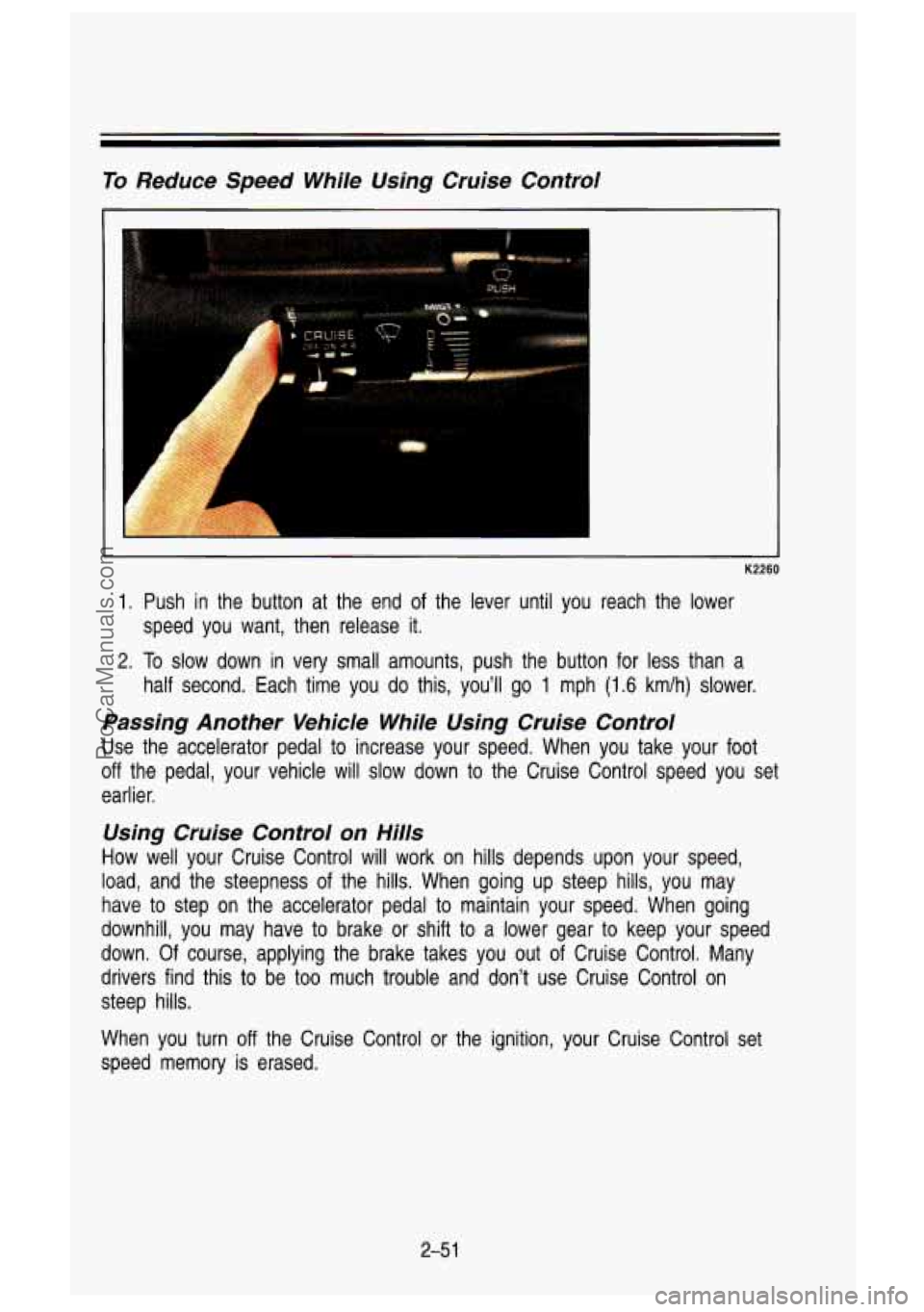
To Reduce Speed While Using Cruise Control
1
K2260
1. Push in the button at the end of the lever until you reach the lower
speed you want, then release it.
2. To slow down in very small amounts, push the button for less than a
half second. Each time you do this, you’ll go 1 mph (1.6 km/h) slower.
Passing Another Vehicle While Using Cruise Control
Use the accelerator pedal to increase your speed. When you take your foot
off the pedal, your vehicle will slow down to the Cruise Control speed you set
earlier.
Using Cruise Control on Hills
How well your Cruise Control will work on hills depends upon \
your speed,
load, and the steepness of the hills. When going up steep hills, you may
have to step on the accelerator pedal to maintain your speed. When going
downhill, you may have to brake or shift to a lower gear to keep your speed
down.
Of course, applying the brake takes you out of Cruise Control. Many
drivers find this to be too much trouble and don’t use Cruise Control on
steep hills.
When you turn
off the Cruise Control or the ignition, your Cruise Control set
speed memory
is erased.
2-5 1
ProCarManuals.com
Page 120 of 436
Features & Confmls
To Get Out of Cruise Control
I
K2206
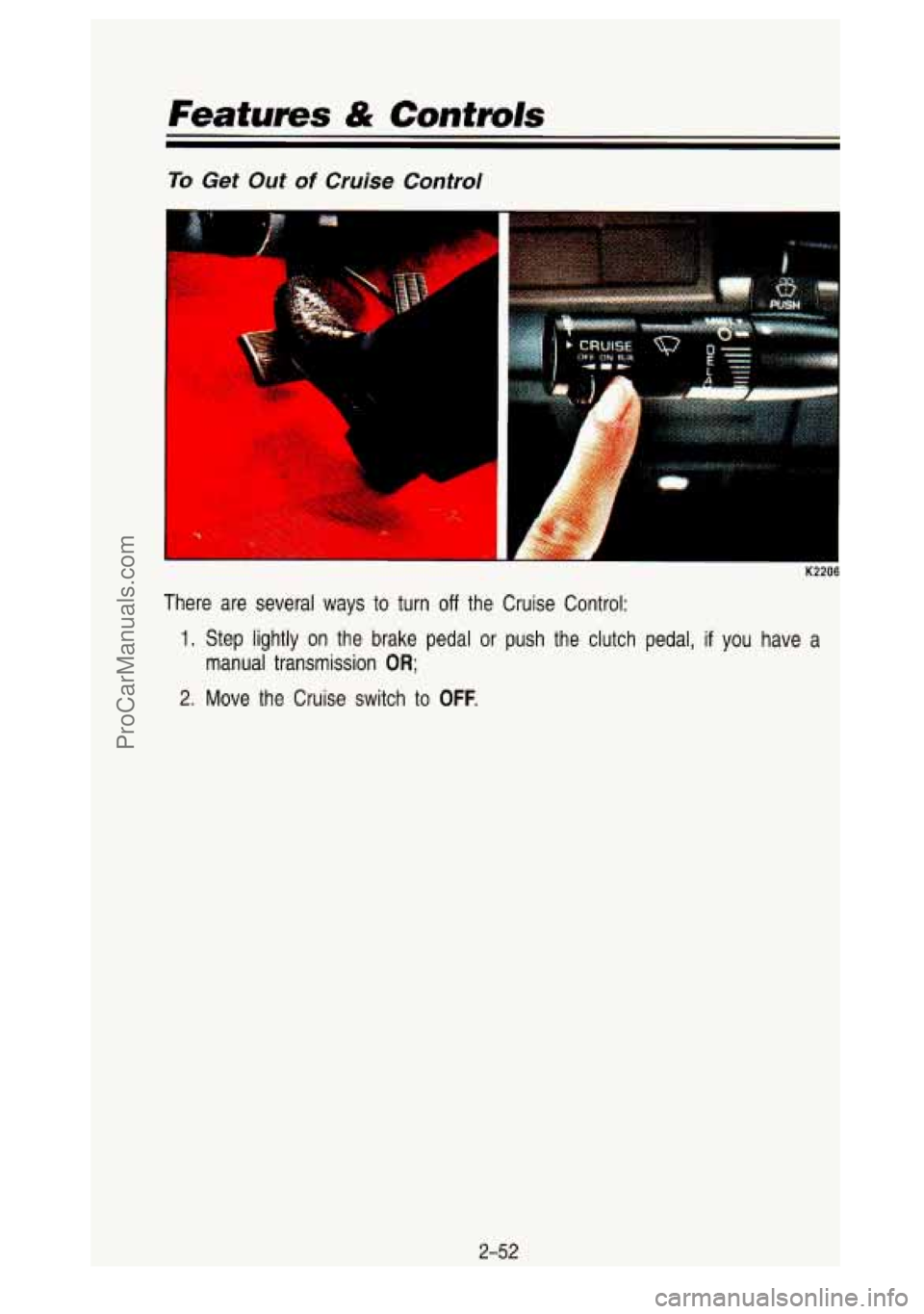
There are several ways to turn off the Cruise Control:
1. Step lightly on the brake pedal or push the clutch pedal, if you have a
manual transmission
OR;
2. Move the Cruise switch to OFF.
2-52
ProCarManuals.com
Page 123 of 436
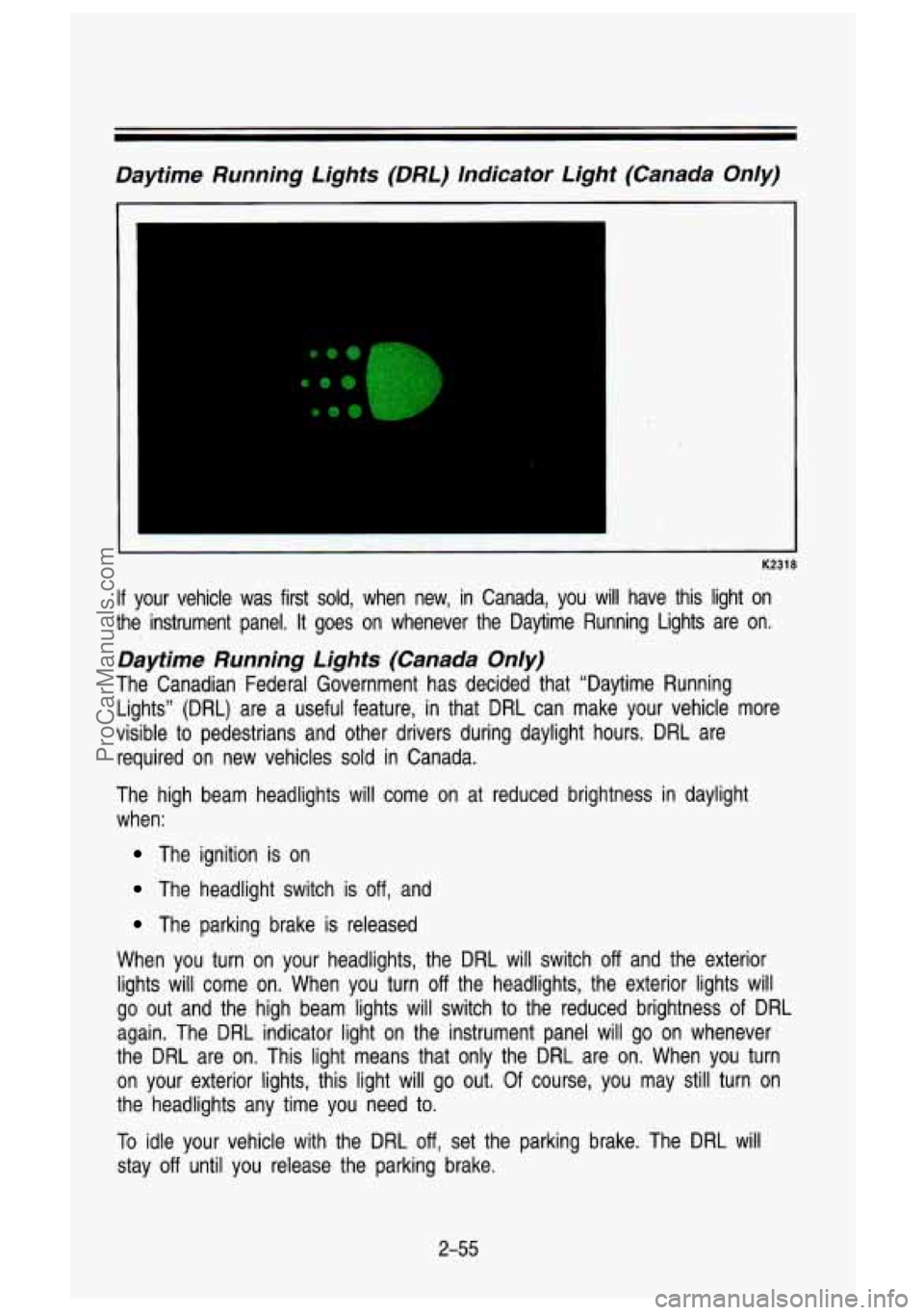
Daytime Running Lights (DRL) Indicator Light (Canada Only)
K2318
If your vehicle was first sold, when new, in Canada, you will have this light on
the instrument panel. It goes on whenever the Daytime Running \
Lights are on.
Daytime Running Lights (Canada Only)
The Canadian Federal Government has decided that “Daytime Run\
ning
Lights” (DRL) are a useful feature, in that
DRL can make your vehicle more
visible to pedestrians and other drivers during daylight hours. DRL are
required on new vehicles sold in Canada.
The high beam headlights will come on at reduced brightness in daylight
when:
The ignition is on
The headlight switch is off, and
The parking brake is released
When you turn on your headlights, the DRL
will switch off and the exterior
lights will come on. When you turn
off the headlights, the exterior lights will
go out and the high beam lights will switch to the reduced brightness
of DRL
again. The DRL indicator light on the instrument panel will go\
on whenever
the DRL are on. This light means that only the DRL are on. When you turn
on your exterior lights, this light will go out.
Of course, you may still turn on
the headlights any time you need to.
To idle your vehicle with the DRL off, set the parking brake. The DRL will
stay
off until you release the parking brake.
2-55
ProCarManuals.com