trailer GMC SIERRA 1993 User Guide
[x] Cancel search | Manufacturer: GMC, Model Year: 1993, Model line: SIERRA, Model: GMC SIERRA 1993Pages: 436, PDF Size: 23.88 MB
Page 180 of 436

Parking on Hills ........................................................................\
........................... 4-49
Winter Driving
........................................................................\
.............................. 4-52
Towing a Trailer
........................................................................\
........................... 4-55
Power Winches ........................................................................\
............................ 4-62
Power Take-Off
........................................................................\
............................ 4-62
4-2
ProCarManuals.com
Page 233 of 436
AM480043
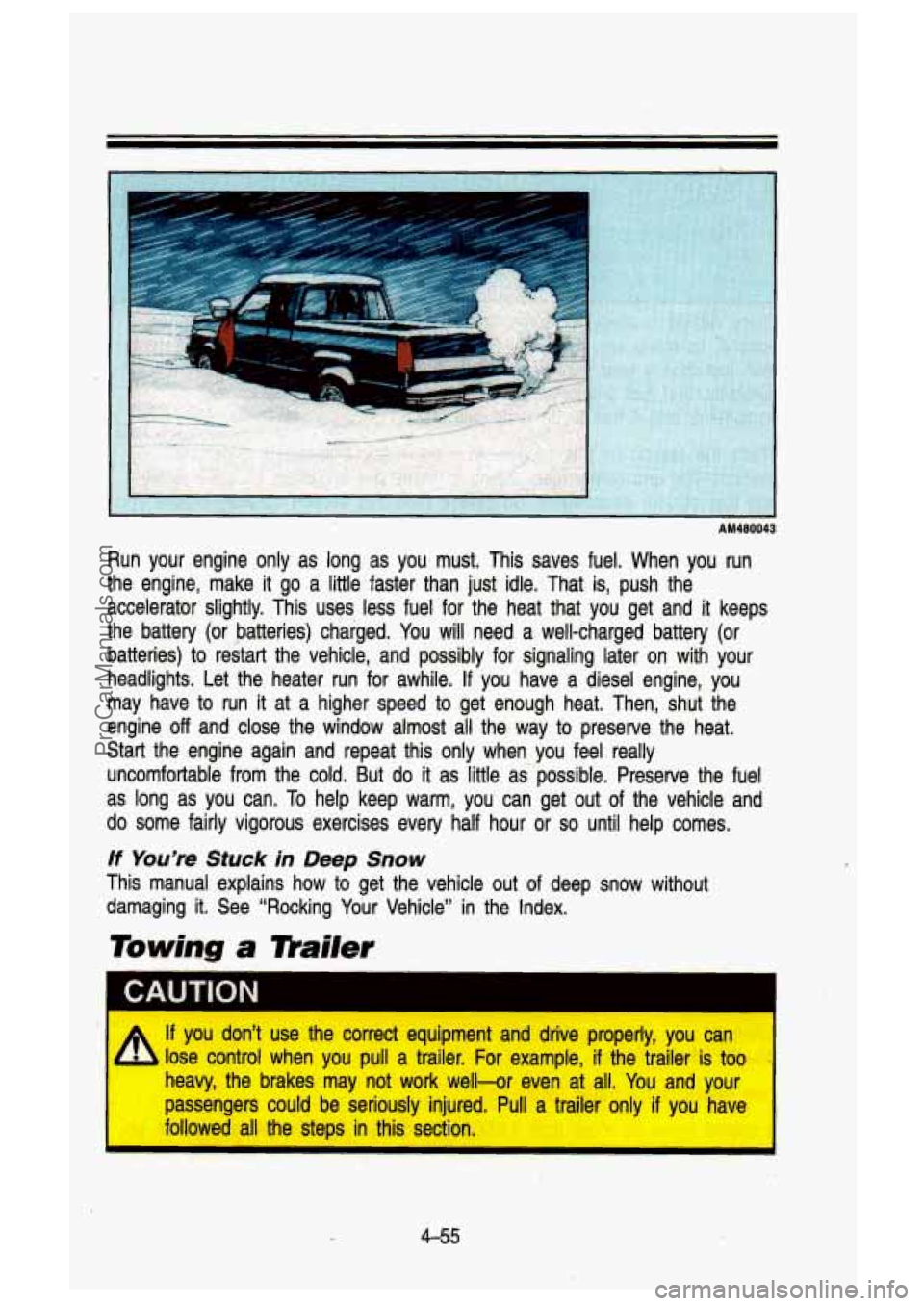
Run your engine only as long as you musk. This saves fuel. When you run
the engine, make it go a little faster than just idle. That is, push the
accelerator slightly. This uses less fuel for the heat that yo\
u get and
it keeps
the battery (or batteries) charged. You will need a well-charged battery (or
batteries) to restart the' vehicle, and possibly for signaling later on with your
headlights. Let the heater run for awhile.
If you 'have a diesel engine, you
may have to run it at a higher speed
to lget enough heat. Then, shut the
engine
off and close the window almost all the way to preserve the heat.
Start the engine again and repeat this only when you feel really
uncomfortable from the cold. But
do it as little as'possible. Preserve the fuel
as long as you can.
To help keep warm, you can get out of the vehicle and
do some fairly vigorous exercises every half hour or so until help comes.
If You're Stuck in Deep Snow
This manual explains how to get the vehicle out of deep snow without
damaging it. See "Rocking Your Vehicle" in the Index.
Towing a mailer
CAUTION I
If you don't use the correct equipment and drive properly, you ca\
n
lose control when you pull a trailer. For example, if the trailer is too
heavy, the brakes may not work well-or even at all. You and your
passengers could be seriously injured. Pull a trailer only if \
you have
followed all the steps in this section.
I
i'- ." "
4-55
ProCarManuals.com
Page 234 of 436
z
Your Driving and the Road
NOTICF
Pulling a trailer improperly can damage your vehicle and result in costly
repairs
not covered by your warranty. To pull a trailer correctly, follow the
advice in this section.
Every vehicle
is ready for some trailer. towing. If it was .built with trailering
options, as many are,
it’s ready for‘heavier trailers. But trailering is different
than just driving your vehicle by itself. Trailering means chan\
ges isn handling,
durability, and fuel .economy. Successful, safe trailering .takes\
correct
equipment, and
it has to be used properly.
That’s the reason for this section. In it are many time-tested, important
trailering tips and safety rules. Many of these are important for your safety
and that of your passengers.
So please read this section carefully before you
pull a trailer.
If You Do Decide To Pull A Trailer
If you do, here are some important .points. .
0 There are many different laws having to do with trailering. Make sure
your rig
will be legal, not only where you live but also where you’ll be\
driving.
A good source for this information can be state or provincial
police.
.Consider using a sway control if your trailer will weigh 4,000 pounds
(1 800 kg) or less. You should always use a sway control if your trailer
will weigh more than 4,000 pounds (1800 kg). You can ask a hitch
dealer about sway controls.
Don’t tow a trailer at all during the first 500 miles (800 km) ‘your new
vehicle is driven. Your engine, axle,
or other parts could be damaged.
Then, during the first 500 miles (800 km) that you tow a trailer, don’t
drive over
50 mph (80 km/ti) and don’t make ,starts at full throttle. T\
hat
will help your engine and other parts of your vehicle wear in at the
heavier load$.
Three important considerations have to do with weight:
Weight
Weight of the Trailer
How heavy can a trailer safely be?
It should never be more than 13,500 Ibs. (6125.6 kg). But even \
that can be
too heavy. It depends on how you plan to use your rig. For example, speed,
altitude, ‘road grades, outside temperature, and how much your vehicle is
4-56
ProCarManuals.com
Page 235 of 436
used to pull a trailer all are important. And, it can also depend on any
special equipment that you have on your vehicle. You can ask your dealer
for
our trailering information or advice, or you can write us at the address listed
in your Warranty and Owner Assistance Information Booklet.
In Canada, write to:
General Motors of Canada Limited
Customer Assistance Center
1908 Colonel Sam Drive
Oshawa, Ontario
L1H 8P7
Weight of the Trailer Tongue
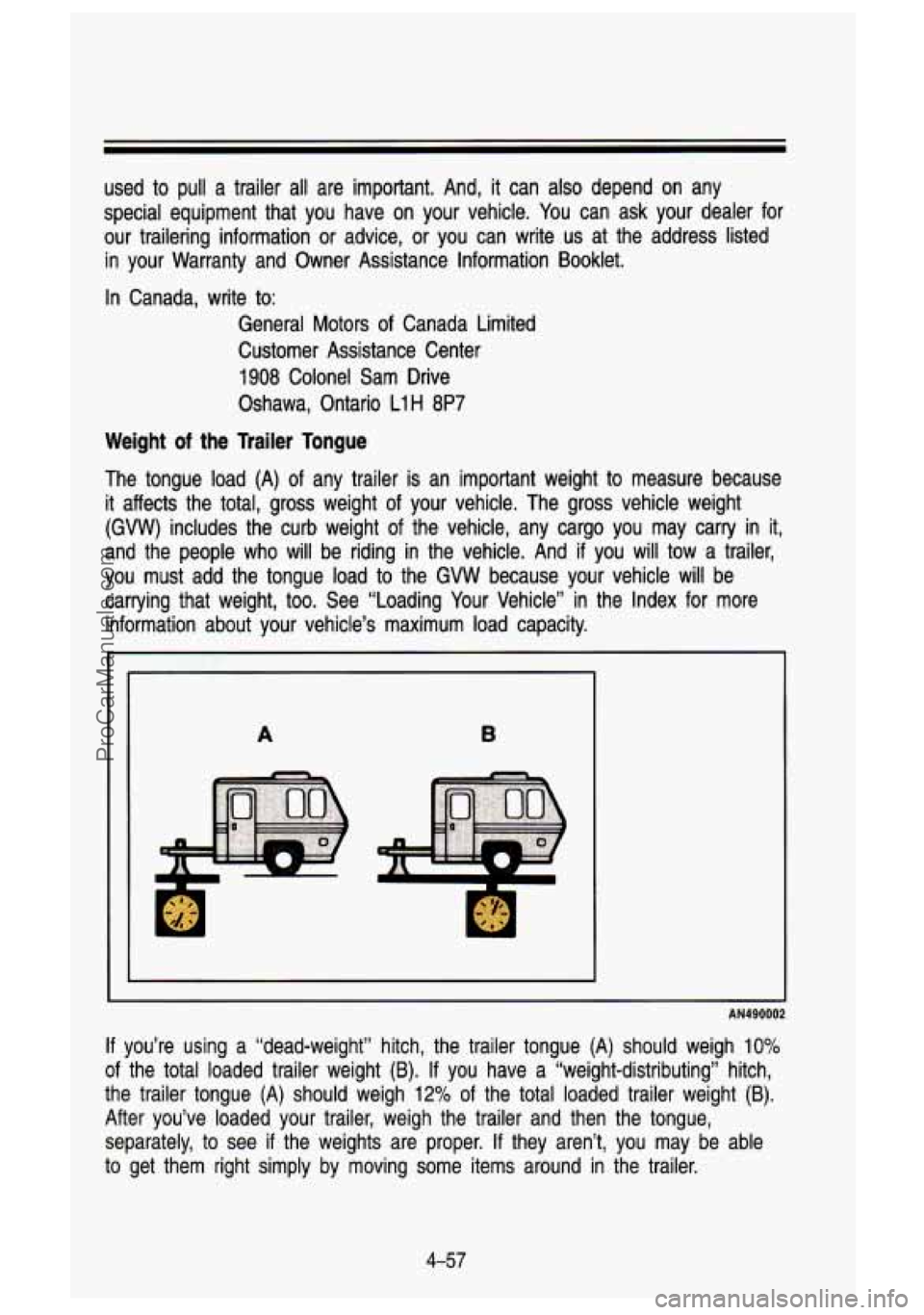
The tongue load (A) of any trailer is an important weight t\
o measure because
it affects the total, gross weight
of your vehicle. The gross vehicle weight
(GVW) includes the curb weight
of the vehicle, any cargo you may carry in it,
and the people who will be riding in the vehicle. And if you will tow a trailer,
you must add the tongue load to the GVW because your vehicle will be
carrying that weight, too. See “Loading Your Vehicle” in the Index
for more
information about your vehicle’s maximum load capacity.
A
m
B
AN490002
If you’re using a “dead-weight” hitch, the trailer tongue (A) should weigh 10%
of the total loaded trailer weight (B). If you have a “weight-distributing” hitch,
the trailer tongue (A) should weigh
12% of the total loaded trailer weight (B).
After you’ve loaded your trailer, weigh the trailer and then\
the tongue,
separately,
to see if the weights are proper. If they aren’t, you may be able
to get them right simply by moving some items around in the \
trailer.
4-57
ProCarManuals.com
Page 236 of 436
Your Driving and the Road
Total Weight on Your Vehicle’s Tires
Be sure your vehicle’s tires are inflated to the limit for cold tires. You’ll find
these numbers on the Certification label at the rear edge of the driver’s door
(or see “Tire Loading” in the Index). Then be sure you don’t go over the
GVW limit for your vehicle.
Hitches
It’s important to have the correct hitch equipment. Crosswinds, large trucks
going by, and rough roads are a few reasons why you’ll need the righ\
t hitch.
Here are some rules
to follow:
If your vehicle has a step bumper and you are going to use a ball-type
hitch, remove the pad and cut holes in
it to match the hitch and safety
chain holes in the bumper.
If you’ll be pulling a trailer that, when loaded, will weigh more than 4,000
pounds (1800 kg) be sure to use a properly mounted weight-distributing
hitch and sway control of the proper size. This equipment is very
important for proper vehicle loading and good handling when you\
’re
driving.
Safety Chains
You should always attach chains between your vehicle and your trail\
er. Cross
the safety chains under the tongue of the trailer
so that the tongue will not
drop
to the road if it becomes separated from the hitch. Instructions about
safety chains may be provided by the hitch manufacturer
or by the trailer
manufacturer. Follow the manufacturer’s recommendation for atta\
ching safety
chains. Always leave just enough slack
so you can turn with your rig. And,
never allow safety chains to drag .on the ground.
Trailer Brakes
If your trailer weighs more than 1,000 pounds (450 kg) loaded, then it needs
its own brakes-and they must be adequate. Be sure
to read and follow the
instructions for the trailer brakes
so you’ll be able to install, adjust and
maintain them properly.
Don’t tap into your vehicle’s brake system
if the trailer’s brake system will use
more than
0.02 cubic inch (0.3~~) of fluid from your vehicles master cylinder.
If it does, both braking systems won’t work well. You could even lose your
brakes.
Will the trailer brake parts take 3,000 psi (20 650 kPa) of pressure? If
not, the trailer brake system must not be used with your vehi\
cle.
If everything checks out this far, then make the brake fluid tap at the
port on the master cylinder that sends fluid
to the rear brakes. But don’t
use copper tubing for this.
If you do, it will bend and finally break off.
Use steel brake tubing.
4-58
ProCarManuals.com
Page 237 of 436
Driving with a Trailer
Towing a trailer requires a certain amount of experience. Before setting out
for the open road, you’ll want to get to know your rig. Acquaint yourself with
the feel of handling and braking with the added weight of the trailer. And
always keep in mind that the vehicle you are driving is now a good deal
longer and not nearly
so responsive as your vehicle is by itself.
Before you start, check the trailer hitch and platform, safety \
chains, electrical
connector, lights, tires and mirror adjustment.
If the trailer has electric brakes,
start your vehicle and trailer moving and then apply the trailer brake controller
by hand to be sure the brakes are working. This lets you check your
electrical connection at the same time.
During your trip, check occasionally to be sure that the load is secure, and
that the lights and any trailer brakes are still working.
Following Distance
Stay at least twice as far behind the vehicle ahead as you w\
ould when
driving your vehicle without a trailer. This can help you avoid situations \
that
require heavy braking and sudden turns.
Passing
You’ll need more passing distance up ahead when you’re towing a trailer.
And, because you’re a good deal longer, you’ll need to g\
o much farther beyond the passed vehicle before you can return to your lane.
Backing Up
Hold the bottom of the steering wheel with one hand. Then, to move the
trailer left, just move your hand to the left.
To move the trailer to the right,
move your hand to the right. Always back up slowly and,
if possible, have
someone guide you.
Making Turns
When you’re turning with a trailer, make wider turns than normal. Do this so
your trailer wheels won’t strike soft shoulders, curbs, road signs\
, trees, or
other objects. Avoid jerky or sudden maneuvers. Signal well in advance.
Turn Signals When Towing a Trailer
When you tow a trailer, your vehicle has to have a different turn signal
flasher and extra wiring. The green arrows on your instrument \
panel will flash
whenever you signal a turn or lane change. Properly hooked up, the trailer
lights will also flash, telling other drivers you’re about t\
o turn, change lanes,
or stop.
When towing a trailer, the green arrows on your instrument pan\
el will flash for
turns even
if the bulbs on the trailer are burned out. Thus, you may think
4-59
ProCarManuals.com
Page 238 of 436
Your Driving and the Road
drivers behind you are seeing your signal when they are not. It’s important to
check occasionally to be sure the trailer bulbs are still working.
Driving on Grades
Reduce speed and shift to a lower gear before you start down long or steep
downgrade.
If you don’t shift down, you might have to use your brakes so
much that they would get hot and no longer work well.
On a long uphill grade, shift down and reduce your speed to
45 mph (70
kmlh) or less to reduce the possibility of engine and transmission overheating.
IT you have an automatic transmission, you should use D (or, as you need to,
a lower gear) when towing a trailer. Operating your vehicle i\
n
D when towing
a trailer will minimize heat buildup and extend the life of your transmission.
Or, if you have a manual transmission with fifth gear and you are towing a
trailer, it’s better not to use fifth gear. Just drive in fourth gear
(or, as you
need to, a lower gear).
Parking on Hills
You really should not park your vehicle, with a trailer attached, \
on a hill. If
something goes wrong, your rig could start to move. People can\
be injured
and both your vehicle and the trailer can be damaged.
But
if you ever have to park your rig on a hill, here’s how to do it:
1. Apply your regular brakes, but don’t shift into P (Park) yet, or into gear
2. Have someone place chocks under the trailer wheels.
for a manual transmission.
3. When the wheel chocks are
in place, release the regular brakes until the
chocks absorb the load.
4. Reapply the regular brakes. Then apply your parking brake, and \
then
5. If you have a four-wheel-drive vehicle, be sure the transfer case is in a
6. Release the regular brakes.
shift
to
P (Park), or R (Reverse) for a manual transmission.
drive gear-not in
N (Neutral).
4-60
ProCarManuals.com
Page 239 of 436
CAUTION
It can be dangerous to get out of your vehicle if the shift lever is not
fully in
P (Park) with the parking brake firmly set. Your vehicle can
roll.
If you have left the engine running, the vehicle can move suddenl\
y.
You
or others could be injured. To be sure your vehicle won’t move,
when you’re on fairly level ground, use the steps that follow.
If you have four-wheel drive and your transfer case is in N (Neutral),
your vehicle will be free to
roll, even if your shift lever is in P (Park).
So, be sure the transfer case is in a drive gear-not in N (Neutral).
If you are parking on a hill, or if you’re pulling a trailer, also see
“Parking On Hills” in the Index.
When You Are Ready to Leave After Parklng on a Hill
1. Apply your regular brakes and hold the pedal down while you:
Start your engine;
Shift into a gear; and
Release the parking brake.
2. Let up on the brake pedal.
3. Drive slowly until the trailer is clear of the chocks.
4. Stop and have someone pick up and store the chocks.
Maintenance When Trailer To wing
Your vehicle will need service more often when you’re pulling a trailer. See
the Maintenance Schedule for more on this. Things that are esp\
ecially
important in trailer operation are automatic transmission fluid (don’t overfill),
engine oil, axle lubricant, belts, cooling system, and brake ad\
justment. Each
of these is covered in this manual, and the Index will help \
you find them
quickly.
If you’re trailering, it’s a good idea to review these sections before
you start your trip.
Check periodically
to see that all hitch nuts and bolts are tight.
mailer Wiring Harness
See “Trailer Wiring Harness’’ in the Index.
4-61
ProCarManuals.com
Page 252 of 436

Problems on the Road
If your engine catches fire because you keep driving with no cool\
ant, your
vehicle can be bac"lI damaged.
T- ! costly rep; 1 would not be Iverec
by your warranty.
If No Steam Is Coming From Your Engine:
If you get the overheat warning but see or hear no steam, th\
e problem may
not be too serious. Sometimes the engine can get a little too\
hot when you:
Climb a long hill on a hot day.
Stop after high speed driving.
Idle for long periods in traffic.
Tow a trailer.
If you get the overheat warning with no sign of steam, try t\
his for a minute
or
so:
1. If you have an air conditioner, turn it off.
2. Turn on your heater to full hot at the highest fan speed and\
open the
3. If you're in a traffic jam, shift to N (Neutral).
window as necessary.
If you no longer have the overheat warning, you can drive. Just
to be safe,
drive slower for about ten minutes.
If the warning doesn't come back on, you
can drive normally.
If the warning continues, pull over, stop, and park your vehic\
le right away.
If there's still no sign of steam, push the accelerator until the engine speed is
about twice
as fast as normal idle speed. Bring the engine speed back to
normal idle speed after two or three minutes. Now see if the warning stops.
But then,
if you still have the warning, TURN OFF THE ENGINE AND GET
EVERYONE
OUT OF THE VEHICLE until it cools down.
You may decide not to
lift the hood but to get service help right away.
5-1 0
ProCarManuals.com
Page 259 of 436
Engine Fan Noise
This vehicle has a clutched engine cooling fan. When the clutch is engaged,
the fan spins faster to provide more air to
cool the engine. In most every day
driving conditions the clutch is not engaged. This improves fue\
l economy and
reduces fan noise. Under heavy vehicle loading, trailer towing andlor high
outside temperatures, the fan speed increases when the clutch e\
ngages.
So
you may hear an increase in fan noise. This is normal and should not be
mistaken as the transmission slipping or making extra shifts. It is merely the
cooling system functioning properly. The fan will
slow down when additional
cooling is not required and the clutch disengages.
You may also hear this fan noise when you start the engine. It will go away
as the fan clutch disengages.
If a Tire Goes Fiat
It’s unusual for a tire to “blow out” while you’re driving, especially if you
maintain your tires properly. If air goes out of a tire, it’s much more likely to
leak out slowly. But
if you should ever have a “blowout,” here are a few tips
about what to expect and what to do:
If a front tire fails, the flat tire will create a drag that pulls the vehicle toward
that side. Take your foot off the accelerator pedal and grip \
the steering wheel
firmly. Steer to maintain lane position, then gently brake to a stop well out of
the traffic lane.
A rear blowout, particularly on a curve, acts much like a skid and may
require the same correction you’d use in a skid. In any rear blowout, remove
your foot from the accelerator pedal. Get the‘vehicle under control by steering
the way you want the vehicle to go. It may be very bumpy and noisy, but
you can still steer. Gently brake to a stop, well off the road
if possible.
If your tire goes flat, the next part shows how to use your jacking equipment
to change a flat tire safely.
Changing a Flat Tire
If a tire goes flat, avoid further tire and wheel damage by driv\
ing slowly to a
level place. Turn on your hazard warning flashers.
5-1 7
ProCarManuals.com