trailer GMC SIERRA 1993 Owner's Manual
[x] Cancel search | Manufacturer: GMC, Model Year: 1993, Model line: SIERRA, Model: GMC SIERRA 1993Pages: 436, PDF Size: 23.88 MB
Page 303 of 436
These numbers on an oil container show its viscosity, or thickness.
Do not use other viscosity oils such as
SAE IOW-40 or SAE 2OW-50.
Energy Conserving II
Oils with these words on the container will help you save fuel.
This doughnut-shaped logo (symbol) is used on most oil containers to help
you select the correct oil.
You should look for this on the oil container, and use
only those oils that
display the logo.
GM Goodwrench@ oil (in Canada, GM Engine Oil) meets all the requirements
for your vehicle.
Engine Oil Additives:
Don’t add anything to your oil. Your GM dealer is ready to advise if you think
something should be added.
When to Change Engine Oil:
See if any one of these is true for you:
Most trips are less than 4 miles (6 km).
It’s below freezing outside and most trips are less than 10 miles
(16 km).
The engine is at low speed most of the time (as in door to door
delivery, or in stop-and-go traffic).
You tow a trailer often.
Most trips are through dusty places.
The vehicle is frequently operated off-road.
If any one of these is true for your vehicle, then you need to change your
oil and filter every 3,000 miles (5000 km) or 3 months-whichever comes
first.
Vehicles with Light Duty Emissions (8500 GVWR or less).
If none of them is true, change the oil every 7,500 miles (12 500 km) or 12
months-whichever comes first. Change the filter at the first oil change and at
every other oil change after that.
Vehicles with Heavy Duty Emissions (8501 GVWR or more).
If none of them is true, change the oil every 6,000 miles (10 000 km) or 12
months-whichever comes first. Change the filter at the first oil change and at
every other oil change after that
‘if mileage determines when you change your
oil.
If time determines when you change your oil, change the filter ea\
ch time
you change your oil.
6-25
ProCarManuals.com
Page 308 of 436
Service & Appearance Cam
heavy-duty applications at temperatures above freezing, 32°F (O’C), SAE
30 grade oil is recommended.
These numbers on an oil container show its viscosity, or thickness.
Do not use other viscosity oils such as
SAE IOW-40 or SAE 2OW-50.
This doughnut-shaped logo (symbol) is used on most oil contai\
ners to help
you select the correct oil.
You should
look for this on the oil container, and use only those oils that
display the logo.
GM Goodwrench@ oil (in Canada, GM Engine Oil) meets all the \
requirements
for your vehicle.
Engine Oil Additives:
Don’t add anything to your oil. Your GM dealer is ready to advise if you think
something should be added.
When to Change Engine Oil:
See if any one of these is true for you:
Most trips are less than 4 miles (6 km).
It’s below freezing outside and most trips are less than 10 miles (16
The engine is at low speed most of the time (as in door to door
You tow a trailer often.
Most trips are through dusty places. km).
delivery, or in stop-and-go traffic).
The vehicle is frequently operated off-road .
If any one of these is true for your vehicle, then you need to change your
oil and filter every 2,500 miles (4000 km) or 3 months-whichever comes
first.
If none of these is true, change the oil and filter every 5,000 miles (8000
km) or 12 months-whichever comes first.
6-30
ProCarManuals.com
Page 311 of 436
Automatic Transmission Fluid
When to Check and Change:
A good time to check your automatic transmission fluid level is when the
engine oil is changed. Refer
to the Maintenance Schedule to determine when
to change your fluid. See "Scheduled Maintenance Services" in the \
Index.
How to Check:
Because this operation can be a little difficult, you may choose to have this
done at a General Motors dealership Service Department.
If you
do it yourself, be sure to follow all the instructions here, or you could
get a false reading on the dipstick.
I Too much or too little fluid can damage your transmission. Too much can
nean that some of the fluid could come out and fall on hot engine parts,
itarting
a fire. Be sure to get an accurate reading if you check your
ransmission ftuid.
Wait at least
30 minutes before checking the transmission fluid level if you
have been driving:
When outside temperatures are above 90°F (32°C).
At high speed for quite a while.
In heavy traffic-especially in hot weather.
While pulling a trailer.
To get the right reading, the fluid must be at normal operating temperature,
which is 180°F
to 200°F (82°C to 93°C).
To check the transmission fluid hot: Get the vehicle warmed up by driving
about
15 miles (24 km) when outside temperatures are above 50°F (1 0°C). If
it's colder than
50°F (lO°C), drive the vehicle in D (3rd gear) until the engine
temperature gage moves and then remains steady for ten minutes. Then
follow the hot check procedures.
To check transmission fluid cold: A cold check is made after the vehicle
has been sitting for eight hours or more with the engine
off and is used only
as a reference. Let the engine run at idle for five minutes
if outside
temperatures are 50°F (10°C) or more.
If it's colder than 50°F (lO"C), you
may have
to idle the engine longer. A hot check must follow when fluid is
added during a cold check.
6-33
ProCarManuals.com
Page 342 of 436
Service & Appearance Care
4. Push in gently on the bulb, turn it counterclockwise and remove it from
the socket.
5. Put in a new bulb and, pushing in gently, turn it clockwise until it is
tight.
6. Put the socket back in the light assembly and replace the lens and lens
seal.
Fuses and Circuit Breakers
The wiring circuits in your vehicle are protected from short circuits by a
combination of fuses, circuit breakers, and fusible thermal links in the wiring
itself. This greatly reduces the chance of fires caused by electrical problems.
See “Fuses and Circuit Breakers’’ in the Index for more information.
Headlights
The headlight wiring is protected by a circuit breaker in the light switch. An
electrical overload will cause the lights to go on and
off, or in some cases to
remain
off. If this happens, have your headlight wiring checked right away.
Windshield Wipers
The windshield wiper motor is protected by a circuit breaker a\
nd a fuse. If
the motor overheats due
to heavy snow, etc., the wiper will stop until the
motor cools.
If the overload is caused by some electrical problem and not
snow, etc., be sure to get it fixed.
Power Windows and Other Power Options
Circuit breakers in the fuse panel protect the power windows and other power
accessories. When the current load is too heavy, the circuit breaker opens
and closes, protecting the circuit until the problem is fixed or goes away.
Trailer Wiring Harness
The optional seven-wire trailer wiring harness is protected by an in-line fuse
in the battery feed wire. This fuse is near the junction block. See “Trailer
Wiring Harness” in the Index for more information.
6-64
ProCarManuals.com
Page 347 of 436
.;
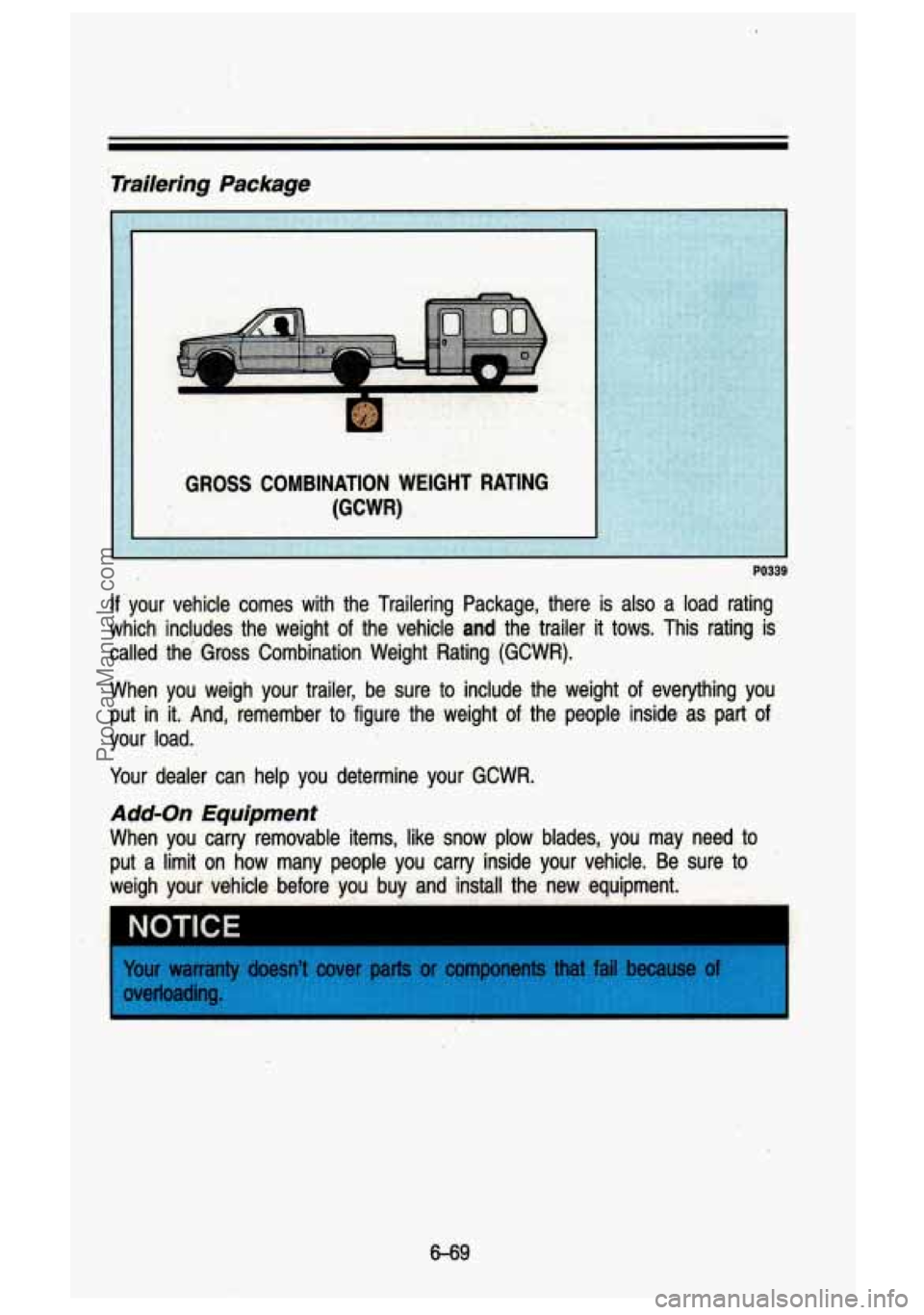
Trajlering Package
PO339
If your vehicle comes with the Trailering Package, there is also 8 load rating
which includes the weight
of the vehicle and the trailer it tows. This rating is
called the Gross Combination Weight Rating (GCWR).
When you weigh your trailer, be sure
to include the weight of everything you
put in it. And, remember to figure the weight
of the people inside as part of
your load.
Your dealer can help you determine your GCWR.
Add-on Equipment
When you carry removable items, like snow plow. blades, you may need to
put a limit on how many people you carry inside your vehicle. Be sure to
weigh your -vehicle -before you buy and install the new equipment.
~____~~.. . __ ~
Your warranty doesn’t cover parts or components that fail because of
~ overloading. I
6-69 ..
ProCarManuals.com
Page 350 of 436
Service & Appearance Care
Trailer Recommendations
You must subtract your hitch loads from the CWR for your vehicle. Weigh
your vehicle with your trailer attached,
so that you won’t go over the GVWR
or the GAWR.
You’ll get the best performance
if you spread out the weight of your load the
right way, and
if you choose the correct hitch and trailer brakes.
For more information, see “Trailer Towing” in the Index.
If you want more information on curb weights, cargo weights, cargo wei\
ght
rating and the correct center of gravity zone for your vehicle, your dealer can
help you. Just ask for a copy of “Consumer Information, Truck-Cam\
per
Loading.”
Pickup Conversion lo. Chassis Cab
General Motors is aware that some vehicle owners may consider having the
pickup box removed and a commercial
or recreational body installed. Before
you do
so, first contact the GM Zone Office for your area for information on
such conversions. (See the “Warranty and Owner Assistance”\
booklet for
Zone Office.) Owners should be aware that, as manufactured, th\
ere are
differences between a chassis cab and a pickup with the box r\
emoved which may affect vehicle safety. The components necessary to adapt the pickup to
permit its safe use with a specialized body should be installed by a bod\
y
builder in accordance with the information available from the Z\
one Office.
Tires
We don’t make tires. Your new vehicle comes with high quali\
ty tires made by
a leading tire manufacturer. These tires are warranted by the \
tire
manufacturers and their warranties are delivered with every new \
vehicle.
If
your spare tire is a different brand than your road tires, you will have a tire
warranty folder from each of these manufacturers.
6-72
ProCarManuals.com
Page 385 of 436
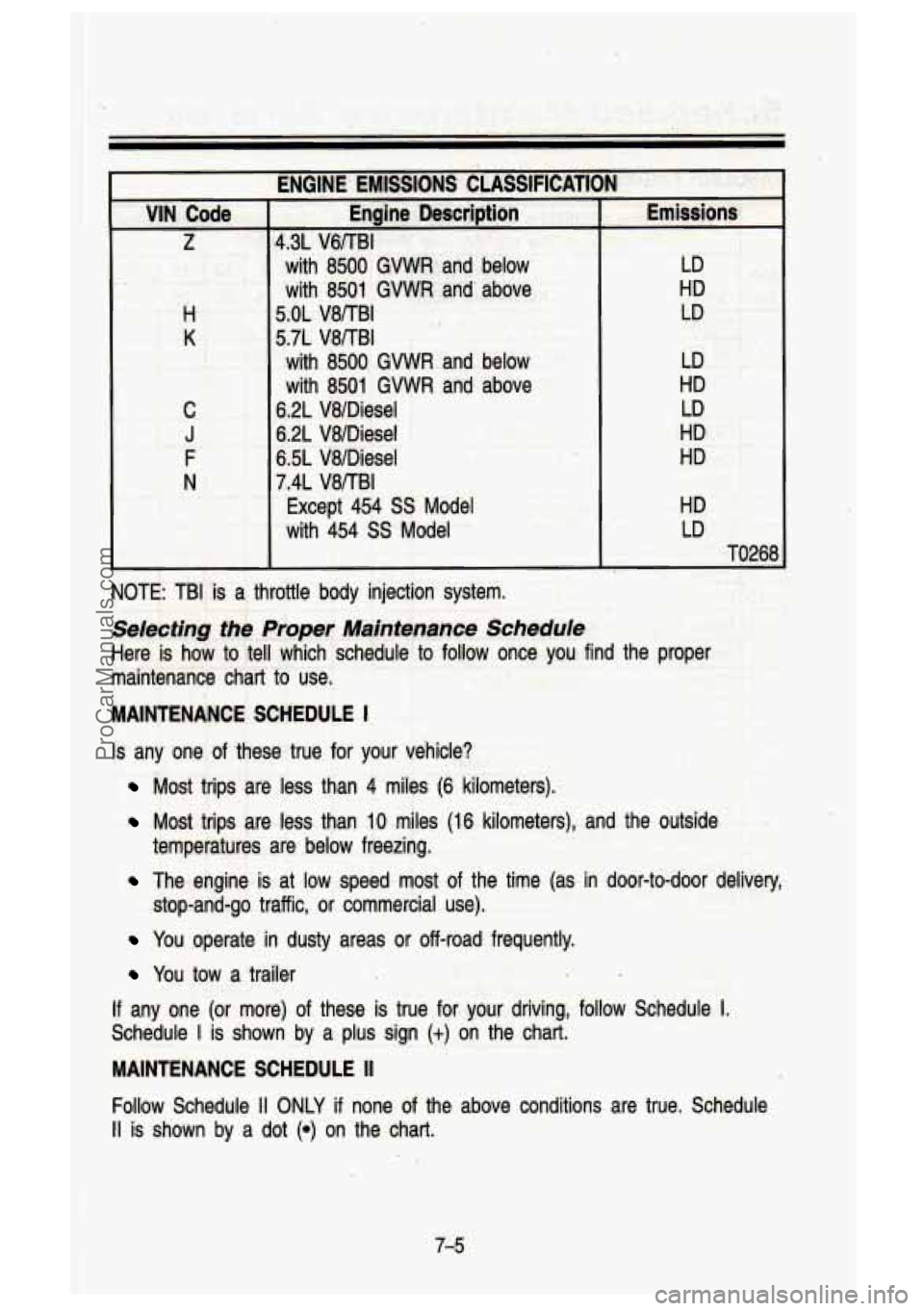
VIN Code
Z
H
K
C
J
F
N
~~~
Engine Description
with 8500 GVWR and below 7~ ! .-
with 8501 GWVR and' above
4.3L V6/TBI
5.0L V8/TBI
5.7L V8/TBI
with 8500 GVWR and belowk=
*&$
with 8501 GVWR and abov-sd
6.2L V8IDiesel
L.
6.2L V8/Diesel >c<
6.5L V8/Diesel g$ c
7.4L V8/TBI I
Except 454 SS Model 'g
with 454 SS Model ;
J= tb-
-1
L..
HD LD
LD
HD
LD
HD
HD
HD LD
TO268
NOTE: TBI Is a throttle body injection system.
Selecting the Proper Maintenance Schedule
Here ,is how to tell which schedule to follow once you find the proper
maintenance chart to use.
MAINTENANCE SCHEDULE I
Is any one of these true for your vehicle?
Most trips are less than 4 miles (6 kilometers).
Most trips are less than 1.0 miles (16 kilometers), and the outside
temperatures are below freezing.
The engine is at low speed most of the time (as in door-to-door delivery,
You operate in dusty areas or off-road frequently.
You tow a trailer
stop-and-go traffic,
or commercial use).
n;r- .I '.
---. - .
-. . r- IA m. : .. 1: . >.' +--,-P~l*~ -L.
If any one (or more) of these is true for your driving, follow Schedule 1.
Schedule I is shown by a plus sign (t) on the chart. &
MAINTENANCE SCHEDULE II
Follow Schedule II ONLY if none of the above conditions are true. Schedule- -
II is shown by a dot (.) on the chart. I
-
L .. -
7-5
ProCarManuals.com
Page 399 of 436
6. AIR CLEANER FILTER REPLACEMENT* -Replace at every 30,000
miles (50 000 km) or more often under dusty conditions. Ask your dealer
for the proper replacement intervals for your driving conditions\
.
7. FRONT WHEEL BEARING REPACK (2 WHEEL DRIVE ONLY) -Clean
and repack the front wheel bearings at each brake relining, or\
at the specified interval, whichever comes first.
8.
TRANSMISSION SERVICE
Automatic Transmission
-Change the transmission fluid and filter every
15,000 miles (25 000 km) for vehicles under 8,600 GVWR or every
12,000 miles (20 000 km) for vehicles over 8,600 GVWR if the vehicle
is mainly driven under one or more of these conditions:
In heavy city traffic.
Where the outside temperature regularly reaches 90°F (32°C\
) or
higher.
In hilly or mountainous terrain.
Frequent trailer pulling.
Uses such as taxi, police, delivery or other commercial service\
.
If the vehicle is not used mainly under any of these conditions, change
the fluid and filter every 30,000 miles
(50 000 km) for vehicles under
8600 GVWR or every
24,000 miles (40 000 km) for vehicles over 8600
GVWR. See “Automatic Transmission Fluid” in the Index for more
information.
Manual Transmission -Transmission fluid does not require periodic
changing.
Regulator Valve System for any worn, plugged or collapsed hoses. Have
the system checked as described in the Service Manual.
9.
CDRV SYSTEM INSPECTION* -Check
the Crankcase Depression
10. FUEL FILTER REPLACEMENT* -Replace the fuel filter at the specified
interval
or sooner if clogged.
11. SPARK PLUGS REPLACEMENT* -Replace spark plugs with the type
listed in Section
6. See “Specification Charts” in the Index.
12.
SPARK PLUG WIRE INSPECTION* -Clean wires and inspect for burns,
cracks or other damage. Check the wire boot fit at the distributor and at
the spark plugs. Replace wires as needed.
*An Emission Control Service
7-1 9
ProCarManuals.com
Page 401 of 436

23. EXHAUST PRESSURE REGULATOR VALVE INSPECTION* -Check that
the valve works properly. Correct any binding. Inspect hoses fo\
r cracks, chafing or decay. Replace parts as needed.
24.
TIRE AND WHEEL ROTATION AND INSPECTION -For proper wear
and maximum tire life, rotate tires at the first
6,000 miles (1 0 000
kilometers) for Schedule I (t) or 7,500 miles (12 500 kilometers) for
Schedule
II (.) and then every 15,000 miles (25 000 kilometers)
thereafter. Follow the instructions and patterns shown in Section 6.
Check tires for uneven wear or damage.
If irregular or premature wear is
apparent, check wheel alignment. Also, check for damaged wheels.\
See
“Tires” in the Index for more information.
For dual wheels, whenever the vehicle, wheels, or fasteners are new,
have the wheel fastener torque set at the first 100,
1,000 and 6,000
miles (160, 1600 and 10
000 km).
For 3500 H.D. Models, block the tires opposite those being removed to
keep the vehicle from rolling.
25.
DRIVE AXLE SERVICE -Check readfront axle fluid level and add as
needed. Check constant velocity joints and axle seals for leaki\
ng.
Locking differential-Drain fluid at first oil change and refill. Check
fluid level and add as needed at subsequent oil changes.
In dusty
areas, or trailer towing applications drain fluid at every 15,0\
00 miles
(24 135 kilometers) and refill$
every oil change. In dusty areas, or trailer towing applications, drain
fluid every 15,000 miles
(24 135 kilometers) and refi1l.t
More frequent lubrication may be required on heavy-duty or off-road
use.
Standard differential -Check fluid level and add as needed at
26.
BRAKE SYSTEM INSPECTION -When the engine oil is changed,
inspect the lines and hoses for proper hookup, binding, leaks, \
cracks,
chafing, etc. Check the parking brake adjustment, and the fluid level in
the master cylinder.
A low fluid level can indicate worn disc brake pads
which may need to be sewiced.t
*An Emission Control Service
tA fluid
loss in these systems may indicate a problem. Have them
inspected and repaired at once.
7-2
1
ProCarManuals.com
Page 425 of 436
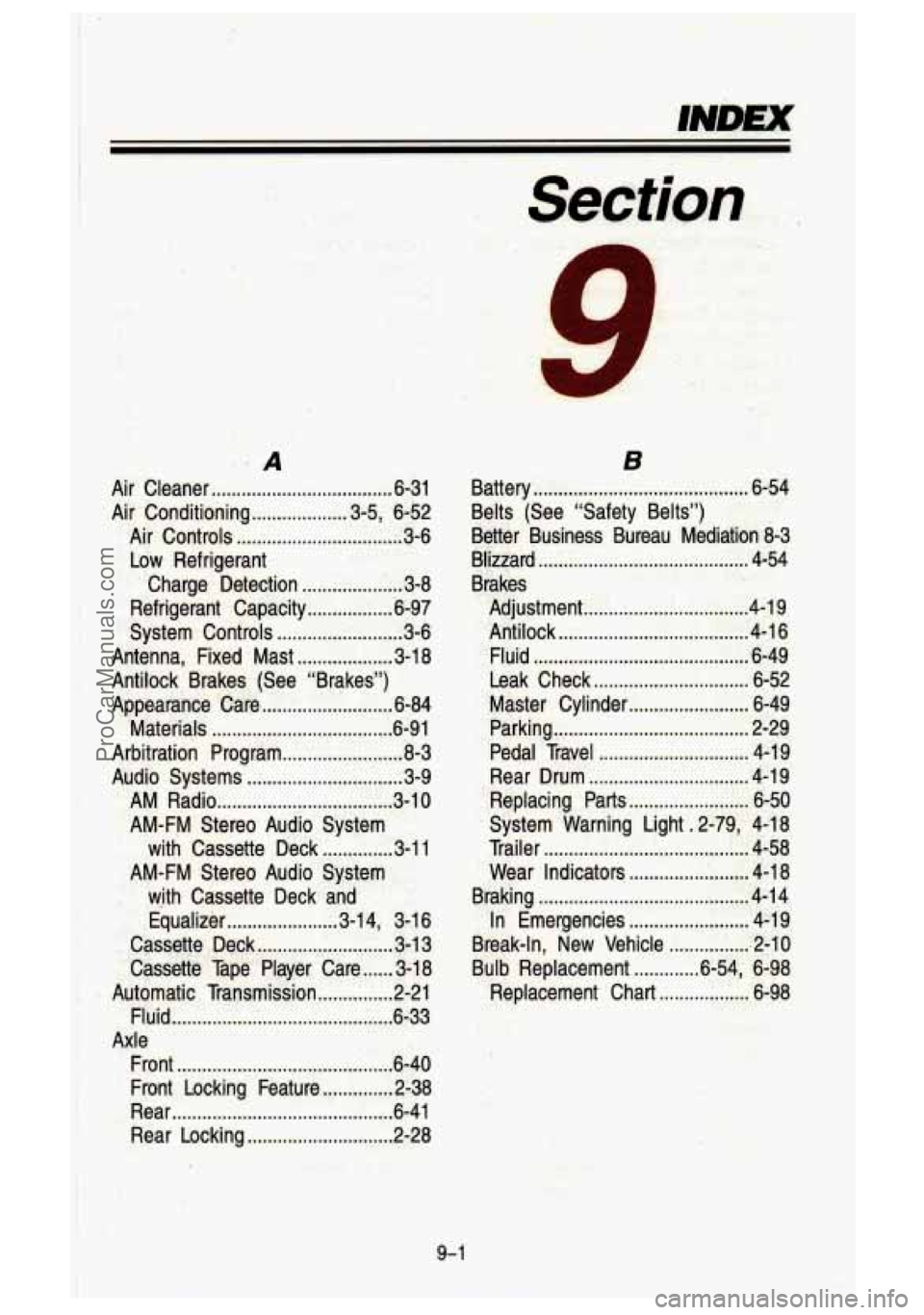
A
B
Battery ........................................... 6-54
Belts (See "Safety Belts")
Better Business Bureau Mediation 8-3
Bliizard
.......................................... 4-54
Brakes 'Adjustment
................................. 4-19
Antilock
...................................... 4-16
Fluid
........................................... . 6.49
Leak Check
............................... 6-52
Master Cylinder ........................ 6-49
Parking
....................................... 2-29
Pedal Travel
.............................. 4-19
Rear Drum
..... ; .......................... 4-19
Replacing Parts
........................ 6-50
System Warning Light .2.79, 4-18
Trailer
......................................... 4-58
Wear Indicators
........................ 4-18
Braking
....................................... .'.'4.14
In Emergencies
........................ 4-19
Break.ln, New Vehicle
; ................ 2.10
Bulb Replacement ............. 6.54, 6-98
Replacement Chart
.................. 6-98
9-1
ProCarManuals.com