warning GMC SIERRA 1993 User Guide
[x] Cancel search | Manufacturer: GMC, Model Year: 1993, Model line: SIERRA, Model: GMC SIERRA 1993Pages: 436, PDF Size: 23.88 MB
Page 148 of 436

Features & Controls
that the pedal is harder to push. Or, the pedal may go closer to the floor.\
It
may take longer to stop. If the light is still on, have the vehicle towed for
service. (See “Towing Your Vehicle” in the Index.)
CAUTION
* Your brake system may not be working properly if the brake warning
light is on. Driving with the brake warning light on can lead\
to an
accident.
If the light is still on after you’ve pulled off the road and
stopped carefully, have
+hq vehicle towed for service.
“WATER IN FUEL” Light
WATER
IN
FUEL I
-l PB010
This light will come on to warn you if there is too much water in the diesel
fuel system. For more information on how this light works, see\
“Diesel Fuel
Requirements and Fuel System” in the Index.
2-80
ProCarManuals.com
Page 149 of 436

GLOW PLUGS Light
I--
GLOW
PLUGS
K2337
Your diesel engine has a special starting system. An instrument\
panel GLOW
PLUGS light tells you when the engine is ready to be started. It is at the
upper right
of your cluster. For more details, see “Starting Your Diesel
Engine” in the Index.
Low Coolant Warning Light
LOW
K2327
If you have a diesel engine, you have a low coolant warning ligh\
t. If this light
comes on, your system is
low on coolant and the engine may overheat. See
2-8 1
ProCarManuals.com
Page 152 of 436
Features & Controls
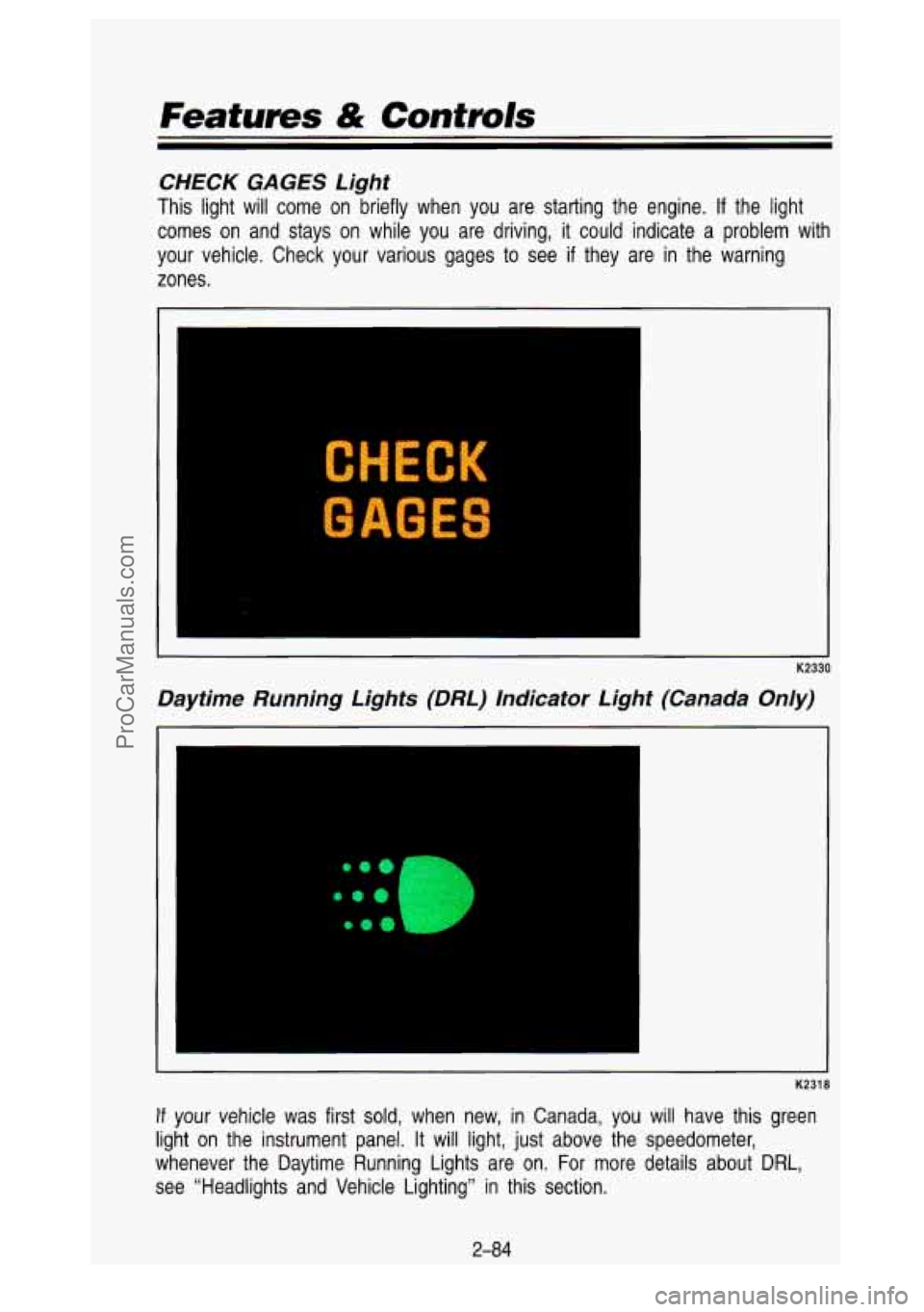
CHECK GAGES Light
This light will come on briefly when you are starting the engine. If the light
comes on and stays
on while you are driving, it could indicate a problem with
your vehicle. Check your various gages to see
if they are in the warning
zones.
K2330
Daytime Running Lights (DRL) Indicator Light (Canada On/y)
I-
K2318
If your vehicle was first sold, when new, in Canada, you will have this green
light on the instrument panel. It will light, just above the \
speedometer,
whenever the Daytime Running Lights are on. For more details a\
bout DRL,
see “Headlights and Vehicle Lighting” in this section.
2-84
ProCarManuals.com
Page 158 of 436
Features & Controls
A reading in the low pressure zone may be caused by a dangerously low oil
level or other problem causing low oil pressure. Check your oil as soon as
possible.
bnu I IUIY
+ Don’t keep driving if the oil pressure is low. If you do, your engine
can become
so hot that it catches on fire. You or others could be
burned. Check your oil as soon as possible and have your vehicle
serviced.
I NOTICE
Damage to your engine from neglected oil problems can be costly anc
not covered by your warranty.
Voltmeter
Standard Cluster Tachometer Cluster
14 14
A
K2336
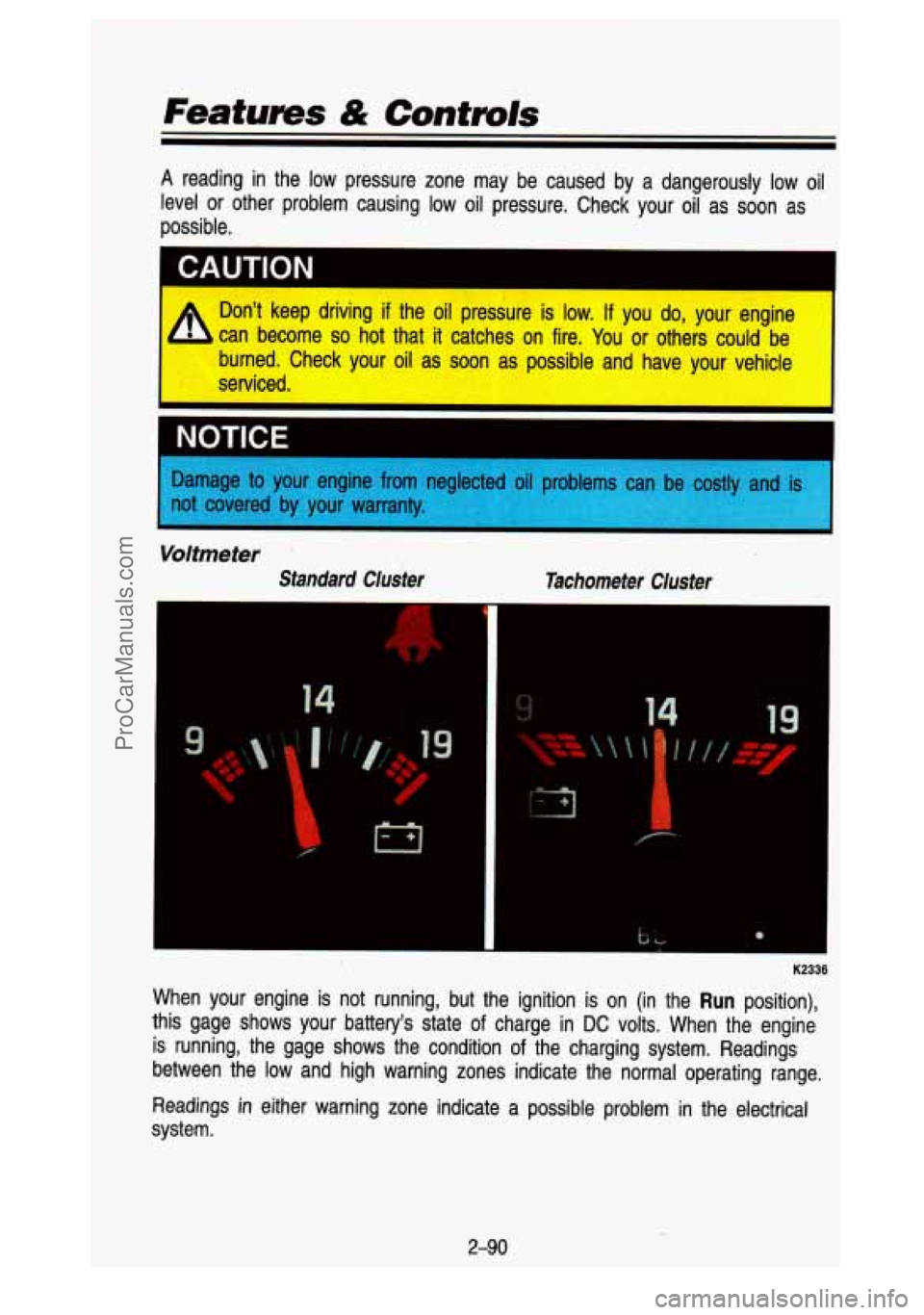
When your engine is not running, but the ignition is on (in the Run position),
this gage shows your battery’s state of charge in DC volts. When the engine
is running, the gage shows the condition of the charging system. Readings
between the low and high warning zones indicate the normal ope\
rating range.
Readings
in either warning zone indicate a possible problem in the electrical
system.
2-90
ProCarManuals.com
Page 159 of 436
.
You can only drive for a short time with the reading in either warning zone. If
you must drive, turn
off all unnecessary accessories, and have the vehicle
serviced as soon as possible.
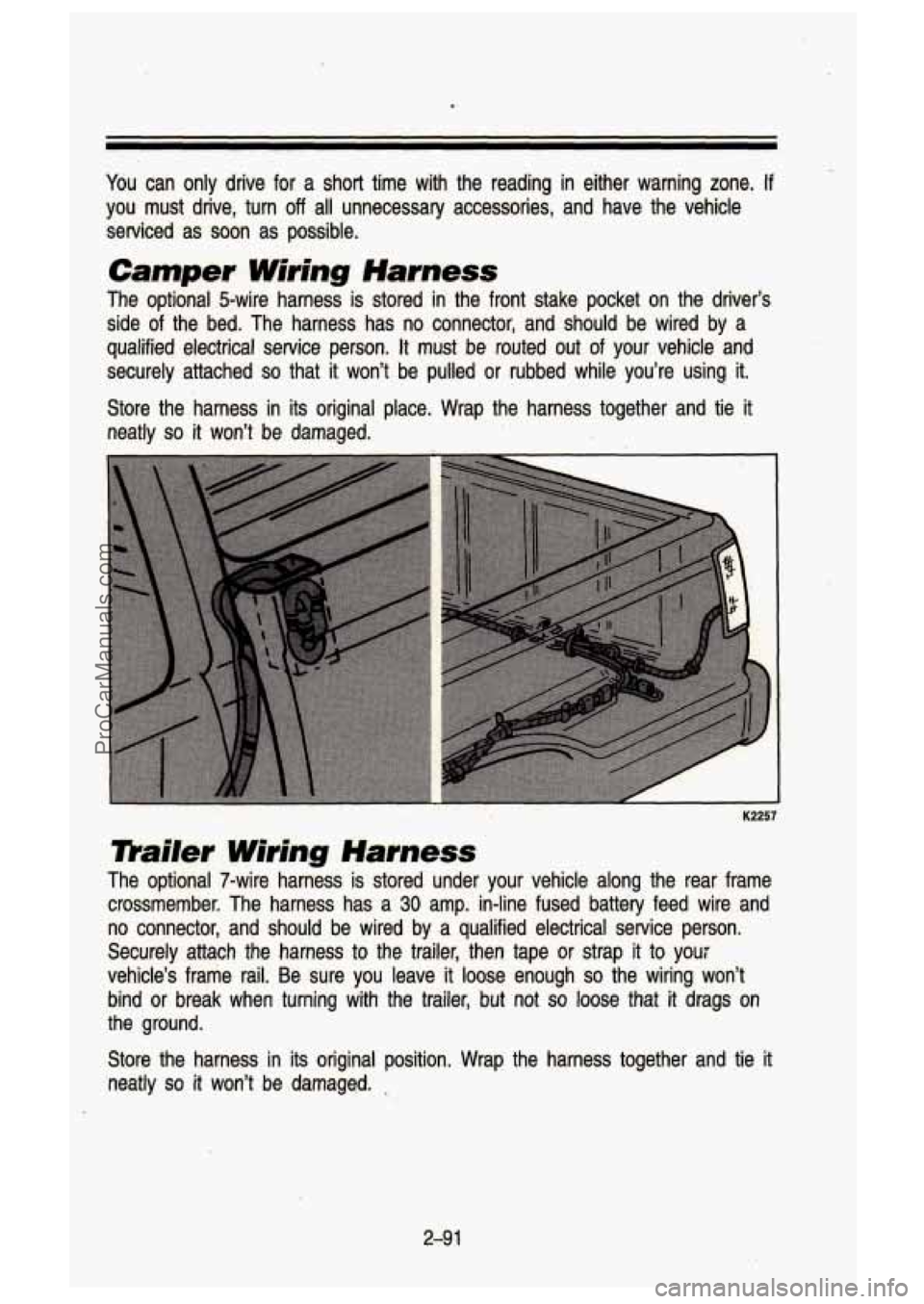
Camper Wiring Harness
The optional 5-wire harness is stored in’ the front stake pocket on the driver’s
side of’ the bed. The harness has no connector, and should be wired by\
a
qualified electrical service person.
It must be routed out of your vehicle and
securely attached
so that it won’t be pulled or rubbed while you’re using it.
Store the -harness in its original place. Wrap the harness together and tie it
neatly
so it won3 be damaged.
The optional 7-wire harness
is stored under your vehicle along the rear frame
crossmember. The harness has a’
30 amp. in-line fused battery feed wire and
no connector, and should be wired by a qualified electrical se\
rvice person.
Securely attach
the harness to the trailer, then tape or strap it to your
vehicle’s frame rail. Be sure you leave it loose enough
so the wiring won’t
bind
or break when turning with the trailer, but not so loose that it drags on
the ground.
Store the harness in its original position. Wrap the harness together and tie it
neatly so it won’t be damaged. ,
2-9 1
ProCarManuals.com
Page 181 of 436

-11
Road Signs
The rbad signs you see everywhere are coded by color, shape a\
nd symbols. It’s a good idea
to know these codes so that you can quickly grasp the basic
meaning
or intent of the sign even before you have a chance to read it.
Color of Road Signs .
. . ? ._ ).+.A; I, -:,x pIill ,3+-.),, . . * ff,, ,%: 1’’ ..::, p.*w: I-$.* . ’ , ’ ” >.F<< :;;:,s::.:;. .., - .. . ’$.,-, , i-, ., .- ., ”.,&.-” :<: . .. . c e-’. .. . . .I :. - % . ._ .. . .I -
I
AM402001
RED means STOP. It may also i..lcate that some movement is not allowed.
Examples are
DO NOT ENTER’ and WRONG WAY.
AM402002
YELLOW indicates a general warning. Slow down and be careful when you\
see a yellow sign.
It may signal a railroad crossing ahead, a no passing
zone, or some
other potentially dangerous situation. Likewise, a yellow solid
line painted on th’e road. means “Don’t Cross.”
-1
4-3
ProCarManuals.com
Page 184 of 436
Your Driving and the Road
AM4020d
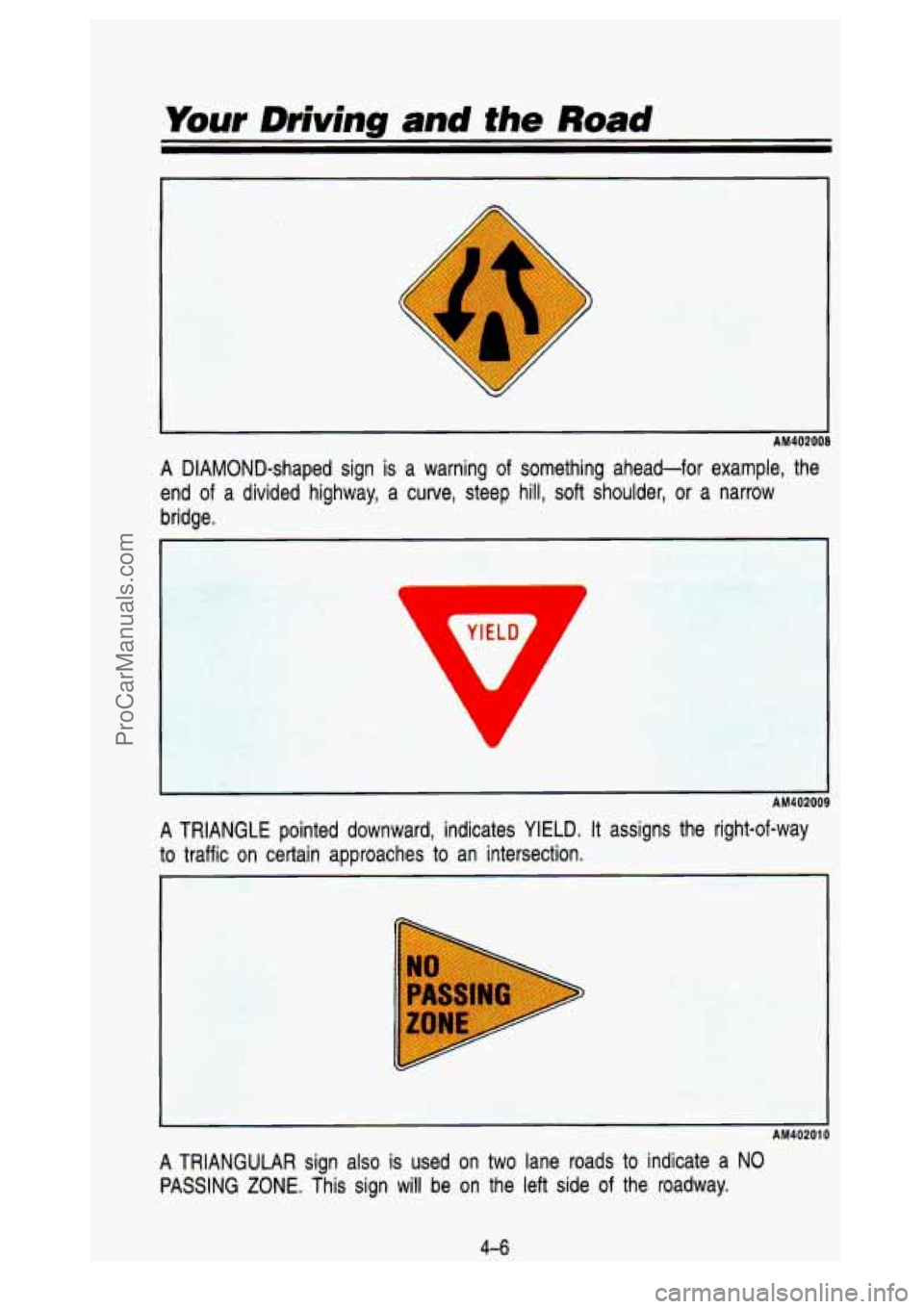
A DIAMOND-shaped sign is a warning of something ahead-for example, the
end
of a divided highway, a curve, steep hill, soft shoulder, or a narrow
bridge.
I
I AM402009
A TRIANGLE pointed downward, indicates YIELD. It assigns the right-of-way
to traffic on certain approaches to an intersection.
A TRIANGULAR sign also is used on two lane roads to indicate a
NO
PASSING ZONE. This sign will be on the left side of the roadway.
4-6
ProCarManuals.com
Page 187 of 436
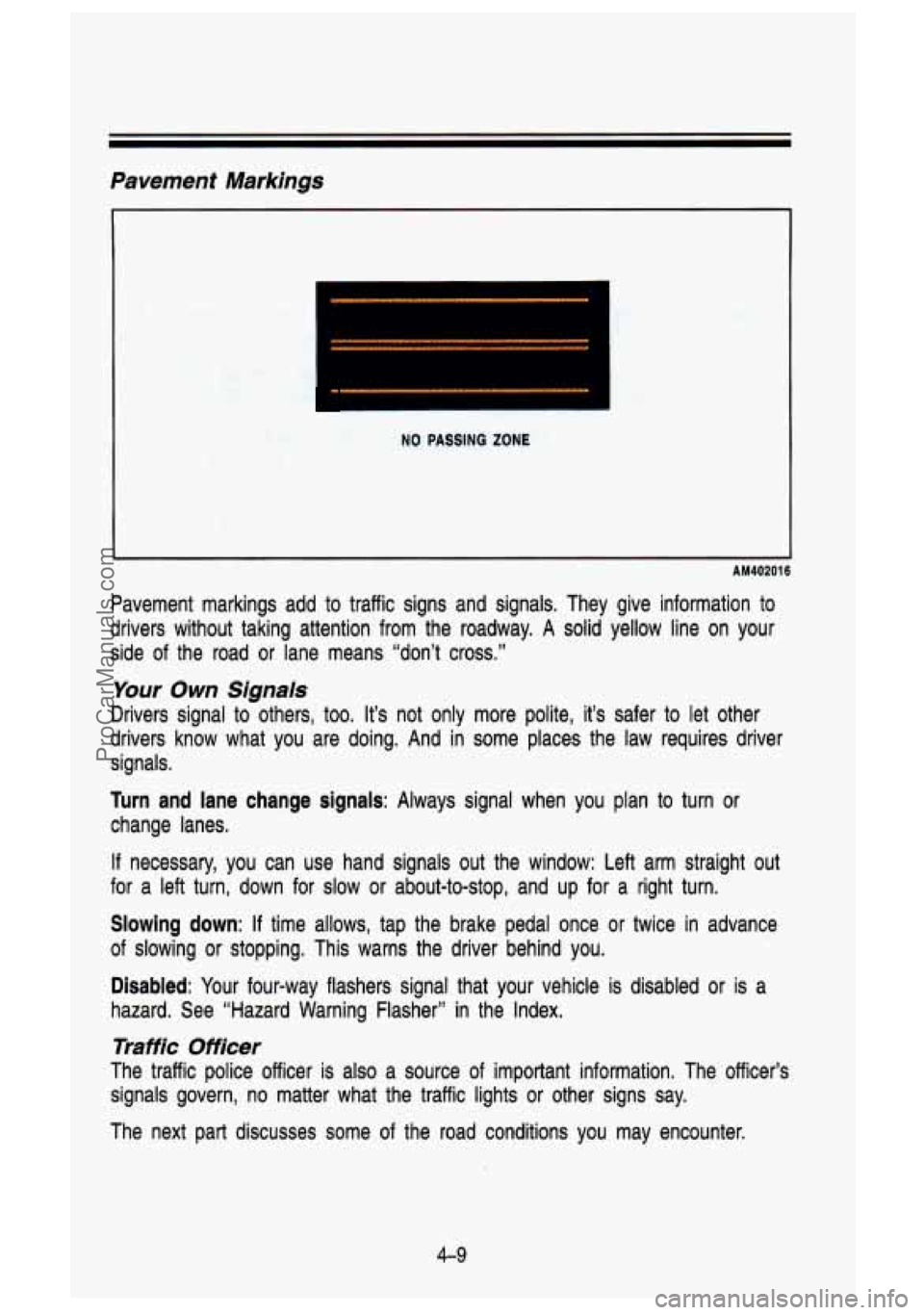
Pavement Markings
NO PASSING ZONE
AM40201 6
Pavement markings add to traffic signs and signals. They give information to
drivers without taking attention from the roadway. A solid yellow line on your
side
of the road or lane means “don’t cross.”
Your Own Signals
Drivers signal to others, too. It’s not only more polite, it’s safer to let other
drivers know what you are doing. And in some places the law requires driver
signals.
Turn and lane change signals: Always signal when you plan to turn or
change lanes.
If necessary, you can use hand signals out the window: Left arm \
straight out
for a left turn, down for
slow or about-to-stop, and up for a right turn.
Slowing down: If time allows, tap the brake pedal once or twice in advance
of slowing or stopping. This warns the driver behind you.
Disabled: Your four-way flashers signal that your vehicle is disabled or is a
hazard. See “Hazard Warning Flasher” in the Index.
Traffic Officer
The traffic police officer is also a source of important informaaon. The officer’s
signals govern, no matter what the traffic lights or other sig\
ns say.
The next part discusses some of the road conditions you may e\
ncounter.
4-9
ProCarManuals.com
Page 196 of 436
Your Driving and fhe Road
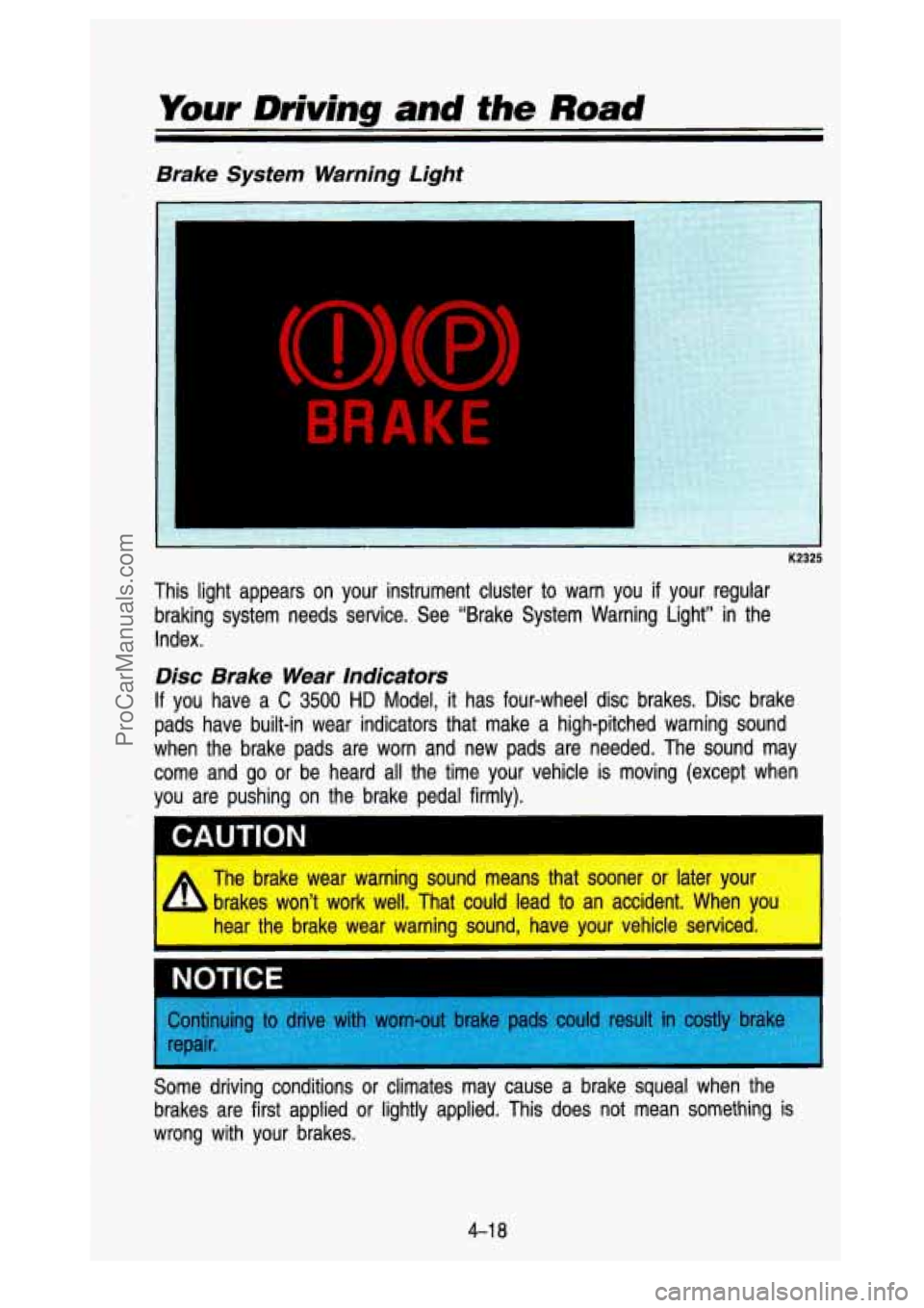
Brake System Warning Light
K2325
This light appears on your instrument cluster to warn you if your regular
braking’ system needs service. See “Brake System Warning L\
ight” in the
Index.
Disc Brake Wear Indicators
If you have a C 3500 HD Model, it has four-wheel disc brakes. Disc brake
pads have built-in wear indicators that make a high-pitched war\
ning sound
when the brake pads are worn and new pads are needed. The so\
und m’ay
come and go or be heard all the time your vehicle is moving (except \
when
you are pushing on the brake pedal firmly).
1 CAUTION
The brake wear warning sound means that sooner or later your
hear the brake wear warning sound, have your vehicle serviced. \
5 brakes won’t work well. That could lead to an accident. When you I ~
I 1
i
~ i
brakes are first applied or lightly applied. This does not mea\
n something is
wrong with your brakes.
4-1 8
ProCarManuals.com
Page 203 of 436
may not realize the surface is slippery until your vehicle is skidding. Learn to
recognize warning clues-such as enough water, ice
or packed snow on the
road to make a “mirrored surface’’-and slow down when you have \
any
doubt.
Remember: the rear wheel anti-lock braking system (RWAL) helps\
avoid only
a rear braking skid. In a braking skid (where the front wheels are no longer
rolling), release enough pressure on the brakes to get the front wheels rolling
again. This restores steering control. Push the brake pedal dow\
n steadily
when you have to stop suddenly.
As long as the front wheels are rolling, you
will have steering control. Steer the way you want to go.
Off-Road Driving with Your FourcWheel
Drive Vehicle
This off-road guide is for vehicles that have four-wheel drive. Also, see
“Anti-lock Brakes” in the Index.
If your vehicle doesn’t have four-wheel drive,
you shouldn’t drive off-road unless you’re on a level, so\
lid surface.
Off-road driving can be great fun. But it does have some defi\
nite hazards.
The greatest
of these is the terrain itself.
“Off-roading” means you’ve left the great North American\
road system behind.
Traffic lanes aren’t marked. Curves aren’t banked. There a\
re no road signs.
Surfaces can be slippery, rough, uphill
or downhill. In short, you’ve gone right
back
to nature.
Off-road driving involves some new skills. And that’s why it’s very important
that you read this guide. You’ll find many driving tips and suggestions. These
will help make your off-road driving safer and more enjoyable. \
Before You Go Off-Roading
There are some things to do before you go out. For example, be sure to
have all necessary maintenance and service work done. Be sure \
you read all
the information about your four-wheel drive vehicle in this manual.
Is there
enough fuel?
Is the spare tire fully inflated? Are the fluid levels up where
they should be? What are the local laws that apply to off-roa\
ding where you’ll be driving?
If you don’t know, you should check with law enforcement people\
in the area. Will you be on someone’s private land?
If so, be sure to get the
necessary permission.
4-25
ProCarManuals.com