overheating GMC SIERRA 1993 Owners Manual
[x] Cancel search | Manufacturer: GMC, Model Year: 1993, Model line: SIERRA, Model: GMC SIERRA 1993Pages: 436, PDF Size: 23.88 MB
Page 7 of 436
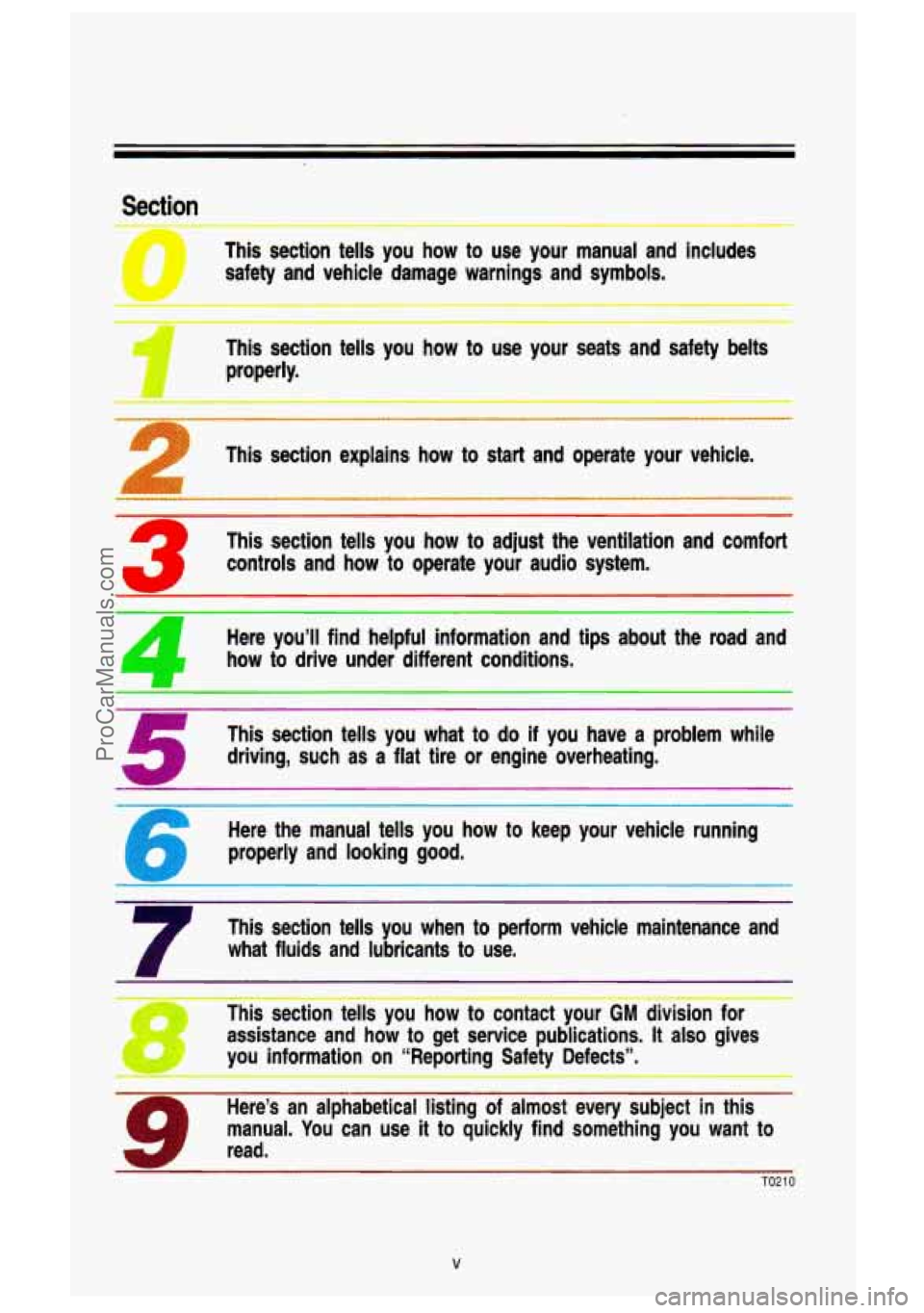
Section
0
This section tells you how to use your manual and includes
safety and vehicle damage warnings and symbols.
I
This section tells you how to use your seats and safety belts
properly.
2
This section explains how to start and operate your vehicle.
3
This section tells you how to adjust the ventilation and comfort
controls and how to operate your audio system.
4
Here you’ll find helpful information and tips about the road and
how to drive under different conditions.
5
This section tells you what to do if you have a problem while
driving, such as
a flat tire or engine overheating.
Here the manual tells you how to keep your vehicle running
properly and looking good.
7
This section tells you when to perform vehicle maintenance and
what fluids and lubricants to use.
8
This section tells you how to contact your GM division for
assistance and
how to get service publications. It also gives
vou information on “Reportina Safetv Defects”.
Here’s an alphabetical listing of alr..,st every subject in this
manual. You can use
it to quickly find something you want to
m read. -
V
ProCarManuals.com
Page 156 of 436

Features & Controls
Listed are four situations you may experience with your fuel g\
age:
At the gas station, the fuel pump shuts off before the gage reads full.
It takes a little more or less fuel to fill up than the fuel gage indicated.
For example, the gage may have indicated the tank was half fu\
ll, but
it
actually took a little more or less than half the tank's capa\
city to fill the
tank.
The gage moves a little when you turn a corner or speed up. \
The gage doesn't go back to empty when you turn off the ignition.
None of these indicate a problem with the fuel gage.
For information on how to
fill your fuel tank see "Fuel-Filling Your Tank" in
the Index.
For your fuel tank capacity, see "Fuel-Tank Capacity"
in the Index.
Engine Coolant Temperature Gage
760
K2334
This gage shows the engine coolant temperature. If the gage pointer moves
into the red area, about 260°F
(145°C) or more, your engine is too hot! It
means that your engine coolant has overheated.
If you have been operating
your vehicle under normal operating conditions, you should pull \
off the road,
stop your vehicle and turn
off the engine as soon as possible.
Hot Coolant Can Burn You Badly!
In "Problems on the Road", this manual shows what to do. See \
"Engine
Overheating" in the Index.
2-88
ProCarManuals.com
Page 238 of 436
Your Driving and the Road
drivers behind you are seeing your signal when they are not. It’s important to
check occasionally to be sure the trailer bulbs are still working.
Driving on Grades
Reduce speed and shift to a lower gear before you start down long or steep
downgrade.
If you don’t shift down, you might have to use your brakes so
much that they would get hot and no longer work well.
On a long uphill grade, shift down and reduce your speed to
45 mph (70
kmlh) or less to reduce the possibility of engine and transmission overheating.
IT you have an automatic transmission, you should use D (or, as you need to,
a lower gear) when towing a trailer. Operating your vehicle i\
n
D when towing
a trailer will minimize heat buildup and extend the life of your transmission.
Or, if you have a manual transmission with fifth gear and you are towing a
trailer, it’s better not to use fifth gear. Just drive in fourth gear
(or, as you
need to, a lower gear).
Parking on Hills
You really should not park your vehicle, with a trailer attached, \
on a hill. If
something goes wrong, your rig could start to move. People can\
be injured
and both your vehicle and the trailer can be damaged.
But
if you ever have to park your rig on a hill, here’s how to do it:
1. Apply your regular brakes, but don’t shift into P (Park) yet, or into gear
2. Have someone place chocks under the trailer wheels.
for a manual transmission.
3. When the wheel chocks are
in place, release the regular brakes until the
chocks absorb the load.
4. Reapply the regular brakes. Then apply your parking brake, and \
then
5. If you have a four-wheel-drive vehicle, be sure the transfer case is in a
6. Release the regular brakes.
shift
to
P (Park), or R (Reverse) for a manual transmission.
drive gear-not in
N (Neutral).
4-60
ProCarManuals.com
Page 243 of 436
Pmb/ems on the Road
1 Section
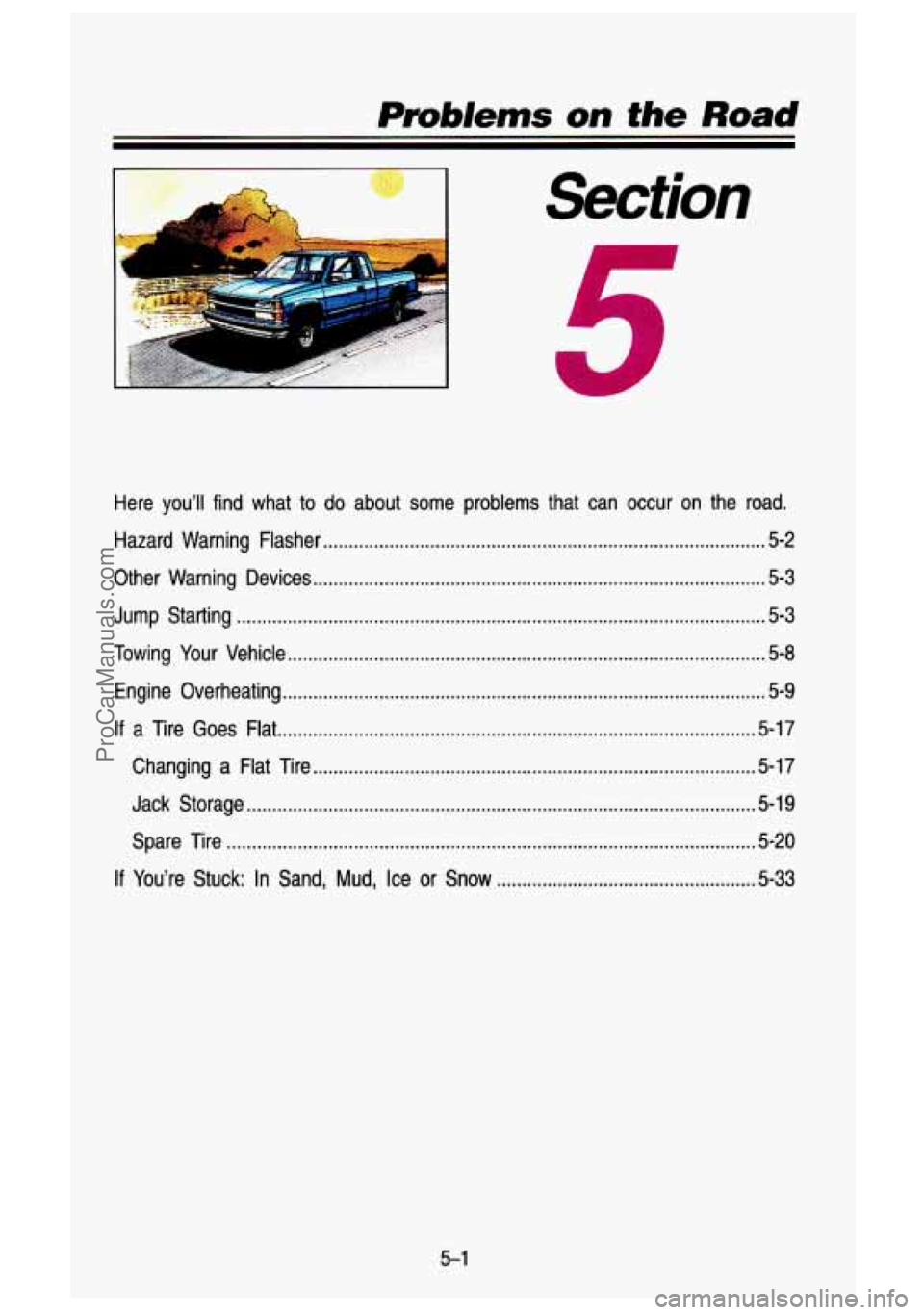
Here you’ll find what to do about some problems that can occur on the road .
Hazard Warning Flasher ........................................................................\
............... 5-2
Other Warning Devices ........................................................................\
................. 5-3
Jump Starting ........................................................................\
................................ 5-3
Towing Your Vehicle ........................................................................\
...................... 5-8
Engine Overheating ........................................................................\
....................... 5-9
If
If
a Tire Goes Flat ........................................................................\
...................... 5-17
Changing a Flat Tire
........................................................................\
............... 5-17
Jack Storage
........................................................................\
............................ 5-19
Spare Tire
........................................................................\
................................ 5-20
You’re Stuck: In Sand. Mud. Ice or Snow ................................................... 5-33
5-1
ProCarManuals.com
Page 251 of 436

If your vehicle has the four-wheel-drive option and the transfer c\
ase is
engaged, a dolly must be used under the rear wheels when towi\
ng from the
front.
Engine Overheating
You will find a coolant temperature gage on your vehicle instrument\
panel. If
you have a diesel engine, you will also find a low coolant light on your
instrument panel.
If Steam Is Coming From Your Engine:
K2509
I CAUTION
A
Steam from an overheated engine can burn you badly, even if you
just open the hood. Stay away from the engine
if you see or hear
steam coming from it. Just turn
it off and get everyone away from
the vehicle until
it cools down. Wait until there is no sign of steam
or coolant before opening the hood.
If you keep driving when your engine is overheated, the liquids in it
can catch fire. You or others could be badly burned. Stop your
engine
if it overheats, and get out of the vehicle until the engine is
cool.
5-9
ProCarManuals.com
Page 254 of 436
I
I
‘4
!b P4
LL
1
PO593
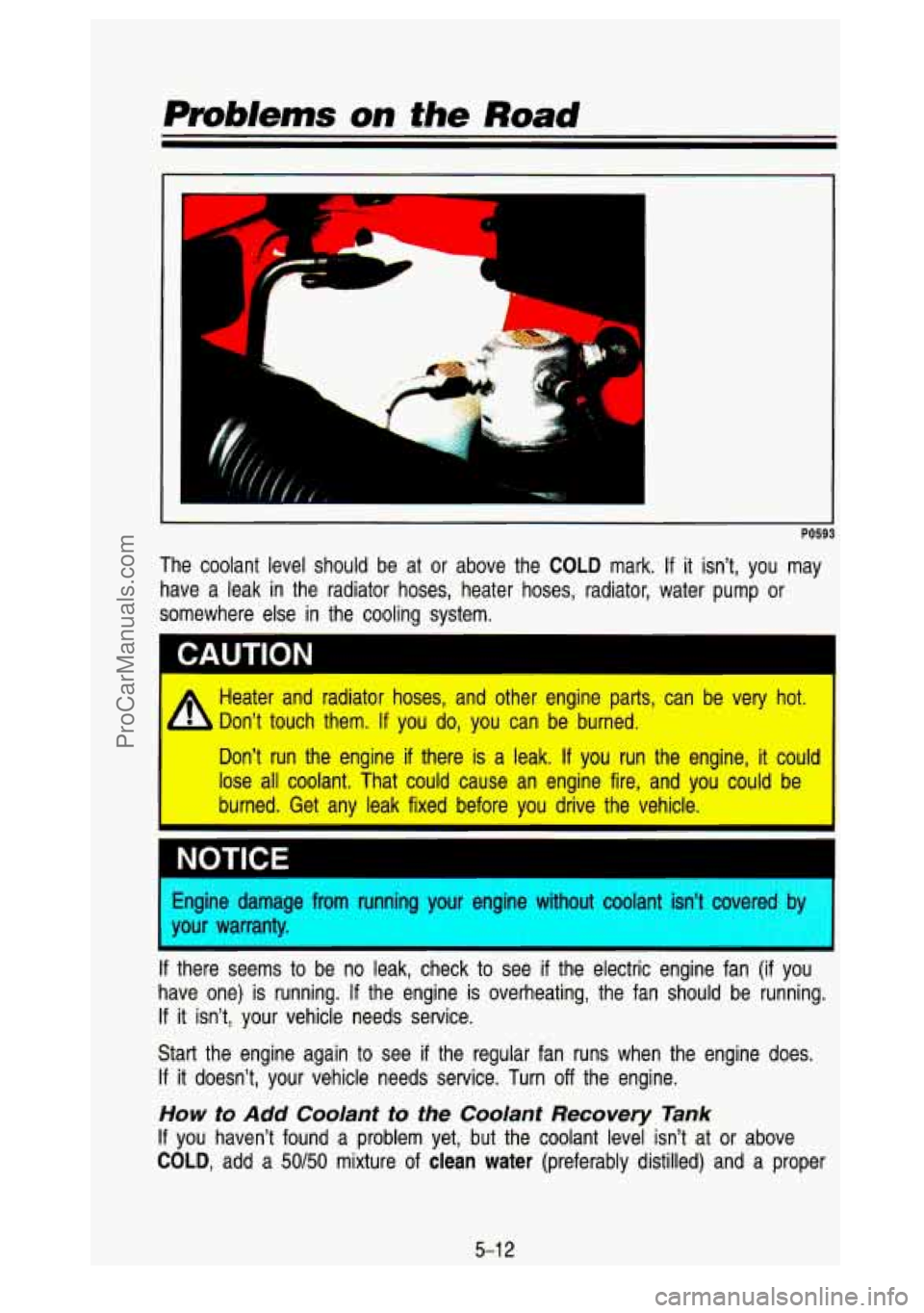
The coolant level should be at or above the COLD mark. If it isn’t, you may
have a leak in the radiator hoses, heater hoses, radiator, water pump or
somewhere else in the cooling system.
Heater and radiator hoses, and other engine parts, can be very\
hot.
-, Don’t touch them. If you do, you can be burned.
Don’t run the engine
if there is a leak. If you run the engine, it cou
lose all coolant. That could cause an engine fire, and you could be
burned. Get any leak fixed before you drive the vehicle.
I I
NOTICE
Engine damage from running your engine without coolant isn’t covered by
I your warranty.
If there seems to be no leak, check to see if the electric engine fan (if you
have one) is running.
If the engine is overheating, the fan should be running.
If it isn’t, your vehicle needs service.
Start the engine again to see
if the regular fan runs when the engine does.
If it doesn’t, your vehicle needs service. Turn off the engine.
How to Add Coolant to the Coolant Recovery Tank
If you haven’t found a problem yet, but the coolant level isn’t at or above
COLD, add a 50hO mixture of clean water (preferably distilled) and a proper
5-1 2
ProCarManuals.com
Page 320 of 436

Service & Appearance ,Care
Engine Coolant
r
PO593
The following explains your cooling system and how to add cool\
ant when it is low.
If you have a problem with -engine overheating, see “Engine
Overheating” in the Index.
The proper coolant for your vehicle will:
Give freezing protection down to -34°F (-37°C).
Give boiling protection up to 258°F (125°C).
Protect against rust and corrosion:
Help keep the proper engine temperature.
Let the warning lights and gages work as thiy should.
What to Use:
Use a ,mixture of clean water (preferably distilled), and antifreeze that meets
“GM Specification 6038-M,” which won’t damage aluminum p\
arts.
Also use
GM Engine Coolant Supplement (sealer) with a complete coolant change. If
you use these, you don’t need to add anything else.
,
6-42
ProCarManuals.com
Page 323 of 436
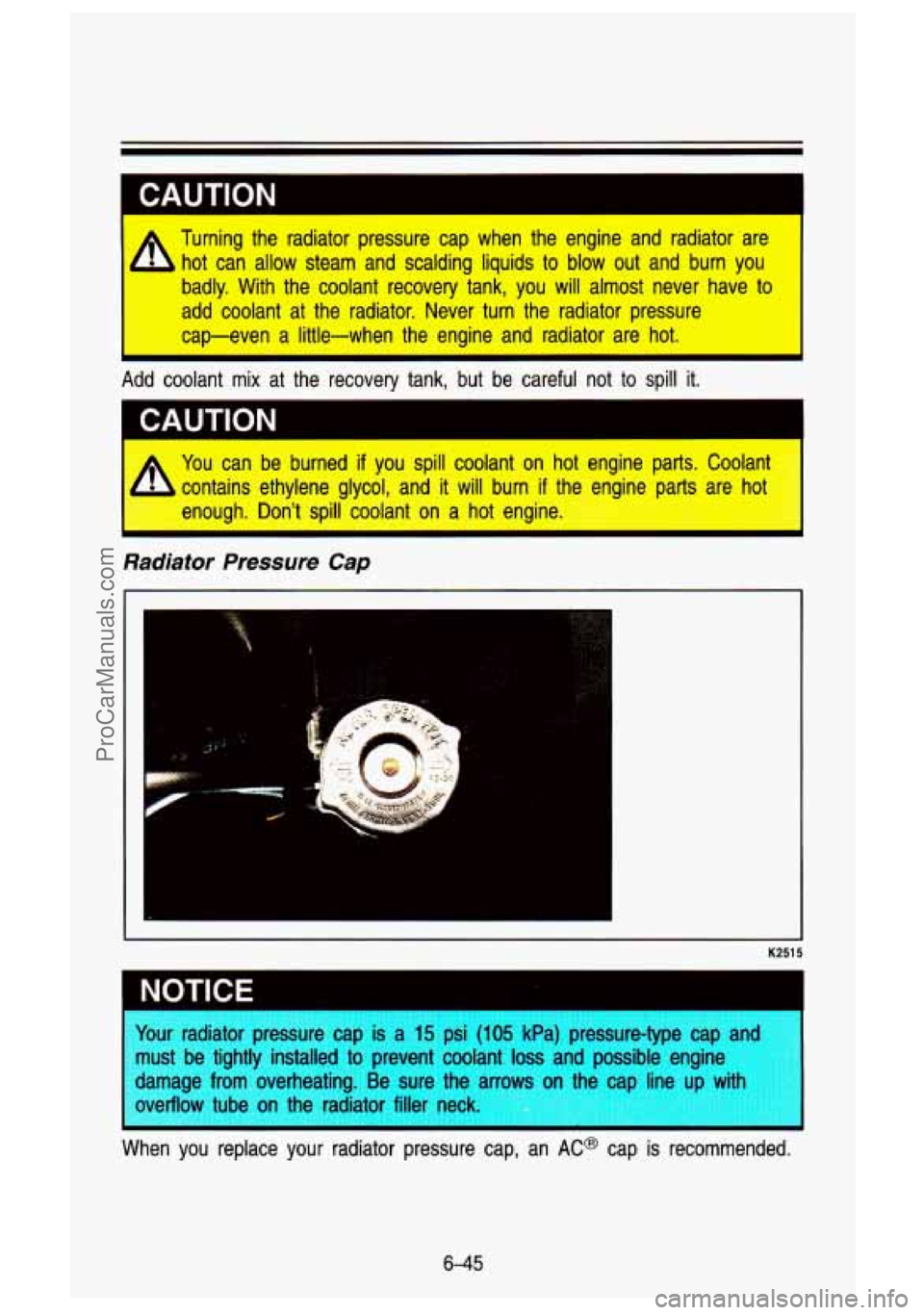
CAUTION
Turning the radiator pressure cap when the engine and radiator are
hot can allow steam and scalding liquids to blow out and burn you
badly. With the coolant recovery tank, you will almost never h\
ave to
add coolant at the radiator. Never turn the radiator pressure cap-even a little-when the engine and radiator are hot.
Add coolant mix at the recovery tank, but be careful not to \
spill it.
You can be burned
if you spill coolant on hot engine parts. Coolant
mtains ethylene glycol, and
it will burn if the engine parts are hot
enough. Don’t spill coolant on a hot engine. ’
Radiator Pressure Cap
K2515
1
Your radiator pressure cap is a 15 psi (105 kPa) pressure-type cap
must be tightly installed to prevent coolant
loss and possible engine
damage from overheating. Be sure the arrows on the cap line up w
overflow tube on the radiator filler neck.
-
When you replace your radiator pressure cap, an ACa cap is recommended.
-
I
6-45
ProCarManuals.com
Page 351 of 436
I CAUTION
Poorly maintained and improperly used tires are dangerous.
Overloading your tires can cause overheating as a result of too
much friction. You could have an air-out and a serious accident.
See “Loading Your Vehicle” in the Index:
The resulting accident could cause serious injury. Check all tires
frequently
to maintain the recommended pressure. Tire pressure
should be checked when your tires are cold.
Overinflated tires are more likely to be cut, punctured, or broken
by sudden impact, such as when you hit a pothole. Keep tires
at the recommended pressure.
Worn, old tires can cause accidents; If your tread is badly worn,
or if your tires have been damaged, replace them.
Even if it’s legal, don’t drive over 85 mph (1 35 kmlh) if you
have
16 inch tires. With 19.5 inch tires, don’t drive over 75 mph
(1 20 km/h).
Underinflated tires pose the same danger as overloaded tires.
See “Special Tire Inflation” in this section for more information on
I loading and inflation pressures at speeds above 65 mph (105 kmlh). I
Inflaiion-Tire Pressure
The Certification/Tire label which is on the rear edge of the driver’s door, or
on the incomplete vehicle document in the cab, shows the corre\
ct inflation
pressures for your tires, when they’re cold.
“Cold” means your vehicle has
been sitting for at least three hours or driven no more than
a mile.
You can operate some vehicles at reduced inflation pressures only w\
hen you’ll
be carrying reduced loads. On those vehicles, the minimum cold \
inflation
pressures for a typical reduced load are printed on the “Improved Ride Tire \
Pressure” label located on the driver’s door. Weigh the v\
ehicle
to find the
load on each tire and see the label
for the minimum cold inflation pressures
for that load.
6-73
ProCarManuals.com
Page 427 of 436
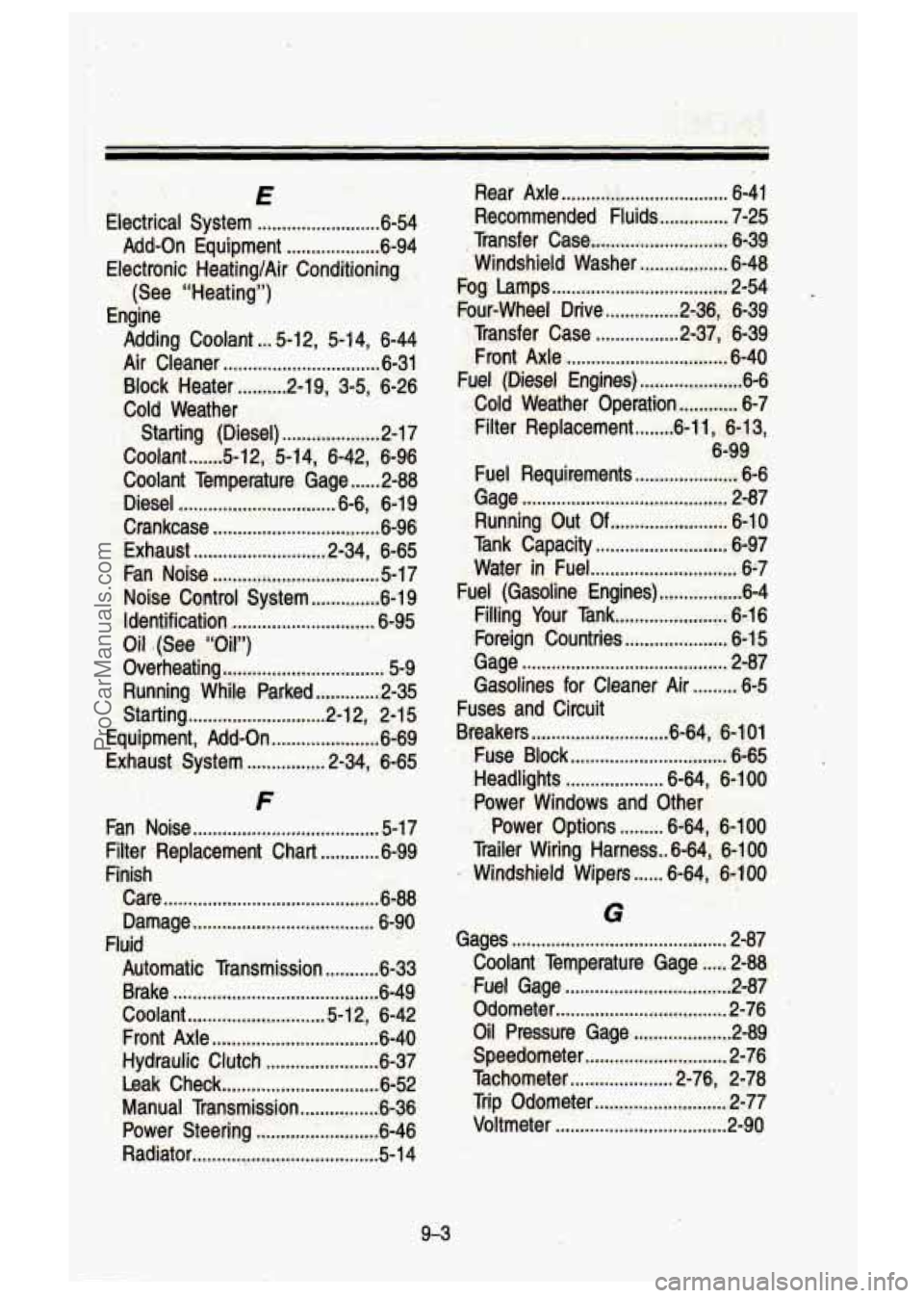
1 Add-on Equipment ................... 6-94
I- Electronic Heatinghir Conditioning
(See "Heating")
Adding Coolant
... 5.12, 5.14. 6-44
... Engine I
Air Cleaner ................................ 6-31
Block Heater
.......... 2.19. 3.5. 6-26
Cold Weather Starting (Diesel)
.................... 2-1 7
Coolant
....... 5.12. 5-1 4. 6.42. 6-96
Coolant Temperature Gage
...... 2-88
Diesel
................................ 6.6. 6-1 9
Crankcase
.................................. 6-96
Fan Noise
.................................. 5-1 7
Noise Control System
.............. 6-1 9
.-Identification,
............................ 6-95
Oil .(See "Oil")
Overheating
................................. 5-9
Running While Parked
............. 2-35
Equipment, Add-on
...................... 6-69
Exhaust System
................ 2.34, 6-65
Exhaust
........................... 2.34,
6-65
Starting
............................ 2.12, 2-1 5
F
Fan Noise ...................................... 5-1 7
Filter
. Replacement Chart ............ 6-99
Finish Care
............................................ 6-88
Damage
..................................... 6-90
Automatic Transmission
........... 6-33
Brake
.......................................... 6-49
Coolant
............................ 5-1 2. 6-42
Front Axle
.................................. 6- 40
Hydraulic Clutch
....................... 6-37
Leak Check
................................ 6-52
Manual Transmission
................ 6-36
Power Steering
............ 1 ............ 6-46
Radiator
....................................... 5-1 4
Fluid
9-3
Rear Axle .................................. 6-41
Recommended Fluids
.............. 7-25
. Transfer Case ............................ 6-39
Windshield Washer.
................. 6-48
Fog Lamps
.................................... 2-54 .
Four-wheel Drive ............... 2.36, 6-39
Transfer Case
................ .2-37, 6-39
Front Axle
................................. 6-40
Fuel (Diesel Engines)
..................... 6.6
Cold Weather Operation
............ 6-7
Filter Replacement
........ 6-1 1, 6.13,
6-99
Fuel Requirements
..................... 6-6
Gage
........................ ; ................. 2-87
Running Out Of
........................ 6-10
Tank Capacity
........................... 6-97
Water in Fuel
.............................. 627
Fuel (Gasoline Engines)
................. 6-4
Filling Your Ta'nk
....................... 6-16
Foreign
. Countries ..................... 6-15
Gage
.......................................... 2-87
Gasolines for Cleaner Air
......... 6-5 A-
Fuses and Circuit
Breakers
............................ 6-64, 6-1 01 * .
Fuse Block ................................ 6-65 . . f
Headlights .................... 6.64, 6-100
Power Windows and Other
Trailer Wiring Harness
.. 6.64, 6-1 00
. Windshield Wipers ...... 6-64, 6-100
G
Gages ............................................ 2.87
Coolant Temperature Gage
..... 2-88
Fuel Gage
.................................. 2-87
Odometer
................................... 2-76
Oil Pressure Gage
..................... 2-89
Speedometer.
............................ 2-76
Tachometer
..................... 2.76, 2-78
Trip Odameter 2-77
Voltmeter
................................... 2-90
-
-.
I
Power Options ......... 6.64, 6-100 :
. ...........................
...
ProCarManuals.com