stop start GMC SIERRA 1993 Owner's Manual
[x] Cancel search | Manufacturer: GMC, Model Year: 1993, Model line: SIERRA, Model: GMC SIERRA 1993Pages: 436, PDF Size: 23.88 MB
Page 222 of 436
Your Driving and the Road
driving. Too-fast or too-slow driving breaks a smooth traffic flow. Treat the left
lane on a freeway as a passing lane.
Entering the Freeway
At the entrance there is usually a ramp that leads to the freewa\
y. If you have
a clear view of the freeway as you drive along the entrance ramp, you
should begin to check traffic.
Try to determine where you expect to blend
with the flow.
If traffic is light, you may have no problem. But if it is heavy,
find a gap as you move along the entering lane and time your approach. T\
ry
to merge into the gap at close to the prevailing speed. Switc\
h on your turn signal, check your rearview mirrors as you move along, and gla\
nce over your
shoulder as often as necessary.
Try to blend smoothly with the traffic flow.
Driving on the Freeway
Once you are on the freeway, adjust your speed to the posted \
limit or to the
prevailing rate if it’s slower. Stay in the right lane unle\
ss you want to pass.
If
you are on a two-lane freeway, treat the right lane as the slow lane and the
left lane as the passing lane. If you are on a three-lane fr\
eeway, treat the
right lane as the slower-speed through lane, the middle lane a\
s the
higher-speed through lane, and the left lane as the passing la\
ne.
Before changing lanes, check your rearview mirrors. Then use yo\
ur turn
signal. Just before you leave the lane, glance quickly over
your shoulder to
make sure there isn’t another vehicle in your “blind” \
spot.
If you are moving from an outside to a center lane on a freeway having
more than two lanes, make sure another vehicle isn’t about \
to move into the
same spot. Look at the vehicles
two lanes over and watch for telltale signs:
turn signals flashing, an increase in speed, or moving toward \
the edge of the lane. Be prepared to delay your move.
Once you are moving on the freeway, make certain you allow a \
reasonable
following distance. Expect to move slightly slower at night.
Leaving the Freeway
When you want to leave the freeway, move to the proper lane \
well in
advance. Dashing across lanes at the last minute is dangerous. \
If you miss
your exit do not, under any circumstances, stop and back up. \
Drive on to the next exit.
At each exit point is a deceleration lane. Ideally it should be long enough for
you to enter
it at freeway speed (after signaling, of course) and then do yo\
ur
braking before moving onto the exit ramp. Unfortunately, not all deceleration
lanes are long enough-some are too short for all the braking. \
Decide when
to start braking.
If you must brake on the through lane, and if there is traffic
444
ProCarManuals.com
Page 237 of 436
Driving with a Trailer
Towing a trailer requires a certain amount of experience. Before setting out
for the open road, you’ll want to get to know your rig. Acquaint yourself with
the feel of handling and braking with the added weight of the trailer. And
always keep in mind that the vehicle you are driving is now a good deal
longer and not nearly
so responsive as your vehicle is by itself.
Before you start, check the trailer hitch and platform, safety \
chains, electrical
connector, lights, tires and mirror adjustment.
If the trailer has electric brakes,
start your vehicle and trailer moving and then apply the trailer brake controller
by hand to be sure the brakes are working. This lets you check your
electrical connection at the same time.
During your trip, check occasionally to be sure that the load is secure, and
that the lights and any trailer brakes are still working.
Following Distance
Stay at least twice as far behind the vehicle ahead as you w\
ould when
driving your vehicle without a trailer. This can help you avoid situations \
that
require heavy braking and sudden turns.
Passing
You’ll need more passing distance up ahead when you’re towing a trailer.
And, because you’re a good deal longer, you’ll need to g\
o much farther beyond the passed vehicle before you can return to your lane.
Backing Up
Hold the bottom of the steering wheel with one hand. Then, to move the
trailer left, just move your hand to the left.
To move the trailer to the right,
move your hand to the right. Always back up slowly and,
if possible, have
someone guide you.
Making Turns
When you’re turning with a trailer, make wider turns than normal. Do this so
your trailer wheels won’t strike soft shoulders, curbs, road signs\
, trees, or
other objects. Avoid jerky or sudden maneuvers. Signal well in advance.
Turn Signals When Towing a Trailer
When you tow a trailer, your vehicle has to have a different turn signal
flasher and extra wiring. The green arrows on your instrument \
panel will flash
whenever you signal a turn or lane change. Properly hooked up, the trailer
lights will also flash, telling other drivers you’re about t\
o turn, change lanes,
or stop.
When towing a trailer, the green arrows on your instrument pan\
el will flash for
turns even
if the bulbs on the trailer are burned out. Thus, you may think
4-59
ProCarManuals.com
Page 239 of 436
CAUTION
It can be dangerous to get out of your vehicle if the shift lever is not
fully in
P (Park) with the parking brake firmly set. Your vehicle can
roll.
If you have left the engine running, the vehicle can move suddenl\
y.
You
or others could be injured. To be sure your vehicle won’t move,
when you’re on fairly level ground, use the steps that follow.
If you have four-wheel drive and your transfer case is in N (Neutral),
your vehicle will be free to
roll, even if your shift lever is in P (Park).
So, be sure the transfer case is in a drive gear-not in N (Neutral).
If you are parking on a hill, or if you’re pulling a trailer, also see
“Parking On Hills” in the Index.
When You Are Ready to Leave After Parklng on a Hill
1. Apply your regular brakes and hold the pedal down while you:
Start your engine;
Shift into a gear; and
Release the parking brake.
2. Let up on the brake pedal.
3. Drive slowly until the trailer is clear of the chocks.
4. Stop and have someone pick up and store the chocks.
Maintenance When Trailer To wing
Your vehicle will need service more often when you’re pulling a trailer. See
the Maintenance Schedule for more on this. Things that are esp\
ecially
important in trailer operation are automatic transmission fluid (don’t overfill),
engine oil, axle lubricant, belts, cooling system, and brake ad\
justment. Each
of these is covered in this manual, and the Index will help \
you find them
quickly.
If you’re trailering, it’s a good idea to review these sections before
you start your trip.
Check periodically
to see that all hitch nuts and bolts are tight.
mailer Wiring Harness
See “Trailer Wiring Harness’’ in the Index.
4-61
ProCarManuals.com
Page 259 of 436
Engine Fan Noise
This vehicle has a clutched engine cooling fan. When the clutch is engaged,
the fan spins faster to provide more air to
cool the engine. In most every day
driving conditions the clutch is not engaged. This improves fue\
l economy and
reduces fan noise. Under heavy vehicle loading, trailer towing andlor high
outside temperatures, the fan speed increases when the clutch e\
ngages.
So
you may hear an increase in fan noise. This is normal and should not be
mistaken as the transmission slipping or making extra shifts. It is merely the
cooling system functioning properly. The fan will
slow down when additional
cooling is not required and the clutch disengages.
You may also hear this fan noise when you start the engine. It will go away
as the fan clutch disengages.
If a Tire Goes Fiat
It’s unusual for a tire to “blow out” while you’re driving, especially if you
maintain your tires properly. If air goes out of a tire, it’s much more likely to
leak out slowly. But
if you should ever have a “blowout,” here are a few tips
about what to expect and what to do:
If a front tire fails, the flat tire will create a drag that pulls the vehicle toward
that side. Take your foot off the accelerator pedal and grip \
the steering wheel
firmly. Steer to maintain lane position, then gently brake to a stop well out of
the traffic lane.
A rear blowout, particularly on a curve, acts much like a skid and may
require the same correction you’d use in a skid. In any rear blowout, remove
your foot from the accelerator pedal. Get the‘vehicle under control by steering
the way you want the vehicle to go. It may be very bumpy and noisy, but
you can still steer. Gently brake to a stop, well off the road
if possible.
If your tire goes flat, the next part shows how to use your jacking equipment
to change a flat tire safely.
Changing a Flat Tire
If a tire goes flat, avoid further tire and wheel damage by driv\
ing slowly to a
level place. Turn on your hazard warning flashers.
5-1 7
ProCarManuals.com
Page 284 of 436
Service & Appearance Care
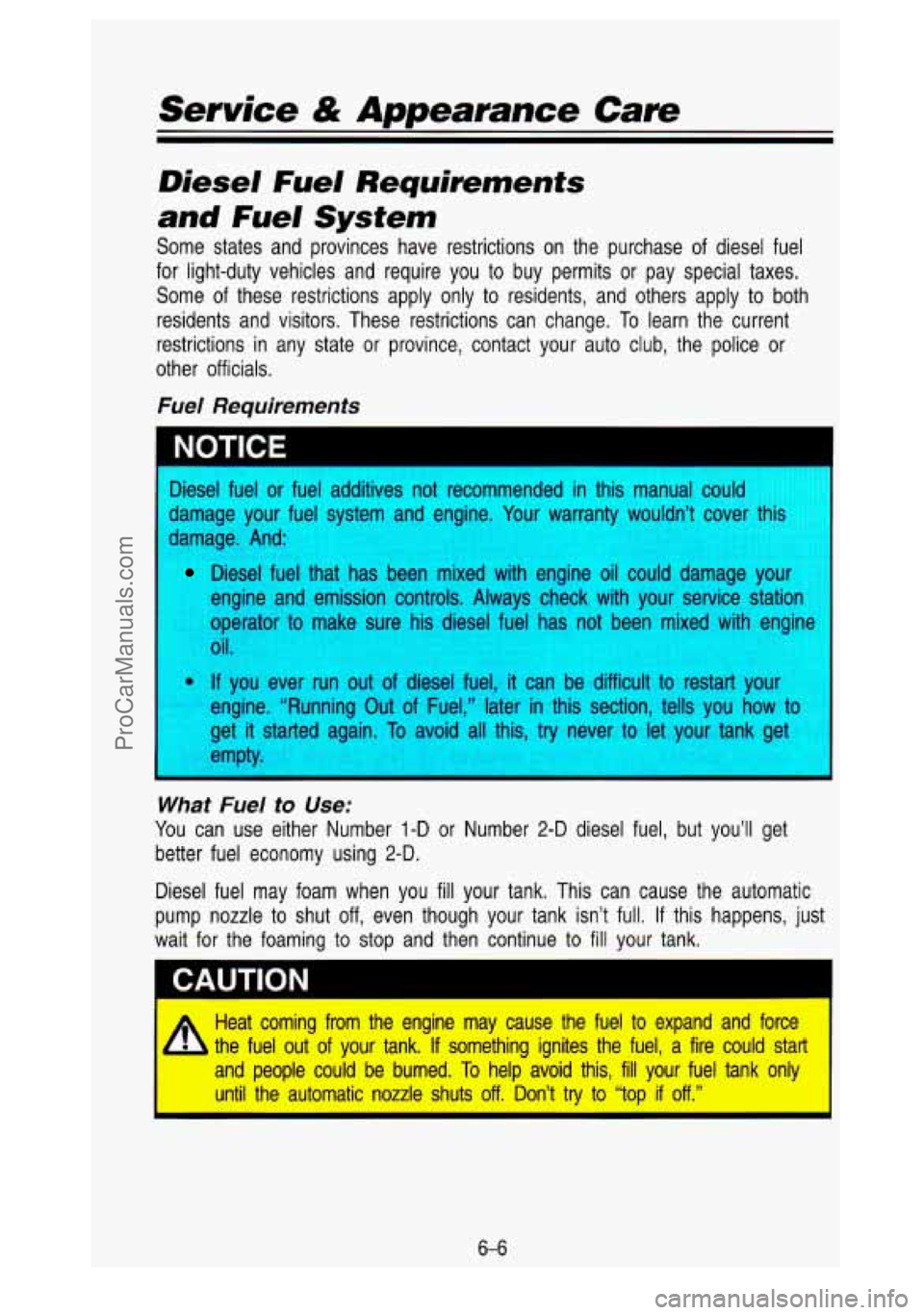
Diesel Fuel Requirements
and Fuel System
Some states and provinces have restrictions on the purchase of diesel fuel
for light-duty vehicles and require you
to buy permits or pay special taxes.
Some of these restrictions apply only
to residents, and others apply to both
residents and visitors. These restrictions can change.
To learn the current
restrictions in any state or province, contact your auto club, \
the police or
other officials.
Fuel Requirements
1 NOTICE
Diesel fuel or fuel additives not recommended in this manual could
damage your fuel system and engine. Your warranty wouldn’t cover thi
damage. And:
Diesel fuel that has been mixed with engine oil could damage your
engine and emission controls.
Always check with your service station
his
diesel fuel, it can be difficult to restart your
engine. “Running Out of Fuel,” later
in this section, tells you how to
get
it started again. To avoid all this, try never to let. your tank get
What Fuel to Use:
You can use either Number I-D or Number 2-D diesel fuel, but you’ll get
better fuel economy using
2-D.
Diesel fuel may foam when you fill your tank. This can cause the automatic
pump nozzle
to shut off, even though your tank isn’t full. If this happens, just
wait for the foaming to stop and then continue to fill your tank.
1 CAUTION
- Heat coming from the engine may cause the fuel to expand and force
the fuel out of your tank. If something ignites the fuel, a \
fire could start
and people could be burned.
To help avoid this, fill your fuel tank only
until the automatic nozzle shuts
off. Don’t try to “top if off .” I
I
6-6
ProCarManuals.com
Page 287 of 436
7
F
K2451
..
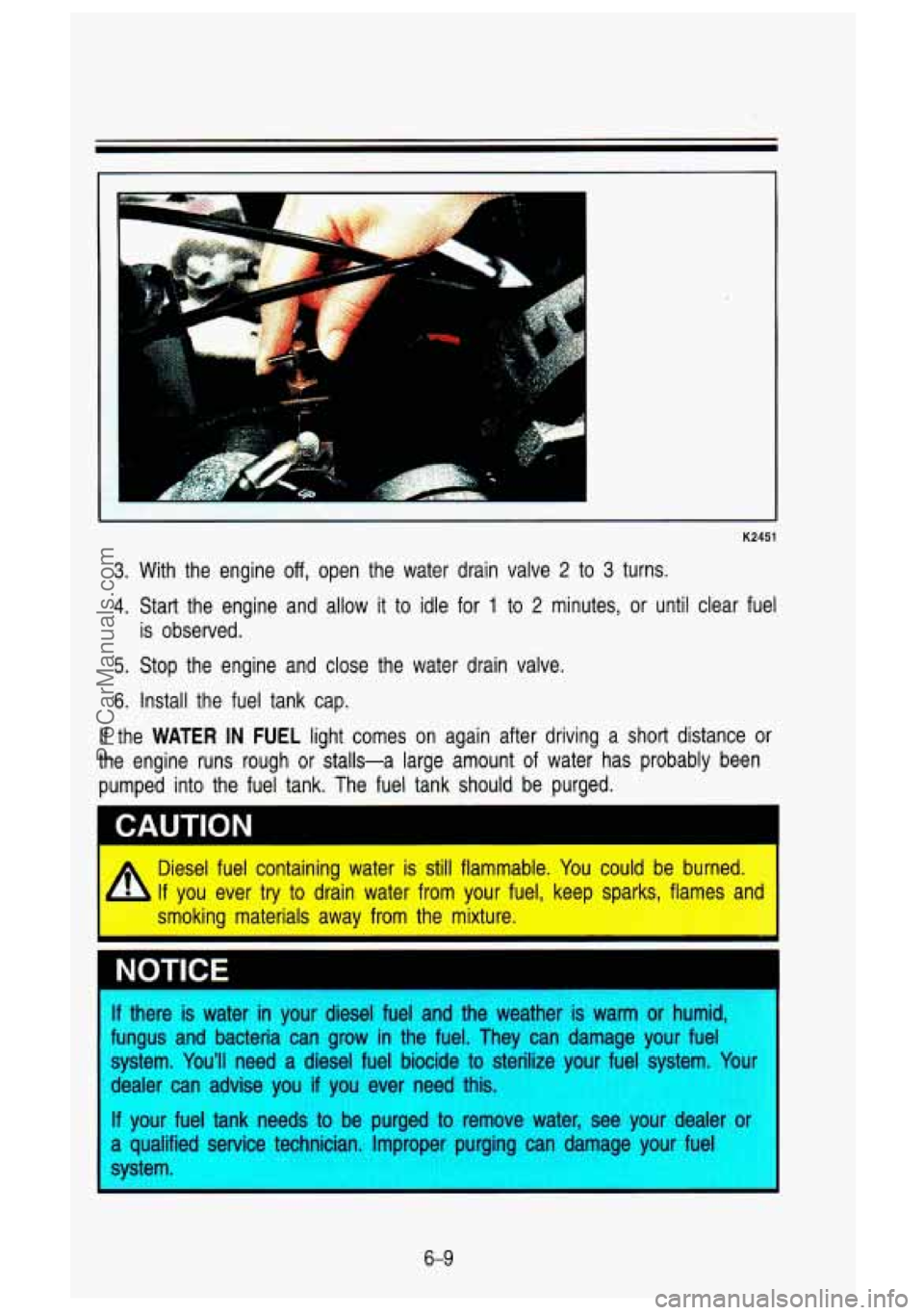
3. With the engine off, open the water drain valve 2 to 3 turns.
4. Start the engine and allow it to idle for 1 to 2 minutes, or until clear fuel
is observed.
5. Stop the engine and close the water drain valve.
6. Install the fuel tank cap.
If the
WATER IN FUEL light comes on again after driving a short distance or
the engine runs rough or stalls-a large amount of water has probably been
pumped into the fuel tank. The fuel tank should be purged.
~ CAUTION I
A Diesel fuel containing water is still flammable. You could h~ burmi.
If you eve:r try to drain water from your fuel, kee,p sparks mes d.
. smoking materials away from the mixture.
If there is water in your diesel fuel and the weather is warm or humid,
fungus and bacteria can grow in the fuel. They can damage your fuel
system. You'll need a diesel fuel biocide
to sterilize your fuel system. Your
dealer can advise you
if you ever need this.
If your fuel tank needs to be purged to remove water, see your dealer or
a qualified service technician. Improper purging can damage your fuel
system.
6-9
ProCarManuals.com