oil GMC SIERRA 1993 Owner's Guide
[x] Cancel search | Manufacturer: GMC, Model Year: 1993, Model line: SIERRA, Model: GMC SIERRA 1993Pages: 436, PDF Size: 23.88 MB
Page 314 of 436
*
Senrice & Appearance Care
Manual Transmission Huld
When to Check:
the fluid in your manual transmission doesn't require changing.
How to 'Check:
Because this operation can be a :little difficult, you may cho\
ose to have this
done at your dealership Service Department.
t A good time to have it checked is when .the engine oil is changed. However,
If you do it yourself, be sure to follow' all the instructions here, or you could
get a false reading..
. . .. . . ... -
Too much or too little fluid can damage your transmission. Too much can
mean that some of the fluid could come out and fall on hot engine parts,
starting a fire. Be sure
to get an accurate reading if you check your
transmission fluid.
Check the fluid level only when your engine is
off, the vehicle is parked on a
level place and the transmission is cool enough for you to re\
st your fingers
on the transmission case.
Then, follow these steps:.
~ ~~ ~
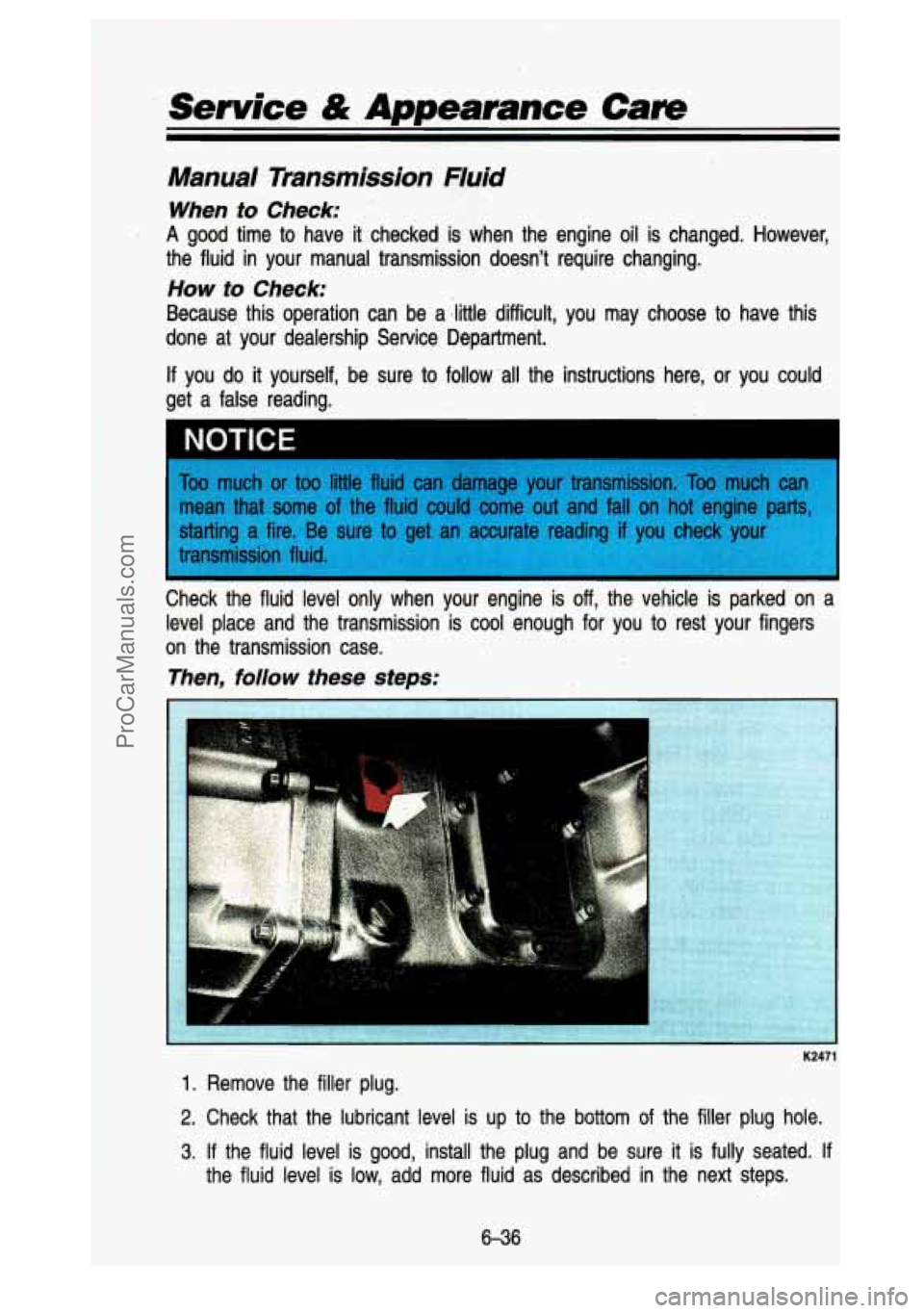
1. Remove the filler plug.
K2471
2. Check that the lubricant level is up to the bottom of the filler- plug hole.
3. If the fluid level is good, install the plug and be sure it is fully seated. If
the fluid level is low, add more fluid as described in the next steps.
6-36
ProCarManuals.com
Page 320 of 436

Service & Appearance ,Care
Engine Coolant
r
PO593
The following explains your cooling system and how to add cool\
ant when it is low.
If you have a problem with -engine overheating, see “Engine
Overheating” in the Index.
The proper coolant for your vehicle will:
Give freezing protection down to -34°F (-37°C).
Give boiling protection up to 258°F (125°C).
Protect against rust and corrosion:
Help keep the proper engine temperature.
Let the warning lights and gages work as thiy should.
What to Use:
Use a ,mixture of clean water (preferably distilled), and antifreeze that meets
“GM Specification 6038-M,” which won’t damage aluminum p\
arts.
Also use
GM Engine Coolant Supplement (sealer) with a complete coolant change. If
you use these, you don’t need to add anything else.
,
6-42
ProCarManuals.com
Page 321 of 436
1 CAUTION
4 Adding only plain water to your cooling system can be dangerous.
Plain water, or some other liquid like alcohol, can boil before th(
)per coolant mix will. Your vehicle’s coolant warning system is set
for the proper coolant mix. With plain water or the wrong mix\
, your
engine could get too hot but you wouldn’t get the overheat warning.
Your engine could catch fire and you or others could be burned. Use
a
50/50 mix of clean water and a proper antifreeze.
NOTICE
If you use an improper coolant mix, your engine could overheat an\
d 1:
badly damaged. The repair cost wouldn’t be covered by your warranty. 1
much water in the mix can freeze and xk +?e t line radiator, heater
core and other parts.
Some conditions, such as air trapped in the cooling system, can affect the
coolant level in the radiator. Check the coolant level when the engine is cold
and follow the steps under “Adding Coolant” for the prope\
r way to add
coolant.
If you have the low coolant warning system, refer to the General Motors
Service Manual or see your dealer for the proper coolant
fill procedure. (To
purchase a Service Manual, see “Service Publications’’ in the Index.) Using
the wrong
fill procedure can cause a low coolant warning indication.
If you have to add coolant more than four times a year, have your dealer
check your cooling system.
If you use the proper coolant, you don’t have to add extra inhibitors or
additives which claim to improve
the system. These can be harmful.
-
NOTICE .I
6-43
ProCarManuals.com
Page 330 of 436
Service & Appearance Care
Windshield Wiper Blade Inserts
I -
r
PO232
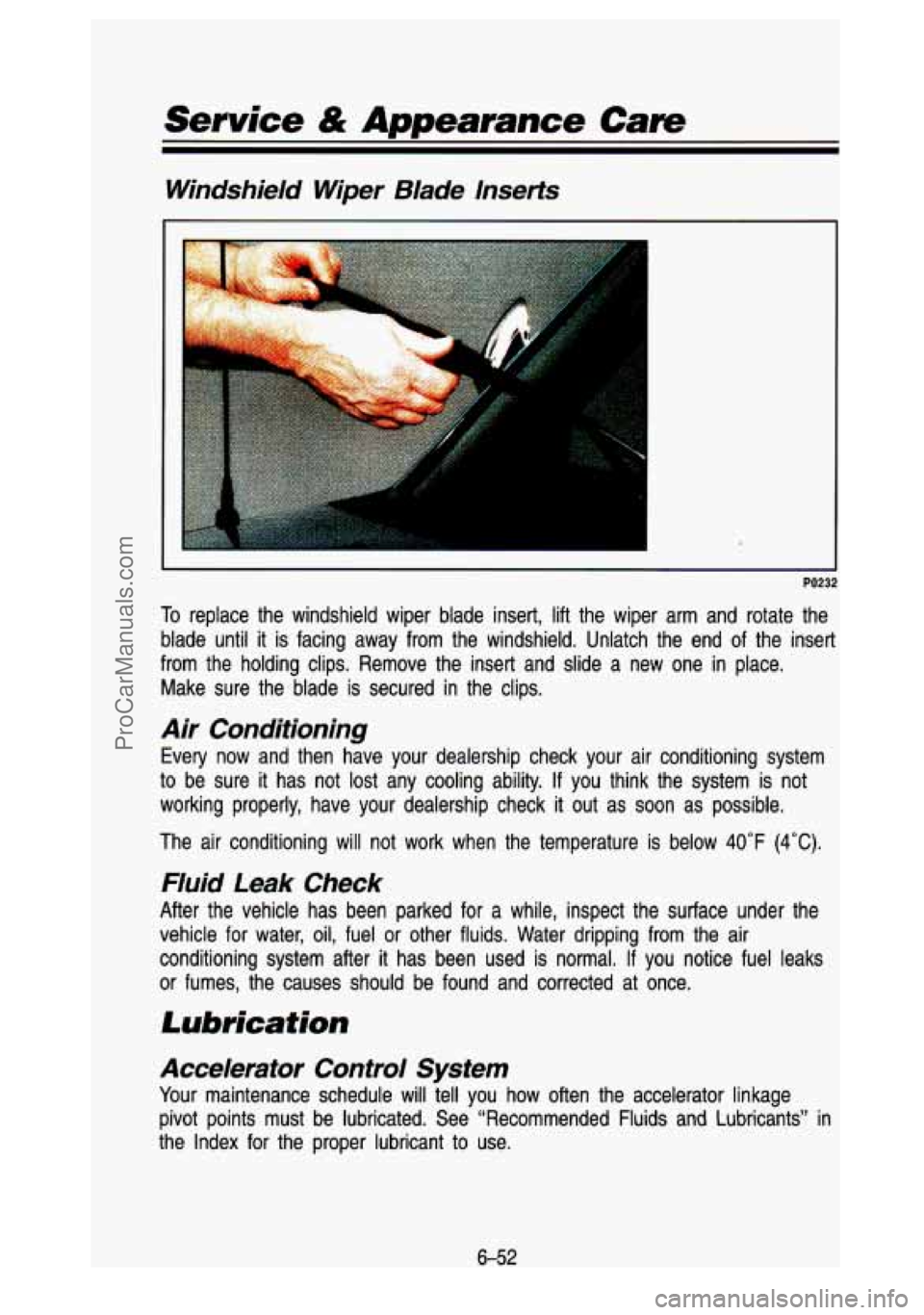
To replace the windshield wiper blade insert, lift the wiper arm and rotate the
blade until it is facing away from the windshield. Unlatch the\
end of the insert
from the holding clips. Remove the insert and slide a new one\
in place.
Make sure the blade is secured in the clips.
Air Conditioning
Every now and then have your dealership check your air conditi\
oning system
to be sure it has not lost any cooling ability.
If you think the system is not
working properly, have your dealership check it out as soon as\
possible.
The air conditioning will not work when the temperature is bel\
ow 40°F
(4°C).
Fluid Leak Check
After the vehicle has been parked for a while, inspect the su\
rface under the
vehicle
for water, oil, fuel or other fluids. Water dripping from the air
conditioning system after it has been used is normal, If you notice fuel leaks
or fumes, the causes should be found and corrected at once.
Lubrication
Accelerator Control System
Your maintenance schedule will tell you how often the accelerator linkage
pivot points must be lubricated. See “Recommended Fluids and \
Lubricants” in
the Index for the proper lubricant to use.
6-52
ProCarManuals.com
Page 331 of 436

Accelerator cables and cruise control cables should not be lubr\
icated. Any
cables that are worn or are hard to pull should be replaced. \
Remove external deposits from injector pump face cam on 6.2L d\
iesel
engines, when the engine is cold.
Hood Latches and Hood Hinge
Your maintenance schedule will tell you how often to lubricate the \
hood latch
and hood hinge assembly. See “Recommended Fluids and Lubrican\
ts” in the
Index for the proper lubricant to use.
Propeller Shaft Slip Splines
See your maintenance. schedule to find out how often the slip \
splines must
be lubricated. See “Recommended Fluids and Lubricants” in \
the Index for the
proper lubricant to use.
Constant Velocity Joints
See your maintenance schedule to find out how often the consta\
nt velocity
joints must be lubricated. See “Recommended Fluids and .Lubri\
cants” in the
Index for the proper lubricant to use.
80dy
Normal use of your vehicle will cause metal to metal wear at some points on
the cab and body
if they are not lubricated.
For exposed surfaces, such as door checks, door lock bolts, lo\
ck striker
plates, dovetail bumper wedges, etc., a thin film of engine oil should be
applied.
The seat adjusters and seat track should be lubricated with chassis grease.
Door weather strips and rubber hood bumpers should be lightly coated with a
rubber lubricant.
Never use too much of any lubricant and be sure to wipe up any extra
lubricant when you are finished.
Your maintenance schedule
will tell you how often to lubricate these Ilems.
See “Recommended Fluids and Lubricants” in the Index for \
the proper
lubricant to use.
Lock Cylinders
To be sure your locks operate properly, they must be lubricated. \
Your vehicle’s
maintenance schedule
will tell you how often to lubricate them. See
“Recommended Fluids and Lubricants” in the Index for the proper lubricant to
use.
6-53
ProCarManuals.com
Page 332 of 436
Service & Appearance Care
You should not use penetrating oils because they could wash out the factory
installed lubricant and cause the lock to bind. De-icers which contain alcohol
could also wash away the lubricant,
so be sure to lubricate the lock after
using a de-icer of this type.
Tailgate Handle
The tailgate handle pivot points on your vehicle should be lub\
ricated to keep
it working smoothly.
Your maintenance schedule will tell you how often to lubricate the handle.
See “Recommended Fluids and Lubricants” in the Index for the proper
lubricant to use.
Electrical System
Battery
Every new GM vehicle has a Delco Freedom@ battery. You never have to
add water to one of these. When it’s time for a new battery, we recomme\
nd
a Delco Freedom@ battery. Get one that has the catalog number \
shown on
the original battery’s label.
Vehicle Storage
If you’re not going to drive your vehicle for 25 days or more, take off the
black, negative
(-) cable from the battery. This will help keep your battery
from running down.
I - Batteries have acid that can burn you and gas that can explod\
e. You I
1 can be badly hurt if you aren’t careful. See “Jump Starting” in the
Index for tips on working around a battery without getting hur\
t.
Contact your dealer to learn how to prepare your vehicle for longer periods.
Bulb Replacement
Before you replace any bulbs, be sure that all the lights are off and the
engine isn’t running.
6-54
ProCarManuals.com
Page 333 of 436
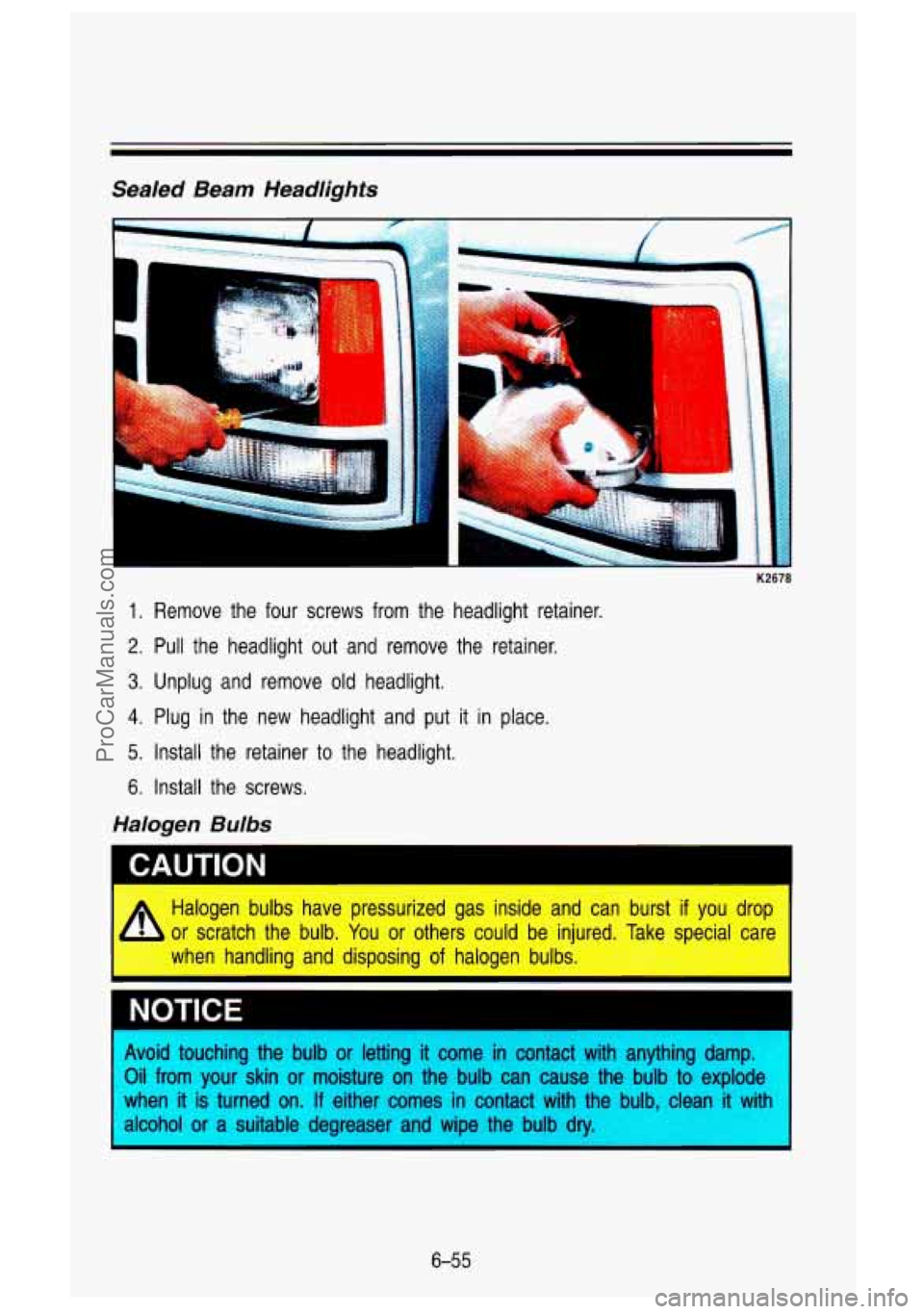
Sealed Beam Headlights
t i
1. Remove the four screws from the headlight retainer.
2. Pull the headlight out and remove the retainer.
3. Unplug and remove old headlight.
4. Plug in the new headlight and put it in place.
5. Install the retainer to the headlight.
6. Install the screws.
Halogen Bulbs
Halogen bulbs have pressurized gas inside and can burst if you drop
or scratch the bulb. You or others could be injured. Take special care
when handling and disposing of halogen bulbs.
& s+?-.- --_ >= - - . * . . . ,x. J - * -
:hi , ._.. i , c: .-?v2 fqk-sq -%. -Lac
Avoid touching the bulb or letting it come in contact with anything damp
Oil from your skin or moisture on the bulb can cause the bulb to explode
when
it is turned on. If either comes in contact with the bulb, clean it with
alcohol or
a suitable degreaser and wipe the bulb dry.
6-55
ProCarManuals.com
Page 364 of 436
Service & Appearance Care
Rinse the section with a clean, wet sponge.
Wipe off what’s left with a slightly damp paper towel or cloth.
Then dry it immediately with an air hose, a hair dryer or a heat lamp.
I
~~~
careful with a hair dryer or heat lamp. You could scorch me lauric.
Wipe with a clean cloth.
Using Solvent-Type Cleaner on Fabric
First, see if you have to use solvent-type cleaner at all. Some spots and
stains will clean
off better with just water and mild soap.
If you need to use it, then:
Gently scrape excess soil from the trim material with a clean,\
dull knife
or scraper. Use very little cleaner, light pressure and clean cloths
(preferably cheesecloth). Cleaning should start at the outside \
of the stain,
“feathering” toward the center. Keep changing to a clean section of the
cloth.
When you clean a stain from fabric, immediately dry the area with an
air hose, hair dryer,
or heat lamp to help prevent a cleaning ring. (See
previous NOTICE.)
Fabric Protection
Your vehicle has upholstery that has been treated with ScotchgardTM \
Fabric
Protector, a
3M product. ScotchgardTM protects fabrics by repelling oil and
water, which are the carriers of most stains. Even with this protection, you
still need to clean your upholstery often
to keep it looking new.
Further information on cleaning is available by calling 1-800-433-3296
(in
Minnesota, 1-800-642-61 67).
Special Cleaning Problems
Greasy or Oily Stains: Like grease, oil, butter, margarine, shoe polish, coffee
with cream, chewing gum, cosmetic creams, vegetable oils, wax c\
rayon, tar
and asphalt.
Carefully scrape off excess stain.
Then follow the solvent-type instructions above.
Shoe polish, wax crayon, tar and asphalt will stain if left on a vehicle
seat fabric. They should be removed as soon as possible. Be c\
areful,
because the cleaner will dissolve them and may cause them to bleed.
6-86
ProCarManuals.com
Page 367 of 436
r Machine compounding or aggressive polishing on a basecoatlclearcoat
paint finish may
dull the finish or leave swirl marks.
Protecting Exterior Bright Metal Parts
Bright metal parts should be cleaned regularly to keep their luster. Washing
with water is all that is usually needed. However, you may use GM Chrome.
Polish on chrome or stainless steel trim,
if necessary.
Use special care with aluminum trim.
To avoid damaging protective trim, never
use auto or chrome polish, steam or caustic soap to clean aluminum.
A
coating of wax, rubbed to a high polish, is recommended for all bright metal
parts.
Aluminum Wheels (If So Equipped)
Your aluminum wheels have a protective coating similar to the painted surface
of your vehicle. Don’t use strong soaps, chemicals, chrome polish,
or other
abrasive cleaners on them because you could damage this coating. After
rinsing thoroughly, a wax may be applied.
1 NOTICE
If you have aluminum wheels, don’t use an automatic vehicle wash that
has hard silicon carbide cleaning brushes. These brushes can take
off the
I protective coating.
White Side wall Tires
Your General Motors dealer has a GM White Sidewall Tire Cleaner. You can
use a stiff brush with it.
Weatherstrips
These are places where glass or metal meets rubber. Silicone g\
rease there
will make them last longer, seal better, and not stick
or squeak. Apply silicone
grease with a clean cloth at least every six months.
Sheet Metal Damage
If your vehicle is damaged and requires sheet metal repair or replacement,
make sure the body repair shop applies anti-corrosion material \
to the parts repaired or replaced to restore corrosion protection.
Foreign Material
Calcium chloride and other salts, ice melting agents, road oil and tar, tree
sap, bird droppings, chemicals from industrial chimneys, and other foreign \
matter can damage your vehicle’s finish
if they remain on painted surfaces.
Use cleaners that are marked safe for painted surfaces for these stains.
6-89
ProCarManuals.com
Page 369 of 436
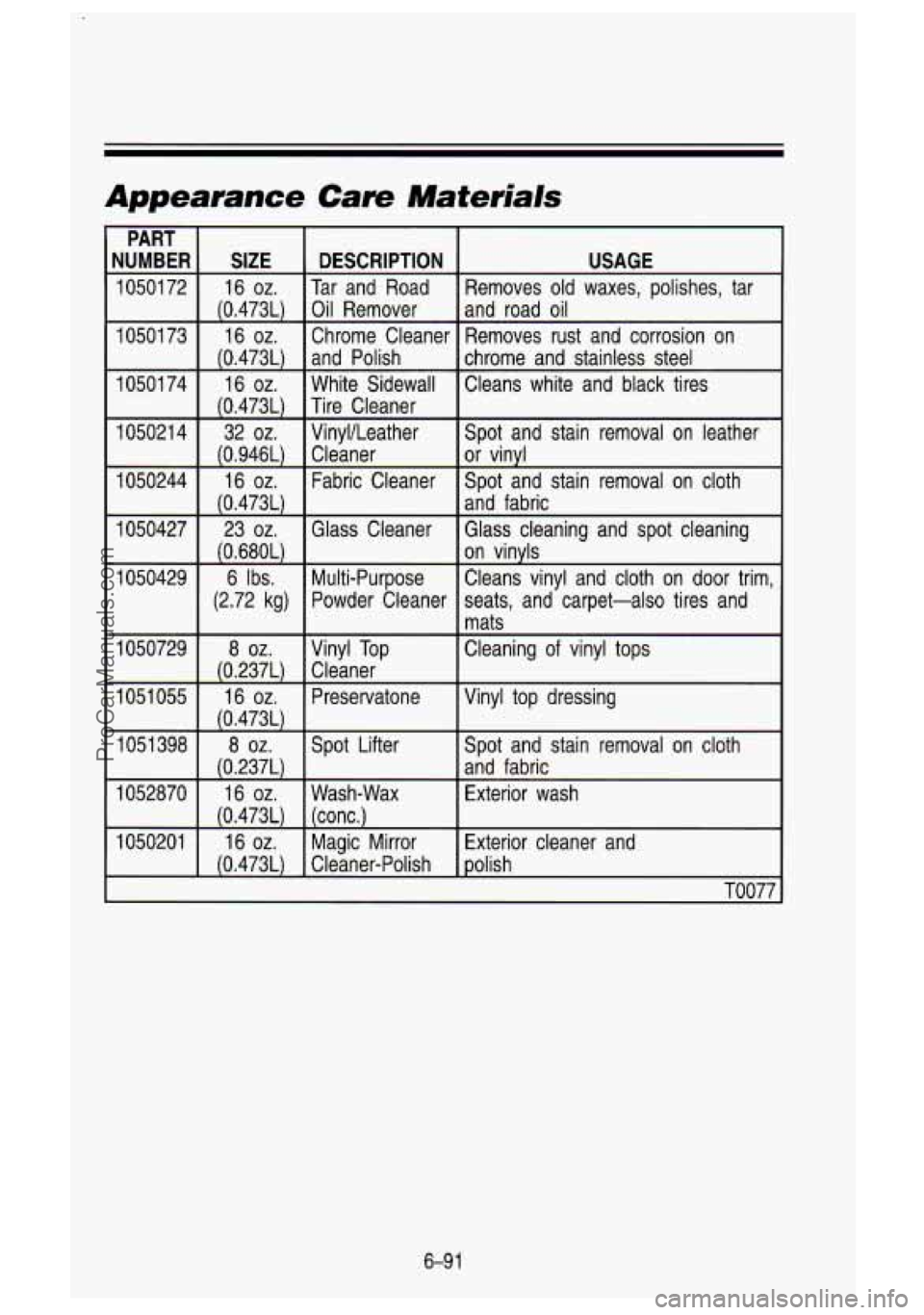
Appearance Care Materials
PART
NUMBER SIZE
1050172 16 oz.
(0.473L)
1050173 16
oz.
(0.473L)
1050174
16 oz.
(0.473L)
1050214 32
oz.
I050729 8 oz.
(0.237L)
1051055 16
oz.
(0.473L)
1051398
8 oz.
(0.237L)
1052870 16
oz.
DESCRIPTION
Tire Cleaner Cleans white and black tires White Sidewall chrome and stainless steel and Polish Removes rust and corrosion on Chrome Cleaner
and road oil Oil Remover
Removes old waxes, polishes, tar
Tar and
Road
USAGE
VinyVLeather Spot and stain removal on leather
Cleaner or vinyl
Fabric Cleaner Spot and stain removal
on cloth
Glass Cleaner Glass cleaning and spot cleaning
Multi-Purpose Cleans vinyl and cloth on door trim,
Powder Cleaner seats, and carpet-also tires and mats
Vinyl Top Cleaning
of vinyl tops
Cleaner
Preservatone Vinyl
top dressing
Spot Lifter Spot and stain removal on cloth
Wash-Wax Exterior wash
and fabric
on vinyls
and fabric
Magic Mirror polish
Cleaner-Polish Exterior cleaner and
TO077
6-9
1
ProCarManuals.com