brake light GMC SIERRA 1993 Owners Manual
[x] Cancel search | Manufacturer: GMC, Model Year: 1993, Model line: SIERRA, Model: GMC SIERRA 1993Pages: 436, PDF Size: 23.88 MB
Page 14 of 436
How To Use This Manual
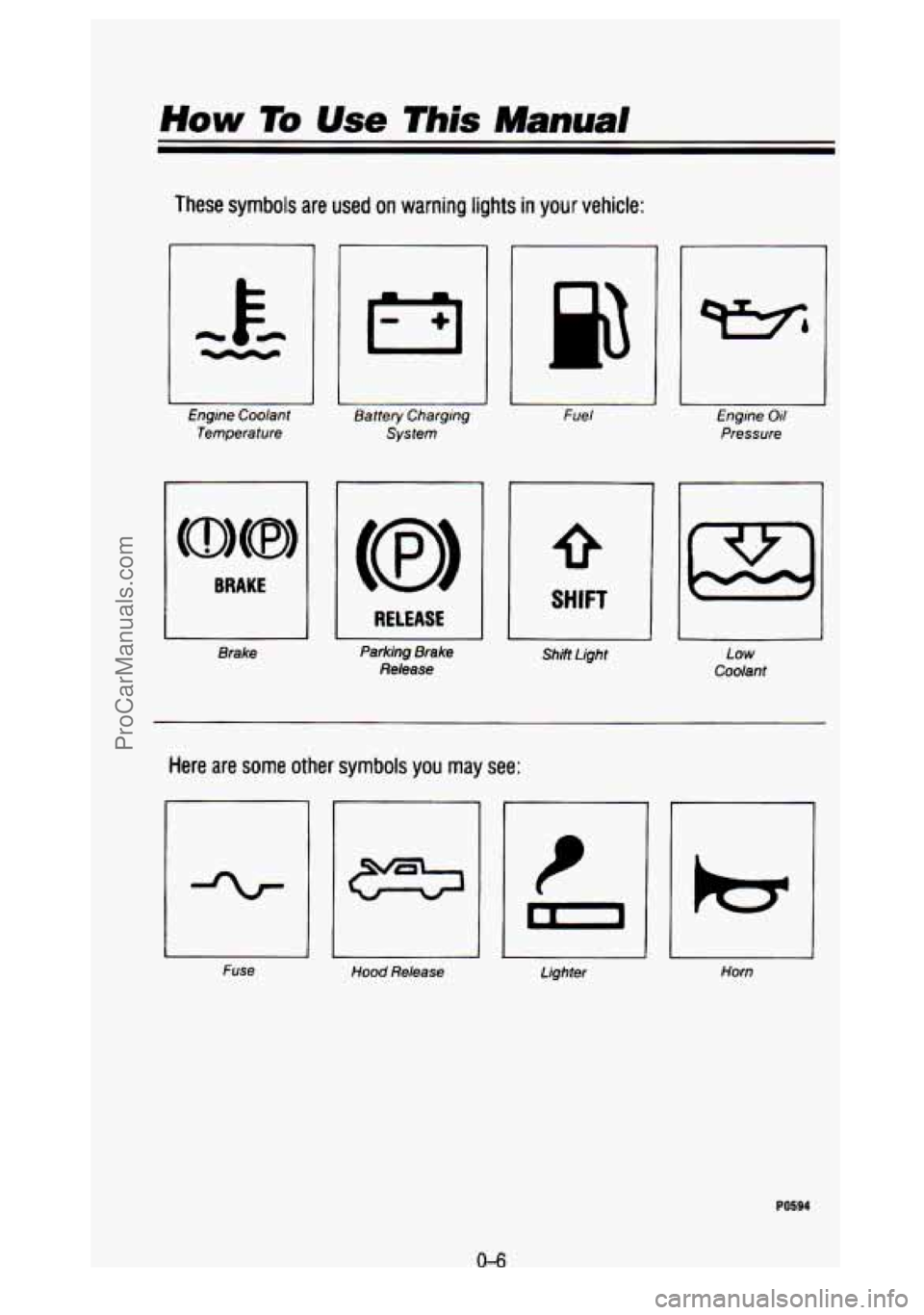
These symbols are used on warning lights in your vehicle:
1-
Engine Coolant Temperature
BRAKE
Brake Battery
Charging
System
I RELEASE
Parking Brake Release
s Fuel
SHIFT
Shift Light
Engine Oil
Pressure
Low
Coolant
Here are some other symbols you may see:
Fuse
I II
Hood Release Lighter Horn
PO594
0-6
ProCarManuals.com
Page 70 of 436

Featums & Contmls
Parking Brake ........................................................................\
.............................. 2-29
Parking Over Things That Burn
........................................................................\
. 2-33
Engine Exhaust
........................................................................\
........................... 2-34
Running Your Engine While You’re Parked
...................................................... 2-35
Four-wheel Drive
........................................................................\
........................ 2-36
Transfer Case
........................................................................\
.......................... 2-37
Front Axle Locking Feature
........................................................................\
.... 2-38
Windows
........................................................................\
....................................... 2-39
Horn
........................................................................\
.............................................. 2-41
Tilt Wheel
........................................................................\
..................................... 2-41
Multifunction Lever
........................................................................\
...................... 2-42
Turn Signal and Lane Change Indicator
....................................................... 2-43
Headlight High-Low Beam
........................................................................\
...... 2-44
Windshield Wipers
........................................................................\
................... 2-45
Windshield Washer
........................................................................\
.................. 2-46
Cruise Control
........................................................................\
.......................... 2-47
Headlights and Vehicle Lighting
........................................................................\
. 2-53
Mirrors
........................................................................\
.......................................... 2-59
Sun Visors
........................................................................\
................................... 2-61
Cigarette LighterlAshtrays
........................................................................\
........... 2-62
Storage Compartments
........................................................................\
............... 2-63
Instrument Cluster ........................................................................\
....................... 2-70
Warning and Indicator Lights
........................................................................\
.. 2-78
Gages
........................................................................\
....................................... 2-87
Camper Wiring Harness
........................................................................\
............. 2-91
Trailer Wiring Harness
........................................................................\
................ 2-91
2-2
ProCarManuals.com
Page 95 of 436
.
N (")
To Stop-Let up on the accelerator pedal and press the brake pedal\
. Just
before the vehicle stops, press the clutch pedal and the brake pedal, and
shift to
N (Neutral).
N (Neutral)-Use this position when you start or idle your engine.
R (Reverse)-To back up, press the clutch pedal and shift into R. Let up on
the clutch pedal slowly while pressing the accelerator pedal. If you shift from
OD into R, the shift lever must first be placed in the N (Neutral) position
centered between
2 and 3 prior to shifting into R.
NOTICE I
Shift to R (Reverse) only after your vehicle is stopped. Shifting to R
(Reverse) while vour vehicle is movina could damaae vour transmission.
- -
Also, use Reverse, along with the parking brake, for parking your ve\
hicle.
Shift Light
I K2317
If you have a manual transmission, you may have a SHIFT light. This light
will show you when to shift to the next higher gear for best fuel economy.
When this light comes on, you can shift to the next higher gear
if weather,
road and traffic conditions let you. For the best fuel economy, accelerate
slowly and shift when the light comes on.
While you accelerate, it is normal for the light to go on and
off if you quickly
change the position
of the accelerator. Ignore the SHIFT light when you
downshift.
2-27
ProCarManuals.com
Page 97 of 436
Parking Brake
K2221
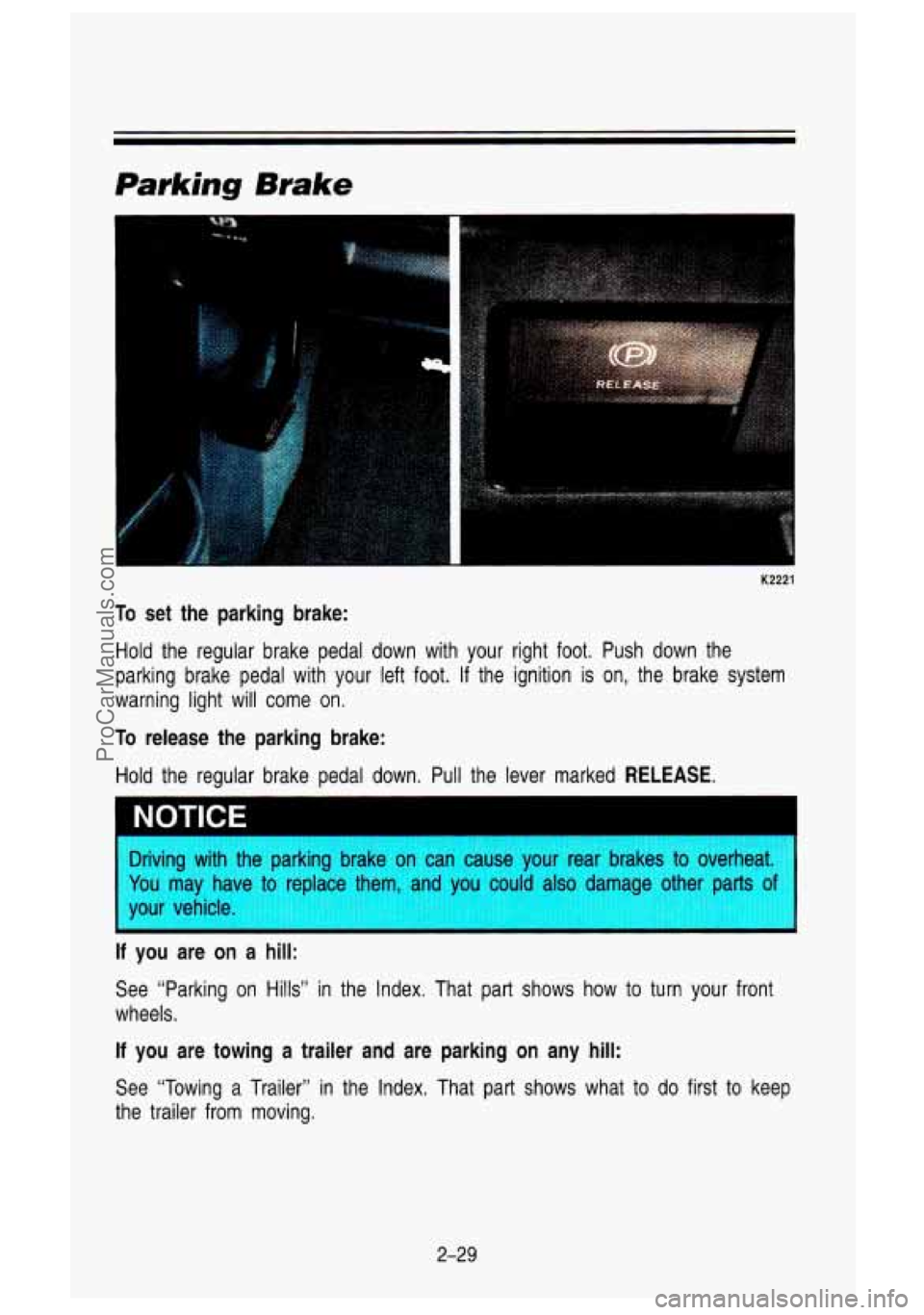
To set the parking brake:
Hold the regular brake pedal down with your right foot. Push down the
parking brake pedal with your left
foot. If the ignition is on, the brake system
warning light will come
on.
To release the parking brake:
Hold the regular brake pedal down. Pull the lever marked RELEASE.
Driving with the parking brake on can cause your rear brakes to overheat.
You may have to replace them, and you also da other p;
of I
your vehicle.
’ ‘
If you are on a hill:
See “Parking on Hills” in the Index. That part shows how to turn your front
wheels.
If you are towing a trailer and are parking on any hill:
See “Towing a Trailer” in the Index. That part shows what to do first to keep
the trailer from moving.
2-29
ProCarManuals.com
Page 120 of 436
Features & Confmls
To Get Out of Cruise Control
I
K2206
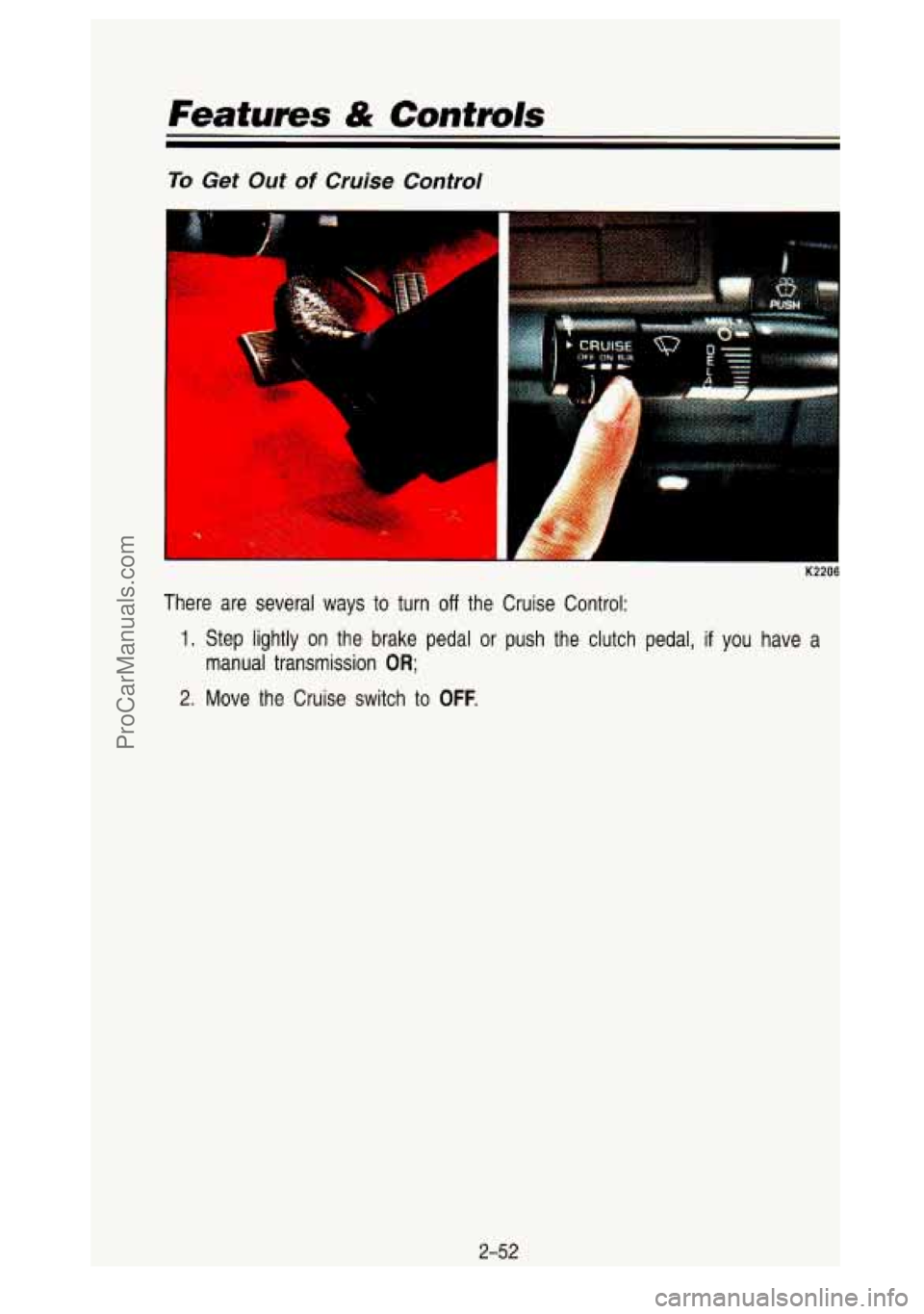
There are several ways to turn off the Cruise Control:
1. Step lightly on the brake pedal or push the clutch pedal, if you have a
manual transmission
OR;
2. Move the Cruise switch to OFF.
2-52
ProCarManuals.com
Page 123 of 436
Daytime Running Lights (DRL) Indicator Light (Canada Only)
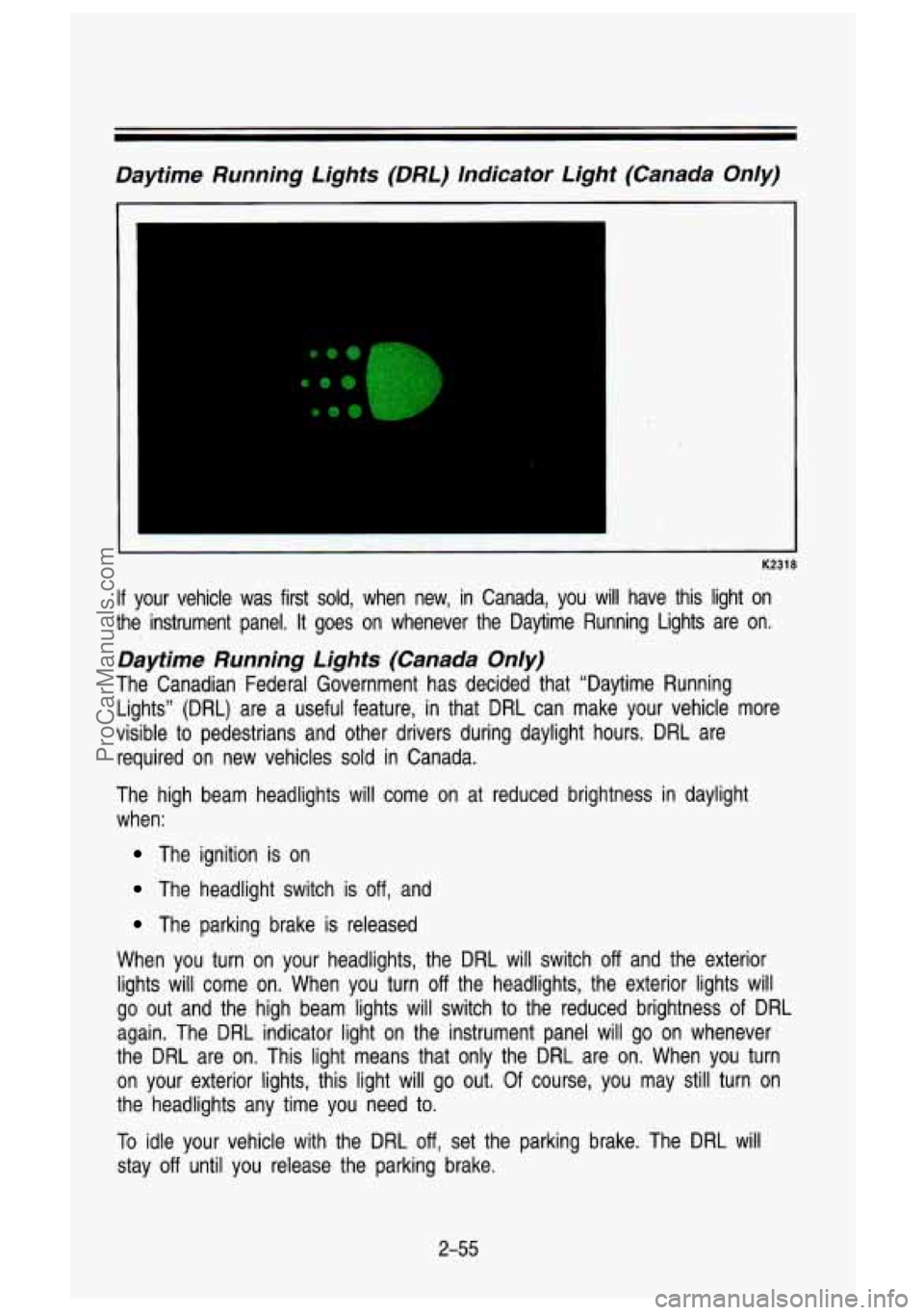
K2318
If your vehicle was first sold, when new, in Canada, you will have this light on
the instrument panel. It goes on whenever the Daytime Running \
Lights are on.
Daytime Running Lights (Canada Only)
The Canadian Federal Government has decided that “Daytime Run\
ning
Lights” (DRL) are a useful feature, in that
DRL can make your vehicle more
visible to pedestrians and other drivers during daylight hours. DRL are
required on new vehicles sold in Canada.
The high beam headlights will come on at reduced brightness in daylight
when:
The ignition is on
The headlight switch is off, and
The parking brake is released
When you turn on your headlights, the DRL
will switch off and the exterior
lights will come on. When you turn
off the headlights, the exterior lights will
go out and the high beam lights will switch to the reduced brightness
of DRL
again. The DRL indicator light on the instrument panel will go\
on whenever
the DRL are on. This light means that only the DRL are on. When you turn
on your exterior lights, this light will go out.
Of course, you may still turn on
the headlights any time you need to.
To idle your vehicle with the DRL off, set the parking brake. The DRL will
stay
off until you release the parking brake.
2-55
ProCarManuals.com
Page 147 of 436
you know they’re working. If you are familiar. with this section, you should not
be alarmed when this happens.
Gages can indicate when there may be or is _a problem with one of your
vehicle’s functions. Often gages and warning lights work together
to let you
know when there’s a problem with your vehicle.
When one of the warning lights comes on and stays on when yo\
u are driving, or when one of the gages shows there may be a probl\
em, check the
section that tells you what to do about it. Please follow the\
manual’s advice.
Waiting to do repairs can be costly-and even dangerous.
So please get to
know your warning lights and gages. They’re a big help.
Brake System. Warning Light
BRAKE
. , K2325
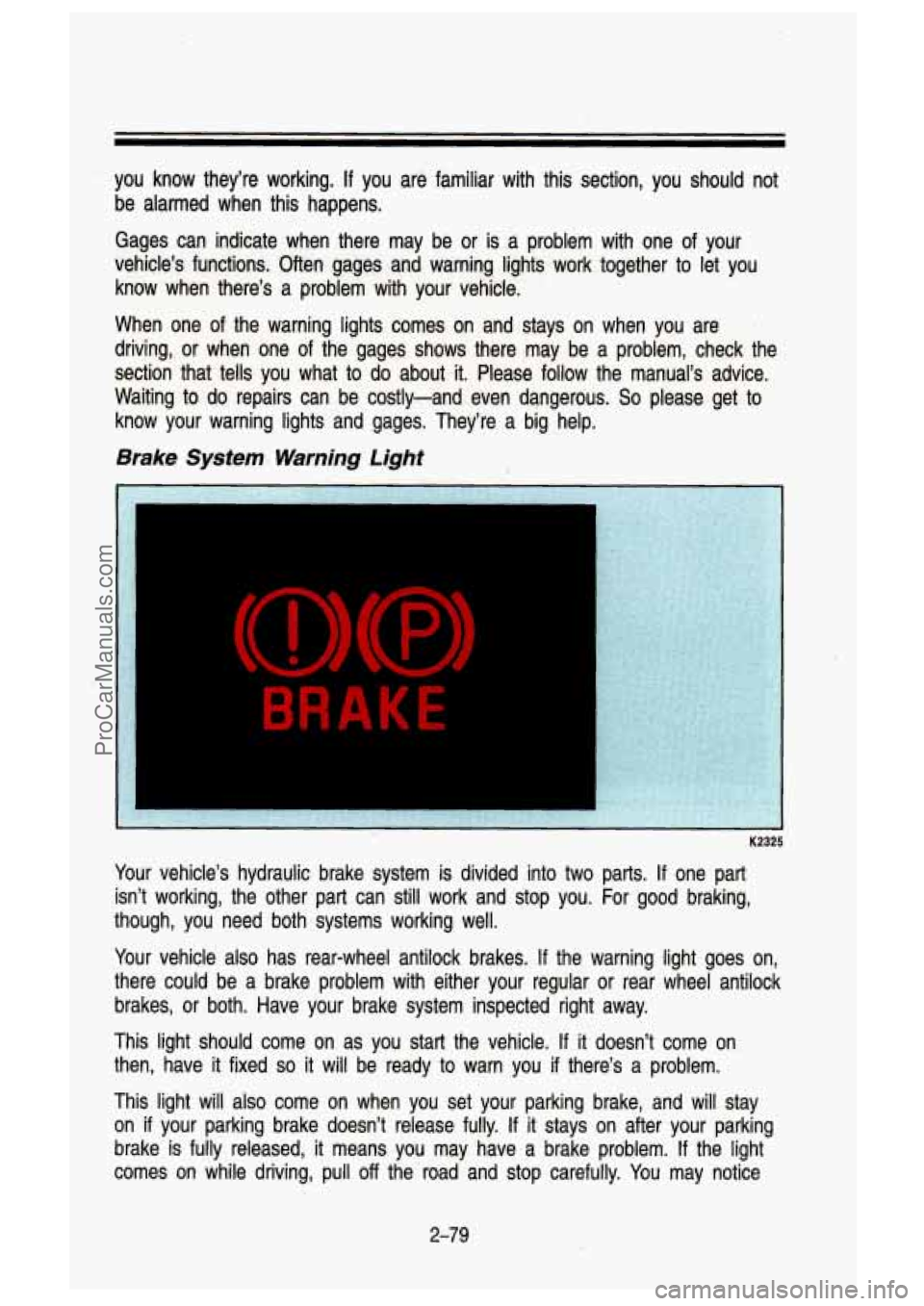
Your vehicle’s hydraulic brake system is divided into two parts. If ,one‘ part
isn’t working, the other part can still work and stop you. \
For good braking,
though, you need both- systems working well.
Your vehicle also has rear-wheel antilock brakes.
If the warning light goes on,
there could be a brake problem with either your regular or rear wheel antilock
brakes, or both. Have your brake system inspected right away.
This light should come on as you start the vehicle.
If it doesn’t come on
then, have
it fixed so it will be ready to warn you if there’s a problem.
This light
will also come on when you set your parking brake, and will stay
on
if your parking brake doesn’t release fully. If it stays on after your parking
brake is fully released,
it means you may ‘have a brake problem. If the light
comes on while driving, pull
off the road and stop carefully. You may notice
2-79
ProCarManuals.com
Page 148 of 436

Features & Controls
that the pedal is harder to push. Or, the pedal may go closer to the floor.\
It
may take longer to stop. If the light is still on, have the vehicle towed for
service. (See “Towing Your Vehicle” in the Index.)
CAUTION
* Your brake system may not be working properly if the brake warning
light is on. Driving with the brake warning light on can lead\
to an
accident.
If the light is still on after you’ve pulled off the road and
stopped carefully, have
+hq vehicle towed for service.
“WATER IN FUEL” Light
WATER
IN
FUEL I
-l PB010
This light will come on to warn you if there is too much water in the diesel
fuel system. For more information on how this light works, see\
“Diesel Fuel
Requirements and Fuel System” in the Index.
2-80
ProCarManuals.com
Page 187 of 436
Pavement Markings
NO PASSING ZONE
AM40201 6
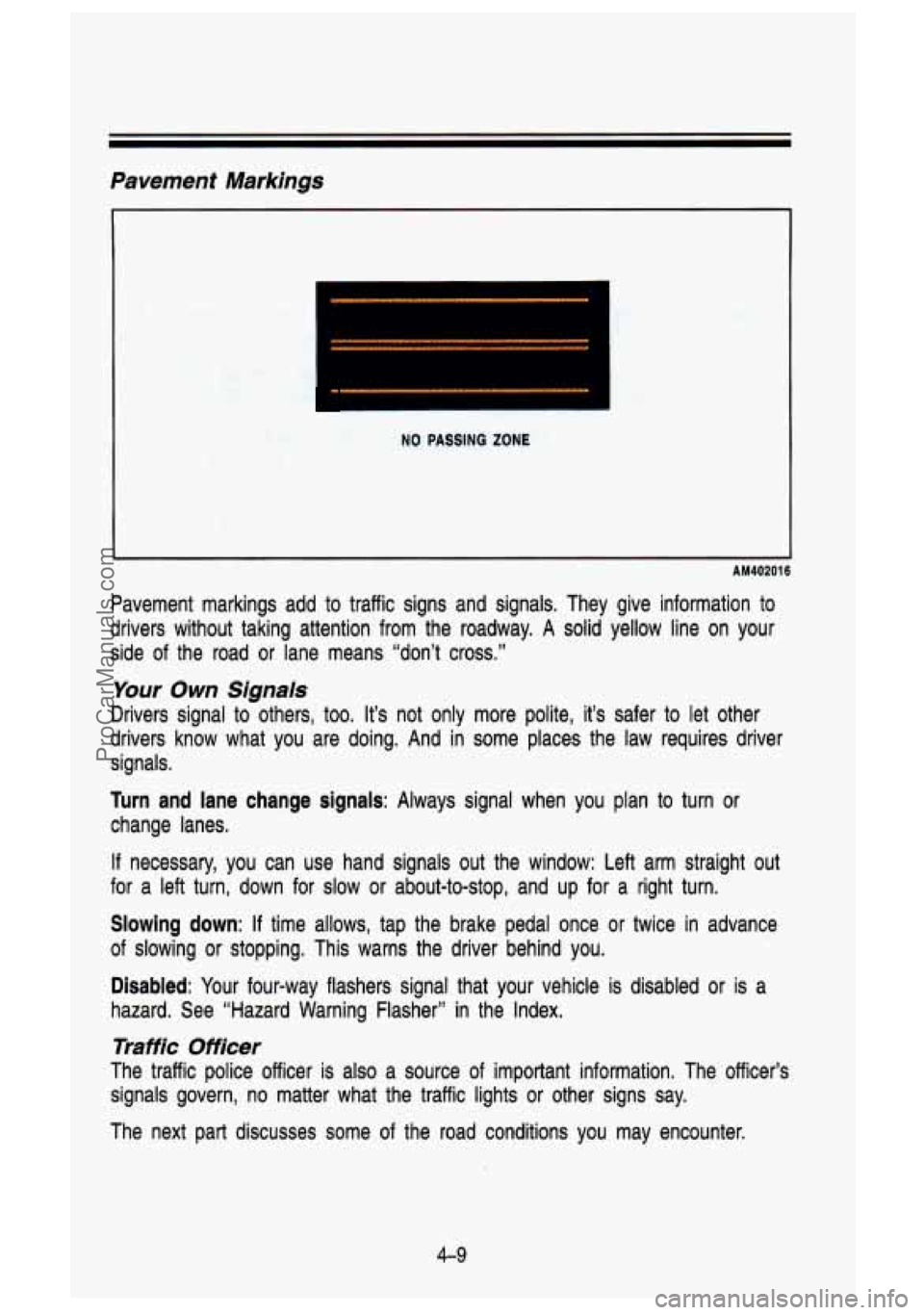
Pavement markings add to traffic signs and signals. They give information to
drivers without taking attention from the roadway. A solid yellow line on your
side
of the road or lane means “don’t cross.”
Your Own Signals
Drivers signal to others, too. It’s not only more polite, it’s safer to let other
drivers know what you are doing. And in some places the law requires driver
signals.
Turn and lane change signals: Always signal when you plan to turn or
change lanes.
If necessary, you can use hand signals out the window: Left arm \
straight out
for a left turn, down for
slow or about-to-stop, and up for a right turn.
Slowing down: If time allows, tap the brake pedal once or twice in advance
of slowing or stopping. This warns the driver behind you.
Disabled: Your four-way flashers signal that your vehicle is disabled or is a
hazard. See “Hazard Warning Flasher” in the Index.
Traffic Officer
The traffic police officer is also a source of important informaaon. The officer’s
signals govern, no matter what the traffic lights or other sig\
ns say.
The next part discusses some of the road conditions you may e\
ncounter.
4-9
ProCarManuals.com
Page 193 of 436

Most drivers treat their brakes with care. Some, however, overw\
ork the
braking system with poor driving habits.
Avoid needless heavy braking. Some people drive in spurts-heavy
acceleration followed by heavy braking-rather than keeping pace with
traffic. This is
a mistake. Your brakes may not have time to cool
between hard stops. Your brakes will wear out much faster
if you do a
lot of heavy braking.
Don’t “ride” the brakes by letting your left foot rest\
lightly on the brake
pedal while driving.
I
I
AM410001
CAUTION I
1 “Riding” your brakes can cause them to overheat to the point that
- they won’t work well. You might not be able to stop your vehicle in
time to avoid an accident. If you “ride” your brakes, they will get
so
hot they will require a lot of pedal force to slow you down. Avoid
“riding” the brakes.
NOTICE
“Riding” the brakes wears them out much faster. You would need costly
brake replacement much sooner than normal. and it also reduces fuel
economv.
4-1 5
ProCarManuals.com