mirror GMC SIERRA 1993 Owners Manual
[x] Cancel search | Manufacturer: GMC, Model Year: 1993, Model line: SIERRA, Model: GMC SIERRA 1993Pages: 436, PDF Size: 23.88 MB
Page 70 of 436

Featums & Contmls
Parking Brake ........................................................................\
.............................. 2-29
Parking Over Things That Burn
........................................................................\
. 2-33
Engine Exhaust
........................................................................\
........................... 2-34
Running Your Engine While You’re Parked
...................................................... 2-35
Four-wheel Drive
........................................................................\
........................ 2-36
Transfer Case
........................................................................\
.......................... 2-37
Front Axle Locking Feature
........................................................................\
.... 2-38
Windows
........................................................................\
....................................... 2-39
Horn
........................................................................\
.............................................. 2-41
Tilt Wheel
........................................................................\
..................................... 2-41
Multifunction Lever
........................................................................\
...................... 2-42
Turn Signal and Lane Change Indicator
....................................................... 2-43
Headlight High-Low Beam
........................................................................\
...... 2-44
Windshield Wipers
........................................................................\
................... 2-45
Windshield Washer
........................................................................\
.................. 2-46
Cruise Control
........................................................................\
.......................... 2-47
Headlights and Vehicle Lighting
........................................................................\
. 2-53
Mirrors
........................................................................\
.......................................... 2-59
Sun Visors
........................................................................\
................................... 2-61
Cigarette LighterlAshtrays
........................................................................\
........... 2-62
Storage Compartments
........................................................................\
............... 2-63
Instrument Cluster ........................................................................\
....................... 2-70
Warning and Indicator Lights
........................................................................\
.. 2-78
Gages
........................................................................\
....................................... 2-87
Camper Wiring Harness
........................................................................\
............. 2-91
Trailer Wiring Harness
........................................................................\
................ 2-91
2-2
ProCarManuals.com
Page 127 of 436
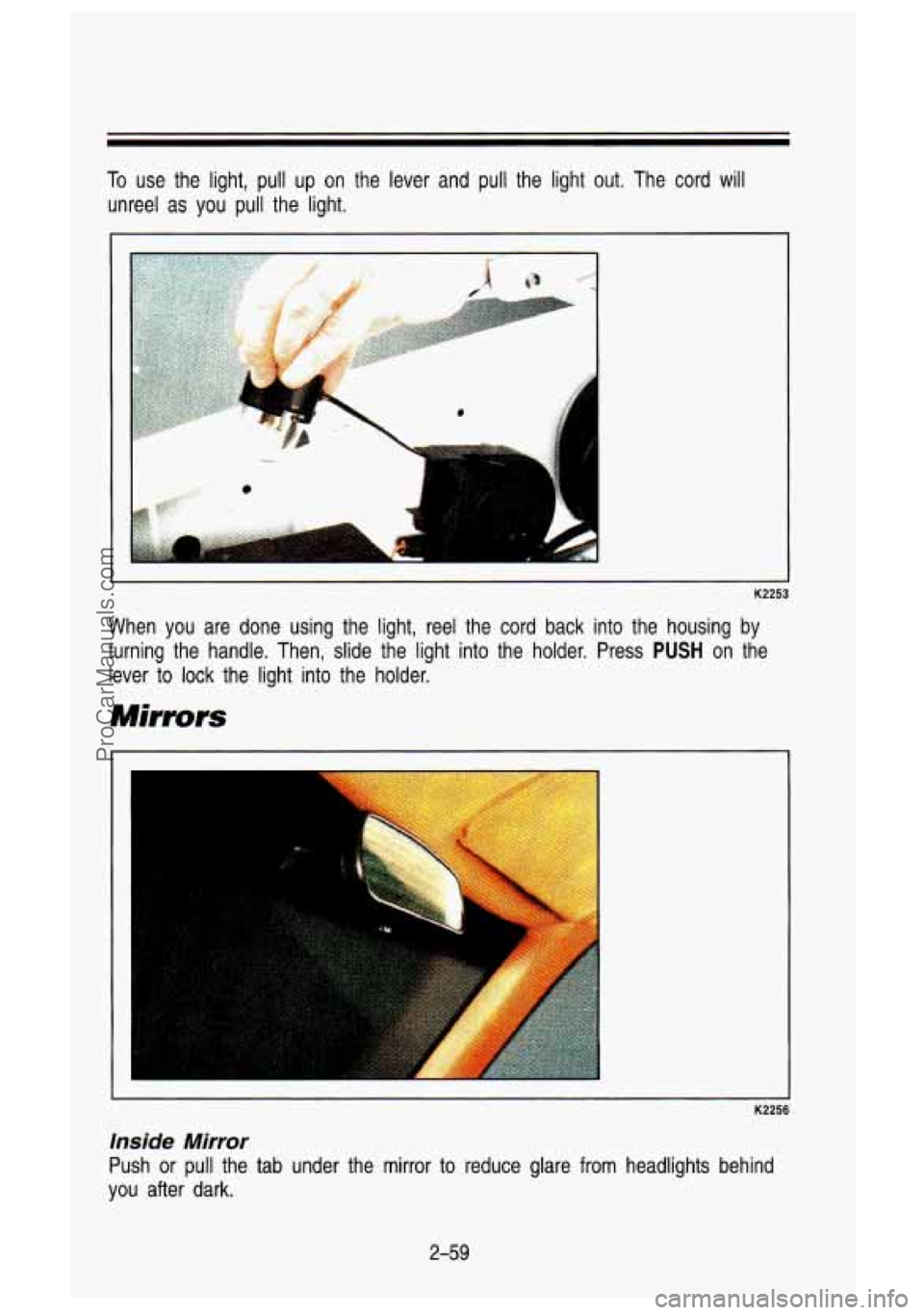
To use the light, pull up on the lever and pull the light out. The cord will
unreel as you pull the light.
K2253
When you are done using the light, reel the cord back into t\
he housing by
turning the handle. Then, slide the light into the holder. Pre\
ss
PUSH on the
lever to lock the light into the holder.
Mirrors
K2256
inside Mirror
Push or pull the tab under the mirror to reduce glare from headlights behind
you after dark.
2-59
ProCarManuals.com
Page 128 of 436
Features & Controls
Outside Mirrors
K2295
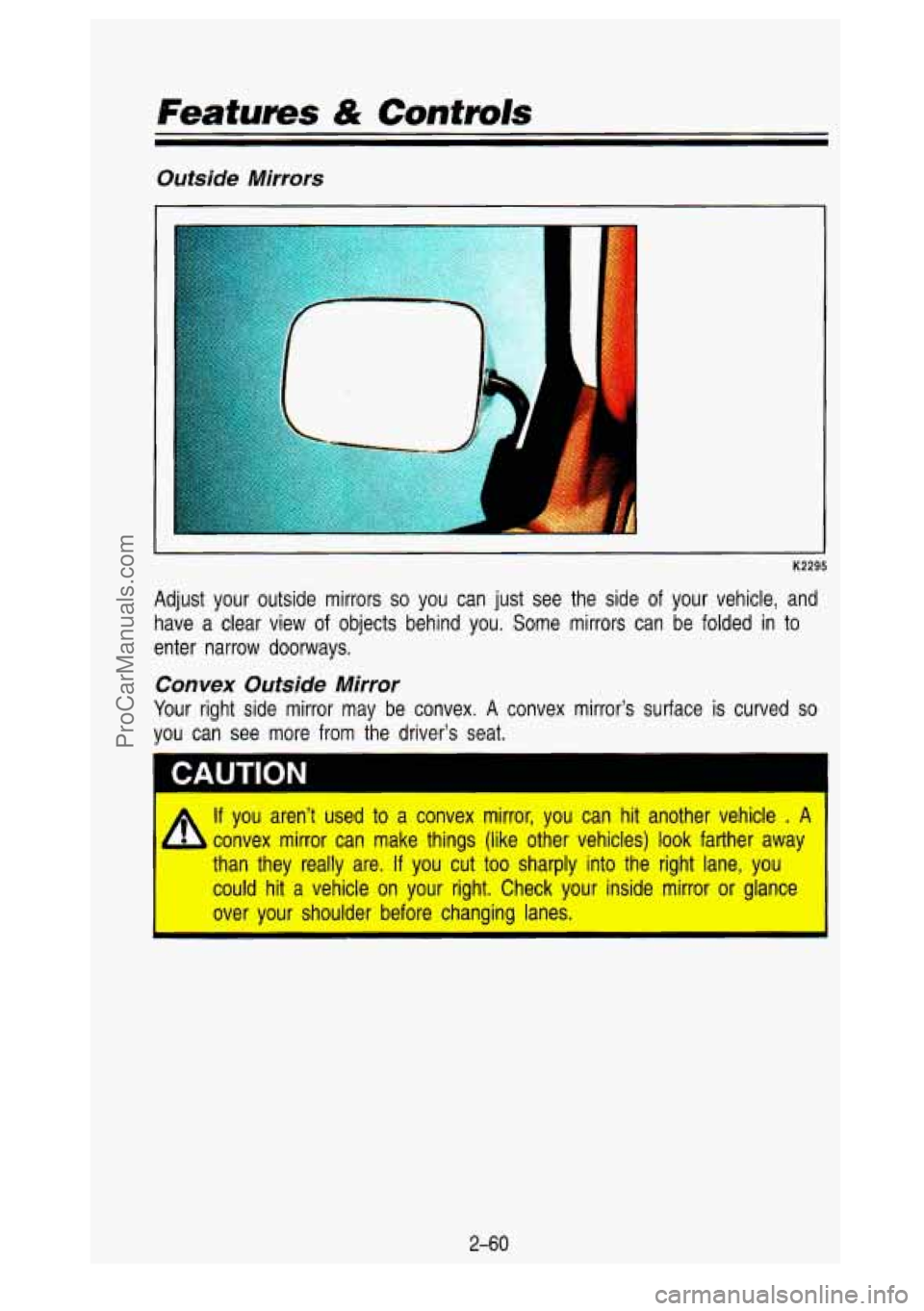
Adjust your outside mirrors so you can just see the side of your vehicle, and
have a clear view
of objects behind you. Some mirrors can be folded in to
enter narrow doorways.
Convex Outside Mirror
Your right side mirror may be convex. A convex mirror’s surface is curved so
you can see more from the driver’s seat.
If you aren’t used to a convex mirror, you can hit another vehicle . A
1 convex mirror can make things (like other vehicles) look fart\
her away
than they really are. If you cut too sharply into the right lane, you
could hit a vehicle on your right. Check your inside mirror o\
r glance over your shoulder before changing lanes.
2-60
ProCarManuals.com
Page 129 of 436
Electric Outside Rearview Mirrors
K2168
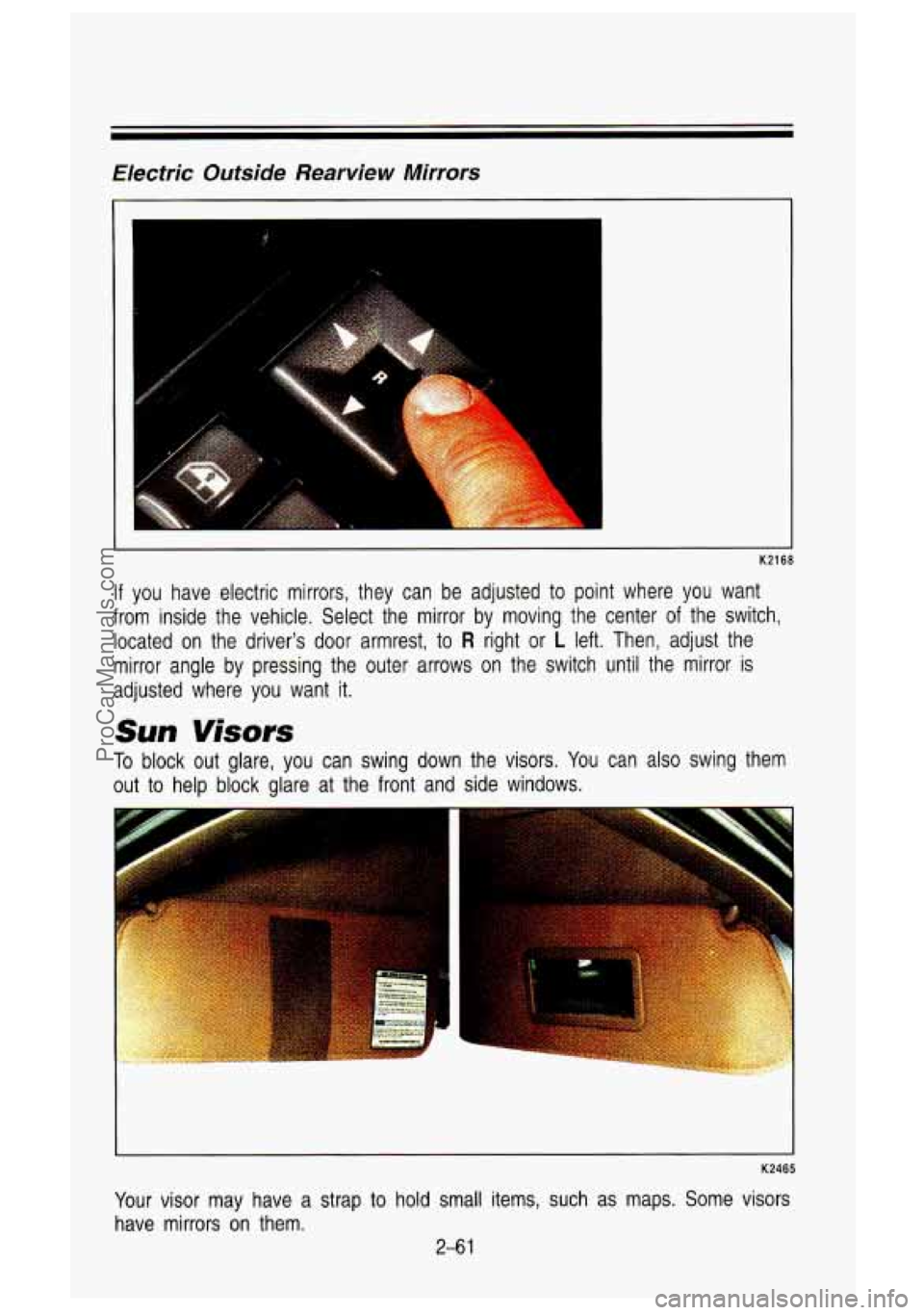
If you have electric mirrors, they can be adjusted to point where you want
from inside the vehicle. Select the mirror by moving the cente\
r of the switch,
located on the driver's door armrest,
to R right or L left. Then, adjust the
mirror angle by pressing the outer arrows on the switch until \
the mirror is
adjusted where you want
it.
Sun Visors
To block out glare, you can swing dowr
out
to help block glare at the front and
7 the visors. You can also swing them
side windows.
1
K2465
Your visor may have a strap to hold small items, such as maps. Some visors
have mirrors on them.
2-6 1
ProCarManuals.com
Page 130 of 436

Featumes & Controls
PO284
Some visors have an extender on the inside edge. When the vis\
or is down,
pull the extender out for extra glare coverage at the front o\
r side.
Some visors have mirrors with lights. The mirror lights will c\
ome on when
you
lift the mirror cover.
Cigarette Lighter/Ashtrays
PO286
To use the 'lighter, push it in all the way, and let go. When it's ready, it will
pop back by itself.
ProCarManuals.com
Page 201 of 436

Not necessarily! Passing another vehicle on a two-lane highway is a
potentially dangerous move, since the passing vehicle occupies t\
he same lane
as oncoming traffic for several seconds.
A miscalculation, an error in
judgment, or a brief surrender to frustration or anger can suddenly put the
passing driver face to face with the worst of all traffic accidents-the head-on
collision.
So here are some tips for passing:
e
e
e
e
e
“Drive ahead.” Look down the road, to the sides, and to crossroads for
situations that might affect your passing patterns.
If you have any doubt
whatsoever about making a successful pass, wait for a better t\
ime.
Watch for traffic signs, pavement markings, and lines. If you \
can see a
sign up ahead that might indicate a turn or an intersection, delay your
pass.
A broken center line usually indicates it’s all right to pass
(providing the road ahead is clear). Never cross a solid line on your side
of the lane or a double solid line, even
if the road seems empty of
approaching traffic.
If you suspect that the driver of the vehicle you want to pass isn’t aware
of your presence, tap the horn a couple of times before passing.
Do not get too close to the vehicle you want to pass while you’re
awaiting an opportunity. For one thing, following too closely r\
educes your
area of vision, especially
if you’re following a larger vehicle. Also, you
won’t have adequate space
if the vehicle ahead suddenly slows or stops.
Keep back a reasonable distance.
When it looks like a chance to pass is coming up, start
to accelerate
but stay in the right lane and don’t get too close. Time your move
so
you will be increasing speed as the time comes to move into the other
lane.
If the way is clear to pass, you will have a “running start” that
more than makes up for the distance you would lose by droppin\
g back.
And
if something happens to cause you to cancel your pass, you need
only slow down and drop back again and wait for another oppor\
tunity.
If other cars are lined up to pass a slow vehicle, wait your turn. But
take care that someone isn’t trying to pass you as you pull out to pass
the slow vehicle. Remember to glance over your shoulder and check the
blind spot.
Check your mirrors, glance over your shoulder, and start your \
left lane
change signal before moving out of the right lane
to pass. When you
are far enough ahead of the passed vehicle to see its front in your
inside mirror, activate your right lane change signal and move \
back into
4-23
ProCarManuals.com
Page 202 of 436

Your Driving and the Road
the right lane. (Remember that your right outside mirror is c\
onvex. The
vehicle you just passed may seem to be farther away from you \
than
it
really is).
Try not to pass more than one vehicle at a time on two-lane roads.
Don’t overtake a slowly moving vehicle too rapidly. Even though the
Reconsider before passing the next vehicle.
brake lights are not flashing, it may be slowing down
or starting to turn.
If you’re being passed, make it easy for the following driver to get ahead
of you. Perhaps you can ease a little
to the right.
Loss of Control
Let’s review what driving experts say about what happens whe\
n the three
control systems (brakes, steering and acceleration) don’t ha\
ve enough friction
where the tires meet the road to do what the driver has asked.
In any emergency, don’t give up. Keep trying to steel+-, arid constantly seek an
escape route
or area of less danger.
Skidding
In a skid, a driver can lose control of the vehicle. Defensive drivers avoid
most skids by taking reasonable care suited
to existing conditions, and by not
“overdriving” those conditions. But skids are always possib\
le.
The three types
of skids correspond to your vehicle’s three control systems.
In the braking skid your wheels aren’t rolling. In the steering
or cornering
skid, too much speed
or steering in a curve causes tires to slip and lose
cornering force. And in the acceleration skid too much throttle\
causes the
driving wheels to spin.
A cornering skid and an acceleration skid are best handled by ea\
sing your
foot
off the accelerator pedal. If your vehicle starts to slide (as when you turn
a corner on a wet, snow-
or ice-covered road), ease your foot off the
accelerator pedal as soon as you feel the vehicle start to sl\
ide. Quickly steer
the way you want the vehicle
to go. If you start steering quickly enough, your
vehicle
will straighten out. As it does, straighten the front wheels.
Of course, traction is reduced when water, snow, ice, gravel, or other material
is on the road.
For safety, you’ll want to slow down and adjust your driving to
these conditions. It is important to slow down on slippery surfaces because
stopping distance will be longer and vehicle control more limit\
ed.
While driving on a surface with reduced traction,
try your best to avoid
sudden steering, acceleration,
or braking (including engine braking by shifting
to a lower gear). Any sudden changes could cause the tires to slid\
e. You
4-24
ProCarManuals.com
Page 203 of 436
may not realize the surface is slippery until your vehicle is skidding. Learn to
recognize warning clues-such as enough water, ice
or packed snow on the
road to make a “mirrored surface’’-and slow down when you have \
any
doubt.
Remember: the rear wheel anti-lock braking system (RWAL) helps\
avoid only
a rear braking skid. In a braking skid (where the front wheels are no longer
rolling), release enough pressure on the brakes to get the front wheels rolling
again. This restores steering control. Push the brake pedal dow\
n steadily
when you have to stop suddenly.
As long as the front wheels are rolling, you
will have steering control. Steer the way you want to go.
Off-Road Driving with Your FourcWheel
Drive Vehicle
This off-road guide is for vehicles that have four-wheel drive. Also, see
“Anti-lock Brakes” in the Index.
If your vehicle doesn’t have four-wheel drive,
you shouldn’t drive off-road unless you’re on a level, so\
lid surface.
Off-road driving can be great fun. But it does have some defi\
nite hazards.
The greatest
of these is the terrain itself.
“Off-roading” means you’ve left the great North American\
road system behind.
Traffic lanes aren’t marked. Curves aren’t banked. There a\
re no road signs.
Surfaces can be slippery, rough, uphill
or downhill. In short, you’ve gone right
back
to nature.
Off-road driving involves some new skills. And that’s why it’s very important
that you read this guide. You’ll find many driving tips and suggestions. These
will help make your off-road driving safer and more enjoyable. \
Before You Go Off-Roading
There are some things to do before you go out. For example, be sure to
have all necessary maintenance and service work done. Be sure \
you read all
the information about your four-wheel drive vehicle in this manual.
Is there
enough fuel?
Is the spare tire fully inflated? Are the fluid levels up where
they should be? What are the local laws that apply to off-roa\
ding where you’ll be driving?
If you don’t know, you should check with law enforcement people\
in the area. Will you be on someone’s private land?
If so, be sure to get the
necessary permission.
4-25
ProCarManuals.com
Page 214 of 436

Your Driving and the Road
After Off-Road Driving
Remove any brush or debris that has collected on the underbody\
, chassis, or
under the hood. These accumulations can be a fire hazard.
After operation in mud or sand, have the brake linings cleaned\
and checked. These substances can cause glazing and uneven braking. Check th\
e body
structure, steering, suspension, wheels, tires, and exhaust syste\
m for damage.
Also, check the fuel lines and cooling system for any leakage.
Your vehicle will require more frequent service due
to off-road use. Refer to
Section
7 for additional information.
Driving at Night
I
--.
-
- AM450002 I
Night driving is more dangerous than day driving. One reason is that some
drivers are likely
to be impaired-by alcohol or drugs, with night vision
problems, or by fatigue.
Here are some tips on night driving.
Drive defensively. Remember, this is the most dangerous time.
Don’t drink and drive (See “Drunken Driving” in the Index for more on
this problem).
Adjust your inside rear view mirror to reduce the glare from headlights
Since you can’t see as well, you may need to slow down and keep
behind
you.
more space between you and other vehicles. It’s hard
to tell how fast
the vehicle ahead is going just
by looking at its taillights.
4-36
ProCarManuals.com
Page 215 of 436

Slow down, especially on higher speed roads. Your headlights ca\
n light
In remote areas, watch for animals.
If you’re tired, pull off the road in a safe place and rest.
up only
so much road ahead.
Night Vision
No one can see as well at night as
in the daytime. But as we get older
these differences increase.
A 50-year-old driver may require at least twice as
much light to see the same thing at night as a 20-year-old.
What you do in the daytime can also affect your night vision.\
For example, if
you spend the day in bright sunshine you are wise to wear sunglasses. Your
eyes will have less trouble adjusting to night.
But if you’re driving, don’t wear sunglasses at night. Th\
ey may cut down on
glare from headlights, but they also make a lot of things inv\
isible that should
remain visible-such as parked cars, obstacles, pedestrians, or e\
ven trains
blocking railway crossings. You may want
to put on your sunglasses after you
have pulled into a brightly-lighted service or refreshment area.\
Eyes shielded
from that glare may adjust more quickly to darkness back on t\
he road. But
be sure to remove your sunglasses before you leave the service\
area.
You can be temporarily blinded by approaching lights.
It can take a second or
two, or even several seconds, for your eyes to readjust to the dark. When
you are faced with severe glare (as from a driver who doesn’\
t lower the high
beams, or a vehicle with misaimed headlights), slow down a little. Avoid\
staring directly into the approaching lights. If there is a line of opposing
traffic, make occasional glances over the line of headlights to make certain
that one of the vehicles isn’t starting to move into your lane. Once you are
past the bright lights, give your eyes time to readjust before\
resuming speed.
High Beams
If the vehicle approaching you has its high beams on, signal by \
flicking yours
to high and then back to low beam. This is the usual signal to lower the
headlight beams.
If the other driver still doesn’t lower the beams, resist the
temptation to put your high beams on. This only makes
two half-blinded
drivers.
On a freeway, use your high beams only in remote areas where \
you won’t impair approaching drivers. In some places, like cities, using \
high beams is
illegal.
When you follow another vehicle on a freeway or highway, use \
low beams.
True, most vehicles now have day-night mirrors that enable the \
driver to
reduce glare. But outside mirrors are not
of this type and high beams from
behind can bother the driver ahead.
4-37
ProCarManuals.com