air condition GMC SIERRA 1994 User Guide
[x] Cancel search | Manufacturer: GMC, Model Year: 1994, Model line: SIERRA, Model: GMC SIERRA 1994Pages: 404, PDF Size: 20.91 MB
Page 228 of 404

A CAUTION:
If your vehicle has air conditioning, the auxiliary electric fa\
n
under the hood can start up even when the engine
is not running
and can injure you. Keep hands, clothing and tools away
from
any underhood electric fan.
If the coolant inside the coolant surge tank is boiling, don’t do anything else
until it cools down.
E The coolant level
should be slightly
above the
COLD
mark. If it isn’t, you
may have a leak in the
radiator hoses, heater
hoses, radiator, water
pump or somewhere
else
in the cooling
system.
5-20
ProCarManuals.com
Page 233 of 404
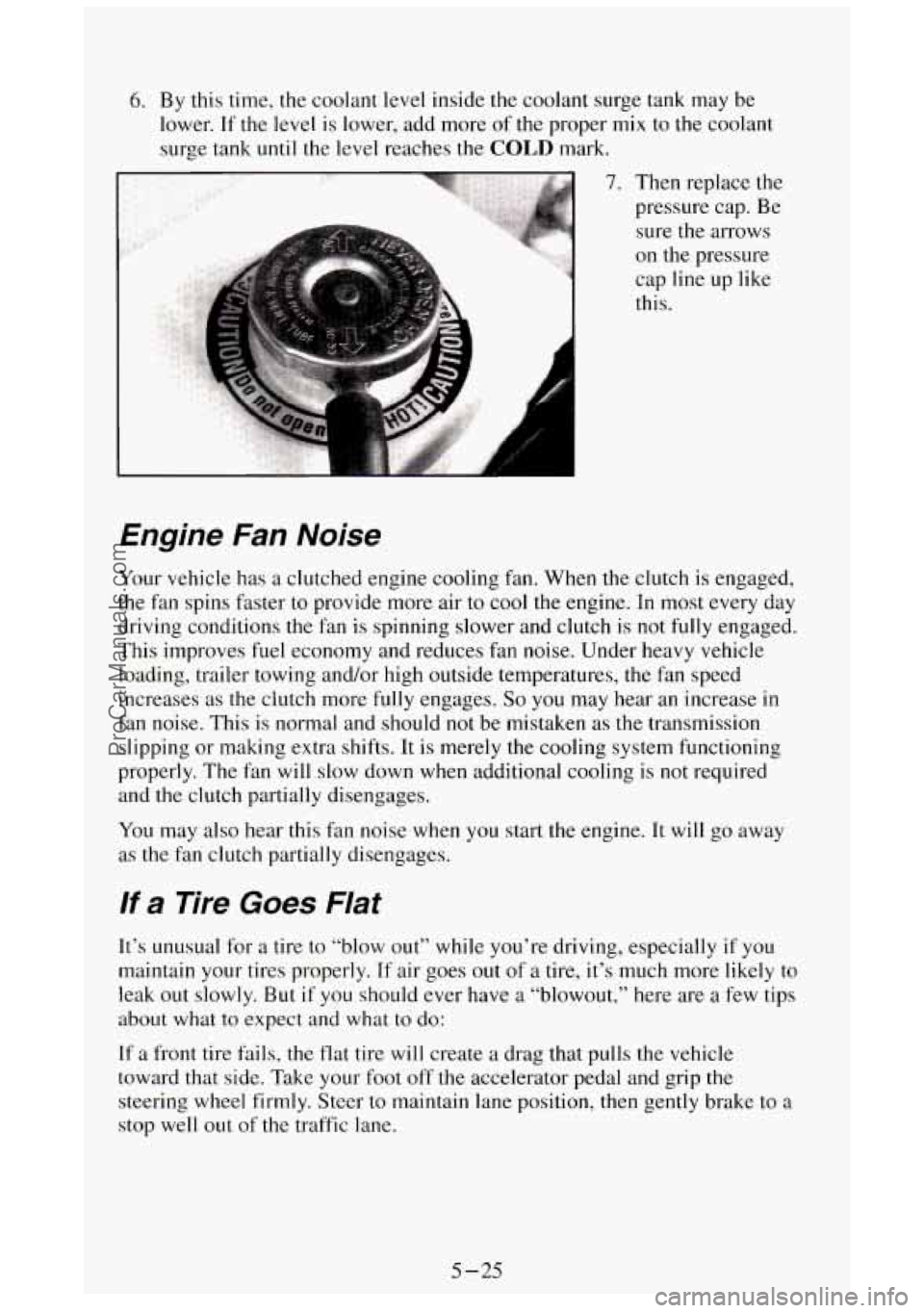
..I . ... . ;. ..
Engine Fan Noise
Your vehicle has a clutched engine cooling fan. When the clutch is engaged,
the fan spins faster
to provide more air to cool the engine. In most every day
driving conditions
the fan is spinning slower and clutch is not fully engaged.
This improves fuel economy and reduces fan noise. Under heavy vehicle
loading, trailer towing and/or high outside temperatures, the fan speed
increases as
the clutch more fully engages. So you may hear an increase in
fan noise. This is normal and should not be mistaken as the transmission
slipping or making extra shifts. It is merely the cooling system functioning
properly. The fan will slow down when additional cooling is not required
and
the clutch partially disengages.
You may also hear
this fan noise when you start the engine. It will go away
as
the fan clutch partially disengages.
If a Tire Goes Flat
It’s UfluSual for a tire to “blow out” while you’re driving, especially if you
maintain your tires properly. If air goes out of a tire, it’s much more likely to
leak
out slowly. But if you should ever have a “blowout,’’ here are a few tips
about what
to expect and what to do:
If a front tire fails, the flat tire will create a drag that pulls the vehicle
toward that side. Take your foot off
the accelerator pedal and grip the
steering wheel firmly. Steer to maintain lane position, then gently brake to a
stop well
out of the traffic lane.
5-25
ProCarManuals.com
Page 265 of 404
Checking Things Under the Hood
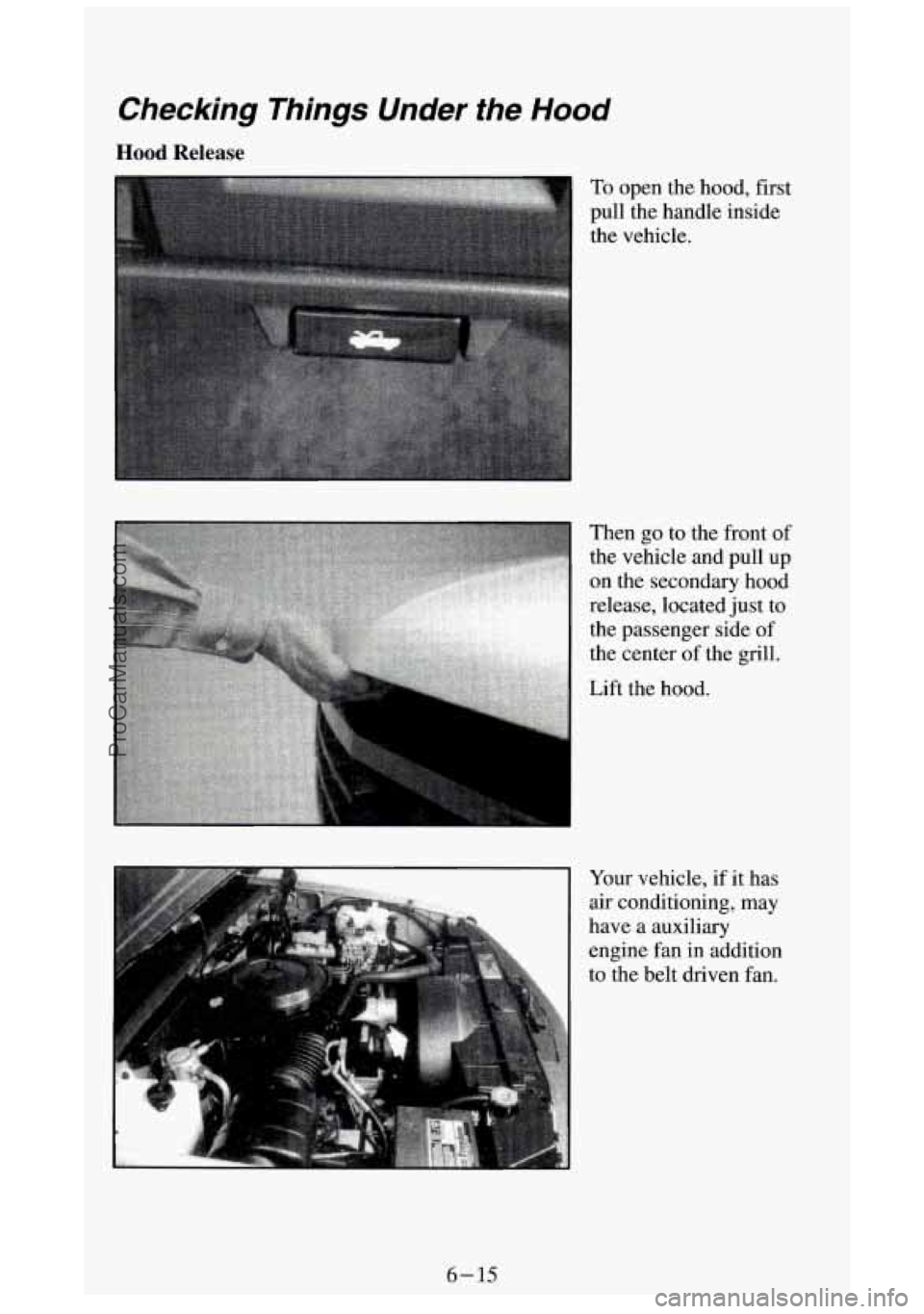
Iood Release
To open the hood, first
pull the handle inside
the vehicle.
Then go to the front
of
the vehicle and pull up
on the secondary hood
release, located just to
the passenger side of
the center of the grill.
Lift the hood.
Your vehicle,
if it has
air conditioning, may
have a auxiliary engine fan in addition
to the belt driven fan.
6- 15
ProCarManuals.com
Page 289 of 404
I NOTICE:
If you use an improper coolant mix, your engine could overheat
and be badly damaged.
The repair cost wouldn’t be covered by
your warranty.
Too much water in the mix can freeze and crack
the engine, radiator, heater core and other parts.
Some conditions, such as air trapped in the cooling system, can affect the
coolant level
in the radiator. Check the coolant level when the engine is cold
and follow the steps under “Adding Coolant” for the proper way to add
coolant.
If you have to add coolant more than four times a year, have your dealer
check your cooling system.
If you use the proper coolant, you don’t have to add extra
inhibitors or additives which claim to improve the system. These
can be harmful.
Adding Coolant -Gas Engines
To Check Coolant
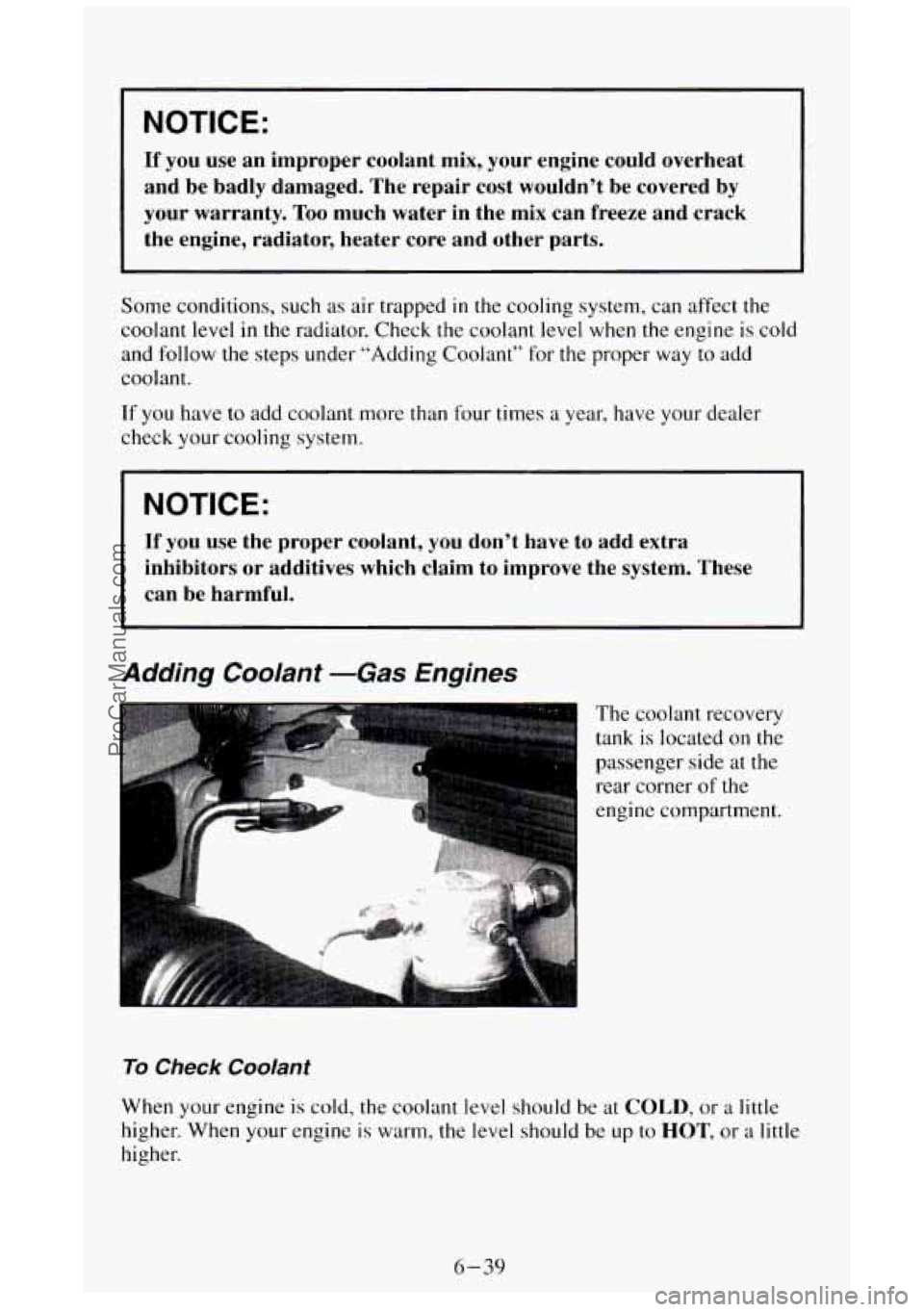
The coolant recovery
tank
is located on the
passenger side at the
rear corner
of the
engine compartment.
When your engine
is cold, the coolant level should be at COLD, or a little
higher. When
your engine is warm, the level should be up to HOT, or a little
higher.
6-39
ProCarManuals.com
Page 298 of 404
Brake Wear
Your vehicle has front disc brakes and rear drum brakes. If you have a
C 3500 HD model, it has four-wheel disc brakes.
Disc brake pads have built-in wear indicators that make
a high-pitched
warning sound when the brake pads are worn and new pads are needed. The
sound may come and go or be heard
all the time your vehicle is moving
(except when you are pushing on the brake pedal firmly).
The brake wear warning sound means that sooner or later your
brakes won’t work well. That could lead to an accident.
When
you hear the brake wear warning sound, have your vehicle
serviced.
NOTICE:
Continuing to drive with worn-out brake pads could result in
costly brake repair.
Some driving conditions or climates may cause a brake squeal when the
brakes are first applied or lightly applied. This does not mean something is
wrong with your brakes.
If
you have rear drum brakes, they don’t have wear indicators, but if you
ever hear a rear brake rubbing noise, have
the rear brake linings inspected.
Also, the rear brake drums should be removed and inspected each time the
tires are removed for rotation or changing. When you have
the front brakes
replaced, have the rear brakes inspected, too.
Brake linings should always be replaced
as complete axle sets.
Brake Pedal Travel
See your dealer if the brake pedal does not return to normal height, or if
there is a rapid increase in pedal travel. This could be a sign of brake
trouble.
6-48
ProCarManuals.com
Page 300 of 404
Wheel Nut Torque
For vehicle with dual wheels, wnen the vehicle, wheel or Tasteners are new,
have the torque set at
the first 100, 1,000 and 6,000 miles (1 60, 1600 and
9600 km). Use the torque specified
in the appropriate Specification Chart
later
in this section.
Single Belt Accessory Drive
If your new vehicle uses a serpentine belt, it is lighter and more durable than
systems with several belts.
The belt runs over or around the pulleys on the engine.
A tensioner may be
used
to keep the belt tight at all times. The tensioner also makes replacing
the belt easier.
If you need to replace the belt, be sure to get the correct
replacement belt. Your dealership or parts supplier can help you with this.
The Accessory Drive belt Routing label on your vehicle will show
you how
to route
the belt your vehicle uses.
Windshield Wiper Blade Inserts
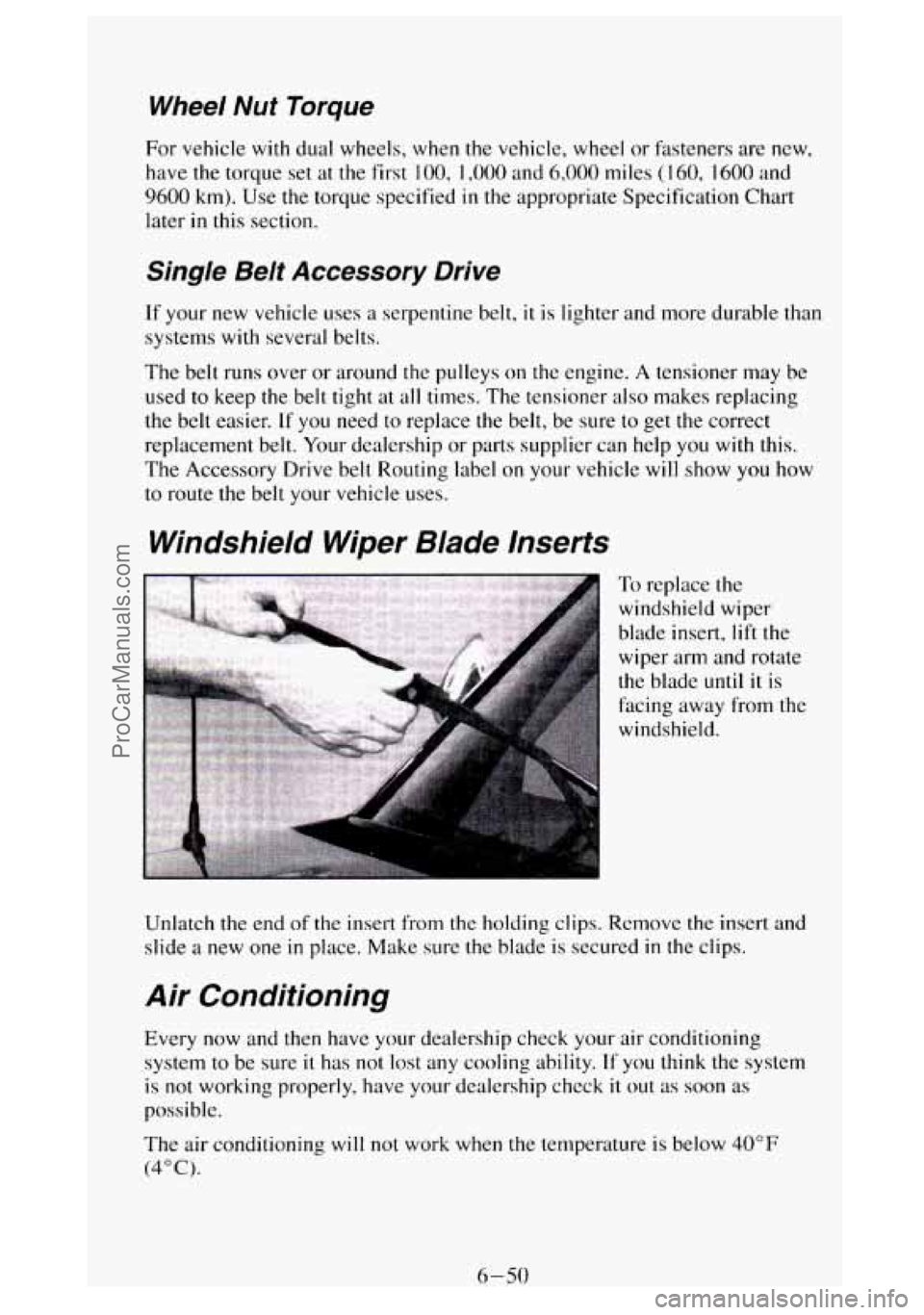
To replace the
windshield wiper
blade insert, lift the
wiper arm and rotate
the blade until
it is
facing away from the
windshield.
Unlatch
the end of the insert from the holding clips. Remove the insert and
slide a new
one in place. Make sure the blade is secured in the clips.
Air Conditioning
Every now and then have your dealership check your air conditioning
system
to be sure it has not lost any cooling ability. If you think the system
is not working properly, have your dealership check it out as soon as
possible.
The air conditioning
will not work when the temperature is below 40°F
(4°C).
6-50
ProCarManuals.com
Page 301 of 404
Fluid Leak Check
After the vehicle has been parked for a while, inspect the surface under the
vehicle for water, oil, fuel or other fluids. Water dripping from the air
conditioning
system after it has been used is normal. If you notice fuel leaks
or fumes, the causes should be found and corrected at once.
Lubrication
Accelerator Control System
Your maintenance schedule will tell you how often the accelerator linkage
pivot points must be lubricated. See “Recommended
Fluids and Lubricants”
in the Tndex for the proper lubricant to use.
Accelerator cables and cruise control cables should not be lubricated.
Any
cab1e.s that are worn or are hard to pull should be replaced.
Hood Latches and Hood Hinge
Your maintenance schedule will tell you how often to lubricate the hood
latch and hood hinge assembly. See “Recommended Fluids and Lubricants”
in the Index for the proper lubricant to use.
Propeller Shaft Slip Splines
See your maintenance schedule to find out how often the. slip splines must
be lubricated. See “Recommended Fluids and Lubricants”
in the Index for
the proper lubricant to use.
Constant Velocity Joints
See your mamtenance schedule to find out how often the constant velocity
joints must be lubricated. See “Recommended Flui-ds and Lubricants”
in the
Index for the proper lubricant to use.
Body
Normal use of your vehicle will cause metal to metal wear at some points on
the cab and body if they are not lubricated.
For exposed surfaces, such as door checks, door lock bolts, lock striker
plates, dovetail bumper wedges, etc., a
thin film of engine oil should be
applied.
The seat adjusters and seat track should be lubricated
with chassis grease.
Door weather strips and rubber hood bumpers should be wiped clean with
a
rubber lubricant.
6-51
ProCarManuals.com
Page 314 of 404
Exhaust System
To help prevent damage to your exhaust system, do not continue to drive
your vehicle
if you notice:
Engine misfiring
Loss of performance
0 Other unusual operating conditions
Have your engine and exhaust system serviced regularly.
Three- Way Catalytic Converter (gas engines)
Your vehicle’s three-way catalytic converter is designed to reduce the
pollutants
in your vehicle’s exhaust. Use only unleaded fuel in your vehicle.
If you use leaded fuel, you could damage your three-way catalytic converter
and other engine components.
Three- Way Catalytic Converter (diesel engines)
Your vehicle’s thre.e-way catalytic converter is designed to reduce the
particulates
in your vehicle’s exhaust. If your vehicles three-way catalytic
converter ever needs to be replaced,
it must be replaced with a three-way
catalytic converter intended for use with diesel engines
only.
Engine Control Module System
(All TBI equipped vehicles and diesel engine
vehicles below
8,500 Ibs. GVWR)
Gasoline Engines
This system has an oxygen sensor (02 ) that helps keep your engine’s
air-fuel mixture at
a proper level. Use only unleaded fuel in your vehicle. If
you use leaded fuel, you could damage your oxygen sensor (02) and
three-way catalytic converter.
Diesel Vehicles Below 8,500 LBS. GVWR
This system monitors engine speed and throttle position. It adjusts exhaust
gas recirculation to limit emissions.
6-64
ProCarManuals.com
Page 328 of 404
While the tires available as standard or optional equipment on General
Motors vehicles may vary with respect
to these grades, all such tires meet
General Motors performance standards and have been approved for use on
General Motors vehicles. All passenger type
(P Metric) tires must conform
to Federal safety requirements in addition to these grades.
Wheel Alignment and Tire Balance
The wheels on your vehicle were aligned and balanced carefully at the
factory
to give you the longest tire life and best overall performance.
In most cases,
you will not need to have your wheels aligned again.
However,
if you notice unusual tire wear or your vehicle pulling one way or
the other, the alignment may need to be reset. If
you notice your vehicle
vibrating when driving on
a smooth road, your wheels may need to be
rebalanced.
Wheel Replacement
Repla@ Zm wheel that is bent, cracked or badly rusted. If wheel nuts keep
coming loose, the wheel, wheel bolts, and wheel nuts should be replaced. If
the wheel leaks air, replace it (except some aluminum wheels, which can
sometimes be repaired). See your GM dealer if any of these conditions exist.
Your dealer will know
the kind of wheel you need.
Each new wheel should have the same load carrying capacity, diameter,
width, offset, and be mounted the same way as the one it replaces.
If you need to replace any of your wheels, wheel bolts, or wheel nuts,
replace them only with new GM original equipment parts. This way,
you
will be sure to have the right wheel, wheel bolts, and wheel nuts for your
GM model.
6-78
ProCarManuals.com
Page 337 of 404
Underbody Maintenance
Chemicals used for ice and snow removal and dust control can collect on
the underbody. If these are not removed, accelerated corrosion (rust) can
occur on the underbody parts such as fuel lines, frame,
floor pan, and
exhaust system even though they have corrosion protection.
At least every spring, tlush these materials from the underbody
with plain
water. Clean any areas where mud and other debris can collect. Dirt packed
in closed areas of the frame should be loosened before being flushed. Your
dealer or an underbody vehicle washing system can do this for you.
Chemical Paint Spotting
Some weather and atmospheric conditions can create a chemical fallout.
Airborne pollutants can fall upon and attack painted surfaces on your
vehicle. This damage can take two forms: blotchy, ringlet-shaped
discolorations, and small irregular dark spots etched into the paint surface.
Although no defect
in the paint job causes this, GM will repair, at no charge
to the owner, the surfaces of new vehicles damaged by this fallout condition
within 12 months or 12,000 miles (20
000 km) of purchase, whichever
comes first.
This applies
only to materials manufactured and sold by General Motors.
Bodies, body conversions or equipment
not made or sold by General Motors
are not covered.
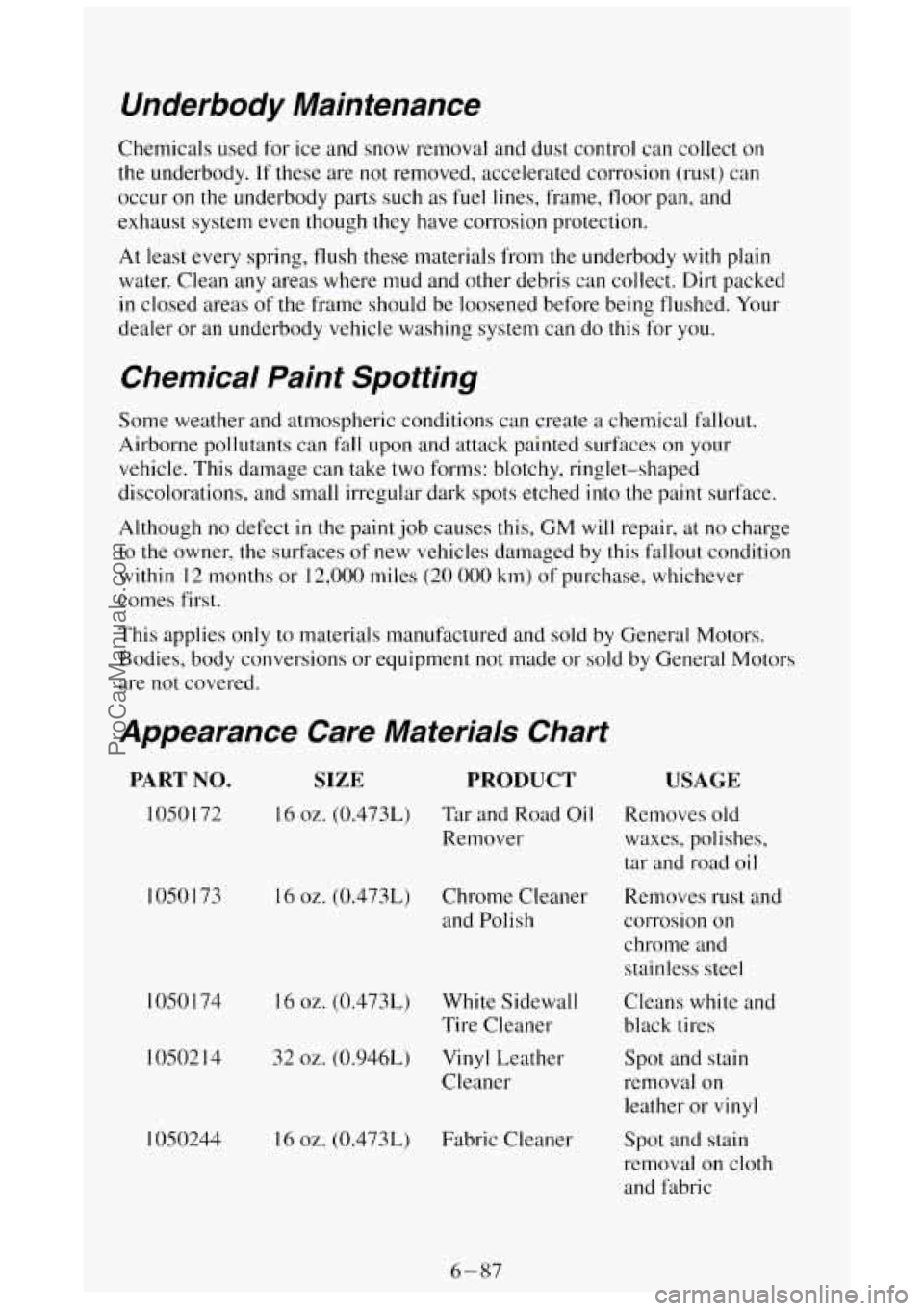
Appearance Care Materials Chart
PART NO.
1050172
I050 173
1050174 1050214
1050244
SIZE
16 oz. (0.473L)
16 oz. (0.473L)
I6
oz. (0.473L)
32
oz. (0.946L)
16 oz. (0.473L)
PRODUCT USAGE
Tar and Road Oil
Removes old
Remover waxes, polishes,
tar and road
oil
Chrome Cleaner Removes rust and
and Polish corrosion
on
chrome and
stainless steel
White Sidewall
Tire Cleaner
Vinyl Leather
Cleaner
Fabric Cleaner Cleans
white and
black tires
Spot and stain
removal on
leather or
vinyl
Spot and stain
removal on cloth
and fabric
6-87
ProCarManuals.com