tire pressure GMC SIERRA 1994 User Guide
[x] Cancel search | Manufacturer: GMC, Model Year: 1994, Model line: SIERRA, Model: GMC SIERRA 1994Pages: 404, PDF Size: 20.91 MB
Page 324 of 404
If your vehicle has front tires with different load ratings or tread designs
(such
as all season vs. on/off road) than the rear tires, don’t rotate your tires
front
to rear.
After the tires have been rotated, adjust the front and rear inflation pressure
as shown on the CertificatiodTire label. Make certain that all wheel nuts are
properly tightened. See “Wheel
Nut Torque” in the Index.
A CAUTION:
Rust or dirt on a wheel, or on the parts to which it is fastened,
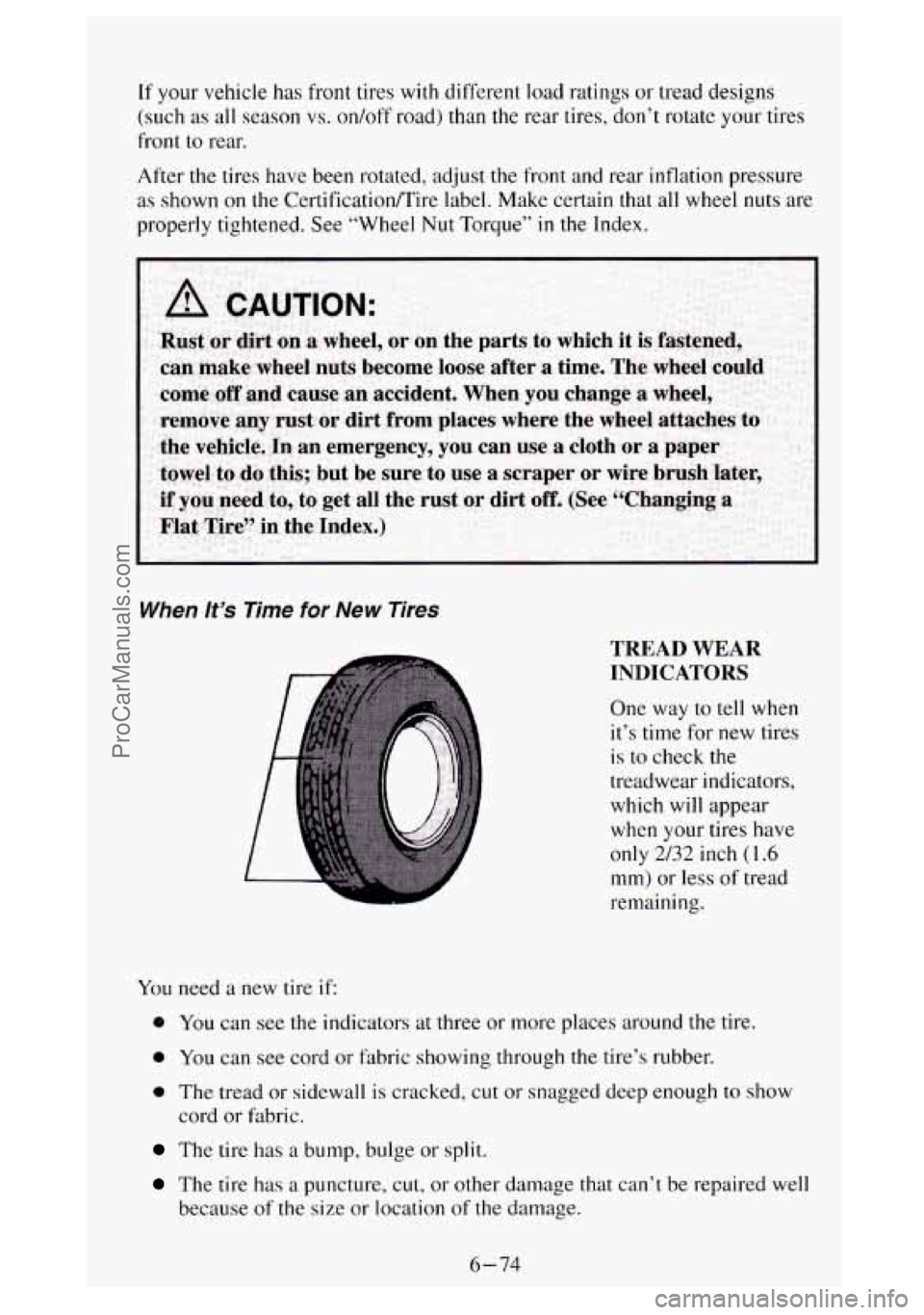
When It’s Time for New Tires
TREAD WEAR
INDICATORS
One way to tell when
it’s time for
new tires
is to check the
treadwear indicators,
which
will appear
when your tires have
only
2/32 inch (1.6
mm) or less of tread
remaining.
You need a
new tire if:
0 You can see the indicators at three or more places around the tire.
0 You can see cord or Fabric showing through the tire’s rubber.
0 The tread or sidewall is cracked, cut or snagged deep enough to show
cord or fabric.
The tire has a bump, bulge or split.
The tire has a puncture, cut, or other damage that can’t be repaired well
because
of the size or location of the damage.
6-74
ProCarManuals.com
Page 326 of 404
Dual lire Operation
If your vehicle has dual rear wheels, the outer tire will usually wear faster
than the inner tire. Your tires will wear more evenly and last longer
if you
rotate the tires periodically. If you’re going to be doing a lot of driving on
high-crown roads,
you can reduce tire wear by adding 5 psi (35 kPa) to the
tire pressure in the outer tires. Be sure to return to the recommended
pressures when
no longer driving under those conditions.
Buying New Tires
To find out what kind and size of tires you need, look at the
CertificationRire label.
The tires installed on your vehicle when it was new had
a Tire Performance
Criteria Specification
(TPC Spec) number on each tire’s sidewall. When you
get new tires, get ones with that same TPC Spec number. That way, your
vehicle will continue
to have tires that are designed to give proper
endurance, handling, speed rating, traction, ride and other things during
normal service on your vehicle. If your tires have an all-season tread
design, the TPC number will be followed by a
“MS” (for mud and snow).
If you ever replace your tires with those not having
a TPC Spec number,
make sure they are
the same size, load range, speed rating and construction
type (bias, bias-belted or radial) as your original tires.
6-76
ProCarManuals.com
Page 362 of 404
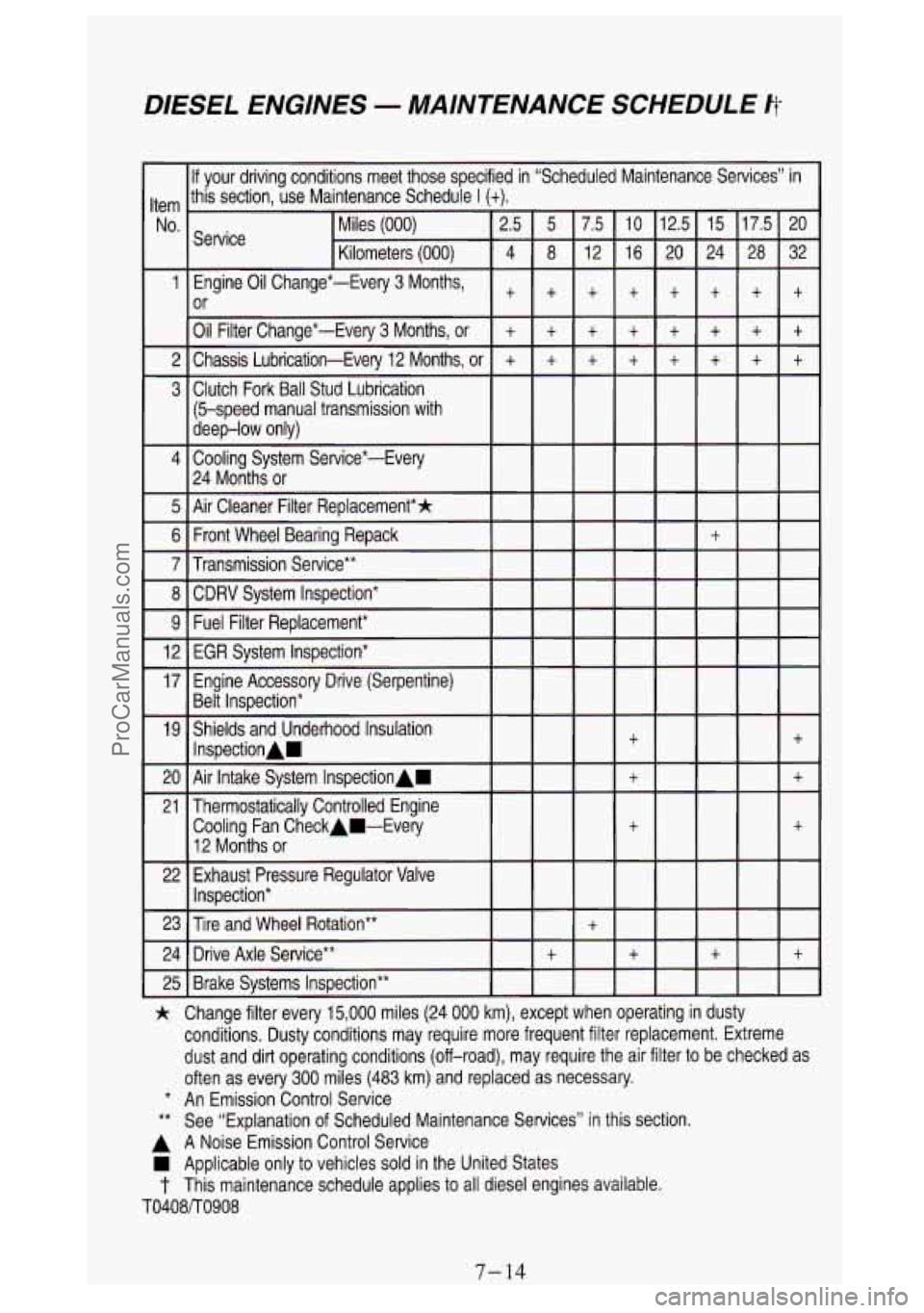
DIESEL ENGINES - MAINTENANCE SCHEDULE yf
20 Air Intake System InspectionAB t t
21 Thermostatically Controlled Engine
Cooling Fan CheckAW-Every
t t
12 Months or
Inspection*
22 Exhaust Pressure Regulator Valve
23 Tire and Wheel Rotation**
t
24 Drive Axle Service** t t t +
25 Brake Systems Inspection**
A Change filter every 15,000 miles (24 000 km), except when op\
erating
in dusty
conditions. Dusty conditions may require more frequent filter re\
placement. Extreme
dust and dirt operating conditions (off-road), may require the air \
filter to be checked as
often as every 300 miles (483 km) and replaced as necessary.
* An Emission Control Service
** See “Explanation of Scheduled Maintenance Services” in this section.
A A Noise Emission Control Service
1 Applicable only to vehicles sold in the United States
t This maintenance schedule applies to all diesel engines available.
T0408/T0908
7-14
ProCarManuals.com
Page 369 of 404
18. EVAPORATIVE CONTROL SYSTEM (ECS) INSPECTION* -
Check all fuel and vapor lines and hoses for proper hookup, routing,
and condition. Check that
the purge valve works properly, if equipped.
Replace as needed.
19.
SHIELDS AND UNDERHOOD INSULATION
INSPECTIONAV
- Inspect shields and underhood insulation for
damage or looseness. Adjust or replace as required.
system installation
to see that gaskets are sealed properly and all hose
connections, fasteners, and other components are tight. Also check to
be sure that the air cleaner housing is properly seated, that
the cover fits
tightly, and
the wing nuts are tight. Tighten connections and fasteners
or replace damaged parts
as required.
20. AIR INTAKE SYSTEM INSPECTIONAV - Check the air intake
2 1. THERMOSTATICALLY CONTROLLED ENGINE COOLING
FAN INSPECTIONAV
- (If so equipped.) Inspect all hoses and
ducts for proper hook-up. Be sure the valve works properly.
22. EXHAUST PRESSURE REGULATOR VALVE INSPECTION”
- Check that the valve works properly. Correct any binding. Inspect
hoses for cracks, chafing
or decay. Replace parts as needed.
23. TIRE AND WHEEL ROTATION AND INSPECTION - For
proper wear and maximum tire life, rotate tires at the first
6,000 miles
( 10 000 kilometers) for Schedule I (+) or 7,500 miles (1 2 500
kilometers) for Schedule IT (0) and then every 15,000 miles (25 000
kilometers) thereafter. Follow the instructions and patterns shown in
Section 6. Check tires for uneven wear or damage. If irregular or
premature wear is apparent, check wheel alignment. Also, check or
damaged wheels. See “Tires”
in the Index for more information.
For dual wheels, whenever the vehicle, wheels, or fasteners are new,
have the wheel fastener torque set at the first
100, 1,000 and 6,000
miles (1 60, 1600 and 10 000 km).
Block the tires opposite those being removed to keep the vehicle from
rolling.
‘i: An Emission Control Service
ANoise Emission Control Service
VApplicable only to vehicles sold
in the United States
7-21
ProCarManuals.com
Page 371 of 404
Owner Checks and Services
Listed below are owner checks and services which should be made at the
time period specified to help ensure proper safety, emission performance,
and dependability
of your vehicle.
Be sure any necessary repairs are completed at once. Whenever any fluids
or lubricants are added to your vehicle, make sure they are
the proper ones,
as shown
in this Section.
At Least Once a Month
Tire inflation pressure check - Check the tires for proper inflation. If
they are low, inflate them to the level specified on the Certification/Tire
label. See “Loading Your Vehicle” or “Inflation-Tire Pressure”
in the Index.
At Least Once a Year
Key lock cylinder lubrication - Lubricate key lock cylinders with engine
oil. See
the “Recommended Fluid and Lubricants” chart in this section.
Transmission neutral or clutch start switch operation -
1. Before you start, be sure you have enough room around the vehicle.
2. Firmly apply both the manual parking brake and the regular brake. See
“Brakes” and “Parking Brake”
in the Index. Do not use the accelerator
pedal.
3. Be ready to turn off the engine immediately if it starts.
4. On automatic transmission vehicles, try to start the engine in each gear.
The starter should work only
in “P’ (Park) or “N” (Neutral).
On manual transmission vehicles, put the shift lever
in “N” (Neutral), push
the clutch down halfway, and try to start the engine. The starter should work
only when the clutch
is pushed down all the way to the floor.
Steering column lock operation - While parked, try to turn the key to
LOCK in each gear shift position.
With an automatic transmission, the key should
turn to LOCK only when
the gear shift
is in “P” (Park).
7-23
ProCarManuals.com
Page 372 of 404
On vehicles with a key release lever, try to turn the key to LOCK without
pressing the lever. The key should turn to
LOCK only with the key lever
depressed.
On
all vehicles, the key should come out only in LOCK.
Parking brake and transmission
“P” (PARK) mechanism operation -
I
Park on a fairly steep hill, with the vehicle facing downhill. Keeping your
foot on the regular brake, set the manual parking brake.
To check the parking brake: With the engine running and the
transmission
in “N” (Neutral), slowly remove foot pressure from the
regular brake pedal. Do this until the vehicle is held by the parking
brake only.
0 To check the “P’ (Park) mechanism’s holding ability: Apply the regular
brake and shift to
“P’ (Park). Release the manual parking brake, then
slowly release the regular brake.
Lap and Shoulder Belts Condition and Operation - Inspect belt system,
including webbing, buckles, latch plates, retractors, guide loops and
anchors. Have
a belt assembly replaced if the webbing has been cut or
otherwise damaged.
Body Lubrication Service - Lubricate all body door hinges with engine
oil. Also lubricate the tailgate, tailgate handle pivot points, and tailgate
mounted spare tire carrier
(if equipped}. Lubricate the body hood, fuel door
and rear compartment hinges, latches and locks including interior glove box
and console doors, and any folding seat hardware. Lubricate the hood safety
lever pivot and prop rod pivot. More frequent lubrication may be required
when exposed to a corrosive environment.
Periodic Maintenance Inspections - Listed below are inspections and
services which should be performed at least twice
a year (for instance each
spring or fall). You should
let your GM dealer’s service department or other
qualified service center do these
jobs. Make sure any necessary repairs are
completed at once.
7-24
ProCarManuals.com
Page 379 of 404
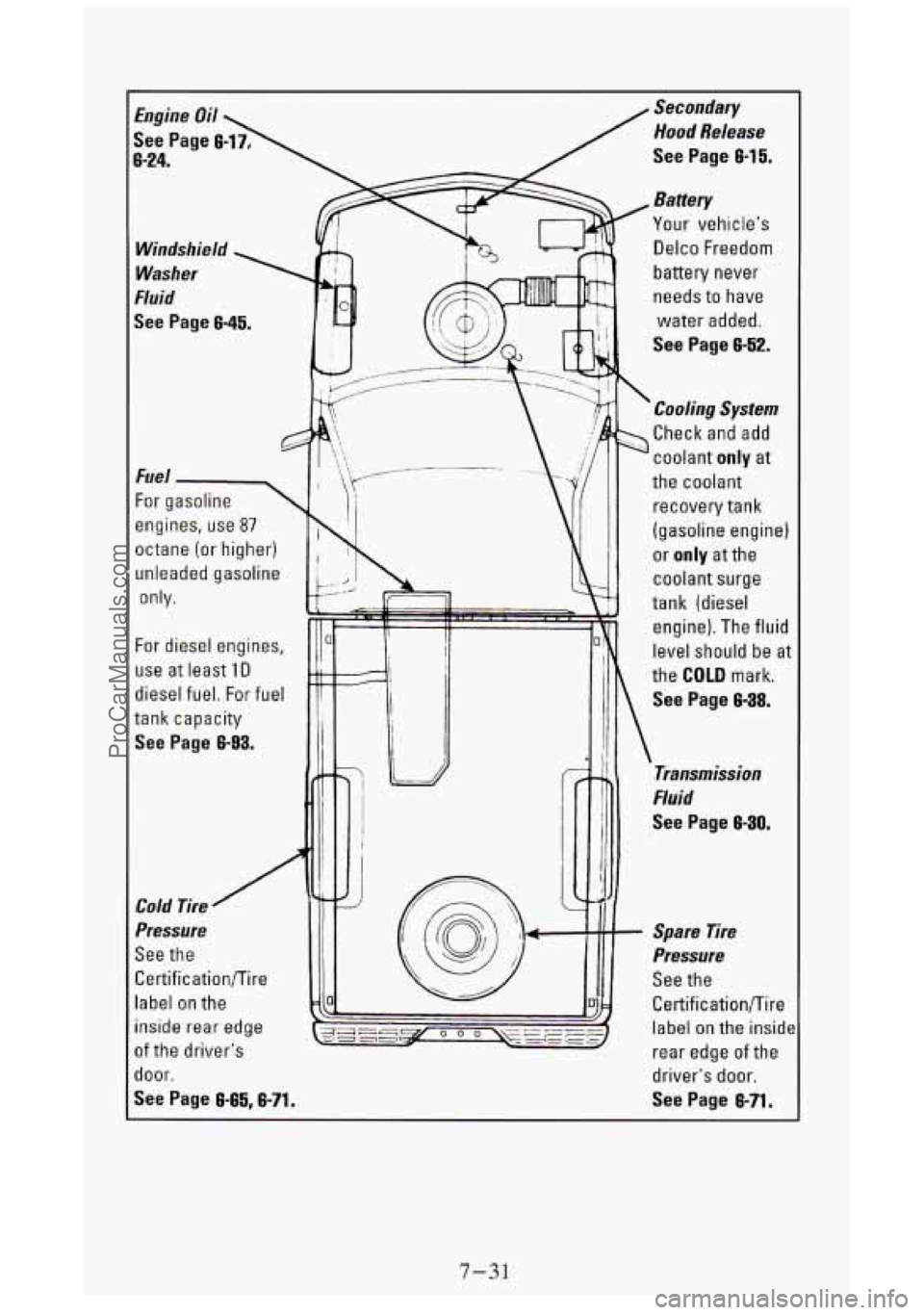
Secondary
Hood Release
See Page 6-15.
Fluid
See Page 6-45.
engines, use 87
octane (or higher)
unleaded gasoline
only.
For diesel engines,
use at least
1 D
diesel fuel. For fuel
tank capacity
See Page 6-93.
Cold Tire /
Pressure
See the
Certificationflire
label on the
inside rear edge
of the driver's
door.
See Page 6-65,6-71.
, Battery
Your vehicle's
Delco Freedom
battery never
needs to have water added.
See Page 6-52.
Cooling System
coolant only at
the coolant
recovery tank
(gasoline engine)
or
only at the
coolant surge
tank (diesel engine). The
fluid
level should be at
the COLD mark.
See Page 6-38.
3 Check and add
Transmission
Fluid
See Page 6-30.
- Spare Tire
Pressure
See the
Certificatisnflire
label on the inside
rear edge
of the
driver's door.
See Page 6-71.
7-31
ProCarManuals.com
Page 397 of 404
Gages (continued) Tachometer
.................................................. 2-69
Voltmeter
.................................................... 2-82
Trip Odometer
................................................ 2-68
HalogenBulbs .................................................. 6-54
Hazard Warning Flashers
........................................... 5-2
Head Restraints
.................................................. 1-5
Headlights
........................................... 2-49,6-53, 6-62
Composite
................................................... 6-54
Halogen
..................................................... 6-54
High Beam Indicator Light
...................................... 2-76
SealedBeam
................................................. 6-53
Heating System (with
A/C) ......................................... 3-6
Rear Window Defogger
......................................... 3-8
Heating System (without A/C)
....................................... 3-5
FanKnob ..................................................... 3-5
FunctionLever
................................................ 3-5
Rear Window Defogger
......................................... 3-8
Hi~h-LowBeam
.............................................. 241
System Controls ............................................... 3-6
Temperature Lever
............................................. 3-5
Highway Hypnosis ............................................... 4-30
Hitches ........................................................ 4-40
Hood
CheclungUnder
.............................................. 6-15
LatchesandHinge ............................................ 6-51
Horn
.......................................................... 2-39
Hydraulicclutch
................................................ 6-34
Grease Fitting
................................................ 6-35
Hydroplaning
................................................... 4-27
I
If You’re Stuck in Sand. Mud. Ice. or Snow ........................... 5-40
Ignitionswitch .................................................. 2-11
Inflation-Tire Pressure ............................................ 6-71
Instrument Panel ................................................ 2-67
Cluster
...................................................... 2-67
Tachometer Cluster
............................................ 2-67
J
Jack Storage ............................................... 5.29, 5.39
Jumpstarting
.................................................... 5-3
K
Key ReleaseLever ............................................... 2-12
Keys
........................................................... 2-3
5
ProCarManuals.com
Page 401 of 404
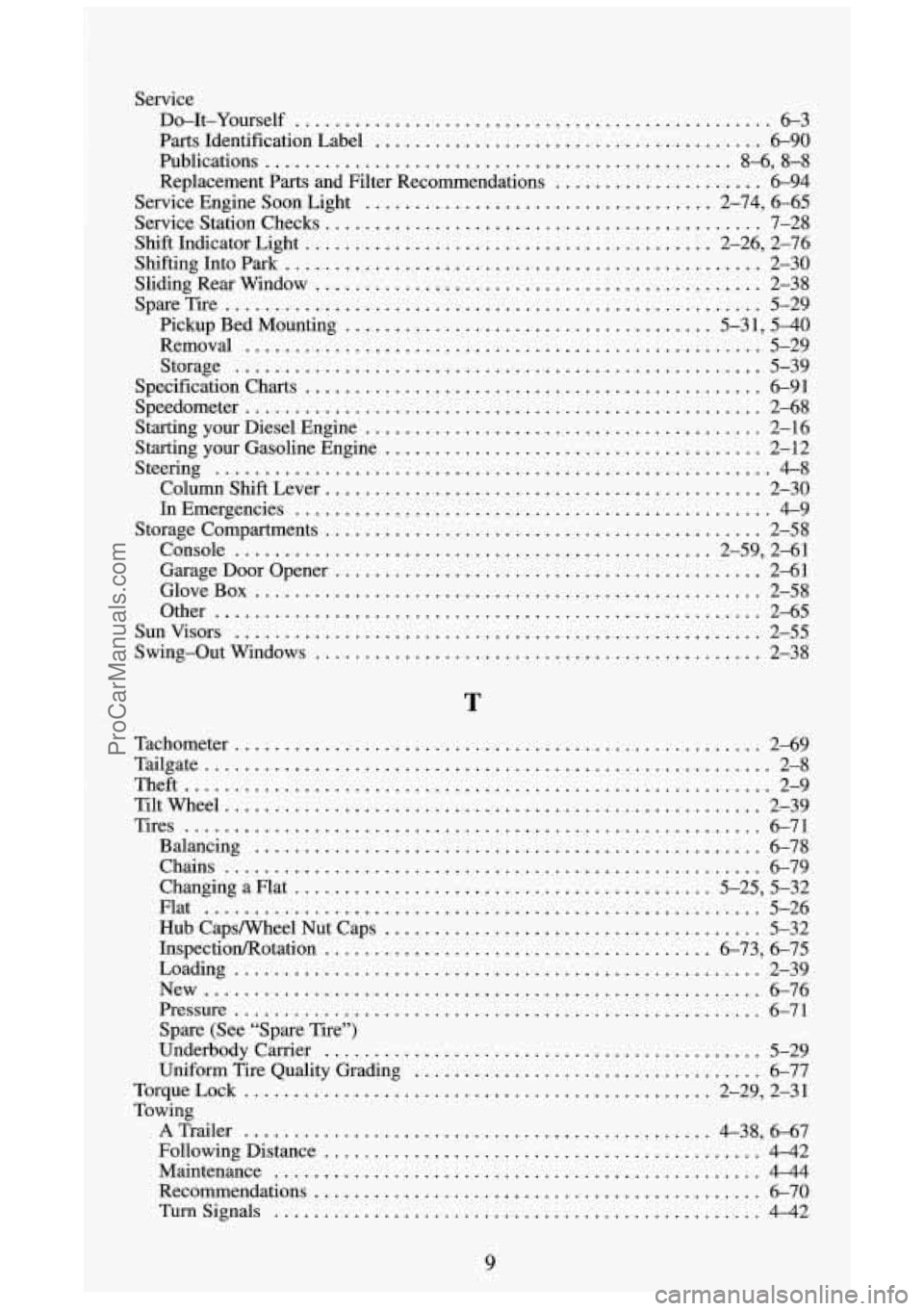
I
Service Do-It-Yourself
.......
Parts Identification Label
Publications
..........
Replacement Parts and Fj
Service Engine Soon Light
Service Station Checks
....
11
........................................ 6-3
....................................... 6-90
.................................... 8.6, 8.8
ter Recommendations
..................... 6-94
.................................. 2.74. 6-65
....................................... 7-28
Shift Indicator Light
......................................... 2.26, 2.76
ShiftingIntoPark
................................................ 2-30
Sliding Rear Window
............................................. 2-38
SpareTire
...................................................... 5-29
Pickup Bed Mounting
..................................... 5.31. 5-40
Specification Charts .............................................. 6-91
Speedometer
.................................................... 2-68
Starting your Diesel Engine
........................................ 2-16
Starting your Gasoline Engine
...................................... 2-12
Removal
.................................................... 5-29
Storage
..................................................... 5-39
Steering
........................................................ 4-8
Column Shift Lever
............................................ 2-30
InEmergencies
................................................ 4-9
Console
................................................ 2-59. 2-61
GarageDoorOpener
........................................... 2-61
GloveBox
................................................... 2-58
Other
....................................................... 2-65
SunVisors
..................................................... 2-55
Swing-Outwindows
............................................. 2-38
Storage Compartments
............................................ 2-58
T
Tachometer ..................................................... 2-69
Tailgate
......................................................... 2-8
Theft
........................................................... 2-9
Tiltwheel
...................................................... 2-39
Tires
.......................................................... 6-71
Chains
...................................................... 6-79
Flat
........................................................ 5-26
Balancing
................................................... 6-78
Changing a Flat
.......................................... 5.25, 5.32
Hub CapsNVheel Nut Caps
...................................... 5-32
InspectionRotation
....................................... 6-73. 6-75
Loading
..................................................... 2-39
New
........................................................ 6-76
Pressure
..................................................... 6-71
Spare (See “Spare Tire”)
Underbodycarrier
............................................ 5-29
Uniform Tire Quality Grading
................................... 6-77
TorqueLock
............................................... 2.29. 2.31
Towing
ATrailer
............................................... 4-38. 6.67
Maintenance
................................................. 4-44
Recommendations
............................................. 6-70
Turnsignals
................................................. 4-42
Following Distance
............................................ 4-42
9
ProCarManuals.com