headlights GMC SIERRA 1994 Owners Manual
[x] Cancel search | Manufacturer: GMC, Model Year: 1994, Model line: SIERRA, Model: GMC SIERRA 1994Pages: 404, PDF Size: 20.91 MB
Page 60 of 404
EngineExhaust ........................................... 2-33
Running
Your Engine While You’re Parked ................... 2-33
Four-WheelDrive
......................................... 2-34
Transfer Case
.......................................... 2-35
Front Axle Locking Feature
............................... 2-36
Windows
................................................ 2-37
Horn
.................................................... 2-39
TiltWheel
............................................... 2-39
Multifunction Lever
........................................ 2-40
Turn Signal and Lane Change Indicator
...................... 2-40
Headlight High-Low Beam
............................... 2-41
Windshield Wipers
...................................... 2-42
Windshield Washer
...................................... 2-43
Cruise Control
.......................................... 2-44
Headlights and Vehicle Lighting
.............................. 2-49
Mirrors
.................................................. 2-54
SunVisors
............................................... 2-55
Cigarette LightedAshtrays ................................... 2-57
Storage Compartments
...................................... 2-58
Instrument Cluster
......................................... 2-67
Warning Lights and Indicators
............................. 2-69
Gages
................................................ 2-78
Center High-Mount Stop Lamp (CHMSL) Feed Wire ............. 2-82
Camper Wiring Harness
..................................... 2-83
Step Bumper Pad
.......................................... 2-84
Trailer Wiring Harness
...................................... 2-83
2-2
ProCarManuals.com
Page 94 of 404
When your headlights or parking lights are on, rotate the dial to the right of
your headlight switch up
to brighten, or down to dim, your transfer case
indicator light.
2H (2-Wheel High): This setting is for driving in most street and highway
situations. Your front axle is not engaged
in two-wheel drive.
4H (4-Wheel High): This setting engages your front axle to help drive your
vehicle. Use
4H when you need extra traction, such as on wet or icy roads,
or in most off-road situations.
N (Neutral): Shift to this setting only when your vehicle needs to be towed
or when using a power take-off.
4L (4-Wheel Low): This setting also engages your front axle to give you
extra power, but should be used only for off-road driving.
You can shift from
2H to 4H or from 4H to 2H while the vehicle is moving.
Your front axle will engage faster if you take your foot off of the accelerator
for a few seconds after you shift.
In extremely cold weather it may be
necessary to stop or slow the vehicle to shift
out of 2H.
To shift into or out of 4L or “N” (Neutral):
Slow the vehicle to a roll, about 1-3 mph (2-5 kdh) and shift your
transmission into neutral.
0 Shift the transfer case shift lever in one continuous motion.
Don’t pause
in “N” (Neutral) as you shift the transfer case into 4L, or your
gears could clash.
Remember that driving
in 4H or 4L may reduce fuel economy. Also, driving
in four-wheel drive on dry pavement could cause your tires to wear fdster
and make your transfer case harder to shift.
Front Axle Locking Feature
The front axle locks and unlocks automatically when you shift the transfer
case. Some delay
for the axle to lock or unlock is normal. If the outside
temperature is very hot, or the vehicle has been used under hard driving
conditions, there may be
a slight delay for the axle to unlock.
Whenever you are
in four wheel drive, the rear wheel anti-lock brake
system does not operate. The regular brake system operates normally. When
you shift back into two-wheel drive, the anti-lock brake system will
operate.
2-36
ProCarManuals.com
Page 99 of 404
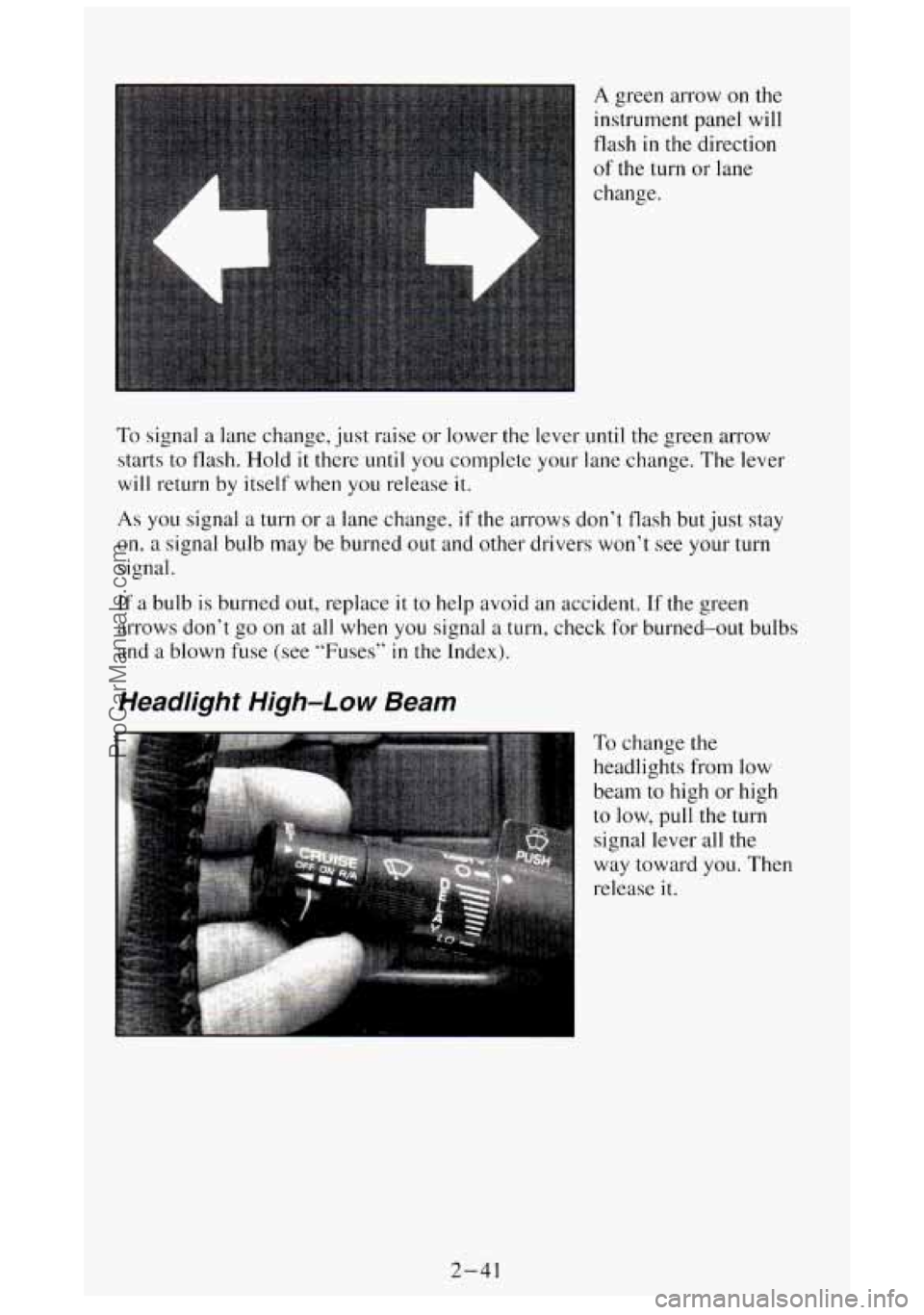
A green arrow on the
instrument panel will
flash
in the direction
of the turn or lane
change.
To signal a lane change, just raise or lower the lever until the green arrow
starts to flash.
Hold it there until you complete your lane change. The lever
will return by itself when you release it.
As you signal a turn or a lane change, if the arrows don’t flash but just stay
on, a signal bulb may be burned out and other drivers won’t see your turn
signal.
If a bulb
is burned out, replace it to help avoid an accident. If the green
arrows don’t go on at all when
you signal a turn, check for burned-out bulbs
and a blown fuse
(see “Fuses” in the Index).
Headlight High-Low Beam
To change the
headlights
from low
beam to high or high
to low, pull the turn
signal lever
all the
way toward
you. Then
release
it.
2-41
ProCarManuals.com
Page 107 of 404
Headlights and Vehicle Lighting
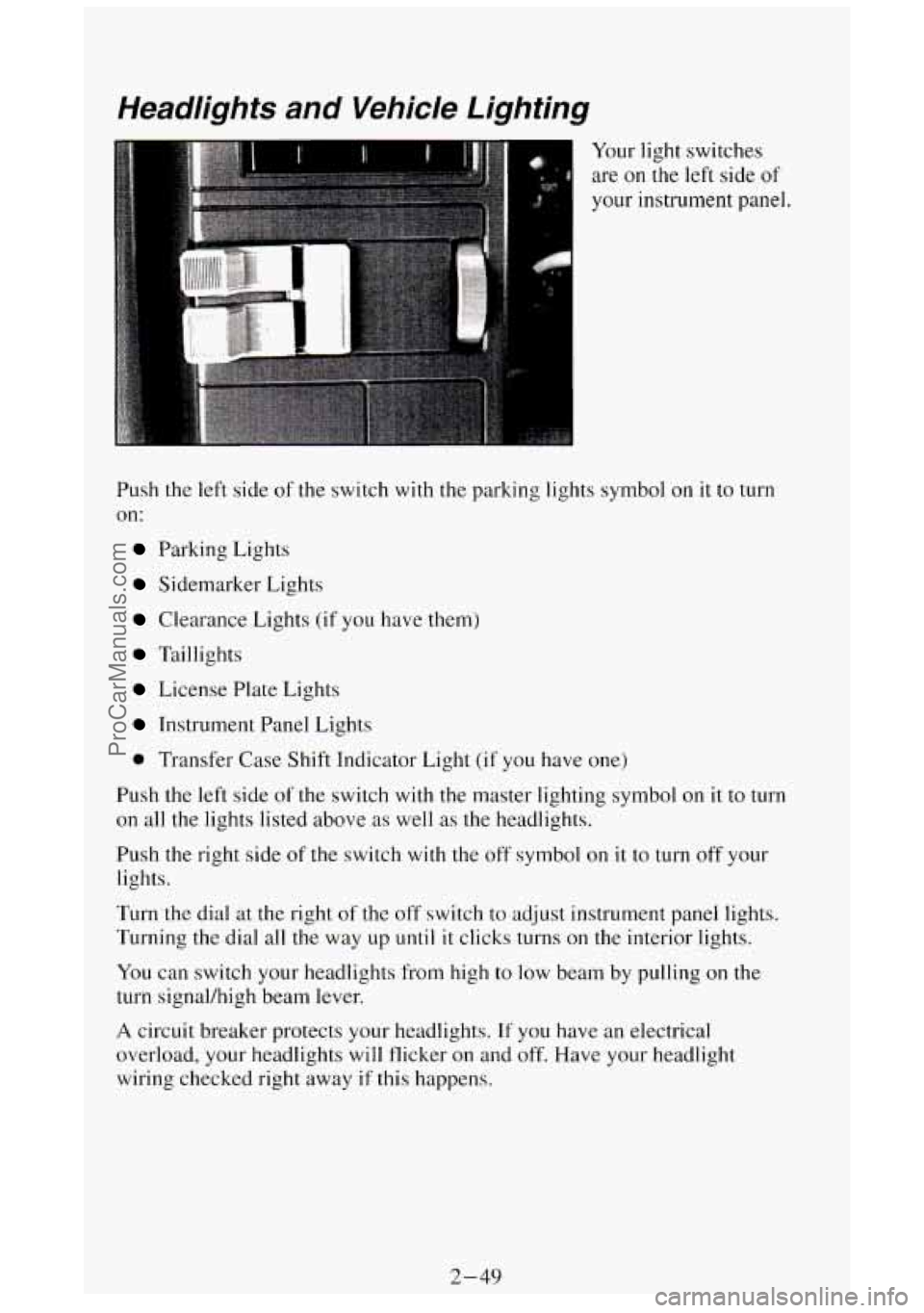
Your light switches
are on
the left side of
your instrument panel.
Push
the left side of the switch with the parking lights symbol on it to turn
on:
Parking Lights
Sidemarker Lights
Clearance Lights (if you have them)
Taillights
License Plate Lights
Instrument Panel Lights
0 Transfer Case Shift Indicator Light (if you have one)
Push the
left side of the switch with the master lighting symbol on it to turn
on all the lights listed above as well as the headlights.
Push the right side of the switch
with the off symbol on it to turn off your
lights.
Turn the dial
at the right of the off switch to adjust instrument panel lights.
Turning the dial all the way up
until it clicks turns on the interior lights.
You can switch your headlights from high to
low beam by pulling on the
turn signal/high beam lever.
A circuit breaker protects your headlights. If you have an electrical
overload, your headlights will flicker on and off. Have your headlight
wiring checked right away
if this happens.
2-49
ProCarManuals.com
Page 108 of 404
Headlights-On Reminder
A buzzer will sound when your headlights are turned on and your ignition is
in
OFF, LOCK or ACC. If you need to use your headlights when the
ignition switch is in
OFE LOCK or ACC, the buzzer can be turned off by
turning the interior light switch dial all the way
off.
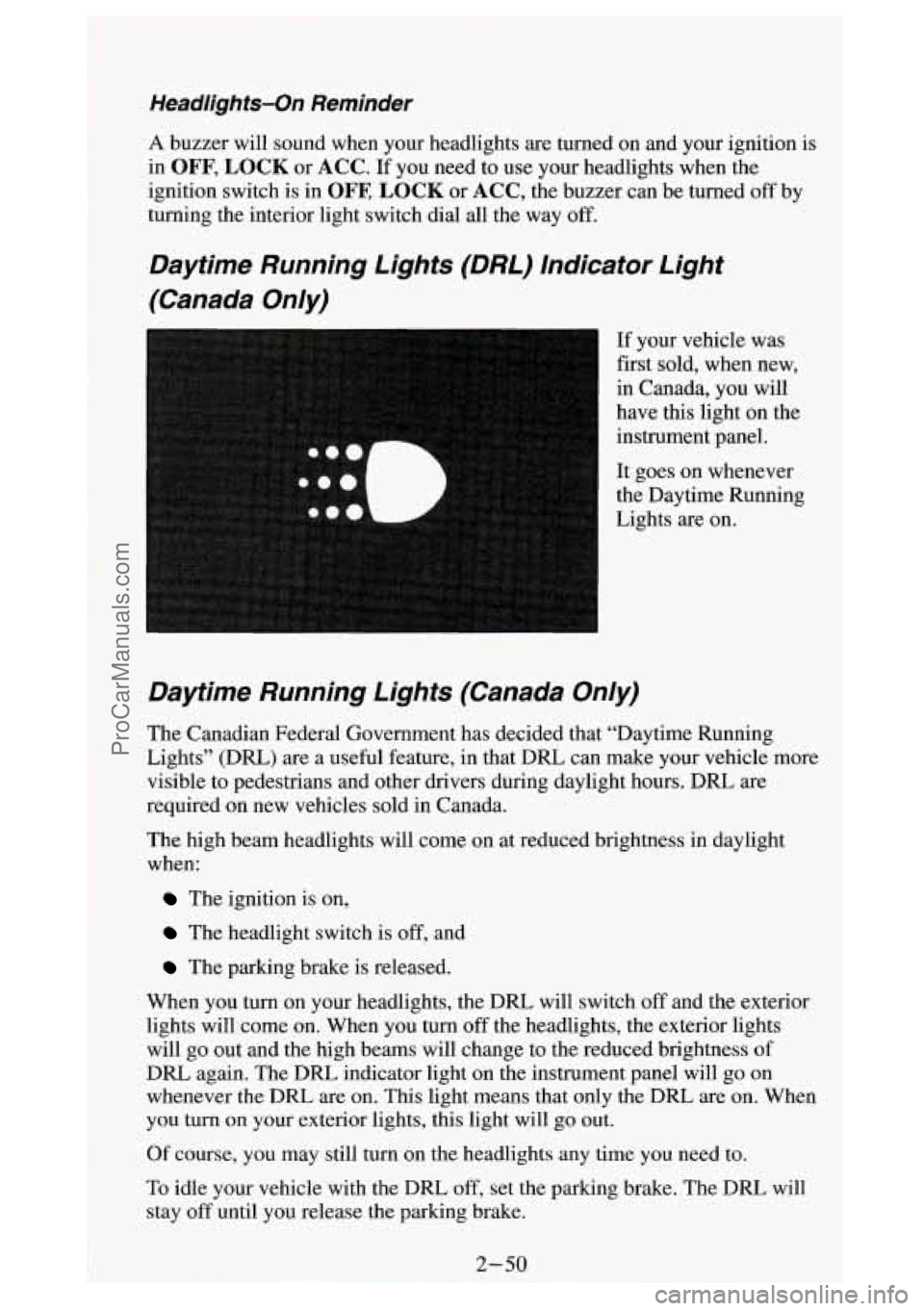
Daytime Running Lights (DRL) Indicator Light
(Canada On/y)
If your vehicle was
first sold, when new,
in Canada, you will
have this light on the
instrument panel.
It goes on whenever
the Daytime Running
Lights are on.
Daytime Running Lights (Canada On/y)
The Canadian Federal Government has decided that “Daytime Running
Lights” (DRL)
are a useful feature, in that DRL can make your vehicle more
visible to pedestrians and other drivers during daylight hours. DRL are
required on new vehicles sold in Canada.
The high beam headlights will come on at reduced brightness in daylight
when:
The ignition is on,
The headlight switch is off, and
The parking brake is released.
When you turn on your headlights, the DRL will switch
off and the exterior
lights will come on. When you turn
off the headlights, the exterior lights
will go out and the high beams will change to the reduced brightness of
DRL again. The
DRL indicator light on the instrument panel will go on
whenever the DRL are on. This light means that only the DRL are on. When
you turn on your exterior lights, this light will go out.
Of course, you may still turn on the headlights any time
you need to.
To idle your vehicle with the DRL
off, set the parking brake. The DRL will
stay
off until you release the parking brake.
ProCarManuals.com
Page 112 of 404
Mirrors
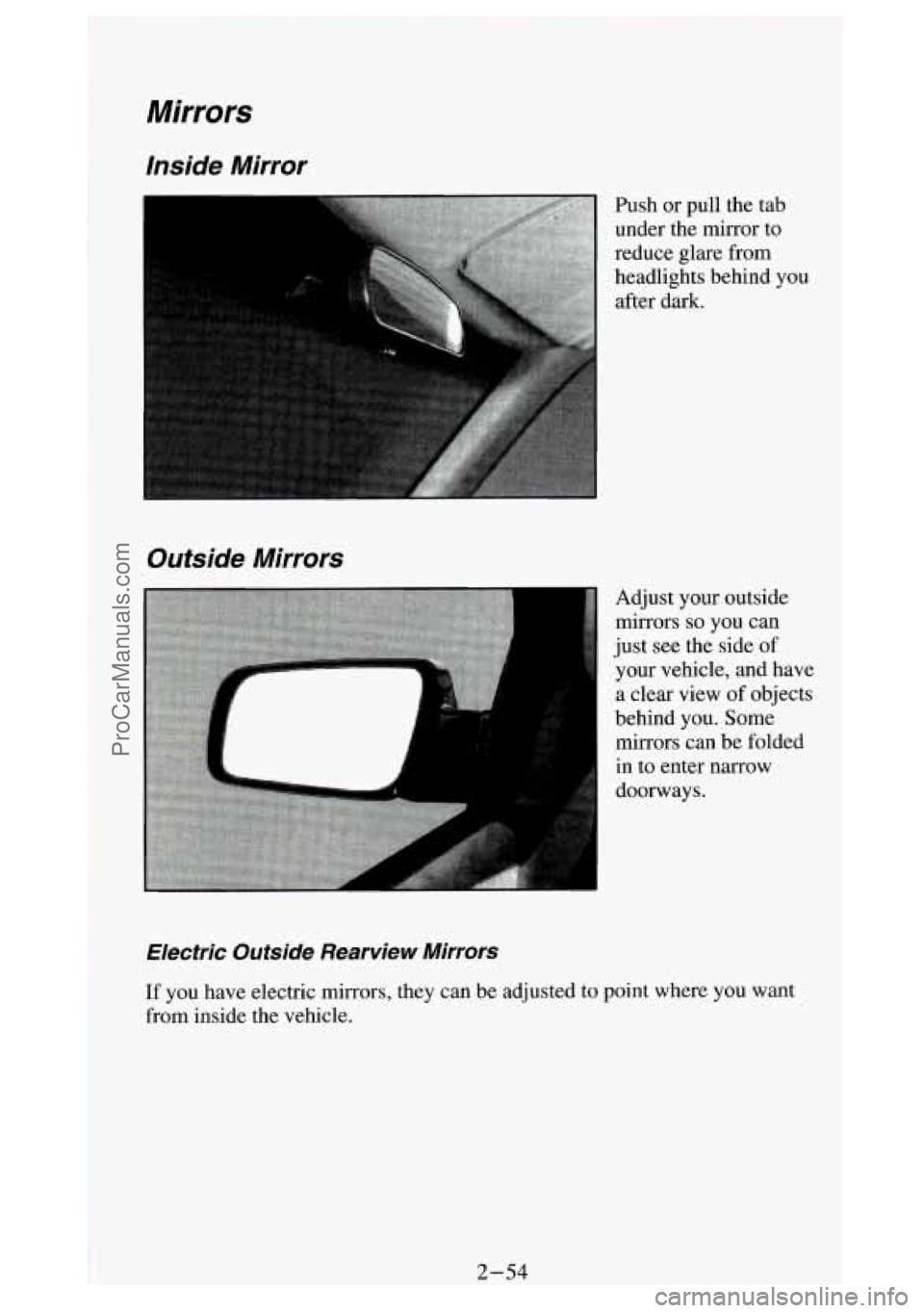
Inside Mirror
Push or pull the tab
under the mirror to
reduce glare from
headlights behind you
after dark.
Outside Mirrors
1
Electric Outside Rearwie w Mirrors
Adjust your outside
mirrors
so you can
just see the side of
your vehicle, and have
a clear view
of objects
behind you. Some
mirrors can be folded
in to enter narrow
doorways.
If you have electric mirrors, they can be adjusted to point where you want
from inside the vehicle.
ProCarManuals.com
Page 133 of 404
Check Gages Light
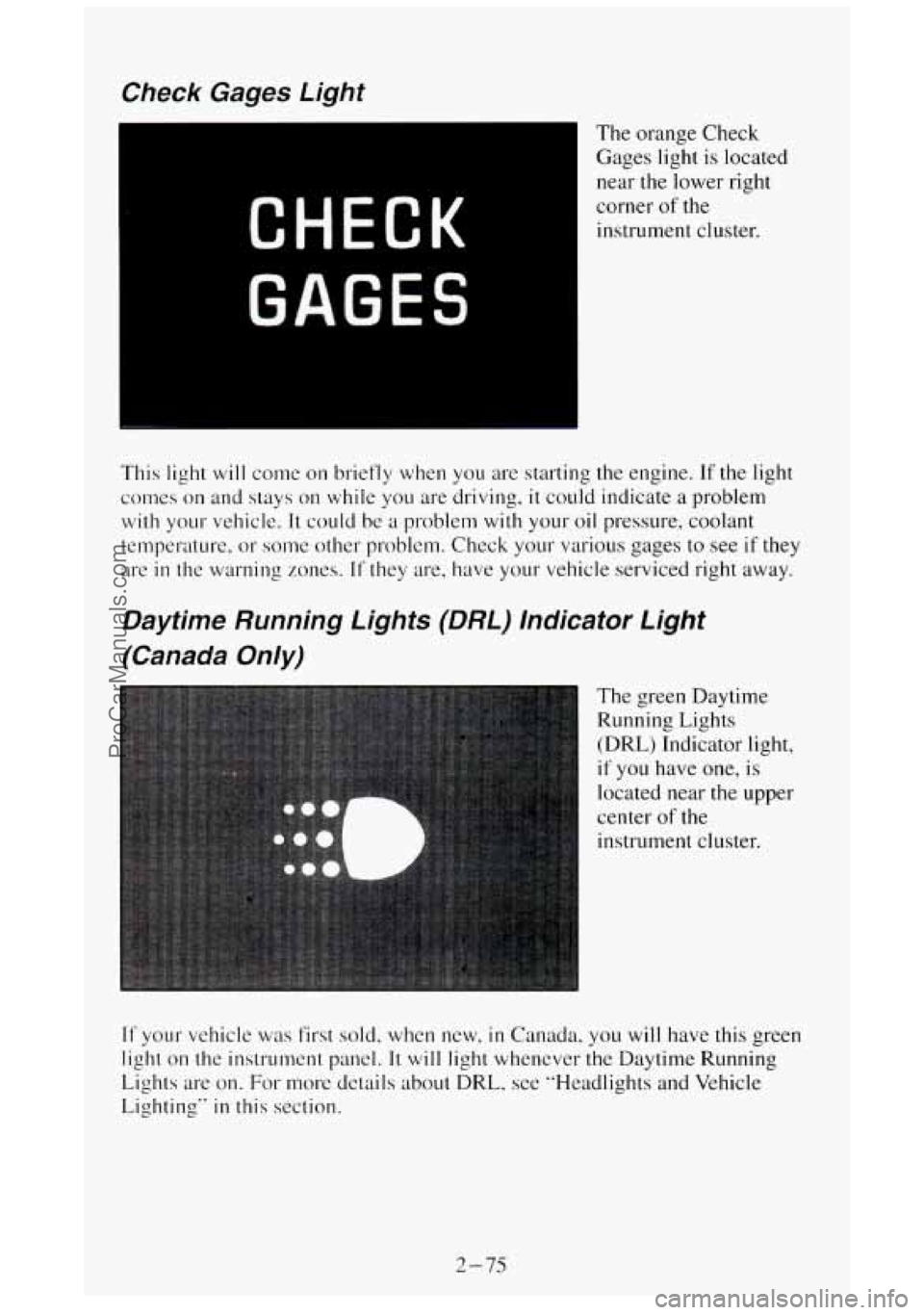
The orange Check
Gages light is located
near the lower right
corner
of the
instrument cluster.
This light
will come on briefly when you are starting the engine. If the light
comes
on and stays on while you are driving. it could indicate a problem
with your vehicle. It could be a problem with your oil pressure, coolant
temperature. or some other problem. Chcck your various gages
to see if they
are
in the warning zones. If they are, have your vehicle serviced right away.
Daytime Running Lights (DRL) Indicator Light
(Canada Only)
The green Daytime
Running Lights
(DRL) Indicator light,
if you have one, is
located near the upper
center
of the
instrument cluster.
If your vehicle was first sold. when new. in Canada, you will have this green
lighl on the instrument pancl.
It will light whenever the Daytime Running
Lights
are on. For more details about DRL, sce "Headlights and Vehicle
Lighting'.
in this section.
2-75
ProCarManuals.com
Page 134 of 404
Shift Indicator Light
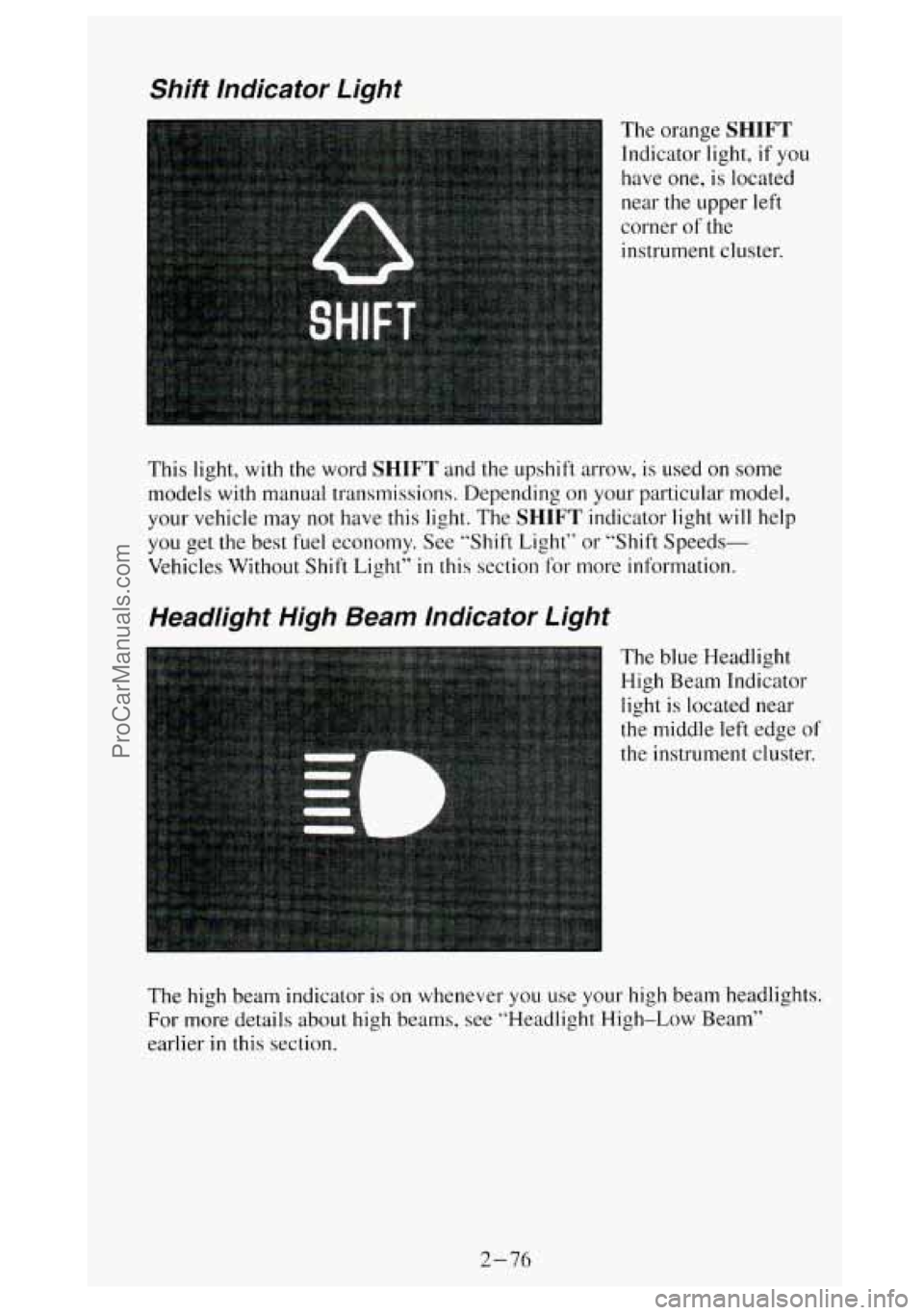
The orange SHIFT
Indicator light, if you
have one,
is located
near the upper left
corner of the
instrument cluster.
This light, with the word
SHIFT and the upshift arrow, is used on some
models with manual transmissions. Depending on your particular model,
your vehicle may
not have this light. The SHIFT indicator light will help
you get the best fuel economy. See “Shift Light” or “Shift Speeds-
Vehicles Without Shift Light”
in this section for more information.
Headlight High Beam Indicator Light
light is located near
the middle left edge of
the instrument cluster.
The high beam indicator
is on whenever you use your high beam headlights.
For more details about high beams, see “Headlight High-Low Beam”
earlier
in this section.
2-76
.
ProCarManuals.com
Page 181 of 404
Here are some other things to consider as you approach a hill.
Is there a constant incline, or does the hill get sharply steeper in places'!
Is there good traction on the hillside, or will the surface cause tire
slipping?
Is there a straight path up or down the hill so you won't have to make
turning maneuvers?
Are there obstructions on the hill that can block your path (boulders,
trees, logs
or ruts)'?
What's beyond the hill? 1s there a cliff, an embankment, a drop-off, a
fence? Get out and walk the
hill if you don't know. It's the smart way
to find out.
Is the hill simply too rough? Steep hills often have ruts, gullies, troughs
and exposed rocks because they are more susceptible
to the effects of
erosion.
Driving Uphill
Once you decide you can safely drive up the hill, you need to take some
special steps.
Use a low gear and get a firm grip on the steering wheel.
Get a smooth start up the hill and try to maintain your speed. Don't use
more power than
you need, because you don"t want your wheels to start
spinning or sliding.
Try to drive straight up the hill if at all possible. If the path twists and
turns, you might want to find another route.
A CAUTION:
Tbrning or driving across steep hills can be dangerous, You
could lose traction, slide sideways, and possibly roll over.
You
could be seriously injured or killed. When driving up hills,
always
try to go straight up.
Ease up on your speed as you approach the top of the hill.
Attach a flag to the vehicle to make you more visible to approaching
traffic
on trails or hills.
Sound the horn as you approach the top of the hill to let opposing
traffic know you're there.
Use your headlights even during the day. They make you more visible
to oncoming traffic.
4- 17
ProCarManuals.com
Page 188 of 404
After Off-Road Driving
Remove any brush or debris that has collected on the underbody, chassis or
under the hood. These accumulations can be
a fire hazard.
After operation
in mud or sand, have the brake linings cleaned and checked.
These substances can cause glazing and uneven braking. Check the body
structure, steering, suspension, wheels, tires, and exhaust system for
damage. Also, check the fuel lines and cooling system for any leakage.
Your vehicle will require more frequent service due to off-road use. Refer
to the Maintenance Schedule for additional information.
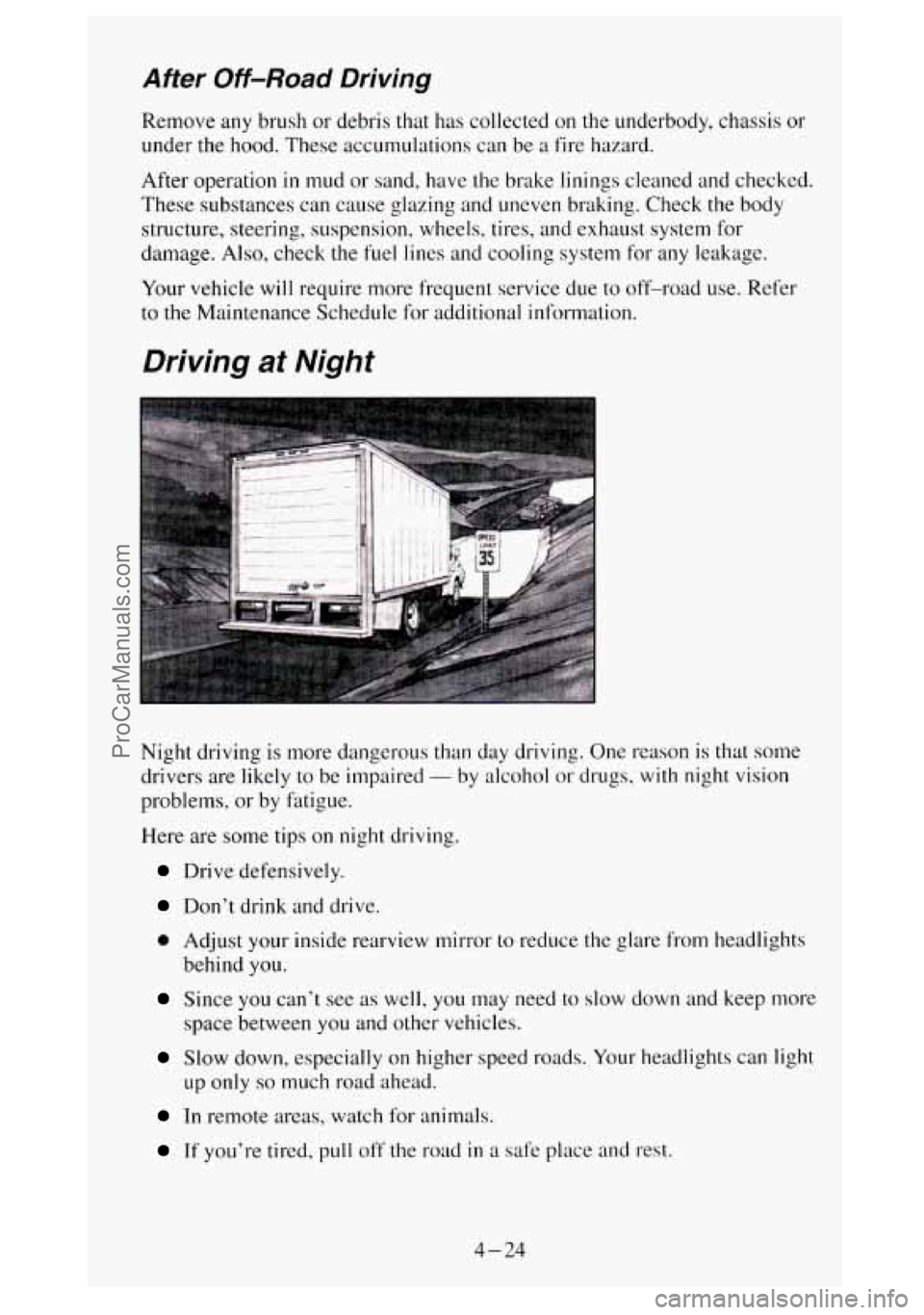
Driving at Night
Night driving is more dangerous than day driving. One reason is that some
drivers are likely to be impaired
- by alcohol or drugs. with night vision
problems,
or by fatigue.
Here are some tips
on night driving.
Drive defensively.
Don’t drink and drive.
a Adjust your inside rearview mirror to reduce the glare from headlights
behind you.
Since you can’t see as well, you may need to slow down and keep more
space between you and other vehicles.
Slow down, especially on higher speed roads. Your headlights can light
up only so much road ahead.
In remote areas, watch for animals.
If you’re tired, pull off the road in a safe place and rest.
4-24
ProCarManuals.com