tire pressure GMC SIERRA 1994 Owners Manual
[x] Cancel search | Manufacturer: GMC, Model Year: 1994, Model line: SIERRA, Model: GMC SIERRA 1994Pages: 404, PDF Size: 20.91 MB
Page 172 of 404
So, use a “squeeze” braking technique. This will give you maximum
braking while maintaining steering control. You do this by pushing on the
brake pedal with steadily increasing pressure. When you do,
it will help
maintain steering control. In many emergencies, steering can help
you more
than even the very best braking.
Steering
Power Steering
If you lose power steering assist because the engine stops or the system is
not functioning, you can steer but it will take much more effort.
Steering lips
Driving on Curves
It’s important to take curves at a reasonable speed.
A lot of the “driver lost control” accidents mentioned on the news happen
on curves. Here’s
why:
Experienced driver or beginner, each of us is subject to the same laws of
physics when driving on curves. The traction
of the tires against the road
surface makes
it possible for the vehicle to change its path when you turn
the front wheels.
If there’s no traction, inertia will keep the vehicle going in
the same direction. If you‘ve ever tried to steer a vehicle on wet ice, you’ll
understand this.
The traction you can get
in a curve depends on the condition of your tires
and the road surface, the angle at which the curve
is banked, and your
speed. While you’re
in a curve, speed is the one factor you can control.
Suppose you’re steering through
a sharp curve. Then you suddenly apply
the brakes. Both control systems
- steering and braking - have to do their
work where the tires meet the road. Adding the hard braking can demand
too much at those places.
You can lose control.
The same thing can happen
if you’re steering through a sharp curve and you
suddenly accelerate. Those
two control systems - steering and acceleration
- can overwhelm those places where the tires meet the road and make you
lose control.
What should you do
if this ever happens? Ease up on the brake or
accelerator pedal, steer the vehicle the way you want
it to go, and slow
down.
Speed
limit signs near curves warn that you should adjust your speed. Of
course, the posted speeds are based on good weather and road conditions.
Under less favorable conditions you’ll want to
go slower.
4-8
ProCarManuals.com
Page 176 of 404
Skidding
In a skid, a driver can lose control of the vehicle. Defensive drivers avoid
most skids by taking reasonable care suited to existing conditions, and by
not “overdriving” those conditions. But skids are always possible.
The three types of skids correspond to your Vehicle’s three control systems.
In the braking skid your wheels aren’t rolling. In the steering or cornering
skid, too much speed or steering in
a curve causes tires to slip and lose
cornering force. And
in the acceleration skid too much throttle causes the
driving wheels to spin.
A cornering skid and an acceleration skid are best handled by easing your
foot off the accelerator pedal.
If your vehicle starts
to slide, ease your foot off the accelerator pedal and
quickly steer the way
you want the vehicle to go. If you start steering
quickly enough, your vehicle may straighten out. Always be ready for
a
second skid if it occurs.
Of course, traction is reduced when water, snow, ice, gravel,
or other
material is
on the road. For safety, you’ll want to slow down and adjust your
driving to these conditions.
It is important to slow down on slippery
surfaces because stopping distance
will be longer and vehicle control more
limited.
While driving
on a surface with reduced traction, try your best to avoid
sudden steering, acceleration, or braking (including engine braking by
shifting
to a lower gear). Any sudden changes could cause the tires to slide.
You may not realize the surface is slippery until your vehicle is skidding.
Learn to recognize warning clues
- such as enough water, ice or packed
snow
on the road to make a “mirrored surface” - and slow down when you
have any doubt.
Remember: The rear-wheel anti-lock braking system (RWAL) helps avoid
only
a rear braking skid. In a braking skid (where the front wheels are no
longer rolling), release enough pressure
on the brakes to get the front wheels
rolling again. This restores steering control. Push the brake pedal down
steadily when you have
to stop suddenly. As long as the front wheels are
rolling, you
will have steering control.
4-12
ProCarManuals.com
Page 186 of 404
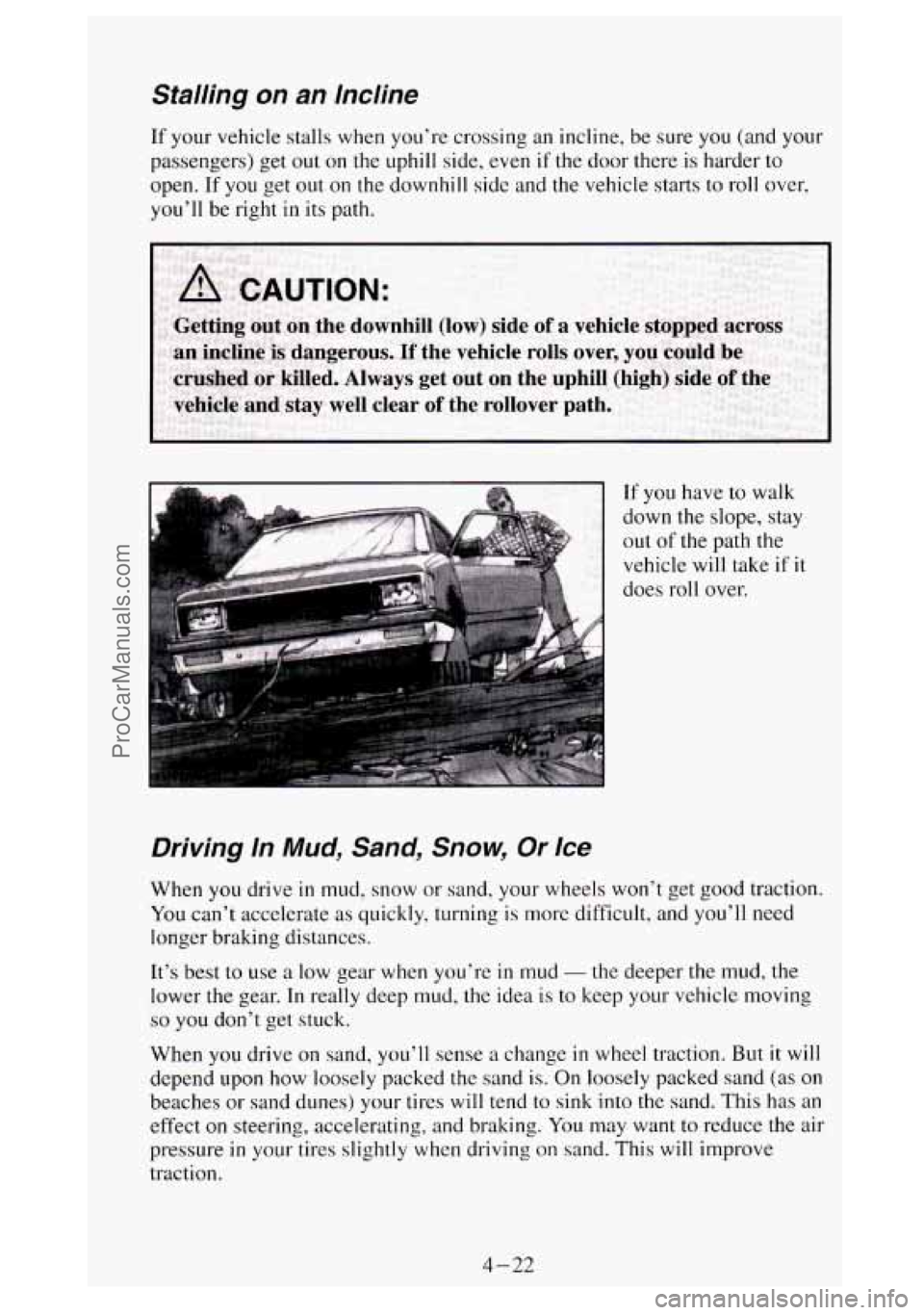
Stalling on an Incline
If your vehicle stalls when you’re crossing an incline, be sure you (and your
passengers) get out on the uphill side, even
if the door there is harder to
open. If
you get out on the downhill side and the vehicle starts to roll over,
you’ll be right in its path.
If you have to walk
down the slope, stay
out
of the path the
vehicle will take if
it
does roll over.
Driving In Mud, Sand, Snow, Or Ice
When you drive in mud, snow or sand, your wheels won’t get good traction.
You can’t accelerate as quickly, turning
is more difficult, and you’ll need
longer braking distances.
It’s best to use
a low gear when you’re in mud - the deeper the mud, the
lower
the gear. In really deep mud, the idea is to keep your vehicle moving
so you don’t get stuck.
When you drive
on sand, you’ll sense a change in wheel traction. But it will
depend upon how loosely packed the sand is. On loosely packed sand
(as on
beaches or sand dunes) your tires
will tend to sink into the sand. This has an
effect
on steering, accelerating, and braking. You may want to reduce the air
pressure
in your tires slightly when driving on sand. This will improve
traction.
4-22
ProCarManuals.com
Page 191 of 404
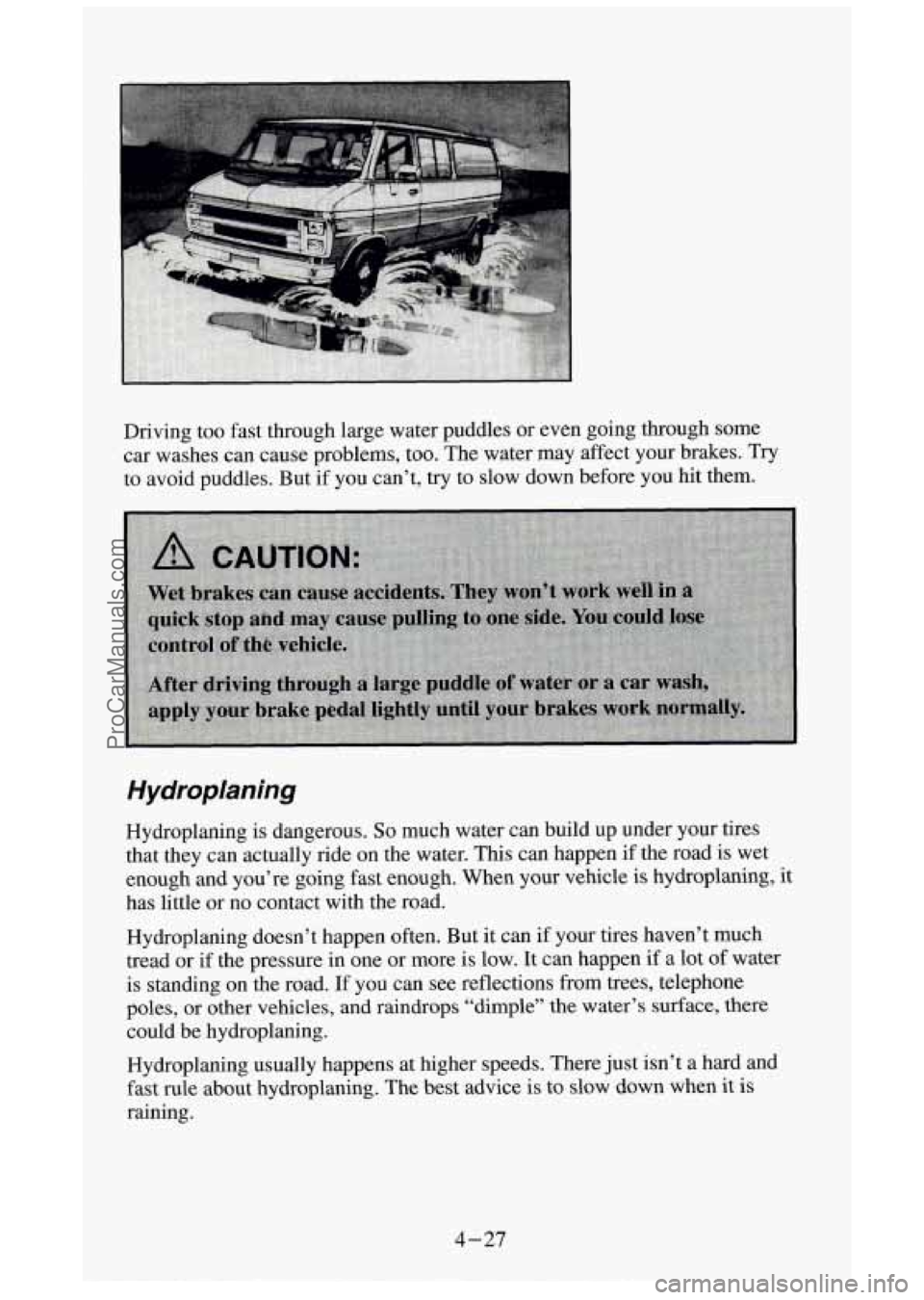
Driving too fast through large water puddles or even going through some
car washes can cause problems,
too. The water may affect your brakes. Try
to avoid puddles. But if you can’t, try to slow down before you hit them.
Hydroplaning
Hjdroplaning is dangerous. So much water can build up under your tires
that they can actually ride on the water. This caa happen if the road is wet
enough and you’re going fast enough. When your vehicle
is hydroplaning, it
has little or no contact with the road.
Hydroplaning doesn’t happen often. But it can
if your tires haven’t much
tread or
if the pressure in one or more is low. It can happen if a lot of water
is standing on the road. If you can see reflections from trees, \
telephone
poles,
or other vehicles, and raindrops “dimple” the water’s sudace, there
could be hydroplaning.
Hydroplaning usually happens at higher speeds. There just isn’t a hard and
fast rule about hydroplaning. The best advice is to slow down when
it is
raining.
4-27
ProCarManuals.com
Page 194 of 404
Reduce your speed according to your speedometer, not to your sense of
motion. After driving for any distance at higher speeds, you may tend
to
think you are going slower than you actually are.
Before Leaving on a Long Trip
Make sure you’re ready. Try to be well rested. If you must start when you’re
not fresh
- such as after a day’s work - don’t plan to make too many
miles that first part
of the journey. Wear comfortable clothing and shoes you
can easily drive in.
Is your vehicle ready for a long trip? If you keep it serviced and maintained,
it’s ready to go.
If it needs service, have it done before starting out. Of
course, you’ll find experienced and able service experts
in Vehicle
dealerships all across
North America. They’ll be ready and willing to help if
you need it.
Here are some things you can check before a trip:
Windshield Washer Fluid: Is the reservoir full? Are all windows clean
inside and outside?
Wiper Blades: Are they in good shape‘?
Fuel, Engine Oil, Other Fluids: Have you checked all levels?
0 Lights: Are they all working? Are the lenses clean‘?
0 Tires: They are vitally important to a safe, trouble-free trip. Is the tread
good enough for long-distance driving‘? Are the tires all inflated
to the
recommended pressure‘?
0 Weather Forecasts: What’s the weather outlook along your route?
Should you delay your trip
a short time to avoid a major storm system?
0 Maps: Do you have up-to-date maps?
Highway Hypnosis
Is there actually such a condition as “highway hypnosis”? Or is it just plain
falling asleep at the wheel?
Call it highway hypnosis, lack of awareness, or
whatever.
There is something about
an easy stretch of road with the same scenery,
along with the hum of the tires on
the road, the drone of the engine, and the
rush of the wind against the vehicle that can make you sleepy. Don’t let it
happen to you! If
it does, your vehicle can leave the road in less than a
second, and you could crash and be injured.
4-30
ProCarManuals.com
Page 252 of 404
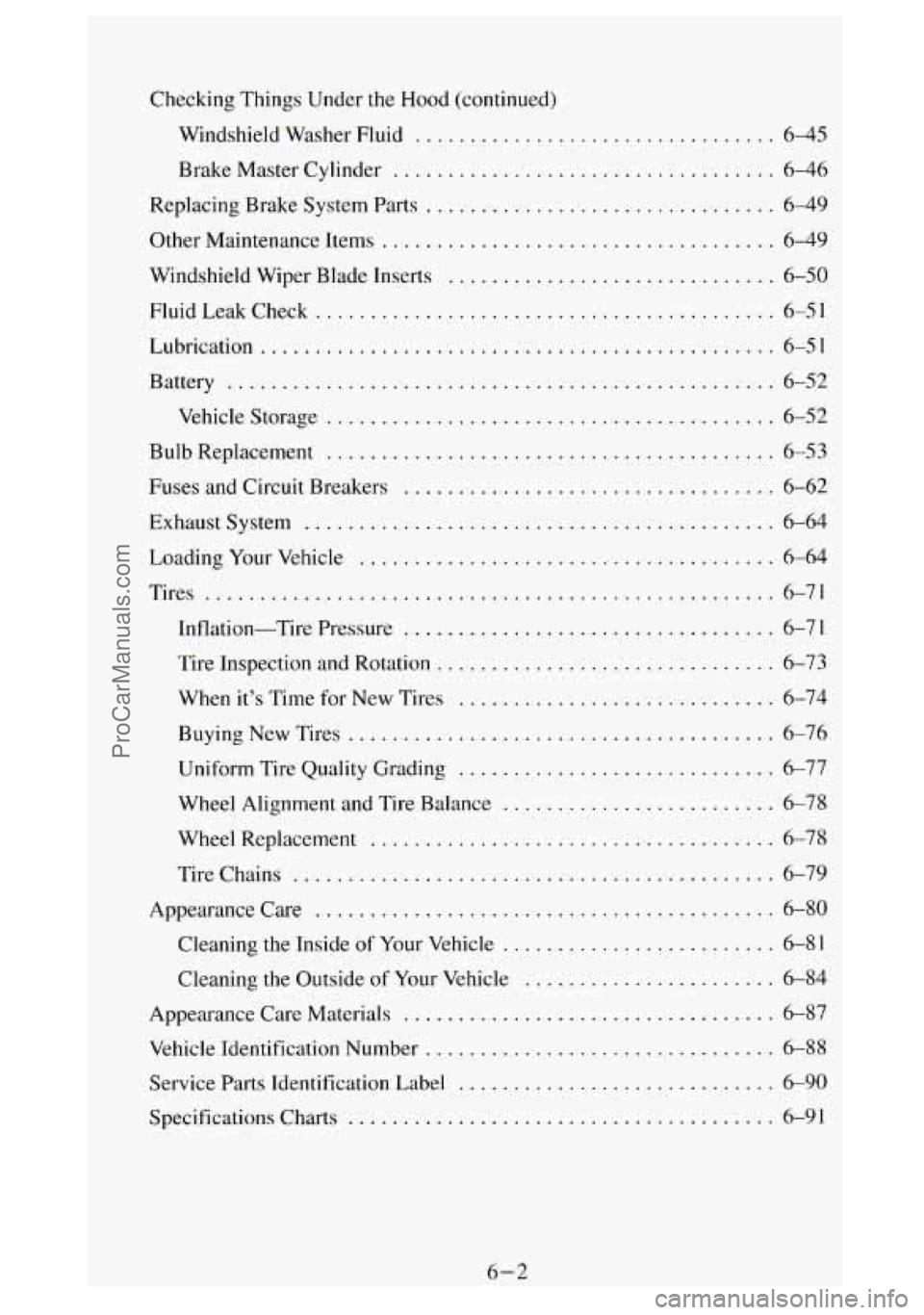
Checking Things Under the Hood (continued)
Windshield Washer Fluid
................................. 6-45
Brake Master Cylinder
................................... 6-46
Replacing Brake System Parts
................................ 6-49
Other Maintenance Items
.................................... 6-49
Windshield Wiper Blade Inserts
.............................. 6-50
FluidLeakCheck
.......................................... 6-51
Lubrication
............................................... 6-51
Battery .................................................. 6-52
Vehiclestorage
......................................... 6-52
Bulb Replacement
......................................... 6-53
Fuses and Circuit Breakers
.................................. 6-62
Exhaustsystem
........................................... 6-64
Loading Your Vehicle
...................................... 6-64
Tires .................................................... 6-71
Inflation-Tire Pressure
.................................. 6-71
Tire Inspection and Rotation
............................... 6-73
When it’s Time for New Tires
............................. 6-74
Buying New Tires
....................................... 6-76
Uniform Tire Quality Grading
............................. 6-77
Wheel Alignment and Tire Balance
......................... 6-78
Wheel Replacement
..................................... 6-78
Tire Chains
............................................ 6-79
Appearancecare
.......................................... 6-80
Cleaning the Inside of Your Vehicle
......................... 6-81
Cleaning the Outside
of Your Vehicle ....................... 6-84
Appearance Care Materials
.................................. 6-87
Vehicle Identification Number
................................ 6-88
Service Parts Identification
Label ............................. 6-90
Specifications Charts
..................................... 6-91
6-2
ProCarManuals.com
Page 315 of 404
Malfunction Indicator
(SERVICE ENGINE SOON) Lamp
The Malfunction Indicator (SERVICE ENGINE SOON) Lamp on your
instrument panel lets you know when
your emission system needs service.
The light
will come on briefly when you start your engine to let you know
that the system is working. If
it does not come on when you start your
engine,
or if it comes on and stays on while you’re driving, your system
may need service. Your vehicle should still be driveable, but
you should
have your system serviced right away.
Secondary Air hjection Reaction (AIR) System
You may have this system. It has a control valve that will direct air to where
it is needed. If the AIR system needs service, your Malfunction Indicator
(SERVICE ENGINE SOON) Lamp on your instrument panel will come on.
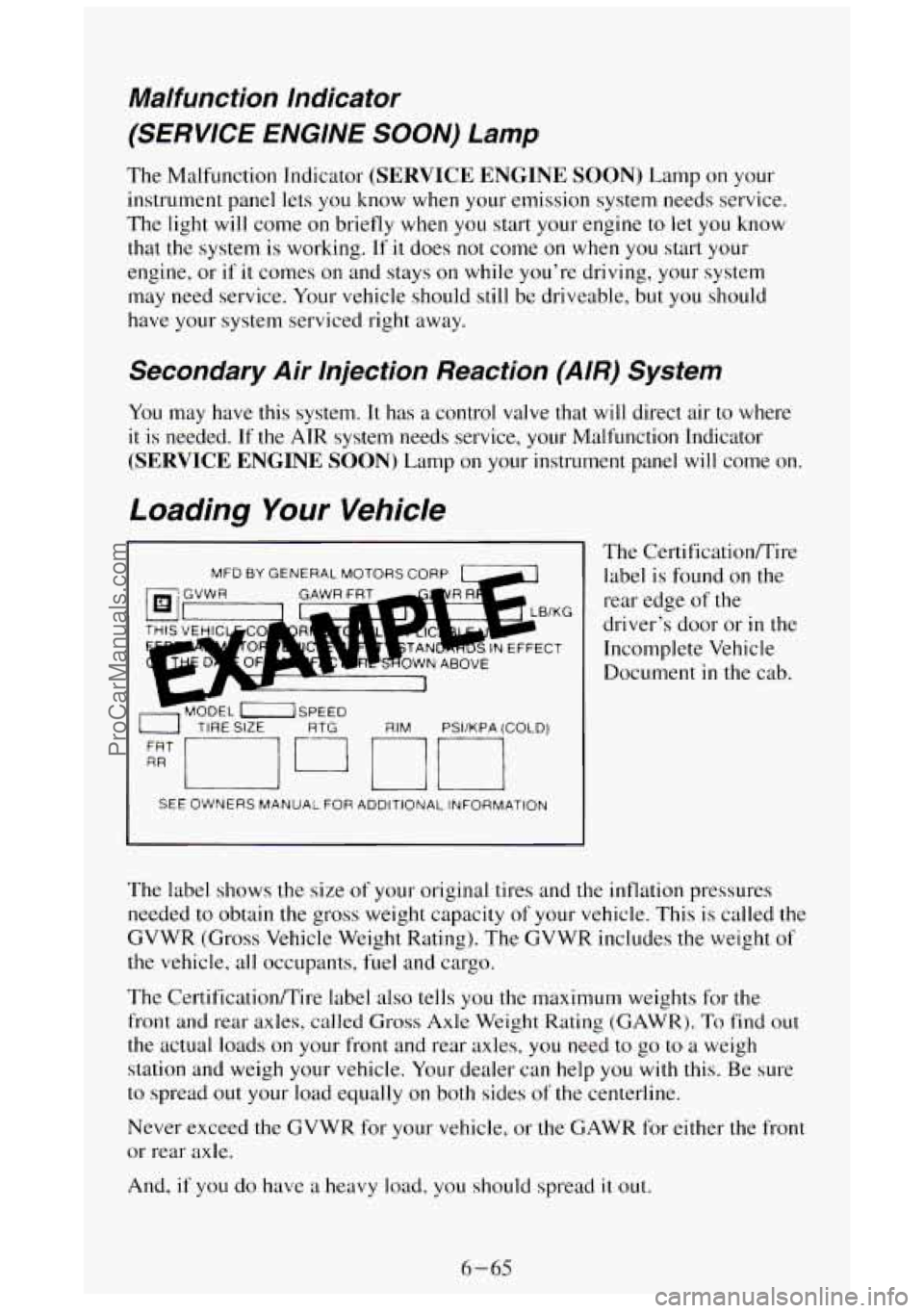
Loading Your Vehicle
SEE OWNERS MANUAL FOR ADDITIONAL INFORMATION
BlKG
The Certification/Tire
label is found on the
rear edge of the
driver’s door or
in the
Incomplete Vehicle
Document
in the cab.
The label shows
the size of your original tires and the inflation pressures
needed to obtain the gross weight capacity of your vehicle. This is called the
GVWR (Gross Vehicle Weight Rating). The GVWR includes the weight of
the vehicle, all occupants, fuel and cargo.
The Certification/Tire label also tells
you the maximum weights for the
front and rear axles, called Gross Axle Weight Rating (GAWR). To find out
the actual loads on your front and rear axles, you need to go to a weigh
station and weigh your vehicle. Your dealer can help you
with this. Be sure
to spread out your load equally
on both sides of the centerline.
Never exceed the GVWR for your vehicle, or
the GAWR for either the front
or rear axle.
And,
if you do have a heavy load, you should spread it out.
6-65
ProCarManuals.com
Page 321 of 404
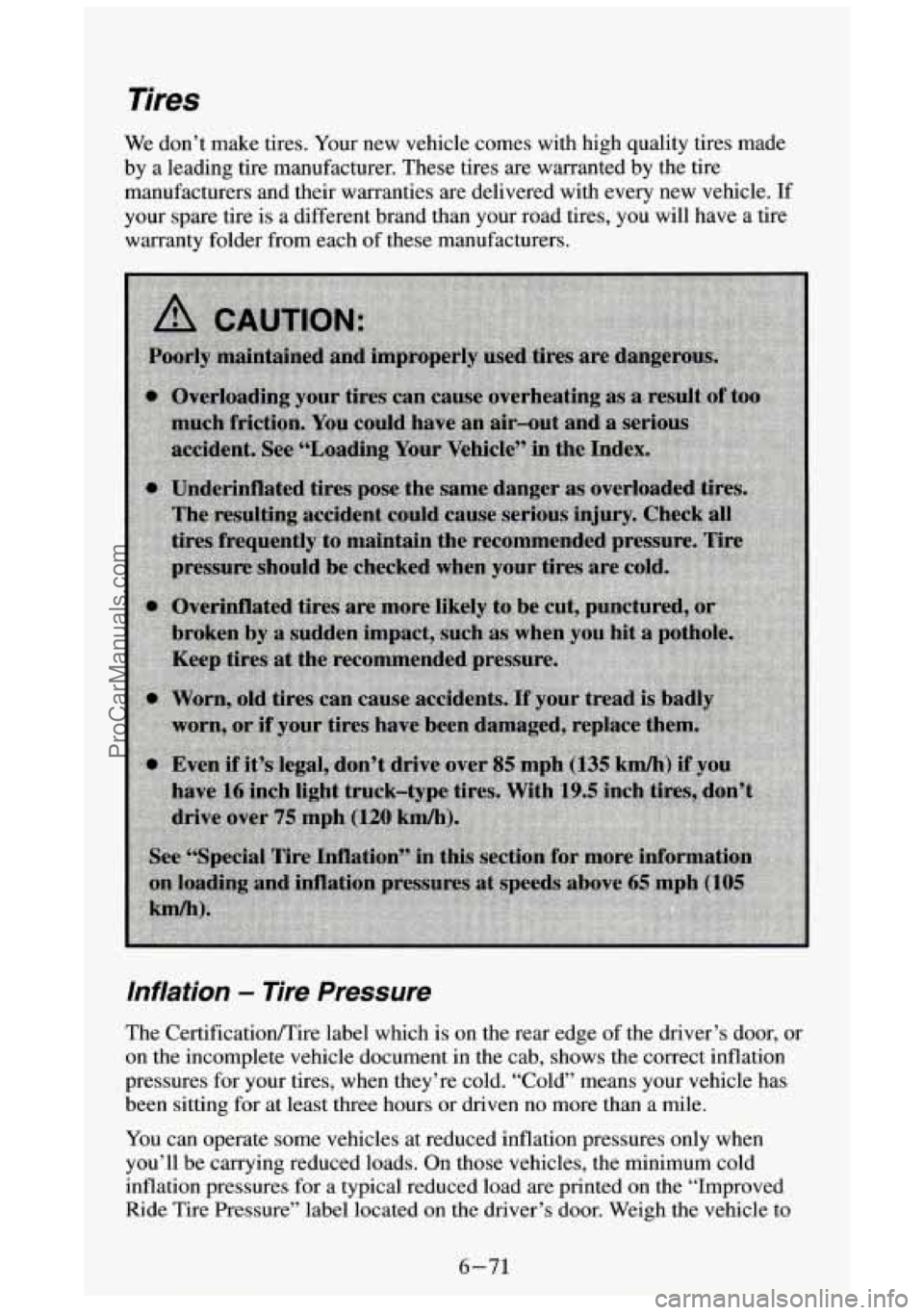
Tires
We don’t make tires. Your new vehicle comes with high quality tires made
by a leading tire manufacturer. These tires
are warranted by the tire
manufacturers and their warranties are delivered with
every new vehicle. If
your spare tire is a different brand than your road tires, you will have a tire
warranty folder from each of these manufacturers.
Inflation - Tire Pressure
The Certificatioflire label which is on the rear edge of the driver’s door, or
on the incomplete vehicle document in the cab, shows the correct inflation
pressures for your tires, when they’re cold. “Cold” means your vehicle has
been sitting for at least three hours or driven no more than a mile.
You can operate some vehicles at reduced inflation pressures only when
you’ll be carrying reduced loads. On those vehicles, the minimum cold
inflation pressures for a typical reduced load are printed on the “Improved
Ride Tire Pressure’’ label located on the driver’s door. Weigh the vehicle to
6-71
ProCarManuals.com
Page 322 of 404
find the load on each tire and see the label for the minimum cold inflation
pressures
for that load.
NOTICE:
Don’t let anyone tell you that underinflation or overinflation is
all right. It’s not. If your tires don’t have enough air
(underinflation) you can get:
Too much flexing
Too much heat
Tire overloading
Bad wear
Bad handling
Bad fuel economy.
If your tires have too much air (overinflation), you can get:
Unusual wear
Bad handling
Rough ride
‘Needless damage from road hazards.
When io Check
Check your tires once a month or more. Also, check the tire pressure of the
spare tire.
How to Check
Use a good quality pocket-type gage to check tire pressure. Simply looking
at the tires
will not tell you the pressure, especially if you have radial tires
- which may look properly inflated even if they’re underinflated.
If your tires have valve caps, be sure to put them back on. They help prevent
leaks by keeping out dirt and moisture.
6-72
ProCarManuals.com
Page 323 of 404
Special Tire lnflation
If you have 16 inch tires on your vehicle, and:
- You’ll be driving for very long at speeds of 66 mph (105 km/h) to
75 mph (120
km/h) where legal, inflate tires to 10 psi (70 kPa)
more than the recommended cold inflation pressures.
- You’ll be driving for very long at speeds of 76 mph (120 km/h) to
85 mph (135
km/h) where legal, cold inflation pressures should be
increased by
10 psi (70 kPa) and you must also reduce axle load
capacity by 10%.
Do not drive over 85 mph (135 km/h) even if
it’s legal.
Inflation pressures should never exceed 10 psi (70 kPa) above the
inflation specified for the maximum load of the tire.
If you have 19.5 inch radial tires on your vehicle, and:
- You’ll be driving for very long at speeds of 66 mph (105 km/h) to
70 mph (110 km/h) where legal, inflate tires to 5 psi (35 kPa) more
than the recommended cold inflation pressures, and reduce the
axle load capacity by 4%.
- You’ll be driving for very long at speeds of 7 1 mph (1 15 km/h) to
75 mph (120
km/h) where legal, cold inflation pressures should be
increased by 5 psi (35 kPa) and you must also reduce axle \
load capacity by 12%.
Do not drive over 75 mph (120 km/h) even if
it’s legal.
Inflation pressures should never exceed 20 psi (140 kPa) above the
inflation specified for the maximum load of the tire.
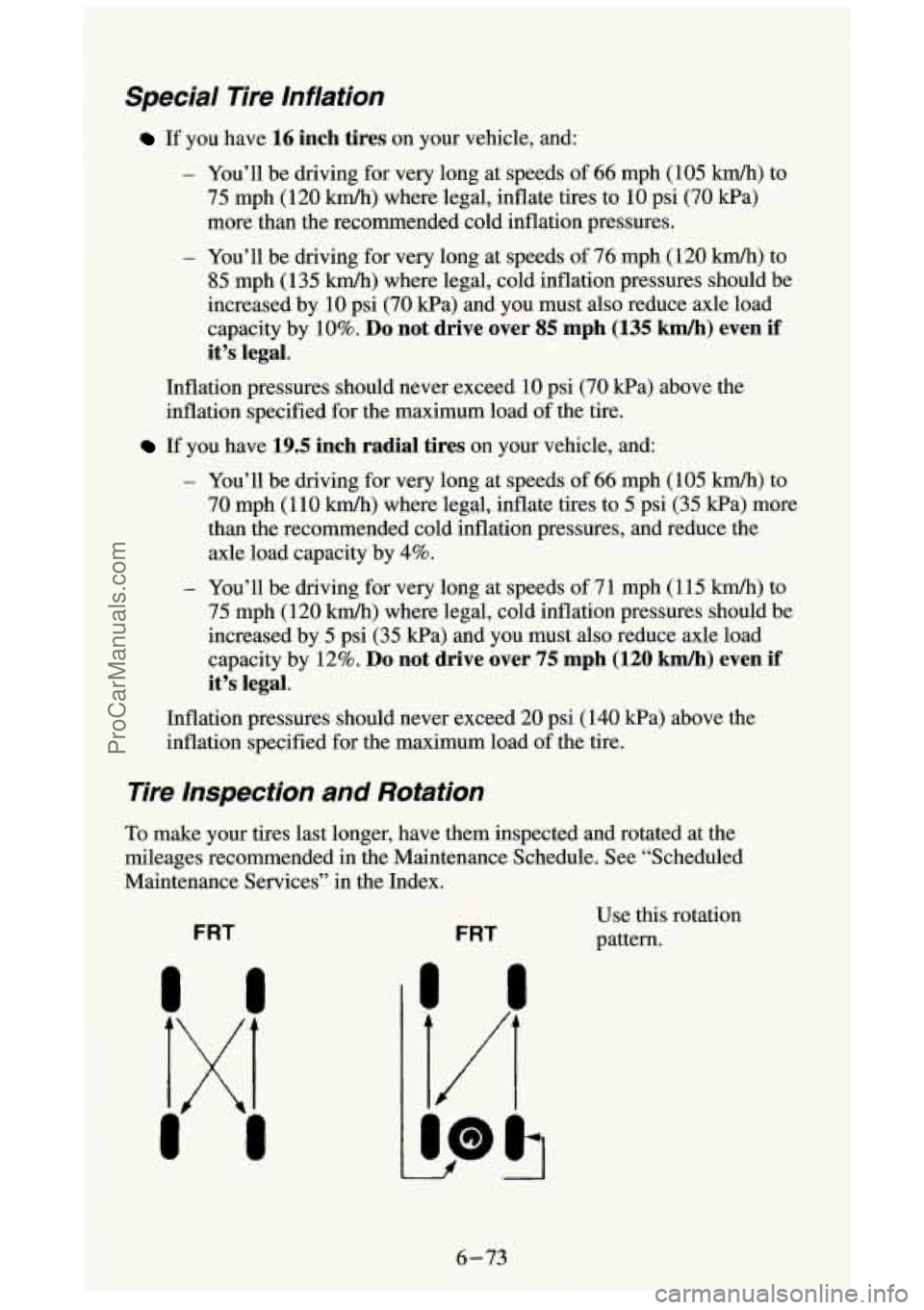
Tire Inspection and Rotation
To make your tires last longer, have them inspected and rotated at the
mileages recommended in the Maintenance Schedule. See “Scheduled
Maintenance Services” in the Index.
FRT
8
FRT
Use this rotation
pattern.
4-73
ProCarManuals.com