fuel GMC SIERRA 1994 Owner's Manual
[x] Cancel search | Manufacturer: GMC, Model Year: 1994, Model line: SIERRA, Model: GMC SIERRA 1994Pages: 404, PDF Size: 20.91 MB
Page 203 of 404
Every vehicle is ready for some trailer towing. If it was built with trailering
options,
as many are, it’s ready for heavier trailers. But trailering is different
than just driving your vehicle by itself. Trailering means changes
in
handling, durability, and fuel economy. Successful, safe trailering takes
correct equipment, and
it has to be used properly.
That’s the reason for this section. In it are many time-tested, important
trailering tips and safety rules. Many
of these are important for your safety
and that of your passengers.
So please read this section carefully before you
pull
a trailer.
If You Do Decide To Pull A Trailer
If you do, here are some important points.
There are many different laws having to do with trailering. Make sure
your rig will be legal,
not only where you live but also where you’ll be
driving. A good source for this information can be state or provincial
police.
Consider using a sway control if your trailer will weigh 4,000 pounds
(1 800 kg) or less. You should always use a sway control if your trailer
will weigh more than 4,000 pounds (I 800 kg).
You can
ask a hitch dealer about sway controls.
0 Don’t tow a trailer at all during the first 500 miles (800 km) your new
vehicle is driven. Your engine, axle or other parts could be damaged.
Then, during the first 500 miles (800 km) that you tow a trailer, don’t
drive over
50 mph (80 kdh) and don’t make starts at full throttle. This
helps your engine and other parts
of your vehicle wear in at the heavier
loads.
Three important considerations have
to do with weight:
Weight of the Trailer
How heavy can a trailer safely be?
It depends on how you plan to use your rig. For example, speed, altitude,
road grades, outside temperature and how much
your vehicle is used to pull
a trailer are all important. And, it can also depend on any special equipment
that
you have on your vehicle.
You can ask your dealer for our trailering information or advice,
or you can
write us at
the address listed in your Warranty and Owner Assistance
Information Booklet.
In Canada, write to General Motors
of Canada Limited, Customer
Assistance Center,
1908 Colonel Sam Drive, Oshawa, Ontario LlH 8P7.
4-39
ProCarManuals.com
Page 233 of 404
..I . ... . ;. ..
Engine Fan Noise
Your vehicle has a clutched engine cooling fan. When the clutch is engaged,
the fan spins faster
to provide more air to cool the engine. In most every day
driving conditions
the fan is spinning slower and clutch is not fully engaged.
This improves fuel economy and reduces fan noise. Under heavy vehicle
loading, trailer towing and/or high outside temperatures, the fan speed
increases as
the clutch more fully engages. So you may hear an increase in
fan noise. This is normal and should not be mistaken as the transmission
slipping or making extra shifts. It is merely the cooling system functioning
properly. The fan will slow down when additional cooling is not required
and
the clutch partially disengages.
You may also hear
this fan noise when you start the engine. It will go away
as
the fan clutch partially disengages.
If a Tire Goes Flat
It’s UfluSual for a tire to “blow out” while you’re driving, especially if you
maintain your tires properly. If air goes out of a tire, it’s much more likely to
leak
out slowly. But if you should ever have a “blowout,’’ here are a few tips
about what
to expect and what to do:
If a front tire fails, the flat tire will create a drag that pulls the vehicle
toward that side. Take your foot off
the accelerator pedal and grip the
steering wheel firmly. Steer to maintain lane position, then gently brake to a
stop well
out of the traffic lane.
5-25
ProCarManuals.com
Page 251 of 404
Service & Appearance Care
Section
Here you will find information about the care of your vehicle . This section
begins with service and fuel information. and then it shows how to check
important fluid and lubricant levels
. There is also technical information
about your vehicle. and a section devoted to its appearance care
.
Service ................................................... 6-3
Fuel (Gasoline Engines)
...................................... 6-4
Diesel Fuel Requirements and Fuel System
...................... 6-5
Checking Things Under the Hood
............................. 6-15
HoodRelease
.......................................... 6-15
Cleaning Your Diesel Engine
.............................. 6-16
Noise Control System .................................... 6-16
Engine Oil (Except Diesel)
................................ 6-17
Engine Oil (Diesel Engines)
............................... 6-24
iri
Air Cleaner ............................................ 6-29
Automatic Fluid ........................................ 6-30
ManualFluid
........................................... 6-33
Hydraulic Clutch
........................................ 6-34
RearAxle ............................................. 6-35
mnsfer Case
.......................................... 6-36
FrontAxle
............................................. 6-37
Engine Coolant
......................................... 6-38
Power Steering Fluid
.................................... 6-43
6-1
ProCarManuals.com
Page 254 of 404
NOTICE:
If you try to do your own service work without knowing enough
about it, your vehicle could be damaged.
__ .
Maintenance Schedule
Section 7 of this manual, “Scheduled Maintenance Services”, explains the
maintenance your new vehicle needs, and when
it should be done. It also
has a form that you can use to record the maintenance work done on your
vehicle. Be sure
to read this information.
Fuel (Gasoline Engine)
If your vehicle has a diesel engine, see “Diesel Fuel Requirements and Fuel
System” in this Section. For vehicles with gasoline engines, please read this.
Use regular unleaded gasoline rated at
87 octane or higher. It should meet
specifications
ASTM D48 14 in the U.S. and CGSB 3.5-92 in Canada.
These fuels should have the proper additives, so you should not have to add
anything to the
fuel.
In the U.S. and Canada, it’s easy to be sure you get the right kind of
gasoline (unleaded). You’ll see “UNLEADED” right on the pump. And only
unleaded nozzles will fit into your vehicle’s filler neck.
Be sure
the posted octane is at least 87. If the octane is less than 87, you
may get a heavy knocking noise when
you drive. If it’s bad enough, it can
damage your engine.
If you’re using fuel rated at 87 octane or higher and you still hear heavy
knocking, your engine needs service. But don’t worry if
you hear a little
pinging noise
when you’re accelerating or driving up a hill. That’s normal
and
you don’t have to buy a higher octane fuel to get rid of pinging. It’s the
heavy, constant knock that means you have
a problem.
What about gasoline with blending materials that contain oxygen
(oxygenates), such as
MTBE or alcohol?
MTBE is “methyl tertiary-butyl ether.’’ Fuel that is no more than 15%
MTBE is fine for your vehicle.
Ethanol is ethyl or grain alcohol. Properly-blended fuel that is no more than
10% ethanol is fine for your vehicle.
Methanol is methyl or wood alcohol.
6-4
ProCarManuals.com
Page 255 of 404
NOTICE:
Fuel that is more than 5 % methanol is bad for your vehicle.
Don’t use it. It can corrode metal parts in your fuel system and
also damage plastic and rubber parts. That damage wouldn’t be
covered under your warranty. And even at
5% or less, there
must be “co~olvent~” and corrosion preventers in this fuel to
help avoid these problems.
Gasolines for Cleaner Air
Your use of gasoline with deposit control additives will help prevent
deposits from forming in your engine and fuel system. That helps keep your
engine
in tune and your emission control system working properly. It’s good
for your vehicle, and you’ll be doing your part for cleaner air.
Many gasolines are now blended with oxygenates. General Motors
recommends that
you use gasolines with these blending materials, such as
MTBE and ethanol. By doing
so, you can help clean the air, especially in
those parts of the country that have high carbon monoxide levels.
In addition, some gasoline suppliers are now producing reformulated
gasolines. These gasolines
are specially designed to reduce vehicle
emissions. General Motors recommends that you use reformulated gasoline.
By doing
so, you can help clean the air, especially in those parts of the
country that have high ozone levels.
You should ask your service station operators if their gasolines contain
deposit control additives and oxygenates, and if they have been
reformulated to reduce vehicle emissions.
Diesel Fuel Requirements and Fuel System
Some states and provinces have restrictions on the purchase of diesel fuel
for light-duty vehicles and require you to buy permits or pay special taxes.
Some
of these restrictions apply only to residents, and others apply to both
residents and visitors. These restrictions can change.
To learn the current
restrictions in any state or province, contact your auto club, the police or
other officials.
6-5
ProCarManuals.com
Page 256 of 404
Fuel Requirements
NOTICE:
Diesel fuel or fuel additives not recommended in this manual
could damage your fuel system and engine. Your warranty
wouldn’t cover this damage. And:
Diesel fuel that has been mixed with engine oil could damage
your engine and emission controls. Always check with your
service station operator to make sure his diesel fuel has not
been mixed with engine oil.
If you ever run out of diesel fuel, it can be difficult to restart
your engine. “Running Out of Fuel,” later in this section, tells
you how to get it started again.
To avoid all this, try never to
let your tank get empty.
What Fuel to Use
For best results, use number 2-D diesel fuel year-round (above and below
freezing conditions) as oil companies blend number
2-D fuel to address
climate differences. Number
1-D diesel fuel may be used in below freezing
weather, however, it will produce a power and
fuel economy loss. The use
of number
1-D diesel fuel in warm or hot climates may result in stalling,
poor starting when the engine
is hot and may damage the fuel injection
system.
Diesel fuel may foam when you fill your tank. This can cause the automatic
pump nozzle to shut off, even though your tank isn’t full. If this happens,
just wait for the foaming to stop and then continue to
fill your tank.
A CAUTION:
Heat coming from the engine may cause the fuel to expand and
force the fuel out of your tank. If something ignites the fuel,
a
fire could start and people could be burned. To help avoid this,
fill your fuel tank only until the automatic nozzle shuts
off.
Don’t try to “top it off.”
6-6
ProCarManuals.com
Page 257 of 404
Cold Weather Operation
In cold weather (below 20”F, or -7”C), use 1-D or “Winterized” Number
2-D fuel (a blend of I-D and 2-D). Be sure you get the right fuel. In very
cold temperatures (when
it stays below 0°F or -1 8OC), use Number 1-D.
If you’re driving in very cold temperatures and can’t get Number I-D or a
“winterized” Number
2-D, you can use one gallon of kerosene for every
two gallons
of diesel fuel. Once you add the kerosene, run your engine for
several minutes
so the fuels will mix. Add kerosene only when the
temperature falls below
0°F (-1 8” C), because the fuel economy of kerosene
isn’t
as good as that of diesel fuel.
NOTICE:
Never use home heating oil or gasoline in your diesel engine.
They can cause engine damage.
In cold weather, your fuel filter may become clogged (waxed), especially if
you use Number
2-D diesel fuel that hasn’t been “winterized.” To unclog it,
warm the filter to between 32°F and 50°F (0°C to 10°C). You won’t need
to replace
it.
Water in Fuel
Sometimes, water can be pumped into your fuel tank along with your diesel
fuel. This can happen
if a service station doesn’t regularly inspect and clean
its
fuel tanks, or if it gets contaminated fuel from its suppliers.
If this happens,
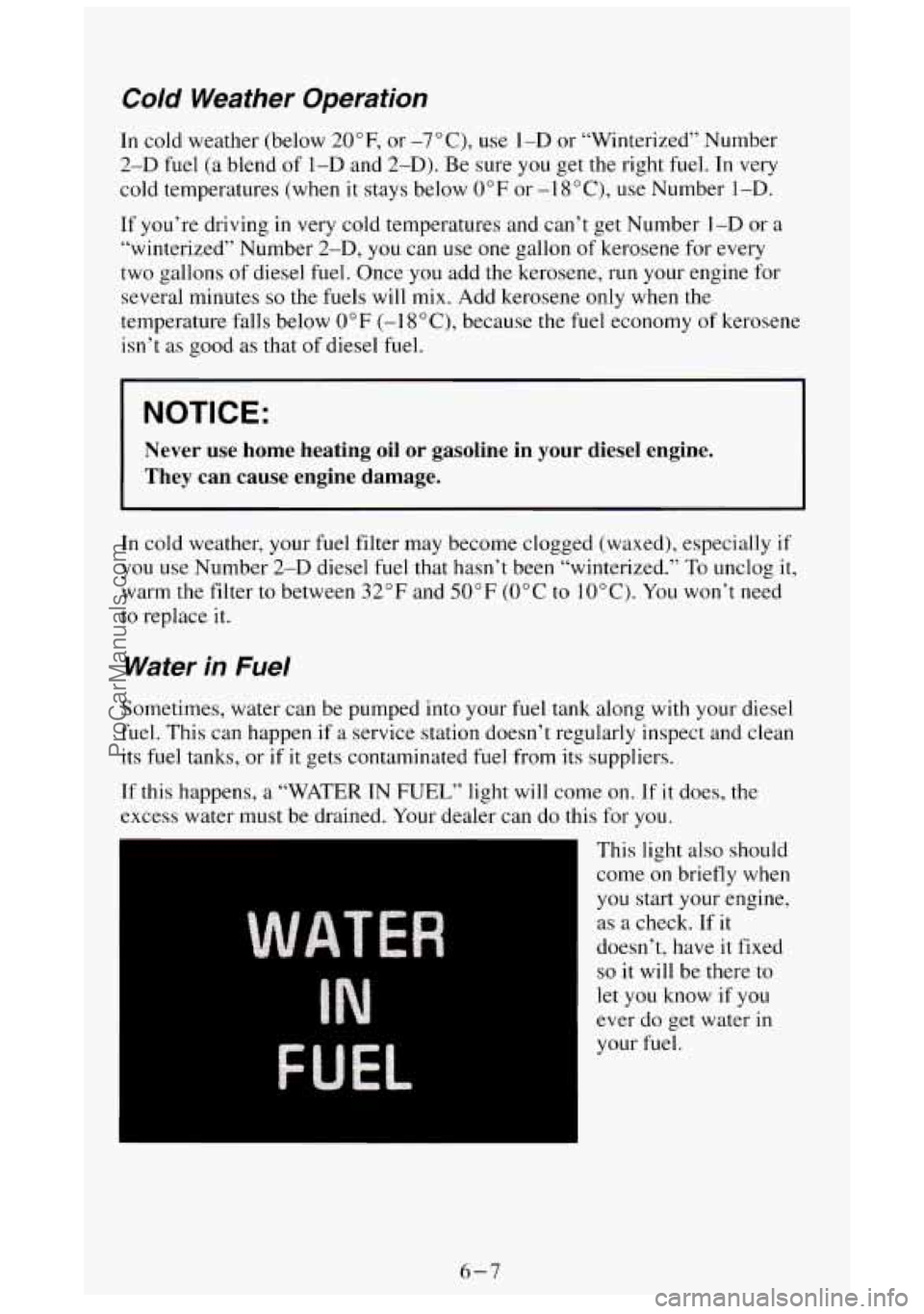
a “WATER IN FUEL” light will come on. If it does, the
excess water must be drained. Your dealer can do this
for you.
This light also should
come on briefly when
you start your engine,
as a check. If it
doesn’t, have it fixed
so it will be there to
let you know if you
ever
do get water in
your fuel.
L
6-7
ProCarManuals.com
Page 258 of 404
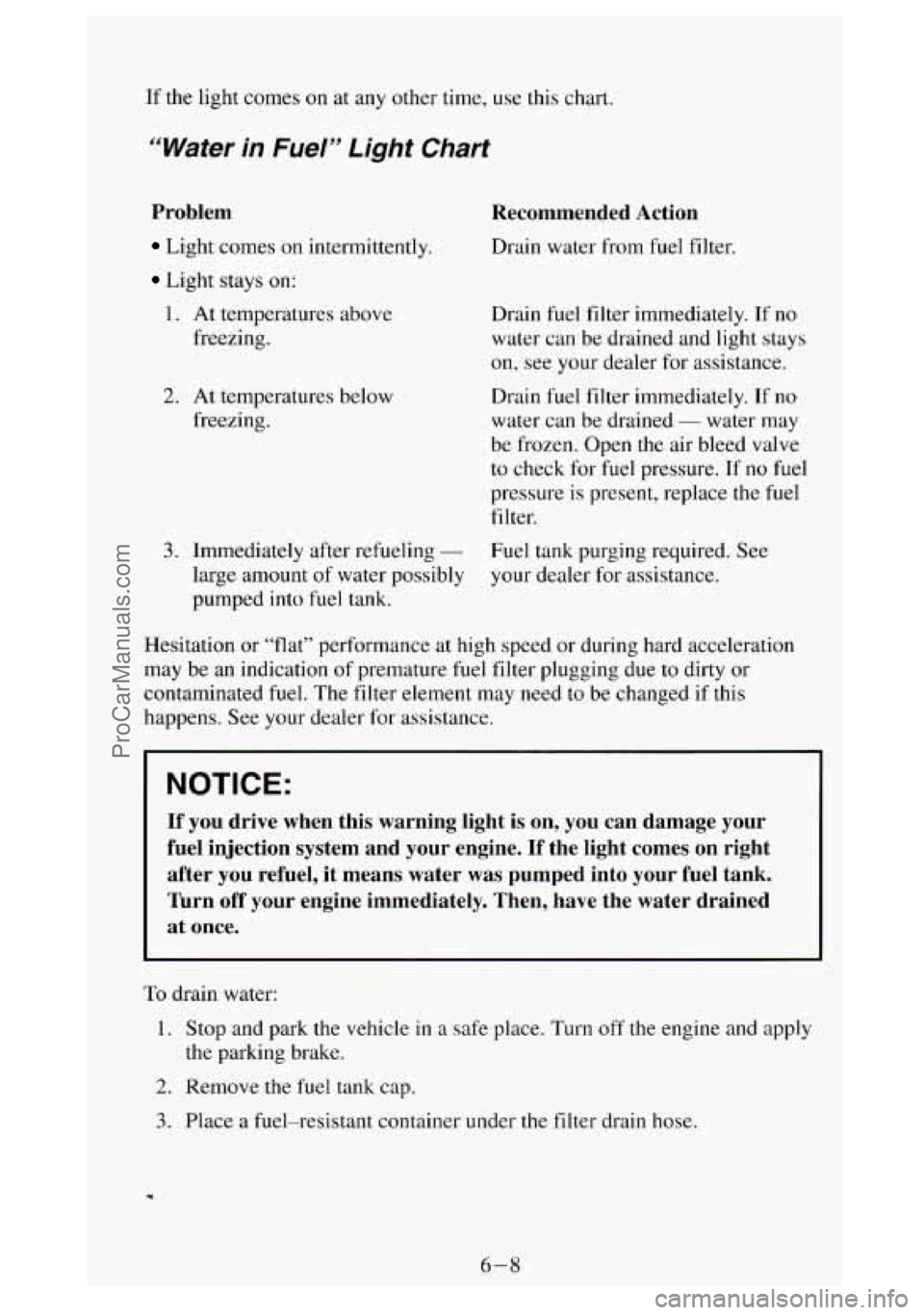
If the light comes on at any other time, use this chart.
“Water in Fuel” Light Chart
Problem
Light comes on intermittently.
Light stays on:
1. At temperatures above
freezing.
2. At temperatures below
freezing.
Recommended Action
Drain water from fuel filter.
Drain fuel filter immediately. If no
water
can be drained and light stays
on, see your dealer for assistance.
Drain fuel filter immediately. If no
water can be drained
- water may
be frozen. Open the air bleed valve
to check
for fuel pressure. If no fuel
pressure is present, replace the
fuel
filter.
3. Immediately after refueling - Fuel tank purging required. See
large amount of water possibly your dealer for assistance.
pumped into fuel tank.
Hesitation or “flat” performance at high speed or during hard acceleration
may be an indication of premature fuel filter plugging due
to dirty or
contaminated fuel, The filter element may need to be changed
if this
happens. See your dealer for assistance.
NOTICE:
If you drive when this warning light is on, you can damage y\
our
fuel injection system and your engine. If the light comes on right
after you refuel,
it means water was pumped into your fuel tank.
Turn off your engine immediately. Then, have the water drained \
at once.
To drain water:
1. Stop and park the vehicle in a safe place. Turn off the engine and apply
the parking brake.
2. Remove the fuel tank cap.
3. Place a fuel-resistant container under the filter drain hose.
6-8
ProCarManuals.com
Page 259 of 404
1
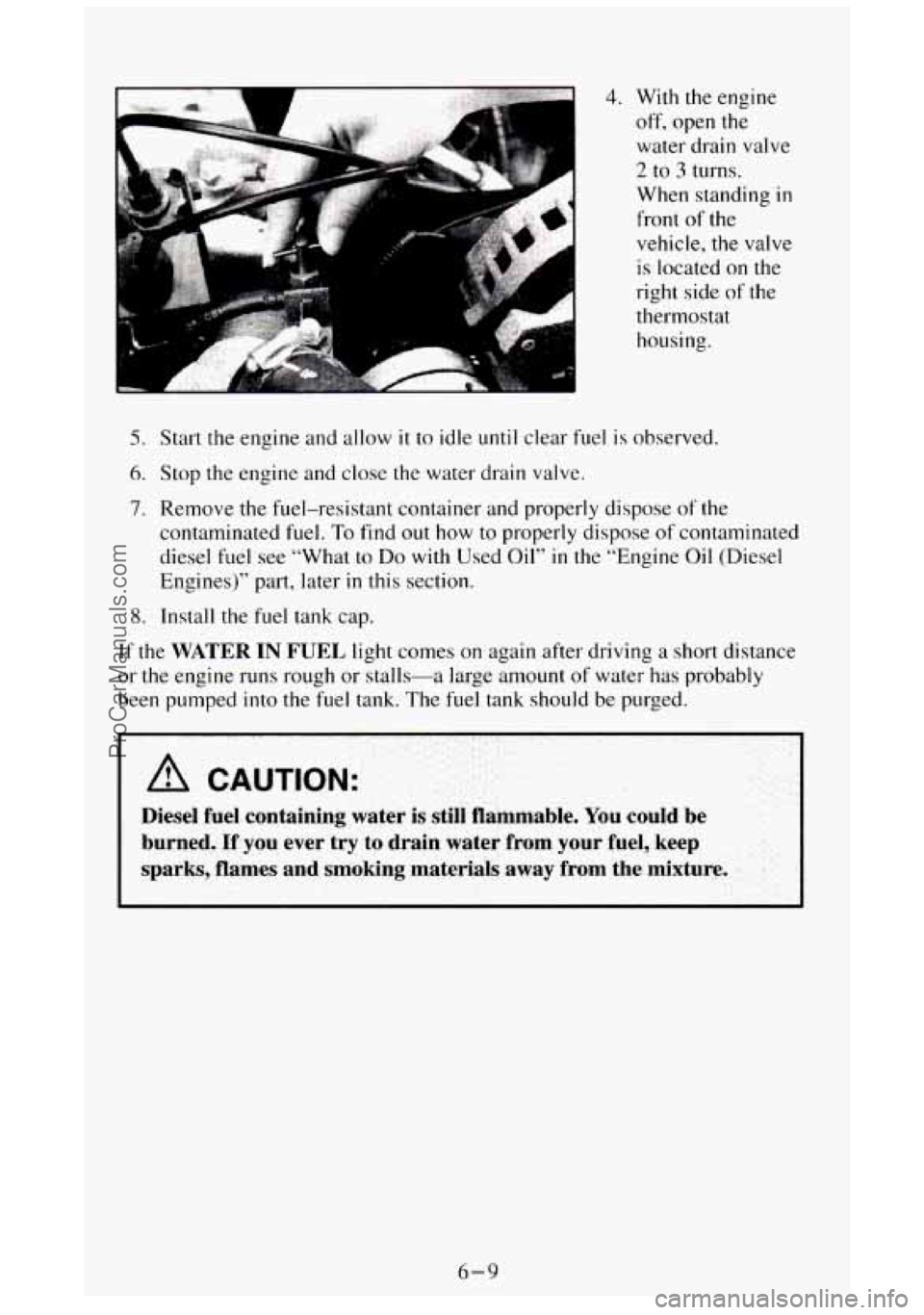
I 4. With the engine
off, open the
water drain valve
2 to 3 turns.
When standing
in
front of the
vehicle, the valve
is located on the
right side of the
thermostat
housing.
5. Start the engine and allow it to idle until clear fuel is observed.
6. Stop the engine and close the water drain valve.
7. Remove the fuel-resistant container and properly dispose of the
contaminated
fuel. To find out how to properly dispose of contaminated
diesel fuel see “What to Do with Used
Oil” in the “Engine Oil (Diesel
Engines)” part, later
in this section.
8. Install the fuel tank cap.
If the WATER IN FUEL light comes on again after driving a short distance
or
the engine runs rough or stalls-a large amount of water has probably
been pumped into the fuel tank. The
fuel tank should be purged.
A CAUTION:
Diesel fuel containing water is still flammable. You could be
burned. If
you ever try to drain water from your fuel, keep
sparks, flames
and smoking materials away from the mixture.
6-9
ProCarManuals.com
Page 260 of 404
~ NOTICE:
If
there is water in your diesel fuel and the weather is warm or
humid, fungus and bacteria can grow in the fuel. They can
damage your fuel system. You'll need
a diesel fuel biocide to
sterilize your fuel system. Your dealer can advise you if you ever
need this.
If your fuel tank needs to be purged to remove water, see your
dealer or
a qualified technician. Improper purging can damage
your fuel system.
Running Out of Fuel (Diesel Engines)
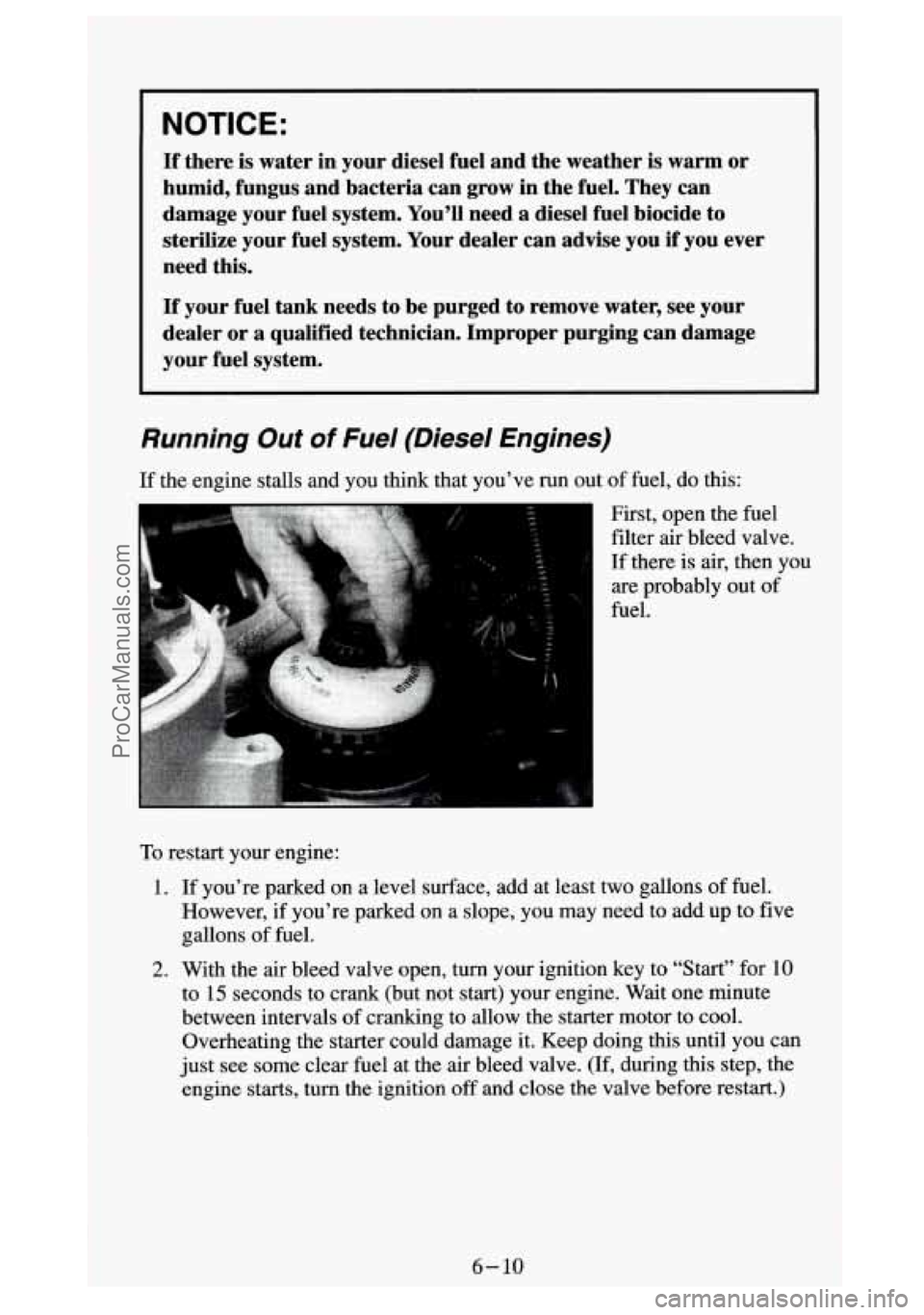
If the engine stalls and you think that you've run out of fuel, do this:
First, open the fuel
filter
air bleed valve.
If there is air, then you are probably out of
fuel.
To restart your engine:
1. If you're parked on a level surface, add at least two gallons of fuel.
However, if you're parked on a slope, you may need to add up to five
gallons of fuel.
2. With the air bleed valve open, turn your ignition key to "Sta\
rt" for 10
to 15 seconds to crank (but not start) your engine. Wait one minut\
e
between intervals of cranking to allow the starter motor to cool.
Overheating the starter could damage it. Keep doing this until you can
just see some clear fuel at the air bleed valve. (If, during this ste\
p, the
engine starts, turn the ignition
off and close the valve before restart.)
6-10
ProCarManuals.com