fuel GMC SIERRA 1994 Workshop Manual
[x] Cancel search | Manufacturer: GMC, Model Year: 1994, Model line: SIERRA, Model: GMC SIERRA 1994Pages: 404, PDF Size: 20.91 MB
Page 351 of 404
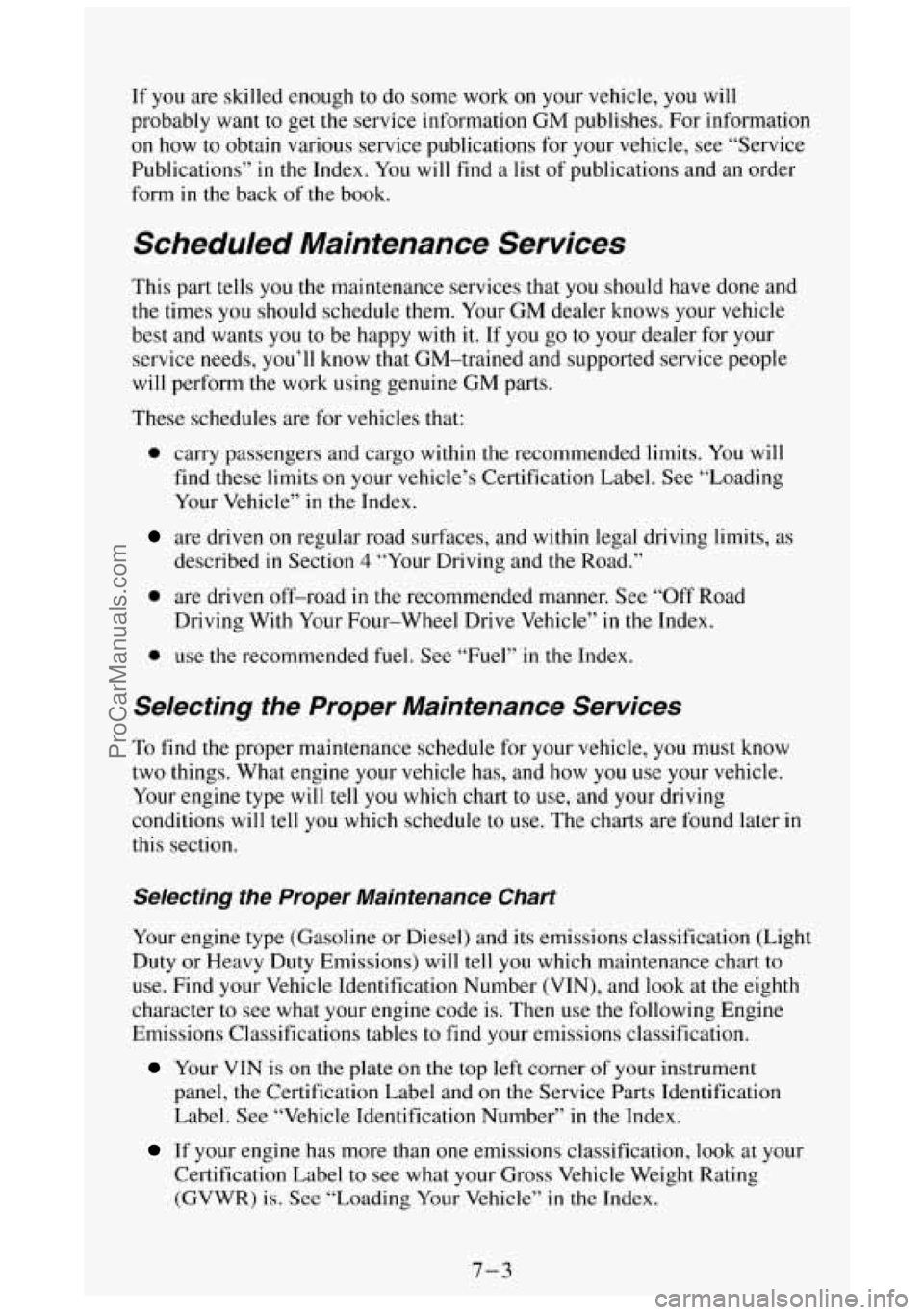
Tf you are skilled enough to do some work on your vehicle, you will
probably want to get the service information
GM publishes. For information
on how
to obtain various service publications for your vehicle, see “Service
Publications”
in the Index. You will find a list of publications and an order
form
in the back of the book.
Scheduled Maintenance Services
This part tells you the maintenance services that you should have done and
the times you should schedule them. Your
GM dealer knows your vehicle
best and wants you to be happy with
it. If you go to your dealer for your
service needs, you’ll know that GM-trained and supported service people
will perform the work using genuine
GM parts.
These schedules are for vehicles that:
0 carry passengers and cargo within the recommended limits. You will
find these limits on your vehicle’s Certification Label. See “Loading
Your Vehicle’’ in the Index.
are driven on regular road surfaces, and within legal driving limits, as
described in Section 4 “Your Driving and the Road.”
0 are driven off-road in the recommended manner. See “Off Road
Driving With Your Four-wheel Drive Vehicle”
in the Index.
0 use the recommended fuel. See “Fuel” in the Index.
Selecting the Proper Maintenance Services
To find the proper maintenance schedule for your vehicle, you must know
two things. What engine your vehicle has, and how you
use your vehicle.
Your engine type will tell
you which chart to use, and your driving
conditions will tell
you which schedule to use. ’The charts are found later in
this section.
Selecting the Proper Maintenance Chart
Your engine type (Gasoline or Diesel) and its emissions classification (Light
Duty or Heavy Duty Emissions) will
tell you which maintenance chart to
use. Find your Vehicle Identification Number (VIN), and look at the eighth
character
to see what your engine code is. Then use the following Engine
Emissions Classifications tables
to find your emissions classification.
Your VIN is on the plate on the top left corner of your instrument
panel, the Certification Label and on the Service Parts Identification
Label. See “Vehicle Identification Number’’
in the Tndex.
If your engine has more than one emissions classification, look at your
Certification Label to see what your Gross Vehicle Weight Rating
(GVWR)
is. See “Loading Your Vehicle” in the Index.
7-3
ProCarManuals.com
Page 352 of 404
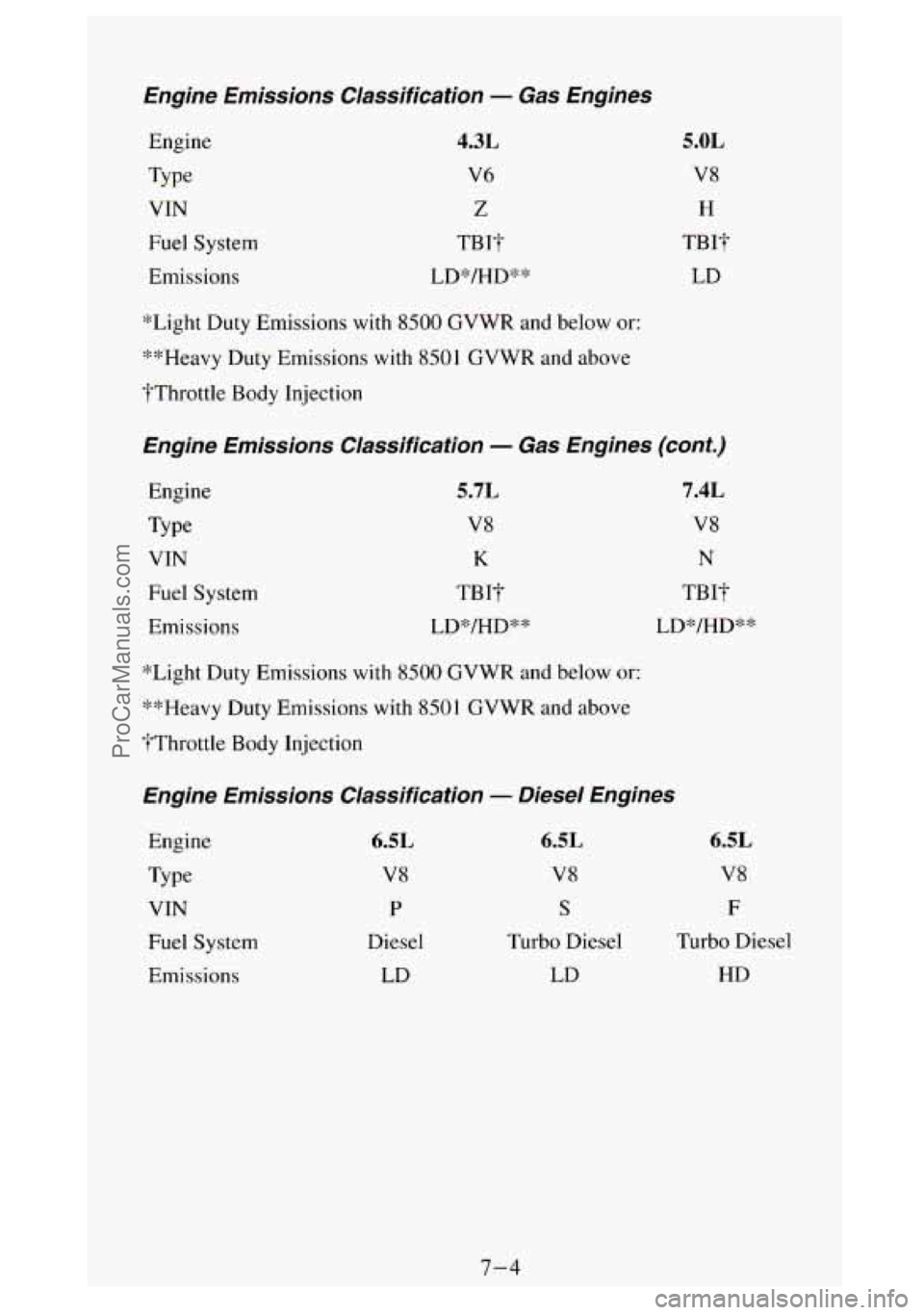
Engine Emissions Classification - Gas Engines
Engine
Type
VIN
Fuel System
Emissions
5.0L
V8
H
TBIT
LD
*Light Duty Emissions with
8500 GVWR and below or:
:%*Heavy Duty Emissions with 8501 GVWR and above
+Throttle Body Injection
Engine Emissions Classification - Gas Engines (cont.)
Engine
Type
VTN
Fuel System
Emissions
5.7L
V8
K
TBTT
LD*/HD*'k
7.4L
V8
N
TBIY
LD*/HD**
*Light Duty Emissions with
8500 GVWR and below or:
**Heavy Duty Emissions with 8501 GVWR and above
?Throttle Body Injection
Engine Emissions Classification - Diesel Engines
Engine
Type
VIN
Fuel System
Emissions
6.5L
V8
P
Diesel LD
6.5L
V8
S
Turbo Diesel LD
6.5L
V8
F
Turbo Diesel
HD
7-4
ProCarManuals.com
Page 367 of 404
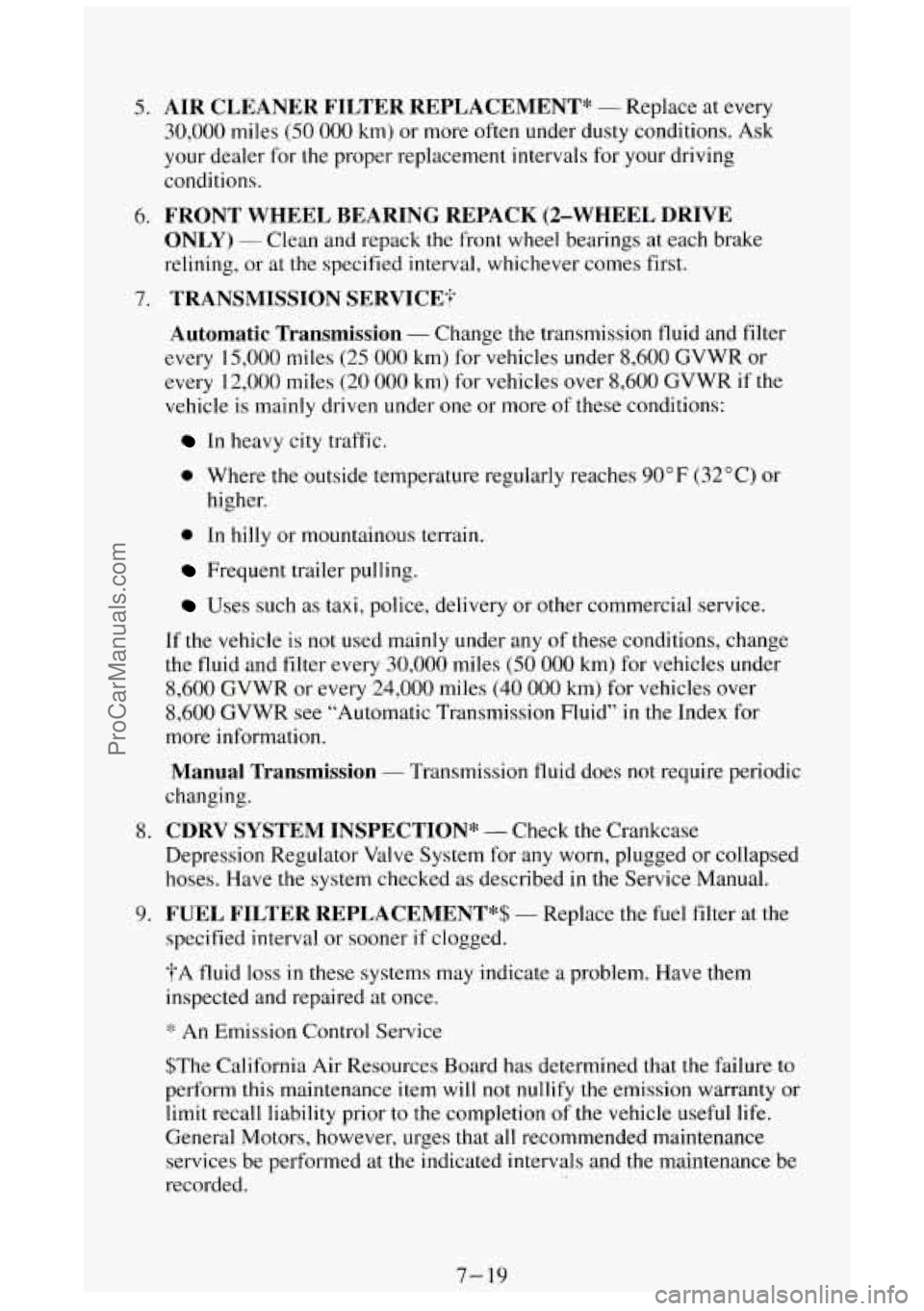
5. AIR CLEANER FILTER REPLACEMENT* - Replace at every
30,000 miles (50 000 km) or more often under dusty conditions. Ask
your dealer for the proper replacement intervals for your driving
conditions.
6. FRONT WHEEL BEARING REPACK (2-WHEEL DRIVE
ONLY)
- Clean and repack the front wheel bearings at each brake
relining, or at
the specified interval, whichever comes first.
7. TRANSMISSION SERVICE’/-
Automatic Transmission
- Change the transmission fluid and filter
every
15,000 miles (25 000 km) for vehicles under 8,600 GVWR or
every 12,000 miles
(20 000 km) for vehicles over 8,600 GVWR if the
vehicle is mainly driven under one or more
of these conditions:
In heavy city traffic.
0 Where the outside temperature regularly reaches 90°F (32°C) or
0 In hilly or mountainous terrain.
higher.
Frequent
trailer pulling.
Uses such as taxi, police, delivery or other commercial service.
If the vehicle
is not used mainly under any of these conditions, change
the fluid and filter every
30,000 miles (50 000 km) for vehicles under
8,600
GVWR or every 24,000 miles (40 000 km) for vehicles over
8,600 GVWR see “Automatic Transmission Fluid”
in the Index for
more information.
Manual Transmission - Transmission fluid does not require periodic
changing.
8. CDRV SYSTEM INSPECTION* - Check the Crankcase
Depression Regulator Valve System for any worn, plugged or collapsed
hoses. Have the system checked as described in the Service Manual.
9. FUEL FILTER REPLACEMENT*$ - Replace the fuel filter at the
specified interval or sooner if clogged.
?A fluid loss
in these systems may indicate a problem. Have them
inspected and repaired at once.
:i: An Emission Control Service
$The California Air Resources Board bas determined that the failure to
perform this maintenance item will not
nullify the emission warranty or
limit recall liability prior to the completion
of the vehicle useful life.
General Motors, however, urges that all recommended maintenance
services be performed at the indicated intervals and the maintenance be
recorded.
7-19
ProCarManuals.com
Page 368 of 404
10.
11.
12.
13.
14.
15.
16.
17.
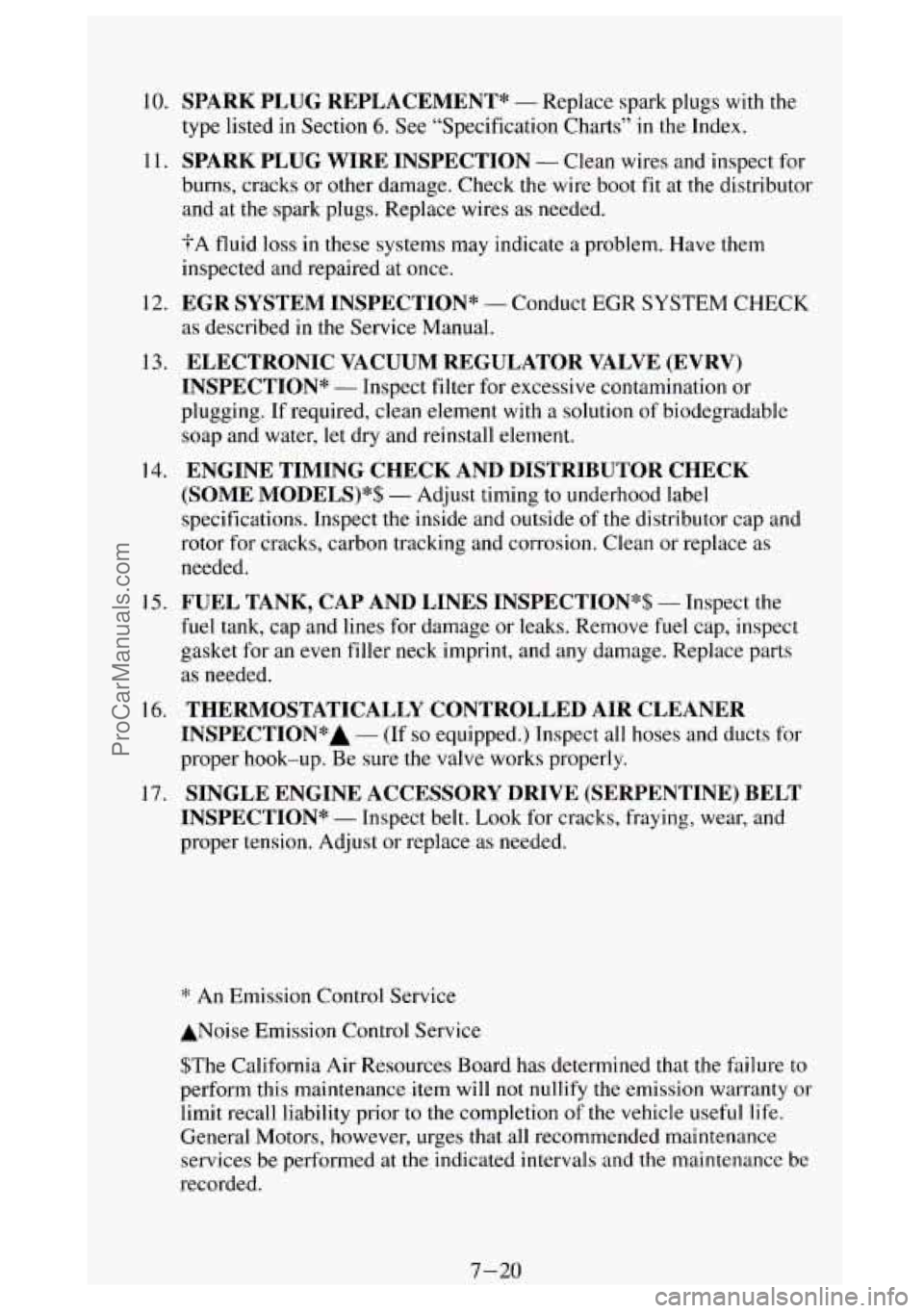
SPARK PLUG REPLACEMENT* - Replace spark plugs with the
type listed in Section
6. See “Specification Charts” in the Index.
SPARK PLUG WIRE INSPECTION - Clean wires and inspect for
bums, cracks or other damage. Check the wire boot
fit at the distributor
and at the spark plugs. Replace wires
as needed.
-f‘A fluid loss in these systems may indicate a problem. Have them
inspected and repaired at once.
EGR SYSTEM INSPECTION* - Conduct EGR SYSTEM CHECK
as described in the Service Manual.
ELECTRONIC VACUUM REGULATOR VALVE (EVRV)
INSPECTION*
- Inspect filter for excessive contamination or
plugging. If required, clean element with
a solution of biodegradable
soap and water, let dry and reinstall element.
ENGINE TIMING CHECK AND DISTRIBUTOR CHECK
(SOME MODELS)*$
- Adjust timing to underhood label
specifications. Inspect the inside and outside of the distributor cap
and
rotor for cracks, carbon tracking and corrosion. Clean or replace as
needed.
FUEL TANK, CAP AND LINES INSPECTION*$ - Inspect the
fuel tank, cap and lines for damage or leaks. Remove
fuel cap, inspect
gasket for an even filler neck imprint, and any damage. Replace parts
as needed.
THERMOSTATICALLY CONTROLLED AIR CLEANER
INSPECTION*A
- (If so equipped.) Inspect all hoses and ducts for
proper hook-up. Be sure
the valve works properly.
SINGLE ENGINE ACCESSORY DRIVE (SERPENTINE) BELT
INSPECTION*
- Inspect belt. Look for cracks, fraying, wear, and
proper tension. Adjust or replace
as needed.
* An Emission Control Service
ANoise Emission Control Service
$The California Air Resources Board has determined that the failure to
perform this maintenance item will not nullify the emission warranty
or
limit recall liability prior to the completion of the vehicle useful life.
General Motors, however, urges that all recommended maintenance
services be performed at
the indicated intervals and the maintenance be
recorded.
7-20
ProCarManuals.com
Page 369 of 404
18. EVAPORATIVE CONTROL SYSTEM (ECS) INSPECTION* -
Check all fuel and vapor lines and hoses for proper hookup, routing,
and condition. Check that
the purge valve works properly, if equipped.
Replace as needed.
19.
SHIELDS AND UNDERHOOD INSULATION
INSPECTIONAV
- Inspect shields and underhood insulation for
damage or looseness. Adjust or replace as required.
system installation
to see that gaskets are sealed properly and all hose
connections, fasteners, and other components are tight. Also check to
be sure that the air cleaner housing is properly seated, that
the cover fits
tightly, and
the wing nuts are tight. Tighten connections and fasteners
or replace damaged parts
as required.
20. AIR INTAKE SYSTEM INSPECTIONAV - Check the air intake
2 1. THERMOSTATICALLY CONTROLLED ENGINE COOLING
FAN INSPECTIONAV
- (If so equipped.) Inspect all hoses and
ducts for proper hook-up. Be sure the valve works properly.
22. EXHAUST PRESSURE REGULATOR VALVE INSPECTION”
- Check that the valve works properly. Correct any binding. Inspect
hoses for cracks, chafing
or decay. Replace parts as needed.
23. TIRE AND WHEEL ROTATION AND INSPECTION - For
proper wear and maximum tire life, rotate tires at the first
6,000 miles
( 10 000 kilometers) for Schedule I (+) or 7,500 miles (1 2 500
kilometers) for Schedule IT (0) and then every 15,000 miles (25 000
kilometers) thereafter. Follow the instructions and patterns shown in
Section 6. Check tires for uneven wear or damage. If irregular or
premature wear is apparent, check wheel alignment. Also, check or
damaged wheels. See “Tires”
in the Index for more information.
For dual wheels, whenever the vehicle, wheels, or fasteners are new,
have the wheel fastener torque set at the first
100, 1,000 and 6,000
miles (1 60, 1600 and 10 000 km).
Block the tires opposite those being removed to keep the vehicle from
rolling.
‘i: An Emission Control Service
ANoise Emission Control Service
VApplicable only to vehicles sold
in the United States
7-21
ProCarManuals.com
Page 372 of 404
On vehicles with a key release lever, try to turn the key to LOCK without
pressing the lever. The key should turn to
LOCK only with the key lever
depressed.
On
all vehicles, the key should come out only in LOCK.
Parking brake and transmission
“P” (PARK) mechanism operation -
I
Park on a fairly steep hill, with the vehicle facing downhill. Keeping your
foot on the regular brake, set the manual parking brake.
To check the parking brake: With the engine running and the
transmission
in “N” (Neutral), slowly remove foot pressure from the
regular brake pedal. Do this until the vehicle is held by the parking
brake only.
0 To check the “P’ (Park) mechanism’s holding ability: Apply the regular
brake and shift to
“P’ (Park). Release the manual parking brake, then
slowly release the regular brake.
Lap and Shoulder Belts Condition and Operation - Inspect belt system,
including webbing, buckles, latch plates, retractors, guide loops and
anchors. Have
a belt assembly replaced if the webbing has been cut or
otherwise damaged.
Body Lubrication Service - Lubricate all body door hinges with engine
oil. Also lubricate the tailgate, tailgate handle pivot points, and tailgate
mounted spare tire carrier
(if equipped}. Lubricate the body hood, fuel door
and rear compartment hinges, latches and locks including interior glove box
and console doors, and any folding seat hardware. Lubricate the hood safety
lever pivot and prop rod pivot. More frequent lubrication may be required
when exposed to a corrosive environment.
Periodic Maintenance Inspections - Listed below are inspections and
services which should be performed at least twice
a year (for instance each
spring or fall). You should
let your GM dealer’s service department or other
qualified service center do these
jobs. Make sure any necessary repairs are
completed at once.
7-24
ProCarManuals.com
Page 376 of 404
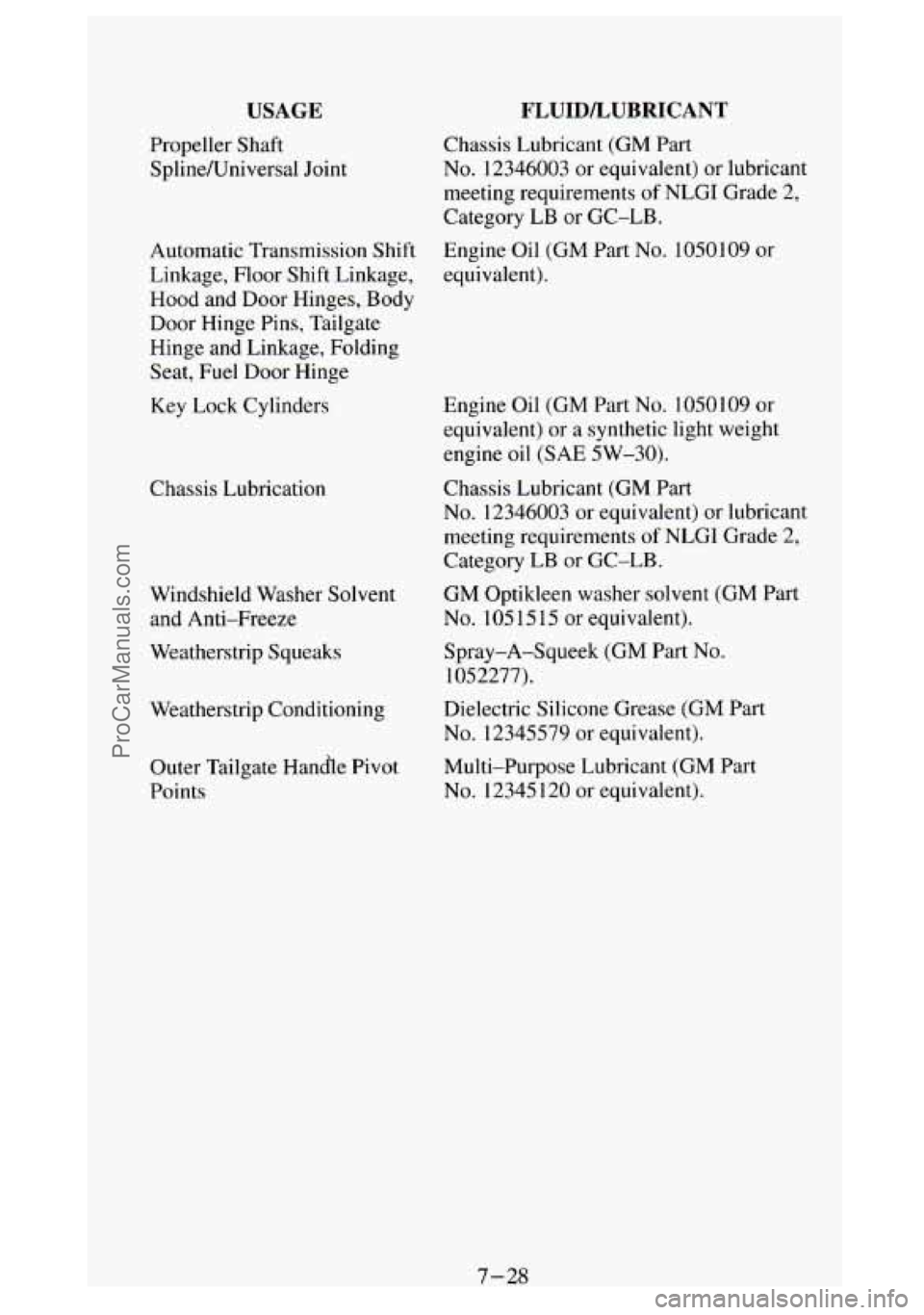
USAGE FLUIDLUBRICANT
Propeller Shaft
SplineNniversal Joint Chassis Lubricant (GM Part
No. 12346003 or equivalent) or lubricant
meeting requirements
of NLGI Grade 2,
Category LB
or GC-LB.
Automatic Transmission Shift Engine Oil (GM Part
No. 1050109 or
Linkage, Floor Shift Linkage, equivalent).
Hood and Door Hinges, Body
Door Hinge Pins, Tailgate
Hinge and Linkage, Folding
Seat,
Fuel Door Hinge
Key Lock Cylinders
Chassis Lubrication
Windshield Washer Solvent and Anti-Freeze
Weatherstrip Squeaks
Weatherstrip Conditioning
Outer Tailgate Handle Pivot
Points Engine Oil
(GM Part No. 1050109
or
equivalent) or a synthetic light weight
engine oil (SAE 5W-30).
Chassis Lubricant (GM Part
No. 12346003 or equivalent) or lubricant
meeting requirements of NLGI Grade 2,
Category LB or GC-LB.
GM Optikleen washer solvent (GM Part
No. 105 15 15 or equivalent).
Spray-A-Squeek (GM Part
No.
1052277).
Dielectric Silicone Grease (GM Part No. 12345579 or equivalent).
Multi-Purpose Lubricant (GM Part
No. 12345 120
or equivalent).
7-28
ProCarManuals.com
Page 378 of 404
Service Station Checks
It is important for you or a service station attendant to perform these
under-hood checks at each fuel fill.
Check the engine oil level and add if necessary.
Check the engine coolant level in the recovery bottle and add \
if
necessary.
Check the windshield washer fluid level and add if necessary.
See these items in the Index for information on how to check them.
7-30
ProCarManuals.com
Page 379 of 404
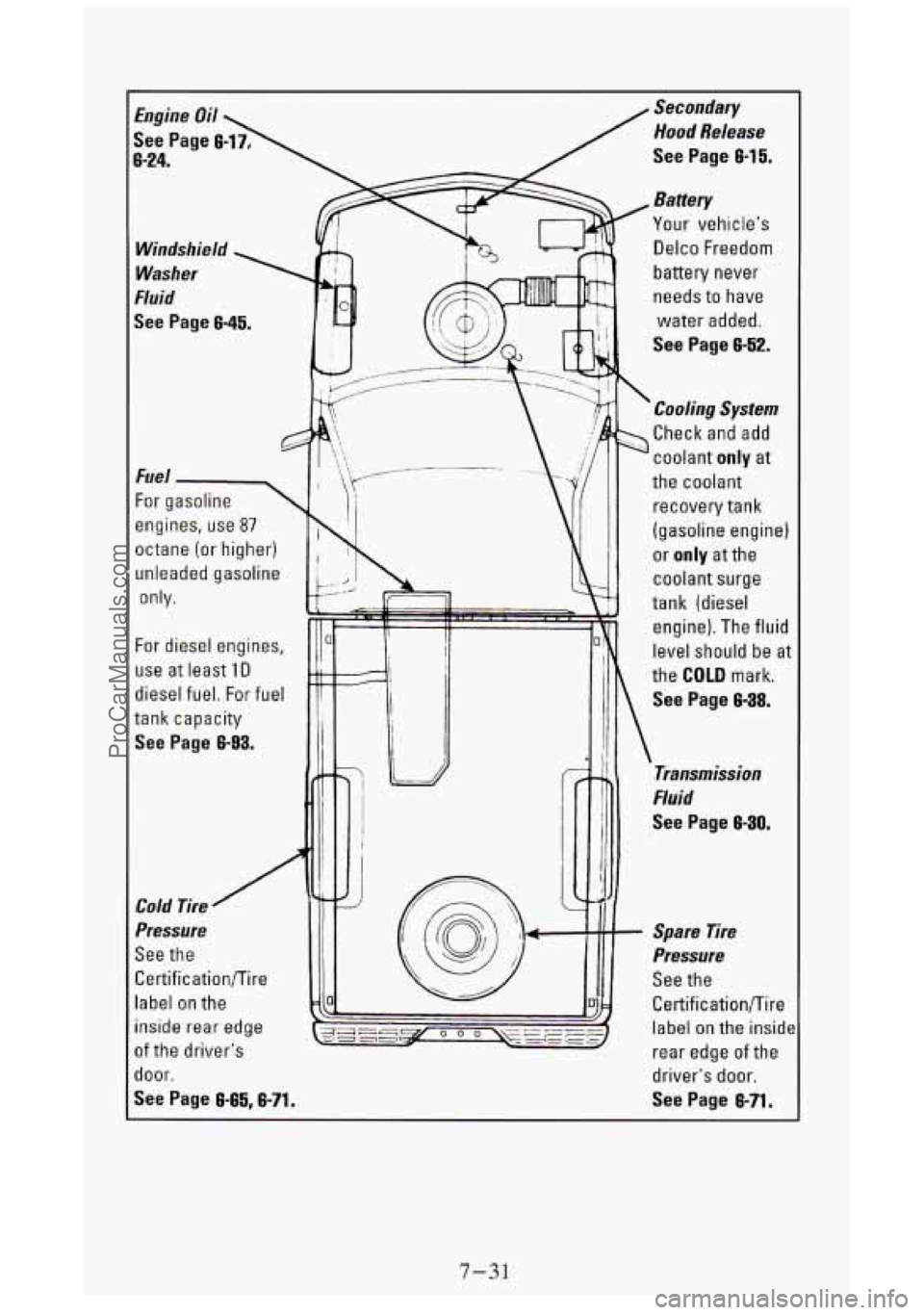
Secondary
Hood Release
See Page 6-15.
Fluid
See Page 6-45.
engines, use 87
octane (or higher)
unleaded gasoline
only.
For diesel engines,
use at least
1 D
diesel fuel. For fuel
tank capacity
See Page 6-93.
Cold Tire /
Pressure
See the
Certificationflire
label on the
inside rear edge
of the driver's
door.
See Page 6-65,6-71.
, Battery
Your vehicle's
Delco Freedom
battery never
needs to have water added.
See Page 6-52.
Cooling System
coolant only at
the coolant
recovery tank
(gasoline engine)
or
only at the
coolant surge
tank (diesel engine). The
fluid
level should be at
the COLD mark.
See Page 6-38.
3 Check and add
Transmission
Fluid
See Page 6-30.
- Spare Tire
Pressure
See the
Certificatisnflire
label on the inside
rear edge
of the
driver's door.
See Page 6-71.
7-31
ProCarManuals.com
Page 394 of 404
C
Camper Wiring Harness ........................................... 2-83
Capacities/Specification Charts ..................................... 6-91
CarbonMonoxide
............................................... 2-33
CargoLamp
.................................................... 2-52
Cassette Tape Player (see “Audio Systems”
)
Catalyticconverter .............................................. 6-64
Certificationire Label
........................................... 6-65
Changing a Flat Tire
......................................... 5-26, 5-32
Chemical Paint Spotting
........................................... 6-87
Child Restraints (See “Safety Belts”)
CHMSLFeedWire
.............................................. 2-82
Cigarette LightedAshtrays
..... ................................... 2-52
Circuit Breakers (See “Fuses”)
Cleaning
Finishcare
.................................................. 6-85
Glass
....................................................... 6-84
Insideofvehicle
.............................................. 6-81
Instrumentpanel. Top
.......................................... 6-83
Outsideofvehicle
............................................. 6-84
Special Problems
.............................................. 6-82
VinylorLeather
.............................................. 6-83
Wheels and Tires
.............................................. 6-86
Windshield
.................................................. 6-84
Clock
......................................................... 3-18
AM-FM Stereo Audio System with Cassette Deck
................... 3-11
AM-FM Stereo Audio System with Cassette Deck and Equalizer
... 3-14. 3-18
Conversion to Chassis Cab
........................................ 6-70
Coolant (See “Engine”)
Cooling System Capacity
.......................................... 5-17
Crankcase Capacity
.............................................. 6-93
Increasespeed
............................................... 2-46
CruiseControl
.................................................. 2-44
EraseSpeedMemory .......................................... 2-48
OnHills
..................................................... 2-48
Passing
..................................................... 247
Reducespeed
................................................ 2-47
Resume
..................................................... 2-46
Set
......................................................... 2-45
ToGetOutOf
................................................ 2-48
Customer Assistance for the Hearing or Speech Impaired
................. 8-3
Customer Satisfaction Procedure
..................................... 8-2
Daytime Running Lights (Canada Only)
......................... 2.50, 2.75
Indicator Light
.......................................... 2.50. 2.75
Diesel Fuel (See “Fuel”)
DomeLights
.................................................... 2-51
Doors
.......................................................... 2-7
Locks ........................................................ 2-5
Driving Across an Incline
............................................. 4-21
After Off-Road Driving
........................................ 4-22
2
ProCarManuals.com