lock GMC SIERRA 1994 Repair Manual
[x] Cancel search | Manufacturer: GMC, Model Year: 1994, Model line: SIERRA, Model: GMC SIERRA 1994Pages: 404, PDF Size: 20.91 MB
Page 273 of 404
Engine Oil Additives
Don’t add anything to your oil. Your GM dealer is ready to advise if you
think something should be added.
When to Change Engine Oil
See if any one of these is true for you:
Most trips are less than 4 miles (6 km).
It’s below freezing outside and most trips are less than 10 miles
(16 km).
The engine is at low speed most of the time (as in door-to-door
delivery, or
in stop-and-go traffic).
You tow a trailer often.
Most trips are through dusty places.
The vehicle is frequently operated off-road.
If any one
of these is true for your vehicle, then you need to change your oil
and-filter every 3,000 miles (5 000 km) or 3 months - whichever comes
first.
Light Duty Emissions:
If none of them is true, change the oil every 7,500 miles (12 500 km) or
12 months
- whichever comes first. Change the filter at the first oil change
and at every other oil change after that.
Heavy Duty Emissions:
If none of them is true, change the oil every 6,000 miles (10 000 km) or
12 months - whichever comes first. Change the filter at the first oil change
and at every other oil change after that if mileage determines when you
change
your oil. If time determines when you change your oil, change the
filter each time you change your oil.
Engine Coolant Heater (Engine Block Heater)
An engine coolant heater can be a big help if you have to park outside in
very cold weather, 0°F (- 18°C) or colder. If your vehicle has this option,
see “Engine Coolant Heater
” in the Index.
6-23
ProCarManuals.com
Page 282 of 404
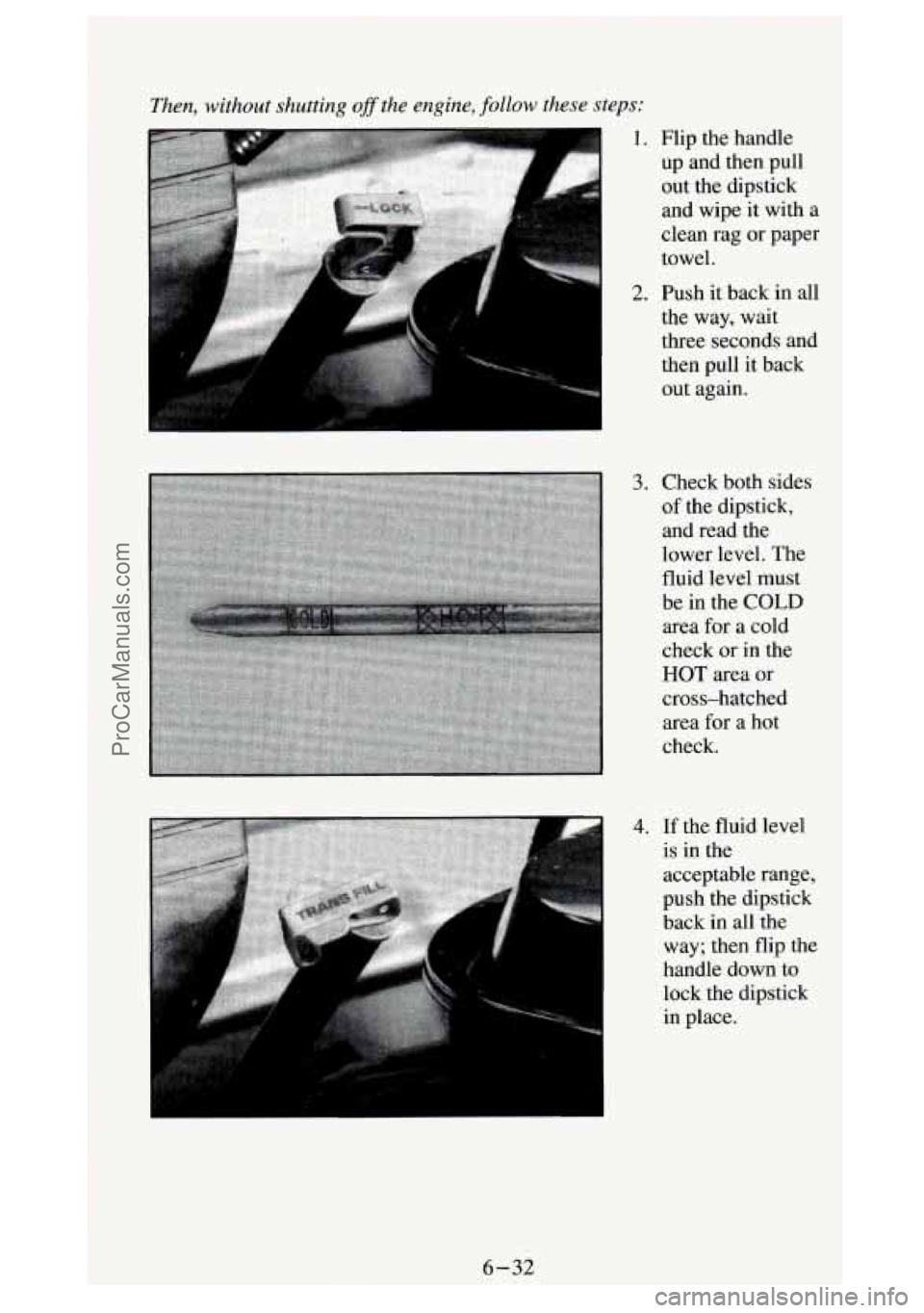
Then, .without shutting ofithe engine, follow these steps:
1. Flip the handle
up and then pull
out the dipstick
and wipe it with a
clean rag
or paper
towel.
2. Push it back in all
the way, wait
three seconds and
then pull it back
out again.
3. Check both sides
of the dipstick,
and read the
lower level. The
fluid level must
be in the COLD area for a cold
check or in the
HOT area or
cross-hatched
area for a hot
check.
4. If the fluid level
is in the
acceptable range,
push the dipstick back in all the
way; then flip the
handle down to
lock the dipstick in place.
ProCarManuals.com
Page 283 of 404
How to Add Fluid
Refer to the Maintenance Schedule to determine what kind of transmission
fluid
to use. See “Recommended Fluids and Lubricants” in the Index.
If the fluid level is low, add
only enough of the proper fluid to bring the
level up to the COLD area for a cold check or the HOT area for a hot check.
It doesn’t take much tluid, generally less than a pint. Don’t overfill. We
recommend you use only fluid labeled DEXRON@-111 or DEXRON@-IIE,
because fluids with that label are made especially for your automatic
transmission. Damage caused by fluid other than
DEXRON@-Ill or
DEXRON@-IIE is not covered by your new vehicle warranty.
After adding fluid, recheck the fluid level as described under “How to
Check.”
When the correct fluid level is obtained, push the dipstick back in all
the way; then flip the handle down to lock the dipstick in place.
Manual Fluid
When to Check
A good time to have it checked is when the engine oil is changed. However,
the fluid
in your manual transmission doesn’t require changing.
How to Check
Because this operation can be a little difficult, you may choose to have this
done at a
GM dealership Service Department.
If you do it yourself, be sure to follow all the instructions here, or you could
get
a false reading.
NOTICE:
Too much or too little fluid can damage your transmission. Too
much can mean that some of the fluid could come out and fall on
hot engine parts or exhaust system, starting a fire. Be sure to get
an accurate reading if
you check your transmission fluid.
Check the fluid level only when your engine is off, the vehicle is parked on
a level place and the transmission is cool enough for you to rest your fingers
on the transmission case.
6-33
ProCarManuals.com
Page 301 of 404
Fluid Leak Check
After the vehicle has been parked for a while, inspect the surface under the
vehicle for water, oil, fuel or other fluids. Water dripping from the air
conditioning
system after it has been used is normal. If you notice fuel leaks
or fumes, the causes should be found and corrected at once.
Lubrication
Accelerator Control System
Your maintenance schedule will tell you how often the accelerator linkage
pivot points must be lubricated. See “Recommended
Fluids and Lubricants”
in the Tndex for the proper lubricant to use.
Accelerator cables and cruise control cables should not be lubricated.
Any
cab1e.s that are worn or are hard to pull should be replaced.
Hood Latches and Hood Hinge
Your maintenance schedule will tell you how often to lubricate the hood
latch and hood hinge assembly. See “Recommended Fluids and Lubricants”
in the Index for the proper lubricant to use.
Propeller Shaft Slip Splines
See your maintenance schedule to find out how often the. slip splines must
be lubricated. See “Recommended Fluids and Lubricants”
in the Index for
the proper lubricant to use.
Constant Velocity Joints
See your mamtenance schedule to find out how often the constant velocity
joints must be lubricated. See “Recommended Flui-ds and Lubricants”
in the
Index for the proper lubricant to use.
Body
Normal use of your vehicle will cause metal to metal wear at some points on
the cab and body if they are not lubricated.
For exposed surfaces, such as door checks, door lock bolts, lock striker
plates, dovetail bumper wedges, etc., a
thin film of engine oil should be
applied.
The seat adjusters and seat track should be lubricated
with chassis grease.
Door weather strips and rubber hood bumpers should be wiped clean with
a
rubber lubricant.
6-51
ProCarManuals.com
Page 302 of 404
Never use too much of any lubricant and be sure to wipe up any extra
lubricant when
you are finished.
Your maintenance schedule
will tell you how often to lubricant these items.
See “Recommended Fluids and Lubricants”
in the Index for the proper
lubricant
to use.
Lock Cylinders
To be sure your locks operate properly, they must be lubricated. Your
vehicle’s maintenance schedule will
tell you how often to lubricate them.
See “Recommended Fluids and Lubricants”
in the Index for the proper
lubricant
to use.
You should not use penetrating oils because they could wash
out the factory
installed lubricant and cause the lock
to bind. De-icers which contain
alcohol could
also wash away the lubricant, so be sure to lubricate the lock
after using
a de-icer of this type.
Tailgate Handle
The tailgate handle pivot points on your vehicle should be lubricated to keep
the handle working smoothly.
Your maintenance schedule
will tell you how often to lubricant the handle.
See “Recommended Fluids and Lubricants” in the Index for the proper
lubricant to use.
Battery
Every new GM vehicle has a Delco Freedom@ battery. You never have to
add water to
one of these. When it’s time for a new battery, we recommend
a Delco Freedom@ battery. Get one that has the catalog number shown on
the original battery’s label.
Vehicle Storage
If you’re not going to drive your vehicle for 25 days or more, take off the
black, negative (-) cable from the battery. This will help keep your battery
from running down.
6-52
ProCarManuals.com
Page 305 of 404
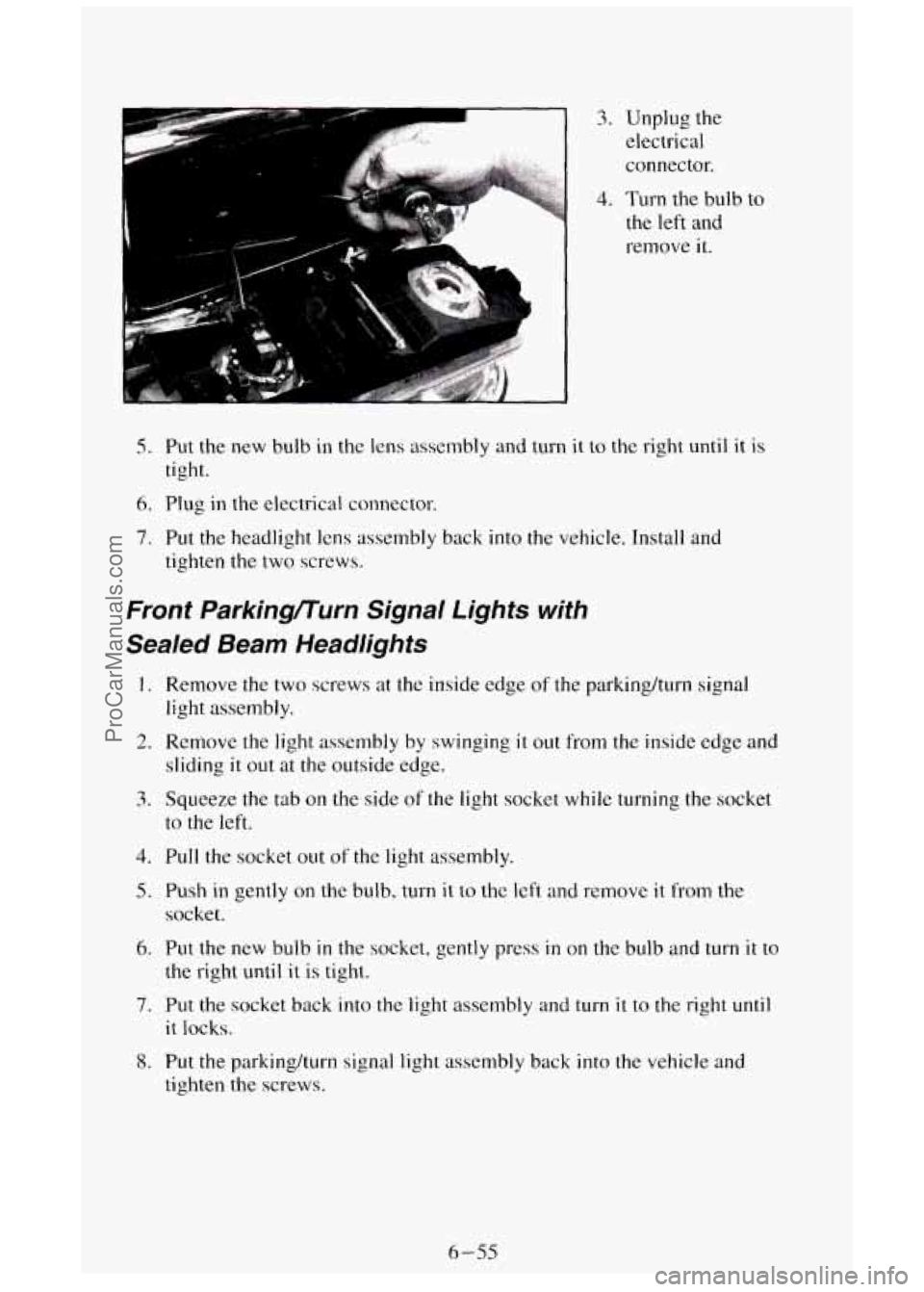
3. Unplug the
electrical
connector.
4. Turn the bulb to
the left and
i
remove it.
5. Put the new bulb in the lens assembly and turn it to the right until it is
tight.
6. Plug in the electrical connector.
7. Put the headlight lens assembly back into the vehicle. Install and
tighten the two screws.
Front Parkingflurn Signal Lights with
Sealed Beam Headlights
1. Remove the two screws at the inside edge of the parking/turn signal
2. Remove the light assembly by swinging it out from the inside edge and
3. Squeeze the tab on the side of the light socket while turning the socket
4. Pull the socket out of the light assembly.
5. Push in gently on the bulb, turn it to the left and remove it from the
6. Put the new bulb in the socket, gently press in on the bulb and turn it to
7. Put the socket back into the light assembly and turn it to the right until
8. Put the parking/turn signal light assembly back into the vehicle and
light assembly.
sliding
it out at the outside edge.
to the
left.
socket.
the right until it is tight.
it locks.
tighten the screws.
6-55
ProCarManuals.com
Page 306 of 404
Front Parkingnurn Signal Lights with
Composite Headlights
-7
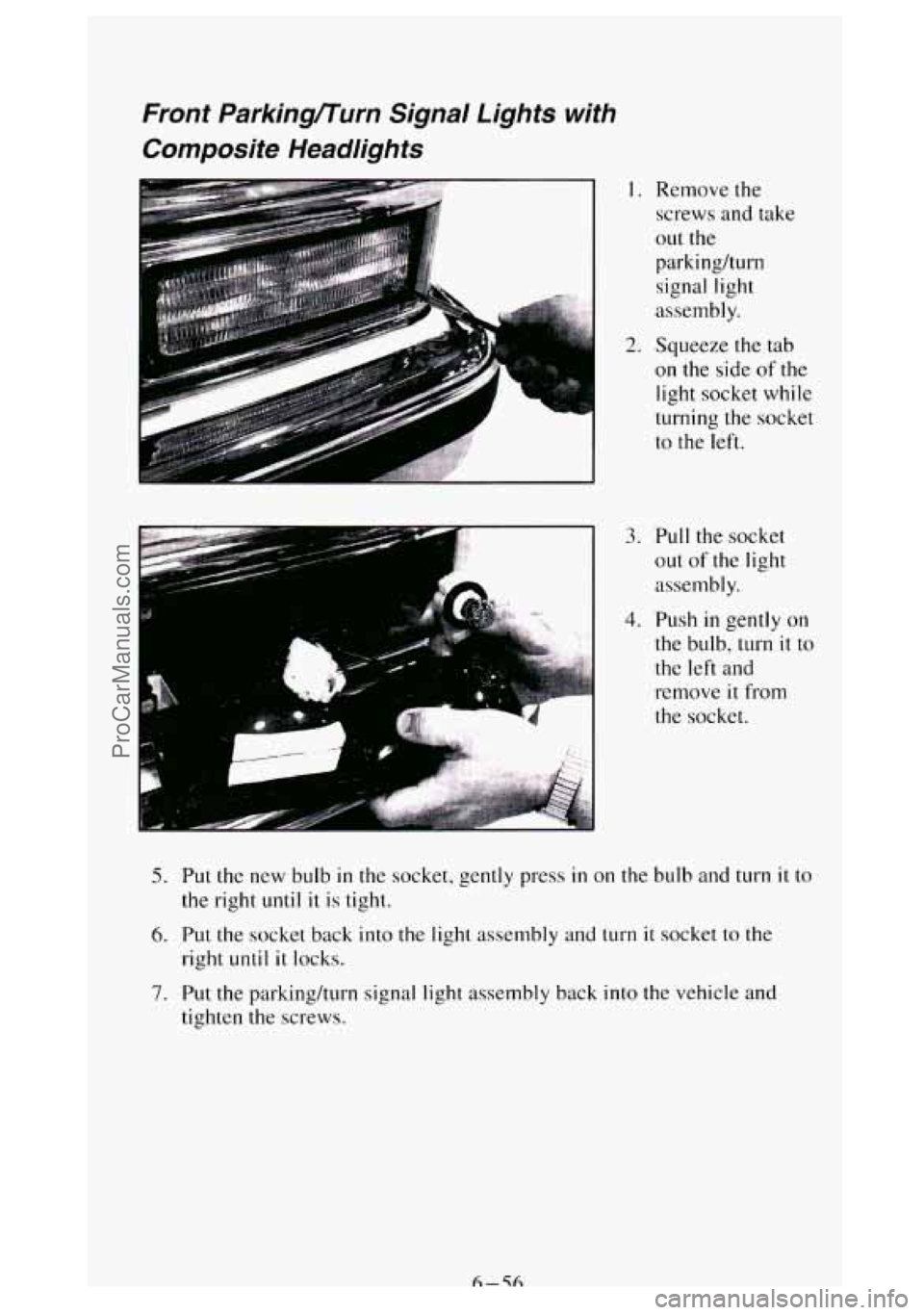
I. Remove the
screws and take
out the parkinghurn
signal light
assembly.
2. Squeeze the tab
on the side of the
light socket while
turning the socket
to the left.
3.
4.
Pull the socket
out
of the light
assembly.
Push
in gently on
the bulb, turn it to
the left and
remove
it from
the socket.
5. Put the new bulb in the socket, gently press in on the bulb and turn it to
the right
until it is tight.
6. Put the socket back into the light assembly and turn it socket to the
right
until it locks.
7. Put the parkinghrn signal light assembly back into the vehicle and
tighten the screws.
6-56
ProCarManuals.com
Page 313 of 404
Trailer Wiring Harness
The optional seven-wire trailer wiring harness is protected by an in-line
fuse
in the battery feed wire. This fuse is near the junction block. See
“Trailer Wiring Harness”
in the Index for more information.
Fuse Block
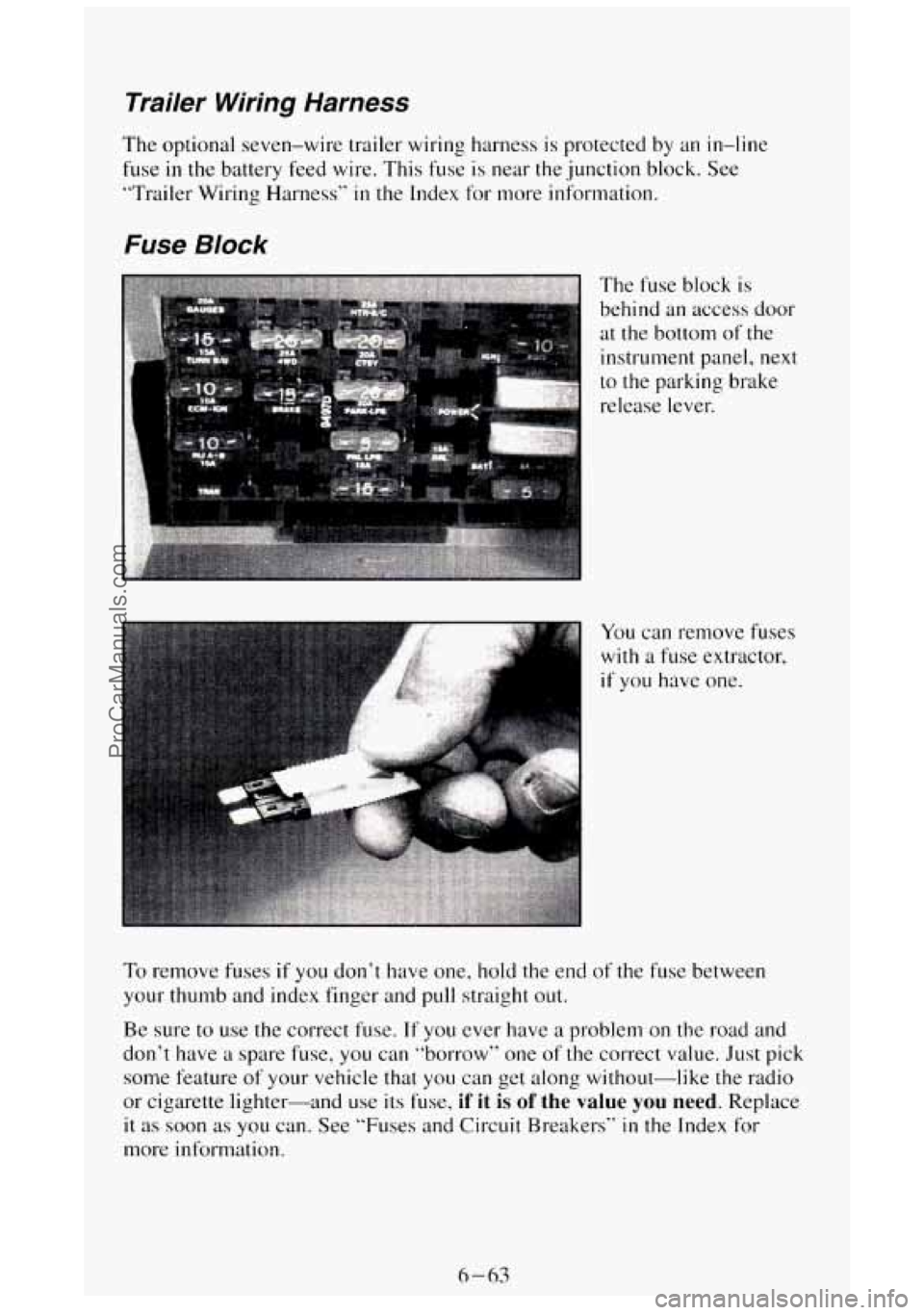
The fuse block is
behind an access door
at the bottom of the
instrument panel,
next
to the parking brake
release lever.
To remove fuses if you don’t have one, hold the end of the fuse between
your thumb and index finger and pull straight out.
Be, sure to use the correct fuse.
If you ever have a problem on the road and
don’t have a spare fuse, you can “borrow” one of the correct value. Just pick
some feature
of your vehicle that you can get along without-like the radio
or cigarette lighter--and use
its fuse, if it is of the value you need. Replace
it as soon as you can. See “Fuses and Circuit Breakers“ in the Index for
more information.
6-63
ProCarManuals.com
Page 345 of 404
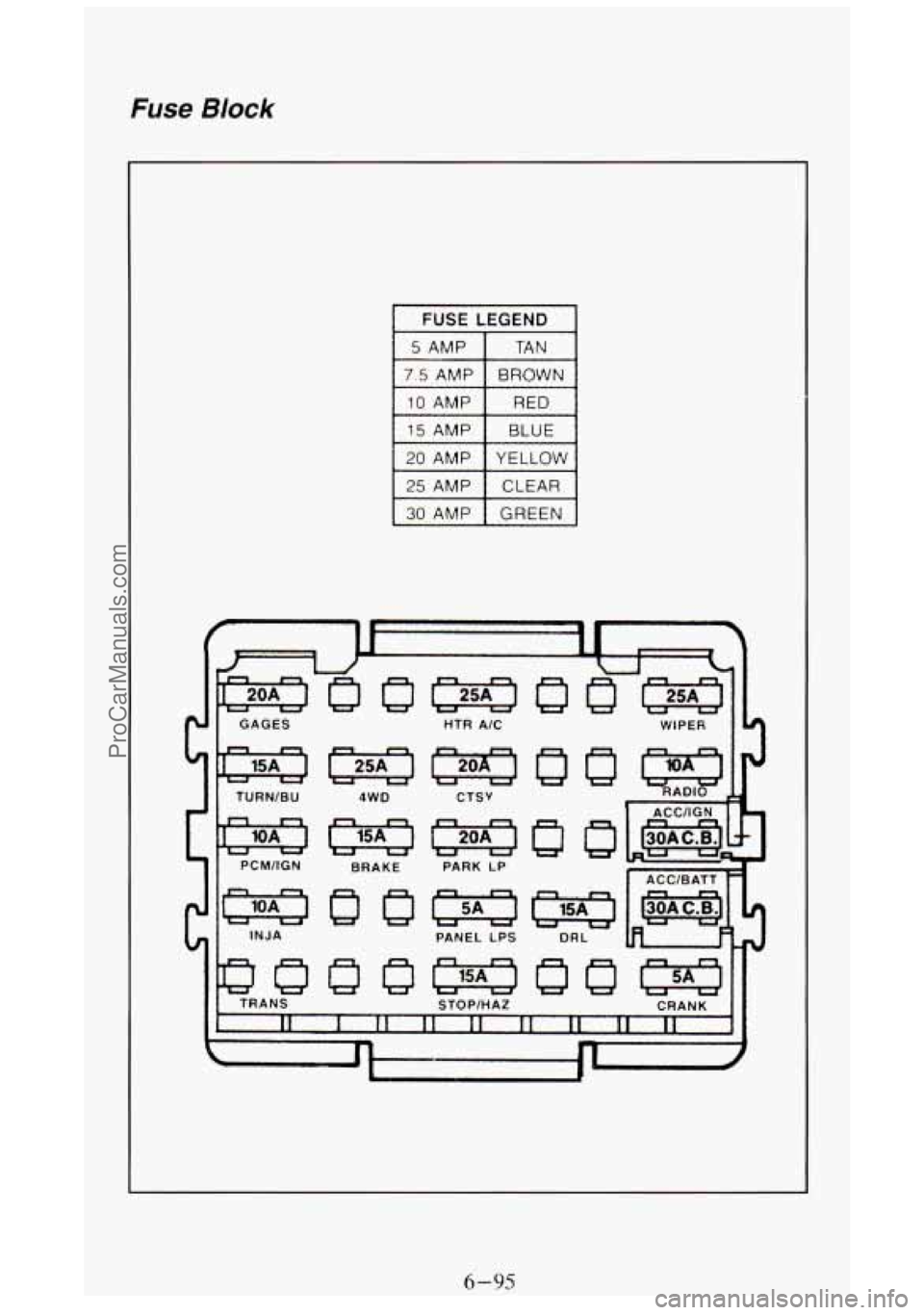
Fuse Block
1 FUSE LEGEND I
I 25 AMP I CLEAR I
I 30 AMP I GREEN
I GAGES
I TURN/BU
I PCM1'GN
I lNJA
STOPlHAZ WIPER
I
DRL
Wl
6-95
ProCarManuals.com
Page 346 of 404
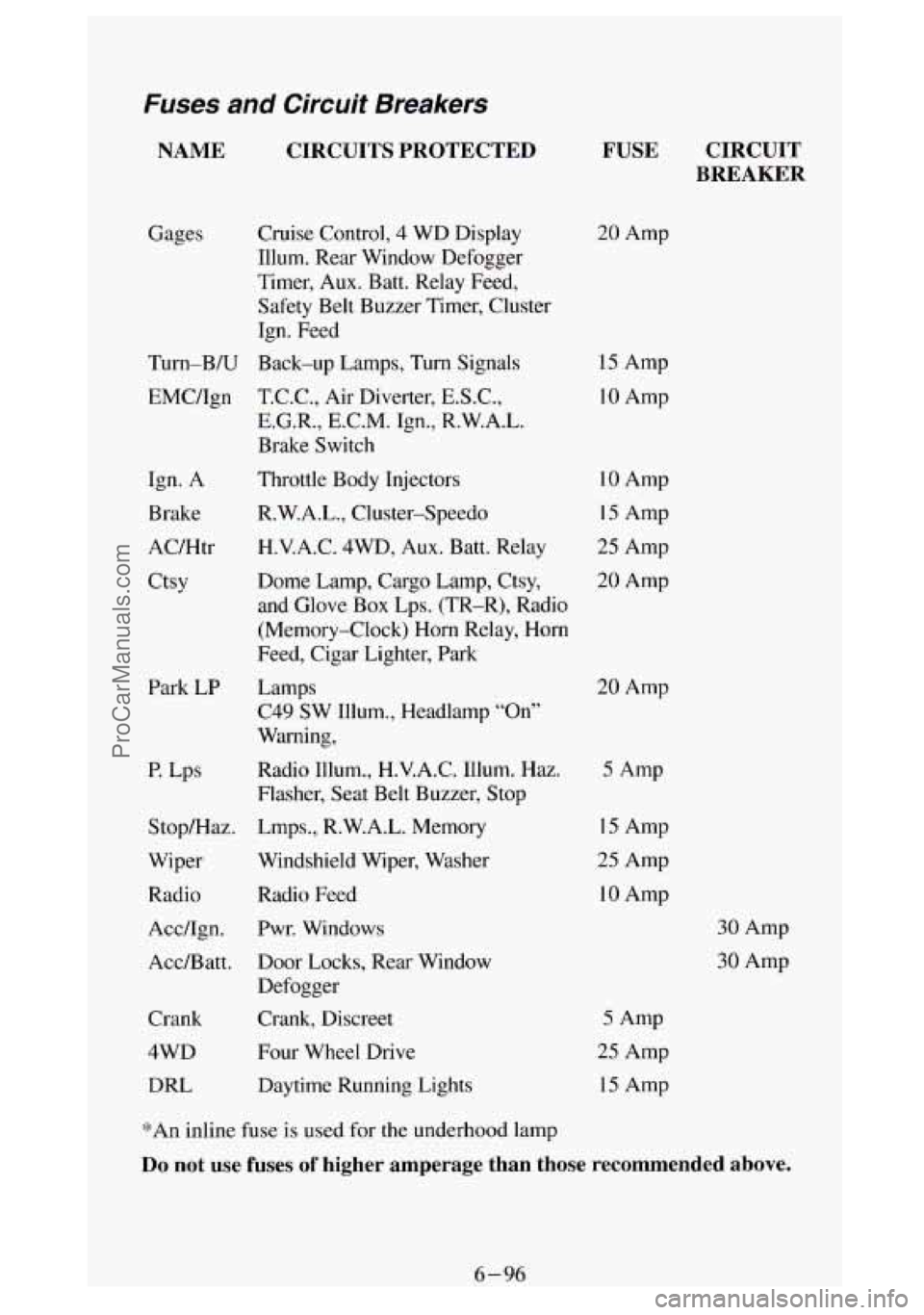
Fuses and Circuit Breakers
NAME CIRCUITS PROTECTED
Gages
Turn-B/U EMC/Ign
Ign. A
Brake
AC/Htr
Ctsy
Park LP
P. Lps
Stop/Haz.
Wiper
Radio
Acc/Ign.
Acc/Batt.
Crank
4WD
DRL
Cruise Control, 4 WD Display
Illum. Rear Window Defogger
Timer, Aux. Batt. Relay Feed,
Safety Belt Buzzer Timer, Cluster
Ign. Feed
Back-up Lamps,
Turn Signals
T.C.C., Air Diverter,
E.S.C.,
E.G.R., E.C.M. Ign., R.W.A.L.
Brake Switch
Throttle Body Injectors
R.W.A.L., Cluster-Speedo
H.V.A.C.
4WD, Aux. Batt. Relay
Dome Lamp, Cargo Lamp, Ctsy,
and Glove Box Lps. (TR-R), Radio
(Memory-Clock) Horn Relay, Horn
Feed, Cigar Lighter, Park
Lamps C49 SW Illum., Headlamp “On”
Warning,
Radio Illum., H.V.A.C. Illum. Haz.
Flasher, Seat Belt Buzzer, Stop
Lmps., R.W.A.L. Memory
Windshield Wiper, Washer
Radio Feed
Pwr. Windows
Door Locks, Rear Window
Defogger
Crank, Discreet
Four Wheel Drive
Daytime Running Lights
FUSE CIRCUIT
BREAKER
20 Amp
15 Amp
10 Amp
10 Amp
15 Amp
25 Amp
20 Amp
20 Amp
5 Amp
15 Amp
25 Amp
10 Amp
30 Amp
30 Amp
5 Amp
25 Amp
15 Amp
*An inline fuse is used
for the underhood lamp
Do not use fuses of higher amperage than those recommended above.
6-96
ProCarManuals.com