lock GMC SIERRA 1994 Owner's Manual
[x] Cancel search | Manufacturer: GMC, Model Year: 1994, Model line: SIERRA, Model: GMC SIERRA 1994Pages: 404, PDF Size: 20.91 MB
Page 63 of 404
Door Locks
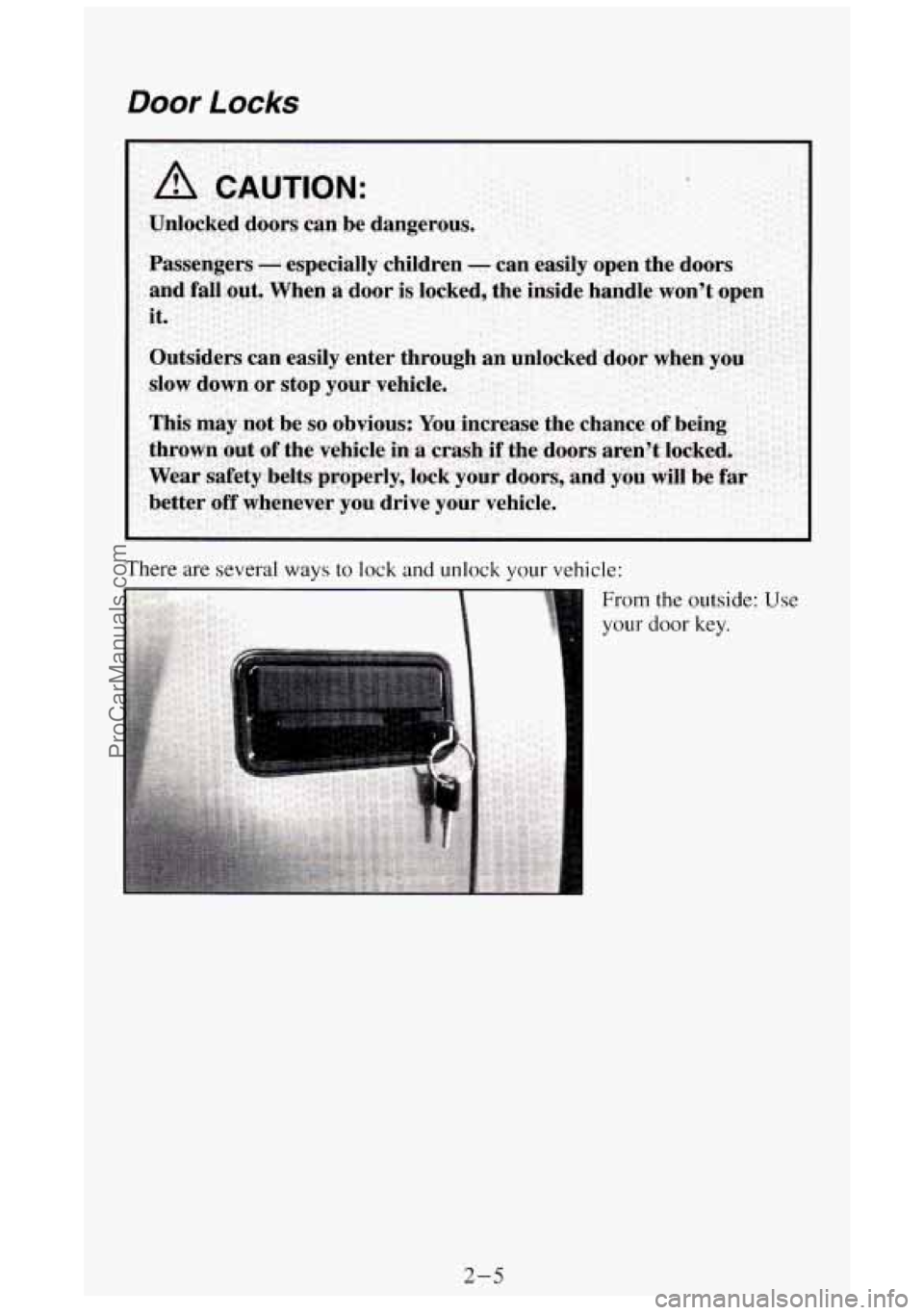
There are several ways to lock and unlock your vehicle:
From the outside:
Use
your door key.
2-5
ProCarManuals.com
Page 64 of 404
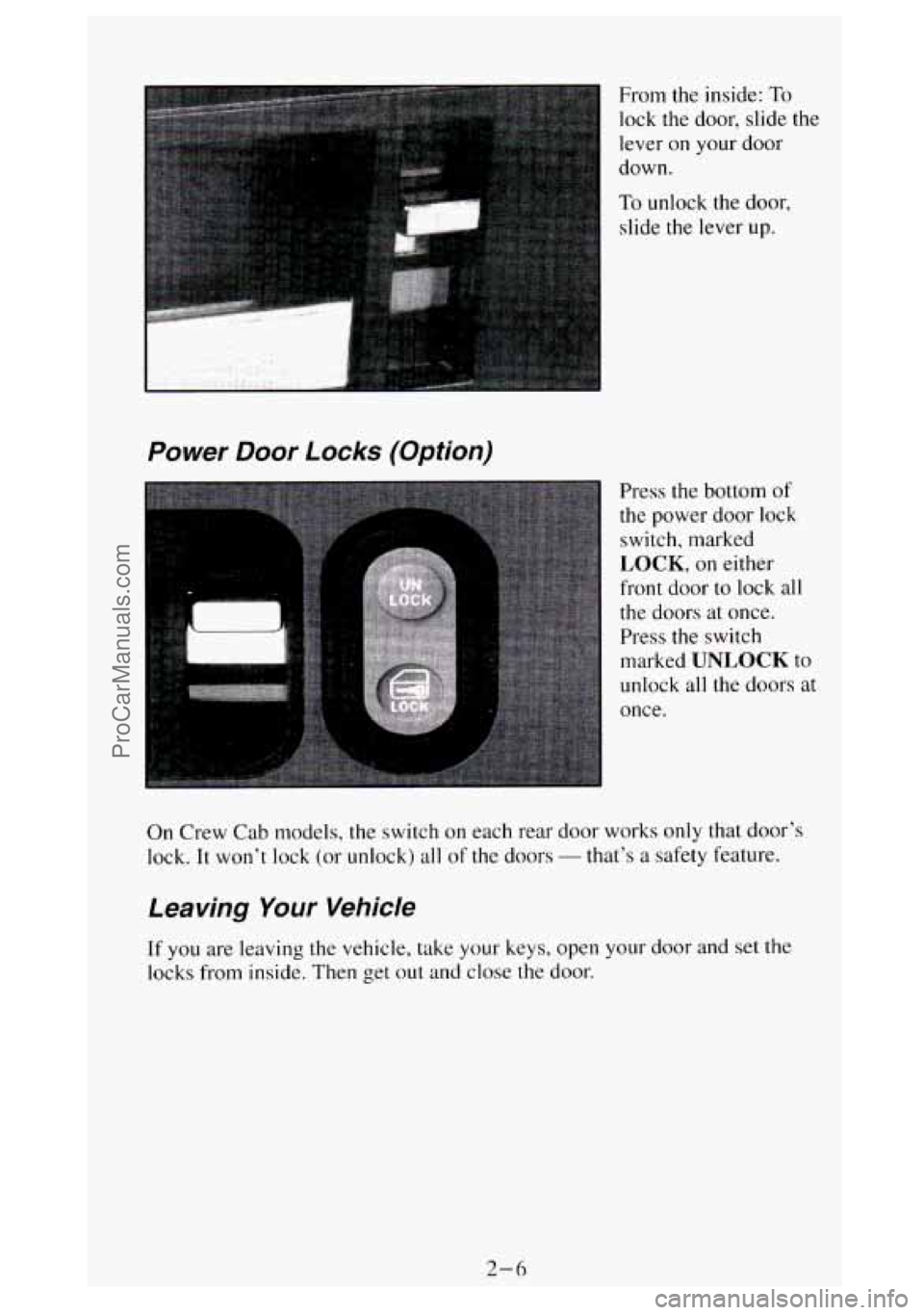
From the inside: To
I lock the door, slide the
Power Door Locks (Option)
Press the bottom of
the power door lock
switch, marked
LOCK, on either
front door
to lock all
the doors at once.
Press the switch marked
UNLOCK to
unlock all the doors at
lever on
your door
down.
To unlock the door,
slide
the lever up.
once.
On Crew Cab models, the switch on each rear door works only that door’s
lock.
It won’t lock (or unlock) all of the doors - that’s a safety feature.
Leaving Your Vehicle
If you are leaving the vehicle, take your keys, open your door and set the
locks from inside. Then get out and close the door.
2-6
ProCarManuals.com
Page 67 of 404
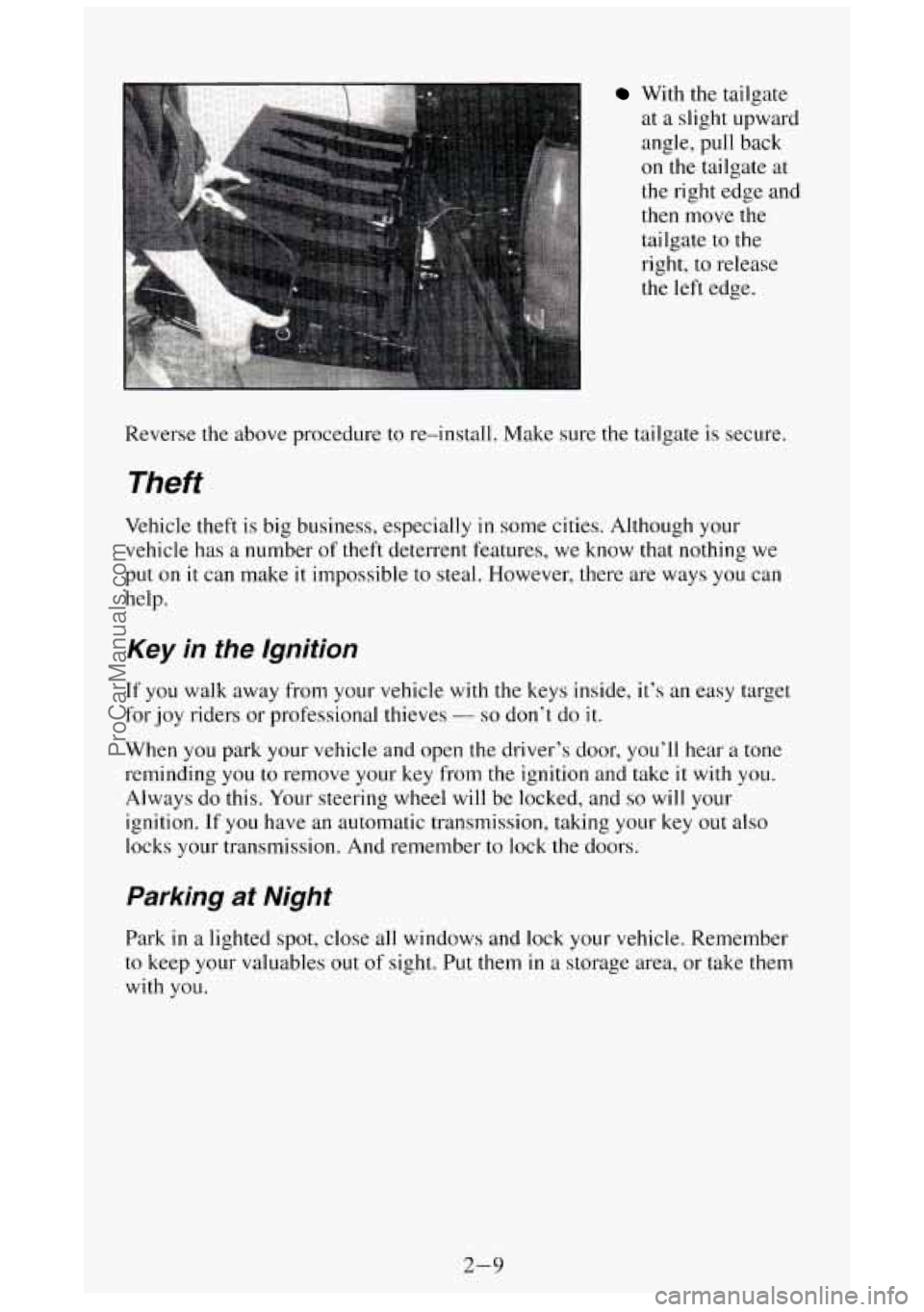
With the tailgate at a slight upward
angle, pull back
on the tailgate at
the right edge and
then move the
tailgate to the
right,
to release
the
left edge.
Reverse the above procedure to re-install. Make sure the tailgate is secure.
Theft
Vehicle theft is big business, especially in some cities. Although your
vehicle has a number of
theft deterrent features, we know that nothing we
put on it can make
it impossible to steal. However, there are ways you can
help.
Key in the Ignition
If you walk away from your vehicle with the keys inside, it’s an easy target
for joy riders or professional thieves
- so don’t do it.
When you park your vehicle and open the driver’s door, you’ll hear a tone
reminding
you to remove your key from the ignition and take it with you.
Always
do this. Your steering wheel will be locked, and so will your
ignition. If you have an automatic transmission, taking your
key out also
locks your transmission. And remember to lock the doors.
Parking at Night
Park in a lighted spot, close all windows and lock your vehicle. Remember
to keep your valuables out of sight. Put them in a storage area, or take them
with you.
2-9
ProCarManuals.com
Page 68 of 404
Parking Lots
If you park in a lot where someone will be watching your vehicle, it’s best
to lock it up and take your keys. But what
if you have to leave your ignition
key? What if you have to leave something valuable
in your vehicle?
0 Put your valuables in a storage area or console.
0 Lock the console.
Lock all the doors except the driver’s.
0 Then take the door key with you.
New Vehide “Break-In”
NOTICE:
Your modern vehicle doesn’t need an elaborate “break-in.” But
it will perform better in the long run if you follow these
guidelines:
Keep your speed at 55 mph (88 km/h) or less for the first
500 miles- (804 km).
Don’t drive at any one speed - fast or slow - for the first
500 miles (804 km). Don’t make full-throttle starts.
0 Avoid making hard stops for the first 200 miles (322 km) or
so. During this time your new brake linings aren’t yet broken
in. Hard stops with new linings can mean premature wear and
earlier replacement. Follow
this “breaking-in” guideline
every time you get new brake linings.
New Vehicle “Break-In” - 3500 HD Model
If you have a 3500 HD model, your parking brake requires a special
break-in procedure. See “Parking Brake” in the Index.
ProCarManuals.com
Page 69 of 404
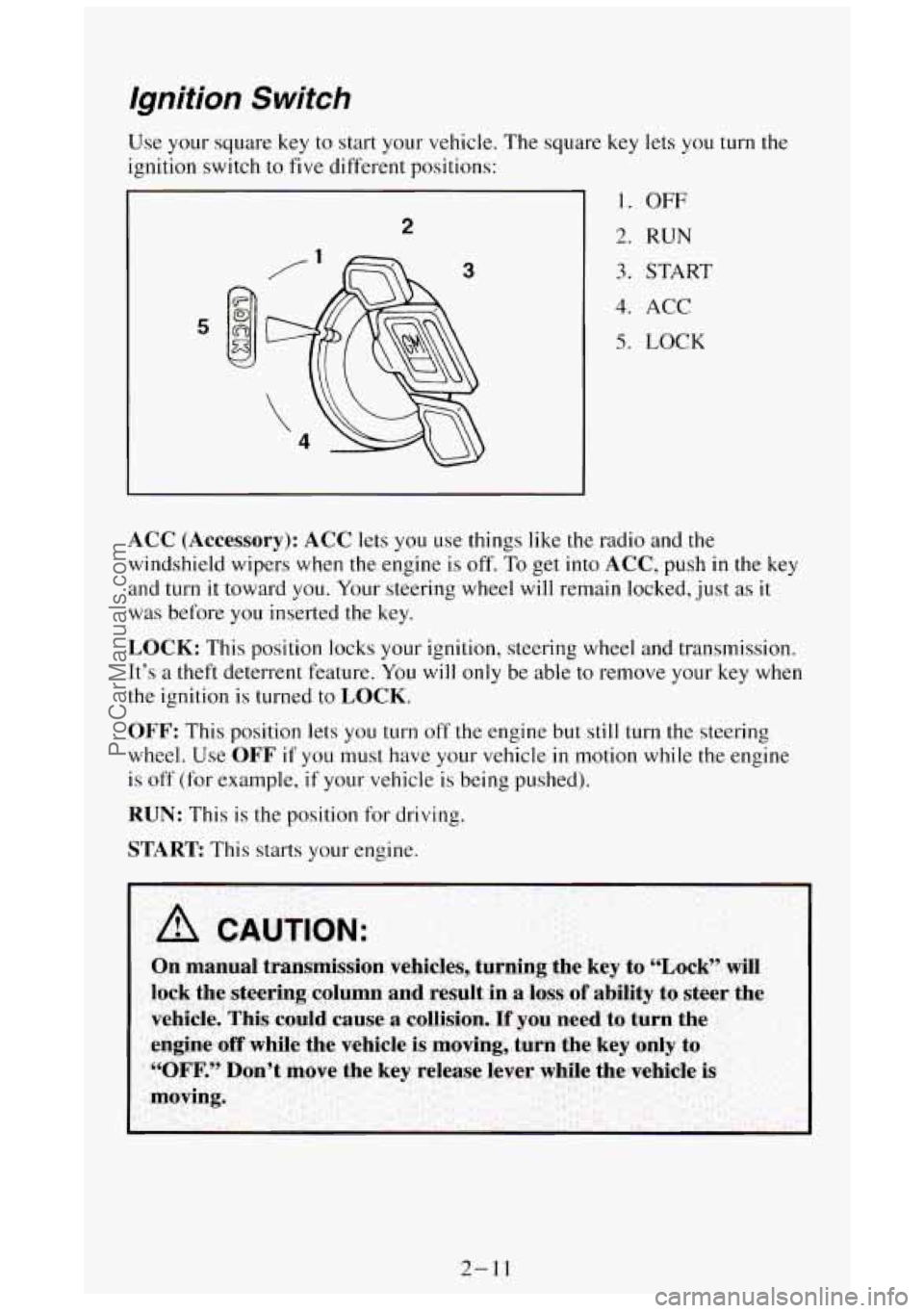
Ignition Switch
Use your square key to start your vehicle. The square key lets you turn the
ignition switch to
five different positions:
I 2
5
Q
3
1. OFF
2. RUN
3. START
4. ACC
5. LOCK
ACC (Accessory): ACC lets you use things like the radio and the
windshield wipers when the engine
is off. To get into ACC, push in the key
and turn
it toward you. Your steering wheel will remain locked, just as it
was before you inserted the key.
LOCK: This position locks your ignition, steering wheel and transmission.
It's
a theft deterrent feature. You will only be able to remove your key when
the ignition is turned to
LOCK.
OFF: This position lets you turn off the engine but still turn the steering
wheel. Use
OFF if you must have your vehicle in motion while the engine
is
off (for example, if your vehicle is being pushed).
RUN: This is the position for driving.
START This starts your engine.
2-11
ProCarManuals.com
Page 70 of 404
NOTICE:
If your key seems stuck in “Lock” and you can’t turn it, be sure
it is all the
way in. If it is, then turn the steering wheel left and
right while you turn the key
hard. But turn the key only with
your hand. Using a tool to force it could break the key or the
ignition switch.
If none of this works, then your vehicle needs
service.
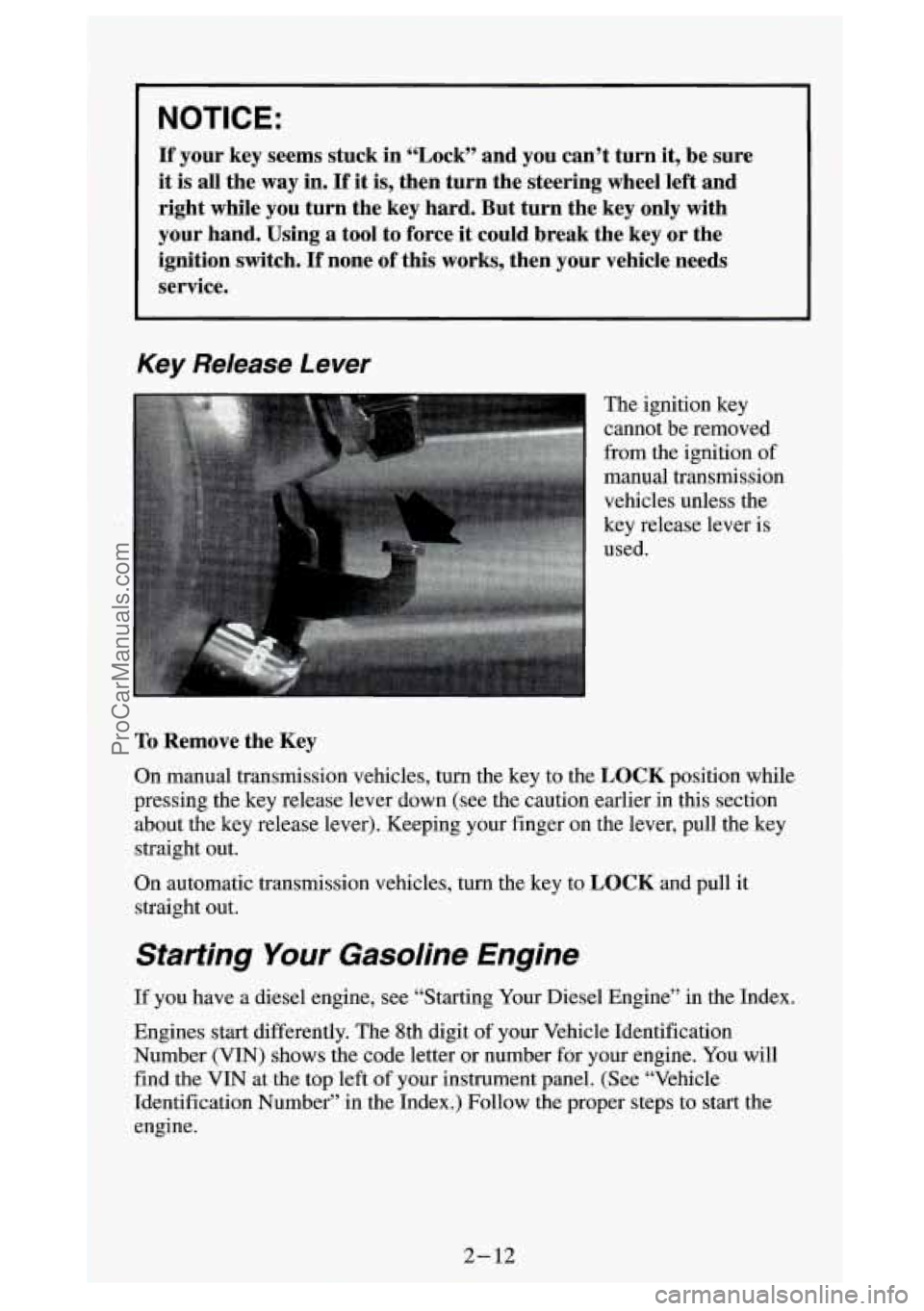
Key Release Lever
The ignition key
cannot be removed
from the ignition of
manual transmission
vehicles unless the
key release lever is
used.
To Remove the Key
On manual transmission vehicles, turn the key to the LOCK position while
pressing the key release lever down (see the caution earlier \
in
this section
about the key release lever). Keeping your finger on the leve\
r, pull the key
straight out.
On automatic transmission vehicles, turn the key to
LOCK and pull it
straight out.
Starting Your Gasoline Engine
If you have a diesel engine, see “Starting Your Diesel Engine” in the Index.
Engines start differently. The 8th digit of your Vehicle Identification
Number (VIN) shows the code letter or number for your engine. You will
find the VIN at the top left of your instrument panel. (See “Vehicle
Identification Number” in the Index.) Follow the proper step\
s to start the
engine.
2-12
-.. ProCarManuals.com
Page 77 of 404
If the light comes on and then goes off and you know your batteries are
charged, but your engine still
won’t start, your vehicle needs service.
If the light does not come on when
the engine is cold, your vehicle needs
service.
If your batteries don’t have enough charge to start your engine, see
“Battery”
in the Index.
Be sure you have the right oil for your engine, and that you’ve changed the
oil at the proper times.
If you use the wrong oil, your engine may be harder
to start.
If
the engine starts, runs a short time, then stops, your vehicle needs service.
1 A CAUTION:
Do not use gasoline or starting “aids,” such as ether, in the air
intake.
They could damage your engine. There could also be a
fire, which could cause serious personal injury.
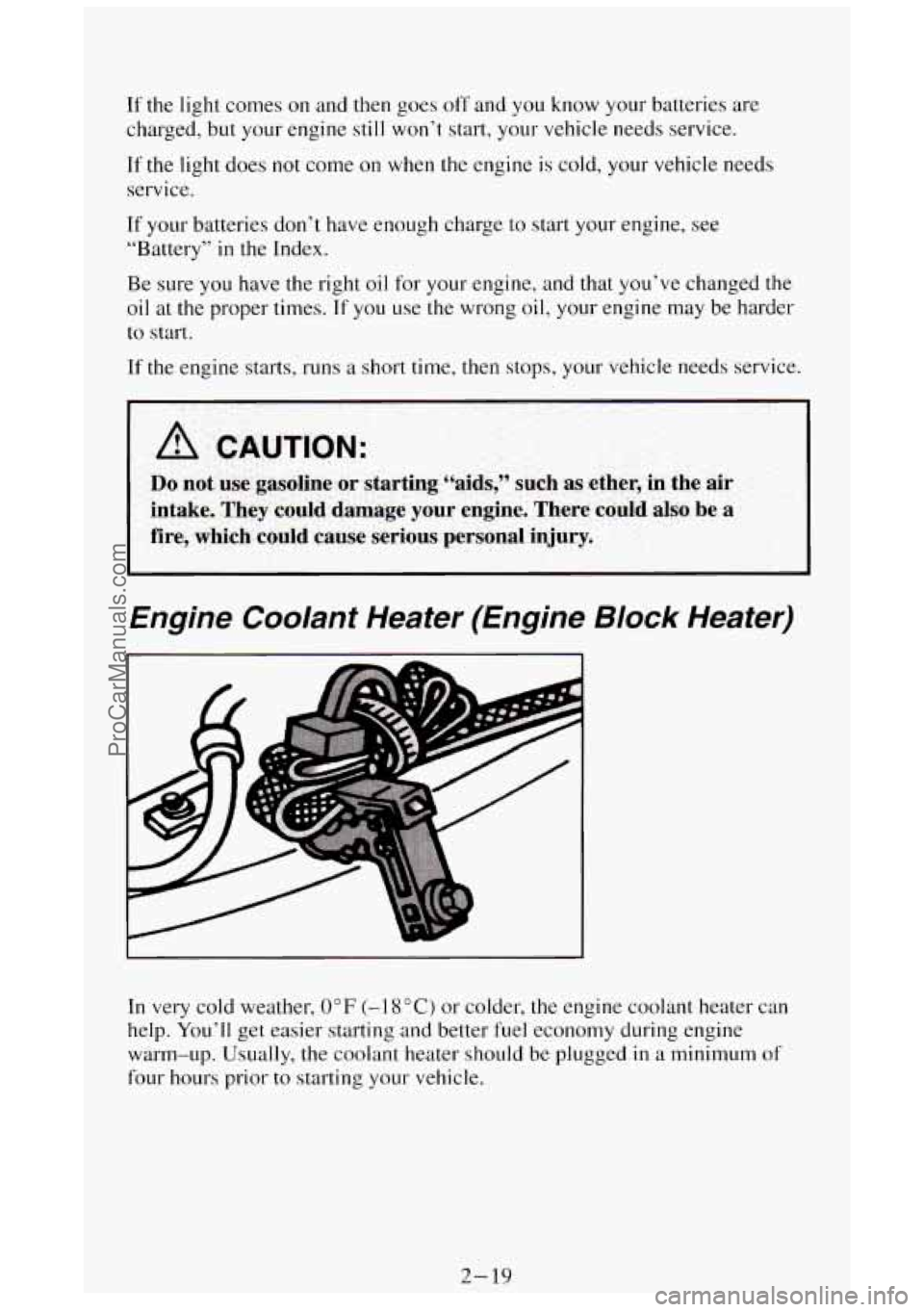
Engine Coolant Heater (Engine Block Heater)
In very cold weather, 0°F (-I 8°C) or colder, the engine coolant heater can
help. You’ll get easier starting and better fuel economy during engine
warm-up. Usually, the coolant heater should be plugged
in a minimum of
four hours prior to starting your vehicle.
2-19
ProCarManuals.com
Page 79 of 404
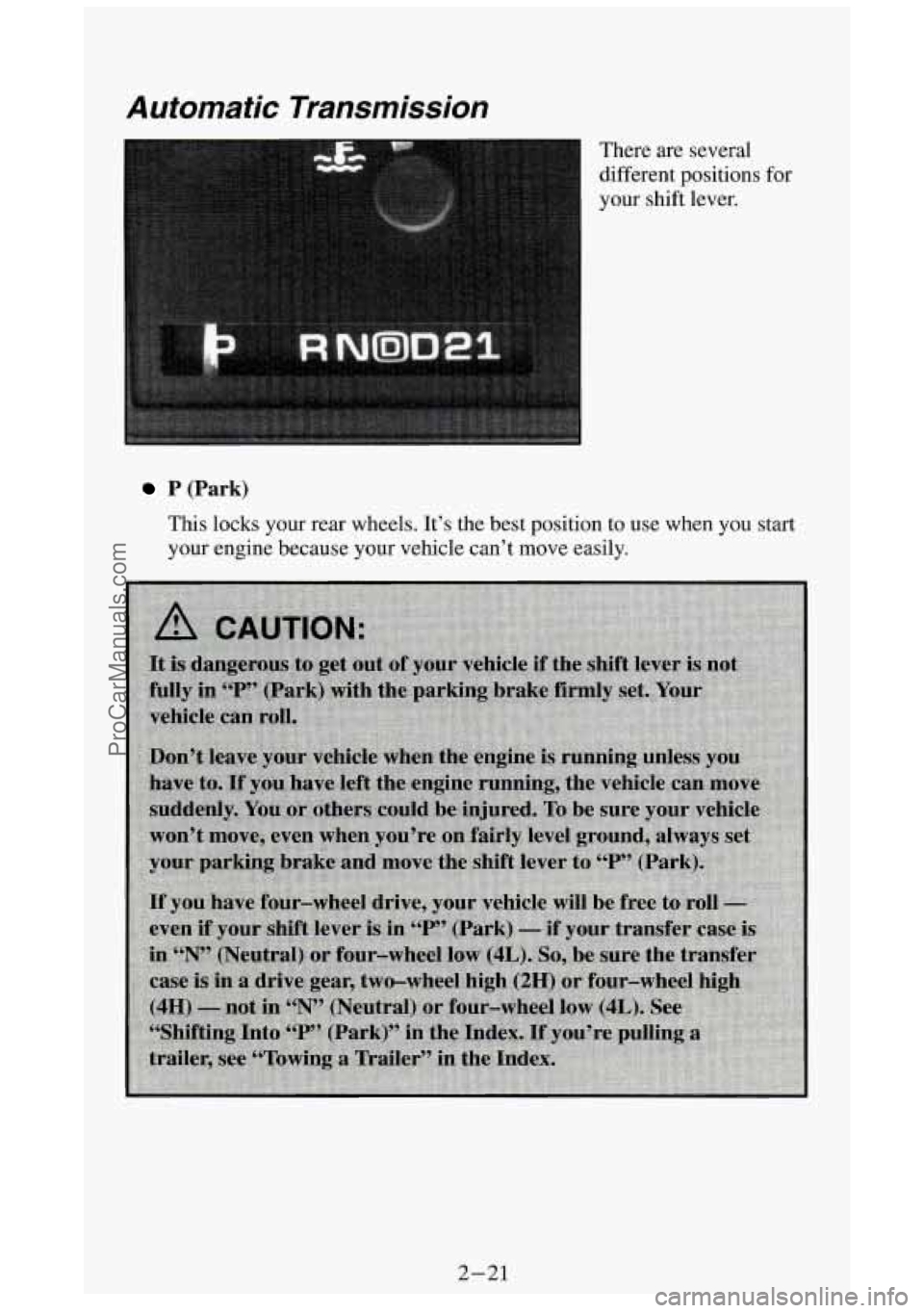
Automatic Transmission
There are several
different positions for
your shift lever.
P (Park)
This locks your rear wheels. It’s the best position to use when you start
your engine because your vehicle can’t move easily.
2-21
ProCarManuals.com
Page 86 of 404
Locking Rear Axle
If you have this feature, your rear axle can give you additional traction on
snow, mud, ice, sand or gravel. It works like a standard axle most of the
time, but when one
of the rear wheels has no traction and the other does, the
locking feature will allow the wheel with traction to move the vehicle.
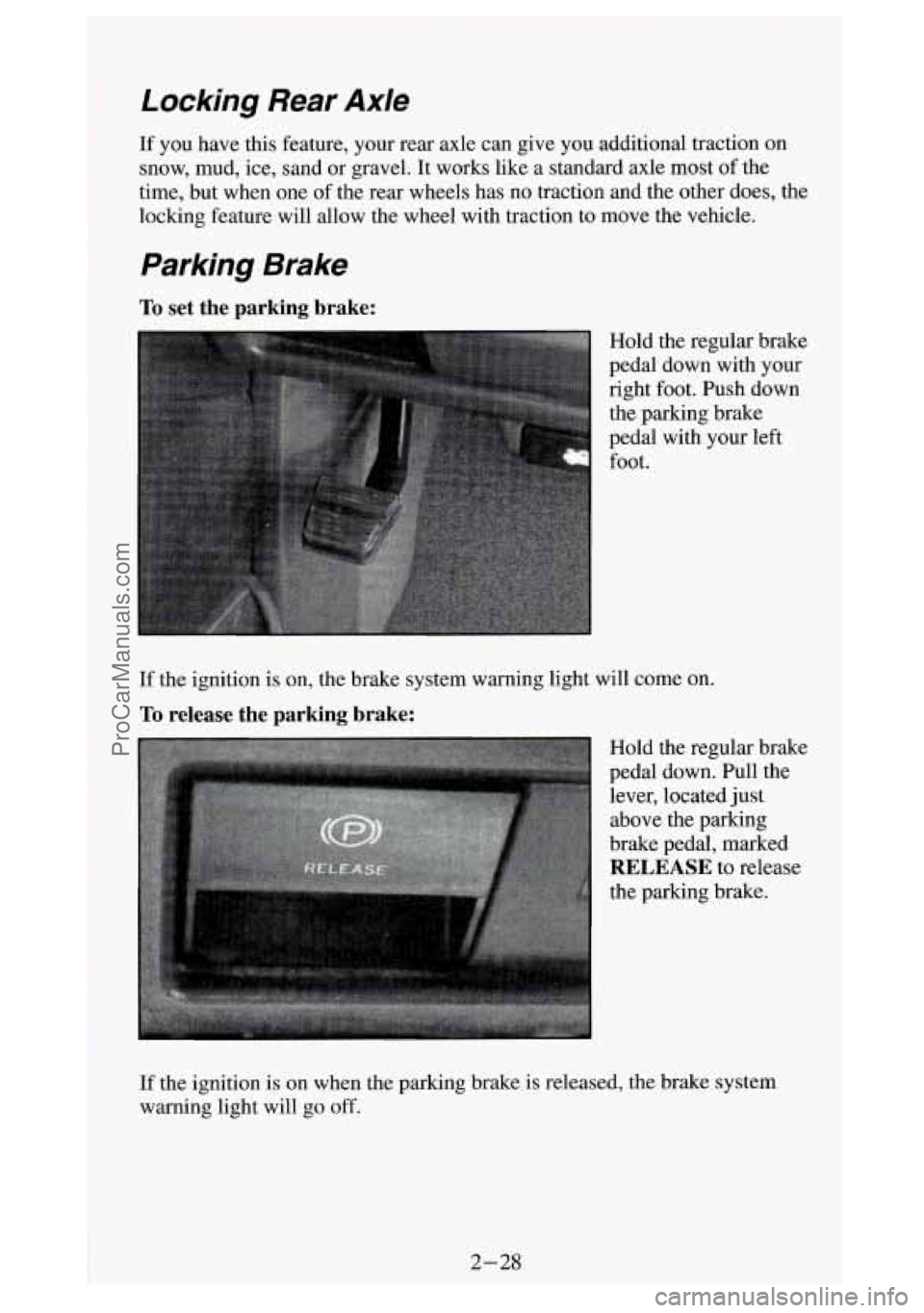
To set the parking brake:
Hold the regular brake
pedal down with your
right foot. Push down the parking brake
pedal with your left
foot.
If the ignition is on, the brake system warning light will come on.
To release the parking brake:
Hold the regular brake
pedal down. Pull the lever, located just
above the parking
brake pedal, marked
RELEASE to release
the parking brake.
-
If the ignition is on when the parking brake is released, the brake system
warning light will
go off.
ProCarManuals.com
Page 87 of 404
NOTICE:
Driving with the parking brake on can cause your rear brakes to
overheat. You may have
to replace them, and you could also
damage other parts of your vehicle.
If you are towing a trailer and are parking on any hill: See “Towing a
Trailer” in the Index. That section shows what to do first to keep the trailer
from moving.
Propshaft Brake Burnish Procedure
If you have a 3500 HD model, it is recommended that the propshaft
mounted parking brake be burnished
as part of the new vehicle break in.
The parking brake will work best after it has been burnished following these
instructions.
Make
10 (ten) stops, using the parking brake foot pedal, from 20 mph
(32 kdh) about
2 1/2 miles (4 km) apart. In between stops, drive the
vehicle at
20 mph (32 km/h).
Torque Lock
The parking brake should be set first whenever you leave the driver’s seat.
If you are parked on
a hill and the transmission is placed in “P” (Park)
before
the parking brake is set, the weight of the vehicle may put too much
force
on the parking pawl in the transmission. It may be difficult to pull the
selector lever out
of “P’ (Park). This is called “torque lock.” To prevent this,
the parking brake should be set
BEFORE moving the gear selector to “P’
(Park).
When preparing to move
a vehicle parked on a hill, the selector lever should
be moved out of
“P’ (Park) BEFORE releasing the parking brake. Even
when
on level surfaces, its a good idea to set the parking brake first before
shifting
the transmission from “P” (Park).
If torque lock does occur, you may have to have another vehicle nudge your
vehicle uphill a little to take some
of the pressure off the transmission while
you pull the selector lever out of “P” (Park).
2-29
ProCarManuals.com