lock GMC SIERRA 1994 Service Manual
[x] Cancel search | Manufacturer: GMC, Model Year: 1994, Model line: SIERRA, Model: GMC SIERRA 1994Pages: 404, PDF Size: 20.91 MB
Page 128 of 404
Gages can indicate when there may be or is a problem with one of your
vehicle’s functions. Often gages and warning lights work together to let
you
know when there’s a problem with your vehicle.
When one of the warning lights comes on and stays on when you are
driving,
or when one of the gages shows there may be a problem, check the
section that tells you what to do about
it. Please follow the manual’s advice.
Waiting
to do repairs can be costly - and even dangerous. So please get to
know your warning lights and gages. They’re
a big help.
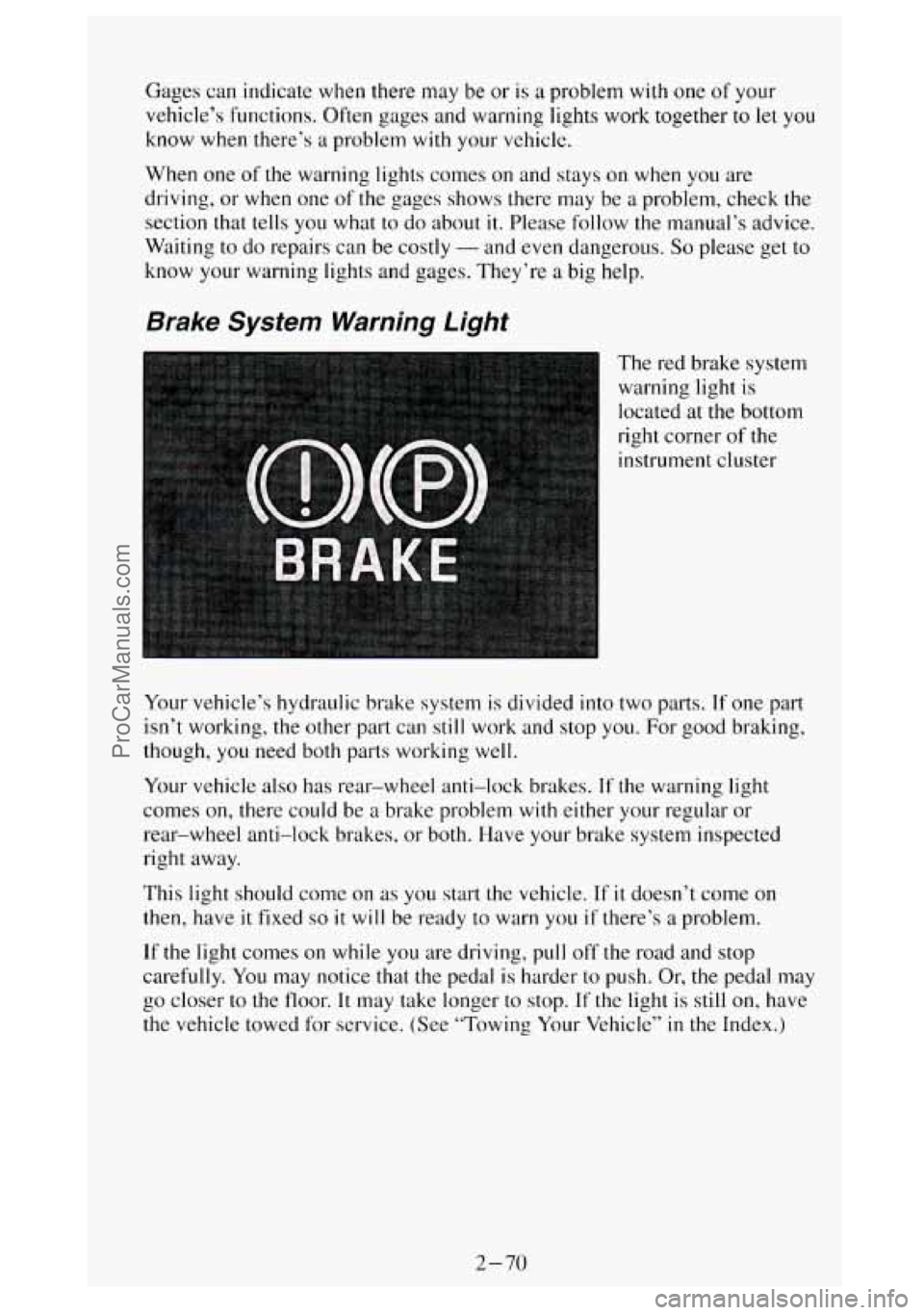
Brake System Warning Light
The red brake system
warning light is
located at the bottom
right corner
of the
instrument cluster
Your vehicle’s hydraulic brake system
is divided into two parts. If one part
isn’t working, the other part can still work and stop you. For good braking,
though, you need both parts working well.
Your vehicle also has rear-wheel anti-lock brakes.
If the warning light
comes on, there could be
a brake problem with either your regular or
rear-wheel anti-lock brakes, or both. Have your brake system inspected
right away.
This light should come on
as you start the vehicle. If it doesn’t come on
then, have it fixed so it will be ready to warn you if there’s a problem.
If the light comes on while you are driving, pull off the road and stop
carefully.
You may notice that the pedal is harder to push. Or, the pedal may
go closer
to the floor. It may take longer to stop. If the light is still on, have
the vehicle towed for service. (See “Towing Your Vehicle”
in the Index.)
2-70
ProCarManuals.com
Page 146 of 404
Heater Output
Engine Coolant Heater (Engine Block Heater)
If your vehicle has a diesel engine, it is equipped with an engine coolant
heater. An engine coolant heater
is optional on gas engine vehicles. You can
use an engine coolant heater during initial start-up
in cold weather (20” F,
-8” C, or lower) to help heat the passenger compartment faster. Because an
engine coolant heater warms the engine coolant, your vehicle’s heating
system can provide some heat
as soon as you start the engine.
The
use of an engine coolant heater also reduces the time it takes for the
engine to reach normal operating temperature, and shortens the time it takes
the heater to reach full output. For more information, See “Engine Coolant
Heater”
in the Index.
Diesel Engine
If you idle your diesel engine for a long time when it’s cold outside, your
heater may blow out cool air. This
is normal. When you increase the engine
speed, your heater should blow
out warmer air. If it doesn’t, your coolant
level may be low. See “Engine Coolant”
in the Index to find out how to
check your coolant level.
3-4
ProCarManuals.com
Page 153 of 404
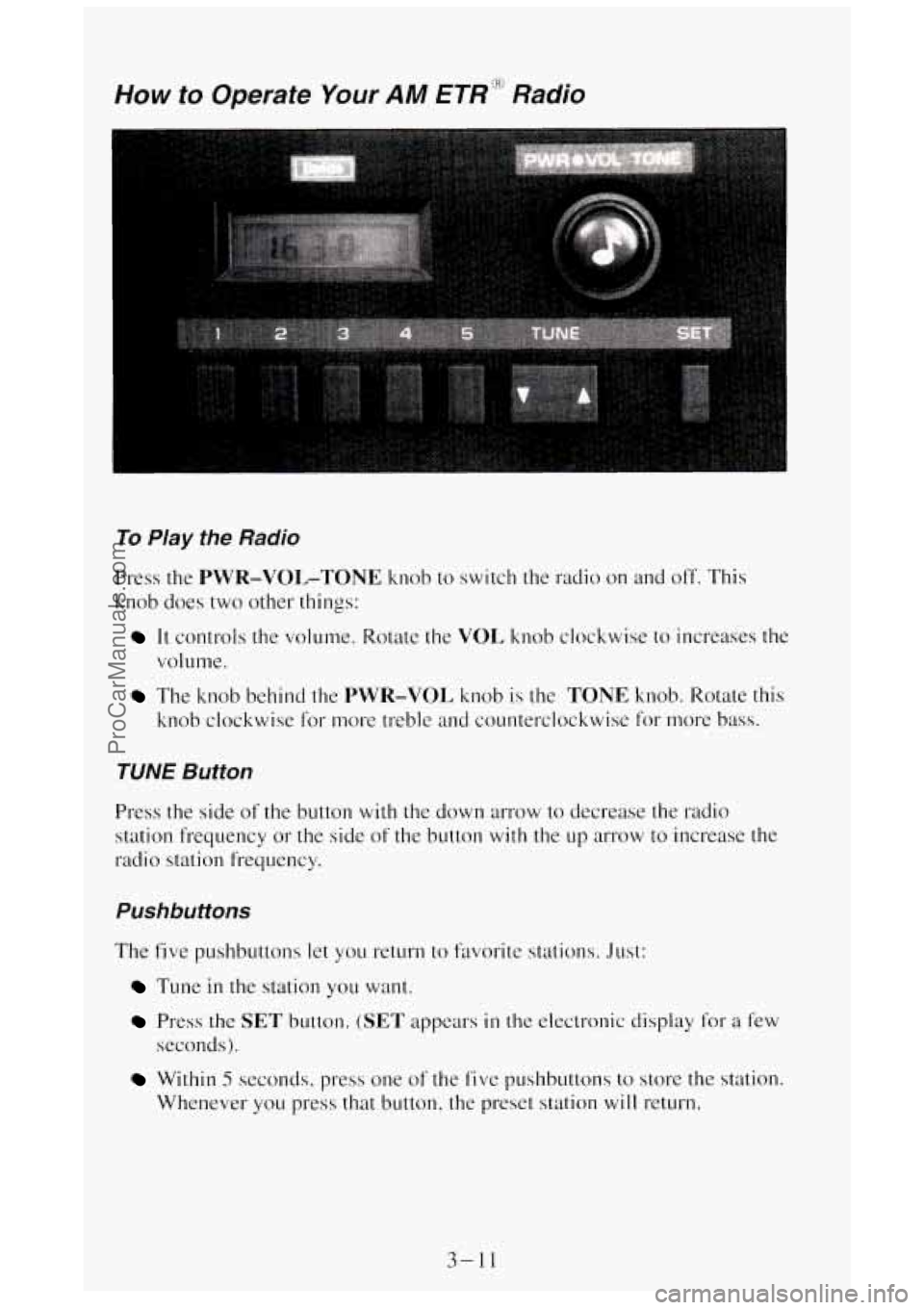
Yow to Operate Your AM ETR':"' Radio
To Play the Radio
Press the PWR-VOL-TONE knob to switch the radio on and off. This
knob does two other things:
It controls the volume. Rotate the VOI, knob clockwise to increases the
volume.
The knob behind the PWR-VOL knob is the TONE knob. Rotate this
knob clockwise
for more treble and counterclockwise for more bass.
TUNE Button
Press the side of the button with the down arrow to decrease the radio
station frequency
or the side of the button with the up arrow to increase the
radio station frequency.
Pushbuttons
The five pushbuttons let you return to favorite stations. Just:
Tune in the station you want.
Press the SET button. (SET appears in the electronic display for a f'ew
seconds).
Within 5 seconds, press one of the fivc pushbuttons to store the station.
Whenever you press that button, the preset station
will return.
3-11
ProCarManuals.com
Page 156 of 404
Clock
To set the clock, just:
0
0
0
0
Press the SET button. The word SET will light up in the electronic
display.
Within
5 seconds, press and hold the SEEK button until the correct
hour appears on the display.
Then, press and hold the
SCAN button until the correct minute appears
on the display.
After you set the time, the word
SET will remain in the electronic
display for a few seconds.
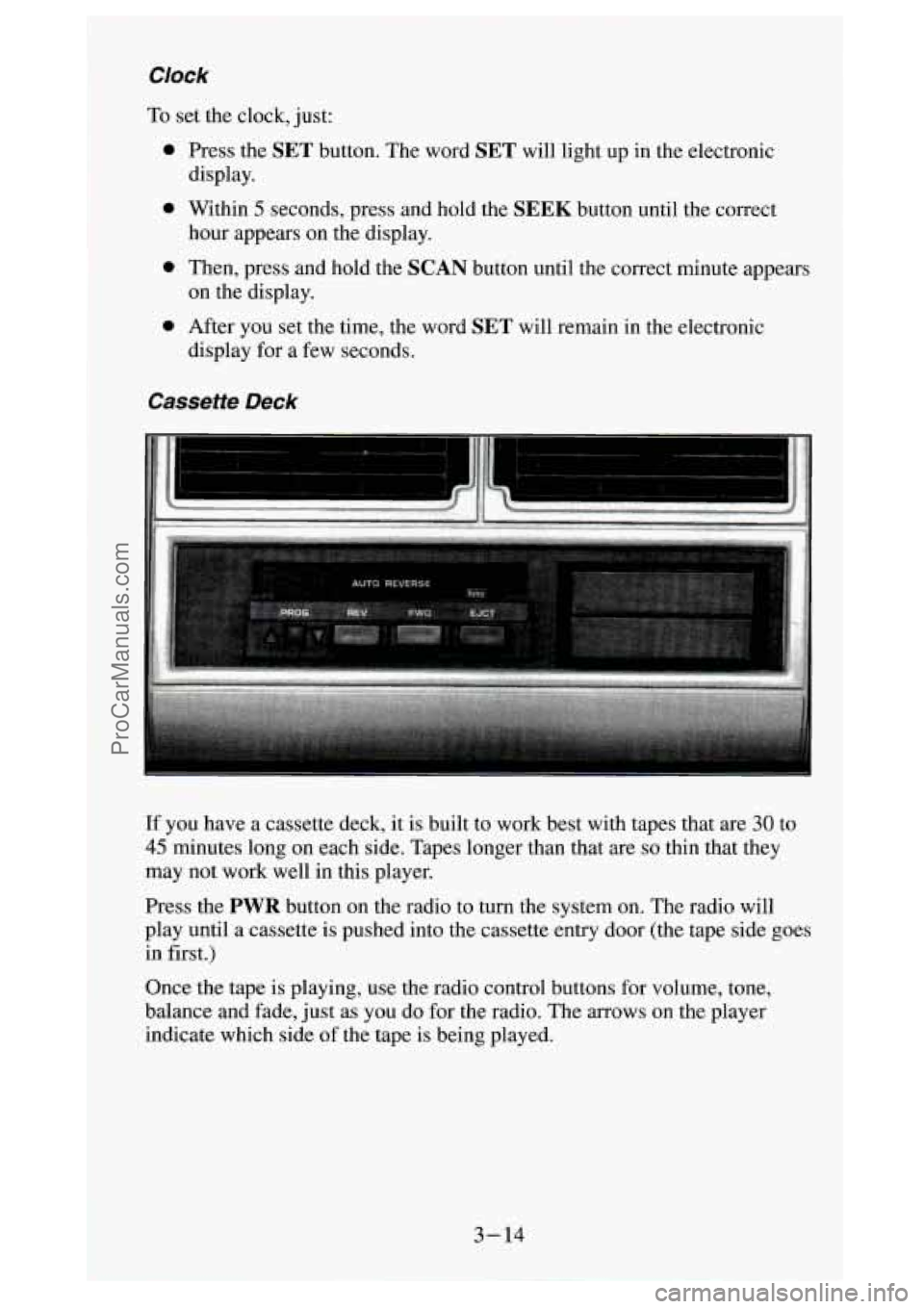
Cassette Deck
p... .... ..... ......................... ..... i' f. ................... ./.. .._..-... ..............
ii .... ........ "_ ......... ........ -. ........ ... .....
If you have a cassette deck, it is built to work best with tapes that are 30 to
45 minutes long on each side. Tapes longer than that are so thin that they
may not work well in this player.
Press the
PWR button on the radio to turn the system on. The radio will
play until a cassette is Dushed into the cassette entry door (the tape side goes
in first.)
Once the tape is playing, use the radio control buttons for volume, tone,
balance and fade, just as you do for the radio. The arrows
on the player
indicate which side of the tape
is being played.
3-14
ProCarManuals.com
Page 160 of 404
Clock
To set the clock, just:
0 Press the SET button. The word SET will light up in the electronic
display.
hour appears on the display.
0 Within 5 seconds, press and hold the SEEK button until the correct
0 Then, press and hold the SCAN button until the correct minute appears
0 After you set the time, the word SET will remain in the electronic
on the display.
display for a few seconds.
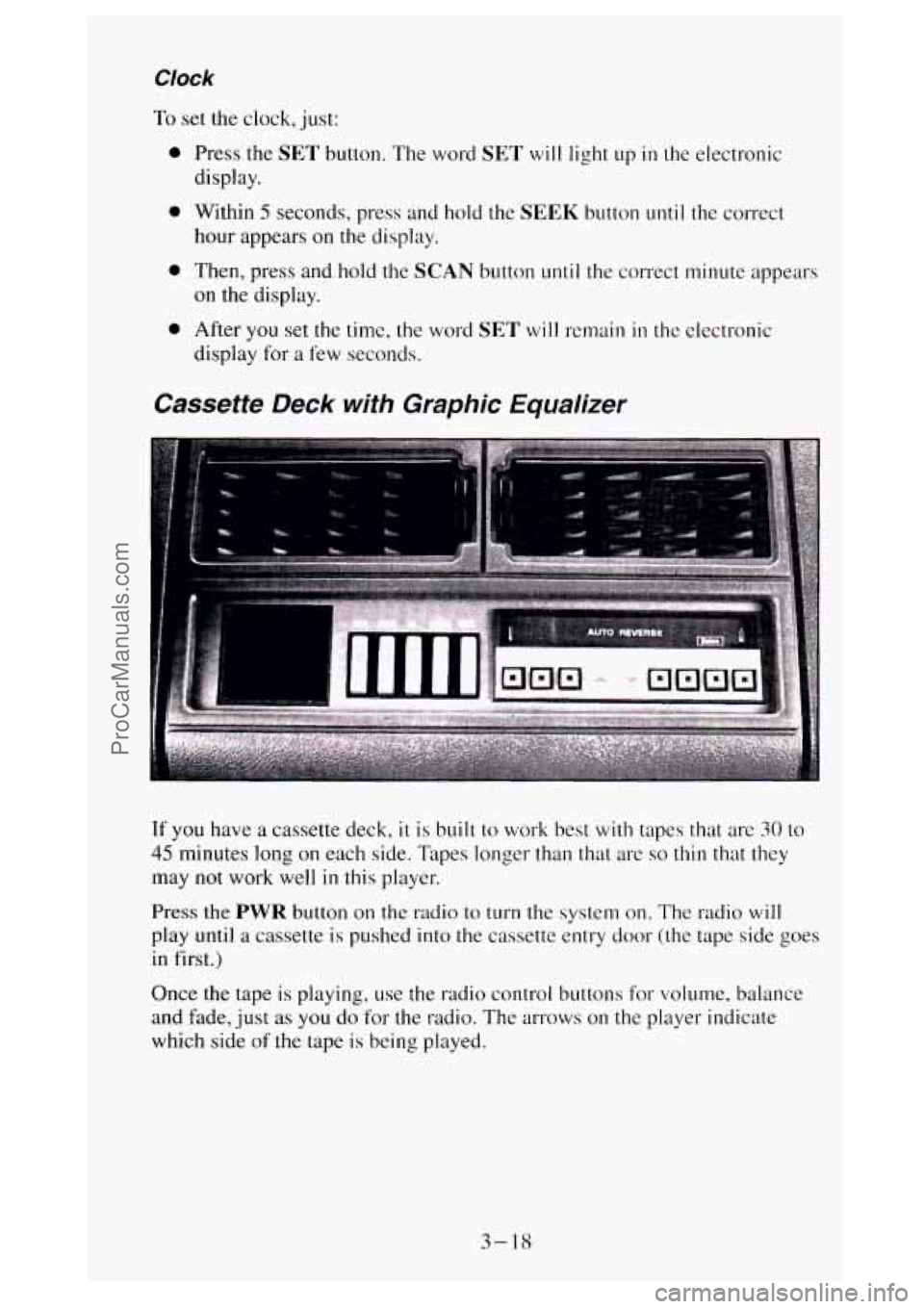
Cassette Deck with Graphic Equalizer
If you have a cassette deck, it is built to work best with tapes that are 30 to
45 minutes long on each side. Tapes longer than that are so thin that they
may not work well
in this player.
Press the PWR button on the radio to turn the system on. The radio will
play until a cassette is pushed into the cassette entry door (the tape side goes
in first.)
Once the tape
is playing, use the radio control buttons for volume, balance
and fade, just
as you do for the radio. The arrows on the player indicate
which side
of the tape is being played.
3- 18
ProCarManuals.com
Page 170 of 404
If your engine ever stops while you’re driving, brake normally but don’t
pump your brakes.
If you do, the pedal may get harder to push down. If
your engine stops, you will still have some power brake assist. But you will
use it when you brake. Once
the power assist is used up, it may take longer
to stop and the brake pedal will be harder to push.
Anti-Lock Brakes (ABS)
Your vehicle has an advanced electronic braking system that can help you
keep it under control.
When you start your vehicle and begin to drive away, you may hear
a
momentary motor or clicking noise. The ABS motor comes on momentarily
when
the vehicle reaches 8 mph (I 2 km/h). And you may even notice that
your brake pedal moves a little while this is going on. This
is the ABS
system testing itself.
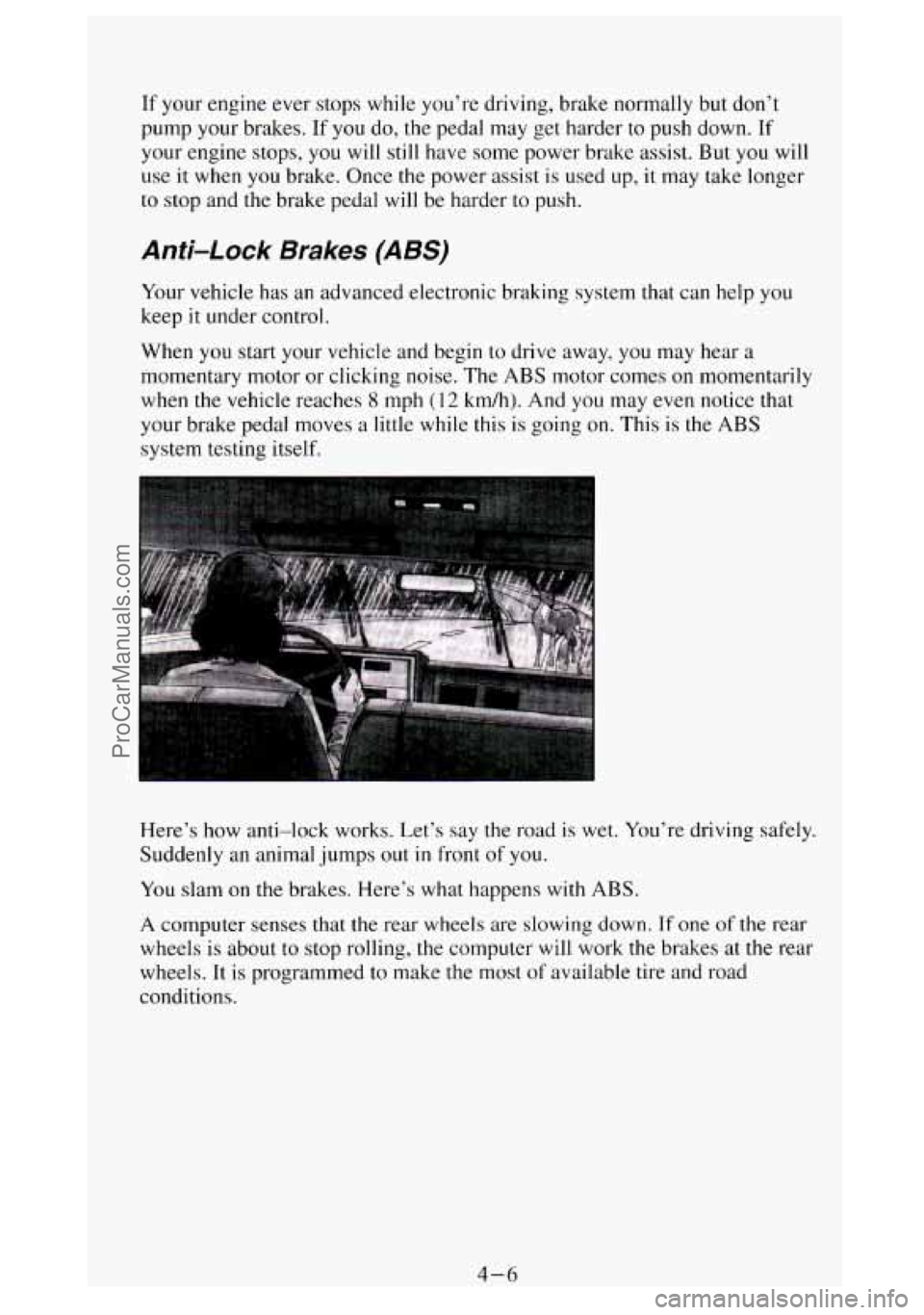
Here’s how anti-lock works. Let’s say the road is wet. You’re driving safely.
Suddenly an animal jumps out
in front of you.
You slam on the brakes. Here’s what happens with ABS.
A computer senses that the rear wheels are slowing down.
IT one of the rear
wheels is about to stop rolling, the computer will work
the brakes at the rear
wheels.
It is programmed to make the most of available tire and road
conditions.
4-6
ProCarManuals.com
Page 171 of 404
I- .,
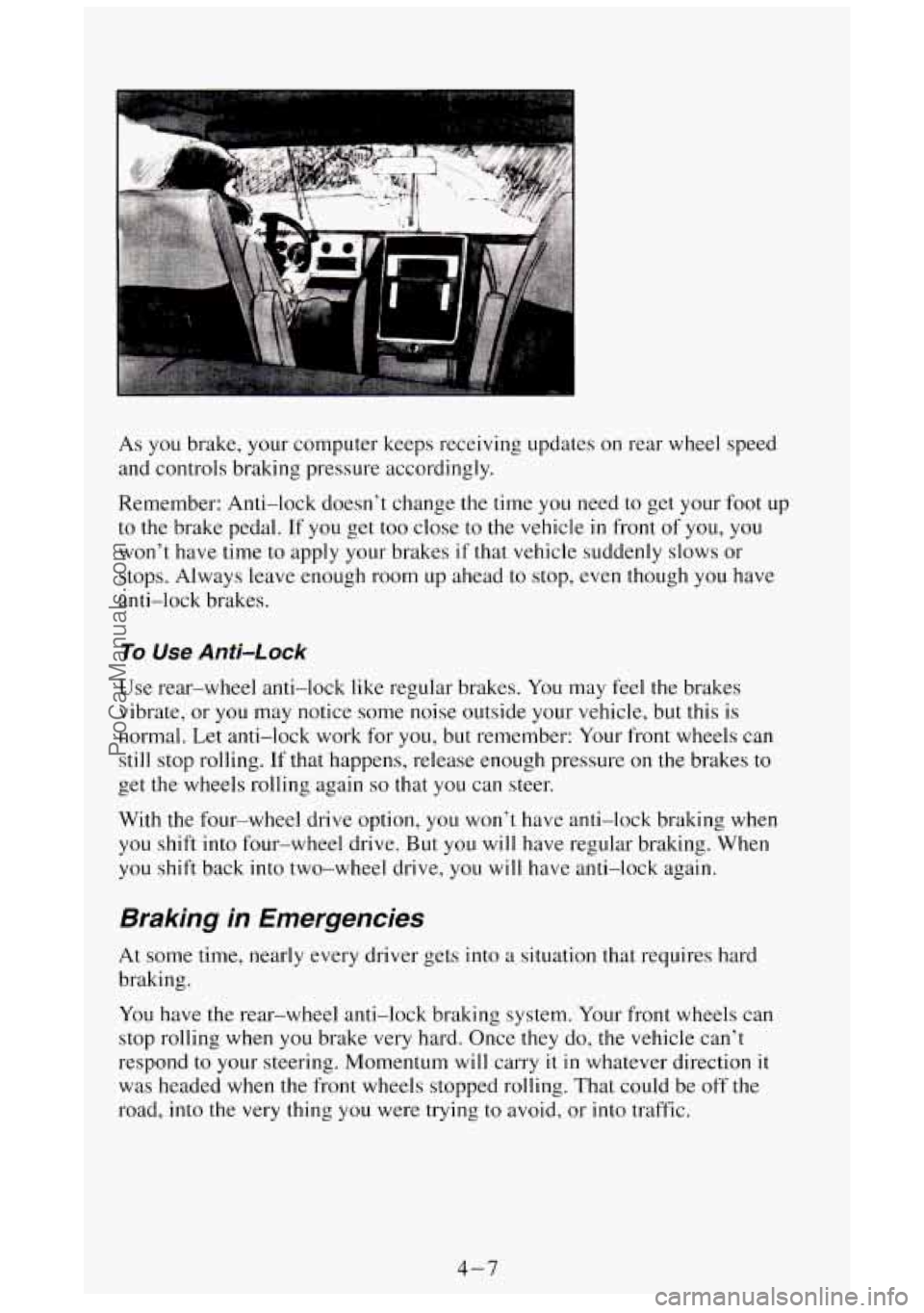
As you brake, your computer keeps receiving updates on rear wheel speed
and controls braking pressure accordingly.
Remember: Anti-lock doesn't change the time you need to get your foot up
to the brake pedal. If you get too close to
the vehicle in front of you, you
won't have time to apply your brakes
if that vehicle suddenly slows or
stops. Always leave enough room up ahead to stop, even though you have
anti-lock brakes.
To Use Anti-Lock
Use rear-wheel anti-lock like regular brakes. You may feel the brakes
vibrate, or
you may notice some noise outside your vehicle, but this is
normal. Let anti-lock work for
you, but remember: Your front wheels can
still stop rolling.
If that happens, release enough pressure on the brakes to
get the wheels rolling again
so that you can steer.
With the four-wheel drive option, you won't have anti-lock braking when
you shift into four-wheel drive. But you will have regular braking. When
you shift back into two-wheel drive, you
will have anti-lock again.
Braking in Emergencies
At some time, nearly every driver gets into a situation that requires hard
braking.
You have the rear-wheel anti-lock braking system.
Your front wheels can
stop rolling
when you brake very hard. Once they do, the vehicle can't
respond
to your steering. Momentum will carry it in whatever direction it
was headed when the front wheels stopped rolling. That could be off the
road, into the very thing you were trying to avoid, or into traffic.
4-7
ProCarManuals.com
Page 173 of 404
If you need to reduce your speed as you approach a curve, do it before you
enter the curve, while your front wheels are straight ahead.
Try
to adjust your speed so you can “drive” through the curve. Maintain a
reasonable, steady speed. Wait to accelerate
until you are out of the curve.
and then accelerate gently into the straightaway.
steering in Emergencies
There are times when steering can be more effective than braking. For
example,
you come over a hill and find a truck stopped in your lane, or a car
suddenly pulls
out from nowhere, or a child darts out from between parked
cars and
stops right in front of you. You can avoid these problems by
braking
- if you can stop in time. But sometimes you can’t; there isn’t
room. That’s the time for evasive action
- steering around the problem.
Your Vehicle can perform very well
in emergen.cies like these. First apply
your brakes, but not enough to lock your front wheels. It
is better to remove
as much speed as you can from a possible collision. Then steer around the
problem, to the
left or right depending on the space available.
An emergency like this requires close attention and a quick decision.
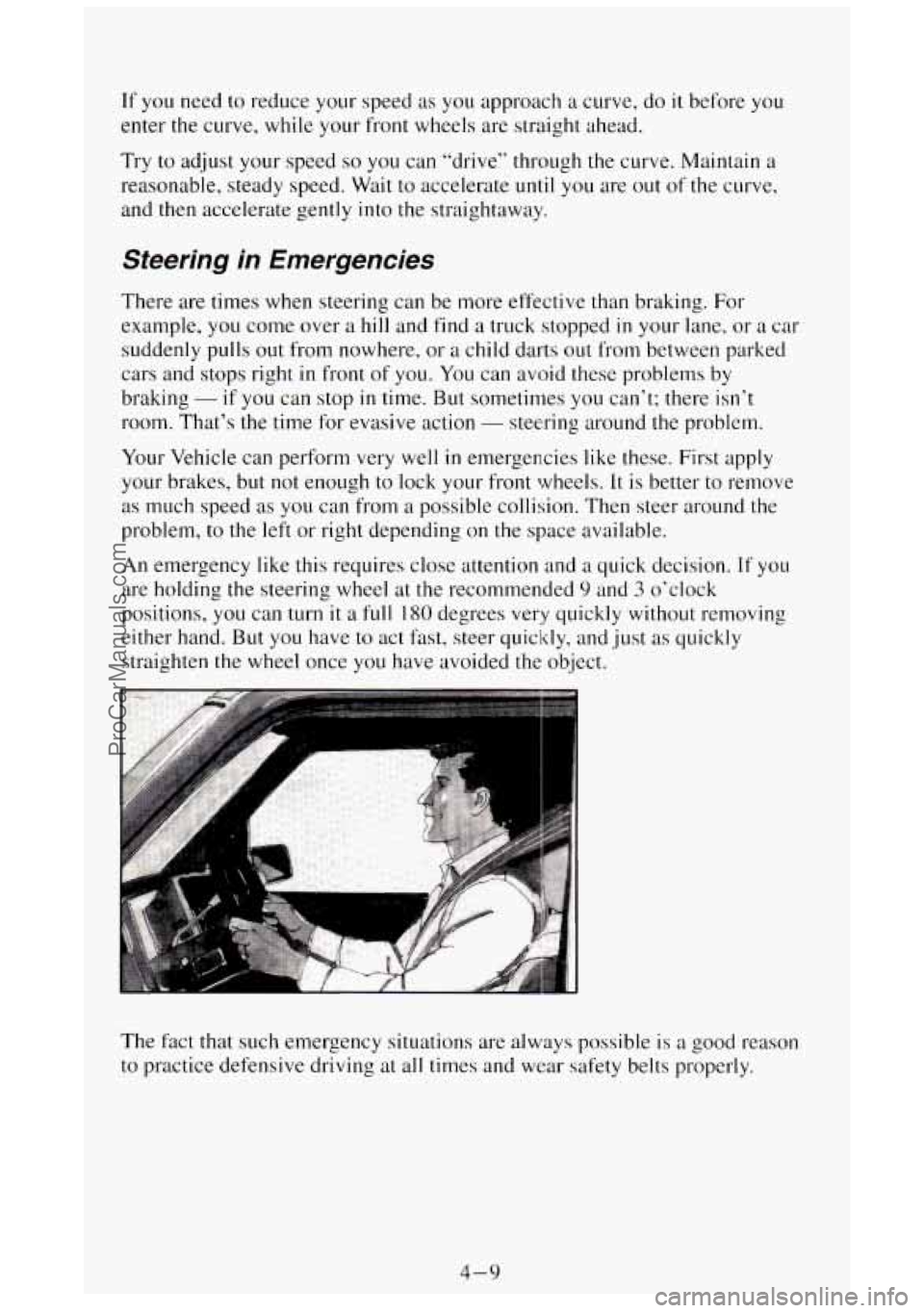
If you
are holding the steering wheel at the recommended
9 and 3 o’clock
positions,
you can turn it a full 180 degrees very quickly without removing
either hand. But you have to act fast, steer quicltly, and just
as quickly
straighten
the wheel once you have avoided the object.
p-:. : . .. , ... 1
The fact that such emergency situations are always
possible is a good reason
to practice defensive driving at all times and wear safety belts properly.
4-9
ProCarManuals.com
Page 176 of 404
Skidding
In a skid, a driver can lose control of the vehicle. Defensive drivers avoid
most skids by taking reasonable care suited to existing conditions, and by
not “overdriving” those conditions. But skids are always possible.
The three types of skids correspond to your Vehicle’s three control systems.
In the braking skid your wheels aren’t rolling. In the steering or cornering
skid, too much speed or steering in
a curve causes tires to slip and lose
cornering force. And
in the acceleration skid too much throttle causes the
driving wheels to spin.
A cornering skid and an acceleration skid are best handled by easing your
foot off the accelerator pedal.
If your vehicle starts
to slide, ease your foot off the accelerator pedal and
quickly steer the way
you want the vehicle to go. If you start steering
quickly enough, your vehicle may straighten out. Always be ready for
a
second skid if it occurs.
Of course, traction is reduced when water, snow, ice, gravel,
or other
material is
on the road. For safety, you’ll want to slow down and adjust your
driving to these conditions.
It is important to slow down on slippery
surfaces because stopping distance
will be longer and vehicle control more
limited.
While driving
on a surface with reduced traction, try your best to avoid
sudden steering, acceleration, or braking (including engine braking by
shifting
to a lower gear). Any sudden changes could cause the tires to slide.
You may not realize the surface is slippery until your vehicle is skidding.
Learn to recognize warning clues
- such as enough water, ice or packed
snow
on the road to make a “mirrored surface” - and slow down when you
have any doubt.
Remember: The rear-wheel anti-lock braking system (RWAL) helps avoid
only
a rear braking skid. In a braking skid (where the front wheels are no
longer rolling), release enough pressure
on the brakes to get the front wheels
rolling again. This restores steering control. Push the brake pedal down
steadily when you have
to stop suddenly. As long as the front wheels are
rolling, you
will have steering control.
4-12
ProCarManuals.com
Page 177 of 404
Driving Guidelines
Off-Road Driving with Your Four-wheel Drive Vehicle
This off-road guide is for vehicles that have four-wheel drive.
Also, see “Anti-lock Brakes”
in the Index.
If your vehicle doesn’t have four-wheel drive, you shouldn’t drive off-road
unless you’re on
a level, solid surface.
Off-road driving can be great
fun. But it does have some definite hazards.
The greatest of these is the terrain itself.
“Off-roading” means you’ve left the great North American road system
behind. Traffic lanes aren’t marked. Curves aren’t banked. There are
no
road signs. Surfaces can be slippery, rough, uphill or downhill. In short,
you’ve gone right back to nature.
Off-road driving involves some new skills. And that’s
why it’s very
important that you read this guide. You’ll find many driving tips and
suggestions. These will help make your off-road driving safer and more
enjoyable.
Before You Go Off-Roading
There are some things to do before you go out. For example, be sure to have
all necessary maintenance and service work done. Be sure you read
all the
information about your four-wheel drive vehicle
in this manual. Is there
enough fuel? Is the spare tire
fully inflated? Are the fluid levels up where
they should be? What are the local laws that apply
to off-roading where
you’ll
be driving’? If you don’t know, you should check with law
enforcement people
in the area. Will you be on someone’s private land‘? If
so, be sure to get the necessary permission.
Loading Your Vehicle for Off-Road Driving
There are some important things to remember about how to load your
vehicle.
0 The heaviest things should be on the load floor and forward of your
rear axle. Put heavier items as far forward as you can.
Be sure the load is secured properly, so driving on the off-road terrain
doesn’t toss things around.
4- 13
ProCarManuals.com