parking brake GMC SIERRA 1994 Owners Manual
[x] Cancel search | Manufacturer: GMC, Model Year: 1994, Model line: SIERRA, Model: GMC SIERRA 1994Pages: 404, PDF Size: 20.91 MB
Page 11 of 404
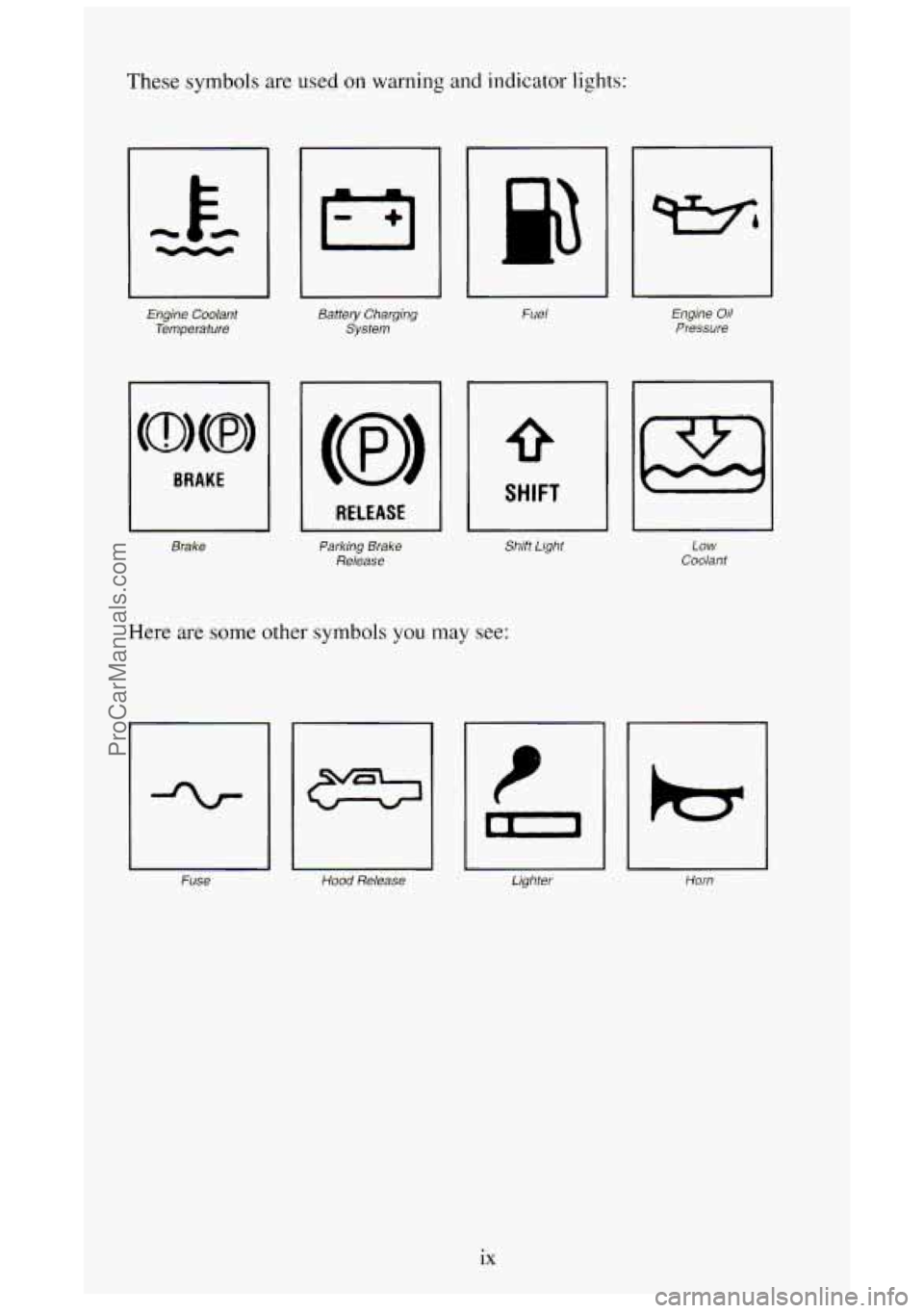
These symbols are used on warning and indicator lights:
Engine Coolant
Temperature Battery Charging
System
I I RELEASE I
Brake Parking Brake
Release
0
SHIFT
Shift Light
Here are some other symbols you may see:
Fuse
Fuel
Hood Release Lighter
I
Engine Oil
Pressure
Low Coolant
I Horn
ix
ProCarManuals.com
Page 59 of 404
Features and Controls
Section
.
Here you can learn about the many standard and optional features on your
vehicle. and information
on starting. shifting and braking . Also explained
are
the instrument panel and the warning systems that tell you if everything
is working properly- and what to do if you have a problem .
For explanation of vehicle symbols. refer to “Vehicle Symbols” in the
Introduction
.
Keys ..................................................... 2-3
DoorLocks
................................................ 2-5
Your Doors and How They Work .............................. 2-7
Tailgate
................................................... 2-8
Theft
............................................. ...... 2-9
New Vehicle “Break-In’’ .................................... 2-10
Ignitionswitch
............................................ 2-11
Starting Your Gasoline Engine
............................... 2-12
Starting Your Diesel Engine
................................. 2-16
Automatic Transmission
.................................... 2-21
Five-Speed Manual Transmission (With
Low Gear) ............ 2-24
Five-Speed Manual Transmission (Without Low Gear)
............ 2-25
LockingRearAxle
......................................... 2-28
ParkingBrake
............................................ 2-28
Parking Over Things That Burn
............................... 2-32
2-1
ProCarManuals.com
Page 68 of 404
Parking Lots
If you park in a lot where someone will be watching your vehicle, it’s best
to lock it up and take your keys. But what
if you have to leave your ignition
key? What if you have to leave something valuable
in your vehicle?
0 Put your valuables in a storage area or console.
0 Lock the console.
Lock all the doors except the driver’s.
0 Then take the door key with you.
New Vehide “Break-In”
NOTICE:
Your modern vehicle doesn’t need an elaborate “break-in.” But
it will perform better in the long run if you follow these
guidelines:
Keep your speed at 55 mph (88 km/h) or less for the first
500 miles- (804 km).
Don’t drive at any one speed - fast or slow - for the first
500 miles (804 km). Don’t make full-throttle starts.
0 Avoid making hard stops for the first 200 miles (322 km) or
so. During this time your new brake linings aren’t yet broken
in. Hard stops with new linings can mean premature wear and
earlier replacement. Follow
this “breaking-in” guideline
every time you get new brake linings.
New Vehicle “Break-In” - 3500 HD Model
If you have a 3500 HD model, your parking brake requires a special
break-in procedure. See “Parking Brake” in the Index.
ProCarManuals.com
Page 83 of 404
NOTICE:
Shift to “R” (Reverse) only after your vehicle is stopped.
Shifting
to “R” (Reverse) while your vehicle is moving could
damage your transmission.
Also, use Reverse, along with the parking brake, when turning off your
engine and parking your vehicle.
Five-Speed Manual Transmission
(Without
Low Gear)
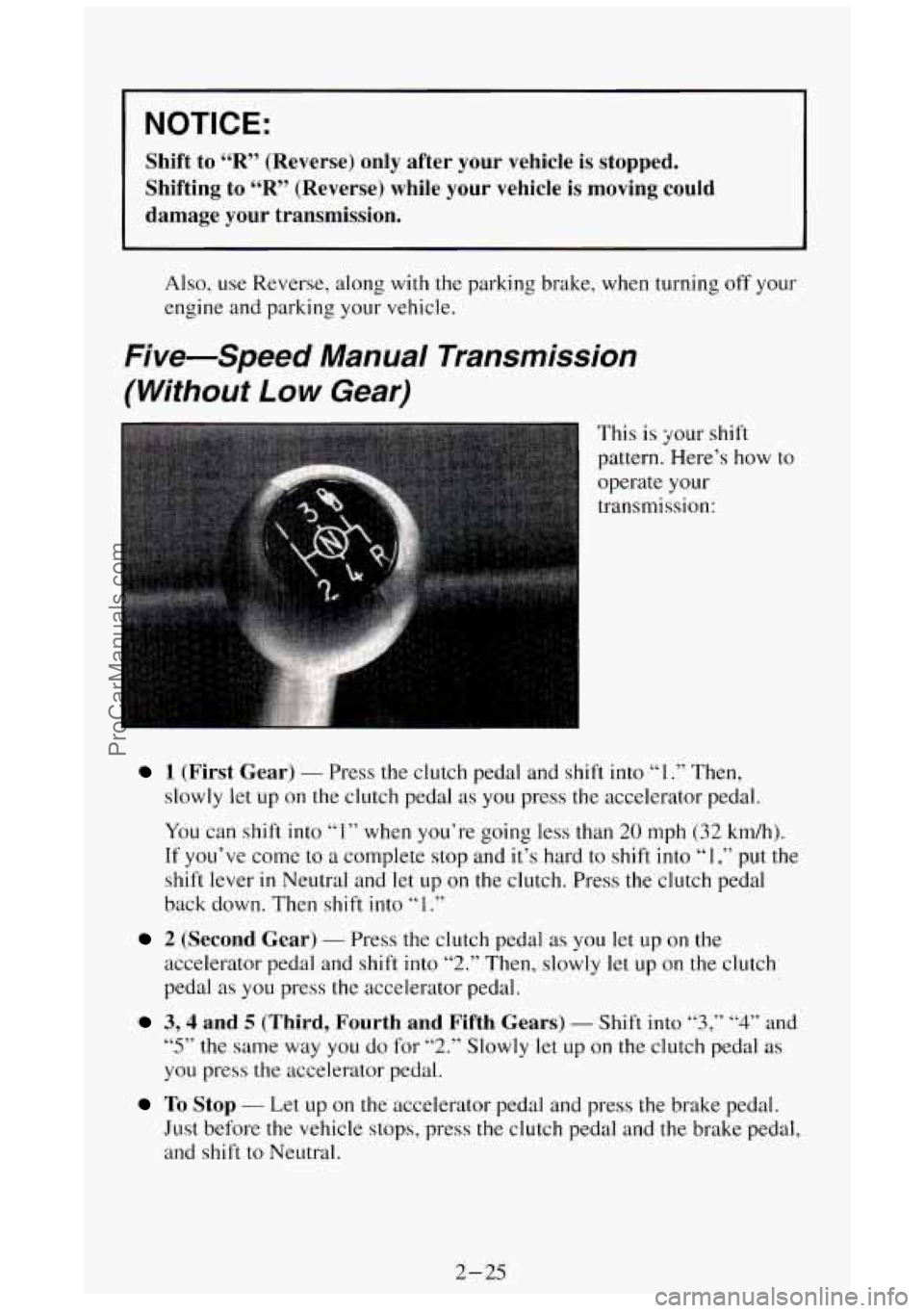
This is your shift
pattern. Here’s how to
operate your
transmission:
1 (First Gear) - Press the clutch pedal and shift into “1 .” Then,
slowly
let up on the clutch pedal as you press the accelerator pedal.
You can shift into
“1” when you’re going less than 20 mph (32 km/h).
If you’ve come to a complete stop and it’s hard to shift into L‘ 1 ,” put the
shift lever
in Neutral and let up on the clutch. Press the clutch pedal
back down. Then shift
into LLl.”
2 (Second Gear) - Press the clutch pedal as you let up on the
accelerator pedal and shift
into “2.” Then, slowly let up on the clutch
pedal as
you press the accelerator pedal.
3,4 and 5 (Third, Fourth and Fifth Gears) - Shift into “3,” “4” and
“5” the same way you do for “2.” Slowly let up on the clutch pedal as
you press the accelerator pedal.
To Stop - Let up on the accelerator pedal and press the brake pedal.
Just before the vehicle stops, press
the clutch pedal and the brake pedal,
and shift to Neutral.
2-25
ProCarManuals.com
Page 84 of 404
R (Reverse) - To back up, first press down the clutch pedal. Wait
3-5 seconds for the internal parts to stop spinning and then, shift into
“R.” Let up on the clutch pedal slowly while pressing the accelerator
pedal.
NOTICE:
Shift to “R” (Reverse) only after your vehicle is stopped.
Shifting to
LLR” (Reverse) while your vehicle is moving could
damage your transmission.
Also, use Reverse, along with the parking brake, when turning off your
engine and parking your vehicle.
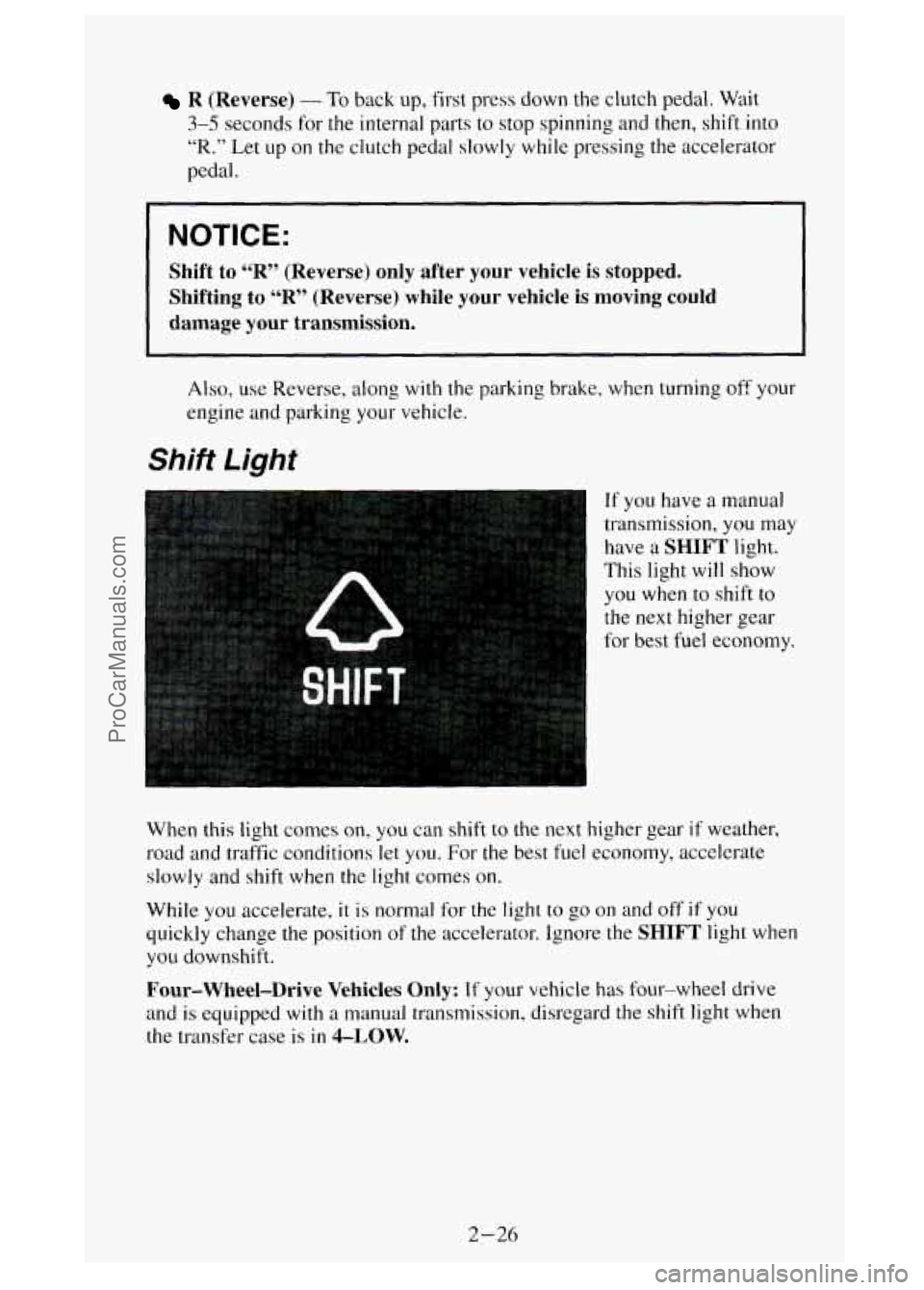
Shift Light
If you have a manual
transmission,
you may
have
a SHIFT light.
This light will show
you when
to shift to
the next higher gear
l for best fuel economy.
I
When this light comes on, you can shift to the next higher gear if weather,
road and traffic conditions let you. For
the best fuel economy, accelerate
slowly and shift when the light comes on.
While you accelerate, it
is normal for the light to go on and off if you
quickly change the position
of the accelerator. Ignore the SHIFT light when
you downshift.
Four-Wheel-Drive Vehicles Only: If your vehicle has four-wheel drive
and is equipped with
a manual transmission, disregard the shift light when
the transfer case is in 4-LOW.
2-26
ProCarManuals.com
Page 86 of 404
Locking Rear Axle
If you have this feature, your rear axle can give you additional traction on
snow, mud, ice, sand or gravel. It works like a standard axle most of the
time, but when one
of the rear wheels has no traction and the other does, the
locking feature will allow the wheel with traction to move the vehicle.
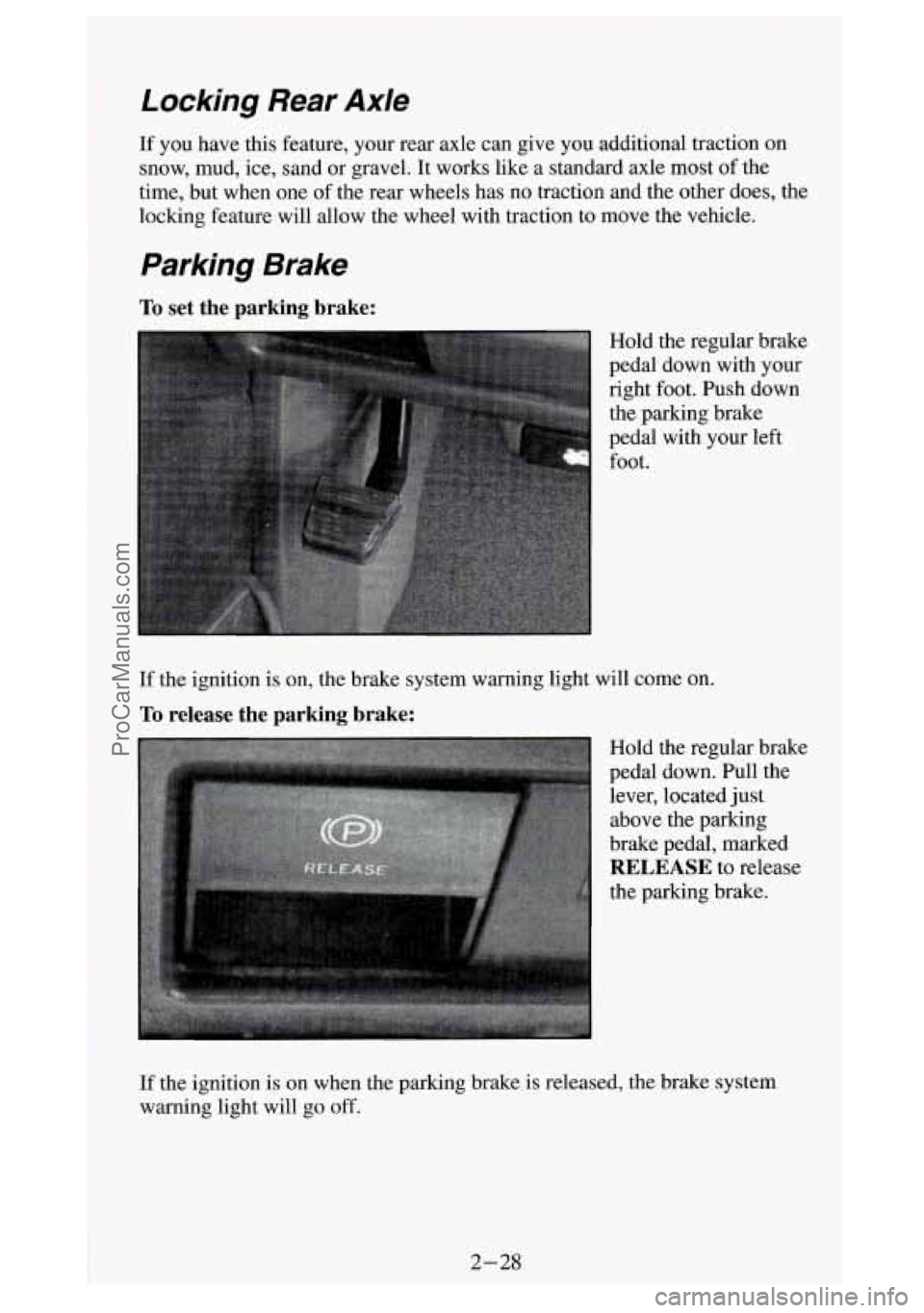
To set the parking brake:
Hold the regular brake
pedal down with your
right foot. Push down the parking brake
pedal with your left
foot.
If the ignition is on, the brake system warning light will come on.
To release the parking brake:
Hold the regular brake
pedal down. Pull the lever, located just
above the parking
brake pedal, marked
RELEASE to release
the parking brake.
-
If the ignition is on when the parking brake is released, the brake system
warning light will
go off.
ProCarManuals.com
Page 87 of 404
NOTICE:
Driving with the parking brake on can cause your rear brakes to
overheat. You may have
to replace them, and you could also
damage other parts of your vehicle.
If you are towing a trailer and are parking on any hill: See “Towing a
Trailer” in the Index. That section shows what to do first to keep the trailer
from moving.
Propshaft Brake Burnish Procedure
If you have a 3500 HD model, it is recommended that the propshaft
mounted parking brake be burnished
as part of the new vehicle break in.
The parking brake will work best after it has been burnished following these
instructions.
Make
10 (ten) stops, using the parking brake foot pedal, from 20 mph
(32 kdh) about
2 1/2 miles (4 km) apart. In between stops, drive the
vehicle at
20 mph (32 km/h).
Torque Lock
The parking brake should be set first whenever you leave the driver’s seat.
If you are parked on
a hill and the transmission is placed in “P” (Park)
before
the parking brake is set, the weight of the vehicle may put too much
force
on the parking pawl in the transmission. It may be difficult to pull the
selector lever out
of “P’ (Park). This is called “torque lock.” To prevent this,
the parking brake should be set
BEFORE moving the gear selector to “P’
(Park).
When preparing to move
a vehicle parked on a hill, the selector lever should
be moved out of
“P’ (Park) BEFORE releasing the parking brake. Even
when
on level surfaces, its a good idea to set the parking brake first before
shifting
the transmission from “P” (Park).
If torque lock does occur, you may have to have another vehicle nudge your
vehicle uphill a little to take some
of the pressure off the transmission while
you pull the selector lever out of “P” (Park).
2-29
ProCarManuals.com
Page 88 of 404
Shifting Into “P” (Park) (Automatic
Transmission Models Only)
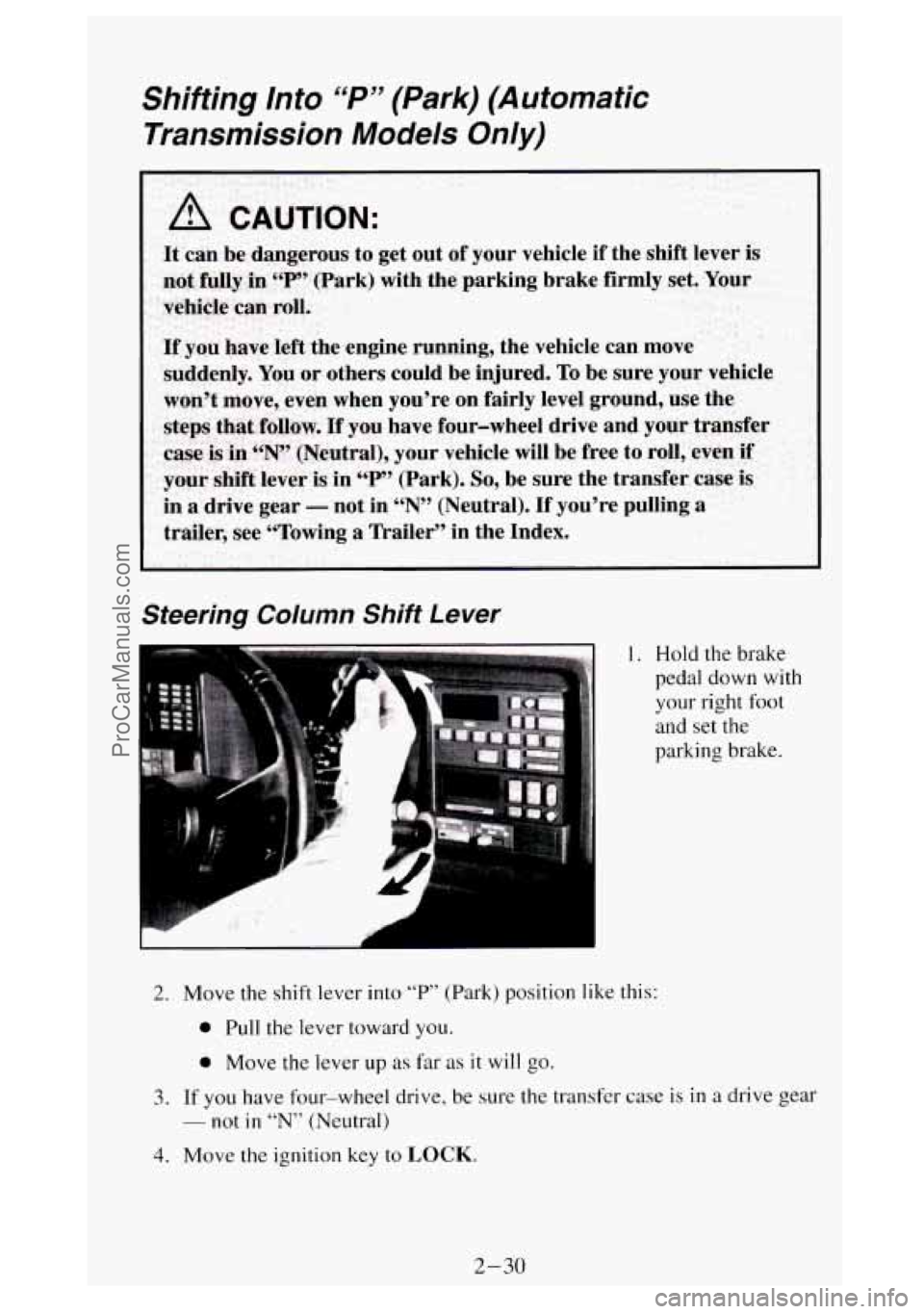
Steering Column Shift Lever
1. Hold the brake
pedal down
with
your right foot
and set the
parking brake.
2. Move the shift lever into “P” (Park) position like this:
0 Pull the lever toward you.
0 Move the lever up as far as it will go.
3. If you have four-wheel drive, be sure the transfer case is in a drive gear
- not in “N” (Neutral)
4. Move the ignition key to LOCK.
2-30
ProCarManuals.com
Page 89 of 404
5. Remove the key and take it with you. If you can walk away from your
vehicle with
the ignition key in your hand, your vehicle is in “P”
(Park).
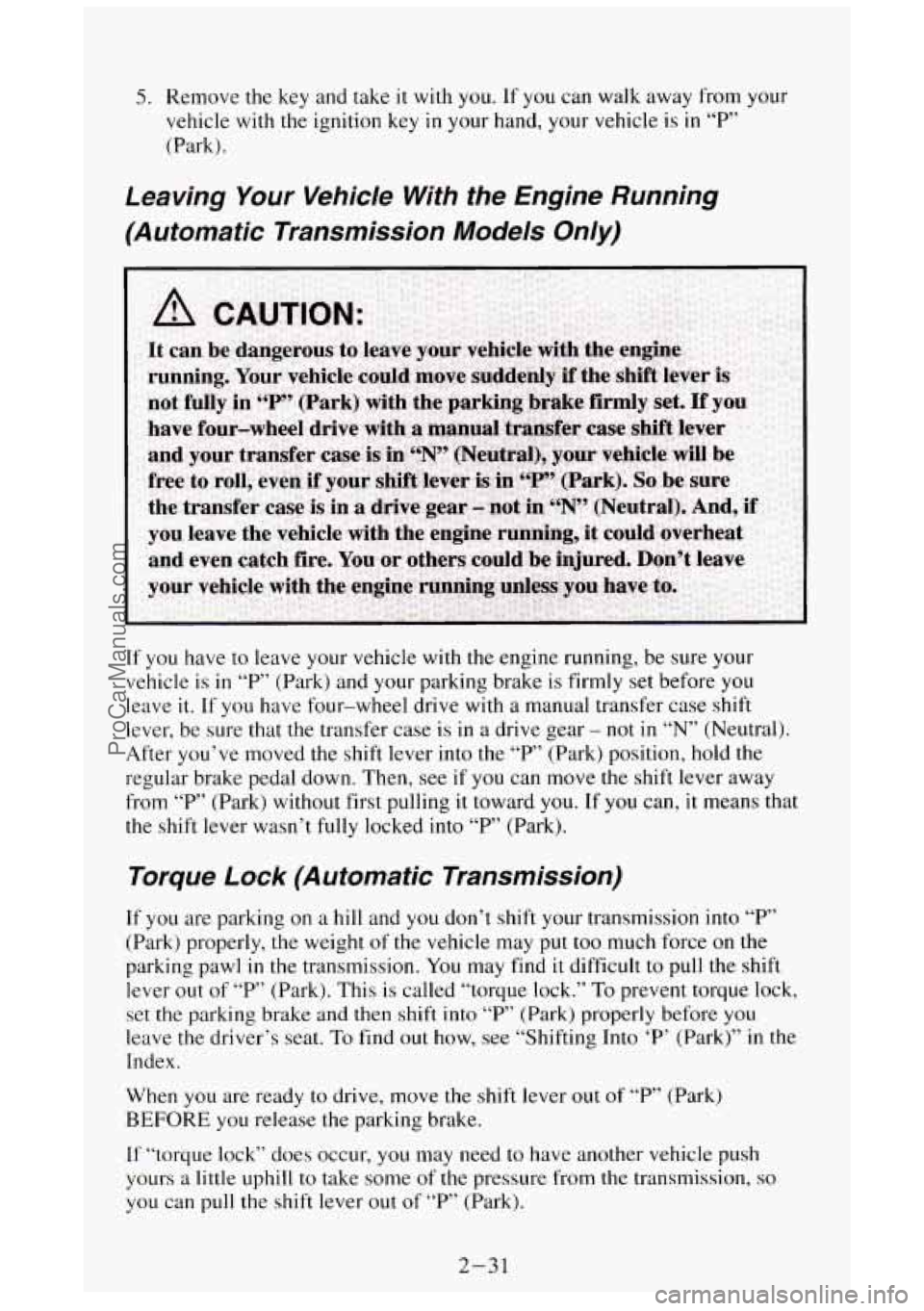
Leaving Your Vehic/e With the Engine Running
(Automatic Transmission Models Only)
If you have to leave your vehicle with the engine running, be sure your
vehicle is
in “P” (Park) and your parking brake is firmly set before you
leave it. If you have four-wheel drive with a manual transfer case shift
lever, be sure that the transfer case
is in a drive gear - not in “N” (Neutral).
After you’ve moved the
shift lever into the “P’ (Park) position, hold the
regular brake pedal down. Then, see if
you can move the shift lever away
from “P” (Park) without first pulling it toward
you. If you can, it means that
the shift lever wasn’t
fully locked into “P” (Park).
Torque Lock (Automatic Transmission)
If you are parking on a hill and you don’t shift your transmission into “P”
(Park) properly,
the weight of the vehicle may put too much force on the
parking pawl
in the transmission. You may find it difficult to pull the shift
lever out of
“P’ (Park). This is called “torque lock.” To prevent torque lock,
set the parking brake and then shift into “P’ (Park) properly before you
leave
the driver’s seat. To find out how, see “Shifting Into ‘P’ (Park)” in the
Index.
When you are ready to drive, move the
shift lever out of “P” (Park)
BEFORE you release the parking brake.
If “torque
lock” does occur, you may need to have another vehicle push
yours
a little uphill to take some of the pressure from the transmission, so
you can pull the shift lever out of “P’ (Park).
2-31
ProCarManuals.com
Page 90 of 404
Parking Your Vehicle
(Manual Transmission Models
Only)
Before you get out of your vehicle, put your manual transmission in “R”
(Reverse), turn off the engine, and firmly apply the parking brake.
If you have four-wheel drive, be sure your transfer case is in a drive gear.
Your vehicle could roll
if it isn’t.
If
you are parking on a hill, or if your pulling a trailer, see “Parking on
Hills” or “Towing a Trailer” in the Index.
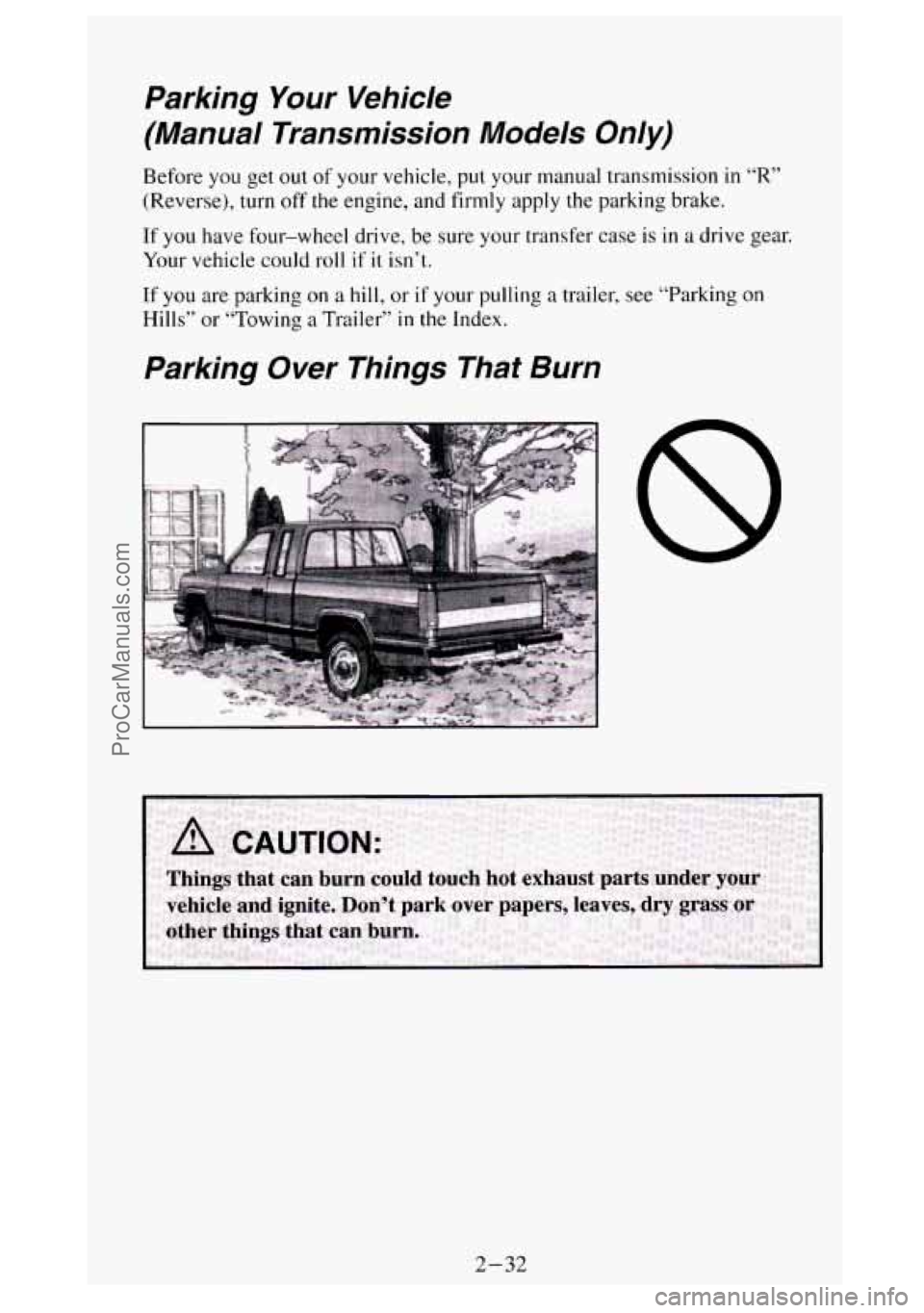
Parking Over Things That Burn
2-32
ProCarManuals.com