transmission GMC SIERRA 1994 Owners Manual
[x] Cancel search | Manufacturer: GMC, Model Year: 1994, Model line: SIERRA, Model: GMC SIERRA 1994Pages: 404, PDF Size: 20.91 MB
Page 59 of 404
Features and Controls
Section
.
Here you can learn about the many standard and optional features on your
vehicle. and information
on starting. shifting and braking . Also explained
are
the instrument panel and the warning systems that tell you if everything
is working properly- and what to do if you have a problem .
For explanation of vehicle symbols. refer to “Vehicle Symbols” in the
Introduction
.
Keys ..................................................... 2-3
DoorLocks
................................................ 2-5
Your Doors and How They Work .............................. 2-7
Tailgate
................................................... 2-8
Theft
............................................. ...... 2-9
New Vehicle “Break-In’’ .................................... 2-10
Ignitionswitch
............................................ 2-11
Starting Your Gasoline Engine
............................... 2-12
Starting Your Diesel Engine
................................. 2-16
Automatic Transmission
.................................... 2-21
Five-Speed Manual Transmission (With
Low Gear) ............ 2-24
Five-Speed Manual Transmission (Without Low Gear)
............ 2-25
LockingRearAxle
......................................... 2-28
ParkingBrake
............................................ 2-28
Parking Over Things That Burn
............................... 2-32
2-1
ProCarManuals.com
Page 67 of 404
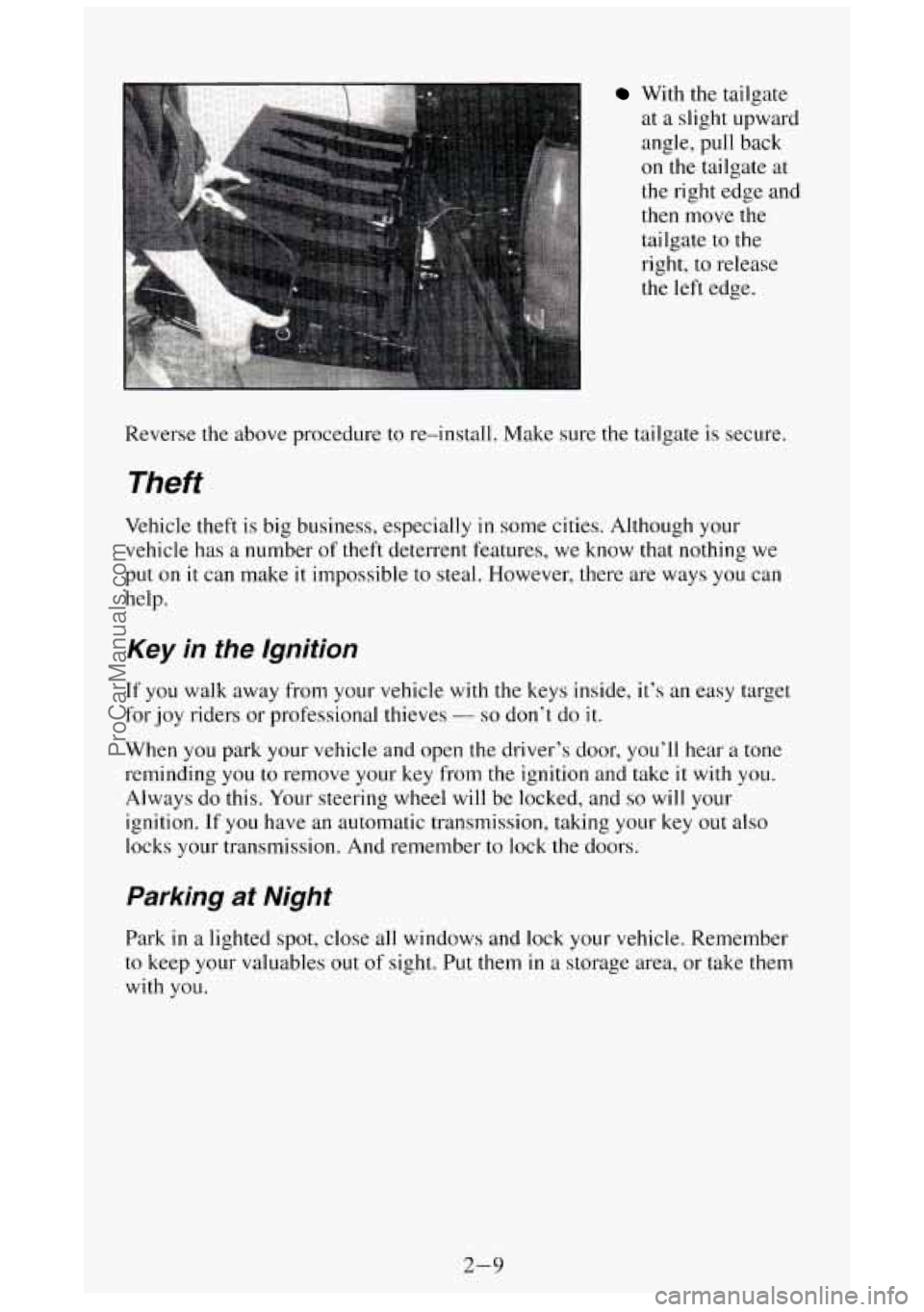
With the tailgate at a slight upward
angle, pull back
on the tailgate at
the right edge and
then move the
tailgate to the
right,
to release
the
left edge.
Reverse the above procedure to re-install. Make sure the tailgate is secure.
Theft
Vehicle theft is big business, especially in some cities. Although your
vehicle has a number of
theft deterrent features, we know that nothing we
put on it can make
it impossible to steal. However, there are ways you can
help.
Key in the Ignition
If you walk away from your vehicle with the keys inside, it’s an easy target
for joy riders or professional thieves
- so don’t do it.
When you park your vehicle and open the driver’s door, you’ll hear a tone
reminding
you to remove your key from the ignition and take it with you.
Always
do this. Your steering wheel will be locked, and so will your
ignition. If you have an automatic transmission, taking your
key out also
locks your transmission. And remember to lock the doors.
Parking at Night
Park in a lighted spot, close all windows and lock your vehicle. Remember
to keep your valuables out of sight. Put them in a storage area, or take them
with you.
2-9
ProCarManuals.com
Page 69 of 404
Ignition Switch
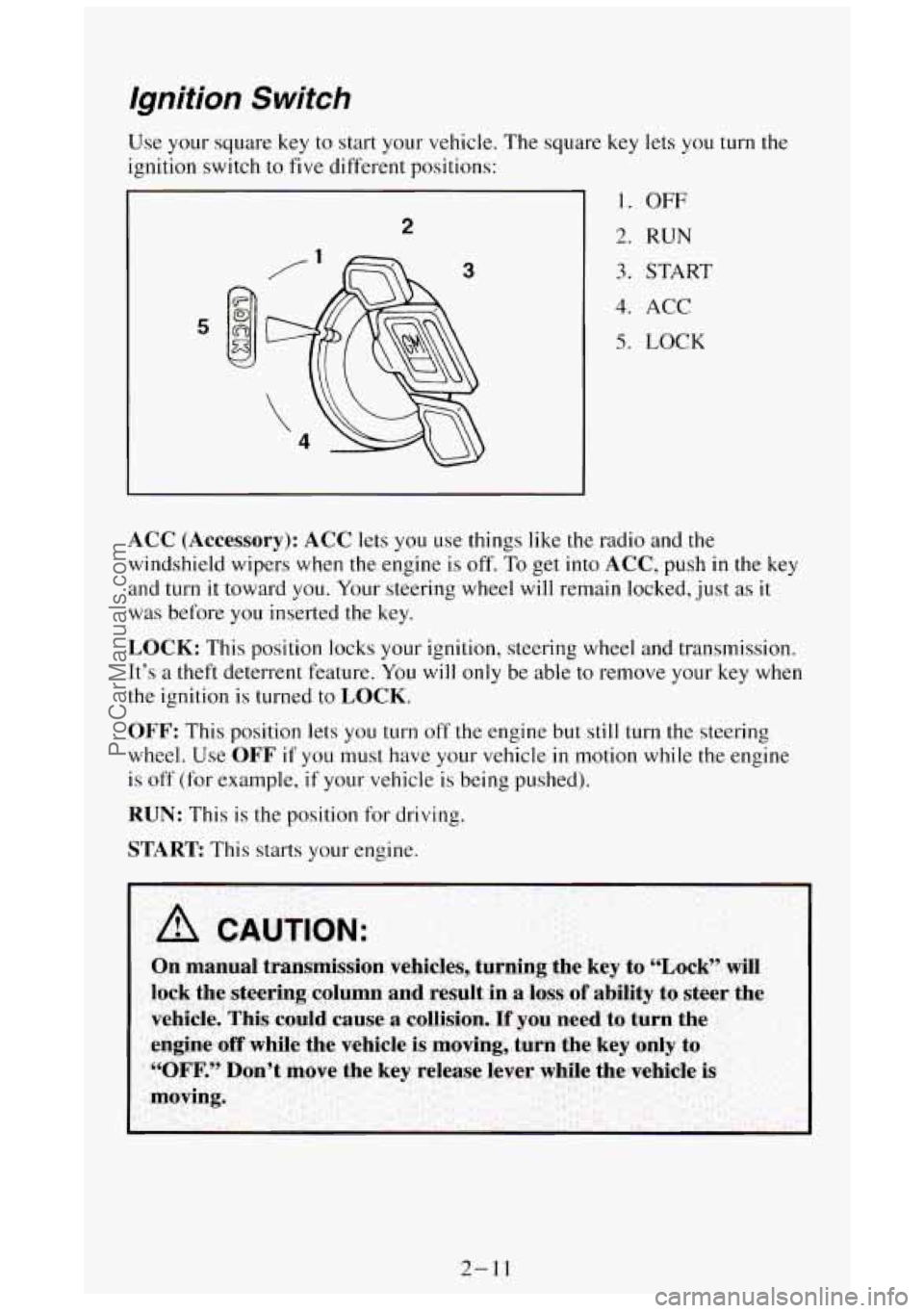
Use your square key to start your vehicle. The square key lets you turn the
ignition switch to
five different positions:
I 2
5
Q
3
1. OFF
2. RUN
3. START
4. ACC
5. LOCK
ACC (Accessory): ACC lets you use things like the radio and the
windshield wipers when the engine
is off. To get into ACC, push in the key
and turn
it toward you. Your steering wheel will remain locked, just as it
was before you inserted the key.
LOCK: This position locks your ignition, steering wheel and transmission.
It's
a theft deterrent feature. You will only be able to remove your key when
the ignition is turned to
LOCK.
OFF: This position lets you turn off the engine but still turn the steering
wheel. Use
OFF if you must have your vehicle in motion while the engine
is
off (for example, if your vehicle is being pushed).
RUN: This is the position for driving.
START This starts your engine.
2-11
ProCarManuals.com
Page 70 of 404
NOTICE:
If your key seems stuck in “Lock” and you can’t turn it, be sure
it is all the
way in. If it is, then turn the steering wheel left and
right while you turn the key
hard. But turn the key only with
your hand. Using a tool to force it could break the key or the
ignition switch.
If none of this works, then your vehicle needs
service.
Key Release Lever
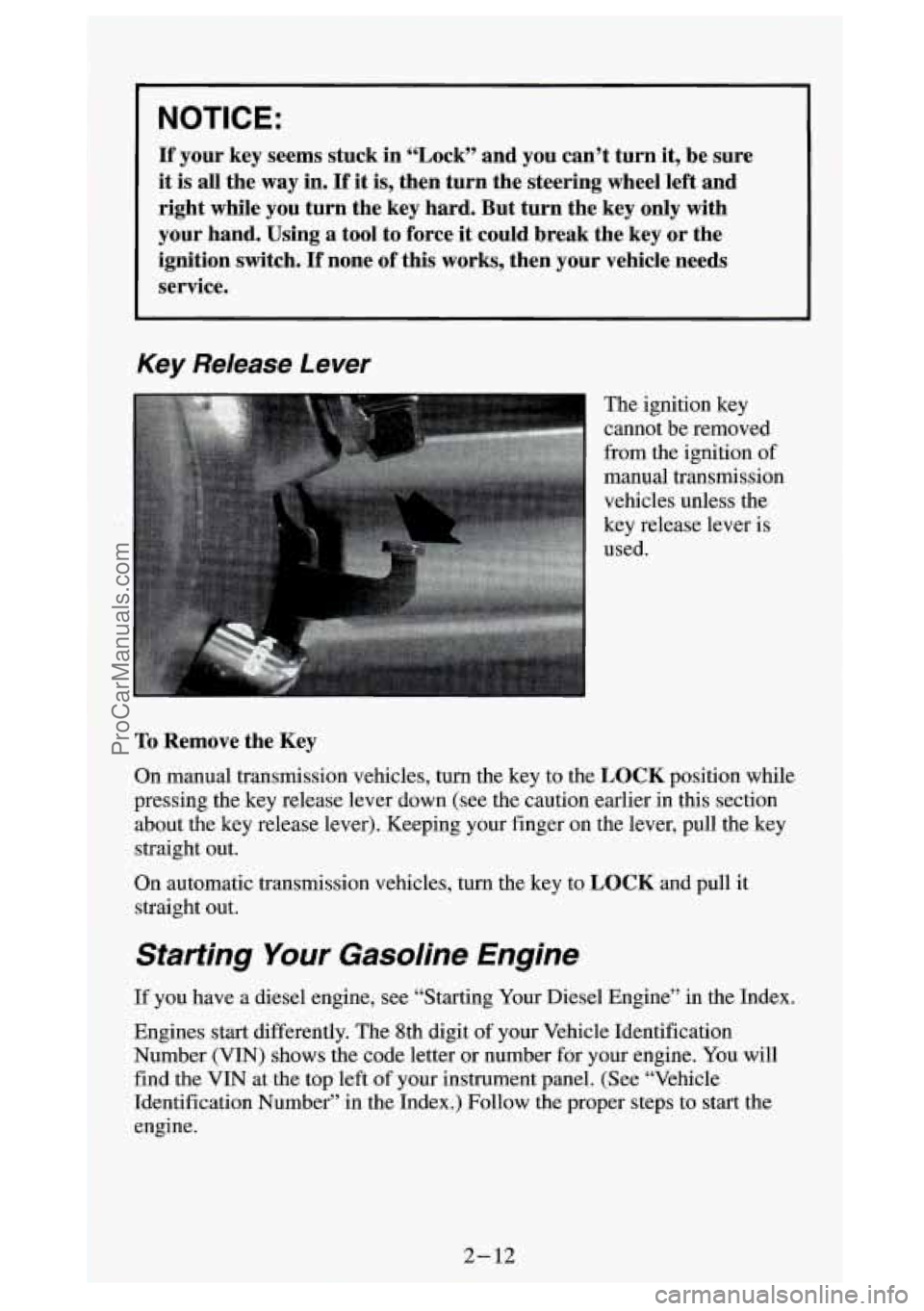
The ignition key
cannot be removed
from the ignition of
manual transmission
vehicles unless the
key release lever is
used.
To Remove the Key
On manual transmission vehicles, turn the key to the LOCK position while
pressing the key release lever down (see the caution earlier \
in
this section
about the key release lever). Keeping your finger on the leve\
r, pull the key
straight out.
On automatic transmission vehicles, turn the key to
LOCK and pull it
straight out.
Starting Your Gasoline Engine
If you have a diesel engine, see “Starting Your Diesel Engine” in the Index.
Engines start differently. The 8th digit of your Vehicle Identification
Number (VIN) shows the code letter or number for your engine. You will
find the VIN at the top left of your instrument panel. (See “Vehicle
Identification Number” in the Index.) Follow the proper step\
s to start the
engine.
2-12
-.. ProCarManuals.com
Page 71 of 404
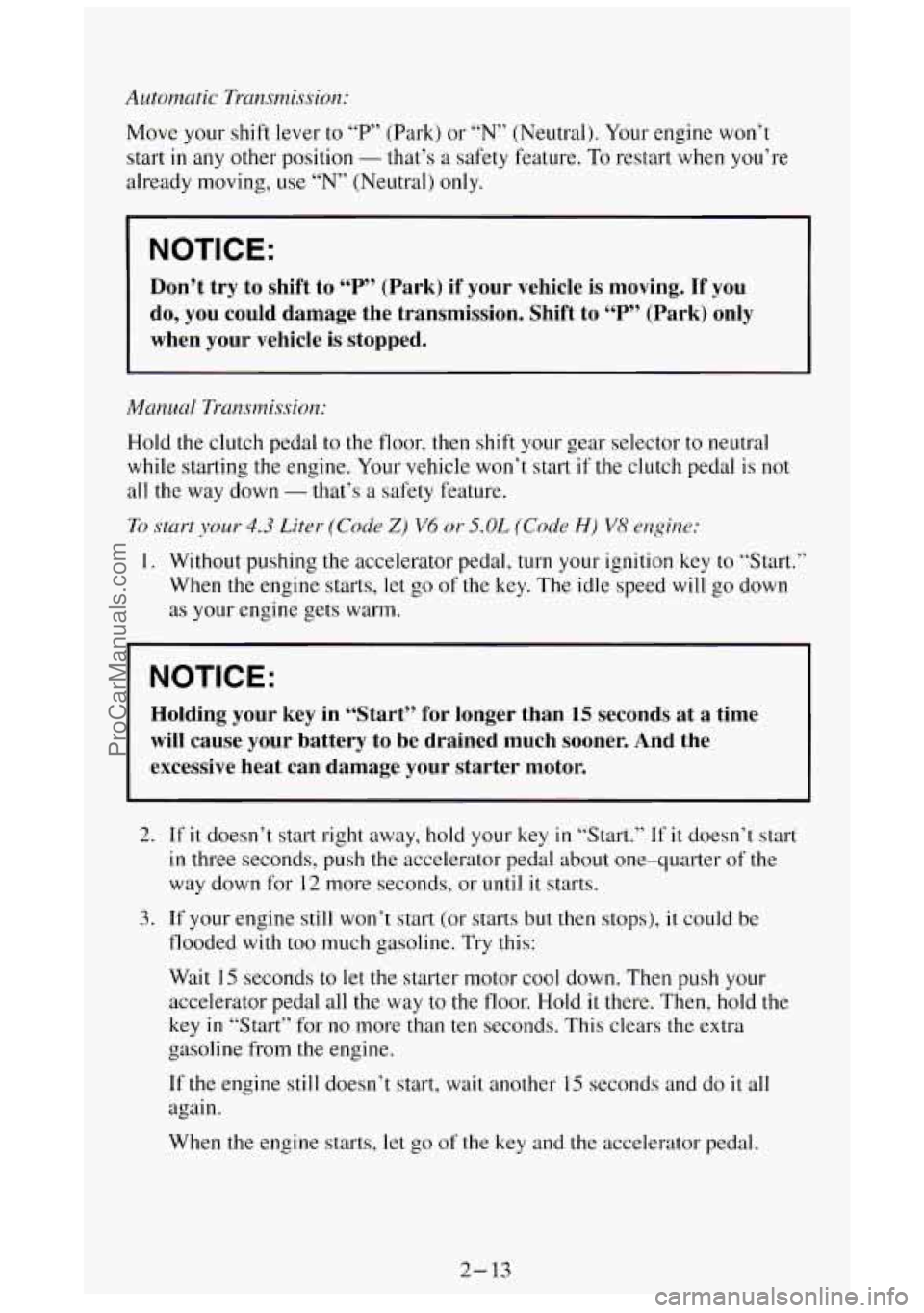
Automatic Transmission:
Move your shift lever to “P’ (Park) or “N” (Neutral). Your engine won’t
start
in any other position - that’s a safety feature. To restart when you’re
already moving, use
“N” (Neutral) only.
NOTICE:
Don’t try to shift to “P” (Park) if your vehicle is moving. If you
do, you could damage the transmission. Shift to “P” (Park) only
when your vehicle
is stopped.
Hold the clutch pedal to the tloor, then shift your gear selector to neutral
while starting
the engine. Your vehicle won’t start if the clutch pedal is not
all the way down
- that’s a safety feature.
To start your 4.3 Liter (Code 2) V6 or 5.0L (Code H) V8 engine:
1. Without pushing the accelerator pedal, turn your ignition key to “Start.”
When
the engine starts, let go of the key. The idle speed will go down
as your engine gets warm.
NOTICE:
Holding your key in “Start” for longer than 15 seconds at a time
will cause your battery to be drained much sooner. And the excessive heat can damage your starter motor.
2. If it doesn’t start right away, hold your key in “Start.” If it doesn’t start
in three seconds, push the accelerator pedal about one-quarter of the
way down for
12 more seconds, or until it starts.
3. If your engine still won’t start (or starts but then stops), it could be
flooded
with too much gasoline. Try this:
Wait
15 seconds to let the starter motor cool down. Then push your
accelerator pedal all the way to
the tloor. Hold it there. Then, hold the
key in “Start” for no more than ten seconds. This clears the extra
gasoline from the engine.
If
the engine still doesn’t start, wait another 15 seconds and do it all
again.
When
the engine starts, let go of the key and the accelerator pedal.
2- 13
ProCarManuals.com
Page 74 of 404
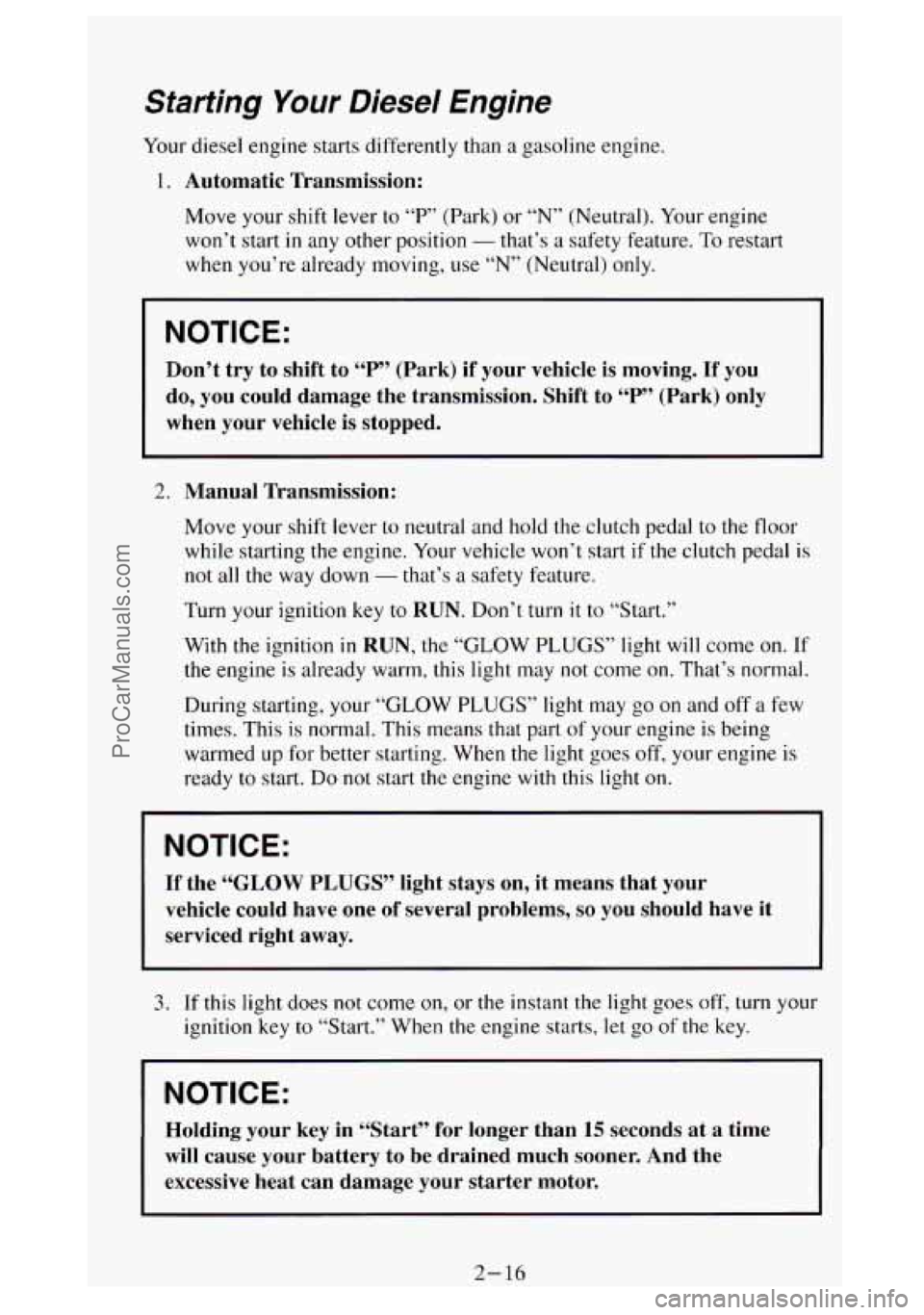
Starting Your Diesel Englne
Your diesel engine starts differently than a gasoline engine.
1. Automatic Transmission:
Move your shift lever to “P” (Park) or “N” (Neutral). Your engine
won’t start in any other position
- that’s a safety feature. To restart
when you’re already moving, use “N” (Neutral) only.
NOTICE:
Don’t try to shift to “P” (Park) if your vehicle is moving. If you
do, you could damage the transmission. Shift to
“P” (Park) only
when your vehicle is stopped.
2. Manual Transmission:
Move your shift lever to neutral and hold the clutch pedal to the floor
while starting the engine. Your vehicle won’t start if the clutch pedal is
not
all the way down - that’s a safety feature.
Turn your ignition key to
RUN. Don’t turn it to “Start.”
With
the ignition in RUN, the “GLOW PLUGS” light will come on. If
the engine is already warm, this light may not come on. That’s normal.
During starting, your “GLOW PLUGS” light may
go on and off a few
times. This is normal. This means that part
of your engine is being
warmed
up for better starting. When the light goes off, your engine is
ready to start. Do not start the engine with this light on.
NOTICE:
If the “GLOW PLUGS” light stays on, it means that your
vehicle could have one
of several problems, so you should have it
serviced right
away.
3. If this light does not come on, or the instant the light goes off, turn your
ignition key to “Start.” When the engine starts,
let go of the key.
NOTICE:
Holding your key in “Start” for longer than 15 seconds at a time
will cause your battery to be drained much sooner. And the
excessive heat can damage your starter motor.
2-16
ProCarManuals.com
Page 79 of 404
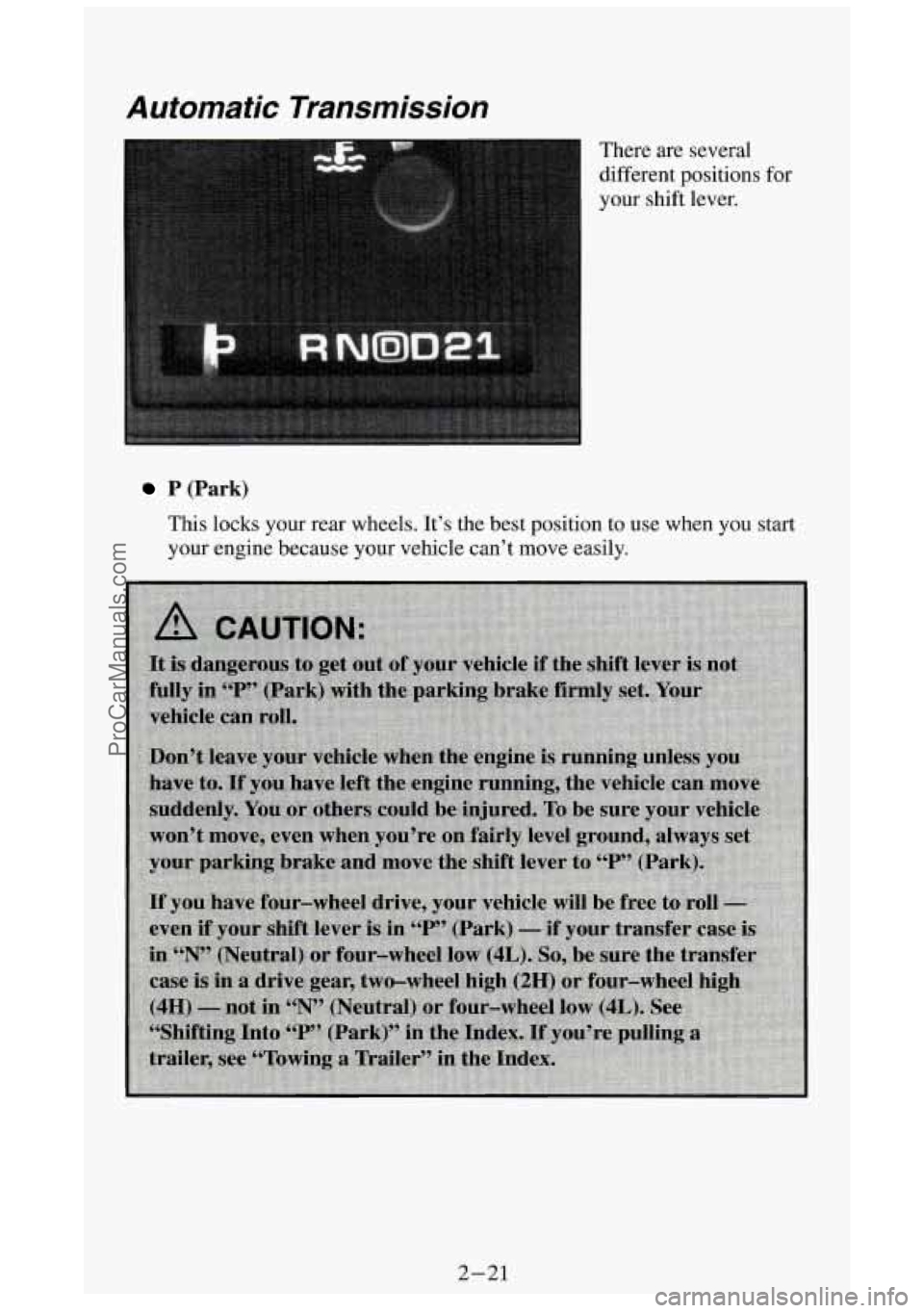
Automatic Transmission
There are several
different positions for
your shift lever.
P (Park)
This locks your rear wheels. It’s the best position to use when you start
your engine because your vehicle can’t move easily.
2-21
ProCarManuals.com
Page 80 of 404
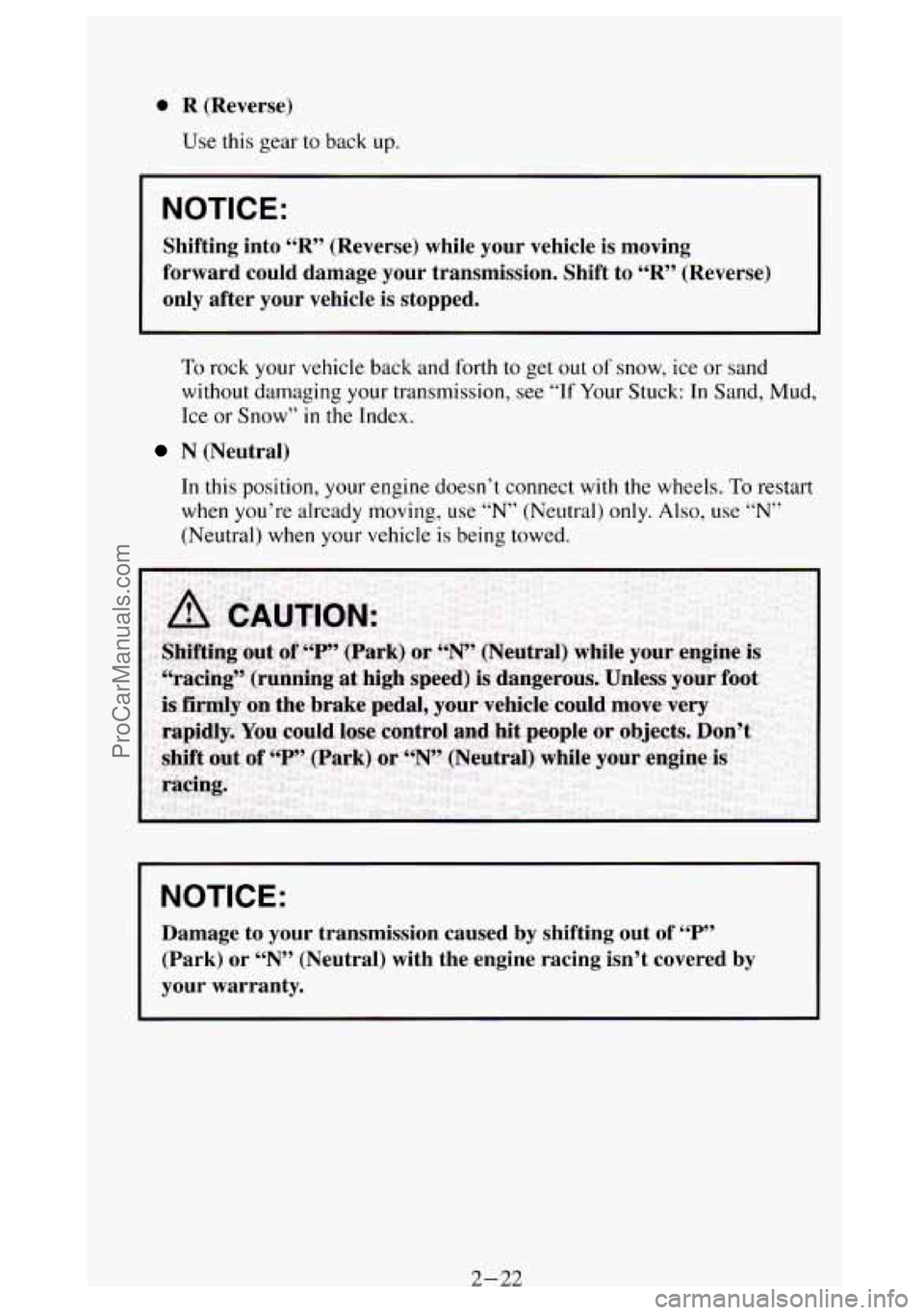
0 R (Reverse)
Use this gear to back up.
NOTICE:
Shifting into “R” (Reverse) while your vehicle is moving
forward could damage your transmission. Shift to
“R” (Reverse)
only after your vehicle is stopped.
To rock your vehicle back and forth to get out of snow, ice or sand
without damaging your transmission, see
“If Your Stuck: In Sand, Mud,
Ice or Snow”
in the Index.
N (Neutral)
In this position, your engine doesn’t connect with the wheels. To restart
when you’re already
moving, use “N” (Neutral) only. Also, use “N”
(Neutral) when your vehicle is being towed.
NOTICE:
Damage to your transmission caused by shifting out of “P”
(Park) or “N” (Neutral) with the engine racing isn’t covered by
your warranty.
2-22
ProCarManuals.com
Page 81 of 404
@ (Automatic Overdrive)
This position is for normal driving. If you need more power for
passing, and you’re:
- Going less than about 35 mph (56 km/h), push your accelerator
pedal about halfway down.
- Going about 35 mph (56 kdh) or more, push the accelerator all
the way down.
You’ll shift down to the next gear and have more power.
@ should not be used when towing a trailer, carrying a heavy load,
driving
on steep hills, or for off road driving. Select “D”(third gear)
when operating the vehicle under any
of these conditions.
D (Third Gear)
This is like @, but you never go into Overdrive. You should use “D”
when towing a trailer, carrying a heavy load, driving on steep hills, or
for off-road driving.
2 (Second Gear)
This position gives you more power but lower fuel economy. You can
use
“2” on hills. It can help control your speed as you go down steep
mountain roads, but then you would
also want to use your brakes off
and
on. If you manually select “2”, the transmission will drive in
second gear. You may use this feature for reducing torque to the rear
wheels when
you are trying to start your vehicle from a stop on
slippery road surfaces.
1 (First Gear)
This position gives you even more power (but lower fuel economy)
than
“2.” You can use it on very steep hills, or in deep snow or mud. If
the selector lever is put in “1 ,” the transmission won’t shift into first
gear
until the vehicle is going slowly enough.
b
NOTICE:
If your rear wheels can’t rotate, don’t try to drive. This might
happen if you were stuck in very deep sand or mud or were up
against
a solid object. You could damage your transmission.
Also,
if you stop when going uphill, don’t hold your vehicle there
with only the accelerator pedal. This could overheat and damage
the transmission. Use your brakes
or shift into “P” (Park) to
hold your vehicle in position on a hill.
2-23
ProCarManuals.com
Page 82 of 404
I
Five-Speed Manual Transmission
(With Low Gear)
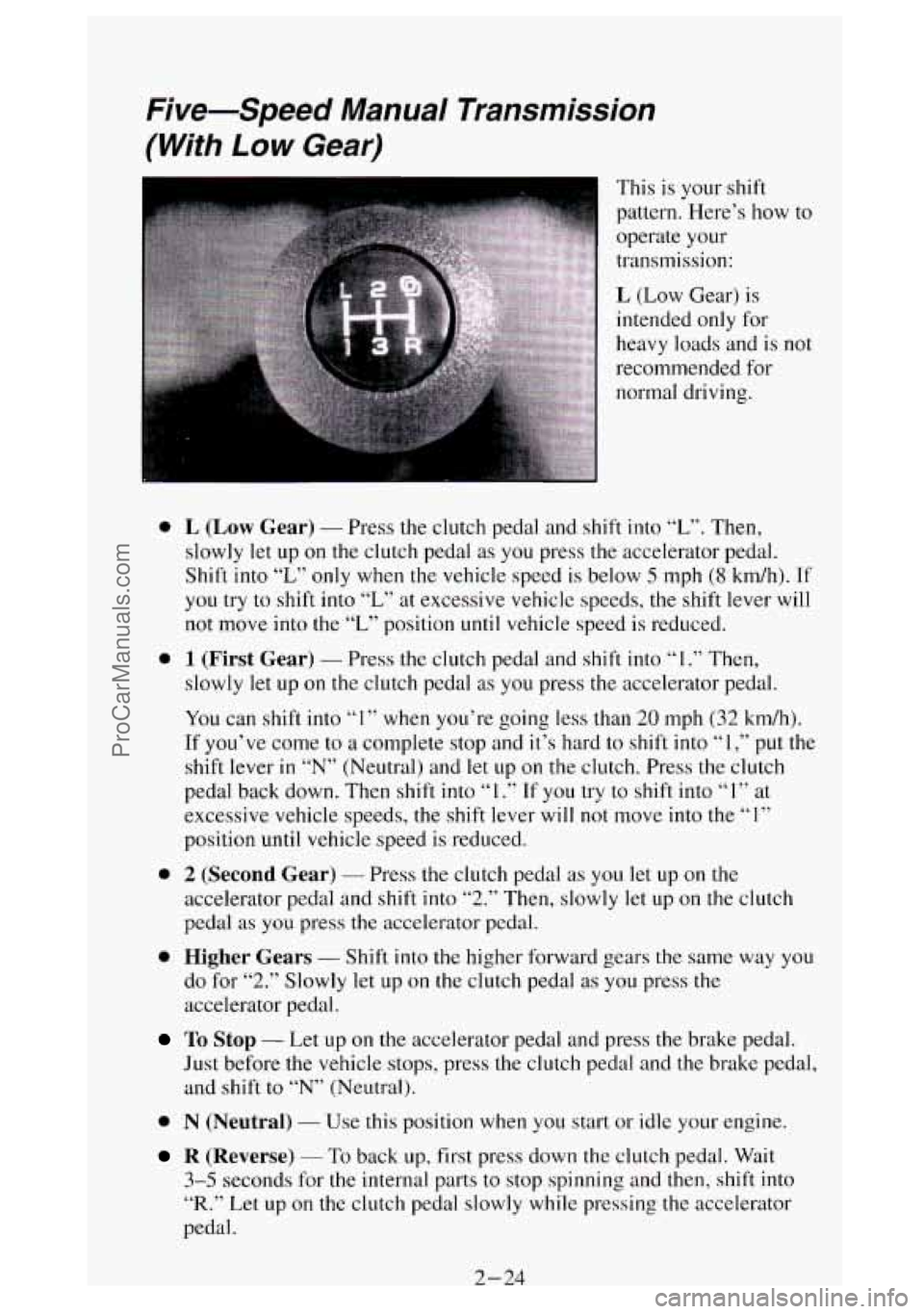
This is your shift
pattern. Here’s how to
operate your
transmission:
L (Low Gear) is
intended only for
heavy loads and is not
recommended for
normal driving.
0 L (Low Gear) - Press the clutch pedal and shift into “L”. Then,
slowly let up on the clutch pedal as
you press the accelerator pedal.
Shift into
“L” only when the vehicle speed is below 5 mph (8 kdh). Tf
you try to shift into “L” at excessive vehicle speeds, the shift lever will
not move into the “L” position until vehicle speed is reduced.
0 1 (First Gear) - Press the clutch pedal and shift into “1.” Then,
slowly let up
on the clutch pedal as you press the accelerator pedal.
You can shift into “1” when you’re going less than 20 mph (32 km/h).
If you’ve come
to a complete stop and it’s hard to shift into “1,” put the
shift lever in “N” (Neutral) and let up on the clutch. Press the clutch
pedal back down. Then shift into
“I .” If you try to shift into “1” at
excessive vehicle speeds,
the shift lever will not move into the “1”
position until vehicle speed is reduced.
0 2 (Second Gear) - Press the clutch pedal as you let up on the
accelerator pedal and shift into “2.” Then, slowly let up on the clutch
pedal as
you press the accelerator pedal.
0 Higher Gears - Shift into the higher forward gears the same way you
do for
“2.” Slowly let up on the clutch pedal as you press the
accelerator pedal.
To Stop - Let up on the accelerator pedal and press the brake pedal.
Just before the vehicle stops, press the clutch pedal and the brake pedal,
and shift
to “N” (Neutral).
0 N (Neutral) - Use this position when you start or idle your engine.
R (Reverse) - To back up, first press down the clutch pedal. Wait
3-5 seconds for the internal parts to stop spinning and then, shift into
“R.” Let up on the clutch pedal slowly while pressing the accelerator
pedal.
2-24
ProCarManuals.com