lights GMC SIERRA 1995 User Guide
[x] Cancel search | Manufacturer: GMC, Model Year: 1995, Model line: SIERRA, Model: GMC SIERRA 1995Pages: 488, PDF Size: 26.01 MB
Page 198 of 488
Night Vision
No one can see as well at night as in the daytime. But as we get older these
differences increase.
A SO-year-old driver may require at least twice as
much
light to see the same thing at night as a 20-year-old.
What
you do in the daytime can also affect your night vision. For example,
if you spend the day in bright sunshine you are wise to wear sunglasses.
Your eyes will have less trouble adjusting to night. But if you’re driving,
don’t wear sunglasses at night. They may cut down on glare from
headlamps, but they also make a lot
of things invisible.
You can be temporarily blinded
by approaching lights. It can take a second
or two, or even several seconds, for your eyes
to readjust to the dark. When
you are faced with severe glare (as from a driver who doesn’t lower the high
beams, or
a vehicle with misaimed headlamps), slow down a little. Avoid
staring directly into the approaching lights.
Keep your windshield and all the glass on your vehicle clean
- inside and
out. Glare at night is made much worse by dirt on the glass. Even the inside
of the glass can build up
a film caused by dust. Dirty glass makes lights
dazzle and flash more than clean glass would, making the pupils of your
eyes contract repeatedly.
Remember that your headlamps light
up far less of a roadway when you are
in a turn or curve. Keep your eyes moving; that way, it’s easier to pick out
dimly lighted objects. Just as your headlamps should be checked regularly
for proper aim, so should your eyes be examined regularly. Some drivers
suffer from night blindness
- the inability to see in dim light - and aren’t
even aware
of it.
Driving in the Rain
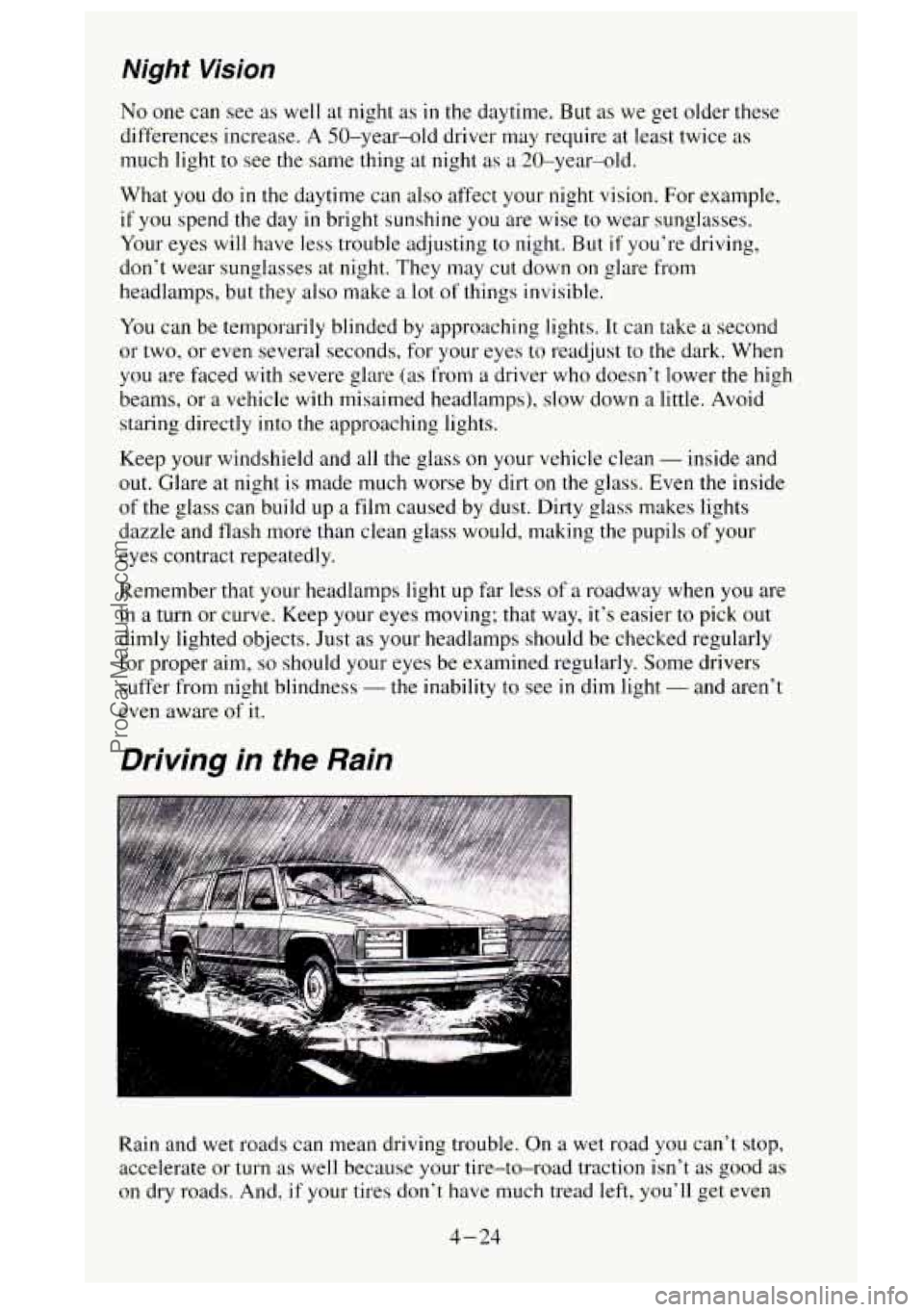
Rain and wet roads can mean driving trouble. On a wet road you can’t stop,
accelerate or
turn as well because your tire-to-road traction isn’t as good as
on dry roads. And, if your tires don’t have much tread left, you‘ll get even
4-24
ProCarManuals.com
Page 200 of 488
Hydroplaning doesn’t happen often. But it can if your tires haven’t much
tread or
if the pressure in one or more is low. It can happen if a lot of water
is standing on
the road. If you can see reflections from trees, telephone
poles, or other vehicles, and raindrops “dimple” the water’s surface, there
could be hydroplaning.
Hydroplaning usually happens at higher speeds. There just isn’t
a hard and
fast rule about hydroplaning. The best advice is
to slow down when it is
raining.
Some Other Rainy Weather Tips
Turn on your low-beam headlights - not just your parking lights - to
help make
you more visible to others.
Besides slowing down, allow some extra following distance. And be
especially careful when you pass another vehicle. Allow yourself more
clear room ahead, and be prepared to have your view restricted by road
spray.
Have good tires with proper tread depth. (See “Tires” in the Index.)
City Driving
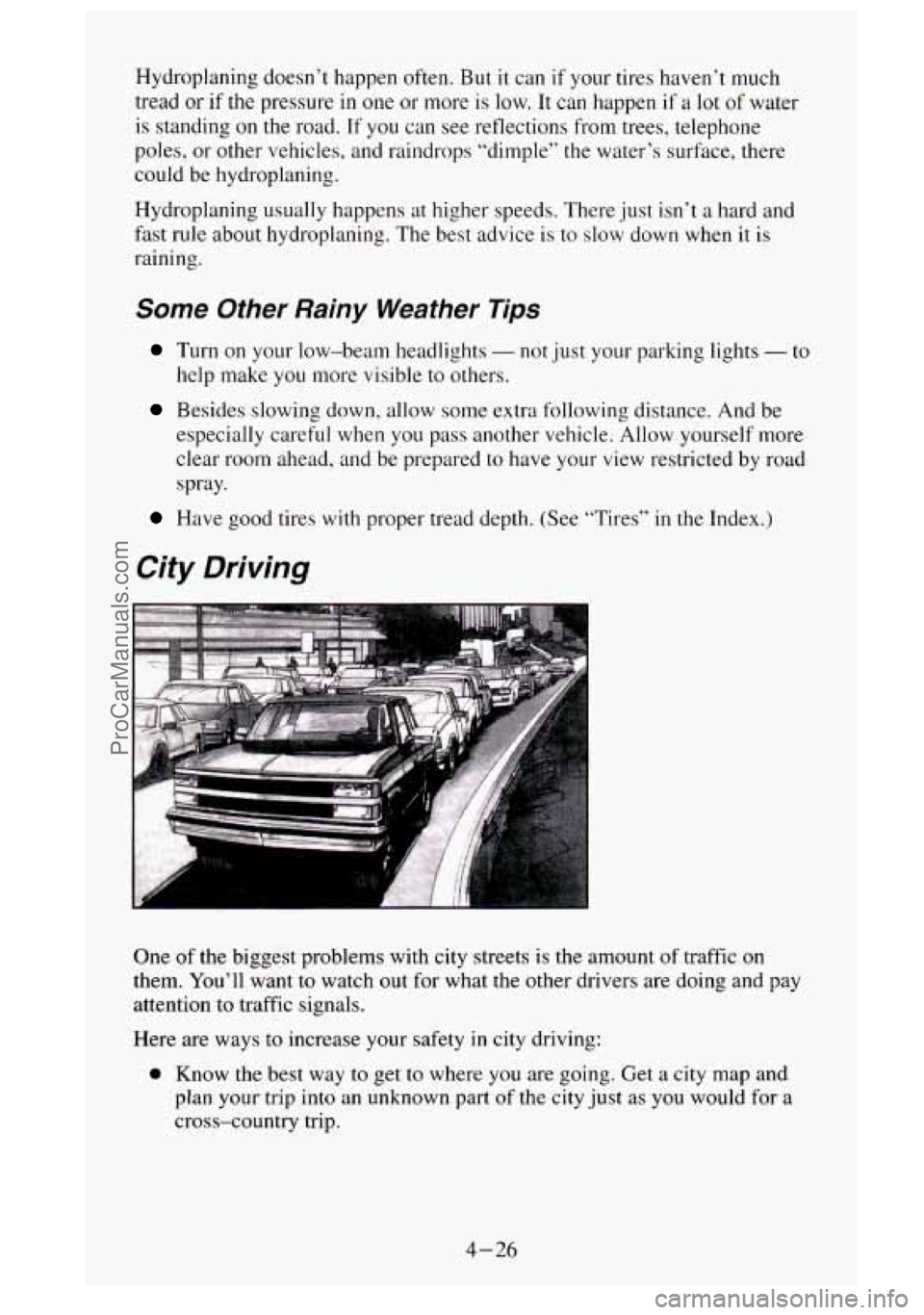
One of the biggest problems with city streets is the amount of traffic on
them. You’ll want
to watch out for what the other drivers are doing and pay
attention to traffic signals.
Here
are ways to increase your safety in city driving:
0 Know the best way to get to where you are going. Get a city map and
plan your trip into an unknown part of the city just as you would for a
cross-country trip.
4-26
ProCarManuals.com
Page 208 of 488
c
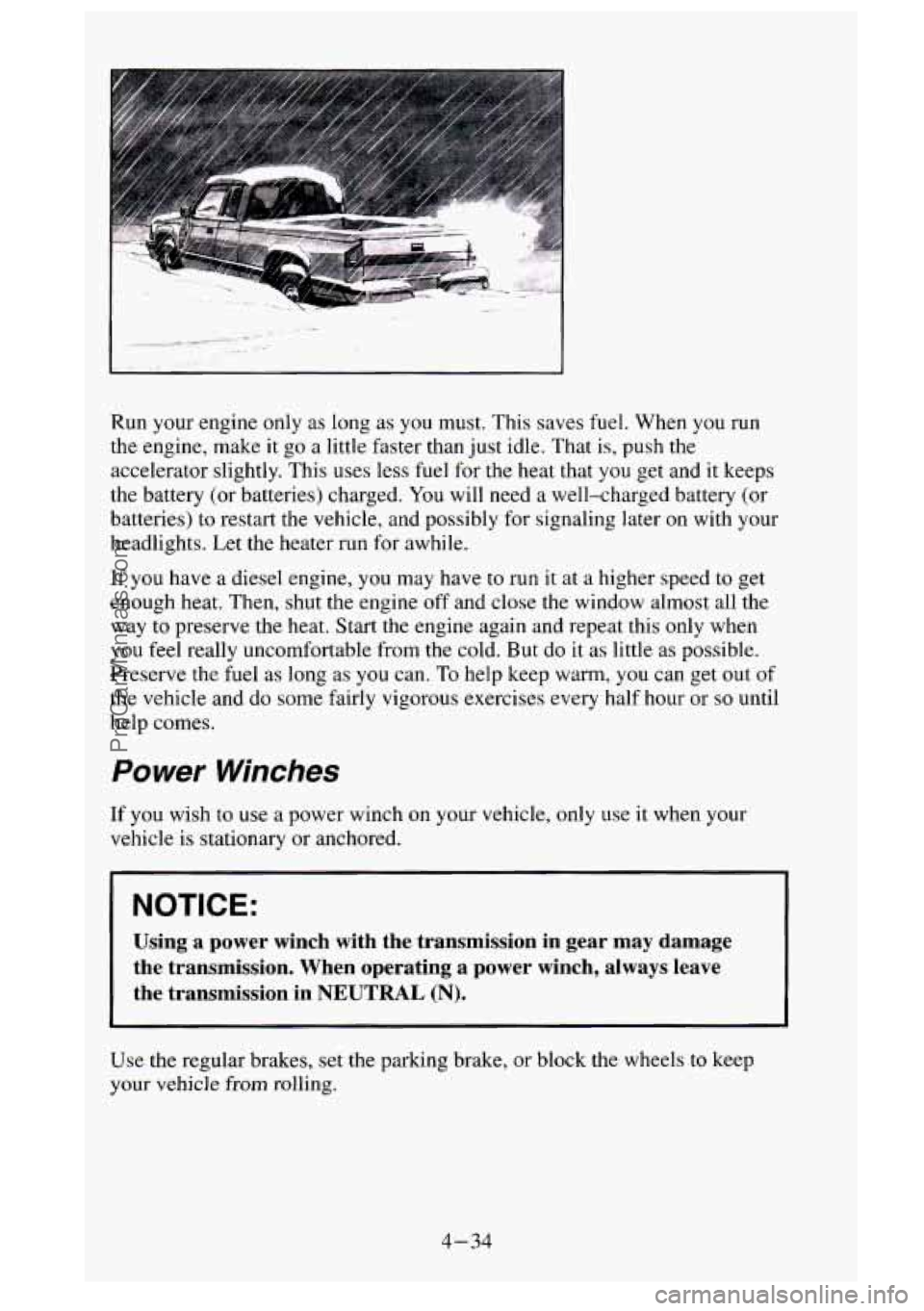
Run your engine only as long as you must. This saves fuel. When you run
the engine, make
it go a little faster than just idle. That is, push the
accelerator slightly. This uses less fuel for the heat that
you get and it keeps
the battery (or batteries) charged. You will need a well-charged battery (or
batteries) to restart the vehicle, and possibly for signaling later on with your
headlights. Let the heater run for awhile.
If you have a diesel engine, you may have to run it at a higher speed to get
enough heat. Then, shut the engine off and close the window almost all the
way
to preserve the heat. Start the engine again and repeat this only when
you feel really uncomfortable from the cold. But do it as little as possible.
Preserve the fuel as long
as you can. To help keep warm, you can get out of
the vehicle and do some fairly vigorous exercises every half hour or so until
help comes.
Power Winches
If you wish to use a power winch on your vehicle, only use it when your
vehicle
is stationary or anchored.
NOTICE:
Using a power winch with the transmission in gear may damage
the transmission. When operating a power winch, always leave
the transmission in NEUTRAL
(N).
Use the regular brakes, set the parking brake, or block the wheels to keep
your vehicle
from rolling.
4-34
ProCarManuals.com
Page 228 of 488
You could be injured if the vehicles roll. Set the parking brake firmly
on each vehicle. Put an automatic transmission in PARK (P) or a
manual transmission in NEUTRAL (N). If you have a
four-wheel-drive vehicle, be sure the transfer case is not in NEUTRAL
(N).
3. Turn off the ignition on both vehicles. Turn off all lights that aren’t
needed, and radios. This
will avoid sparks and help save both batteries.
And it could save your radio!
NOTICE:
If you leave your radio on, it could be badly damaged. The
repairs wouldn’t be covered by your warranty.
4. Open the hoods and locate the batteries. Find the positive (+) and
negative
(-) terminals on each battery.
A CAUTION:
Using a match near a battery can cause battery gas to explode.
People have been hurt doing this, and some have been blinded.
Use
a flashlight if you need more light.
Be sure the batteries have enough
water. You don’t need to add
water to the Delco Freedom@ battery (or batteries) installed in
every new
GM vehicle. But if a battery has filler caps, be sure
the right amount of fluid is there.
If it is low, add water to take
care
of that first. If you don’t, explosive gas could be present.
Battery fluid contains acid that can burn you. Don’t get
it on
you.
ff you accidentally get it in your eyes or on your skin, flush
the place with water and get medical help immediately.
5. Check that the jumper cables don’t have loose or missing insulation. If
they do,
you could get a shock. The vehicles could be damaged, too.
Before you connect the cables, here are some basic things you should
know. Positive
(+) will go to positive (+) and negative (-) will go to
negative
(-) or a metal engine part. Don’t connect (+) to (-) or you’ll
get
a short that would damage the battery and maybe other parts, too.
5-4
ProCarManuals.com
Page 473 of 488
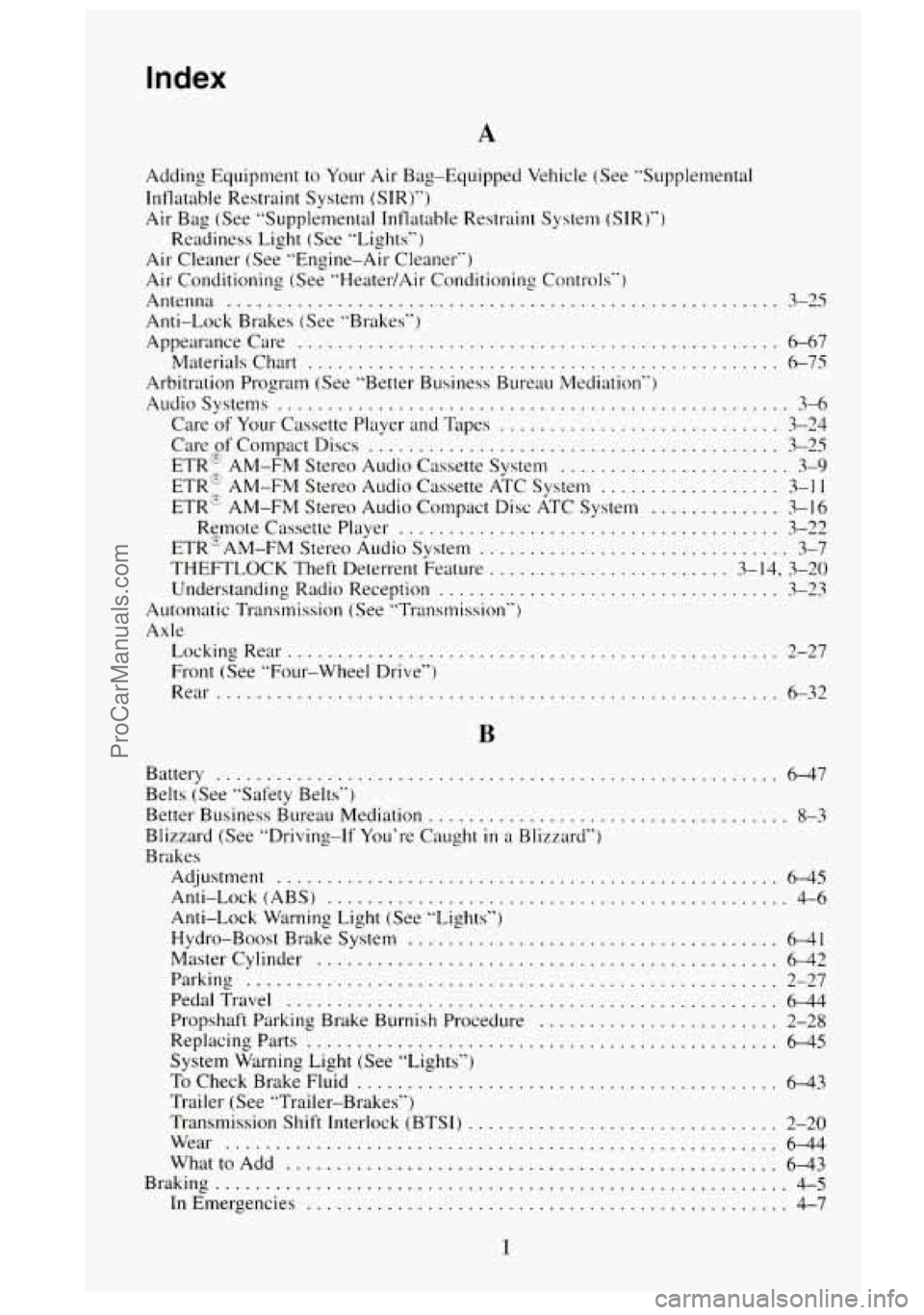
Index
A
Adding Equipment to Your Air Bag-Equipped Vehicle (See "Supplemental
Intlatable Restraint System (SIR)")
Air Bag (See "Supplemental Intlatable Restrain1 System (SIR)")
Air Cleaner (See "Engine-Air Cleaner")
Air Conditioning (See "HeatedAir Conditioning Controls")
Antenna
....................................................... 3-25
Readiness Light
(See "Lights")
Anti-Lock Brakes (See "Brakes")
Appearance Care
................................
Materials Chart ..............................
Arbitration Program (See "Better Business Bureau Media
Audio Systems
.................................
................ 6-67
................. 6-75
. tion")
.................. 3-6
Care of Your Cassette Player and Tapes ............................ 3-24
Care_of Compact Discs
......................................... 3-25
ETR: AM-FM Stereo Audio Cassette System
....................... 3-9
ETRf AM-FM Stereo Audio Cassette ATC System
.................. 3-11
ETR'?' AM-FM Stereo Audio Compact Disc ATC System ............. 3-16
Rcmote Cassette Player
...................................... 3-22
ETR&AM-FM Stereo Audio System
............................... 3-7
THEFTLOCK Theft Deterrent Feature
........................ 3- 14. 3-20
Understanding Radio Reception .................................. 3-23
Automatic Transmission (See "Tnlnsmission")
Axle LockingRea r
................................................. 2-27
Front (See "Four-Wheel Drive")
Rear
........................................................ 6-32
B
Battery ........................................................ 6-47
Belts (See "Safety Belts")
Better Business Bureau Mediation
.................................... 8-3
Blizzard (See "Driving-If You're Caught
in a Blizzard")
Brakes Adjustment
.................................................. 6-45
Anti-Lock (ABS)
.............................................. 4-6
Anti-Lock Warning Light (See "Lights")
Hydro-Boost Brake System
..................................... 6-41
Master Cylinder .............................................. 6-42
Parking
..................................................... 2-27
PedalTravel
................................................. 644
Propshaft Parking Brake Burnish Procedure
........................ 2-28
Replacingparts
............................................... 6-45
System Warning Light (See *'Lights")
To Check Brake Fluid .......................................... 6-43
Trailer (.See "Trailer-Brakes")
Transmission Shift Interlock
(BTSI) ............................... 2-20
Wear
....................................................... 6-44
WhattoAdd
................................................. 643
Braking ......................................................... 4-5
In Emergencies ................................................ 4-7
1
ProCarManuals.com
Page 475 of 488
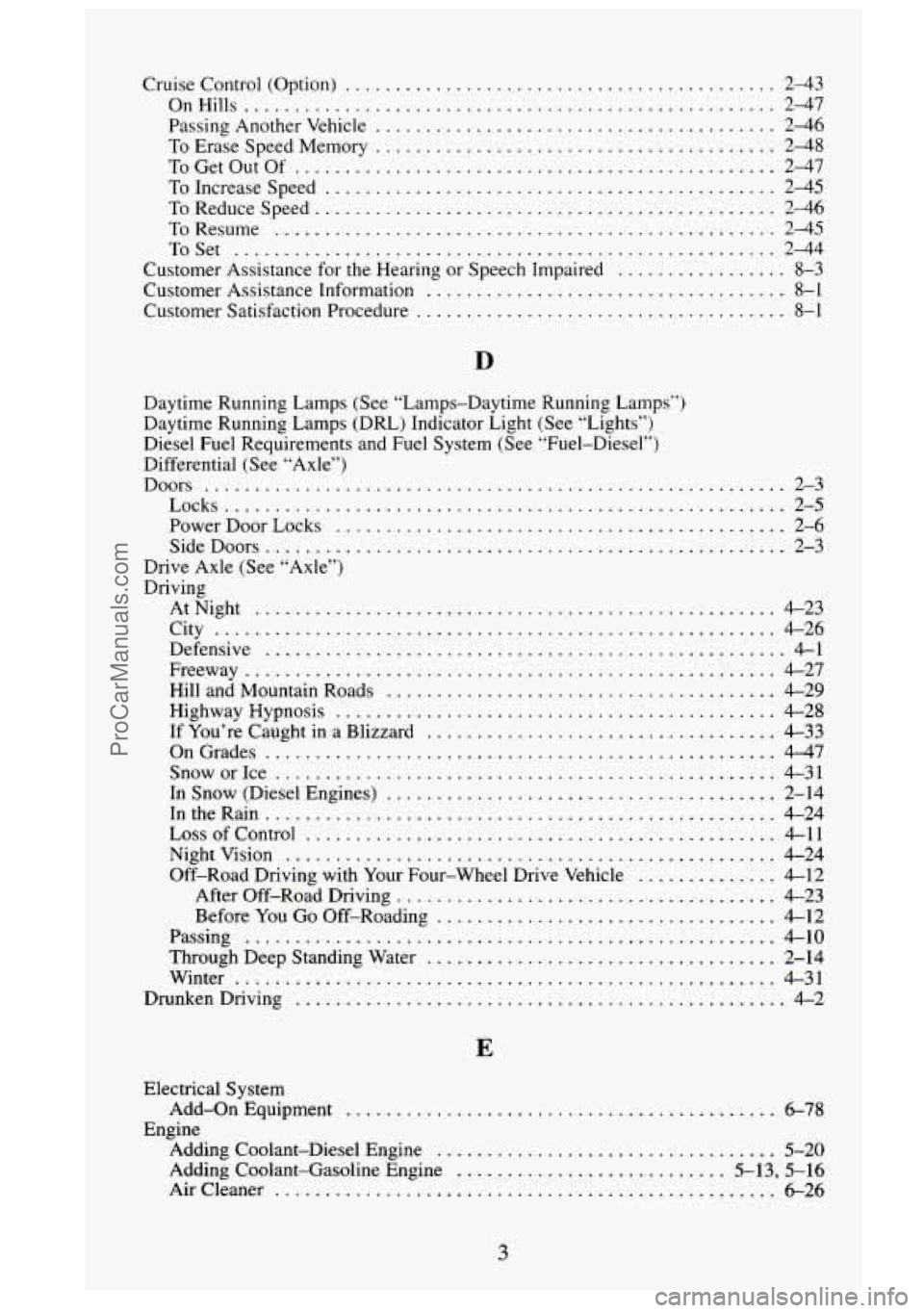
Cruise Control (Option) ........................................... 2-43
OnHills
..................................................... 2-47
Passing Another Vehicle
........................................ 2-46
To Erase Speed Memory
........................................ 2-48
ToGetOutOf ................................................ 2-47
ToIncreaseSpeed
............................................. 2-45
ToReduceSpeed
.............................................. 2-46
ToResume
.................................................. 2-45
ToSet ...................................................... 2-44
Customer Assistance for the Hearing or Speech Impaired
................. 8-3
Customer Assistance Information
.................................... 8-1
Customer Satisfaction Procedure ..................................... 8-1
Daytime Running Lamps (See “Lamps-Daytime Running Lamps”)
Daytime Running Lamps (DRL) Indicator Light (See “Lights”)
Diesel Fuel Requirements and Fuel System (See “Fuel-Diesel”)
Differential (See “Axle”) Doors
.......................................................... 2-3
Locks
........................................................ 2-5
PowerDoorLocks
............................................. 2-6
SideDoors
.................................................... 2-3
Drive Axle (See
“Axle”)
Driving AtNight
.................................................... 4-23
City
........................................................ 4-26
Defensive
.................................................... 4-1
Freeway ..................................................... 4-27
HillandMountainRoads
....................................... 4-29
Highway Hypnosis
............................................ 4-28
If You’re Caught in a Blizzard
................................... 4-33
OnGrades
................................................... 447
SnoworIce
.................................................. 4-31
In Snow (Diesel Engines) ....................................... 2-14
IntheRain
................................................... 4-24
LossofControl
............................................... 4-11
Nightvision
................................................. 4-24
Off-Road Driving with Your Four-wheel Drive Vehicle
.............. 4-12
After Off-Road Driving
...................................... 4-23
Before
You Go Off-Roading .................................. 4-12
Passing
..................................................... 4-10
Through Deep Standing Water ................................... 2-14
Winter ...................................................... 4-31
DrunkenDriving ................................................. 4-2
Electrical System
Engine Add-on Equipment
........................................... 6-78
Adding
Coolant-Diesel Engine .................................. 5-20
Adding Coolant-Gasoline Engine ........................... 5-13. 5-16
Aircleaner .................................................. 6-26
3
ProCarManuals.com
Page 477 of 488
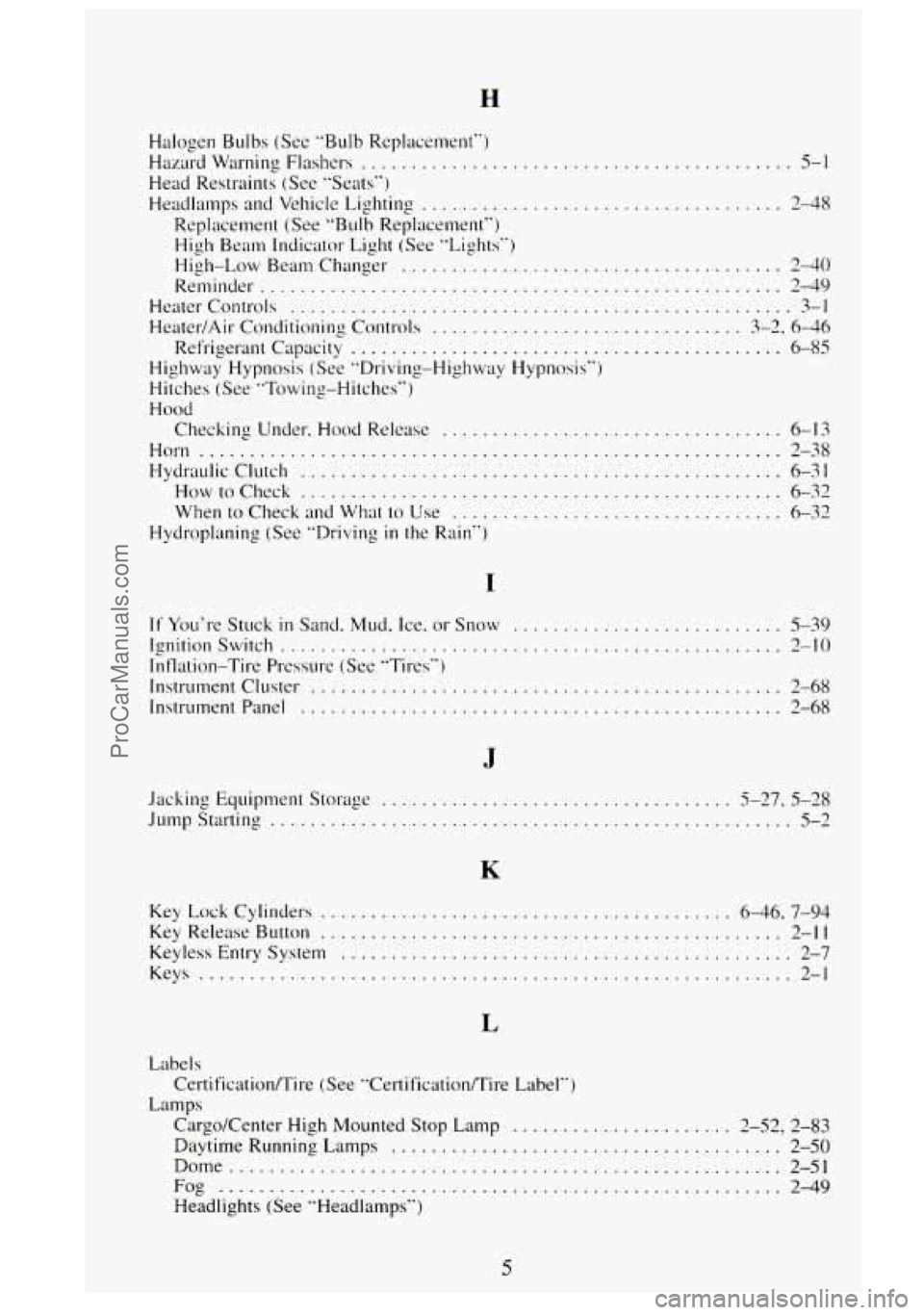
H
Halogen Bulbs (See "Bulb Replacement")
Hazard Warning Flashers
........................................... 5-1
Head Restraints (See "Seats")
Headlamps and Vehicle Lighting
.................................... 2-48
Replacement (See "Bulb Replacement")
High Beam Indicator Light (See "Lights")
High-Low Beam Changer
...................................... 240
Reminder .................................................... 2-49
Heater Controls .................................................. 3-1
Refrigerant Capacity ........................................... 6-85
Heater/Air Conditioning Controls ............................... 3-2 . 6-46
Highway Hypnosis (See "Driving-Highway Hypnosis")
Hitches (See "Towing-Hitches")
Hood
Checking Under: Hood Release .................................. 6-13
Horn .......................................................... 2-38
Hydraulic Clutch ................................................ 6-31
When to Check and What to Use ................................. 6-32
Howtocheck ................................................ 6-32
Hydroplaning (See "Driving in the Rain")
I
If You're Stuck in Sand . Mud. Ice . or Snow ........................... 5-39
Ignition Switch .................................................. 2-10
Intlation-Tire Prussure (See "Tires")
Instrument Cluster
............................................... 2-68
InstrumentPanel ................................................ 2-68
J
Jacking Equipment Storage ................................... 5-27 . 5-28
Jump Starting .................................................... 5-2
K
Key Lock Cylinders ......................................... 6-46.7-94
Key Release Button .............................................. 2-11
Keyless Entry System ............................................. 2-7
Keys
........................................................... 2-1
L
Labe 1 s
Lamps
Certification/Tire (See "CertificaticdTire Label")
CargdCenter High Mounted Stop Lamp
...................... 2.52, 2.83
Daytime Running Lamps ....................................... 2-50
Dome
....................................................... 2-51
Fog ........................................................ 2-49
Headlights
(See "Headlamps")
5
ProCarManuals.com
Page 478 of 488
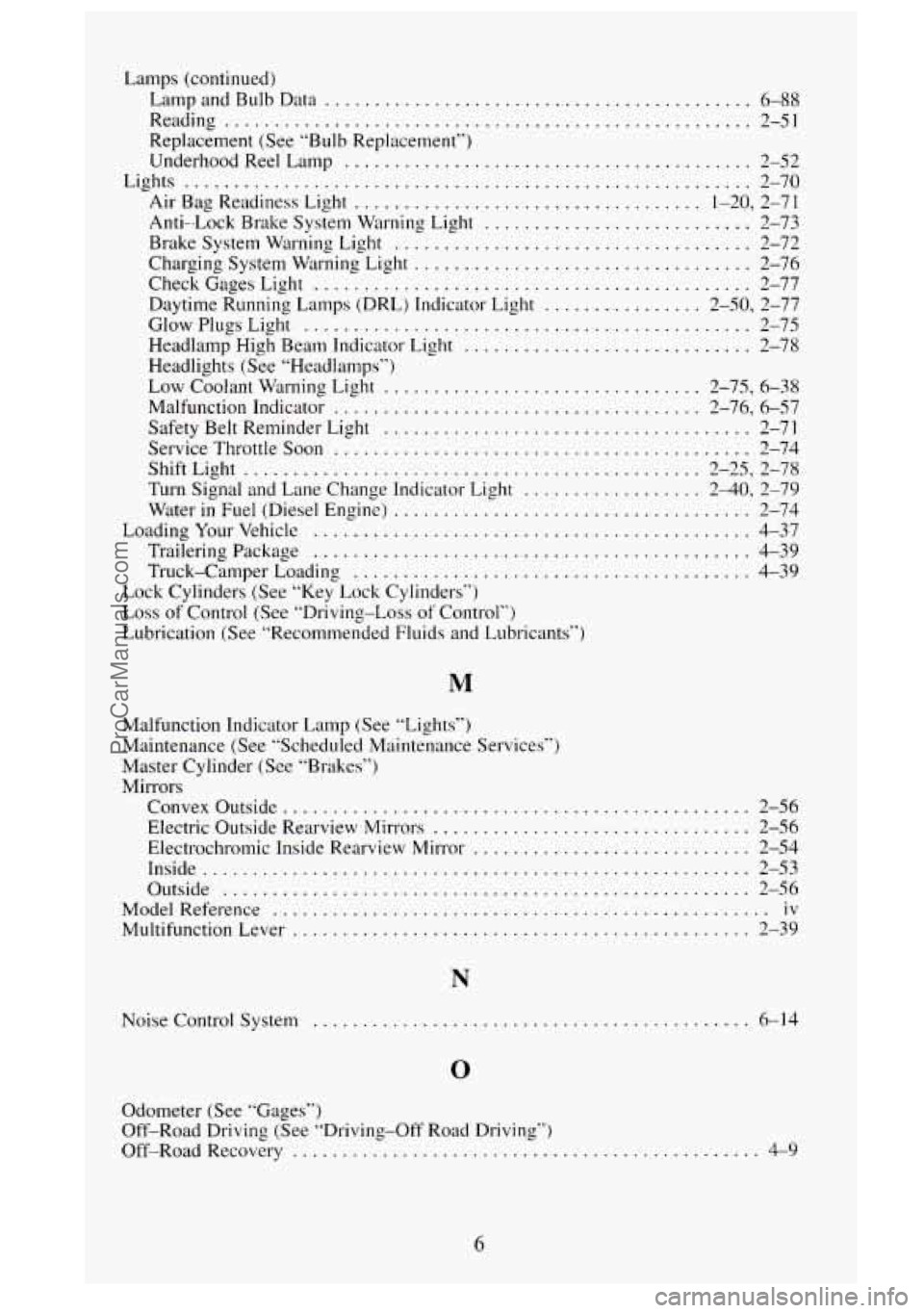
Lamps (continued)
Lamp and Bulb Data
........................................... 6-88
Reading
..................................................... 2-51
Replacement (See “Bulb Replacement“)
Underhood Reel Lamp
......................................... 2-52
Lights ......................................................... 2-70
Air Bag Readiness Light
................................... 1-20, 2-71
Anti-. Lock Brake System Warning Light
........................... 2-73
Brake System Warning Light
.................................... 2-72
Charging System Warning Light
.................................. 2-76
Daytime Running Lamps (DRL) Indicator Light
................ 2-50, 2-77
Check
Gages Light
............................................ 2-77
Glow Plugs Light
............................................. 2-75
Headlamp High Beam Indicator Light
............................. 2-78
Headlights (See “Headlamps”) Low Coolant Warning Light
................................ 2-75, 6-38
Malfunction Indicator
..................................... 2-76, 6-57
Safety Belt Reminder Light
..................................... 2-71
Service Throttle Soon
.......................................... 2-74
ShiftLight
.............................................. 2-25, 2-78
Turn Signal and Lane Change Indicator Light .................. 240, 2-79
Water
in Fuel (Diesel Engine) .................................... 2-74
Loading Your Vehicle
............................................ 4-37
Trailering Package
............................................ 4-39
Truck-Camper Loading
........................................ 4-39
Lock Cylinders (See “Key Lock Cylinders“)
Loss of Control (See “Driving-Loss
of Control”)
Lubrication (See “Recommended Fluids and Lubricants“)
M
Malfunction Indicator Lamp (See “Lights”)
Maintenance (See “Scheduled Maintenance Services”)
Master Cylinder (See “Brakes”)
Mirrors Convexoutside
............................................... 2-56
Electric Outside Rearview Mirrors
................................ 2-56
Electrochromic Inside Rearview Mirror
............................ 2-54
Inside
....................................................... 2-53
Outside
..................................................... 2-56
ModelReference
.................................................. iv
Multifunction Lever .............................................. 2-39
N
Noise Control System ............................................ 6-14
0
Odometer (See “Gages“)
Off-Road Driving (See ”Driving-Off Road Driving”)
Off-Road Recovery
............................................... 4-9
6
ProCarManuals.com
Page 480 of 488
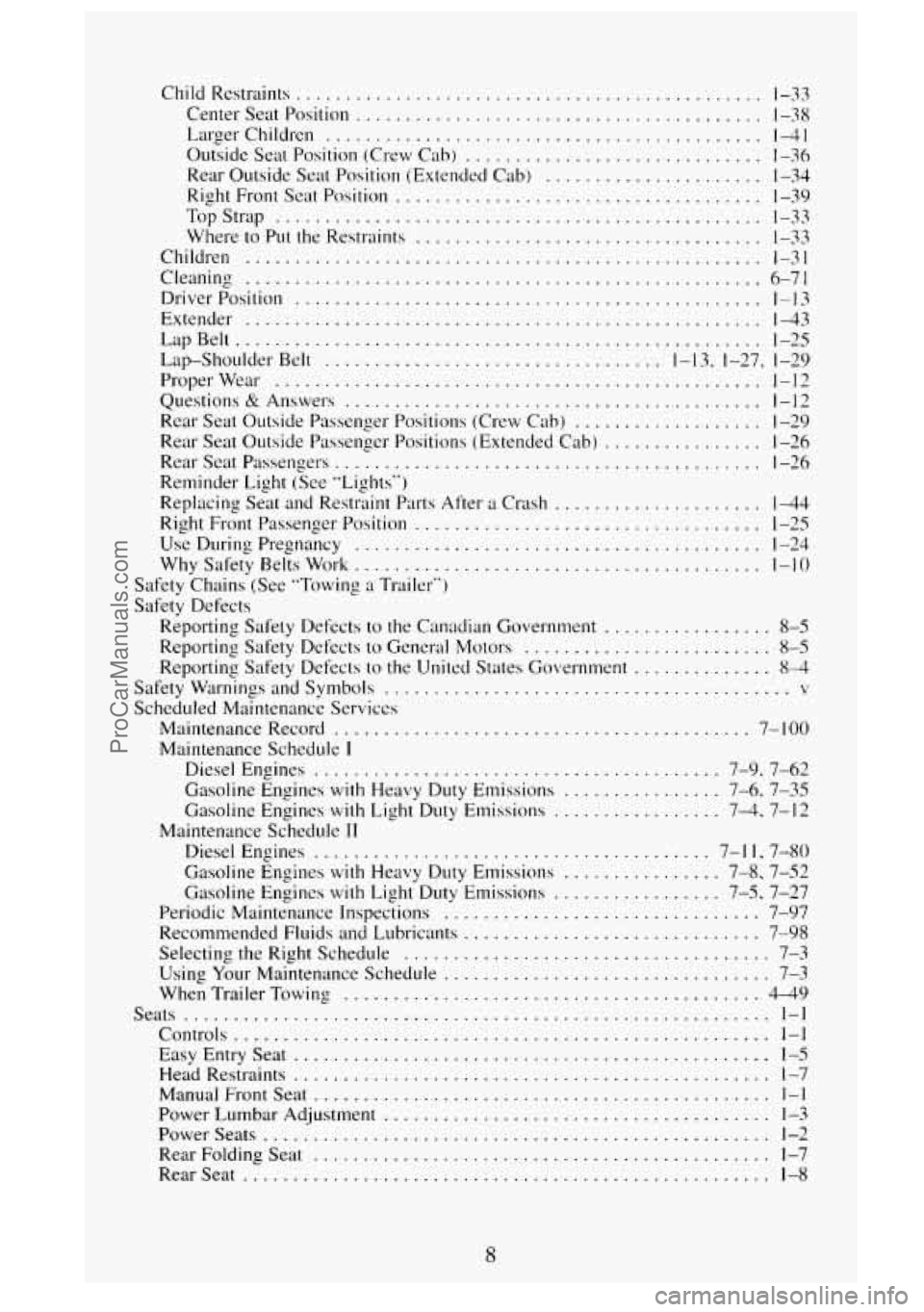
Child Restraints ............................................... 1-33
Center Seat Position
......................................... 1-38
Larger Children ............................................
Properwear ................................................. 1-12
Rear Seat Outside Passenger Positions (Crew Cab) ................... 1-29
Rear Seat Outside Passenger Positions (Extended
Cab) ................ 1-26
Reminder Light (See "Lights")
Replacing Seat and Restraint Parts After
a Crash ..................... 144
Lap-Shoulder Belt .................................. 1-13 . 1-27 . 1-29
Questions & Answers .......................................... I -12
Rear Seat Passengers
........................................... 1-26
Right Front Passenfer Position ................................... 1-25
Use During Pregnancy ......................................... 1-24
Why Safety Belts Work
......................................... 1-10
Safety Chains (See "Towing a Trailer")
Safety Defects Reporting Safety Defects
to the Canadian Governrnent ................. 8-5
Reporting Safety Defects to General Motors ......................... 8-5
Reporting Safety Defects to the United States Governnlent .............. 8-4
Safety WarninFs and Symbols ......................................... v
Scheduled Malntenance Serviccs
Maintenance Record
.......................................... 7- 100
Maintenance Schedule I
Diesel Engines ......................................... 7-9.7-62
Gasoline Engines with Heavy Duty Emissions
................ 7-6 . 7-35
Gasoline Engines with Light Duty Emissions
................. 74 . 7-12
Diesel Engines
........................................ 7-1 I, 7-80
Gasoline Engines with Heavy Duty Emissions
................ 7-8 . 7-52
Gasoline Engines with Light Duty Emissions
................. 7-5, 7-27
Periodic Maintenance Inspections
................................ 7-97
Recommended Fluids and Lubricants .............................. 7-98
Selecting the Right Schedule
..................................... 7-3
Using
Your Maintenance Schedule ................................. 7-3
Maintenance Schedule
IT
WhenTrailerTowing .......................................... 4-49
Seats ........................................................... 1-1
Controls ...................................................... 1-1
Easy Entry
Seat ................................................ 1-5
Head Restraints ................................................ 1-7
ManualFrontSeat .............................................. 1-1
Power Lumbar Adjustment ....................................... 1-3
Powerseats ................................................... 1-2
Rear Folding Seat .............................................. 1-7
RearSeat ..................................................... 1-8
8
ProCarManuals.com
Page 481 of 488
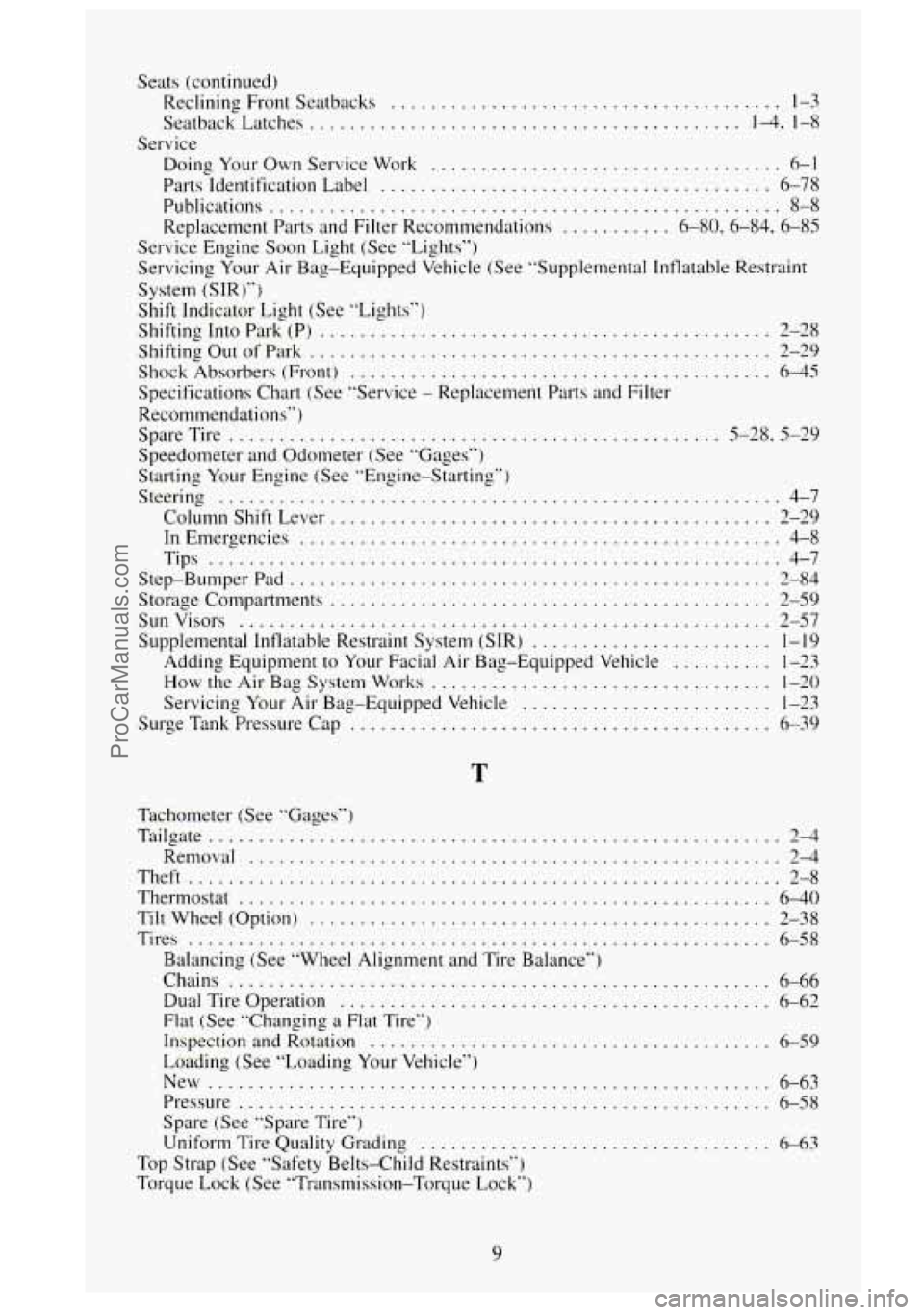
Seats (continued) Reclining Front Seatbacks
....................................... 1-3
Seatback Latches
........................................... 14. 1-8
Doing Your Own Service Work ................................... 6-1
Parts Identification Label
.....................
Service
Publications
.................................
Replacement Parts and Filter Recommendations ....
Service Engine Soon Light (See “Lights”)
Servicing Your Air Bag-Equipped Vehicle (See “Supple
System (SIR)”)
Shift Indicator Light (See *‘Lights“)
Shifting Into Park (P)
...........................
Shifting Out of Park .............................
Shock Absorbers (Front) .........................
.................. 6-78
.................. 8-8
....... 6-80.6-84,6-85
:r nental Inflatable Restraint
................. 2-28
................. 2-29
................. 6-45
Specifications Chart (See “Service . Replacement Parts and Filter
Recommendations“) SpareTire
................................................. 5-28.5-29
Speedometer and Odometer (See “Gages”)
Starting Your Engine (See ”Engine-Starting”)
Steering
........................................................ 4-7
Column Shift Lever
............................................ 2-29
InEmergencies
................................................ 4-8
Tips
......................................................... 4-7
Step-Bumperpad ................................................ 2-84
Storage Compartments
............................................ 2-59
Sunvisors
..................................................... 2-57
Supplemental Inflatable Restraint System (SIR)
........................ 1-19
Adding Equipment to Your Facial Air Bag-Equipped Vehicle
.......... 1-23
How the Air Bag System Works .................................. 1-20
Servicing Your Air Bag-Equipped Vehicle
......................... 1-23
Surge Tank Pressure Cap
.......................................... 6-39
T
Tachometer (See “Gages”)
Tail~ate
......................................................... 2-4
Removal ..................................................... 2-4
TIleft ........................................................... 2-8
Thermostat
..................................................... 6-40
Tilt Wheel (Option) .............................................. 2-38
Tires
.......................................................... 6-58
Balancing (See “Wheel Alignment and Tire Balance”)
Chains
...................................................... 6-66
Dual Tire Operation ........................................... 6-62
Flat (See ”Changing
a Flat Tire”)
Inspection and Rotation
........................................ 6-59
Loading (See “Loading Your Vehicle”)
New
........................................................ 6-63
Pressure
..................................................... 6-58
Spare (See ”Spare Tire”)
Uniform Tire Quality Grading
................................... 6-63
Top Strap (See “Safety Belts-Child Restraints“)
Torque Lock (See “Transmission-Torque Lock“)
9
ProCarManuals.com