maintenance GMC SIERRA 1995 User Guide
[x] Cancel search | Manufacturer: GMC, Model Year: 1995, Model line: SIERRA, Model: GMC SIERRA 1995Pages: 488, PDF Size: 26.01 MB
Page 293 of 488
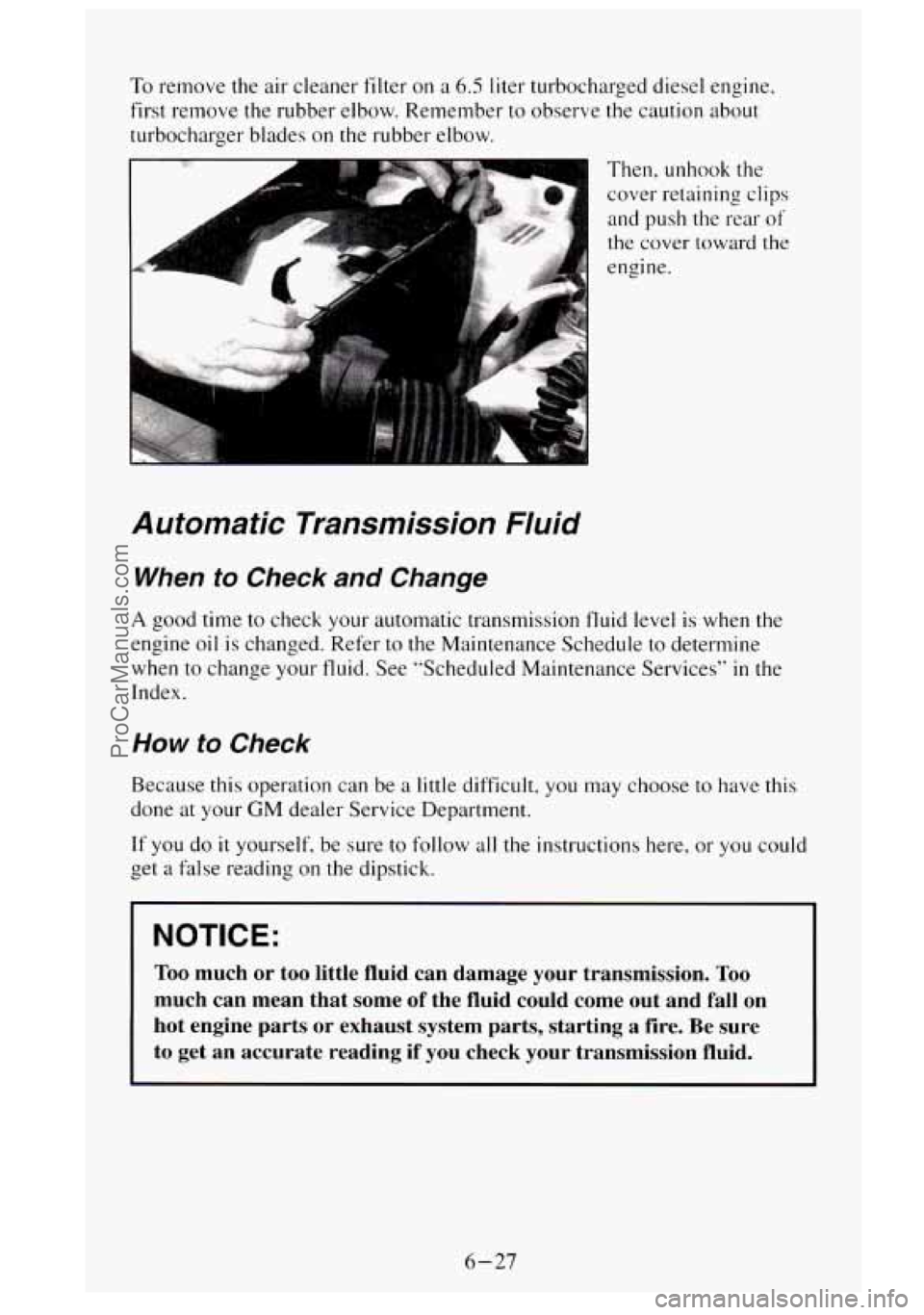
To remove the air cleaner filter on a 6.5 liter turbocharged diesel engine,
first remove the rubber elbow. Remember to observe the caution about
turbocharger blades on the rubber elbow.
Then, unhook the
cover retaining clips
and push the rear
of
the cover toward the
engine.
Automatic Transmission Fluid
When to Check and Change
A good time to check your automatic transmission fluid level is when the
engine
oil is changed. Refer to the Maintenance Schedule to determine
when to change your fluid. See "Scheduled Maintenance Services''
in the
Index.
How to Check
Because this operation can be a little difficult, you may choose to have this
done at your
GM dealer Service Department.
If you do
it yourself, be sure to follow all the instructions here, or you could
get
a false reading on the dipstick.
NOTICE:
Too much or too little fluid can damage your transmission. Too
much can mean that some of the fluid could come out and fall on
hot engine parts or exhaust system parts, starting a fire. Be \
sure
to get an accurate reading if you check your transmission fluid.
6-27
ProCarManuals.com
Page 296 of 488
How to Add Fluid
Refer to the Maintenance Schedule to determine what kind of transmission
fluid
to use. See “Recommended Fluids and Lubricants” in the Index.
Add fluid only after checking the transmission fluid
HOT. (A COLD check
is used
only as a reference.) If the fluid level is low, add only enough of the
proper fluid to bring the level up
to the HOT area for a hot check. It doesn’t
take much fluid, generally less than a
int. Don ’t overfill. We recommend
you use only fluid labeled DEXRON
-111, because fluid with that label is
made especially for your automatic transmission. Damage caused by fluid
other than DEXRON@-I11 is not covered by your
new vehicle warranty.
8
0 After adding fluid, recheck the fluid level as described under “How to
Check.”
0 When the correct fluid level is obtained, push the dipstick back in all
the way; then flip the handle down
to lock the dipstick in place.
Manual Transmission Fluid
When to Check
A good time to have it checked is when the engine oil is changed. However,
the fluid
in your manual transmission doesn’t require changing.
How to Check
Because this operation can be a little difficult, you may choose to have this.
done at your
GM dealer Service Department.
If you do it yourself, be sure to follow all the instructions here, or you could
get a false reading.
NOTICE:
Too much or too little fluid can damage your transmission. Too
much can mean that some of the fluid could come out and fall on
hot engine parts or exhaust system parts, starting a fire.
Be sure
to get an accurate reading if you check your transmission fluid.
Check the fluid level only when your engine is off, the vehicle is parked on
a level place and the transmission is cool enough for you to rest your fingers
on the transmission case.
6-30
ProCarManuals.com
Page 297 of 488
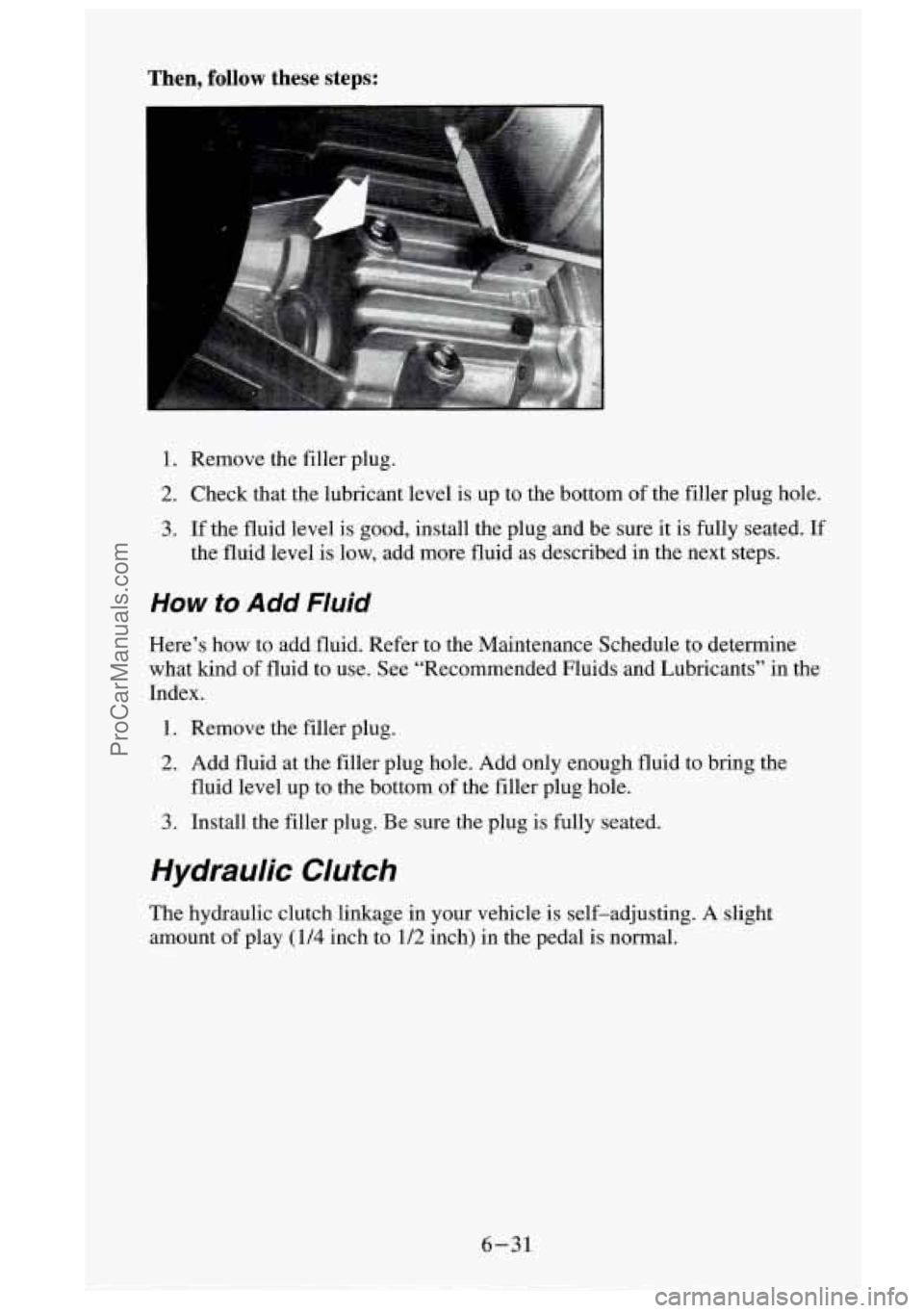
Then, follow these steps:
1. Remove the filler plug.
2. Check that the lubricant level is up to the bottom of the filler plug hole.
3. If the fluid level is good, install the plug and be sure it is fully seated. If
the fluid level is low, add more fluid as described in the next steps.
How to Add Fluid
Here’s how to add fluid. Refer to the Maintenance Schedule to determine
what kind of fluid to use. See “Recommended Fluids and Lubricants” in \
the
Index.
1. Remove the filler plug.
2. Add fluid at the filler plug hole. Add only enough fluid to bring the
fluid level up to the bottom of the filler plug hole.
3. Install the filler plug. Be sure the plug is fully seated.
Hydraulic Clutch
The hydraulic clutch linkage in your vehicle is self-adjusting. A slight
amount
of play (1/4 inch to 1/2 inch) in the pedal is normal.
6-31
ProCarManuals.com
Page 298 of 488
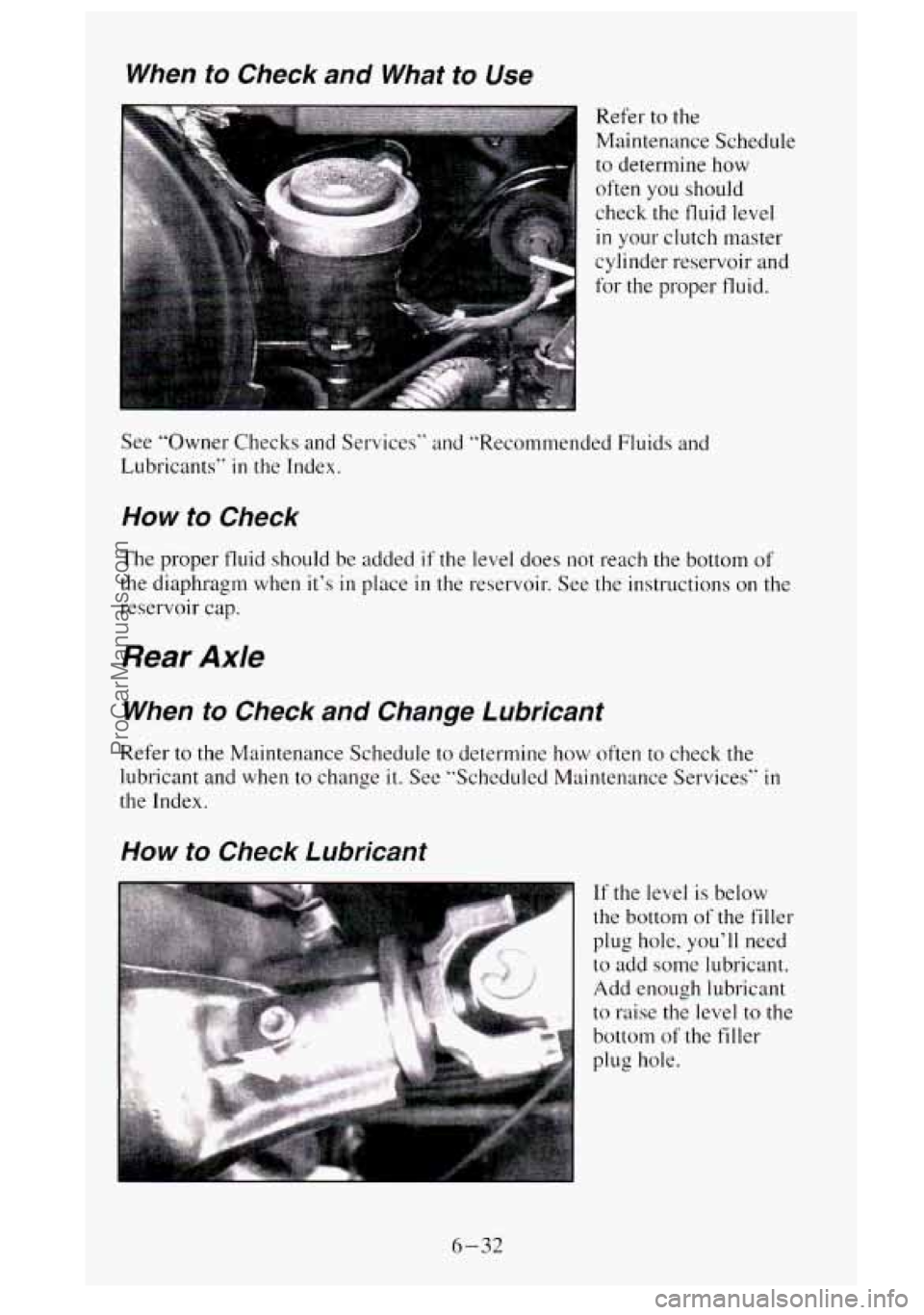
When to Check and What to Use
Refer to the
Maintenance Schedule
to determine how
often
you should
check the
fluid level
in your clutch master
cylinder reservoir and
d for the proper fluid.
See “Owner Checks and Services” and “Recommended Fluids and
Lubricants”
in the Index.
How to Check
The proper fluid should be added if the level does not reach the bottom of
the diaphragm when it’s in place in the reservoir. See the instructions on the
reservoir cap.
Rear Axle
When to Check and Change Lubricant
Refer to the Maintenance Schedule to determine how often to check the
lubricant and when to change
it. See ”Scheduled Maintenance Services’‘ in
the Index.
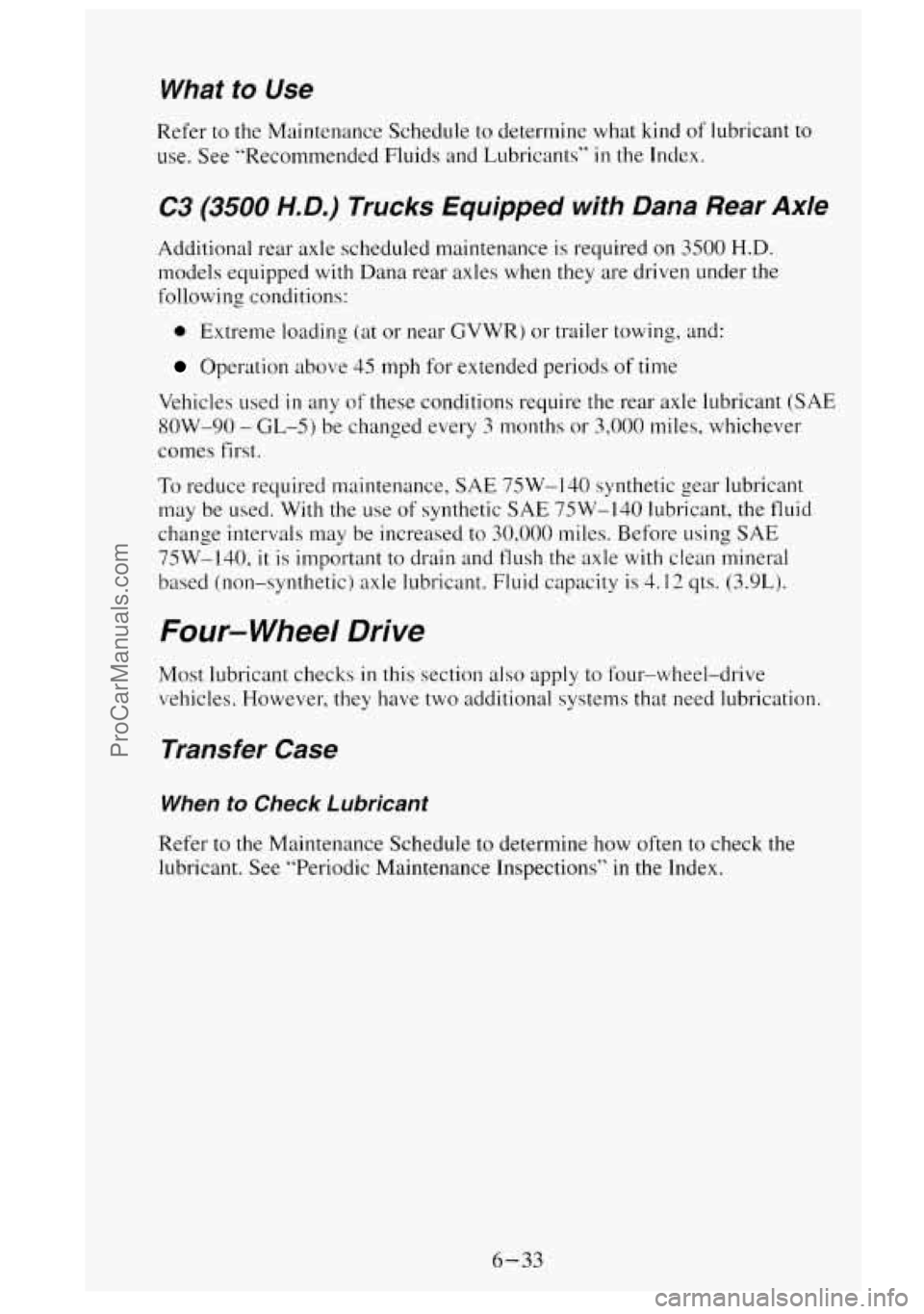
How to Check Lubricant
If the level is below
the bottom of the filler
plug hole, you’ll need
to add some lubricant.
Add enough lubricant
to raise the level to the
bottom of the filler
plug hole.
6-32
ProCarManuals.com
Page 299 of 488
What to Use
Refer to the Maintenance Schedule to determine what kind of lubricant to
use. See “Recommended Fluids and Lubricants”
in the Index.
C3 (3500 H.D.) Trucks Equipped with Dana Rear Axle
Additional rear axle scheduled maintenance is required on 3500 H.D.
models equipped with Dana rear axles when they are driven under the
following conditions:
0 Extreme loading (at or near GVWR) or trailer towing, and:
Operation above 45 mph for extended periods of time
Vehicles used
in any of these conditions require the rear axle lubricant (SAE
8OW-90 - GL-5) be changed every 3 months or 3,000 miles, whichever
comes first.
To reduce required maintenance, SAE 75W-140 synthetic gear lubricant
may be used. With the use of synthetic
SAE 75W-140 lubricant, the fluid
change intervals may be increased to 30,000 miles. Before using SAE
75W-140, it is important to drain and flush the axle with clean mineral
based (non-synthetic) axle lubricant. Fluid capacity is 4.12 qts. (3.9L).
Four- Wheel Drive
Most lubricant checks in this section also apply to four-wheel-drive
vehicles. However, they have two additional systems that need lubrication.
Transfer Case
When to Check Lubricant
Refer to the Maintenance Schedule to determine how often to check the
lubricant. See “Periodic Maintenance Inspections”
in the Index.
6-33
ProCarManuals.com
Page 300 of 488
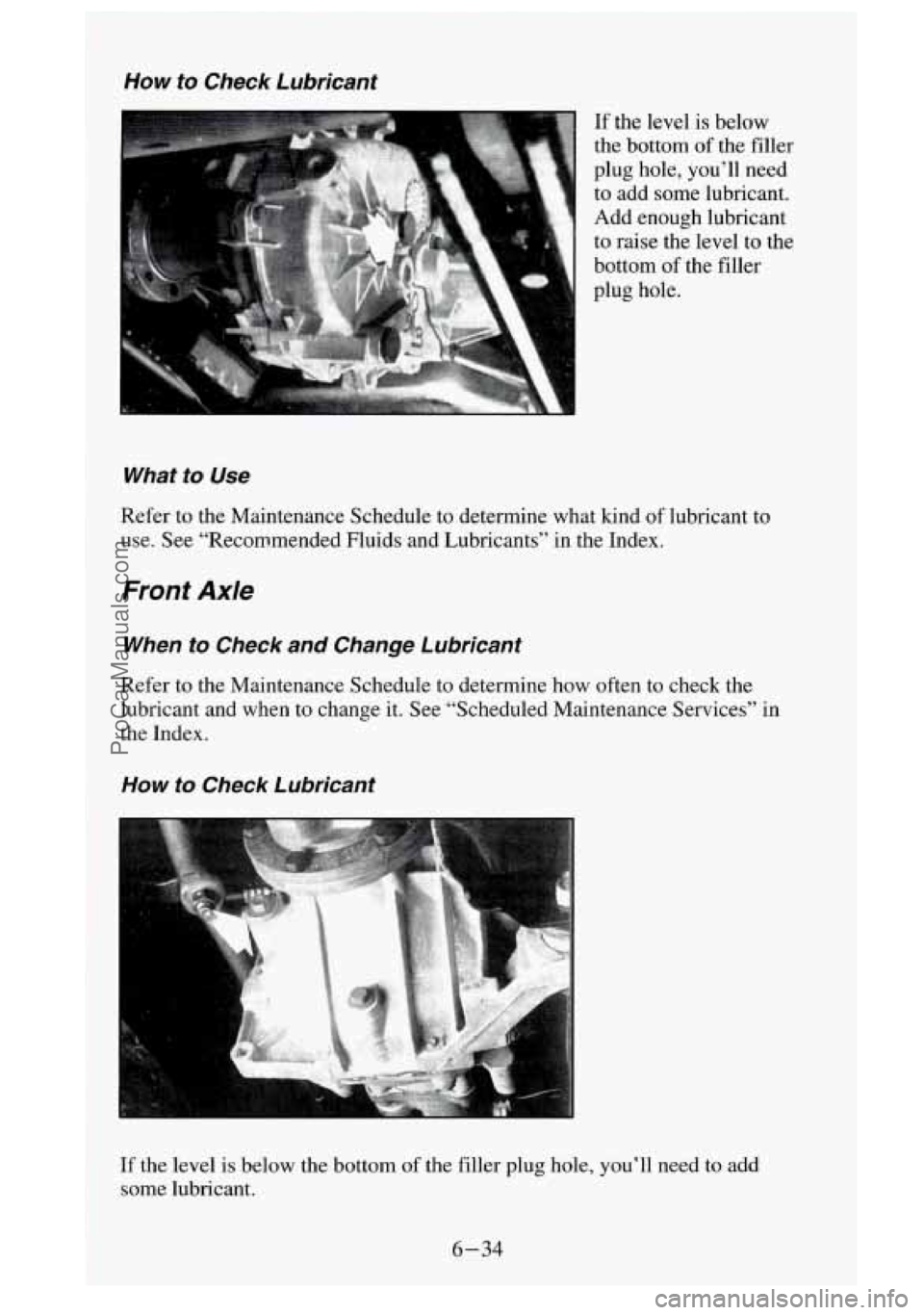
How to Check Lubricant
What to Use
If the level is below
the bottom
of the filler
plug hole, you’ll need
to add some lubricant.
Add enough lubricant
to raise the level
to the
bottom of the
filler
plug hole.
Refer to the Maintenance Schedule to determine what kind of lubricant to
use. See “Recommended Fluids and Lubricants” in the Index.
Front Axle
When to Check and Change Lubricant
Refer to the Maintenance Schedule to determine how often to check the
lubricant and when to change it. See “Scheduled Maintenance Services”
in
the Index.
How to Check Lubricant
If the level is below the bottom of the filler plug hole, you’ll need to add
some lubricant.
6-34
ProCarManuals.com
Page 301 of 488
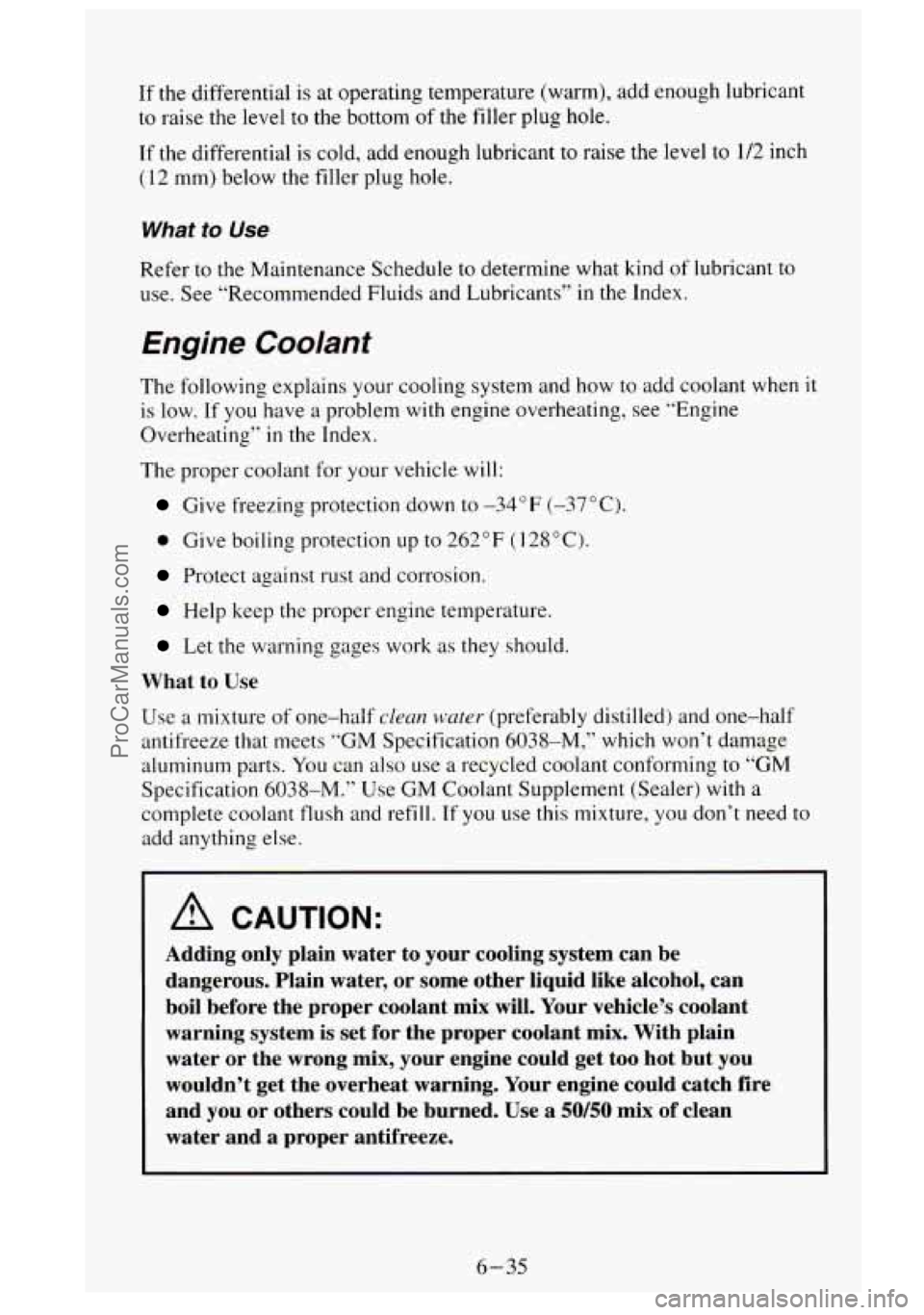
If the differential is at operating temperature (warm), add enough lubricant
to raise the level to the bottom
of the filler plug hole.
If the differential is cold, add enough lubricant to raise the level to
1/2 inch
( 12 mm) below the filler plug hole.
What to Use
Refer to the Maintenance Schedule to determine what kind of lubricant to
use. See “Recommended Fluids and Lubricants” in the Index.
Engine Coolant
The following explains your cooling system and how to add coolant when it
is low. If you have a problem with engine overheating, see “Engine
Overheating”
in the Index.
The proper coolant for your vehicle will:
Give freezing protection down to -34°F (-37°C).
0 Give boiling protection up to 262°F (128°C).
Protect against rust and corrosion.
Help keep the proper engine temperature.
Let the warning gages work as they should.
What to Use
Use a mixture of one-half cleun water (preferably distilled) and one-half
antifreeze that meets “GM Specification 6038-M,” which won’t damage
aluminum parts.
You can also use a recycled coolant conforming to “GM
Specification 6038-M.” Use GM Coolant Supplement (Sealer) with a
complete coolant flush and refill. If you use this mixture. you don’t need to
add anything else.
A CAUTION:
Adding only plain water to your cooling system can be
dangerous. Plain water, or some other liquid like alcohol, can
boil before the proper coolant mix will. Your vehicle’s coolant
warning system
is set for the proper coolant mix. With plain
water or the wrong mix, your engine could get too hot but
you
wouldn’t get the overheat warning. Your engine could catch fire
and you or others could be burned. Use
a 50/50 mix of clean
water and
a proper antifreeze.
6-35
ProCarManuals.com
Page 307 of 488
What to Add
Refer to the Maintenance Schedule to determine what kind of' tluid to use
See "Recommended Fluids and Lubricants"
in the Index.
NOTICE:
When adding power steering fluid or making a complete fluid
change, always use the proper fluid. Failure to use
the proper
fluid can cause leaks and damage hoses and seals.
Hydro-Boost Brake System (Hydraulic Pump)
The power steering pump is also used as the Hydro-boost pump. Refer to
"Power Steering System''
in this section when checking fluid level or
adding fluid.
Windshield Washer Fluid
What to Use
When you need windshield washer fluid, be sure to read the manuhcturer's
instructions before use.
If you will be operating your vehicle in an area
where the temperature
may fall below freezing, use a fluid that has
sufficient protection against freezing.
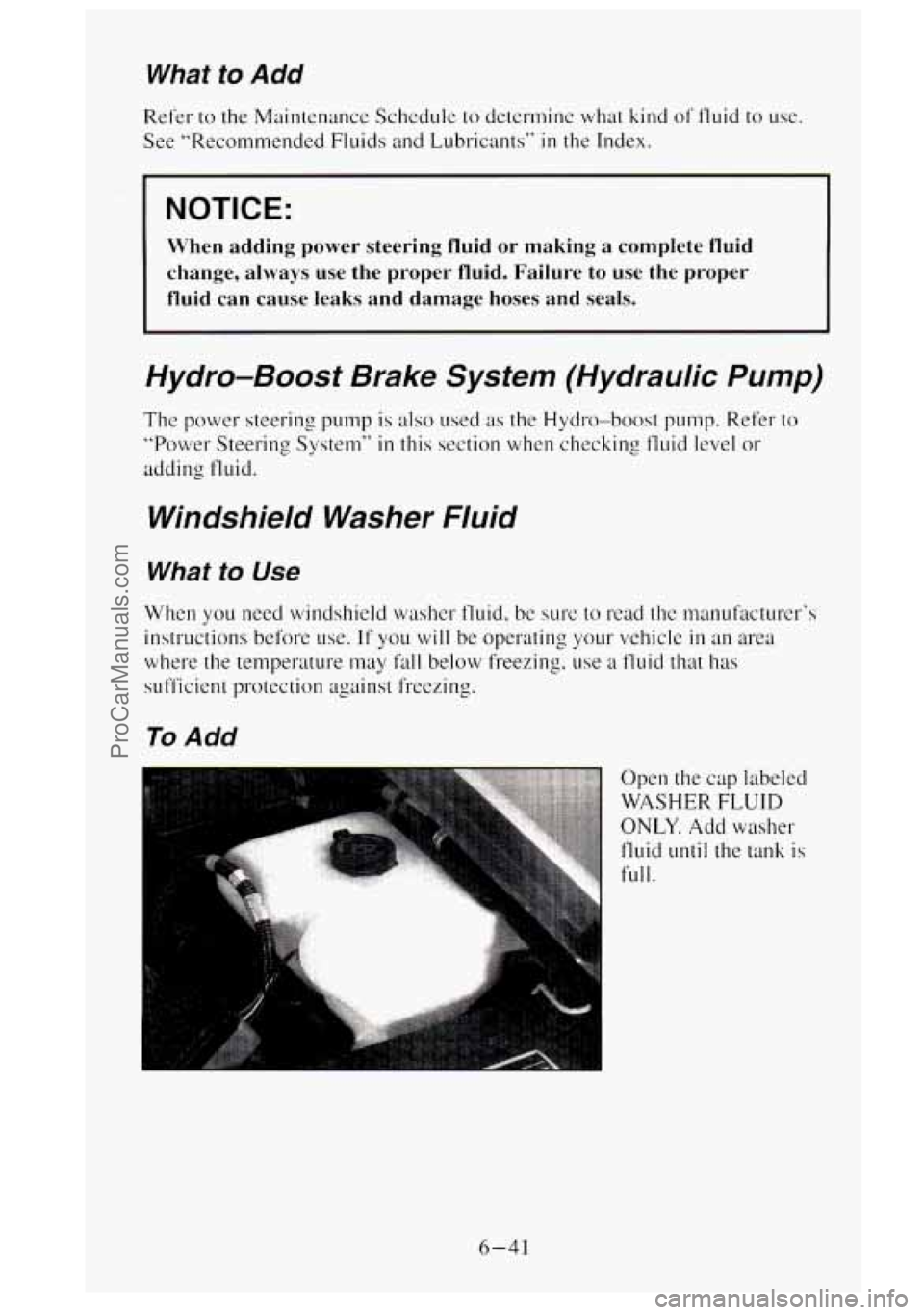
To Add
Open the cap labeled
WASHER FLUID
ONLY. Add washer
fluid
until the tank is
full.
6-41
ProCarManuals.com
Page 309 of 488
(or remove) brake fluid, as necessary, only when work is done on the brake
hydraulic system.
A CAUTION:
If you have too much brake fluid, it can spill on the engine. The
fluid will burn
if the engine is hot enough. You or others could
be burned, and your vehicle could be damaged. Add brake fluid
only when work is done on the brake hydraulic system.
Refer to the Maintenance Schedule to determine when to check your brake
fluid. See “Periodic Maintenance Inspections”
in the Index.
To Check Brake Fluid
You can check the brake fluid without taking off the cap. Just look at the
windows on the brake fluid reservoir. The fluid levels should be above MIN.
If they aren’t, have your brake system checked to see if there is a leak.
After work
is done on the brake hydraulic system, make sure the levels are
above MIN and below the top
of each window.
What to Add
When you do need brake fluid, use only DOT-3 brake fluid - such as
Delco Supreme 11
@ (GM Part No. 1052535). Use new brake fluid from a
sealed container only, and always clean the brake fluid reservoir cap before
removing it.
NOTICE:
Don’t let someone put in the wrong kind of fluid. For
example, just
a few drops of mineral-based oil, such as engine
oil, in your brake system can damage brake system parts
so
badly that they’ll have to be replaced.
Brake fluid can damage paint, so be careful not to spill brake
fluid on your vehicle.
If you do, wash it off immediately. See
“Appearance Care” in the Index.
6-43
ProCarManuals.com
Page 312 of 488
Windshield Wiper Blade Inserts
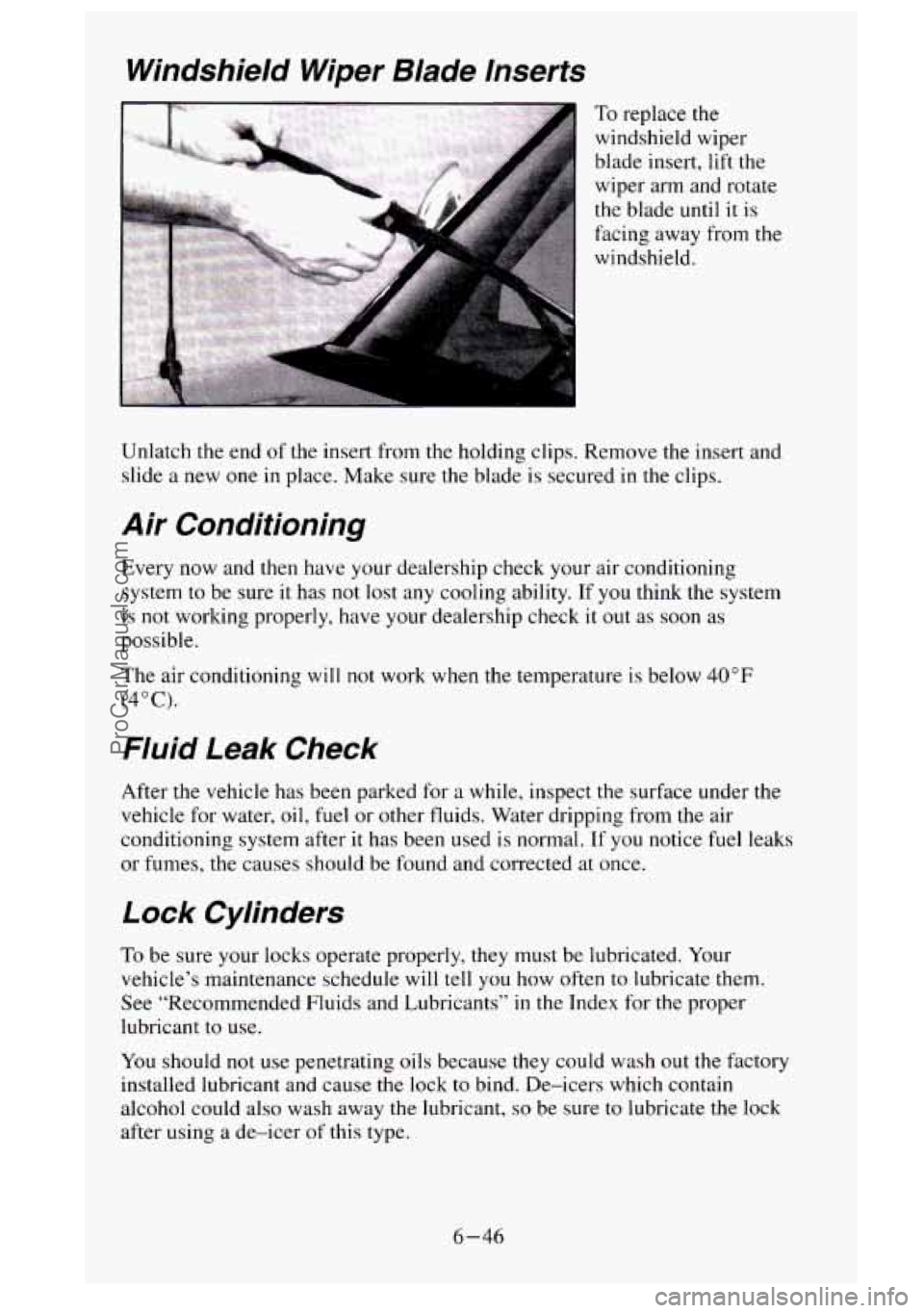
To replace the
windshield wiper
blade insert, lift
the
wiper arm and rotate
the blade until
it is
facing away from the
windshield.
Unlatch the end
of the insert from the holding clips. Remove the insert and
slide
a new one in place. Make sure the blade is secured in the clips.
Air Conditioning
Every now and then have your dealership check your air conditioning
system to be sure it
has not lost any cooling ability. If you think the system
is not working properly, have your dealership check it out as soon as
possi bleb
The air conditioning will
not work when the temperature is below 40°F
(4°C).
Fluid Leak Check
After the vehicle has been parked for a while, inspect the surface under the
vehicle for water, oil, fuel
or other fluids. Water dripping from the air
conditioning system after it has been used is normal.
If you notice fuel leaks
or fumes, the causes should be found and corrected at once.
Lock Cylinders
To be sure your locks operate properly, they must be lubricated. Your
vehicle’s maintenance schedule will tell you how often to lubricate them.
See “Recommended Fluids and Lubricants” in the Index for
the proper
lubricant to use.
You should
not use penetrating oils because they could wash out the factory
installed lubricant and cause
the lock to bind. De-icers which contain
alcohol could also
wash away the lubricant, so be sure to lubricate the lock
after using
a de-icer of this type.
6-46
ProCarManuals.com