tow GMC SIERRA 1995 Owners Manual
[x] Cancel search | Manufacturer: GMC, Model Year: 1995, Model line: SIERRA, Model: GMC SIERRA 1995Pages: 488, PDF Size: 26.01 MB
Page 18 of 488
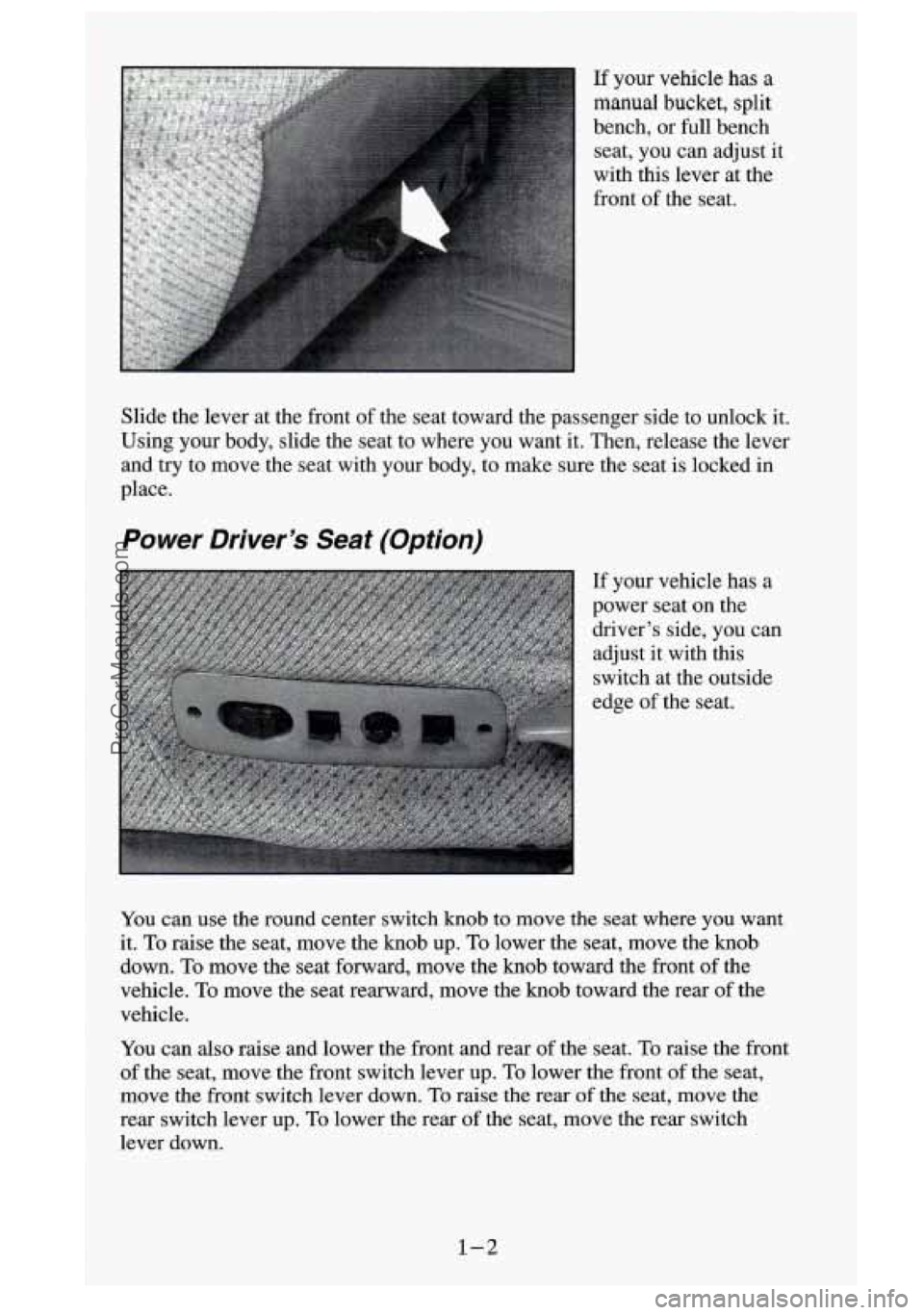
If your vehicle has a
manual bucket, split
bench, or full bench
seat, you can adjust it
with this lever at the
front of the seat.
Slide the lever at the front of the seat toward the passenger side to unlock it.
Using your body, slide the seat to where you want it. Then, release the lever
and try to move the seat with your body, to make sure the seat is locked in
place.
Power Driver's Seat (Option)
If your vehicle has a
power seat on the
driver's side, you can
adjust it with this
switch at the outside
edge of the seat.
You can use the round center switch
knob to move the seat where you want
it.
To raise the seat, move the knob up. To lower the seat, move the knob
down.
To move the seat forward, move the knob toward the front of the
vehicle.
To move the seat rearward, move the knob toward the rear of the
vehicle.
You can also raise and lower the front and rear of the seat.
To raise the front
of the seat, move the front switch lever up. To lower the front of the seat,
move the front switch lever down.
To raise the rear of the seat, move the
1-2
I rear switch lever up. To lower the rear of the seat, move the rear switch
lever down.
ProCarManuals.com
Page 22 of 488
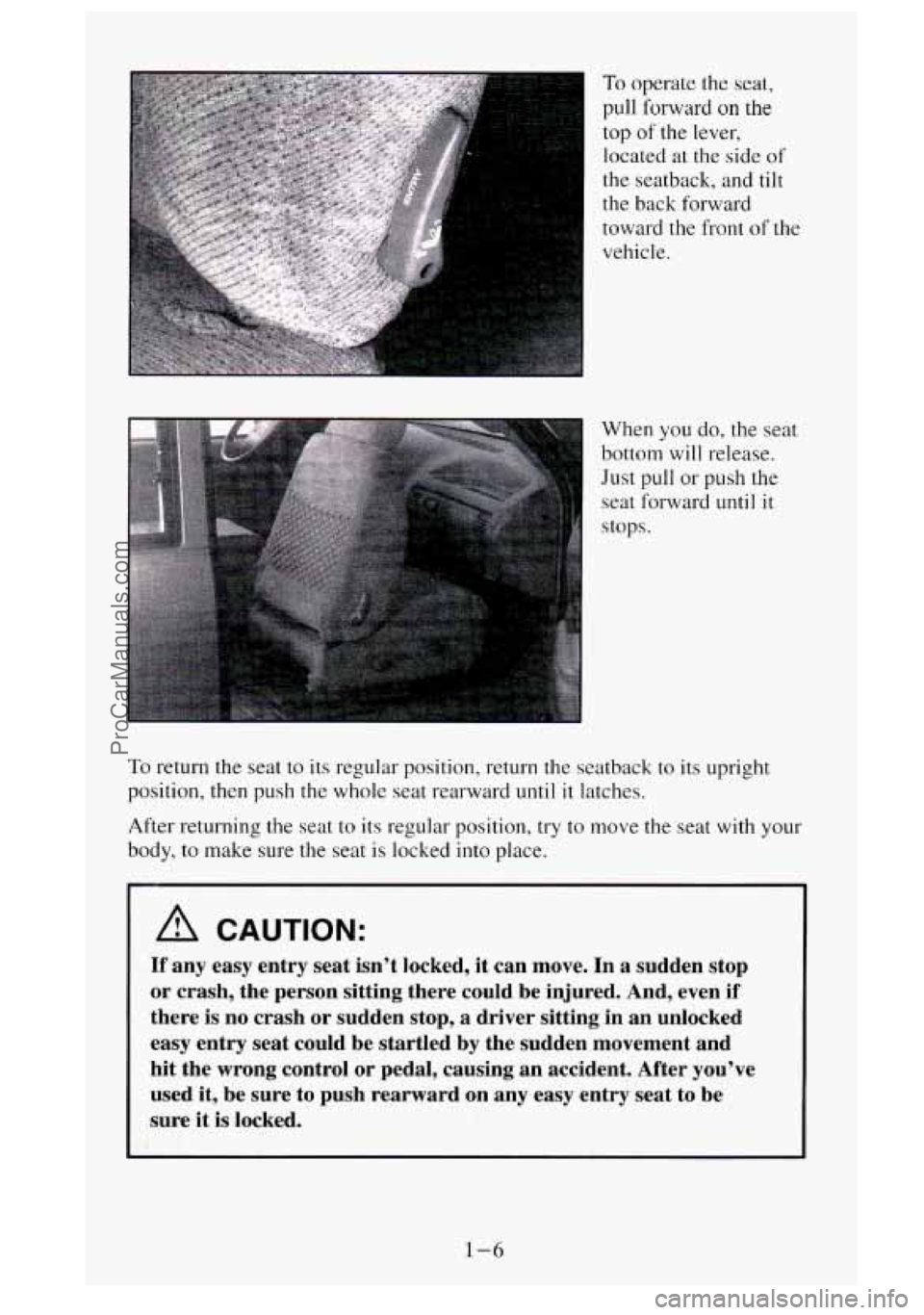
To operate the seat,
pull forward
on the
top of the lever,
located at the side
of
the seatback, and tilt
the back forward
toward the front
of the
vehicle.
When
you do, the seat
bottom will release.
Just
pull or push the
seat forward
until it
stops.
To return the seat to its regular position, return the seatback to its upright
position, then push the whole seat rearward until
it latches.
After returning the seat to its regular position, try to move the seat with your
body, to
make sure the seat is locked into place.
A CAUTION:
If any easy entry seat isn’t locked, it can move. In a sudden stop
or crash, the person sitting there could be injured. And, even
if
there is no crash or sudden stop, a driver sitting in an unlocked
easy entry seat could be startled by the sudden movement and
hit the wrong control or pedal, causing an accident. After you’ve
used it, be sure to push rearward
on any easy entry seat to be
sure
it is locked.
1-6
ProCarManuals.com
Page 24 of 488
Rear Seat (Crew Cab)
You can adjust the seat by sliding the lever at the front of the seat toward the
seat
support to unlock it. Then, slide the seat to where you want it. Release
the lever and try
to move the seat with your body, to make sure the seat is
locked into place.
Seatback Latch (Rear Bench Seat Without Center
Armrest)
The rear seatback can be folded forward to let you reach the area behind it.
Your seatback will move back and forth freely, unless you come to a sudden
stop. Then, it will lock into place.
Seatback Latch (Rear Bench Seat With Center
Armrest)
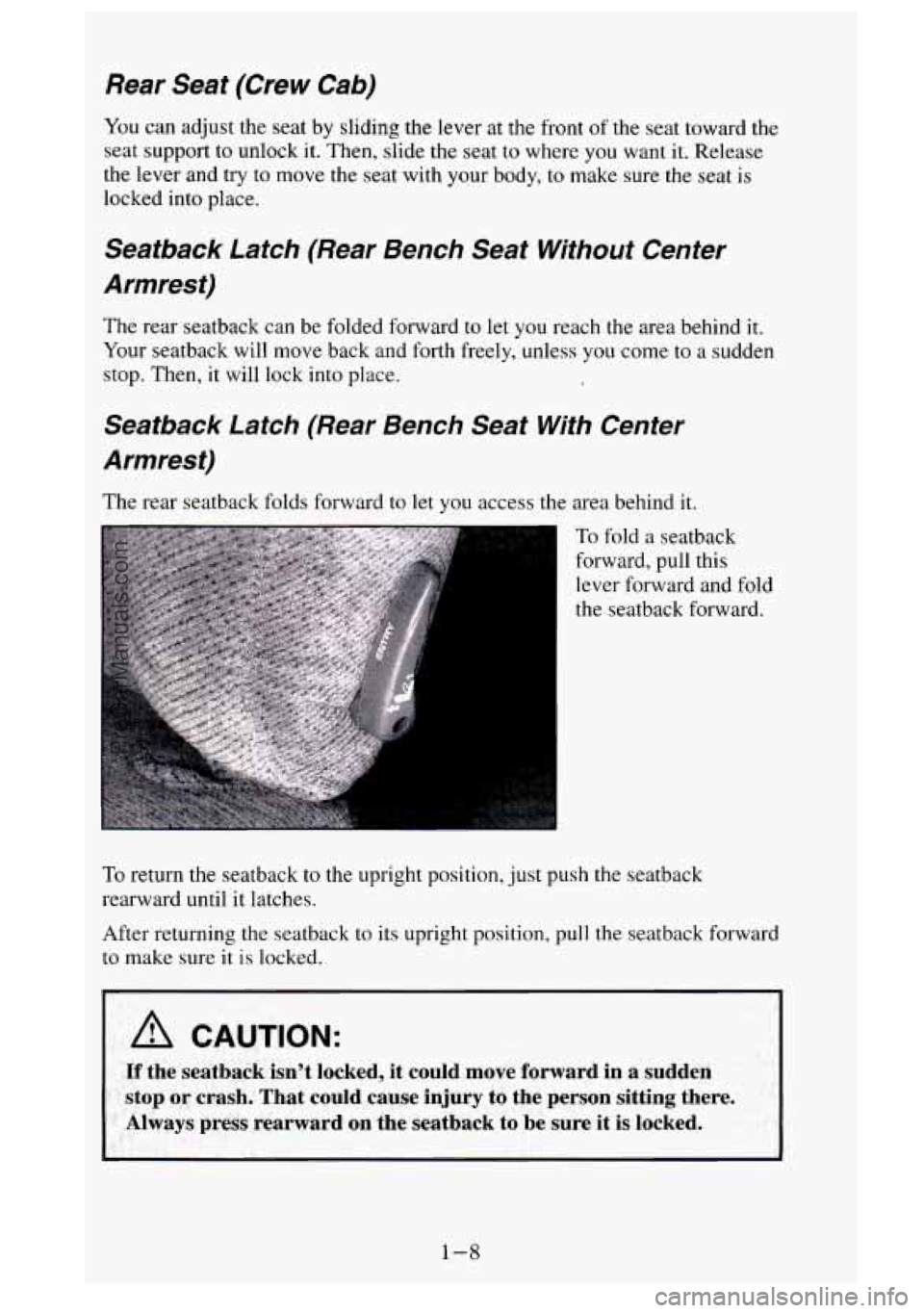
The rear seatback folds forward to let you access the area behind it.
To fold a seatback
forward, pull this
lever forward and fold
the seatback forward.
To return the seatback
to the upright position, just push the seatback
rearward until it latches.
After returning the seatback to its upright position, pull the seatback forward
to make sure it is locked.
A CAUTION:
If the seatback isn’t locked, it could move forward in a sudden
stop
or crash. That could cause injury to the person sitting there.
Always press rearward on the seatback to be sure it
is locked.
1-8
ProCarManuals.com
Page 38 of 488
impact more evenly over the occ.upant’s upper body, stopping the occupant
more gradually. But air bags would not help you
in many types of collisions,
including rollovers and rear and side impacts, primarily because an
occupant’s motion
is not toward the air bag. Air bags should never be
regarded
as anything more than a supplement to safety belts, and then only
in moderate to severe frontal or near-frontal collisions.
What will you see after an air bag inflates?
After the air bag inflates, it quickly deflates. This occurs so quickly that
some people may not even realize the air bag inflated. Some components of
the air bag module
in the steering wheel hub will be hot for a short time, but
the part of the bag that comes into contact with you will not be hot to the
touch. There will be some smoke
and dust coming from vents in the deflated
air bag. Air bag inflation
will not prevent the driver from seeing or from
being able to steer the vehicle, nor
will it stop people from leaving the
vehicle.
A CAUTION:
When an air bag inflates, there is dust in the air. This dust could
cause breathing problems for people with
a history of asthma or
other breathing trouble. To avoid this, everyone in the vehicle
should get out as soon as it
is safe to do so. If you have breathing
problems but can’t get out of the vehicle after an air bag\
inflates,
then get fresh air
by opening a window or door.
e
e
0
The air bag is designed to inflate only once. After it inflates, you’ll
need some new parts for your air bag system.
If you don’t get them, the
air
bag system won’t be there to help protect you in another crash. A
new system
will include the air bag module and possibly other parts.
The service manual for your vehicle covers the need to replace other
parts.
Your vehicle is equipped with a diagnostic module, which records
information about the air bag system. The module records information
about the readiness of the system, when
the sensors are activated and
driver’s safety belt usage at deployment.
Let only qualified technicians work on your air bag system. Improper
service can mean that your air bag system won’t work properly. See
your dealer for service.
1-22
ProCarManuals.com
Page 58 of 488
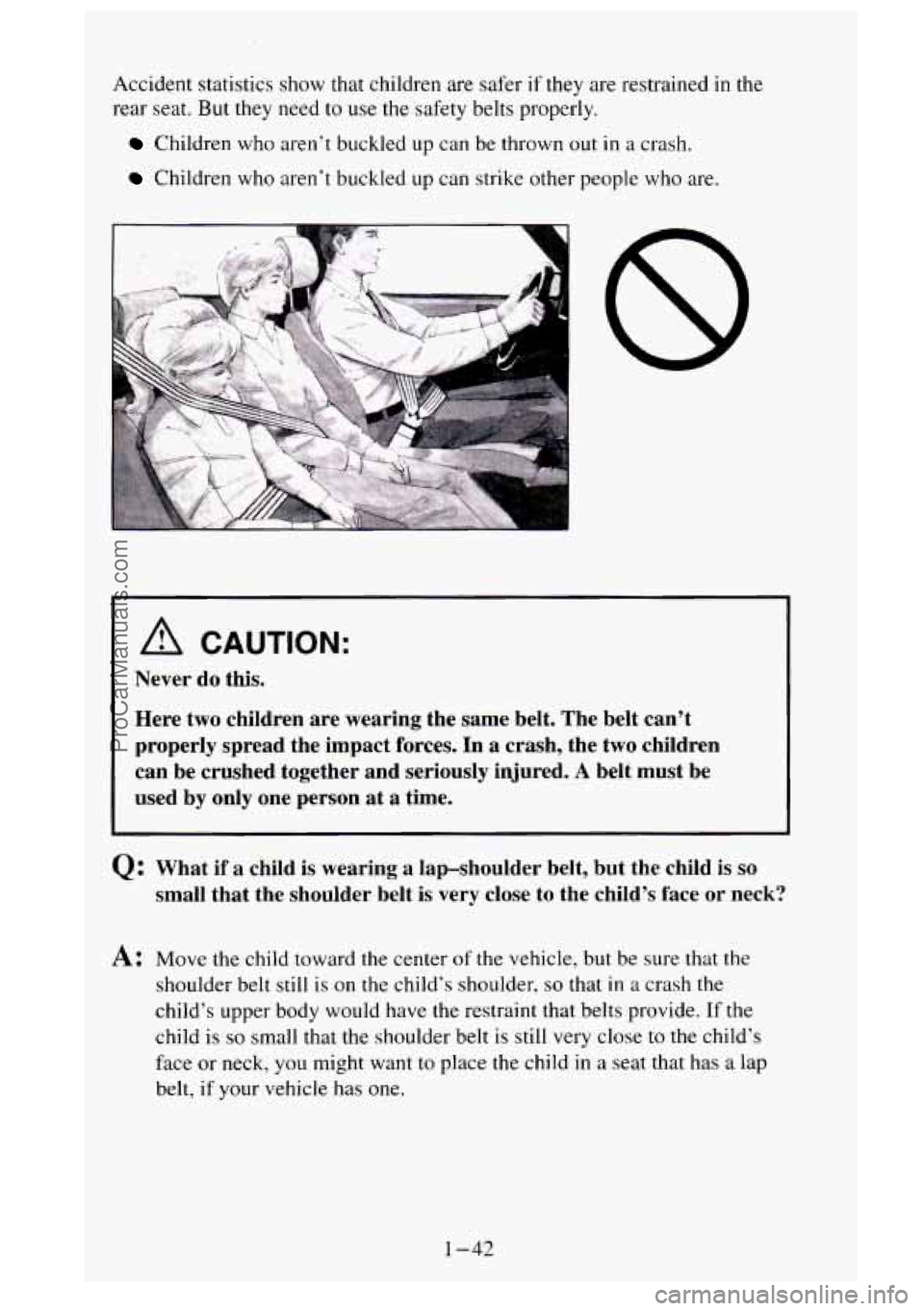
Accident statistics show that children are safer if they are restrained in the
rear seat. But they need
to use the safety belts properly.
Children who aren’t buckled up can be thrown out in a crash.
Children who aren’t buckled up can strike other people who are.
~ A CAUTION:
Never do this.
Here two children are wearing the same belt. The belt can’t
properly spread the impact forces.
In a crash, the two children
can be crushed together and seriously injured.
A belt must be
used by only one person at a time.
Q: What if a child is wearing a lap-shoulder belt, but the child is so
small that the shoulder belt is very close to the child’s face or neck?
A: Move the child toward the center of the vehicle, but be sure that the
shoulder belt still is
on the child’s shoulder, so that in a crash the
child’s upper body would have the restraint that belts provide. If the
child is
so small that the shoulder belt is still very close to the child’s
face
or neck, you might want to place the child in a seat that has a lap
belt, if your vehicle has one.
1-42
ProCarManuals.com
Page 65 of 488
Your Doors and How They Work
Side Doors
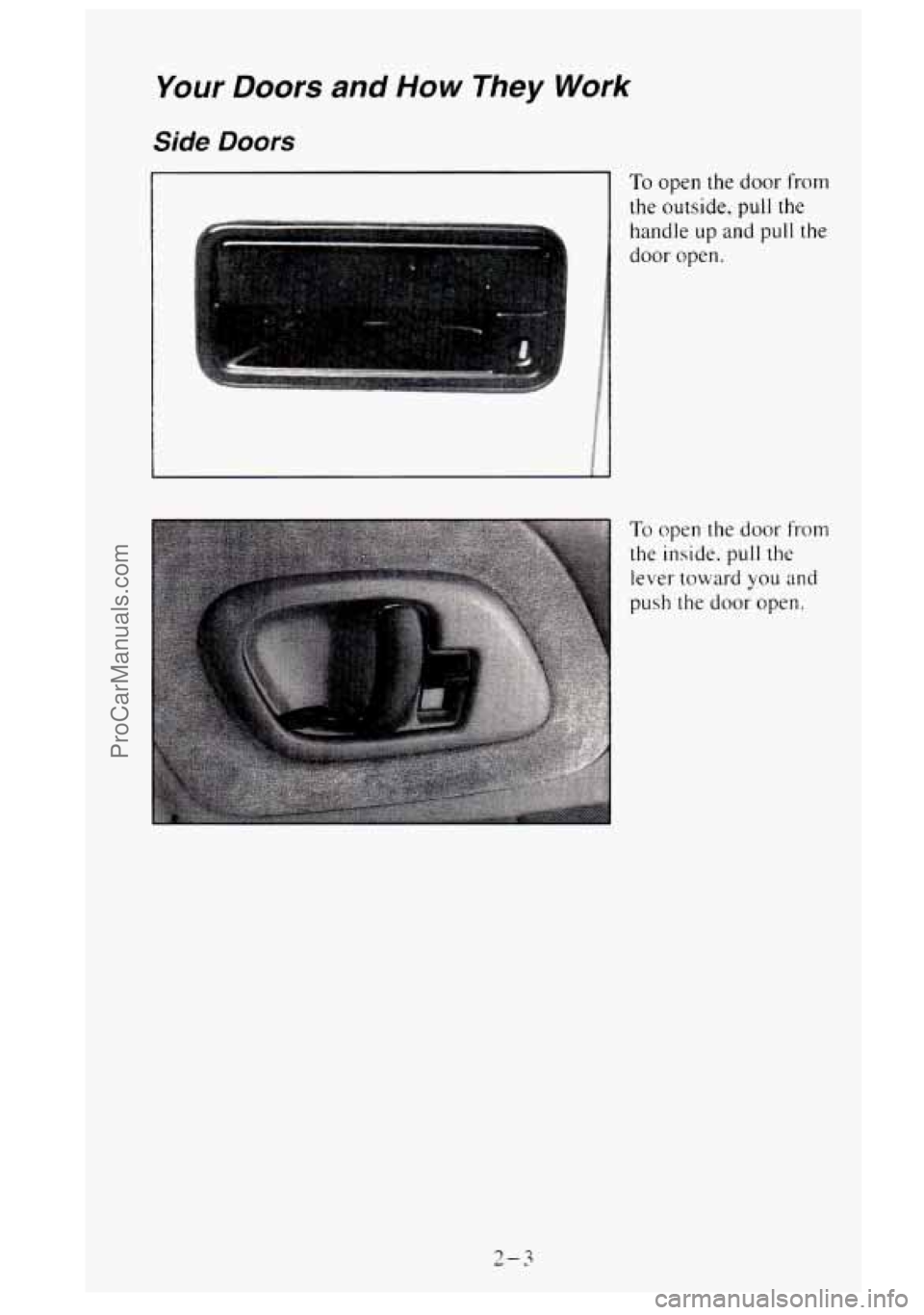
To open the door from
the outside. pull the
handle up and pull the
door open.
To open the door from
the inside. pull the
lever toward
you and
push the door open.
2-3
ProCarManuals.com
Page 66 of 488
Tailgate
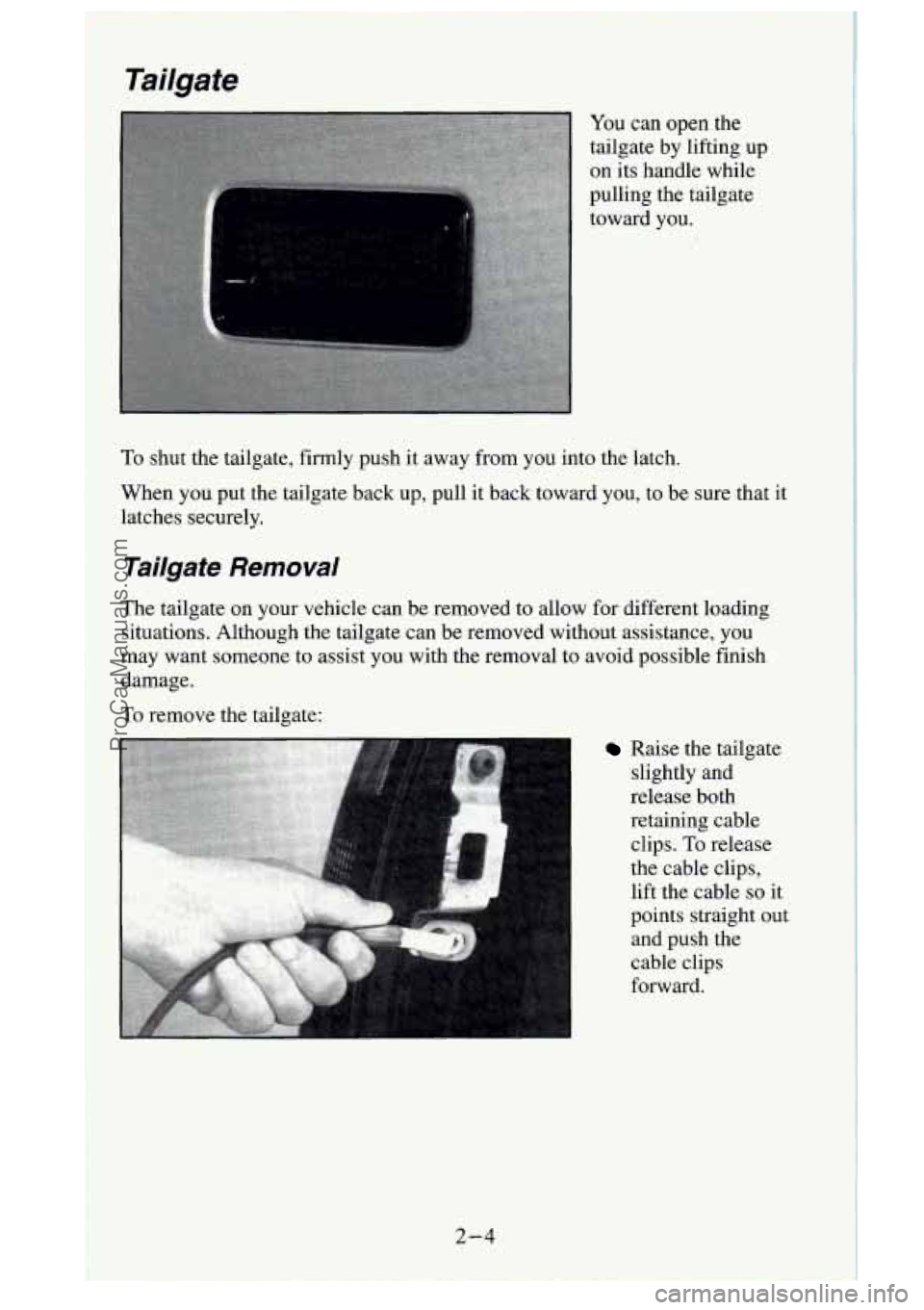
You can open the
tailgate by lifting up
on its handle while
pulling the tailgate
toward you.
To shut the tailgate, firmly push it away from you into the latch.
When you put the tailgate back up, pull it back toward you, to be sure that it
latches securely.
Tailgate Removal
The tailgate on your vehicle can be removed to allow for different loading
situations. Although the tailgate can be removed without assistance, you
may want someone to assist you with the removal to avoid possible finish
damage.
To remove the tailgate:
Raise the tailgate slightly and
release both
retaining cable
clips. To release
the cable clips,
lift the cable so it
points straight out
and push the
cable clips forward.
2-4
7 F
ProCarManuals.com
Page 71 of 488
Key in the Ignition
If you walk away from your vehicle with the keys inside, it’s an easy target
for joy riders or professional thieves
- so don’t do it.
When you park your vehicle and open the driver’s door, you‘ll hear a tone
reminding
you to remove your key from the ignition and take it with you.
Always do this.
Your steering wheel will be locked, and so will your
ignition. If you have
an automatic transmission, taking your key out also
locks your transmission. And remember to lock the doors.
Parking at Night
Park in a lighted spot, close all windows and lock your vehicle. Remember
to keep
your valuables out of sight. Put them in a storage area, or take them
with
you.
Parking Lots
If you park in a lot where someone will be watching your vehicle, it‘s best
to lock
it up and take your keys. But what if you have to leave your ignition
key? What if
you have to leave something valuable in your vehicle?
Put your valuables in a storage area, like your glove box.
Lock all the doors except the driver’s.
New Vehicle “Break-In ”
NOTICE:
Your modern vehicle doesn’t need an elaborate “break-in.” But
it will perform better in the long run if you follow these
guidelines:
Keep your speed at 55 mph (88 km/h) or less for the first 500
miles (804 km).
Don’t drive at any one speed - fast or slow - for the first
500 miles
(804 km). Don’t make full-throttle starts.
Avoid making hard stops for the first 200 miles (322 km) or
so. During this time your new brake linings aren’t yet broken
in. Hard stops with new linings can mean premature wear and
earlier replacement. Follow this “breaking-in” guideline
every time you get new brake linings.
Don’t tow a trailer during “break-in.” See “Towing a Trailer”
in the Index
for more information.
2-9
ProCarManuals.com
Page 72 of 488
New Vehicle “Break-In” - 3500 HD Model
If you have a 3500 HD model, your parking brake requires a special
break-in procedure. See “Parking Brake”
in the Index.
Ignition Switch
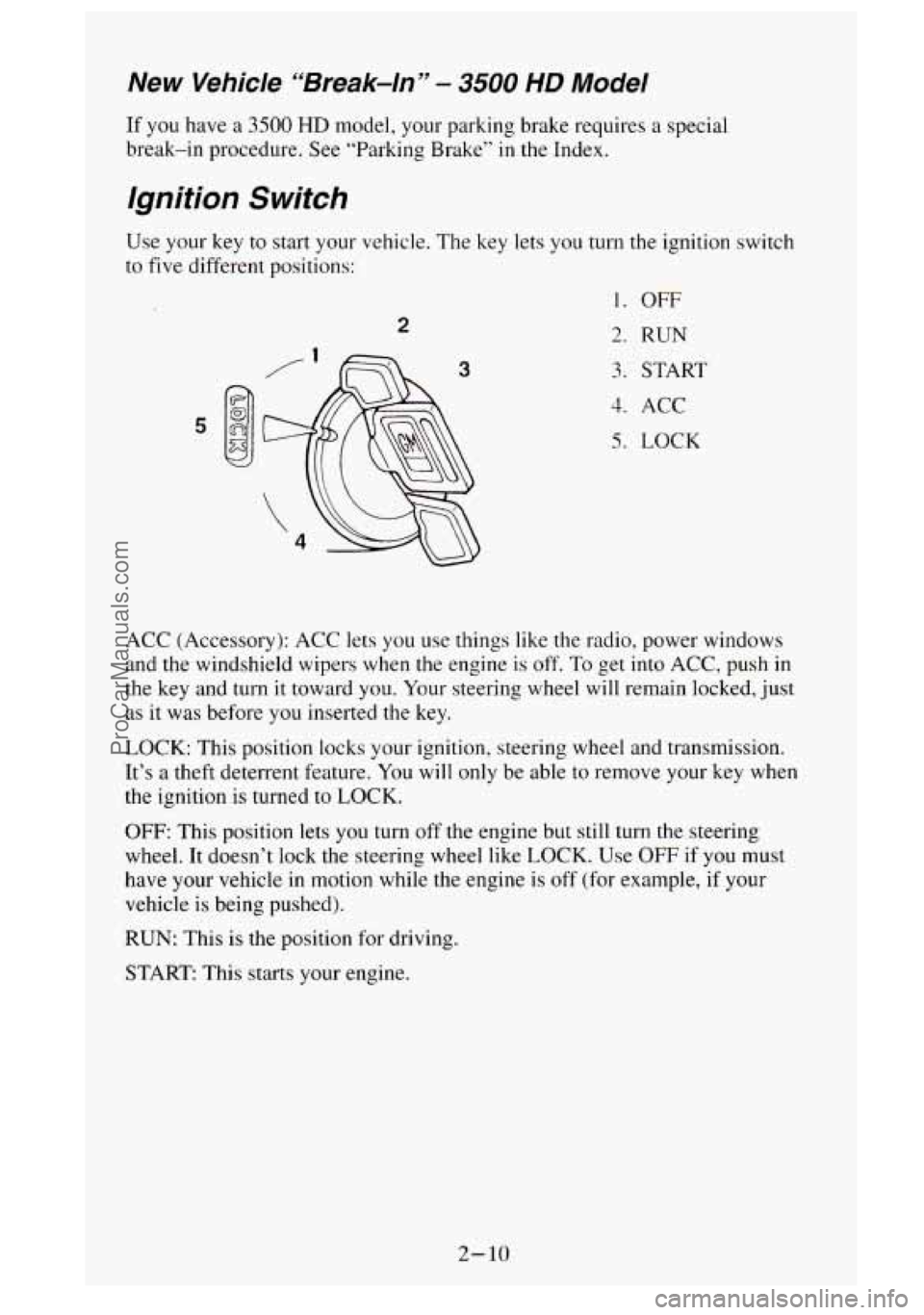
Use your key to start your vehicle. The key lets you turn the ignition switch
to five different positions:
2
5
1. OFF
2. RUN
3. START
4. ACC
5. LOCK
ACC (Accessory):
ACC lets you use things like the radio, power windows
and the windshield wipers when the engine is off. To get into ACC, push in
the key and turn it toward you. Your steering wheel will remain locked, just
as it was before you inserted the key.
LOCK: This position locks your ignition, steering wheel and transmission.
It’s
a theft deterrent feature. You will only be able to remove your key when
the ignition
is turned to LOCK.
OFF: This position lets you turn off the engine but still turn the steering
wheel. It doesn’t lock the steering wheel like LOCK. Use
OFF if you must
have your vehicle
in motion while the engine is off (for example, if your
vehicle is being pushed).
RUN: This is the position for driving.
START: This starts your engine.
2- 10
ProCarManuals.com
Page 75 of 488
key in START for no more than ten seconds. This clears the extra
gasoline from the engine.
If the engine still doesn’t start, wait another
15 seconds and do Step 4
again.
When the engine starts, let go
of the key and the accelerator pedal.
NOTICE:
Your engine is designed to work with the electronics in your
vehicle.
If you add electrical parts or accessories, you could
change the
way the fuel injection system operates. Before adding
electrical equipment, check with your dealer.
If you don’t, your
engine might not perform properly.
If you ever have to have your vehicle towed, see t,he part of this
manual that tells how to do it without damaging your vehicle.
See “Towing Your Vehicle” in the Index.
To start your 5.7 Liter (Code K) or 7.4 Liter (Code N) V8 engine:
1. Without pushing the accelerator pedal, turn your ignition key to
START. When the engine starts, let go of the key. The idle speed will
go down as your engine gets warm.
NOTICE:
Holding your key in START for longer than 15 seconds at a time
will cause your battery to be drained much sooner. And the
excessive heat can damage your starter motor.
2. If it doesn’t start right away, hold your key in START. If it doesn’t start
in three seconds, push the accelerator pedal about one-quarter of the
way down for
12 more seconds, or until it starts.
3. If your engine still won’t start (or starts but then stops), it could be
flooded with too much gasoline. Try this:
4. Wait 15 seconds to let the starter motor cool down. Then push your
accelerator pedal
all the way to the floor. Hold it there. Then hold the
key
in START for no more than ten seconds. This clears the extra
gasoline from
the engine. If the engine still doesn’t start, wait another
15 seconds and do Step 4 again.
When
the engine starts, let go of the key and the accelerator pedal.
2- 13
ProCarManuals.com