weight GMC SIERRA 1995 User Guide
[x] Cancel search | Manufacturer: GMC, Model Year: 1995, Model line: SIERRA, Model: GMC SIERRA 1995Pages: 488, PDF Size: 26.01 MB
Page 217 of 488
Most vehicles are ready for some trailer towing. If yours was built with
trailering options,
as many are, it’s ready for heavier trailers. But trailering
is different than just driving your vehicle by itself. Trailering means changes
in handling, durability, and fuel economy. Successful, safe trailering takes
correct equipment, and
it has to be used properly.
That’s the reason for this part.
In it are many time-tested, important
trailering tips and safety rules. Many of these are important for your safety
and that of your passengers.
So please read this section carefully before you
pull a trailer.
If You Do Decide To Pull A Trailer
If you do, here are some important points.
e
e
a
0
a
There are many different laws, including speed limit restrictions,
having to do with trailering. Make sure your rig will be legal, not only
where you live but also where you’ll be driving.
A good source for this
information can be state or provincial police.
Consider using
a sway control if your trailer will weigh 4,000 pounds
(I 800 kg) or less. You should always use a sway control if your trailer
will weigh more than
4,000 pounds (1 800 kg). You can ask a hitch
dealer about sway controls.
Don’t tow
a trailer at all during the first 500 miles (800 km) your new
vehicle
is driven. Your engine, axle or other parts could be damaged.
Then, during the first
500 miles (800 km) that you tow a trailer, don‘t
drive over
50 mph (80 kdh) and don’t make starts at full throttle. This
helps your engine and other parts of your vehicle wear
in at the heavier
loads.
If you have an automatic transmission, you should use DRIVE (3) (or,
as you need to, a lower gear) when towing a trailer. Operating your
vehicle in DRIVE
(3) when towing a trailer will minimize heat
build-up and extend the life
of your transmission. If you have a manual
transmission and you are towing
a trailer, it’s better not to use FIFTH
(5) gear. Just drive in FOURTH (4) gear (or, as you need to, a lower
gear).
Three important considerations have
to do with weight:
Weight of the Trailer
How heavy can a trailer safely be?
It depends on how you plan to use your rig. For example, speed, altitude,
road grades, outside temperature and how much your vehicle is used
to pull
a trailer are all important. And, it can
also depend on any special equipment
that you have on your vehicle.
4-43
ProCarManuals.com
Page 218 of 488
You can ask your dealer for our trailering information or advice, or you can
write us at the address listed
in your Warranty and Owner Assistance
Information Booklet.
In Canada, write to:
General Motors
of Canada Limited
Customer Assistance Center
1908 Colonel Sam Drive
Oshawa, Ontario
Ll H 8P7
Weight of the Trailer Tongue
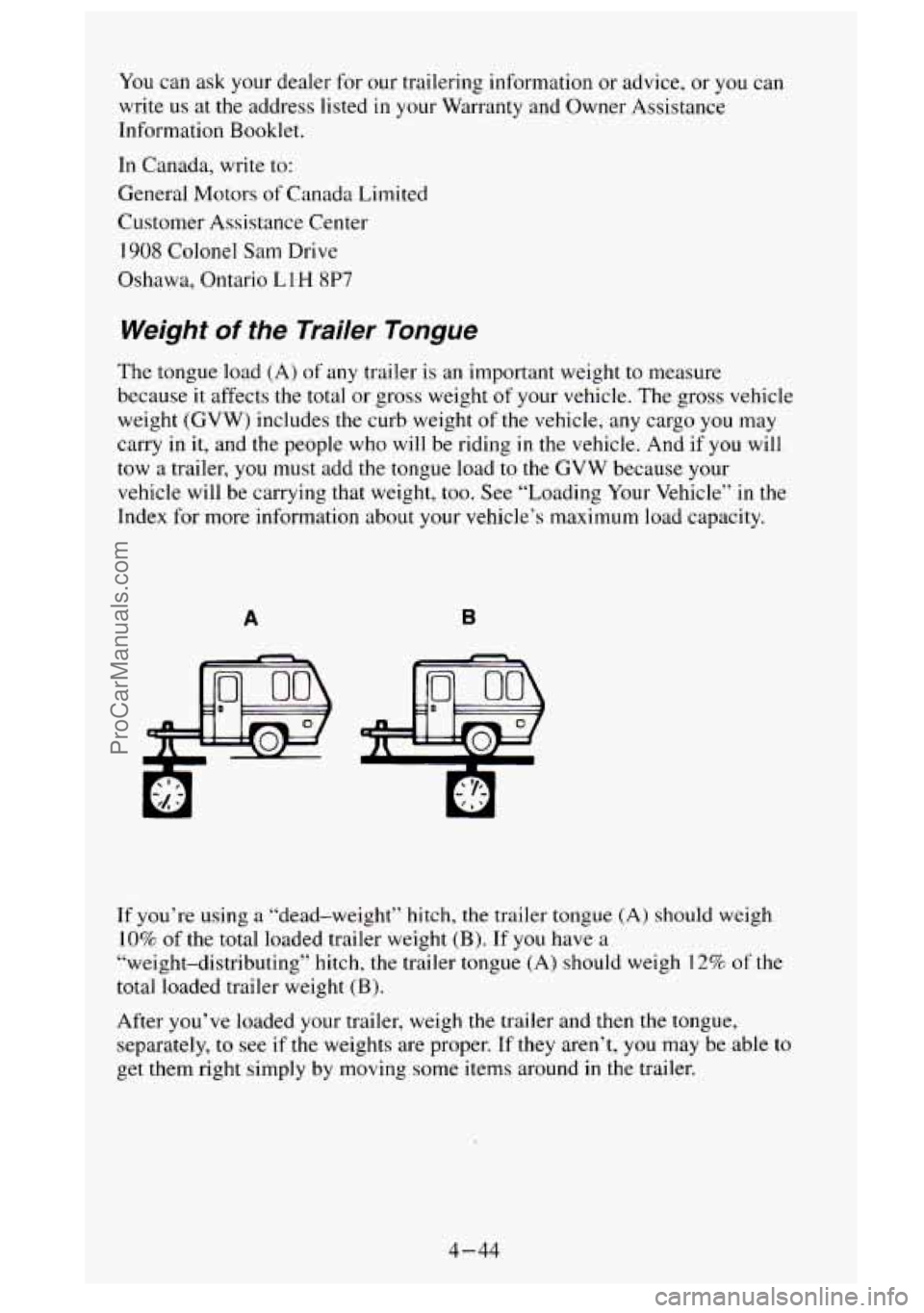
The tongue load (A) of any trailer is an important weight to measure
because
it affects the total or gross weight of your vehicle. The gross vehicle
weight (GVW) includes
the curb weight of the vehicle, any cargo you may
carry
in it, and the people who will be riding in the vehicle. And if you will
tow a trailer, you must add the tongue load to
the GVW because your
vehicle will be carrying that weight, too. See “Loading Your Vehicle”
in the
Index
for more information about your vehicle’s maximum load capacity.
A B
If you’re using a “dead-weight” hitch, the trailer tongue (A) should weigh
10% of the total loaded trailer weight (B). If you have a
“weight-distributing” hitch,
the trailer tongue (A) should weigh 12% of the
total loaded trailer weight
(B).
After you’ve loaded your trailer, weigh the trailer and then the tongue,
separately,
to see if the weights are proper. If they aren’t, you may be able to
get them right simply by moving some items around in the trailer.
4-44
ProCarManuals.com
Page 219 of 488
Total Weight on Your Vehicle’s Tires
Be sure your vehicle‘s tires are inflated to the limit for cold tires. You’ll find
these numbers on the Certification label at the rear
edge of the driver’s door
or see “Tire Loading“
in the Index. Then be sure you don‘t go over the
GVW limit for your vehicle, includins the weight of the trailer tongue.
Hitches
It’s important to have the correct hitch equipment. Crosswinds, large trucks
going by, and rough roads are
a few reasons why you’ll need the right hitch.
Here are some rules to follow:
e
e
If you use a step bumper hitch, and your trailer tongue has a V-shaped
foot. your bumper could be damaged
in sharp turns. Check the distance
from the front edge
of the foot to the middle of the hitch ball socket. If
the distance is less than 12 inches, take the foot off the trailer tongue.
If you‘ll be pulling a trailer that, when loaded,
will weigh more than
4,000 pounds
( 1 8 14 kg) be sure to use a properly mounted,
weight-distributing hitch and sway control
of the proper size. This
equipment is very important for proper vehicle loading and good
handling when you’re driving.
Safety Chains
You should always attach chains between your vehicle and your trailer.
Cross the safety chains under the tongue
of the trailer so that the tongue will
not drop to the road if it becomes separated from the hitch. Instructions
about safety chains may be provided by the hitch manufacturer or by the
trailer manufacturer. Follow the manufacturer’s recommendation for
attaching safety chains and do not attach them to the bumper. Always leave
just enough slack
so you can turn with your rig. And, never allow safety
chains to drag on the ground.
Trailer Brakes
If your trailer weighs more than 1,000 pounds (450 kg) loaded, then it needs
its own brakes
- and they must be adequate. Be sure to read and follow the
instructions for the trailer brakes
so you’ll be able to install. adjust and
maintain them properly.
Your trailer brake system can tap into your vehicle’s hydraulic brake system,
but consider the following:
Don’t tap into your vehicle’s brake system if the trailer’s brake system
will use more than 0.02 cubic inch (0.3~~)
of fluid from your vehicle’s
master cylinder.
Tf it does, both braking systems won’t work well. You
could even lose your brakes.
4-45
ProCarManuals.com
Page 220 of 488
Will the trailer brake parts take 3,000 psi (20 650 Wa) of Ijressure? If
not, the trailer brake system must not be used with your vehicle.
Driving with a Trailer
Towing a trailer requires a certain amount of experience. Before setting out
for the open road, you’ll want to get to know your rig. Acquaint yourself
with the feel of handling and braking with the added weight of the trailer.
And always keep in mind that the vehicle you
are driving is now a good
deal longer and not nearly as responsive as your vehicle is by itself.
Before you start, check the trailer hitch and platform (and attachments),
safety chains, electrical connector, lamps, tires and mirror adjustment. If the
trailer has electric brakes, start your vehicle and trailer moving and then
apply the trailer brake controller by hand to be sure the brakes
are working.
‘This lets you check your electrical connection at the same \
time.
During your trip, check occasionally to be sure that the load is secure, and
that the lamps and any trailer brakes
are still working.
Following Distance
Stay at least twice as far behind the vehicle ahead as you would when
driving your vehicle without a trailer.
This can help you avoid situations that
require heavy braking and sudden turns.
Passing
You’ll need more passing distance up ahead when you’re towing a trailer.
And, because you’re a good deal longer, you’ll need to go much farther
beyond the passed vehicle before you can return to your lane.
.
Backing Up
Hold the bottom of the steering wheel with one hand. Then, to move the
trailer to the left, just move that hand to the left.
To move the trailer to the
right, move your hand to the right. Always back
up slowly and, if possible,
have someone guide you.
4-46
ProCarManuals.com
Page 271 of 488
Canadian Fuels
Diesel-powered trucks are now equipped with emission control systems that
require the use of diesel fuel with low-sulfur
(.05% by weight) content.
Both low- and higher-sulfur fuels will be available
in Canada. Only
low-sulfur diesel fuels are available
in the United States. It is important that
diesel-powered trucks are refueled with low-sulfur fuel. Use of fuels with
higher-sulfur content will affect
the function of the emission components
and may cause reduced performance, excessive smoke and unpleasant odor.
Cold Weather Operation
Follow the instructions listed previously under the heading “What Fuel to
Use.”
If you’re driving
in very toold temperatures and can’t get a “winterized”
Number
2-D that has been adapted to cold weather or a Number 1-D, you
can
use one gallon of kerosene for every two gallons of diesel fuel. Once
you add the kerosene, run your engine for several minutes
so the fuels will
mix. Add kerosene only when the temperature falls below 0°F (-1 S”C),
because the fuel economy of kerosene isn’t as good as that of diesel fuel.
NOTICE:
Never use home heating oil or gasoline in your diesel engine. \
They can cause engine damage.
In cold weather, your fuel filter may become clogged (waxed). To unclog it,
warm the filter to between
32°F and 50°F (OOC to 10°C). You won’t need
to replace
it.
Water in Fuel
Sometimes, water can be pumped into your fuel tank along with your diesel
fuel. This can happen
if a service station doesn’t regularly inspect and clean
its fuel tanks, or
if it gets contaminated fuel from its suppliers.
If this happens, a WATER
IN FUEL light will come on. If it does, the excess
water must be drained. Your dealer can show
you how to do this.
6-5
ProCarManuals.com
Page 280 of 488
A CAUTION:
If your vehicle has air conditioning, the auxiliary engine fan
under the hood can start up and injure you even when the
engine is not running. Keep hands, clothing and tools
away from
any underhood electric fan.
A CAUTION:
Things that burn can get on hot engine parts and start a fire.
These include liquids like gasoline or diesel fuel, oil, coolant,
brake fluid, windshield washer and other fluids, and plastic
or
rubber. You or others could be burned. Be careful not to drop or
spill things that
will burn onto a hot engine.
Before closing the hood, be sure
all filler caps are on properly. Pull down
the
hood and close it firmly.
Cleaning Your Diesel Engine
I NOTICE:
If you spray or pour water or any other liquid on your engine
when it is warm or hot, or when it
is running, you could cause
serious damage to it.
If you ever clean the engine, clean it only
when it is cold.
Noise Control System
The following information relates to compliance with Federal noise
emission standards for vehicles with a Gross Vehicle Weight Rating
(GVWR)
of more than 10,000 pounds (4 536 kilograms). The Maintenance
Schedule booklet provides information on maintaining
the noise control
system to minimize degradation of the noise emission control system during
the life of your vehicle. The noise control system warranty is given in your
Warranty booklet.
These standards apply only
to vehicles sold in the United States.
6-14
ProCarManuals.com
Page 360 of 488
If your engine has more than one emissions classification, the classification
is determined by the Gross Vehicle Weight Rating (GVWR) of your vehicle
as shown on the Certification Label. See “Loading Your Vehicle”
in the
Index.
Once you’ve determined your engine type and,
if necessary, emissions
classification, you’ll need to decide which of the two schedules is right for
your vehicle. See Definitions for Maintenance Schedule
I and Maintenance
Schedule
I1 following.
Schedule I Definition - Gasoline Engines With Light Duty
Emissions
Follow Maintenance Schedule I if any one of these is true for your vehicle:
iII Most trips are less than 5 to 10 miles (8 to 16 km). This is particularly
important when outside temperatures are below freezing.
0 Most trips include extensive idling (such as frequent driving in
stop-and-go traffic).
You operate your vehicle in dusty areas or off-road frequently.
0 You frequently tow a trailer.
Schedule
I should also be followed if the vehicle is used for delivery
service, police, taxi, or other commercial application.
Schedule I Intervals - Gasoline Engines With Light Duty
Emissions
Every
3,000 Miles (5 000 km) or 3 Months, Whichever Occurs First
Engine Oil and Filter Change
Chassis Lubrication
Drive Axle Service
At 6,000 Miles (10 000 km) - Then Every 12,000 Miles (25 000 km)
Tire Rotation
Every 75,000 Miles (25 000 km)
Air Cleaner Filter Inspection, if driving in dusty conditions
Front Wheel Bearing Repack
(or at each brake relining) (2WD Only)
7-4
ProCarManuals.com