engine oil GMC SIERRA 1995 Owner's Manual
[x] Cancel search | Manufacturer: GMC, Model Year: 1995, Model line: SIERRA, Model: GMC SIERRA 1995Pages: 488, PDF Size: 26.01 MB
Page 284 of 488
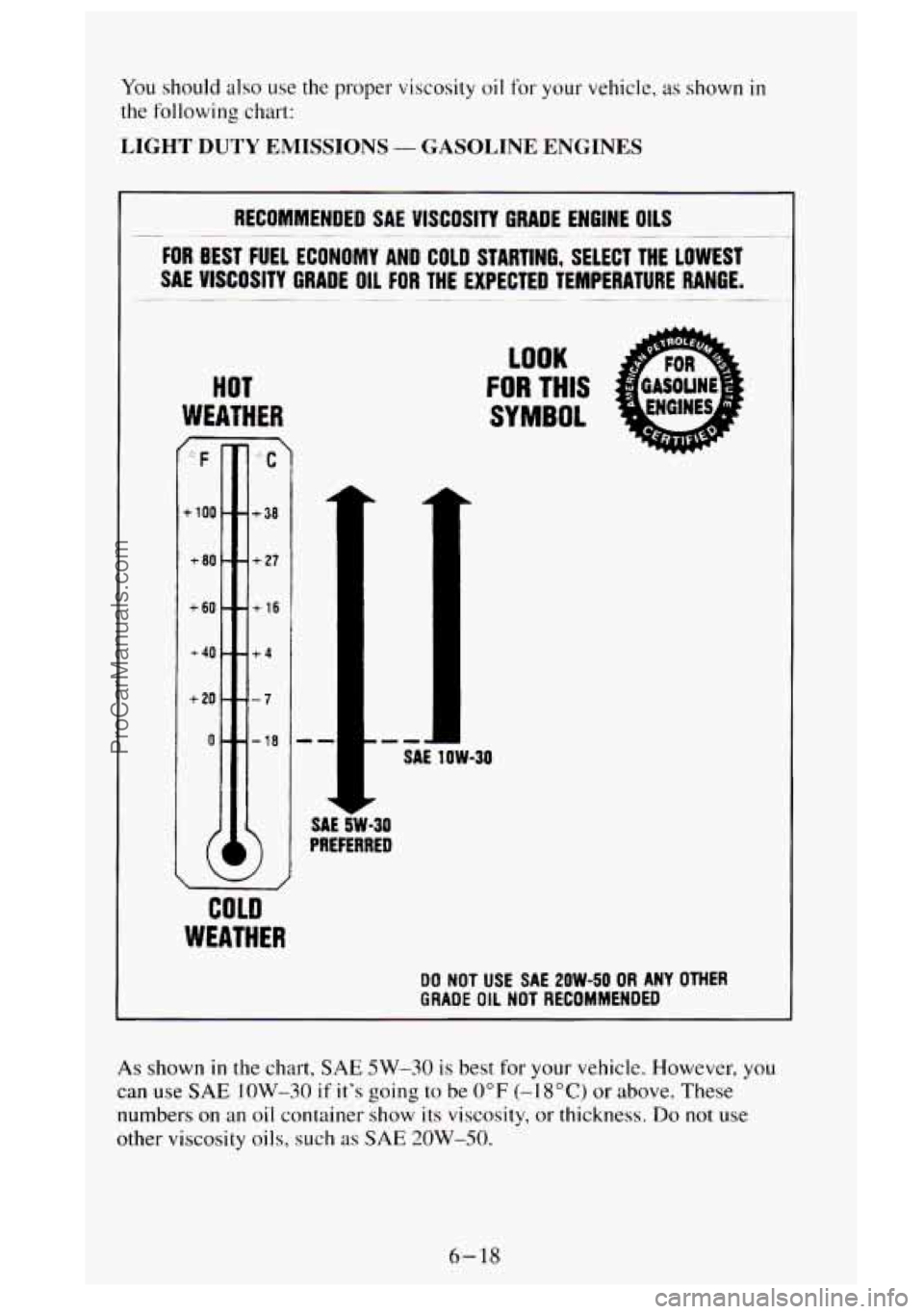
You should also use the proper viscosity oil for your vehicle, as shown in
the following chart:
LIGHT DUTY EMISSIONS - GASOLINE ENGINES
FOR BEST FUEL ECONOMY AND COLD STARTING, SELECT THE LOWEST
SAE VISCOSITY GRADE 011 FOR THE EXPECTED TEMPERATURE RANGE.
HOT
WEATHER
WEATHER
n
c
.
SAE IOW-30
L
LOOK
FOR THIS
SYMBOL
r31.
ip
L c,
SAE SW-30
PREFERRED
DO NOT USE SAE 2OW-50 OR ANY OTHER
GRADE OIL NOT RECOMMENDED
As shown in the chart, SAE 5W-30 is best for your vehicle. However, you
can use SAE IOW-30 if it’s going to be 0°F (-I 8°C) or above. These
numbers on
an oil container show its viscosity, or thickness. Do not use
other viscosity oils, such as
SAE 2OW-SO.
6-18
ProCarManuals.com
Page 285 of 488
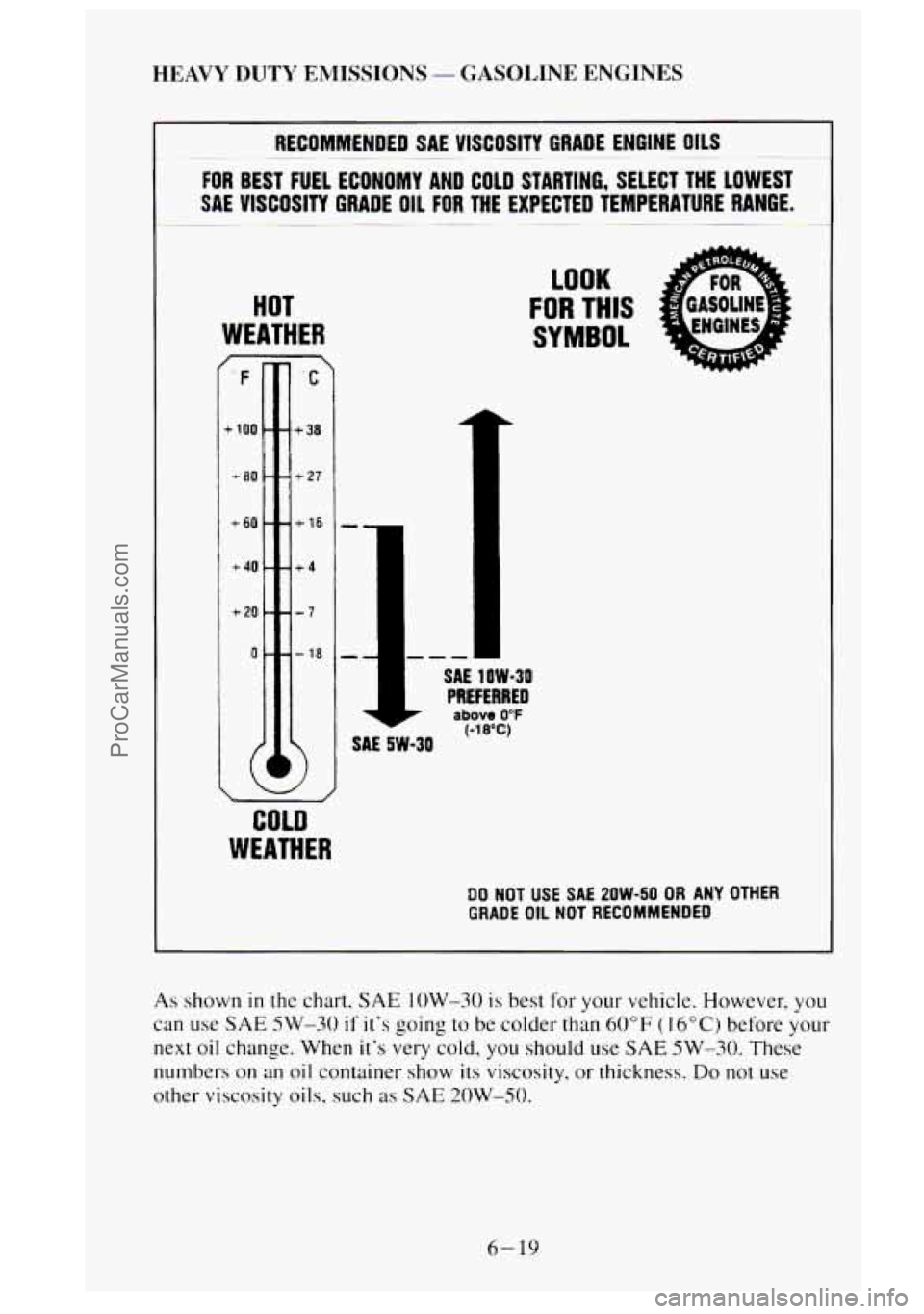
HEAVY DUTY EMISSIONS - GASOLINE ENGINES
RECOMMENDED SAE VISCOSITY GRADE ENGINE OILS ~ ~ ~~~
FOR BEST FUEL ECONOMY AND COLD STARTING, SELECT
THE LOWEST
SAE
VISCOSITY GRADE OIL FOR THE EXPECTED TEMPERATURE RANGE.
HOT
WEATHER
SA€ 5W-30
LOOK
FOR THIS
SYMBOL
SAE 10W-30
PREFERRED
above 0°F (‘1 8°C)
COLD
WEATHER
00 NOT USE SA€ 2OW-50 OR ANY OTHER
GRADE OIL NOT RECOMMENDED
As shown in the chart, SAE 10W-30 is best for your vehicle. However, you
can use SAE SW-30 if it’s going to be colder than 60°F (16°C) before your
next oil change. When it‘s very cold, you should use SAE 5W-30. These
numbers on
an oil container show its viscosity, or thickness. Do not use
other viscosity
oils, such as SAE 2OW-50.
6- 19
ProCarManuals.com
Page 286 of 488

NOTICE:
Use only engine oil with the American Petroleum Institute
Certified For Gasoline Engines “Starburst” symbol. Failure \
to
use the proper oil can result in engine damage not covered
by
your warranty.
GM Goodwrench@ oil (in Canada, GM Engine Oil) meets all the
requirements for your vehicle.
Engine Oil Additives
Don’t add anything to your oil. Your GM dealer is ready to advise if you
think something should be added.
When to Change Engine Oil
See if any one of these is true for you:
Most trips are less than 5 to 10 miles (8 to 16 km). This is particularly
important when outside temperatures are below freezing.
Most trips include extensive idling (such as frequent driving in stop and
go traffic).
Most trips are through dusty areas.
You operate your vehicle in dusty areas or off-road frequently.
You frequently tow a trailer.
If any one
of these is true for your vehicle, then you need to change your oil
and filter every
3,000 miles (5 000 km) or 3 months - whichever comes
first.
Light Duty Emissions:
If none of them is true, change the oil and filter every 7,500 miles (12 500
km) or 12 months - whichever comes first.
Heavy Duty Emissions:
If none of them is true, change the oil and filter every 6,000 miles (10 000
km) or 12 months - whichever comes first.
6-20
ProCarManuals.com
Page 287 of 488
Engine Coolant Heater
An engine coolant heater can be a big help if you have to park outside in
very cold weather, 0°F (-1 8OC) or colder. If your vehicle has this option,
see “Engine Coolant Heater’’ in the Index.
What to Do with Used Oil
Did you know that used engine oil contains certain elements that may be
unhealthy for your skin and could even cause cancer? Don’t let used oil stay
on your skin for very long. Clean your skin and nails with soap and water,
or a good hand cleaner. Wash or properly throw away clothing or rags
containing used engine oil. (See the manufacturer‘s warnings about the use
and disposal of
oil products.)
Used oil can be a real threat to
the environment. If you change your own oil,
be sure to drain all free-flowing oil from the filter before disposal. Don’t
ever dispose
of oil by putting it in the trash, pouring it on the ground, into
sewers, or into streams or bodies
of water. Instead. recycle it by taking it to
a place that collects used oil. If you have a problem properly disposing of
your used oil, ask your dealer, a service station or a local recycling center
for help.
Engine Oil (Diesel Engines)
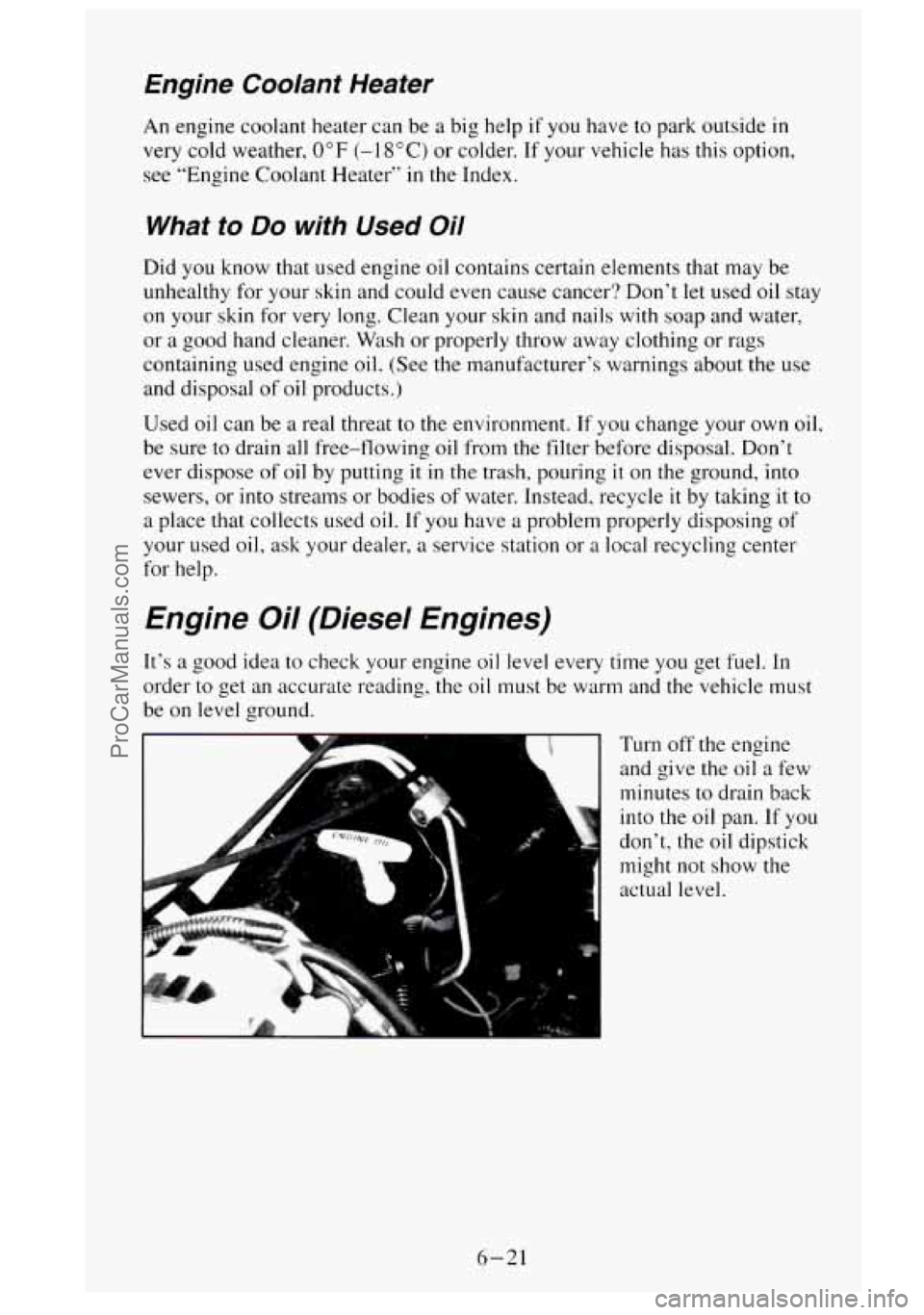
It’s a good idea to check your engine oil level every time you get fuel. In
order to get an accurate reading, the oil must be warm and
the vehicle must
be on level ground.
Turn off the engine
and give the oil
a few
minutes
to drain back
into the
oil pan. If you
don’t, the oil dipstick
might not show the
actual level.
6-21
ProCarManuals.com
Page 288 of 488
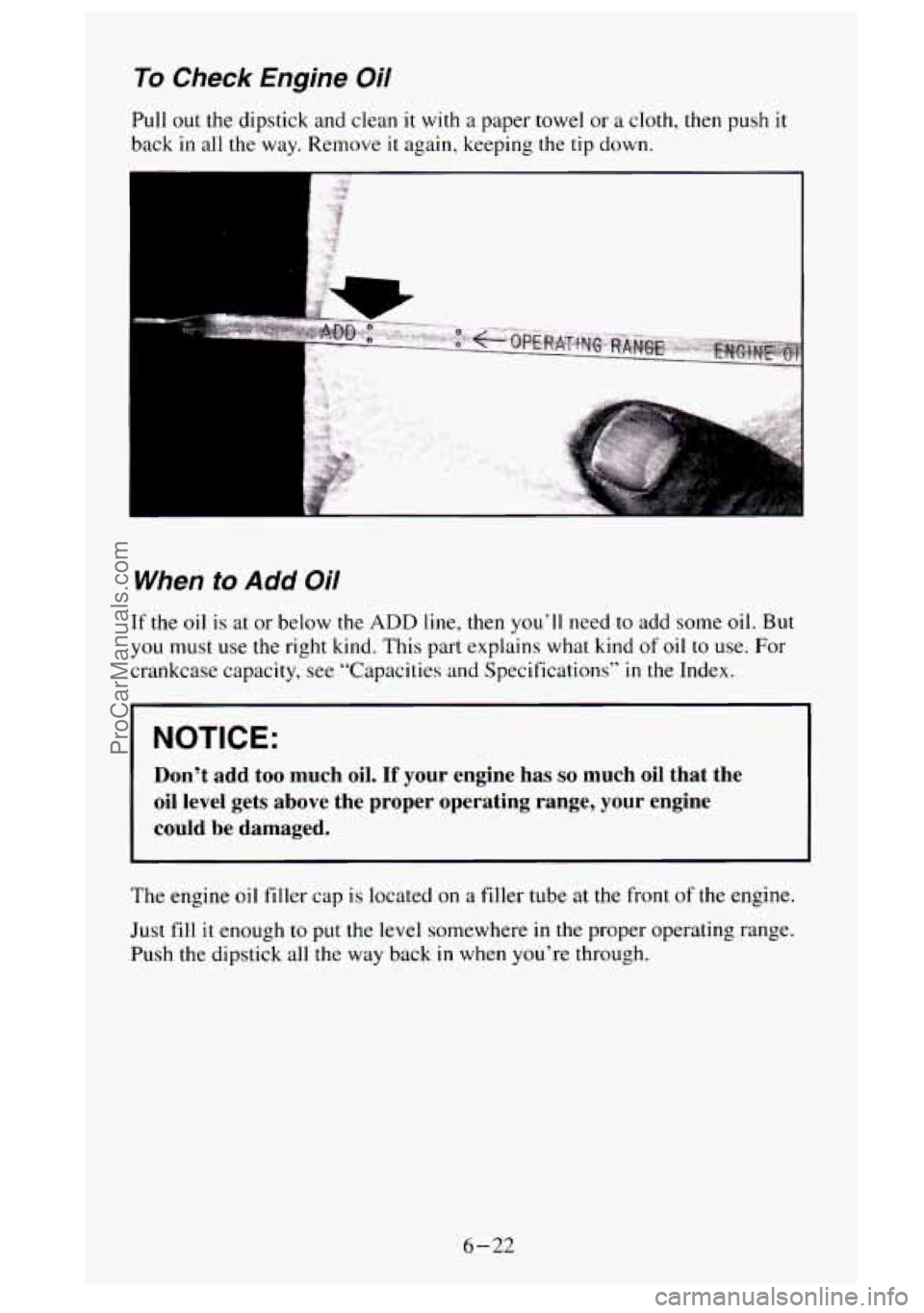
To Check Engine Oil
Pull out the dipstick and clean it with a paper towel or a cloth, then push it
back in all the way. Remove it again, keeping the tip down.
When to Add Oil
If the oil is at or below the ADD line, then you’ll need to add some oil. But
you must use the right kind. This part explains what kind of oil to use. For
crankcase capacity, see “Capacities and Specifications”
in the Index.
I I
I NOTICE: I
Don’t add too much oil. If your engine has so much oil that the
oil level gets above the proper operating range, your engine
could be damaged.
I I
The engine oil filler cap is located on a filler tube at the front of the engine.
Just fill it
enough to put the level somewhere in the proper operating range.
Push the dipstick
all the way back in when you’re through.
6-22
ProCarManuals.com
Page 289 of 488
What Kind of Oil to Use
Look for these two things:
CF-4/SH
CF-4/SH
is the best oil for your vehicle. However. if you can not find
CF4SH oil, you may use
CF4SG or CE/SH or CE/SG oil.
These may be listed as shown or in reverse order, for example
SHKF-4. Other letters may
also be listed, such as SH/CD, CE, CF4.
These letters show American Petroleum Institute
(API) levels of
quality.
NOTICE:
If you use oils that don’t have these designations, you can ca\
use
engine damage which is not covered
by your warranty.
6-23
ProCarManuals.com
Page 290 of 488
DIESEL ENGINES
RECOMMENDED SAE VISCOSITY GRADE ENGINE OILS
SELECT THE SAE GRADE OIL BASE0 ON
THE EXPECTED TEMPERATURE RANGE
BEFORE NEXT OIL CHANGE
HOT
WEATHER r
:' F
I- 100
+ 60
+ 32
0
-20
- -
-
- -+16
-3 0
- - -16
- - -29
1 +
/c3'
FOR LOOK THIS @
SYMBOL
SAE 1OW-30
- SAE J 30
SAE 15W4
PREFERRED
above 0°F (-1 8°C)
WEATHER
00 NOT USE SAE 2OW-50 OR ANY OTHER
GRADE OIL NOT RECOMMENDED
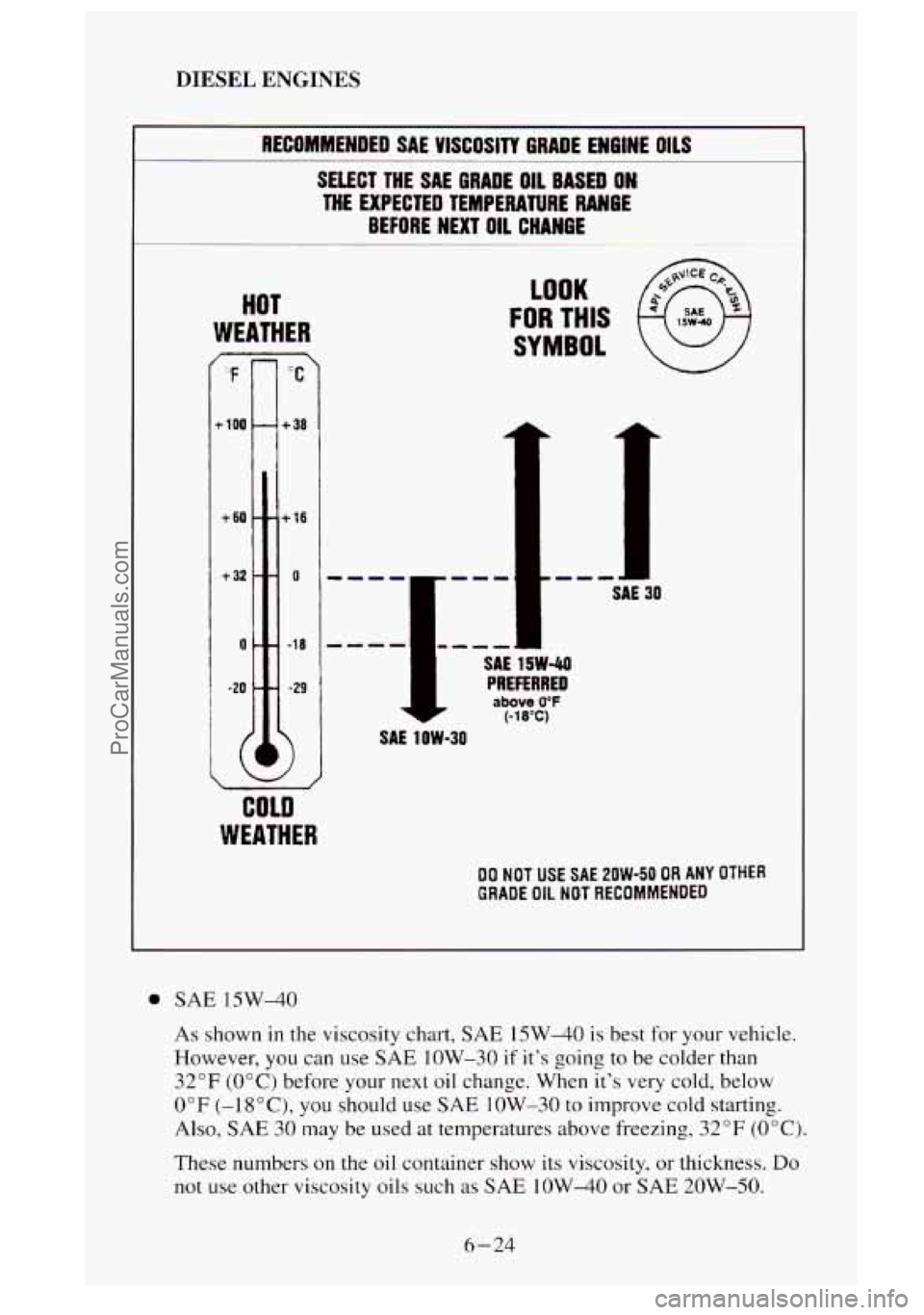
a SAE 15W-40
As shown in the viscosity chart, SAE 15W-40 is best for your vehicle.
However, you can use
SAE IOW-30 if it's going to be colder than
32°F (0°C) before your next oil change. When it's very cold, below
0°F (-18"C), you should use SAE low-30 to improve cold starting.
Also, SAE 30 may be used at temperatures above freezing, 32°F (0°C).
These numbers on the
oil container show its viscosity, or thickness. Do
not use other viscosity oils such as SAE 10W-40 or SAE 20W-50.
6-24
ProCarManuals.com
Page 291 of 488
This doughnut-shaped logo (symbol) is used on most oil containers to help
you select the correct oil.
You should look for this
on the oil container, and use only those oils that
display the logo.
GM Goodwrench‘ oil (in Canada, GM Engine Oil) meets all the
requirements for your vehicle.
Engine Oil Additives
Don’t add anything to your oil. Your GM dealer is ready to advise if you
think something should be added.
When to Change Engine Oil
See if any one of these is true for you:
0 Most trips are less than 5 to IO miles (8 to 16 km). This is particularly
important when outside temperatures are below freezing.
0 Most trips include extensive idling (such as frequent driving in stop and
e 00 traffic).
0 You operate your vehicle in dusty areas or off-road frequently.
0 You frequently tow a trailer or use a carrier on top of your vehicle.
If any of these is true for your vehicle, then you need to change your oil and
filter every
2,500 miles (4 000 km) or 3 months - whichever comes first.
If none of them is true, change the oil and filter every
5,000 miles (8 000
km) or 12 months - whichever comes first.
What to Do with Used Oil
Did you know that used engine oil contains certain elements that may be
unhealthy for your skin and could even cause cancer? Don‘t let used oil stay
on your skin for very long. Clean your skin and nails with soap and water,
or
a good hand cleaner. Wash or properly throw away clothing or rags
containing used engine oil. (See the manufacturer’s warnings about the use
and disposal
of oil products.)
Used oil can be a real threat
to the environment. If you change your own oil,
be sure
to drain all free-flowing oil from the filter before disposal. Don’t
ever dispose of oil by putting it
in the trash, pouring it on the ground, into
sewers, or into streams or bodies of water. Instead, recycle
it by taking it to
a place that collects used oil. If you have a problem properly disposing of
your used oil, ask your dealer, a service station or a local recycling center
for help.
6-25
ProCarManuals.com
Page 293 of 488
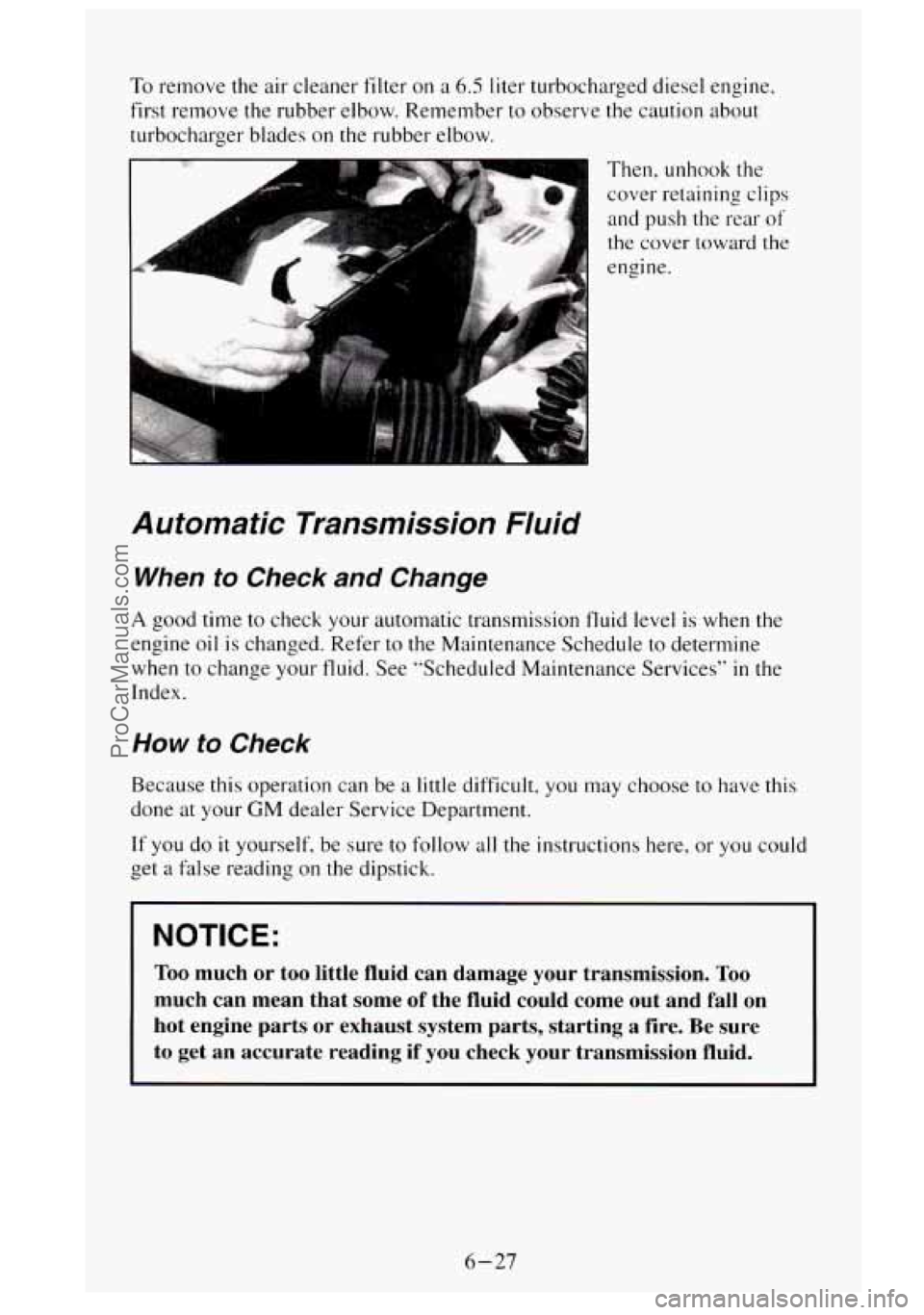
To remove the air cleaner filter on a 6.5 liter turbocharged diesel engine,
first remove the rubber elbow. Remember to observe the caution about
turbocharger blades on the rubber elbow.
Then, unhook the
cover retaining clips
and push the rear
of
the cover toward the
engine.
Automatic Transmission Fluid
When to Check and Change
A good time to check your automatic transmission fluid level is when the
engine
oil is changed. Refer to the Maintenance Schedule to determine
when to change your fluid. See "Scheduled Maintenance Services''
in the
Index.
How to Check
Because this operation can be a little difficult, you may choose to have this
done at your
GM dealer Service Department.
If you do
it yourself, be sure to follow all the instructions here, or you could
get
a false reading on the dipstick.
NOTICE:
Too much or too little fluid can damage your transmission. Too
much can mean that some of the fluid could come out and fall on
hot engine parts or exhaust system parts, starting a fire. Be \
sure
to get an accurate reading if you check your transmission fluid.
6-27
ProCarManuals.com
Page 296 of 488
How to Add Fluid
Refer to the Maintenance Schedule to determine what kind of transmission
fluid
to use. See “Recommended Fluids and Lubricants” in the Index.
Add fluid only after checking the transmission fluid
HOT. (A COLD check
is used
only as a reference.) If the fluid level is low, add only enough of the
proper fluid to bring the level up
to the HOT area for a hot check. It doesn’t
take much fluid, generally less than a
int. Don ’t overfill. We recommend
you use only fluid labeled DEXRON
-111, because fluid with that label is
made especially for your automatic transmission. Damage caused by fluid
other than DEXRON@-I11 is not covered by your
new vehicle warranty.
8
0 After adding fluid, recheck the fluid level as described under “How to
Check.”
0 When the correct fluid level is obtained, push the dipstick back in all
the way; then flip the handle down
to lock the dipstick in place.
Manual Transmission Fluid
When to Check
A good time to have it checked is when the engine oil is changed. However,
the fluid
in your manual transmission doesn’t require changing.
How to Check
Because this operation can be a little difficult, you may choose to have this.
done at your
GM dealer Service Department.
If you do it yourself, be sure to follow all the instructions here, or you could
get a false reading.
NOTICE:
Too much or too little fluid can damage your transmission. Too
much can mean that some of the fluid could come out and fall on
hot engine parts or exhaust system parts, starting a fire.
Be sure
to get an accurate reading if you check your transmission fluid.
Check the fluid level only when your engine is off, the vehicle is parked on
a level place and the transmission is cool enough for you to rest your fingers
on the transmission case.
6-30
ProCarManuals.com