engine coolant GMC SIERRA 1995 Owners Manual
[x] Cancel search | Manufacturer: GMC, Model Year: 1995, Model line: SIERRA, Model: GMC SIERRA 1995Pages: 488, PDF Size: 26.01 MB
Page 14 of 488
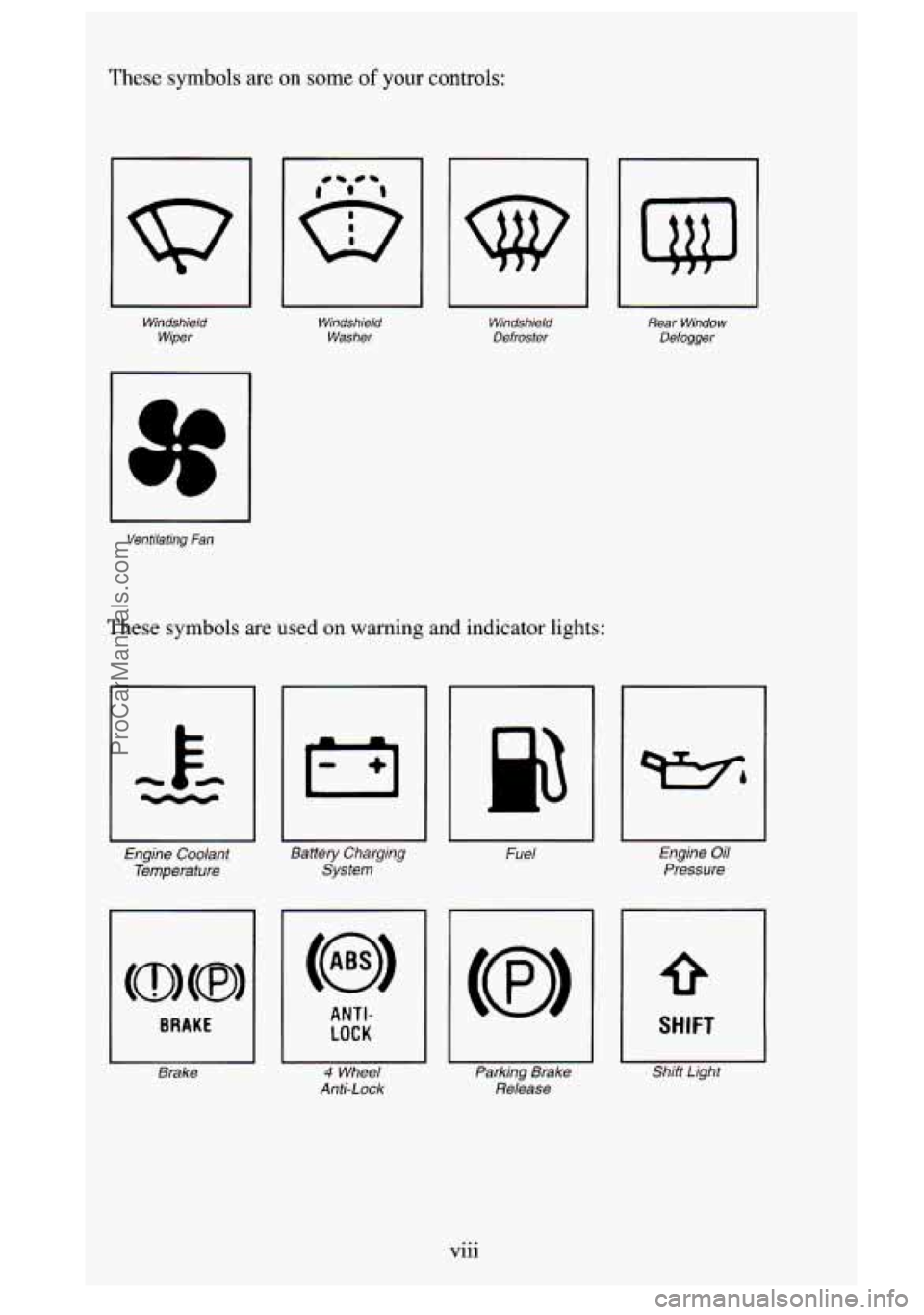
These symbols are on some of your controls:
uu
Windshield Wiper Windshield
Washer
I I
Windshield Defroster
Ventilating Fan
These symbols are used on warning and indicator lights:
Engine Coolant
Temperature
~~
Battery Charging
System
BRAKE
Brake
ANTI-
LOCK
4 Wheel
Anti-Lock
I 1
Rear Window
Defogger
Fuel
Parking Brake
Release
Engine Oil
Pressure
SHIFT
Shift Lighf
Vlll . ..
ProCarManuals.com
Page 78 of 488
NOTICE:
If you’re not in an idling vehicle and the engine overheats, you
wouldn’t be there to see the coolant temperature gage. This
could damage your vehicle. Don’t let your engine run when
you’re not in your vehicle.
Cold Weather Starting (Diesel Engine)
The following tips will help you get good starting in cold weather.
Use
SAE IOW-30 oil when the outside temperature drops below freezing.
When the outside temperature drops below
0°F (-1 floc), use your engine
coolant heater.
If you park your vehicle in a garage, you shouldn’t need to use the coolant
heater until the garage temperature goes below
0°F (-I SOC), no matter how
cold
it is outside.
To use the engine coolant heater, first turn off the engine. Then open the
hood, unwrap the electrical cord and plug it in. It uses normal house voltage
(I 10 volts), but:
A CAUTION:
Plugging the cord into an ungrounded outlet could cause an
electrical shock. Also, the wrong kind of extension cord could
overheat and cause
a fire. You could be seriously injured. Plug
the cord into a properly grounded three-prong 110-volt outlet.
If the cord won’t reach, use a heavy-duty three-prong extension
cord rated for
at least 15 amps.
NOTICE:
After you’ve used the coolant heater, be sure to store the cord in
the manner it was, to help keep it away from moving engine
parts.
If you don’t, it could be torn and damaged.
2-16
ProCarManuals.com
Page 79 of 488
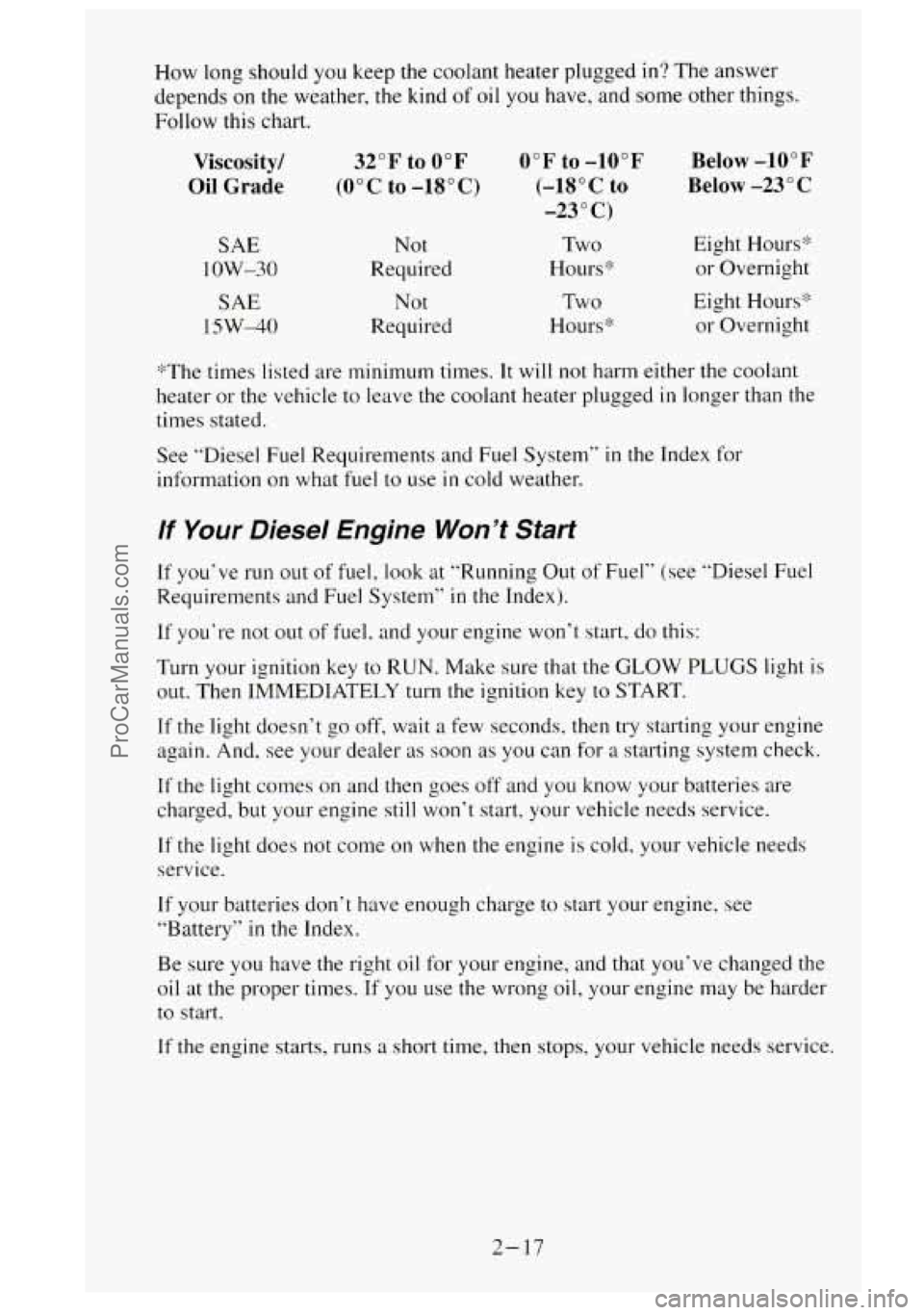
How long should you keep the coolant heater plugged in? The answer
depends on the weather,
the kind of oil you have, and some other things.
Follow this chart.
Viscosity/
Oil Grade
SAE
1 OW-30
SAE
15W-40
32°F to 0°F
(0°C to -18°C)
Not
Required
Not
Required
0°F to -10°F
(-18OC
to
-23 O C)
Two
Hours:!:
Two
Hours‘%
Below -10°F
Below -23”
C
Eight Hours’>
or Overnight
Eight Hours* or Overnight
’%The times listed are minimum times.
It will not harm either the coolant
heater or the vehicle to leave
the coolant heater plugged in longer than the
times stated.
See “Diesel Fuel Requirements and Fuel System’’
in the Index for
information
on what fuel to use in cold weather.
If Your Diesel Engine Won’t Start
If you‘ve run out of fuel, look at “Running Out of Fuel” (see “Diesel Fuel
Requirements and Fuel System”
in the Index).
If you‘re not out of fuel, and your engine won’t start, do this:
Turn your ignition key to RUN. Make sure that the GLOW PLUGS light is
out. Then IMMEDIATELY turn the ignition key to START.
If the light doesn’t go off, wait a few seconds, then try starting your engine
again. And, see your dealer as soon as
you can for a starting system check.
If the light comes on and then goes off and you know your batteries are
charged, but your engine still won’t start, your vehicle needs service.
If the light does not come on when the engine is cold, your vehicle needs
service.
If your batteries don‘t have enough charge to start your engine, see
“Battery”
in the Index.
Be sure you have the right oil for your engine, and that you’ve changed the
oil at the proper times. If you use the wrong
oil, your engine may be harder
to start.
If the engine starts, runs a short time, then stops, your vehicle needs service.
2- 17
ProCarManuals.com
Page 80 of 488
A CAUTION:
Do not use gasoline or starting “aids,” such as ether, in the air
intake. They could damage your engine. There could also be
a
fire, which could cause serious personal injury.
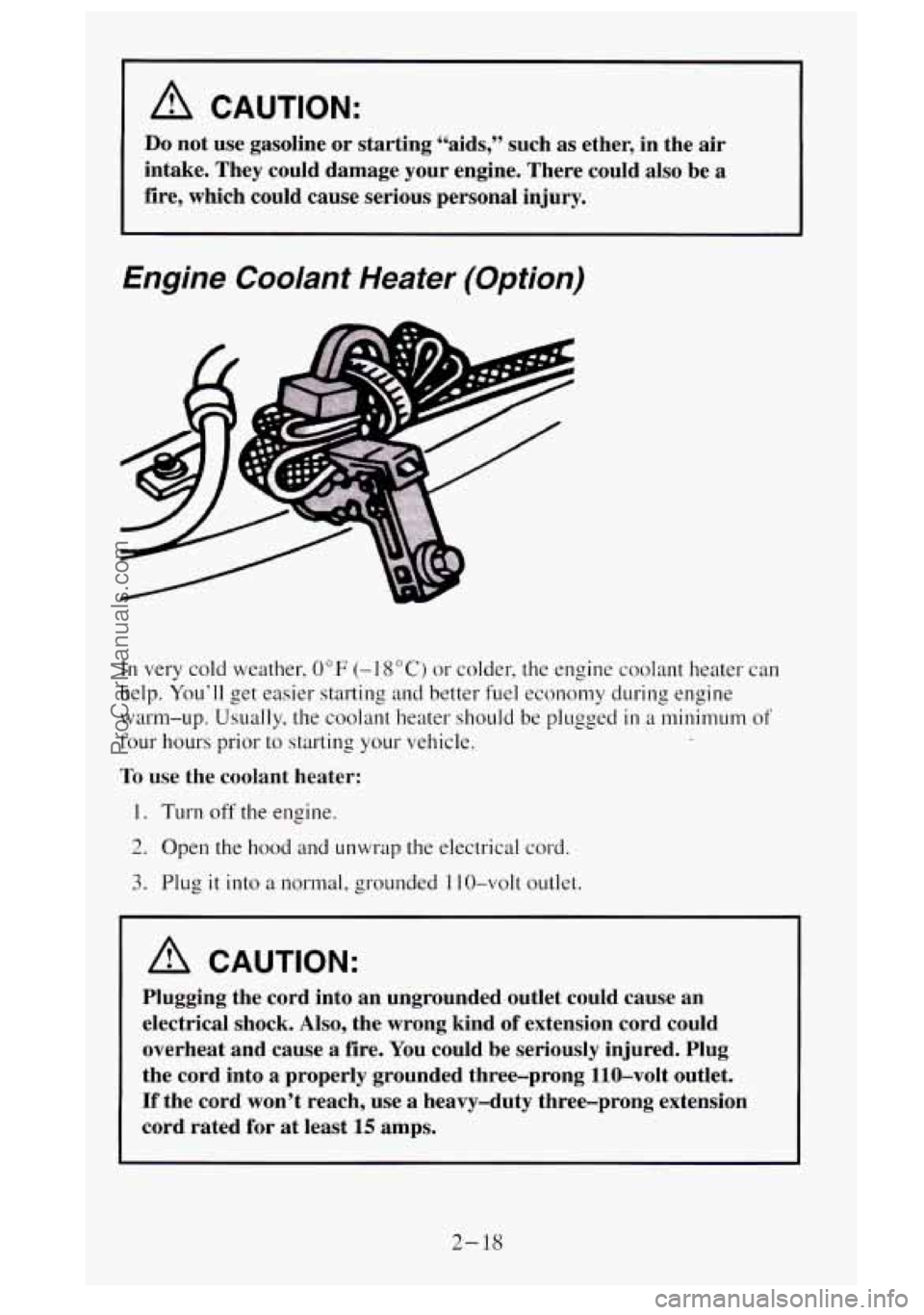
Engine Coolant Heater (Option)
In very cold weather. 0°F (-I SOC) or colder, the engine coolant heater can
help. You’ll get easier starting and better fuel economy during engine
warm-up. Usually, the coolant heater should
be plugged in a minimum of
four hours prior to starting your vehicle.
To use the coolant heater:
1. Turn off the engine.
2. Open the hood and unwrap the electrical cord.
3. Plug it into a normal, grounded I IO-volt outlet.
A CAUTION:
Plugging the cord into an ungrounded outlet could cause an
electrical shock. Also, the wrong kind
of extension cord could
overheat and cause
a fire. You could be seriously injured. Plug
the cord into
a properly grounded three-prong 110-volt outlet.
If the cord won’t reach, use a heavy-duty three-prong extension
cord rated for
at least 15 amps.
2-18
ProCarManuals.com
Page 81 of 488
NOTICE:
After you’ve used the coolant heater, be sure to store the cord as
it was before to keep
it away from moving engine parts. If you
don’t,
it could be damaged.
How long should you keep the coolant heater plugged in? The answer
depends on the weather, the kind of oil you have. and some other things.
Inste.ad of trying
to list everything here, we ask that you contact your GM
dealer in the area where you‘ll be parking your vehicle. The dealer can give
you the best advice for that particular area.
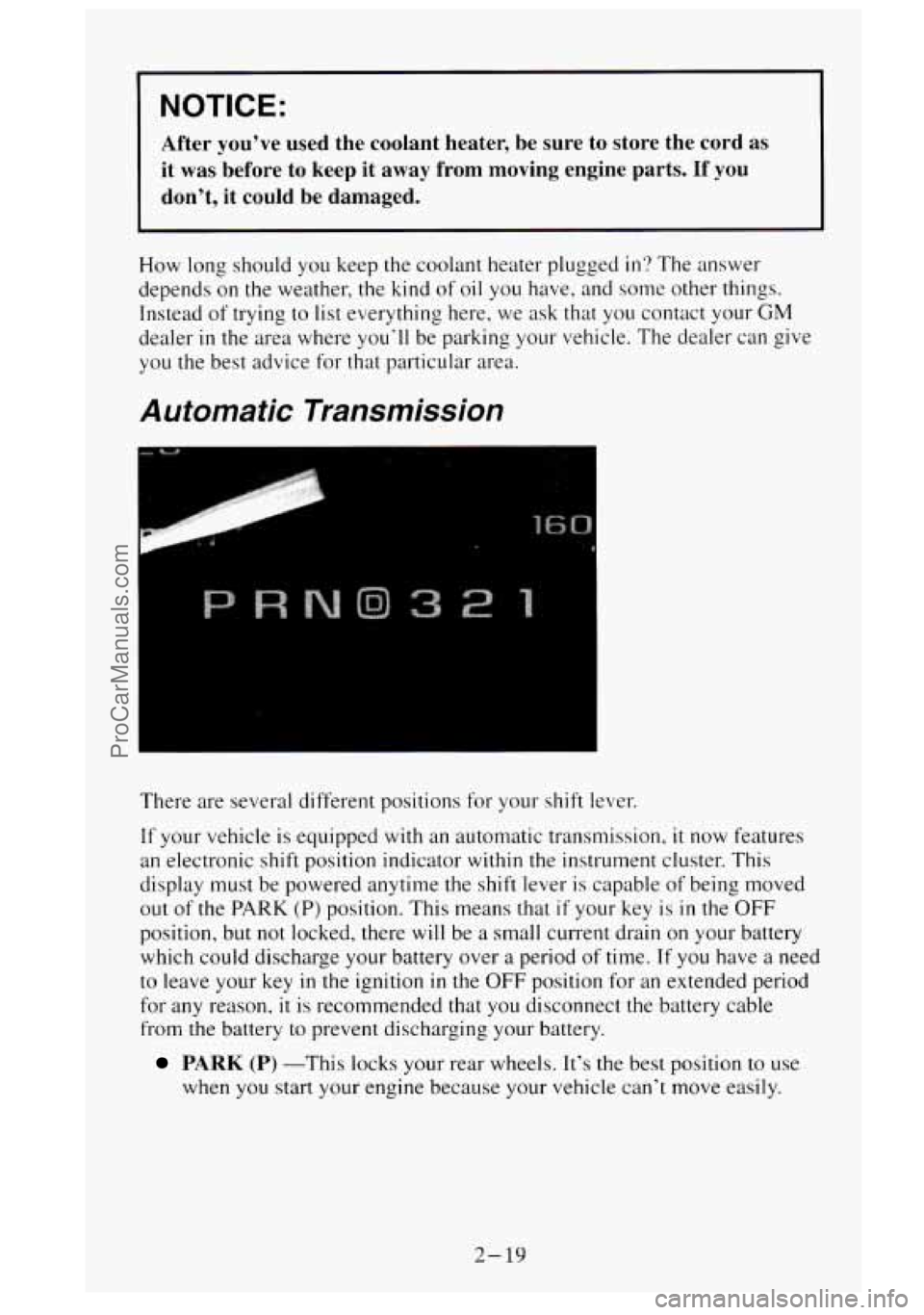
Automatic Transmission
There are several different positions for your shift lever.
If your vehicle is equipped with an automatic transmission, it now features
an electronic shift position indicator
within the instrument cluster. This
display must be powered anytime the shift lever is capable
of being moved
out of the
PARK (P) position. This means that if your key is in the OFF
position, but not locked, there will be a small current drain on your battery
which could discharge your battery over
a period of time. If you have a need
to leave your key
in the ignition in the OFF position for an extended period
for any reason,
it is recommended that you disconnect the battery cable
from the battery to prevent discharging your battery.
PARK (P) -This locks your rear wheels. It’s the best position to use
when you start your engine because your vehicle can’t move easily.
2- 19
ProCarManuals.com
Page 137 of 488
Glow Plugs Light
GLO
PLUGS
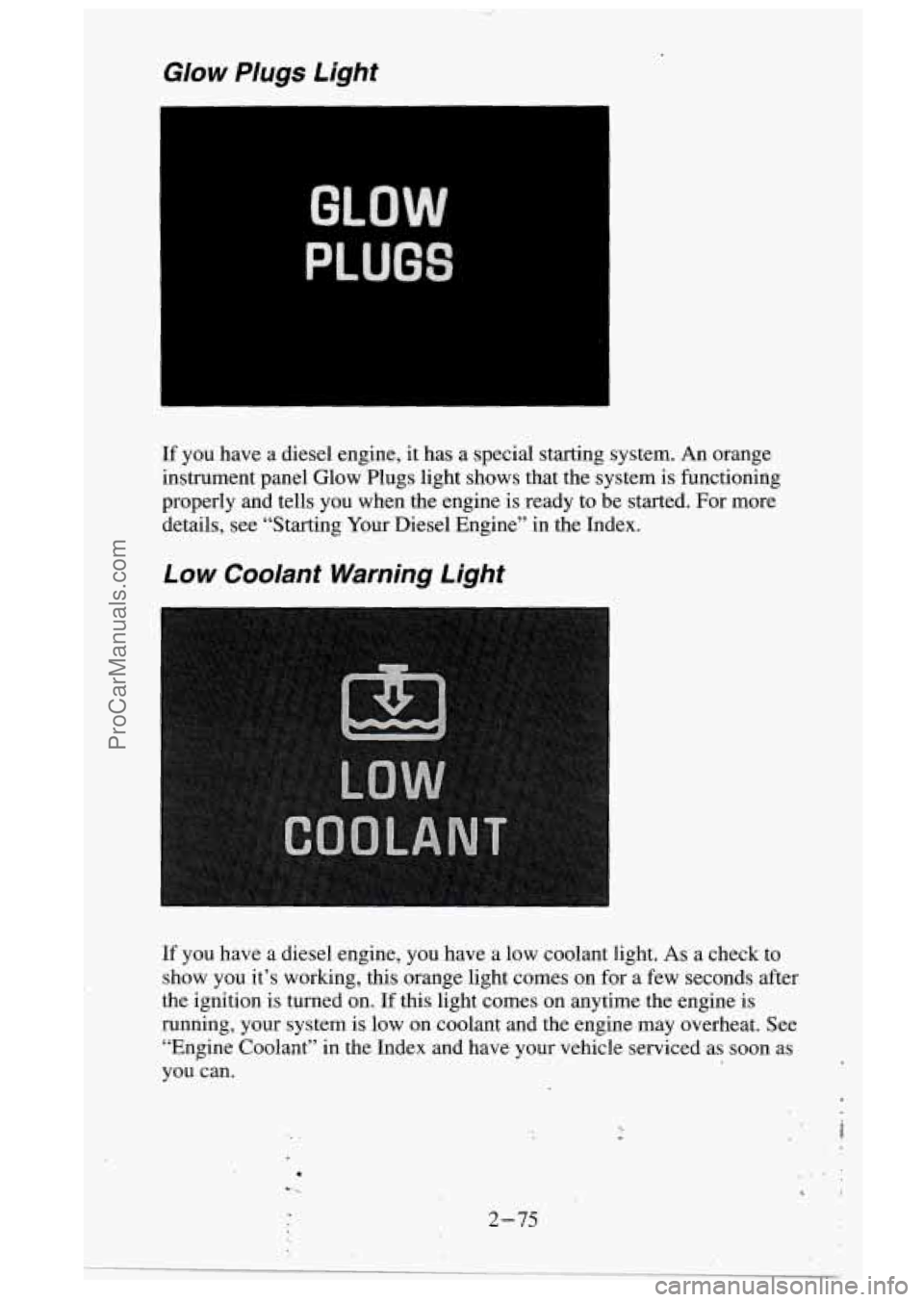
If you have a diesel engine, it has a special starting system. An orange
instrument panel Glow Plugs light shows that the system is functioning
properly and tells you when the engine is ready to be started. For more
details, see “Starting
Your Diesel Engine’’ in the Index.
Low Coolant Warning Light
41 h,
2-75
t
ProCarManuals.com
Page 139 of 488
NOTICE:
If you keep driving your vehicle with this light on, after a while
the emission controls
won’t work as well, your fuel economy
won’t
be as good, and your engine may not run as smoothly.
This could lead
to costly repairs not covered by your warranty.
Check Gages Light
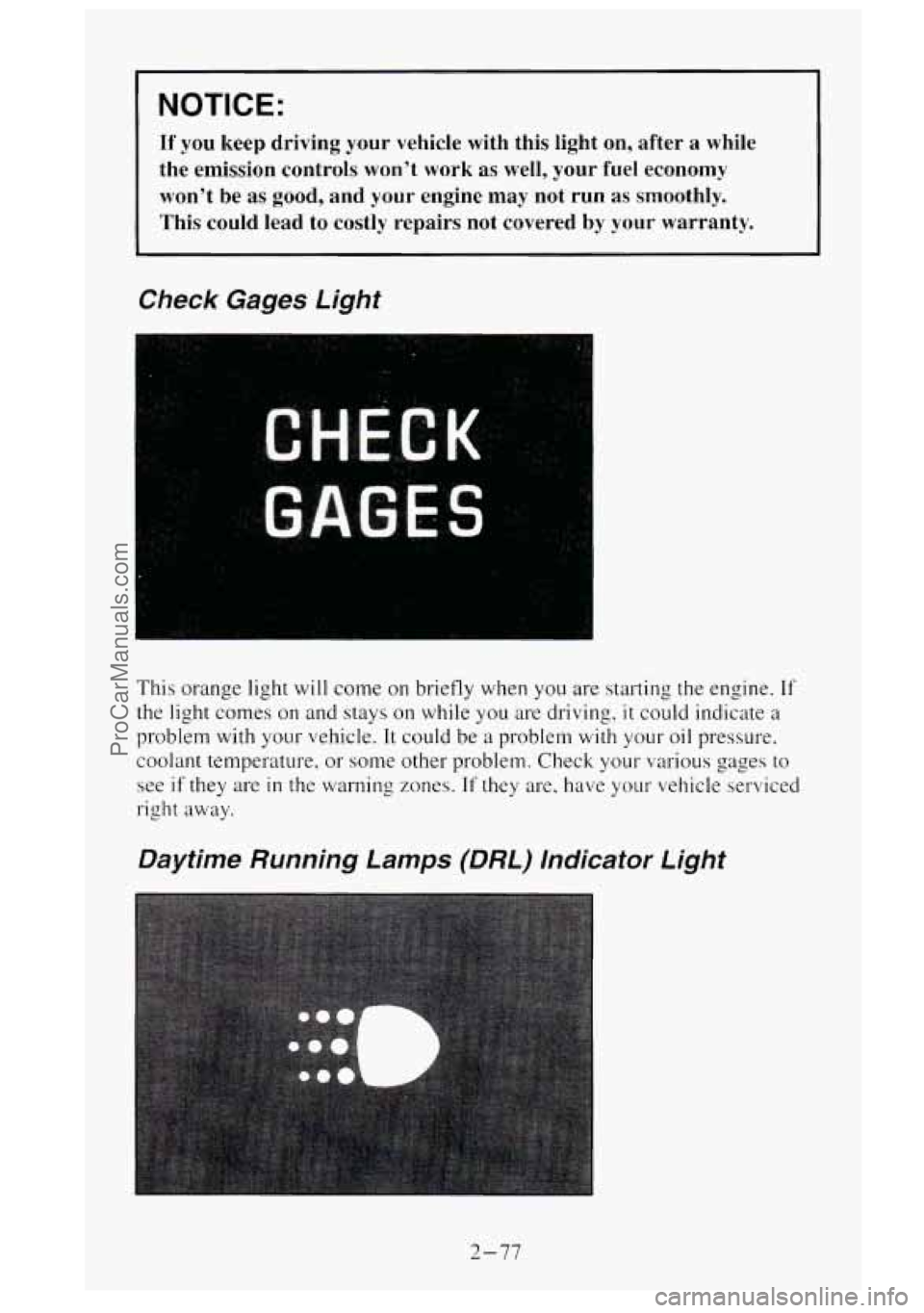
This orange light will come on briefly when you are starting the engine. If
the light comes on and stays on while you are driving, it could indicate a
problem with your vehicle.
It could be a problem with your oil pressure.
coolant temperature, or some other problem. Check your various gages
to
see if they are in the warning zones. If they are, have your vehicle serviced
right away.
Daytime Running Lamps (DRL) Indicator Light
2-77
ProCarManuals.com
Page 142 of 488
Listed are four situations you may experience with your f~~el gage:
At the gas station. the fuel pump shuts off before the gage reads full.
It lakes a little more or less fuel to fill up than the fuel gage indicated.
For example, the gage may have indicated the tank was half
full, but it
actually took a little more or less than half the tank's capacity to fill the
, tank.
The gage moves a little when you turn a corner or speed up.
The gage doesn't go back to empty when you turn off the ignition.
None of these indicate
a problem with the fuel gage.
For information on how to fill your fuel tank, see "Fuel - Filling Your
Tank"
in the Index.
For your fuel tank capacity, see "Fuel -Tank Capacity" in the Index.
Engine Coolant Temperature Gage
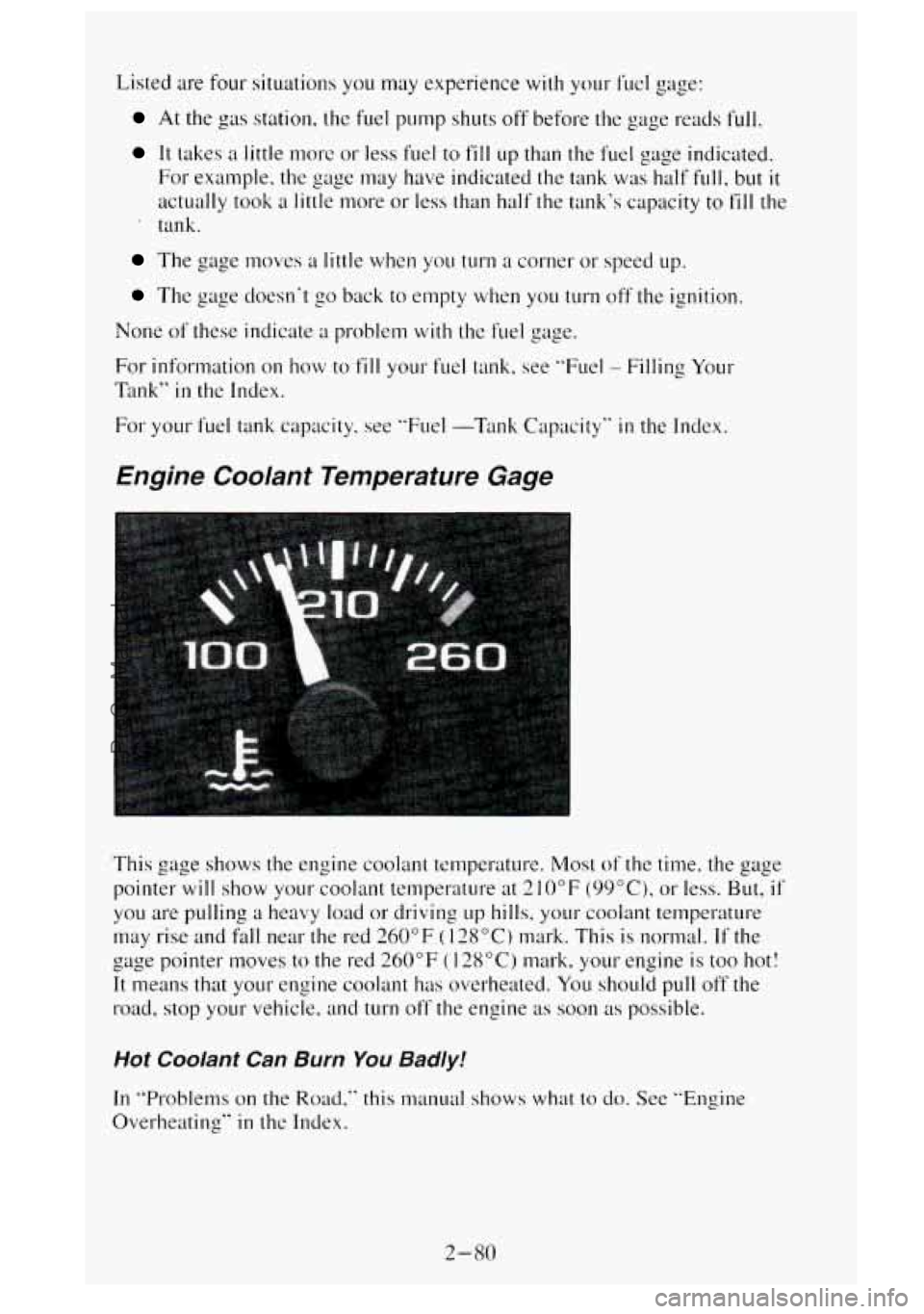
This gage shows the engine coolant temperature. Most of the time. the gage
pointer
will show your coolant temperature at 2 10°F (99"C), or less. But, if
you are pulling a heavy load or driving LIP hills, your coolant temperature
may rise and
fall near the red 260°F ( 128°C) mark. This is normal. If the
gage pointer moves to the red 260°F
(128°C) mark, your engine is too hot!
It means that your engine coolant has overheated. You should pull off the
road,
stop your vehicle. and turn off the engine as soon as possible.
Hot Coolant Can Burn You Badly!
In "Problems on the Road," this manual shows what to do. See "Engine
Overheating"
in thc Index.
2-80
ProCarManuals.com
Page 150 of 488
fuel economy. This setting also cools the air the fastest and can be used to
keep “unwanted odors” and/or dust from entering the vehicle. When using
the air conditioner, turn off recirculation after the vehicle reaches
a
comfortable interior temperature.
When
the right knob on the control panel is between HEAT and DEFROST,
the recirculation feature will not function.
A/C - This button, between the middle and right knobs. allows the air
coming into your vehicle
to be cooled and directed through the instrument
panel vents. This setting is useful for normal cooling
on hot days. When you
first use
A/C with the recirculation button pushed in, turn off recirculation
as soon as the vehicle reaches a comfortable interior temperature.
Engine Coolant Heater
If your vehicle has a diesel engine, it is equipped with an engine coolant
heater.
An engine coolant heater is optional on gas engine vehicles. If you
use the engine coolant heater before starting your engine
(in cold weather
(20” F, (-8” C), or lower) your heating system will produce warmer air
faster, to heat the passenger compartment
in cold weather.
The use
of an engine coolant heater also reduces the time it takes for the
engine to reach normal operating temperature. and shortens the time it takes
the heater
to reach full output. For more information, See “Engine Coolant
Heater” in the Index.
Diesel Engine Heater Output
If you idle your diesel engine for a long time when it’s cold outside, your
heater may blow out cool air. This is normal. When you increase the engine
speed, your heater should blow out warmer air.
If it doesn’t, your coolant
level may be too low. See “Engine Coolant”
in the Index to see how to
check your coolant level.
Rear Window Defogger (Option)
You can tell if your vehicle has this option by looking at the rear window. If
you see lines running across the glass, you have it. These are the wire-like
elements which heat your window.
I NOTICE:
Scraping the inside of your rear window could cut and damage
the defogger.
Your warranty would not cover this damage. And,
don’t put decals there, you might have to scrape them off.
For best results, clear the window of as much snow or ice as possible first.
3-4
ProCarManuals.com
Page 205 of 488
Winter Driving
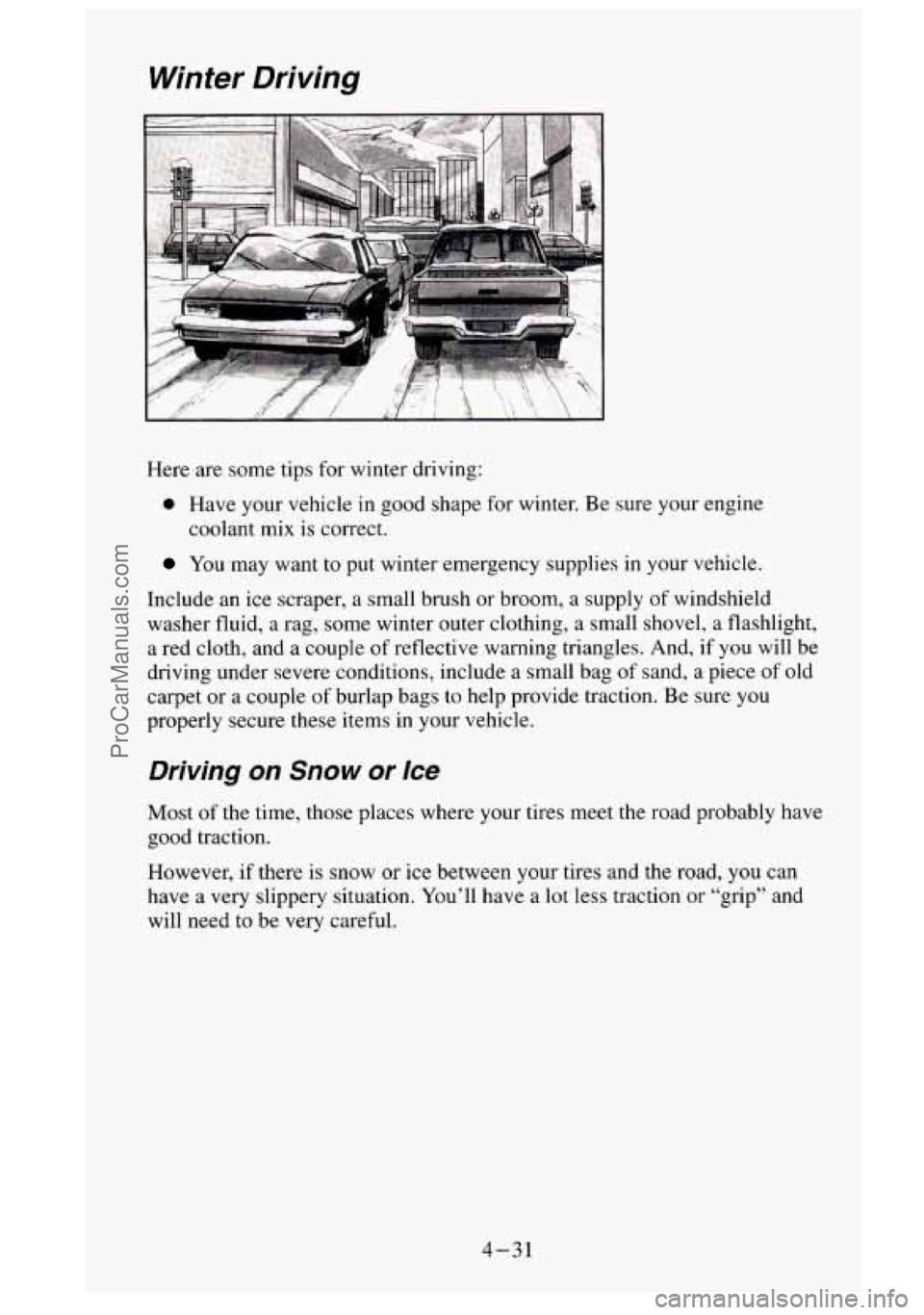
Here are some tips for winter driving:
0 Have your vehicle in good shape for winter. Be sure your engine
coolant mix is correct.
You may want to put winter emergency supplies in your vehicle.
Include an ice scraper, a small brush or broom, a supply of windshield
washer fluid, a rag, some winter outer clothing, a small shovel,
a flashlight,
a red cloth, and a couple of reflective warning triangles. And, if you will be
driving under severe conditions, include a small bag
of sand, a piece of old
carpet or a couple
of burlap bags to help provide traction. Be sure you
properly secure
these items in your vehicle.
Driving on Snow or Ice
Most of the time, those places where your tires meet the road probably have
good traction.
However, if there is snow
or ice between your tires and the road, you can
have a very slippery situation. You’ll have a lot less traction
or “grip” and
will need to be very careful.
4-31
ProCarManuals.com