washer fluid GMC SIERRA 1995 Owners Manual
[x] Cancel search | Manufacturer: GMC, Model Year: 1995, Model line: SIERRA, Model: GMC SIERRA 1995Pages: 488, PDF Size: 26.01 MB
Page 104 of 488
Heavy snow or ice can overload your wipers. The windshield wiper motor is
protected from overload by
a circuit breaker and a fuse. If the motor
overheats due to heavy snow, etc., the wiper will stop
until the motor cools.
Although the circuit is protected from electrical overload, overload due
to
heavy snow, etc. may cause wiper linkage damage. Always clear ice and
heavy snow from the windshield before using your windshield wipers.
Windshield Washer
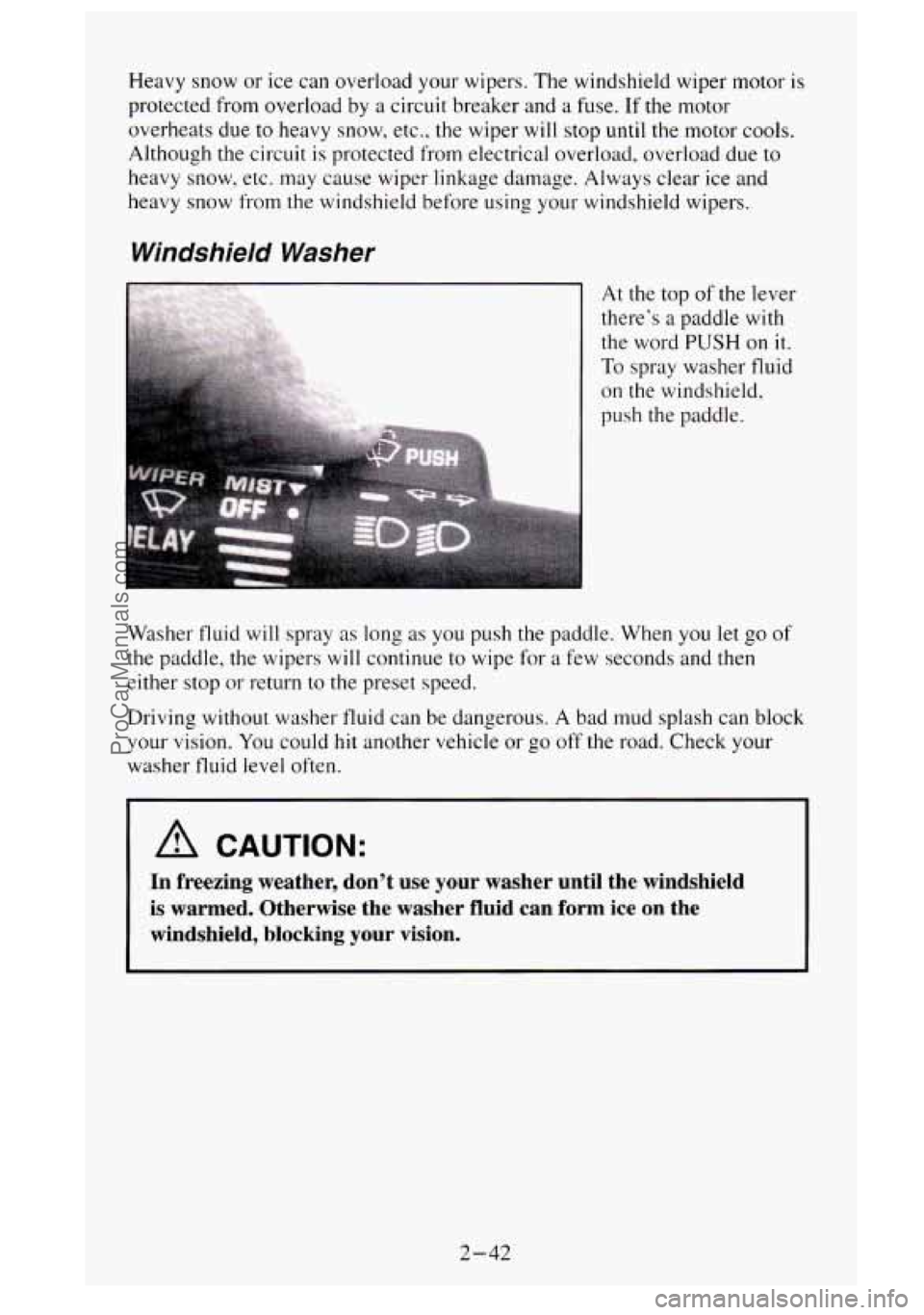
At the top of the lever
there’s a paddle with
the word
PUSH on it.
To spray washer fluid
on the windshield,
push the paddle.
Washer fluid will spray
as long as you push the paddle. When you let go of
the paddle, the wipers will continue to wipe for a few seconds and then
either stop
or return to the preset speed.
Driving without washer fluid can be dangerous.
A bad mud splash can block
your vision. You could
hit another vehicle or go off the road. Check your
washer fluid level often.
A CAUTION:
In freezing weather, don’t use your washer until the windshi\
eld
is warmed. Otherwise the washer
fluid can form ice on the
windshield, blocking your vision.
2-42
ProCarManuals.com
Page 105 of 488
NOTICE:
When using concentrated washer fluid, follow the
manufacturer’s instructions for adding water.
0 Don’t mix water with ready-to-use washer fluid. Water can cause the solution to freeze and damage your washer fluid
tank and other parts of the washer system.
Also, water
doesn’t clean as well as washer fluid.
0 Fill your washer fluid tank only 3/4 full when it’s very cold.
This allows for expansion, which could damage the tank if it is
completely full.
Don’t use radiator antifreeze in your windshield washer. It
can damage your washer system and paint.
Cruise Control (Option)
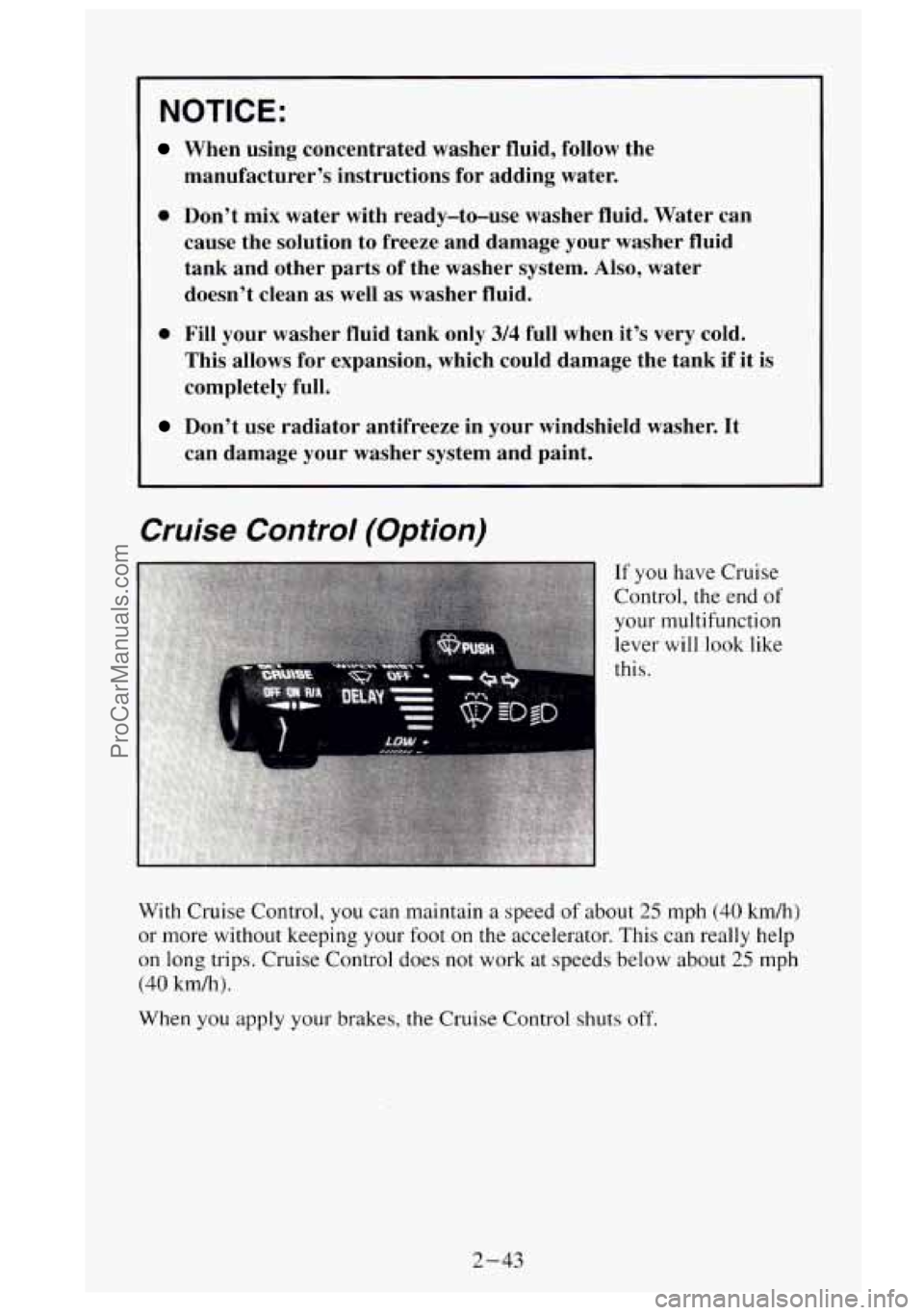
If you have Cruise
Control, the end
of
your multifunction
lever
will look like
this.
With Cruise Control,
you can maintain a speed of about 25 mph (40 kdh)
or more without keeping your foot on the accelerator. This can really help
on
long trips. Cruise Control does not work at speeds below about 25 mph
(40 kmk).
When you apply your brakes, the Cruise Control shuts off.
2-43
ProCarManuals.com
Page 202 of 488
When you want to leave the freeway, move to the proper lane well in
advance. If
you miss your exit do not, under any circumstances, stop and
back up. Drive on
to the next exit.
The exit ramp can be curved, sometimes quite sharply.
The
exit speed is usually posted.
Reduce your speed according to your speedometer, not to your sense
of
motion. After driving for any distance at higher speeds, you may tend to
think you are going slower than you actually are.
Before Leaving on a Long Trip
Make sure you’re ready. Try to be well rested. If you must start when you’re
not fresh
- such as after a day’s work - don’t plan to make too many
miles that first part
of the journey. Wear comfortable clothing and shoes you
can easily drive
in.
Is your vehicle ready for a long trip‘? If you keep it serviced and maintained,
it’s ready to go.
If it needs service, have it done before starting out. Of
course, you’ll find experienced and able service experts
in GM dealers all
across North America. They’ll be ready and willing to help if you need it.
Here are some things you can check before a trip:
0
0
0
0
0
a
0
Windshield Washer Fluid: Is the reservoir full? Are all windows clean
inside and outside?
Wiper Blades: Are they in good shape?
FueZ, Engine Oil, Other Fluids: Have you checked all levels?
Lamps: Are they all working? Are the lenses clean?
Tires: They are vitally important to a safe, trouble-free trip. Is the tread
good enough for long-distance driving? Are
the tires all inflated to the
recommended pressure?
Weather Forecasts: What’s the weather outlook along your route?
Should
you delay your trip a short time to avoid a major storm system?
Maps: Do you have up-to-date maps?
Highway Hypnosis
Is there actually such a condition as “highway hypnosis”? Or is it just plain
falling asleep at the wheel? Call it highway hypnosis, lack of awareness, or
whatever.
There
is something about an easy stretch of road with the same scenery,
along with the
hum of the tires on the road, the drone of the engine, and the
rush
of the wind against the vehicle that can make you sleepy. Don’t let it
happen
to you! If it does, your vehicle can leave the road in less than a
second, and you could crash and be injured.
4-28
ProCarManuals.com
Page 205 of 488
Winter Driving
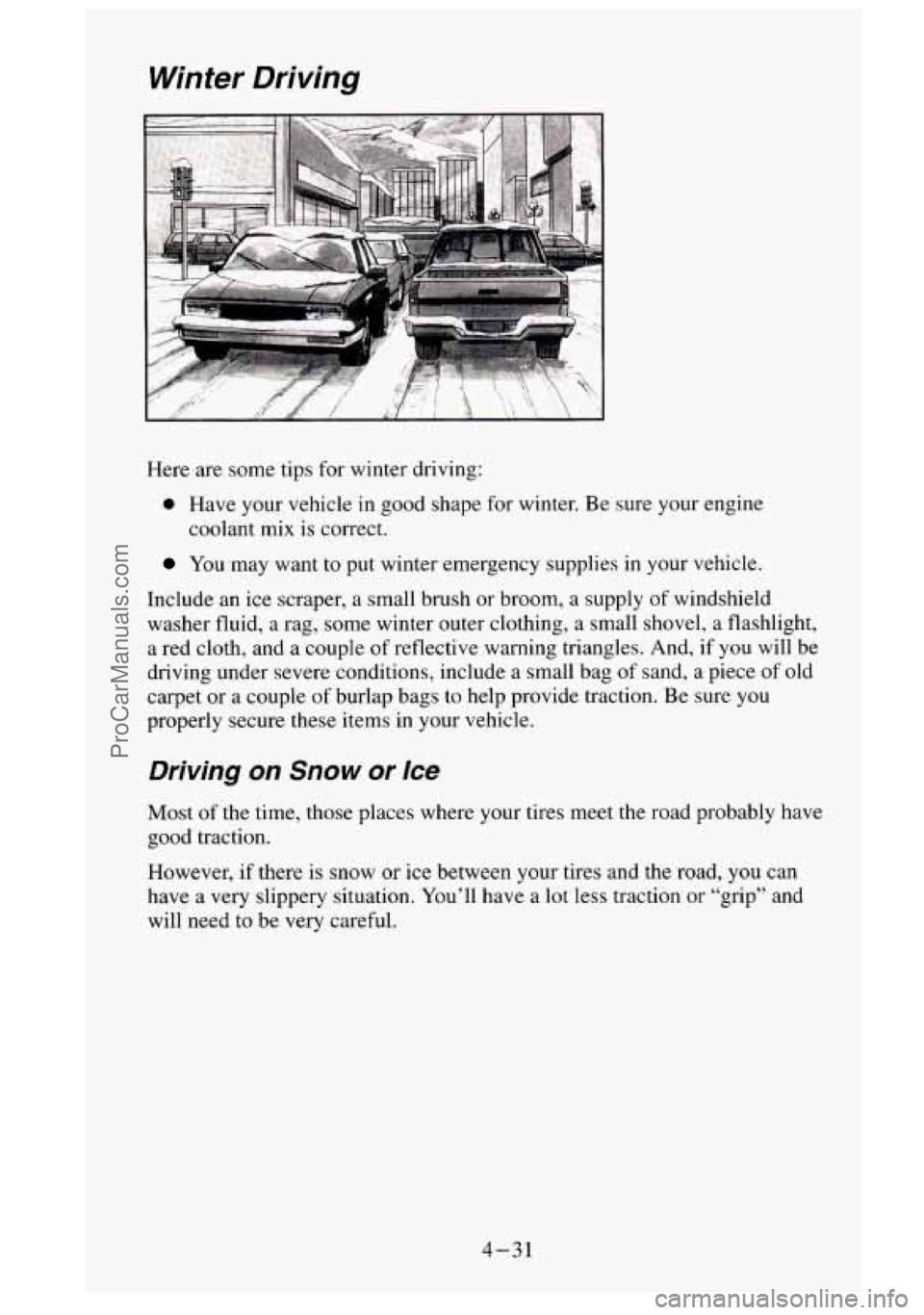
Here are some tips for winter driving:
0 Have your vehicle in good shape for winter. Be sure your engine
coolant mix is correct.
You may want to put winter emergency supplies in your vehicle.
Include an ice scraper, a small brush or broom, a supply of windshield
washer fluid, a rag, some winter outer clothing, a small shovel,
a flashlight,
a red cloth, and a couple of reflective warning triangles. And, if you will be
driving under severe conditions, include a small bag
of sand, a piece of old
carpet or a couple
of burlap bags to help provide traction. Be sure you
properly secure
these items in your vehicle.
Driving on Snow or Ice
Most of the time, those places where your tires meet the road probably have
good traction.
However, if there is snow
or ice between your tires and the road, you can
have a very slippery situation. You’ll have a lot less traction
or “grip” and
will need to be very careful.
4-31
ProCarManuals.com
Page 280 of 488
A CAUTION:
If your vehicle has air conditioning, the auxiliary engine fan
under the hood can start up and injure you even when the
engine is not running. Keep hands, clothing and tools
away from
any underhood electric fan.
A CAUTION:
Things that burn can get on hot engine parts and start a fire.
These include liquids like gasoline or diesel fuel, oil, coolant,
brake fluid, windshield washer and other fluids, and plastic
or
rubber. You or others could be burned. Be careful not to drop or
spill things that
will burn onto a hot engine.
Before closing the hood, be sure
all filler caps are on properly. Pull down
the
hood and close it firmly.
Cleaning Your Diesel Engine
I NOTICE:
If you spray or pour water or any other liquid on your engine
when it is warm or hot, or when it
is running, you could cause
serious damage to it.
If you ever clean the engine, clean it only
when it is cold.
Noise Control System
The following information relates to compliance with Federal noise
emission standards for vehicles with a Gross Vehicle Weight Rating
(GVWR)
of more than 10,000 pounds (4 536 kilograms). The Maintenance
Schedule booklet provides information on maintaining
the noise control
system to minimize degradation of the noise emission control system during
the life of your vehicle. The noise control system warranty is given in your
Warranty booklet.
These standards apply only
to vehicles sold in the United States.
6-14
ProCarManuals.com
Page 307 of 488
What to Add
Refer to the Maintenance Schedule to determine what kind of' tluid to use
See "Recommended Fluids and Lubricants"
in the Index.
NOTICE:
When adding power steering fluid or making a complete fluid
change, always use the proper fluid. Failure to use
the proper
fluid can cause leaks and damage hoses and seals.
Hydro-Boost Brake System (Hydraulic Pump)
The power steering pump is also used as the Hydro-boost pump. Refer to
"Power Steering System''
in this section when checking fluid level or
adding fluid.
Windshield Washer Fluid
What to Use
When you need windshield washer fluid, be sure to read the manuhcturer's
instructions before use.
If you will be operating your vehicle in an area
where the temperature
may fall below freezing, use a fluid that has
sufficient protection against freezing.
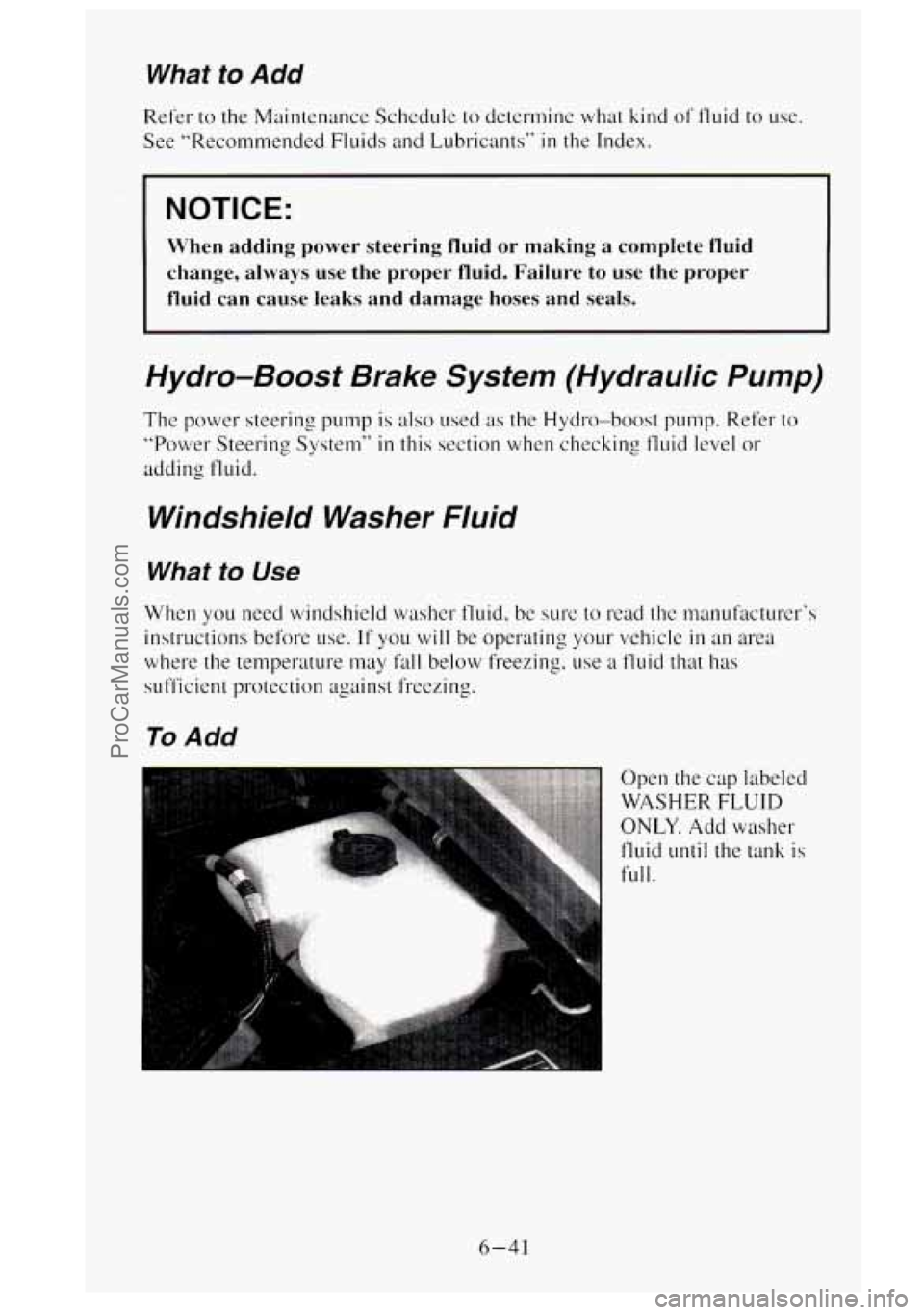
To Add
Open the cap labeled
WASHER FLUID
ONLY. Add washer
fluid
until the tank is
full.
6-41
ProCarManuals.com
Page 308 of 488
~ NOTICE:
When using concentrated washer fluid,
follow the
manufacturer’s instructions for adding water.
Don’t mix water with ready-to-use washer fluid. Water can
cause the solution to freeze and damage your washer fluid
tank and other parts of the washer system.
Also, water
doesn’t clean as well as washer fluid.
0 Fill your washer fluid tank only 3/4 full when it’s very cold.
This allows for expansion, which could damage the tank if it
is
completely full.
0 Don’t use radiator antifreeze in your windshield washer. It
can damage your washer system and paint.
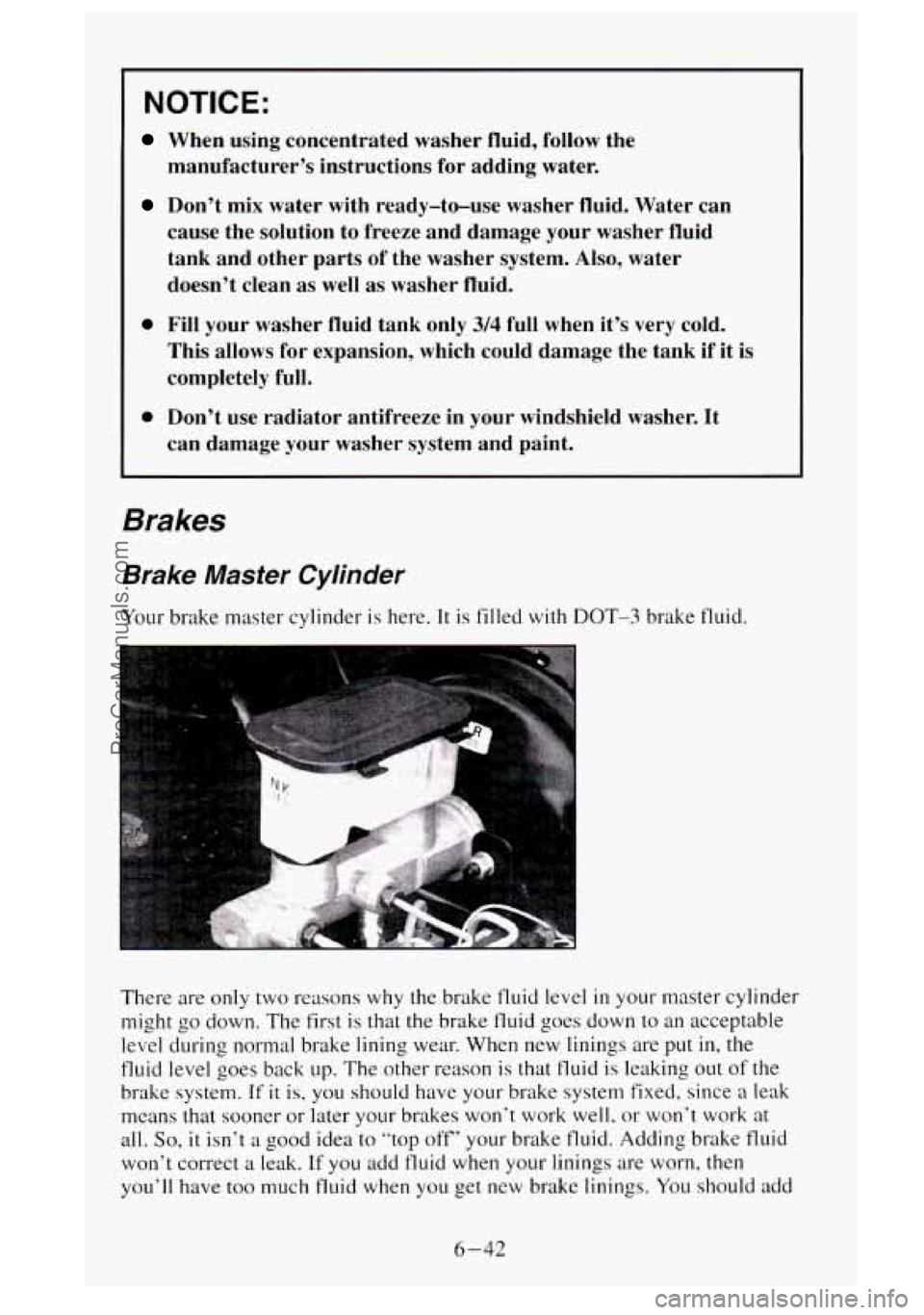
Brake Master Cylinder
Your brake master cylinder is here. It is filled with DOT-3 brake fluid.
There are only two reasons why the brake fluid level
in your master cylinder
might go down. The first is that the brake fluid goes down to an acceptable
level during normal brake lining wear. When new linings are put in, the
fluid level goes back up. The other reason
is that fluid is leaking out of the
brake system. If it is, you should have your brake system fixed, since a leak
means that sooner or later your brakes won’t work well, or won’t work at
all.
So, it isn‘t a good idea to “top off’ your brake fluid. Adding brake fluid
won’t correct a leak. If you add fluid when your linings are worn, then
you’ll have
too much fluid when you get new brake linings. You should add
6-42
ProCarManuals.com
Page 337 of 488
Care of Safety Belts
Keep belts clean and dry.
A CAUTION:
Do not bleach or dye safety belts. If you do, it may severely
weaken them. In a crash they might not be able to provide
adequate protection. Clean safety belts only with mild soap and\
lukewarm water.
Glass
Glass should be cleaned often. GM Glass Cleaner (GM Part No. 1050427)
or a liquid household glass cleaner will remove normal tobacco smoke and
dust films.
Don’t use abrasive cleaners
on glass, because they may cause scratches.
Avoid placing decals on the inside rear window, since they may have to be
scraped off later. If abrasive cleaners are used on the inside
of the rear
window, an electric defogger element may be damaged. Any temporary
license should not be attached across the defogger grid.
Cleaning the Outside of the Windshield and
Wiper Blades
If the windshield is not clear after using the windshield washer, or if the
wiper blade chatters when running, wax or other material may be on the
blade or windshield.
Clean the outside of the windshield with GM Windshield Cleaner, Bon-Ami
Powder@ (GM
Part No. 105001 1). The windshield is clean if beads do not
form when
you rinse it with water.
Clean
the blade by wiping vigorously with a cloth soaked in full strength
windshield washer solvent. Then rinse the blade with water.
Wiper blades should be checked
on a regular basis and replaced when worn.
Weatherstrips
Silicone grease on weatherstrips will make them last longer, seal better, and
not stick or squeak. Apply silicone grease with a clean cloth at least every
six months. During very cold, damp weather more frequent application may
be required. (See “Recommended Fluids and Lubricants” in the Index.)
6-71
ProCarManuals.com
Page 449 of 488
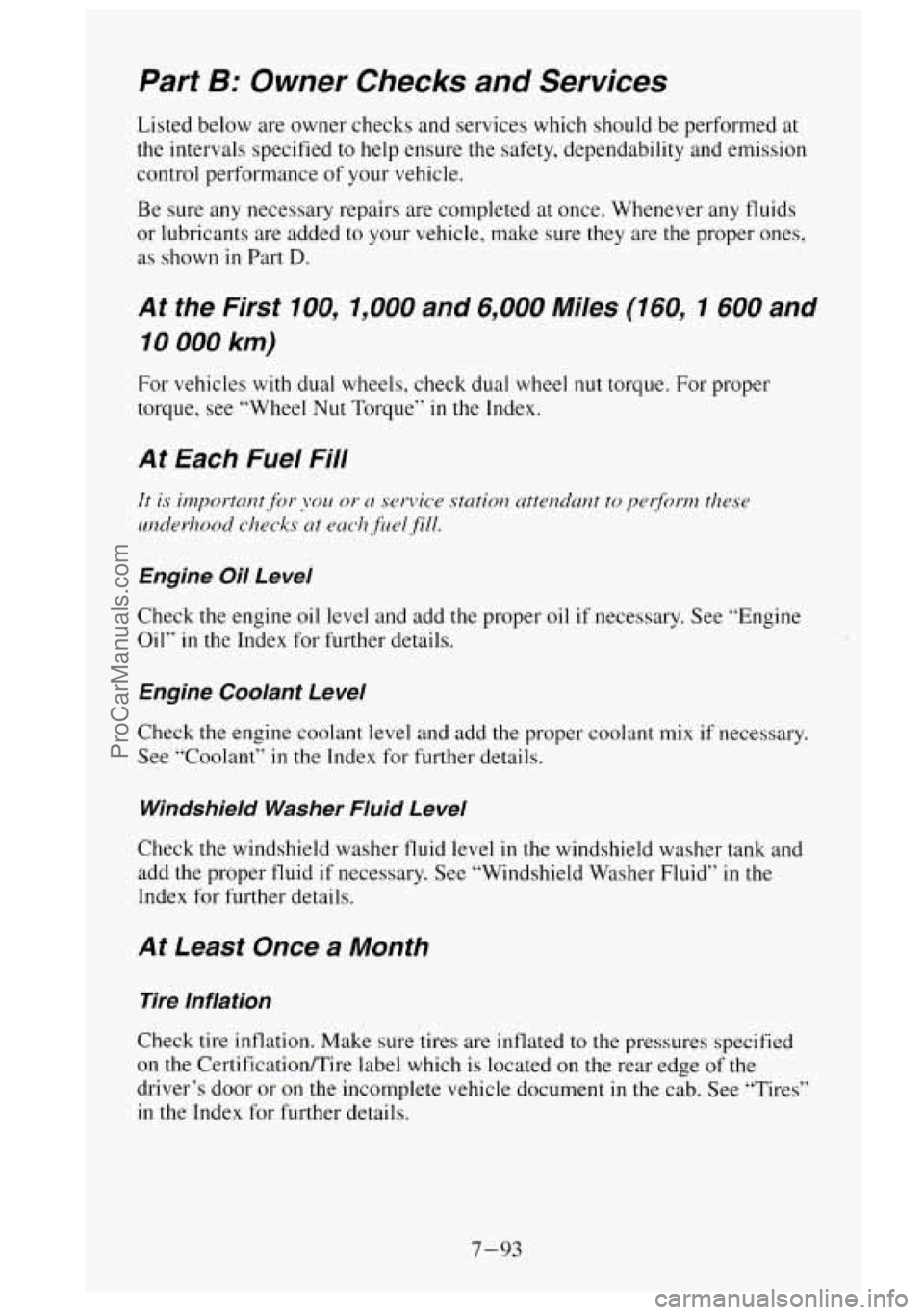
Part B: Owner Checks and Services
Listed below are owner checks and services which should be performed at
the intervals specified to help ensure the safety, dependability and emission
control performance of your vehicle.
Be sure any necessary repairs are completed at once. Whenever any fluids
or lubricants are added to your vehicle, make sure they are the proper ones,
as shown in Part D.
At the First 100, 1,000 and 6,000 Miles (160, I 600 and
IO 000 km)
For vehicles with dual wheels, check dual wheel nut torque. For proper
torque, see “Wheel
Nut Torque’’ in the Index.
At Each Fuel Fill
Engine Oil Level
Check the engine oil level and add the proper oil if necessary. See “Engine
Oil”
in the Index for further details.
Engine Coolant Level
Check the engine coolant level and add the proper coolant mix if necessary.
See ”Coolant”
in the Index for further details.
Windshield Washer Fluid Level
Check the windshield washer fluid level in the windshield washer tank and
add the proper fluid if necessary. See ”Windshield Washer Fluid” in the
Index for further details.
At Least Once a Month
Tire Inflation
Check tire inflation. Make sure tires are inflated to the pressures specified
on the Certification/Tire label which is located on the rear edge of the
driver’s door or on the incomplete vehicle document in the cab. See “Tires”
in the Index for further details.
7-93
ProCarManuals.com
Page 456 of 488
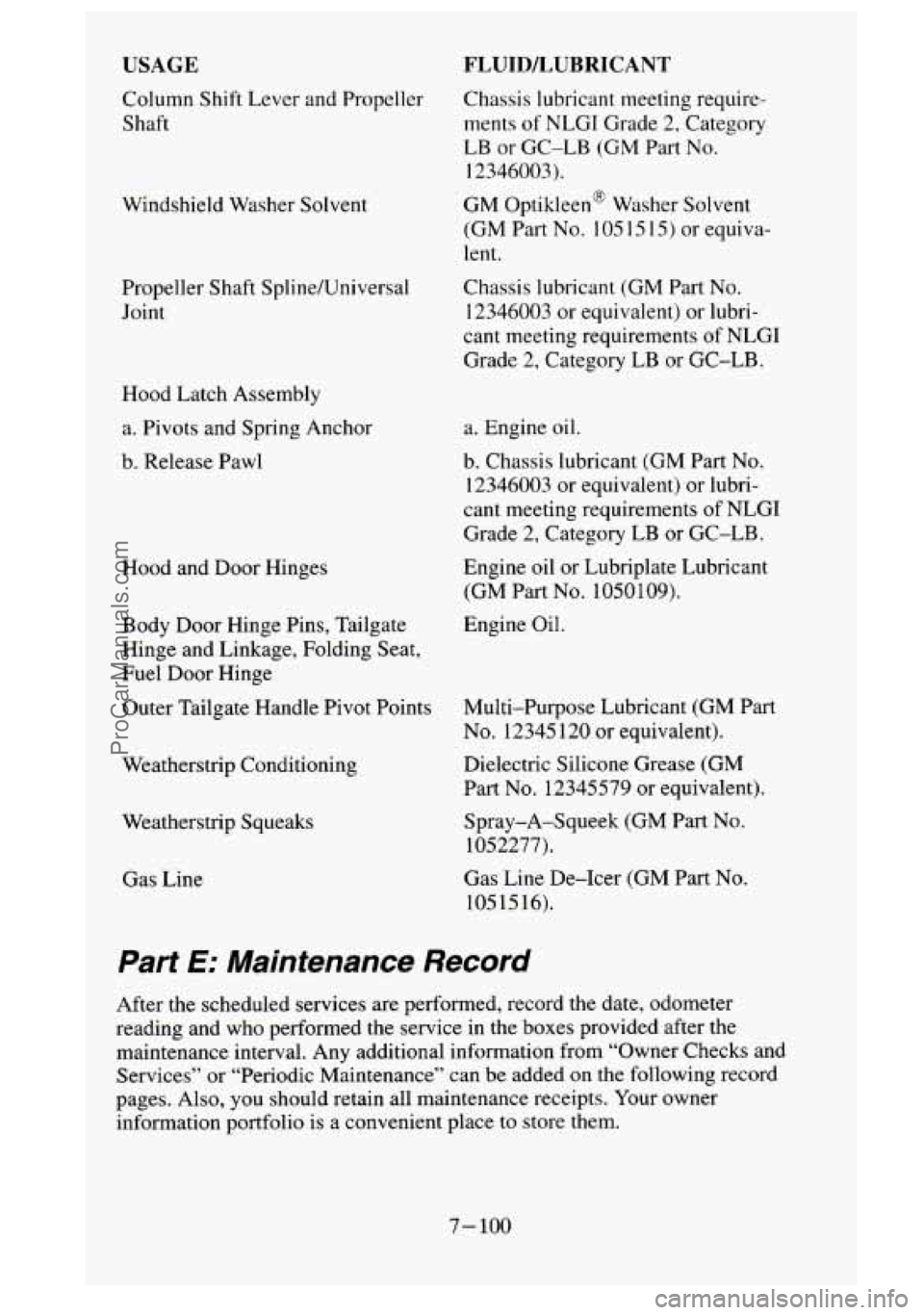
USAGE
Column Shift Lever and Propeller
Shaft
Windshield Washer Solvent
Propeller Shaft Spline/Universal
Joint
Hood Latch Assembly
a. Pivots and Spring Anchor
b. Release Pawl
Hood and Door Hinges
Body Door Hinge Pins, Tailgate
Hinge and Linkage, Folding Seat,
Fuel
Door Hinge
Outer Tailgate Handle Pivot Points
Weatherstrip Conditioning
Weatherstrip Squeaks
Gas Line
FLUIDLUBRICANT
Chassis lubricant meeting require-
ments
of NLGI Grade 2, Category
LB
or GC-LB (GM Part No.
12346003).
GM Optikleen’ Washer Solvent
(GM Part
No. 105 1 5 1 5) or equiva-
lent.
Chassis lubricant (GM Part
No.
12346003 or equivalent) or lubri-
cant meeting requirements
of NLGI
Grade 2, Category LB or GC-LB.
a. Engine oil.
b. Chassis lubricant (GM Part No.
12346003 or equivalent) or lubri-
cant meeting requirements
of NLGI
Grade 2, Category LB or GC-LB.
Engine oil or Lubriplate Lubricant
(GM Part
No. 1050109).
Engine Oil.
Multi-Purpose Lubricant (GM Part
No. 12345 120 or equivalent).
Dielectric Silicone Grease (GM
Part
No. 12345579 or equivalent).
Spray-A-Squeek (GM
Part No.
1 05 2277).
Gas Line De-Icer (GM Part No.
105 15 16).
Part E: Maintenance Record
After the scheduled services are performed, record the date, odometer
reading and who performed the service
in the boxes provided after the
maintenance interval. Any additional information from “Owner Checks and
Services” or “Periodic Maintenance” can be added on the following record
pages. Also, you should retain all maintenance receipts. Your owner
information portfolio
is a convenient place to store them.
7-100
ProCarManuals.com