air condition GMC SIERRA 1996 User Guide
[x] Cancel search | Manufacturer: GMC, Model Year: 1996, Model line: SIERRA, Model: GMC SIERRA 1996Pages: 404, PDF Size: 21.57 MB
Page 227 of 404
If No Steam Is Coming From Your Engine
If you get the overheat warning but see or hear no
steam, the problem may
not be too serious. Sometimes
the engine can get
a little too hot when you:
Climb a long hill on a hot day.
0 Stop after high-speed driving.
Idle for long periods in traffic.
Tow a trailer. See “Driving on Grades” in the Index.
If you get the overheat warning with no sign of steam,
try
this for a minute or so:
I. If you have an air conditioner, turn it off.
2. Turn on your heater to full hot at the highest fan
speed and open the window
as necessary.
3. If you’re in a traffic jam, shift to NEUTRAL (N);
otherwise, shift to the highest gear while
driving
-- AUTOMATIC OVERDRIVE (0)
or THIRD (3) for automatic transmissions.
If you no longer have the overheat warning, you can drive.
Just to be safe, drive slower
for about 10 minutes. If the
warning doesn’t come back
on, you can drive normally.
If the warning continues, pull over, stop, and park your
vehicle right away.
If there’s still
no sign of steam, push the accelerator
until the engine speed is about twice as fast as normal
idle speed. Bring the engine speed back
to normal idle
speed after two or three minutes. Now see
if the warning
stops.
But then, if you still have the warning, turn of
the engine nrzd get everyone nut of the vehicle until it
cools down.
You
may decide not to lift the hood but to get service
help right away.
5-11
ProCarManuals.com
Page 228 of 404
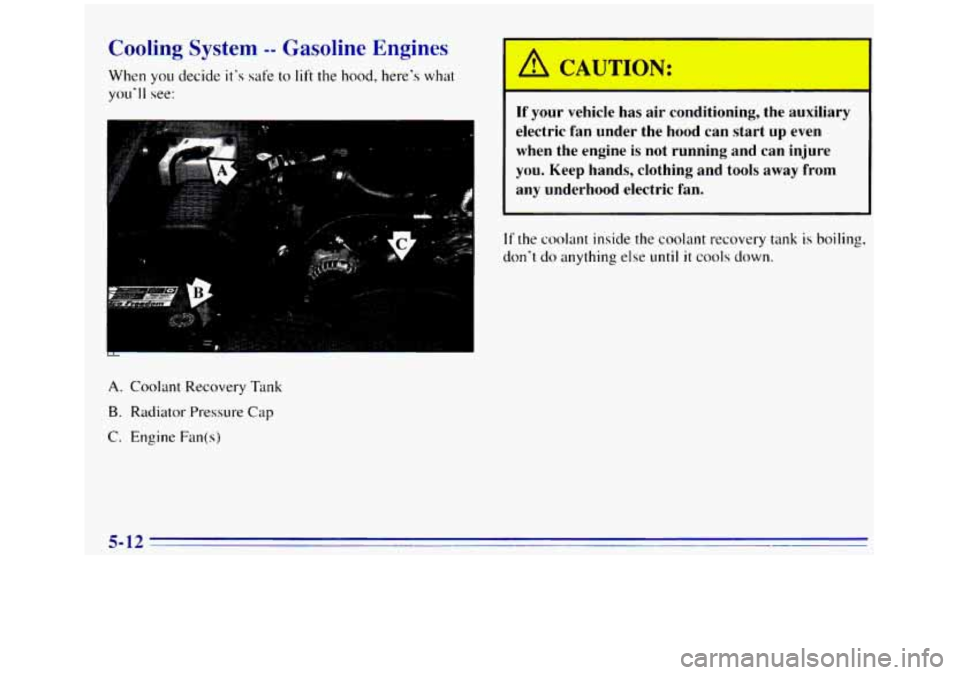
Cooling System -- Gasoline Engines
When you decide it's safe to lift the hood, here's what
you'll see:
A. Coolant Recovery Tdnk
B. Radiator Pressure Cap
C. Engine Fan(s)
A CAUTION:
If your vehicle has air conditioning, the auxiliary
electric fan under the hood can start up even when the engine is not running and can injure
you. Keep hands, clothing and tools away from
any underhood electric fan.
If the coolant inside the coolant recovery tank is boiling,
don't do anything else
until it cools down.
ProCarManuals.com
Page 236 of 404
Engine Fan Noise
Your vehicle has a clutched engine cooling fan. When the
clutch
is engaged, the fan spins fdster to provide more air
to cool the engine.
In most every day driving conditions,
the fan
is spinning slower and the clutch is not fully
engaged. This improves fuel economy and reduces fan
noise. Under heavy vehicle loading, trailer towing andor
high outside temperatures, the
fm speed increases as the
clutch more fully engages.
So you may hear an increase
in fan noise. This is normal and should not be mistaken
as the transmission slipping or making extra shifts.
It is
merely the cooling system functioning properly. The fan
will slow down when additional cooling is not required
and the clutch partially disengages.
You may also hear this
fm noise when you start
the engine.
It will go away as the fan clutch
partially disengages.
If a Tire Goes Flat
It’s unusual for a tire to “blow out” while you’re driving,
especially
if you maintain your tires properly. If air goes
out
of a tire, it’s much more likely to leak out slowly.
But if you should ever have a “blowout,” here are a few
tips about what
to expect and what to do:
If a front tire fails, the flat tire will create a. drag that
pulls the vehicle toward that side. Fake your foot off the
accelerator pedal and grip the steering wheel firmly.
Steer to maintain
lane position, and then gently brake to
a stop well out of the traffic lane.
A rear blowout, particularly on a curve, acts much like
a skid and
ITMY require the same correction you’d use in
a skid. In any rear blowout, remove your foot from the
accelerator pedal. Get the vehicle under control by
steering the way you want the vehicle to
go. It may be
very bumpy and
noisy, but you can still steer. Gently
brake to a stop
-- well off the road if possible.
If a tire goes tlat, the next part shows how to use your
jacking equipment to change
a flat tire safely.
5-20
ProCarManuals.com
Page 253 of 404
If your vehicle is certified to meet California Emission
Standards (indicated on the underhood tune-up label),
it
is designed to operate on fuels that meet California
specifications.
If such fuels are not available in states
adopting California emissions standards,
your vehicle
will operate satisfactorily
on fuels meeting federal
specifications, but emission control system performance
may be affected. The malfunction indicator lamp on
your instrument panel may
turn on and/or your vehicle
may fail a smog-check test.
If this occurs, return to your
authorized GM dealer for diagnosis
to determine the
cause
of failure. In the event it is determined that the
cause
of the condition is the type of fuels used, repairs
may not be covered by
your warranty.
In Canada. some gasolines contain an octane-enhancing
additive called
MMT. If you use such fuels, your
emission control system performance may deteriorate
and the tnalfunction indicator lamp
on your instrument
panel may turn on. If this happens, return to your
authorized
CM dealer for service.
To provide cleaner air, all gasolines are now required to
contain additives that will help prevent deposits from
forming
in your engine and fuel system, allowing your
emission control system
to function properly. Therefore,
you should not have to add anything to the fuel. In
addition, gasolines containing oxygenates, such as ethers
and ethanol, and reformulated gasolines may be
available
in your area to help clean the air. General
Motors recommends that
you use these gasolines if they
comply with the specifications described earlier.
NOTICE:
Your vehicle was not designed for fuel that
contains methanol. Don’t use it.
It can corrode
metal parts
in your fuel system and also damage
plastic and rubber parts. That damage wouldn’t
be covered under your warranty.
6-3
ProCarManuals.com
Page 256 of 404
Be careful not to spill gasoline. Clean gasoline from
painted surfxes as soon
as possible. See “Cleaning the
Outside
of Your Vehicle” in the Index.
When you put the cap back
on, turn it to the right until
you hear at least three clicks. Make sure you fully install
the cap. The diagnostic system can determine if the fuel
cap has been
left off or improperly installed. This would
allow
fuel to evaporate into the atmosphere. See
“Malfunction Indicator Lamp” in the Index.
I NOTICE:
If you need a new cap, be sure to get the right
type. Your dealer can get one for you. If you get
the wrong type, it may not fit or have proper
venting, and your fuel tank and emissions system
might be damaged.
Checking Things Under the Hood
h
I ! CAUTION:
If your vehicle has air conditioning, the auxiliary
engine fan under the hood can start up and
hjure you even when the engine
is not running.
Keep hands, clothing and tools away from any
underhood electric fan.
Things that burn can get on hot engine parts and
start a fire. These include liquids like gasoline or
diesel fuel, oil, coolant, brake fluid, windshield
washer and other fluids, and plastic or rubber.
You
or others could be burned. Be careful not to drop
or spill things that will burn onto a hot engine.
6-6
ProCarManuals.com
Page 286 of 404
NOTICE: .
Continuing to drive with worn-out brake pads
could result in costly brake repair.
Some driving conditions or climates may cause a brake
squeal when the brakes are first applied or lightly
applied. This does not mean something is wrong with
your brakes.
Free movement
of brake calipers and properly torqued
wheel nuts
are necessary to help prevent brake
pulsation. When tires
are rotated, inspect.brake calipers
for movement, brake pads for wear, and evenly torque
wheel nuts in the proper sequence
to GM specifications.
If you have rear drum brakes, they don’t have wear
indicators, but
if you ever hear a rear brake rubbing
noise, have the rear brake linings inspected.
Also, the
rear brake drums should be remoQed and inspected each
time the tires are removed for rotation or changing.
When you have the front brakes replaced, have the rear
brakes inspected,
too. I
Brake linings should always be replaced as complete
axle sets.
Brake Pedal Travel
See your dealer if the brake pedal does not return to
normal height, or if there is a rapid increase in pedal
travel. This could be a sign of brake trouble.
Brake Adjustment
Every time you make a brake stop, your disc brakes
adjust for wear.
If your brake pedal goes down farther than normal, your
rear drum brakes may need adjustment. Adjust them by
backing up and firmly applying the brakes a few times.
Replacing Brake System Parts
The braking system on a modern vehicle is complex. Its
many parts have to be
of top quality and work well
together if the vehicle is to have really good braking.
Vehicles we design and test have top-quality
GM brake
parts
in them, as your vehicle does when it is new. When
you replace parts of your braking system -- for example,
when- your brhke linings wear do.wn and you have
to
haye new ones put in -- be sure you get new genuine
GM replacement parts. If you don’t, your brakes may
no longer work properly. For example,
if someone
puts in brake linings that are wrong for your vehicle,
the balance between your front and rear brakes can
change
-- for the worse. The braking performance
you’ve come to expect can change
in many other ways
if someone puts in the wrong replacement brake parts.
I
I
6-36
ProCarManuals.com
Page 303 of 404
Dual Tire Operation
When the vehicle is new, or whenever a wheel, wheel
bolt or wheel nut is replaced, check the wheel nut torque
after
100, 1,000 and 6,000 miles ( 160, I 600 and IO 000
km) of driving. For proper torque, see "Wheel Nut
Torque" in the Index.
The outer tire on a dual wheel setup generally wears
faster than the inner tire. Your tires will wear more
evenly and last longer
if you rotate the tires periodically.
If you're going to be doing a lot of driving on
high-crown roads,
you can reduce tire wear by adding
5 psi (35 kPa) to the tire pressure in the outer tires. Be
sure to return to the recommended pressures when no
longer driving under those conditions. See "Changing
a
Flat Tire" in the Index for more information.
A CAUTION:
I
If you operate your vehicle with a tire that is
badly underinflated, the tire can overheat. An
overheated tire can lose air suddenly or catch fire.
You or others could be injured. Be sure
all tires
(including the spare, if any) are properly inflated.
Buying New Tires
To find out what kind and size of tires you need, look at
the Certificntion/Tire label.
Tlze tires installed
on your vehicle when it was new had
a Tire Performance Criteria Specification (TPC Spec)
number
on each tire's sidewall. When you get new tires,
get ones
with that same TPC Spec number. That way
your vehicle
will continue to have tires that are designed
to give proper endurance, handling, speed rating,
traction, ride and other things during normal service
on
your vehicle. If your tires have an all-season tread
design,
the TPC number will be followed by an "MS"
(for mud and snow).
If you ever replace your tires with those not having a
TPC
Spec number, make sure they are the same size,
load range, speed rating and construction type
(bias,
bias-belted or radial) as your original tires.
6-53
ProCarManuals.com
Page 305 of 404
Tempera A, B, c
The temperature grades are A (the highest), B, and C,
representing the tire’s resistance to the generation of
heat and its ability
to dissipate heat when tested under
controlled conditions
on a specified indoor laboratory
test wheel. Sustained high temperature can cause the
material of the tire to degenerate and reduce tire life, and
excessive temperature can lead
to sudden tire failure.
The grade
C corresponds to a level of performance
which
all passenger car tires must meet under the
Federal Motor Vehicle Safety Standard
No. 109. Grades
B and A represent higher levels of performance on the
laboratory test wheel than the minimum required
by law.
--
Warning: The temperature grade for this tire is
established for a tire that is properly inflated and not
overloaded. Excessive speed, underinflation, or
excessive loading, either separately or in combination,
can cause heat buildup and possible tire failure.
Wheel Alignment and Tire Balance
The wheels on your vehicle were aligned and balanced
carefully at the factory
to give you the longest tire life
and best overall performance,
In most cases, you will not need to have your wheels
aligned again. However, if
you notice unusual tire wear
or
your vehicle pulling one way or the other, the
alignment may need
to be reset. If you notice your
vehicle vibrating when driving
on a smooth road, your
wheels may need to be rebalanced.
Wheel Replacement
Replace any wheel that is bent, cracked, or badly rusted
or corroded.
If wheel nuts keep coming loose, the wheel,
wheel bolts and wheel nuts should be replaced.
If the
wheel leaks air, replace it (except some aluminum
wheels, which can sometimes be repaired). See your
GM dealer if any of these conditions exist.
Your dealer will know the kind of wheel you need.
ProCarManuals.com
Page 315 of 404
Underbody Maintenance
Chemicals used for ice and snow removal and dust
control can collect
on the underbody, If these are
not removed, accelerated corrosion (rust) can occur
on the underbody parts such as fuel lines, frame,
floor pan and exhaust system even though they have
corrosion protection.
At least every spring, flush these materials from the
underbody with plain water. Clean any areas where mud
and other debris can collect. Dirt packed
in closed areas
of the frame should be loosened before being flushed.
Your dealer or an underbody vehicle washing system
can do this for you.
Chemical Paint Spotting
Some weather and atmospheric conditions can create a
chemical fallout. Airborne pollutants can
fdl upon and
attack painted surfxes
on your vehicle. This damage can
take two forms: blotchy, ringlet-shaped discolorations, and
small irregular dark spots etched into the paint surface.
Although
no defect in the paint job causes this, GM
will repair, at no charge to the owner, the surfaces of
new vehicles damaged by this fallout condition within
12 months or 12,000 miles (20 000 km) of purchase,
whichever occurs first.
This applies
only to materials manufactured and sold by
General Motors. Bodies, body conversions or equipment
not made or
sold by General Motors are not covered.
6-65
ProCarManuals.com
Page 322 of 404
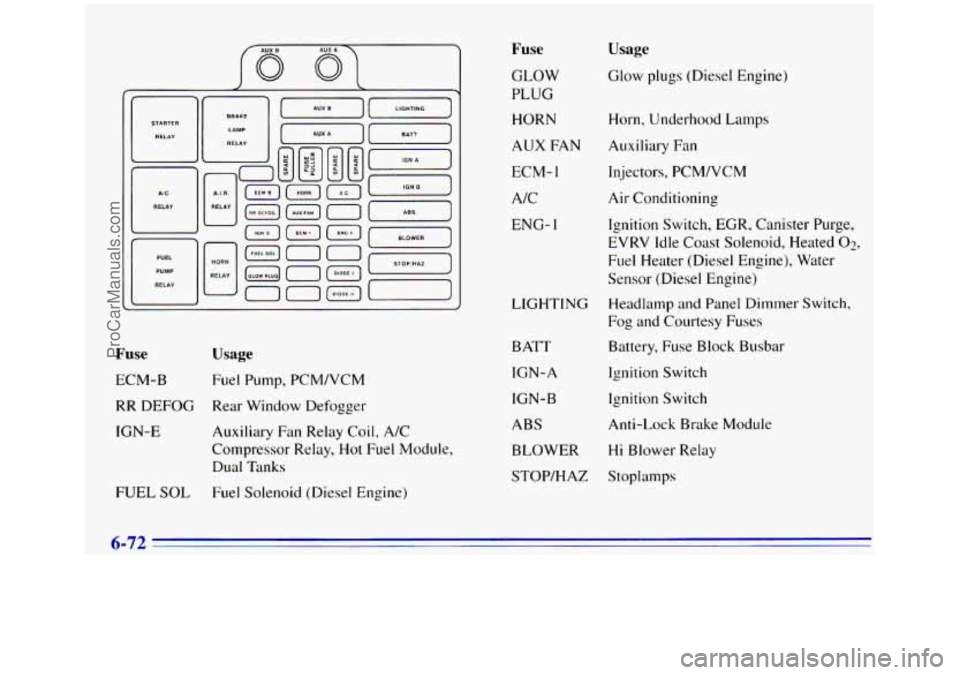
Fuse
ECM-B
Usage
Fuel Pump, PCM/VCM
RR DEFOG Rear Window Defogger
IGN-E Auxiliary Fan Relay Coil, A/C
Compressor Relay, Hot Fuel Module,
Dual Tanks
FUEL SOL Fuel Solenoid (Diesel Engine)
Fuse
GLOW
PLUG
HORN
AUX FAN
ECM-
1
A/C
ENG-
1
Usage
Glow plugs (Diesel Engine)
Horn, Underhood Lamps Auxiliary Fan
Injectors, PCM/VCM
Air Conditioning
Ignition Switch, EGR, Canister Purge,
EVRV Idle Coast Solenoid, Heated
02,
Fuel Heater (Diesel Engine), Water
Sensor (Diesel Engine)
LIGHTING Headlamp and Panel Dimmer Switch,
Fog and Courtesy Fuses
Battery,
Fuse Block Busbar
BATT
IGN-A
IGN-B
ABS Ignition Switch
Ignition Switch
Anti-Lock Brake Module
BLOWER
Hi Blower Relay
STOP/HAZ Stoplamps
ProCarManuals.com