wheel GMC SIERRA 1996 Service Manual
[x] Cancel search | Manufacturer: GMC, Model Year: 1996, Model line: SIERRA, Model: GMC SIERRA 1996Pages: 404, PDF Size: 21.57 MB
Page 178 of 404
@ Hidden obstacles can make the steepness of the
incline even worse.
If you drive across a rock with
the uphill wheels, or if the downhill wheels drop into
a rut or depression, your vehicle can tilt even more.
For reasons like these,
you need to decide carefully
whether to try
to drive across an incline. Just because
the trail goes across
the incline doesn’t mean you
have to drive
it. The last vehicle to try it might have
rolled over.
Q.’ What if I’m driving across an incline that’s not
too steep, but I hit some loose gravel and start to
slide downhill. What should
I do?
A: If you feel your vehicle starting to slide sideways,
turn downhill.
This should help straighten out the
vehicle and prevent the side slipping. However, a
much better way to prevent this
is to get out and
“walk the course”
so you know what the surface is
like before you drive
it.
1 A CAUTION: r: .. -. :. *. -
Driving across an incline that’s too steep will
make your vehicle roll over.
You could be
seriously injured or killed.
If you have any doubt
about the steepness of the incline, don’t drive
across it. Find another route instead.
I I
4-24
ProCarManuals.com
Page 180 of 404
Driving in Mud, Sand, Snow or Ice
When you drive in mud, snow or sand, your wheels
won’t get good traction.
You can’t accelerate as
quickly, turning
is more difficult, and you’ll need
longer braking distances.
It’s best to
use a low gear when you’re in mud -- the
deeper the mud, the lower the gear. In really deep mud,
the idea is to keep your vehicle moving so you don’t
get stuck.
When
you drive on sand, you’ll sense a change in wheel
traction. But
it will depend upon how loosely packed the
sand is. On loosely packed sand (as on beaches or sand
dunes) your tires will tend
to sink into the sand. This has
an effect on steering, accelerating and braking. You may
want t.o reduce the air pressure in your tires slightly
when driving
on sand. This will improve traction. Hard
packed snow and ice offer the worst tire traction.
On these surfaces, it’s very easy
to lose control. On wet
ice, for example, the traction is so poor that you will
have difficulty accelerating. And if you do get moving,
poor steering and difficult braking can cause
you to slide
out of control.
Driving on frozen lakes, ponds or rivers can be
dangerous. Underwater springs, currents under
the ice, or sudden thaws can weaken the ice. Your
vehicle could fall through the ice and you and
your passengers could drown. Drive your vehicle
on safe surfaces only.
4-26
ProCarManuals.com
Page 181 of 404
Driving in Water
Light rain causes no special off-road driving problems.
But heavy rain can mean flash flooding, and flood
waters demand extreme caution.
Find out how deep the water
is before you drive through
it.
If it’s deep enough to cover your wheel hubs, axles or
exhaust pipe, don’t try
it -- you probably won’t get
through. Also, water that deep can damage your axle
and other vehicle parts.
If the water isn’t too deep, then drive through it
slowly. At fast speeds, water splashes on your ignition
system and your vehicle can stall. Stalling can also
occur
if you get your tailpipe under water. And, as
long as your tailpipe
is under water, you’ll never be
able to start your engine. When you go through water,
remember that when your brakes get wet,
it may take
you longer
to stop. Driving mrough rushing water can be dangerous.
Deep water can sweep your vehicle downstream
and you and your passengers could drown.
If it’s
only shallow water, it can still wash away the
ground from under your tires, and you could lose
traction and roll the vehicle over. Don’t drive
through rushing water.
See “Driving Through Water” in the Index for more
information on driving through water.
4-27
ProCarManuals.com
Page 182 of 404
Dr g at I
Remove any brush or debris that has collected on the
underbody, chassis or under the hood. These
accumulations can be a fire hazard.
After operation
in mud or sand, have the brake linings
cleaned
and checked. These substances can cause
glazing and uneven braking. Check the body structure,
steering, suspension, wheels, tires and exhaust system
for damage. Also, check the fuel lines and cooling
system for any leakage.
Your vehicle
will require more frequent service due to
off-road use. Refer
to the Maintenance Schedule for
additional information.
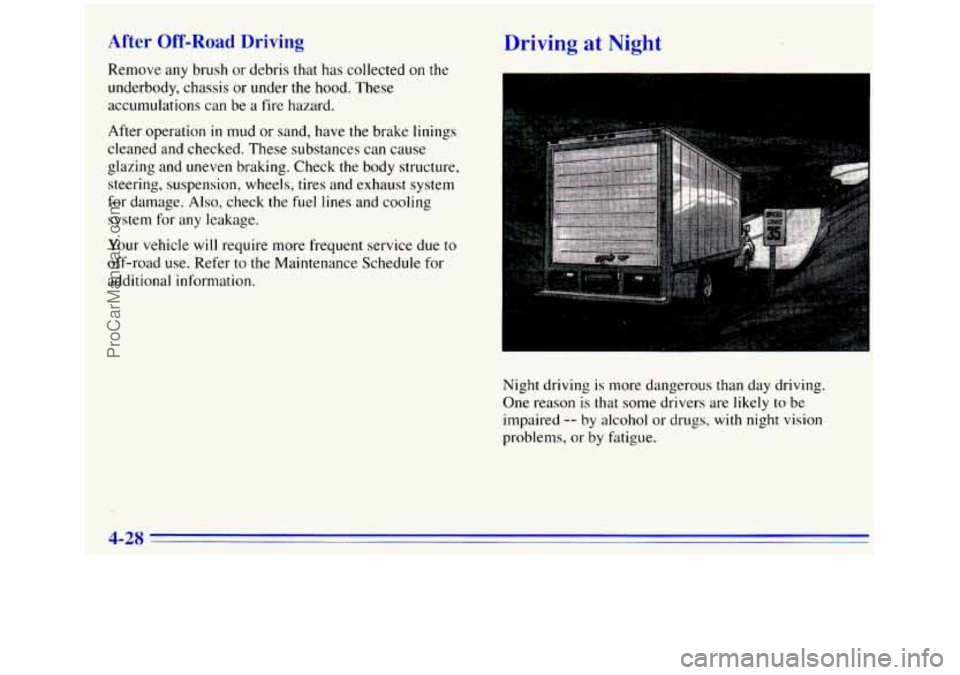
Night driving
is more dangerous than day driving.
One reason
is that some drivers are likely to be
impaired
-- by alcohol or drugs, with night vision
problems, or by fatigue.
4-28
ProCarManuals.com
Page 190 of 404
‘--b hway Hypnosis
Is there actually such a condition as “highway hypnosis”?
Or is
it just plain falling asleep at the wheel? Call it
highway hypnosis, lack
of awareness, or whatever.
There is something about an easy stretch
of road with the
same scenery, along with the hum
of the tires on the road,
the drone of the engine, and the rush
of the wind against
the vehicle that can make
you sleepy. Don’t let it happen
to you!
If it does, your vehicle can leave the road in less
thun CI secmd, and you could crash and be injured.
What can you do about highway hypnosis? First, be
aware that
it can happen.
Then here are some tips:
0
0
0
Make sure your vehicle is well ventilated, with a
comfortably cool interior.
Keep your eyes moving. Scan the road ahead and
to the sides. Check your mirrors and your
instruments frequently.
If you get sleepy, pull off the road into a rest, service
or parking area and take
a nap, get some exercise, or
both. For safety, treat drowsiness on
the highway as
an emergency.
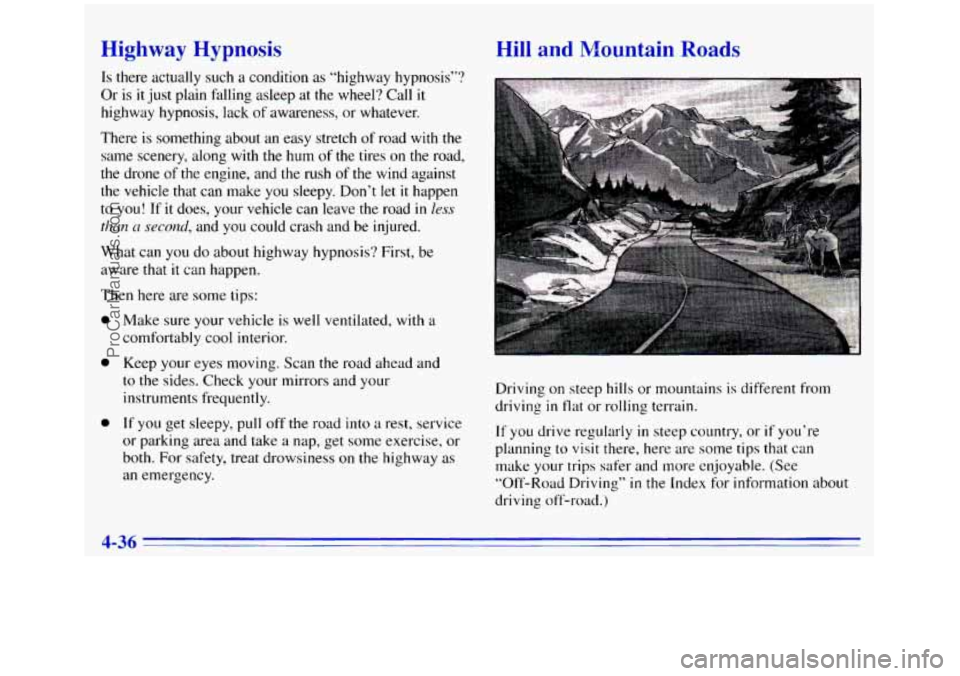
Hill and Mountain Roads
Driving on steep hills or mountains is different from
driving
in flat or rolling terrain.
If you drive regularly in steep country, or if you’re
planning to visit there, here are some tips that can
make your trips safer and more enjoyable. (See
“Off-Road Driving”
in the Index for information about
driving off-road.)
ProCarManuals.com
Page 193 of 404
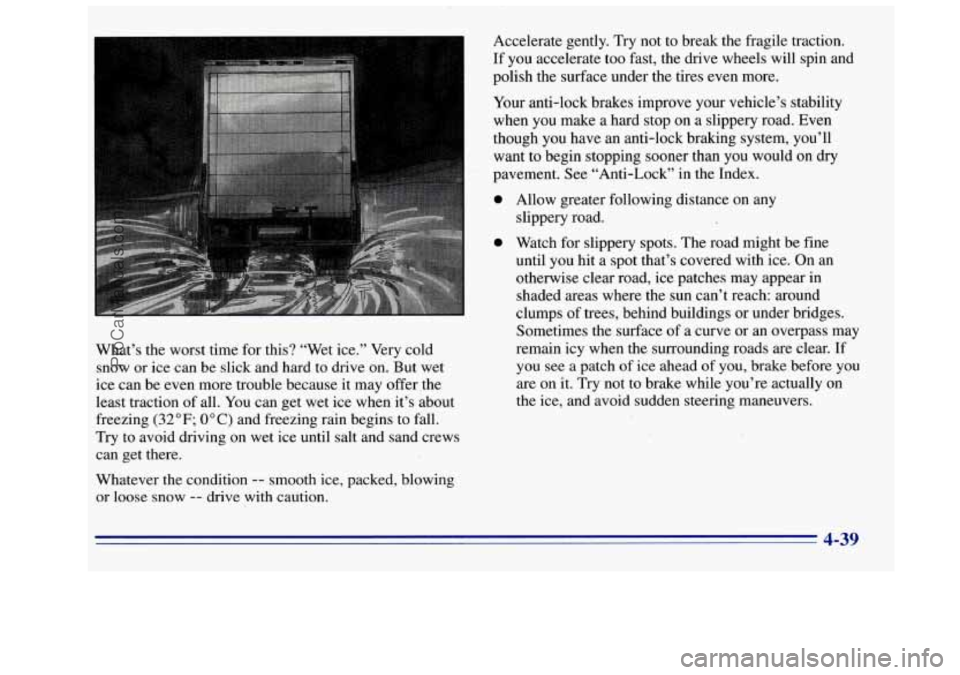
What’s the worst time for this? “Wet ice.” Very cold
snow or ice can be slick and hard to drive on. But wet
ice can be even more trouble because it may offer,the
least traction of all. You can get wet ice when it’s about
freezing
(32 OF; 0 O C) and freezing rain begins to fall.
Try to avoid driving on wet ice until salt and sand crews
can get there.
Whatever the condition
-- smooth ice, packed, blowing
or loose snow
-- drive with caution. Accelerate
gently. Try not to break the fragile traction.
If you accelerate too fast, the drive wheels will spin and
polish the surface under the tires even more.
Your anti-lock brakes improve your vehicle’s stability
when you make a hard stop on a slippery road. Even
though you have an anti-lock braking system, you’ll
want to begin stopping sooner than you would on dry
pavement. See “Anti-Lock”
in the Index.
0 Allow greater following distance on any
slippery road.
0 Watch for slippery spots. The road might be fine
until you hit a spot that’s covered with ice. On an
otherwise clear road, ice patches may appear in
shaded areas where the sun can’t reach: around
clumps
of trees, behind buildings or under bridges.
Sometimes the surface
of a curve or an overpass may
remain icy when the surrounding roads are clear. If
you see a patch of ice ahead of you, brake before you
are on it. Try not to brake while you’re actually on
the ice, and avoid sudden steering maneuvers.
4-39
ProCarManuals.com
Page 199 of 404
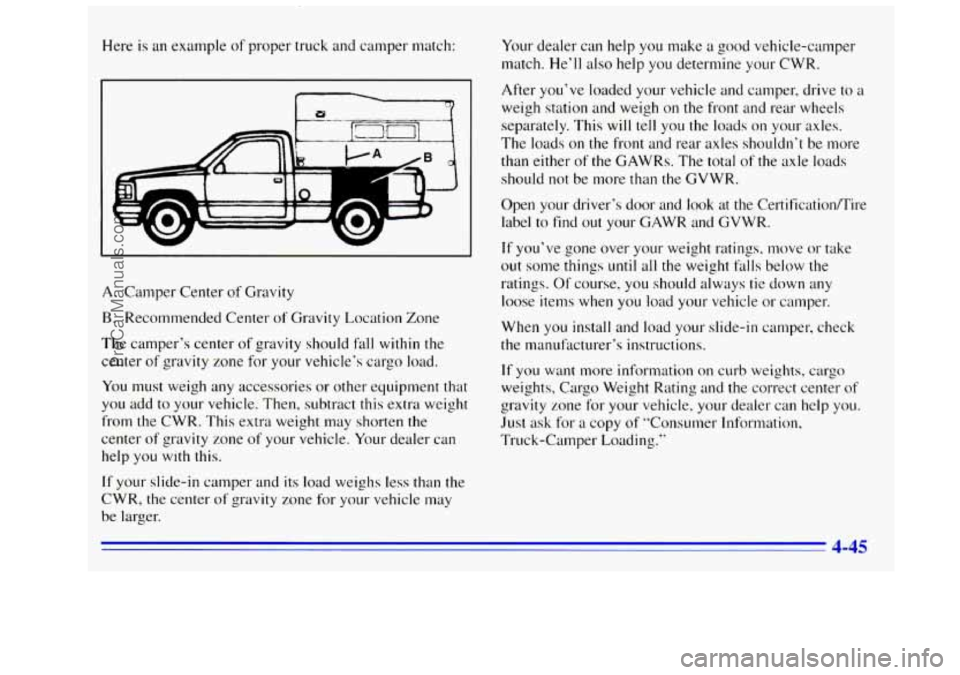
Here is an example of proper truck and camper match:
A. Camper Center of Gravity
B. Recommended Center of Gravity Location Zone
The camper‘s center of gravity should
fall within the
center of gravity zone
for your vehicle’s cargo load.
You must weigh
any accessories or other equipment that
you add
to your vehicle. Then, subtract this extra weight
from the CWR. This extra weight may shorten the
center
of gravity zone of your vehicle. Your dealer can
help
you with this.
If your slide-in camper and its load weighs less than the
CWR, the center of gravity zone for your vehicle may
be larger. Your
dealer can help
you make a good vehicle-camper
match. He’ll also help you determine
your CWR.
After you’ve loaded your vehicle and camper, drive to a
weigh station and weigh on the front and rear wheels
separately. This will tell
you the loads on your axles.
The loads
on the front and rear axles shouldn’t be more
than either of the GAWRs. The total of the axle loads
should not be more than the GVWR.
Open your driver’s door and
look at the Cel-tificationflire
label to find
out your GAWR and GVWR.
If you’ve gone over your weight ratings, move or take
out some things until all the weight f;llls below the
ratings. Of course,
you should always tie down any
loose items when
you load your vehicle or camper.
When
you install and load your slide-in camper, check
the manufacturer’s instructions.
If you want more information
on curb weights, cargo
weights, Cargo Weight Rating and the correct center
of
Just ask for a copy of “Consumer Information,
Truck-Camper Loading.”
L qravity zone for your vehicle, your dealer can help you.
’ 4-45
ProCarManuals.com
Page 205 of 404
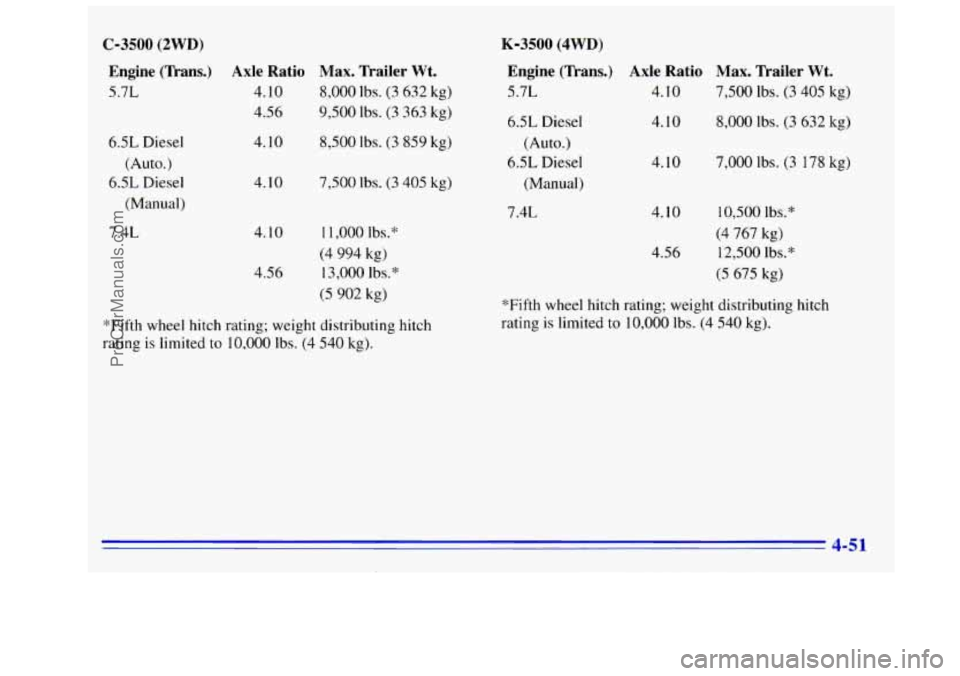
C-3500 (2WD)
Engine (Tkans.) Axle Ratio Max. Trailer Wt.
5.7L 4.10 8,000 lbs. (3 632 kg)
4.56 9,500 Ibs. (3 363 kg)
4.10
8,500 Ibs. (3 859 kg) 6.5L Diesel
(Auto.)
6.5L Diesel
(Manual)
7.4L 4.10
4.10
4.56 7,500 Ibs. (3 405 kg)
11,000 Ibs."
(4 994 kg)
13,000
Ibs.*
(5 902 kg)
*Fifth wheel
hitch rating; weight distributing hitch
rating
is limited to 10,000 lbs. (4 540 kg).
K-3500 (4WD)
Engine (lkans.) Axle Ratio Max. Trailer Wt.
5.7L 4.10 7,500 lbs. (3 405 kg)
6.5L Diesel
(Auto.)
6.5L Diesel
(Manual)
7.4L 4.10
4.10
4.10
4.56
8,000 lbs. (3 632 kg)
7,000 Ibs. (3 178 kg)
10,500 lbs.*
(4 767 kg)
12,500 lbs.*
(5 675 kg)
*Fifth wheel hitch rating; weight distributing hitch
rating is limited
to 10,000 lbs. (4 540 kg).
4-51
ProCarManuals.com
Page 206 of 404
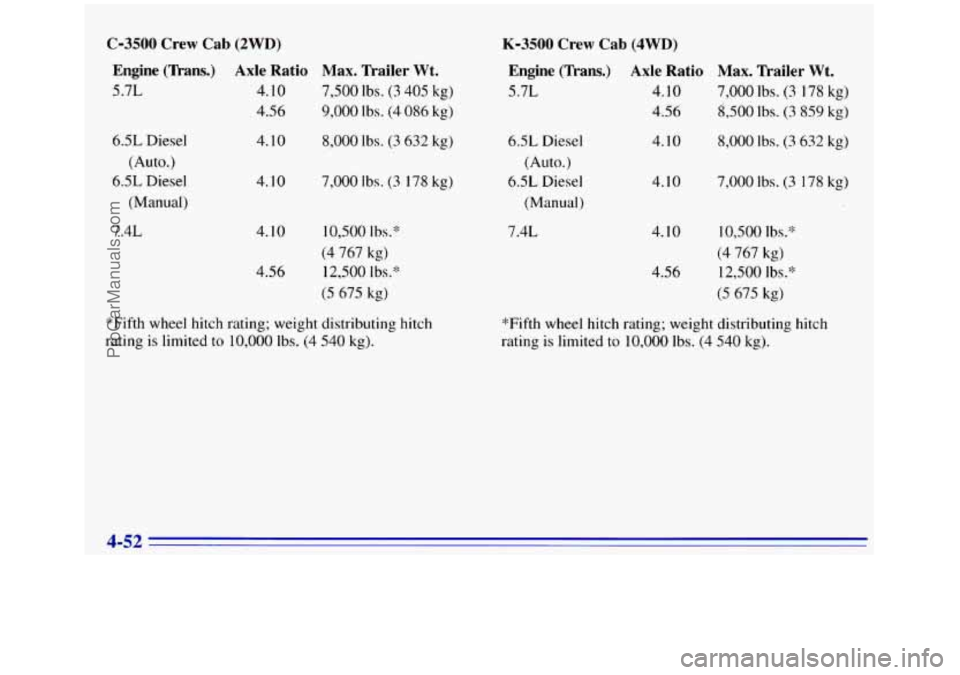
C-3500 Crew Cab (2WD)
Engine (Trans.) Axle Ratio Max. Trailer Wt.
5.7L 4.10 7,500 lbs. (3 405 kg)
4.56 9,000
Ibs. (4 086 kg)
6.5L Diesel
(Auto.)
6.5L Diesel
(Manual)
7.4L
4.10
4.10
4.10
4.56
8,000 lbs. (3 632 kg)
7,000
Ibs. (3 178 kg)
10,500 lbs.*
(4 767 kg)
12,500
Ibs.*
(5 675 kg)
*Fifth
wheel hitch rating.; weight distributing hitch
rating
is limited to 10,000 lbs. (4 540 kg).
K-3500 Crew Cab (4WD)
Engine (Tkans.) Axle Ratio Max. Trailer Wt.
5.7L 4.10 7,000 Ibs. (3 178 kg)
4.56 8,500
Ibs. (3 859 kg)
6% Diesel
(Auto.)
6.5L Diesel
(Manual)
7.4L 4.10
4.10
4.10
4.56
8,000 Ibs. (3 632 kg)
7,000
Ibs. (3 178 kg)
10,500
Ibs*
(4 767 kg)
12,500
Ibs?
(5 675 kg)
*Fifth wheel hitch rating; weight distributing hitch
rating
is limited to 10,000 Ibs. (4 540 kg).
4-52
ProCarManuals.com
Page 207 of 404
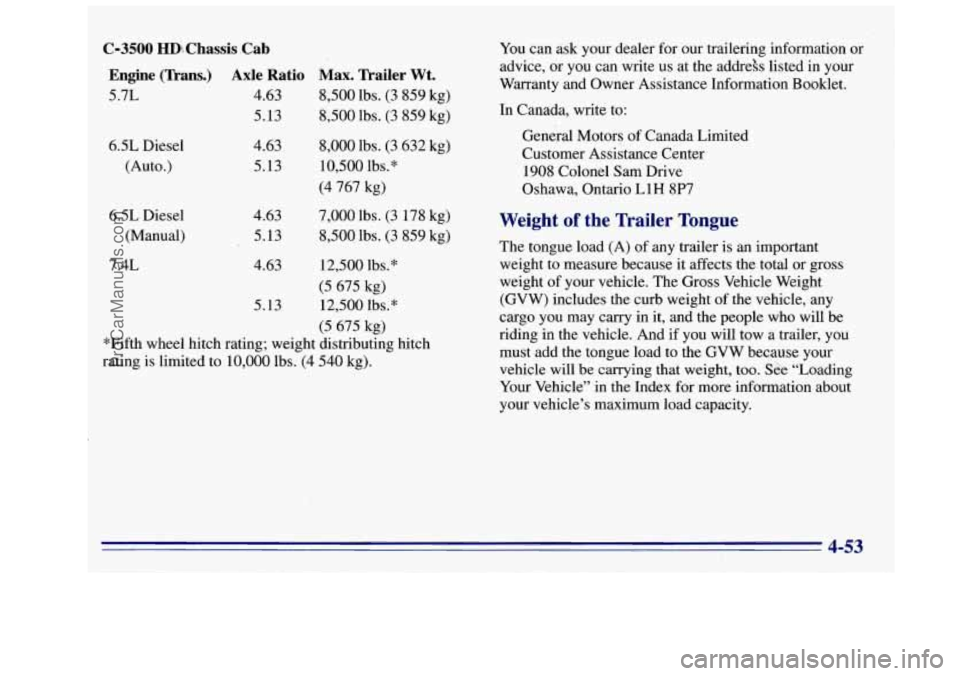
(2-3500 HDiChassis .Cab Engine (Trans.) Axle Ratio
Max. Trailer Wt.
5.7L 4.63 8,500 lbs. (3 859 kg)
5.13
8,500 lbs. (3 859 kg)
6% Diesel
(Auto.)
6.5L Diesel
(Manual)
7.4L 4.63
5.13
4.63 5.13
4.63
5.13
8,000 lbs. (3 632 kg)
10,500 lbs.*
(4 767 kg)
7,000 lbs. (3 178 kg)
8,500 lbs. (3 859 kg)
12,500 lbs.*
(5 675 kg)
12,500 lbs.*
(5 675 kg)
*Fifth wheel hitch rating; weight distributing hitch
rating is limited to 10,000 lbs. (4 540 kg). You
can ask your dealer for our trailering information or
advice, or you can write us at the addreis listed in your
Warranty and Owner Assistance Information Booklet.
In Canada, write to:
General Motors of Canada Limited
Customer Assistance Center
1908 Colonel Sam Drive
Oshawa, Ontario LlH 8P7
Weight of the Trailer Tongue
The tongue load (A) of any trailer is an important
weight to measure because it affects the total or gross
weight of your vehicle. The Gross Vehicle Weight
(GVW) includes the curb weight of the vehicle, any
cargo you may carry in it, and the people who will be
riding in the vehicle. And if you will tow a trailer, you
must add the tongue load to the GVW because your
vehicle will be carrying that weight, too. S&e “Loading
Your Vehicle” in the Index for more information about
your vehicle’s maximum load capacity.
4-53
ProCarManuals.com