wheel GMC SIERRA 1996 Manual Online
[x] Cancel search | Manufacturer: GMC, Model Year: 1996, Model line: SIERRA, Model: GMC SIERRA 1996Pages: 404, PDF Size: 21.57 MB
Page 305 of 404
Tempera A, B, c
The temperature grades are A (the highest), B, and C,
representing the tire’s resistance to the generation of
heat and its ability
to dissipate heat when tested under
controlled conditions
on a specified indoor laboratory
test wheel. Sustained high temperature can cause the
material of the tire to degenerate and reduce tire life, and
excessive temperature can lead
to sudden tire failure.
The grade
C corresponds to a level of performance
which
all passenger car tires must meet under the
Federal Motor Vehicle Safety Standard
No. 109. Grades
B and A represent higher levels of performance on the
laboratory test wheel than the minimum required
by law.
--
Warning: The temperature grade for this tire is
established for a tire that is properly inflated and not
overloaded. Excessive speed, underinflation, or
excessive loading, either separately or in combination,
can cause heat buildup and possible tire failure.
Wheel Alignment and Tire Balance
The wheels on your vehicle were aligned and balanced
carefully at the factory
to give you the longest tire life
and best overall performance,
In most cases, you will not need to have your wheels
aligned again. However, if
you notice unusual tire wear
or
your vehicle pulling one way or the other, the
alignment may need
to be reset. If you notice your
vehicle vibrating when driving
on a smooth road, your
wheels may need to be rebalanced.
Wheel Replacement
Replace any wheel that is bent, cracked, or badly rusted
or corroded.
If wheel nuts keep coming loose, the wheel,
wheel bolts and wheel nuts should be replaced.
If the
wheel leaks air, replace it (except some aluminum
wheels, which can sometimes be repaired). See your
GM dealer if any of these conditions exist.
Your dealer will know the kind of wheel you need.
ProCarManuals.com
Page 306 of 404
Each new wheel should have the same load-carrying
capacity, diameter, width, offset and be mounted the same way as the one it replaces.
If you need to replace any
of your wheels, wheel bolts
or wheel nuts, replace them only with new
GM original
equipment parts. This way, you will be sure
to have the
right wheel, wheel bolts and wheel nuts for your vehicle.
CAUTION:
I
Using the wrong replacement wheels, wheel bolts
or wheel nuts on your vehicle can be dangerous.
It could affect the braking and handling of your
vehicle, make your tires lose air and make you
lose. control.
You could have a collision in which
you or others could be injured. Always use the
correct wheel, wheel bolts and wheel nuts for
replacement.
NOTICE:
The wrong wheel can also cause problems with
bearing life, brake cooling, speedometer or
odometer calibration, headlamp aim, bumper
height, vehicle ground clearance and tire or tire
chain clearance to the body and chassis.
7
Whenever a wheel, wheel bolt or wheel nut is replaced
on a dual wheel setup, check the wheel
nut torque after
100,
1,000 and 6,000 miles (160, 1 600 and 10 000 km)
of driving. For proper torque, see “Wheel Nut Torque”
in
the Index.
See “Changing a Flat Tire” in the Index for
more information.
6-56
ProCarManuals.com
Page 307 of 404
Used Replacement Wheels Tire Chains
1
-- 4
Putting a used wheel .on your vehicle is dangerous.
You can’t know how it’s been used or how many
miles it’s been driven.
It could fail suddenly and
cause an accident.
If you have to replace a wheel,
use a new
GM original equipment wheel.
NOTICE:
If your vehicle has dual wheels or P265/75R16
size tires, don’t use tire chains. They can damage
your vehicle.
If you don’t have dual wheels or if you have a tire
size other than P265/75R16, use tire chains only
where legal and only when you must. Use chains
that are the proper size for your tires. Install
them on the tires of the rear axle.
Don’t use chains on the tires of the front axle.
Tighten them as tightly as possible with the ends
,
securely fastened. Drive slowly and follow the chain
manufacturer’s instructions.
If you can. hear the
chains ‘contacting your vehicle, stop and retighten
them.
If the contact continues, slow dawn until it
stops. Driving too fast or spinning the wheels with
chains on
will damage your vehicle.
4
6-57
ProCarManuals.com
Page 314 of 404
Aluminum or Chrome Wheels
(If So Equipped)
Keep your wheels clean using a soft clean cloth with
mild soap and water. Rinse with clean water. After
rinsing thoroughly, dry with a soft clean towel. A wax
may then be applied.
The surface of these wheels is similar to the painted
surface
of your vehicle. Don’t use strong soaps,
chemicals, abrasive polishes, abrasive cleaners or
abrasive cleaning brushes
on them because you could
damage
the surface. You may use chrome polish on
chrome wheels, but avoid any painted surface
of the
wheel, and buff
off immediately after application.
Don’t take your vehicle through an automatic
vehicle wash that. has silicon carbide
tire cleaning
brushes. These brushes can also damage
the surface
of these wheels.
Tires
To clean your tires, use a stiff brush with a tire cleaner.
NOTICE:
When applying a tire dressing always take care to
wipe
off any overspray or splash from all painted
surfaces on the body
or wheels of the vehicle.
Petroleum-based products may damage the paint
finish.
Sheet Metal Damage
If your vehicle is damaged and requires sheet metal
repair or replacement, make sure the body repair shop
applies anti-corrosion material
to the parts repaired or
replaced
to restore corrosion protection.
Finish Damage
Any stone chips, fractures or deep scratches in the finish
should be repaired right away. Bare metal will corrode
quickly and may develop into
a major repair expense.
Minor chips and scratches can be repaired with touch-up
materials available from
your dealer or other service
outlets. Larger areas
of finish damage can be corrected
in your dealer’s body and paint shop.
6-64 .~
ProCarManuals.com
Page 324 of 404
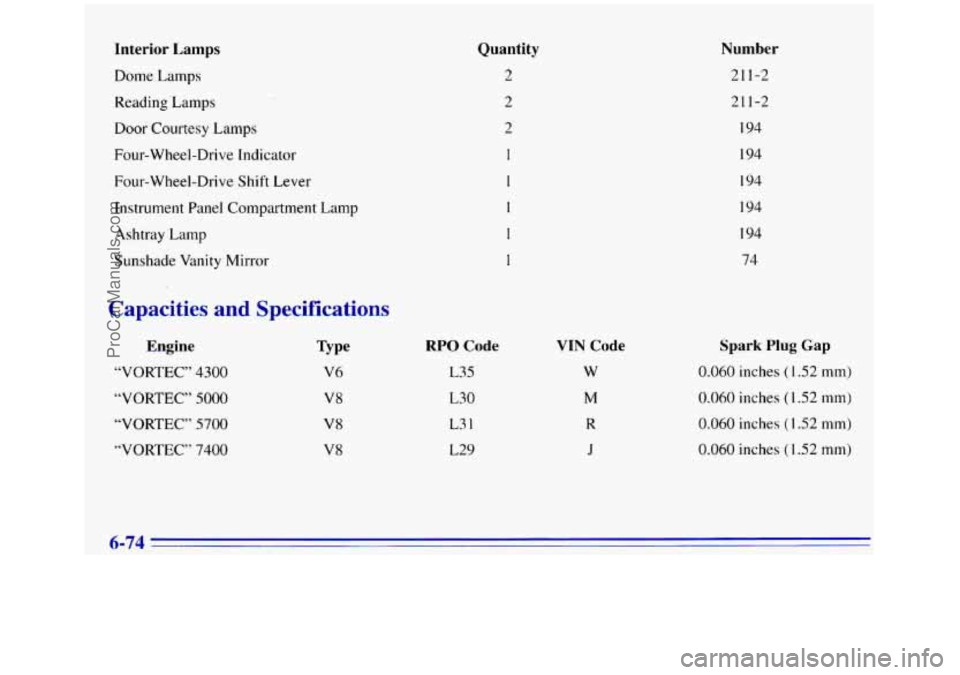
Interior Lamps
Dome Lamps
Reading ‘Lamps
Door Courtesy Lamps
Four-Wheel-Drive Indicator
Four-Wheel-Drive Shift Lever
Instrument Panel Compartment Lamp
Ashtray
Lamp
Sunshade Vanity Mirror
Capacities and Specifications
Engine
“VORTEC” 4300
“VORTEC” 5000
“VORTEC”
5700
“VORTEC” 7400
Type
V6
V8
V8
V8
Quantity
2
2
2
1
1
1
1
1
RPO Code
L35
L30
L3 1
L29
VIN Code
W
M
R
J
Number
21 1-2
21 1-2
194
194
194
194
194
74
Spark Plug Gap
0.060 inches ( 1.52 mm)
0.060 inches (1.52 mrn)
0.060 inches (1.52 mm)
0.060 inches (I -52 mm)
6-74
ProCarManuals.com
Page 325 of 404
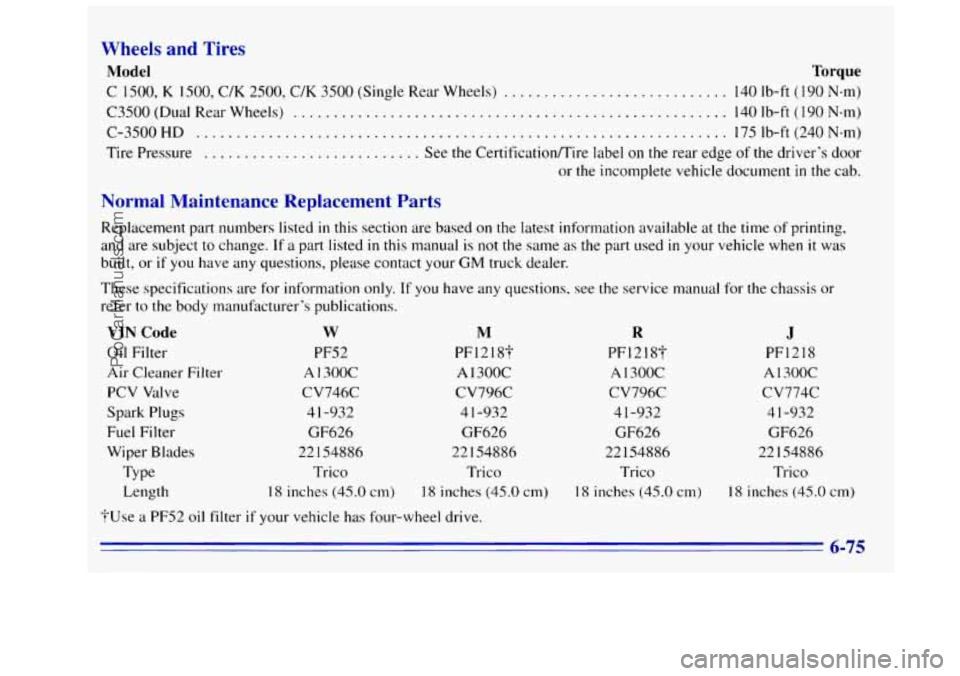
Wheels and Tires
Model Torque
C 1500, K 1500, C/K 2500, C/K 3500 (Single Rear Wheels) ............................ 140 Ib-ft (190 N-m)
C3500 (Dual
Rear Wheels) ...................................................... 140 Ib-ft (190 N-m)
Tire Pressure ........................... See the Certificationflire label on the rear edge of the driver's door
or the incomplete vehicle document in the cab.
C-3500HD
.................................................................. 175Ib-ft(240N-m)
Normal Maintenance Replacement Parts
Replacement part numbers listed in this section
are based on the latest information available at the time of printing,
and are subject to change.
If a part listed in this manual is not the same as the part used in your vehicle when it was
built, or
if you have any questions, please contact your GM truck dealer.
These specifications are
for information only. If you have any questions. see the service manual for the chassis or
refer
to the body manufacturer's publications.
VIN Code w M
Oil Filter PF52
PF1218T
Air
Cleaner Filter A 1300C A 1300C
PCV Valve CV746C CV796C
Spark Plugs 4 1-932 4 1-932
Fuel Filter GF626
GF626
Wiper Blades 22 154886 221 54886
Type Trico Trico
Length
18 inches (45.0 cm) 18 inches (45.0 cm)
?Use a PF52 oil filter if your vehicle has four-wheel drive.
R
PF1218T
A 130OC
CV796C
4 1-932
GF626
22 154886
Trico
18 inches (45.0 cm)
J
PF1218
A
1300C
cv774c
41 -932
GF626
22 154886
Trico
18 inches (45.0 cm)
6-75
ProCarManuals.com
Page 329 of 404
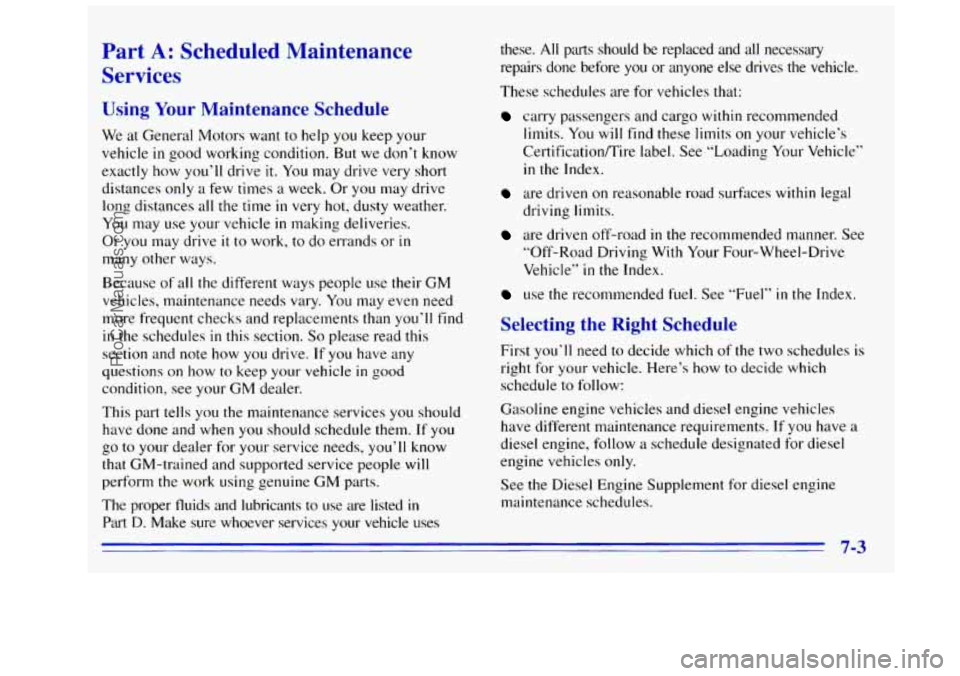
Part A: Scheduled Maintenance
Services
Using Your Maintenance Schedule
We at General Motors want to help you keep your
vehicle
in good working condition. But we don’t know
exactly how you’ll drive
it. You may drive very short
distances only a few times a week. Or
you may drive
long distances all the time
in very hot, dusty weather.
You may use your vehicle in making deliveries.
Or you may drive
it to work, to do errands or in
many other ways.
Because
of all the different ways people use their GM
vehicles, maintenance needs vary. You may even need
more frequent checks and replacements than you’ll find
in the schedules in this section. So please read this
section and note how
you drive. If you have any
questions on
how to keep your vehicle in good
condition, see your GM dealer.
This part tells
you the maintenance services you should
have done and when
you should schedule them. If you
go to your dealer for your service needs, you’ll know
that GM-trained and supported service people will
perform the work using genuine GM parts.
The proper fluids and lubricants to
use are listed in
Part D. Make sure whoever services your vehicle uses these.
All parts should be replaced and all necessary
repairs done before
you or anyone else drives the vehicle.
These schedules are for vehicles that:
carry passengers and cargo within recommended
limits. You will find these limits
on your vehicle’s
CertificatiodTire label. See “Loading Your Vehicle”
in the Index.
are driven on reasonable road surfaces within legal
driving limits.
are driven off-road in the recommended manner. See
”Off-Road Driving With Your Four-Wheel-Drive
Vehicle”
in the Index.
use the recommended fuel. See “Fuel” in the Index.
Selecting the Right Schedule
First you’ll need to decide which of the two schedules is
right for your vehicle.
Here’s how to decide which
schedule
to follow:
Gasoline engine vehicles and diesel engine vehicles
have different maintenance requirements.
If you have a
diesel engine, follow a schedule designated
for diesel
engine vehicles only.
See the Diesel Engine Supplement for diesel engine
maintenance schedules.
7-3
ProCarManuals.com
Page 330 of 404
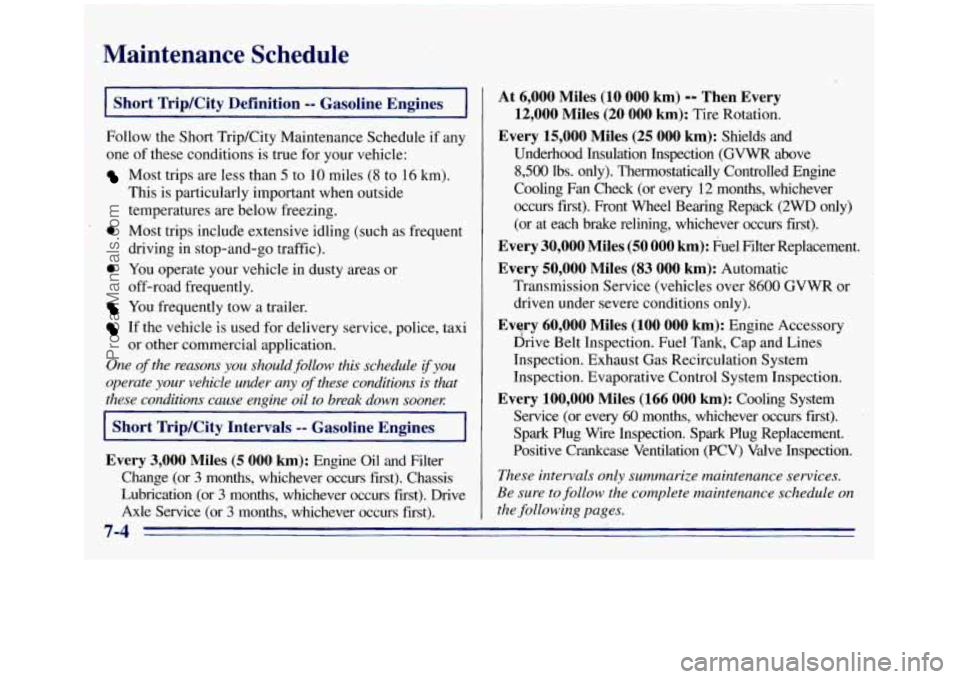
Maintenance Schedule
I Short Trip/City Definition -- Gasoline Engines . I ~
Follow the Short Trip/City Maintenance Schedule if any
one of these conditions is true for your vehicle:
Most trips are less than 5 to 10 miles (8 to 16 km).
This is particularly important when outside
temperatures are below freezing.
driving in stop-and-go traffic).
off-road frequently.
0 Most trips include extensive idling (such as frequent
0 You operate your vehicle in dusty areas or
You frequently tow a trailer.
If the vehicle is used for delivery service, police, taxi
One of the reasons you should follow this schedule if you
operate your vehicle under any of these conditions is that
these conditions cause engine oil to break down soonez
or other commercial application.
I Short Trip/City Intervals -- Gasoline Engines I
Every 3,000 Miles (5 000 km): Engine Oil and Filter
Change
(or 3 months, whichever occurs first). Chassis
Lubrication (or
3 months, whichever occurs first). Drive
Axle Service (or
3 months, whichever occurs first).
At 6,000 Miles (10 000 km) -- Then Every
12,000 Miles (20
000 km): 'Tire Rotation.
Every 15,000 Miles (25 000 km): Shields and
Underhood Insulation Inspection
(GVWR above
8,500 lbs. only). Thermostatically Controlled Engine
Cooling Fan Check (or every
12 months, whichever
occurs first). Front Wheel Bearing Repack
(2WD only)
(or at each brake relining, whichever occurs first).
Every 30,000 Miles (50 000 km): Fuel Filter Replacement.
Every 50,000 Miles (83 000 km): Automatic
Transmission Service (vehicles over
8600 GVWR or
driven under severe conditions only).
Evwy 60,000 Miles (100 000 km): Engine Accessory
Drive Belt Inspection. Fuel Tank, Cap and Lines
Inspection. Exhaust Gas Recirculation System
Inspection. Evaporative Control System Inspection.
Every 100,000 Miles (166 000 km): Cooling System
Service (or every
60 months, whichever occurs first).
Spark Plug Wire Inspection. Spark Plug Replacement.
Positive Crankcase Ventilation
(PCV) Valve Inspection.
These intervals only summarize maintenance services.
Be sure to follow the complete maintenance schedule
on
the following pages.
7-4
ProCarManuals.com
Page 331 of 404
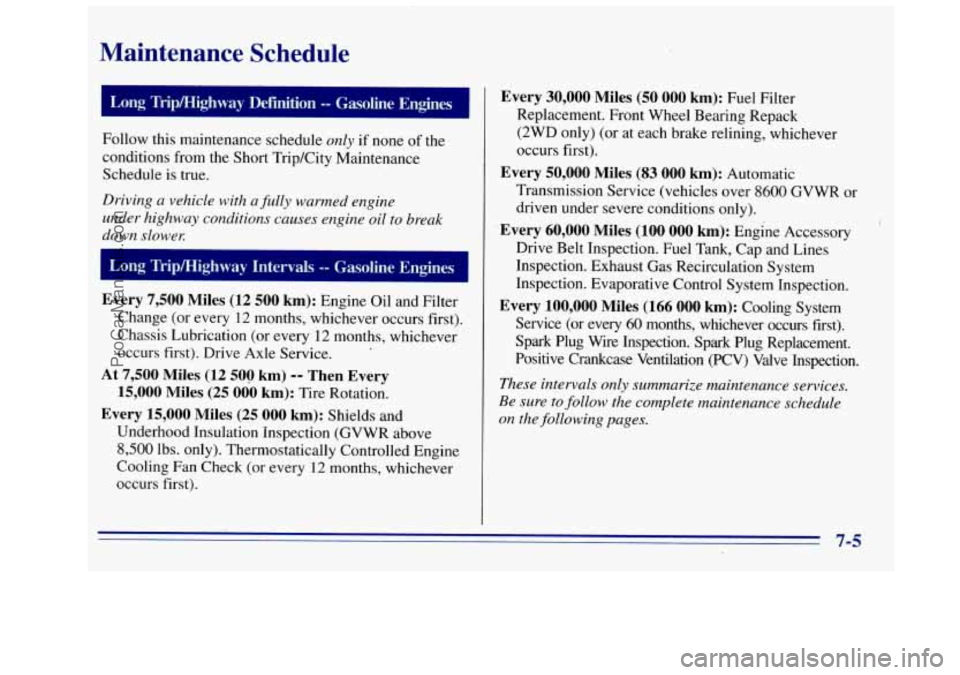
Maintenance Schedule
Long Trip/Highway Definition -- Gasoline Engines 1
Follow this maintenance schedule only if none of the
conditions from the Short TripKity Maintenance
Schedule is true.
Driving a vehicle with a fully warmed engine
under highway conditions causes engine oil to break
down slower:
I Long Tripmighway Intervals -- Gasoline Engines I
Every 7,500 Miles (12 500 km): Engine Oil and Filter
Change (or every
12 months, whichever occurs first).
Chassis Lubrication (or every
12 months, whichever
occurs first). Drive Axle Service.
At 7,500 Miles (12 500 km) -- Then Every
15,000 Miles (25
000 km): Tire Rotation.
Every 15,000 Miles (25 000 km): Shields and
Underhood Insulation Inspection (GVWR above
8,500 lbs. only). Thermostatically Controlled Engine
Cooling Fan Check (or every
12 months, whichever
occurs first).
Every 30,000 Miles (50 000 km): Fuel Filter
Replacement. Front Wheel Bearing Repack
(2WD only) (or at each brake relining, whichever
occurs first).
Transmission Service (vehicles over
8600 GVWR or
driven under severe conditions only).
-Every 60,000 Miles (100 000 km): Engine Accessory I
Drive Belt Inspection. Fuel Tank, Cap and Lines
Inspection. Exhaust Gas Recirculation System
Inspection. Evaporative Control System Inspection.
Every 100,000 Miles (166 000 km): Cooling System
Service (or every
60 months, whichever occurs first).
Spark Plug Wire Inspection. Spark Plug Replacement.
Positive Crankcase Ventilation (PCV) Valve Inspection.
These intervals only summarize maintenance services.
Be sure to follow the complete maintenance schedule
on the following pages.
Every 50,000 Miles (83 000 km): Automatic
7-5
ProCarManuals.com
Page 335 of 404
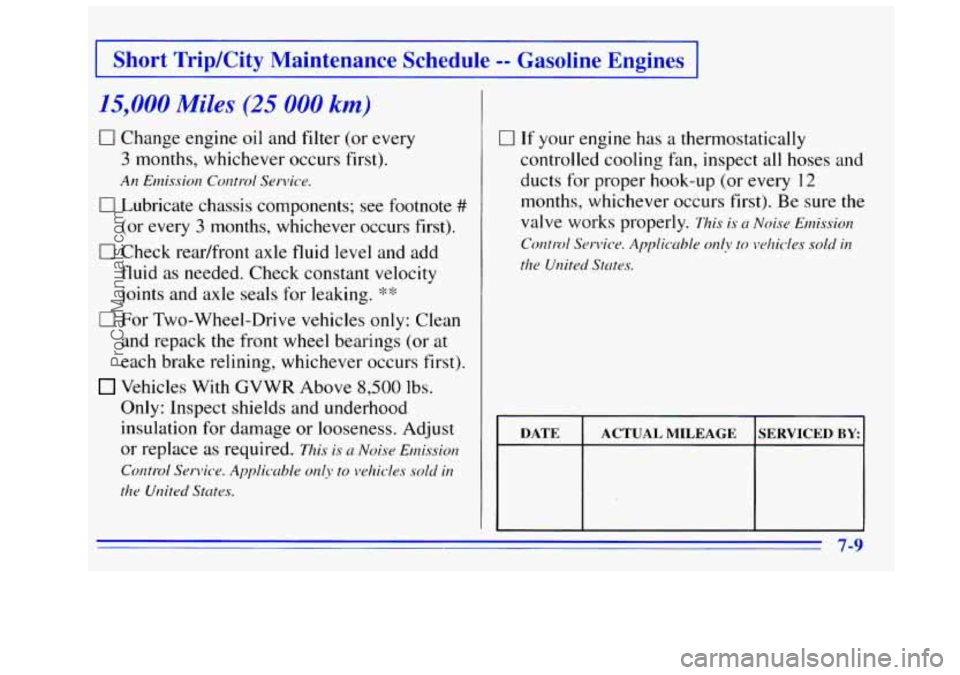
Short Trip/City Maintenance Schedule -- Gasoline Engines
15,000 Miles (25 000 km)
0 Change engine oil and filter (or every
3 months, whichever occurs first).
An Emission Control Service.
0 Lubricate chassis components; see footnote #
(or every 3 months, whichever occurs first).
0 Check readfront axle fluid level and add
fluid
as needed. Check constant velocity
joints and axle seals for leaking.
**
0 For Two-Wheel-Drive vehicles only: Clean
and repack the front wheel bearings (or
at
each brake relining, whichever occurs first).
Vehicles With GVWR Above 8,500 lbs.
Only: Inspect shields and underhood
insulation
for damage or looseness. Adjust
or replace
as required. This is CE Noise Emission
Control Service. Applicable only to vehicles sold in
the United Stcrtes.
0 If your engine has a thermostatically
controlled cooling fan, inspect all hoses and
ducts for proper
hook-up (or every 12
months, whichever occurs first). Be sure the
valve works properly. This is n Noise Elnission
Contml Sot*vic'e. Applicuhle only to vehicles sold in
the United Stcrtes.
DATE ACTUAL MILEAGE SERVICED BY:
7-9
ProCarManuals.com