wheel GMC SIERRA 1996 Manual PDF
[x] Cancel search | Manufacturer: GMC, Model Year: 1996, Model line: SIERRA, Model: GMC SIERRA 1996Pages: 404, PDF Size: 21.57 MB
Page 249 of 404
Rocking your vehicle to get it out:
First. turn your steering wheel left and right. That will
clear the area around your front wheels. Then shift back
and forth between REVERSE
(R) and a forward gear (or
with a manual transmission, between FIRST (1) or
SECOND (2) and REVERSE(R)), spinning the wheels
as little as possible. Release the accelerator pedal while
you
shift. and press lightly on the accelerator pedal
when the transmission is
in gear. If that doesn't get you
out after a few tries. you nlay need to be towed out. Or,
you
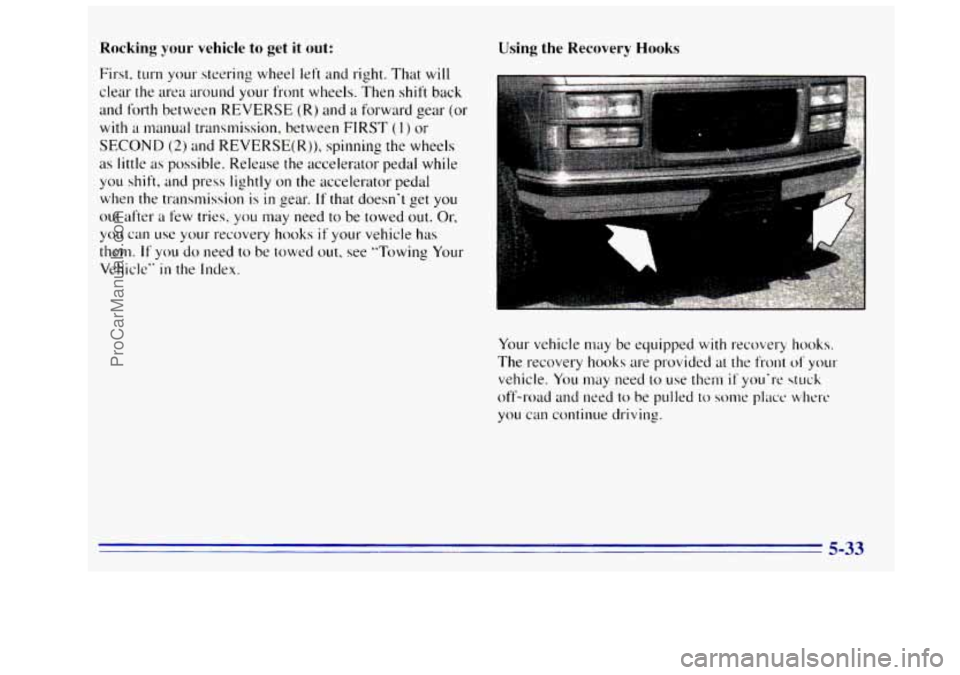
can use your recovery hooks if your vehicle has
them.
If you do need.to be towed out, see "Towing Your
Vehicle" in the Index.
Using the Recovery Hooks
ProCarManuals.com
Page 275 of 404
Four-wheel Drive
Most lubricant checks in this section also apply to
four-wheel-drive vehicles. However, they have two
additional systems that need lubrication.
Transfer Case
M7hen to Check Lubricant
How to Check Lubricant
Refer to the Maintenance Schedule to determine how
often to check the lubricant. See “Periodic Maintenance
Inspections’’
in the Index.
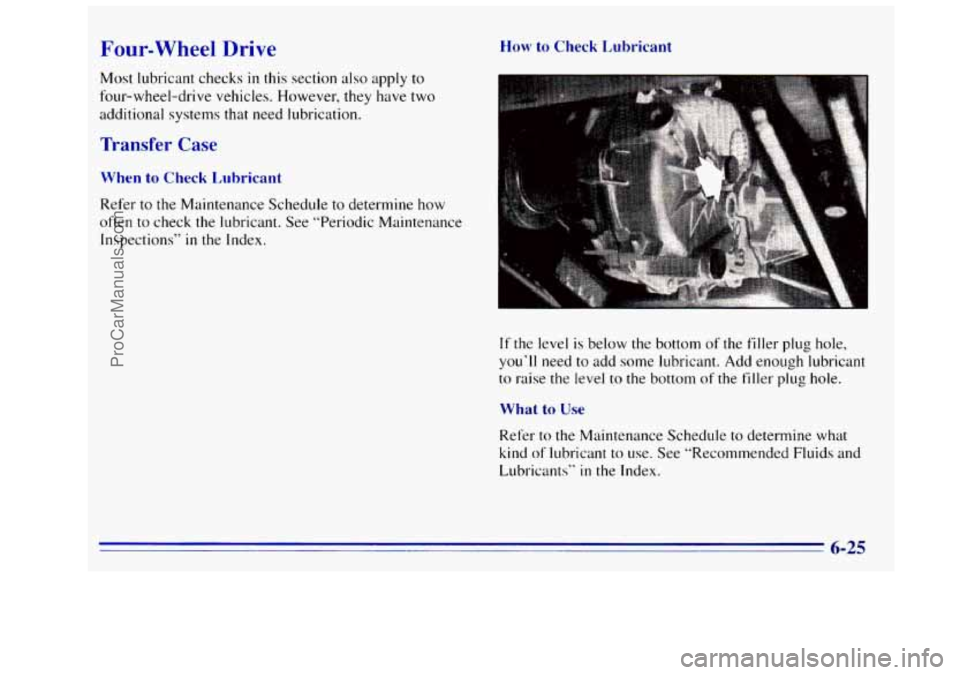
If the level is below the bottom of the filler plug hole,
you’ll need to add some lubricant. Add enough lubricant
to raise the level to the bottom of the filler plug hole.
What to Use
Refer to the Maintenance Schedule to determine what
kind
of lubricant to use. See “Recommended Fluids and
Lubricants”
in the Index.
6-25
ProCarManuals.com
Page 285 of 404
NOTICE:
0
0
Using the wrong fluid can badly damage
brake system parts. For example,.just a few
drops of mineral-based oil, such
as engine
oil,
in your brake system can damage brake
system parts
so badly that they’ll have to be
replaced. Don’t let someone put in the
wrong kind of fluid.
If you spill brake fluid on your vehicle’s
painted surfaces, the paint finish can be
damaged. Be careful not to spill brake
fluid on your vehicle.
If you do, wash it
off immediately. See &‘Appearance Care”
in
the Index.
Brake Wear
If you have a C 3500 HD model, it has four-wheel
disc brakes.
Disc brake pads have built-in wear indicators that
make a high-pitched warning sound when the brake
pads are worn and
new pads are needed. The sound
may come and
go or be heard all the time your vehicle
is moving (except when you are pushing on the brake
pedal firmly).
A’ CAUTION:
I
The brake wear warning sound means that
sooner or later your brakes won’t work well.
That could lead to an accident. When you hear
the brake wear warning sound, have your vehicle serviced.
6-35
ProCarManuals.com
Page 286 of 404
NOTICE: .
Continuing to drive with worn-out brake pads
could result in costly brake repair.
Some driving conditions or climates may cause a brake
squeal when the brakes are first applied or lightly
applied. This does not mean something is wrong with
your brakes.
Free movement
of brake calipers and properly torqued
wheel nuts
are necessary to help prevent brake
pulsation. When tires
are rotated, inspect.brake calipers
for movement, brake pads for wear, and evenly torque
wheel nuts in the proper sequence
to GM specifications.
If you have rear drum brakes, they don’t have wear
indicators, but
if you ever hear a rear brake rubbing
noise, have the rear brake linings inspected.
Also, the
rear brake drums should be remoQed and inspected each
time the tires are removed for rotation or changing.
When you have the front brakes replaced, have the rear
brakes inspected,
too. I
Brake linings should always be replaced as complete
axle sets.
Brake Pedal Travel
See your dealer if the brake pedal does not return to
normal height, or if there is a rapid increase in pedal
travel. This could be a sign of brake trouble.
Brake Adjustment
Every time you make a brake stop, your disc brakes
adjust for wear.
If your brake pedal goes down farther than normal, your
rear drum brakes may need adjustment. Adjust them by
backing up and firmly applying the brakes a few times.
Replacing Brake System Parts
The braking system on a modern vehicle is complex. Its
many parts have to be
of top quality and work well
together if the vehicle is to have really good braking.
Vehicles we design and test have top-quality
GM brake
parts
in them, as your vehicle does when it is new. When
you replace parts of your braking system -- for example,
when- your brhke linings wear do.wn and you have
to
haye new ones put in -- be sure you get new genuine
GM replacement parts. If you don’t, your brakes may
no longer work properly. For example,
if someone
puts in brake linings that are wrong for your vehicle,
the balance between your front and rear brakes can
change
-- for the worse. The braking performance
you’ve come to expect can change
in many other ways
if someone puts in the wrong replacement brake parts.
I
I
6-36
ProCarManuals.com
Page 292 of 404
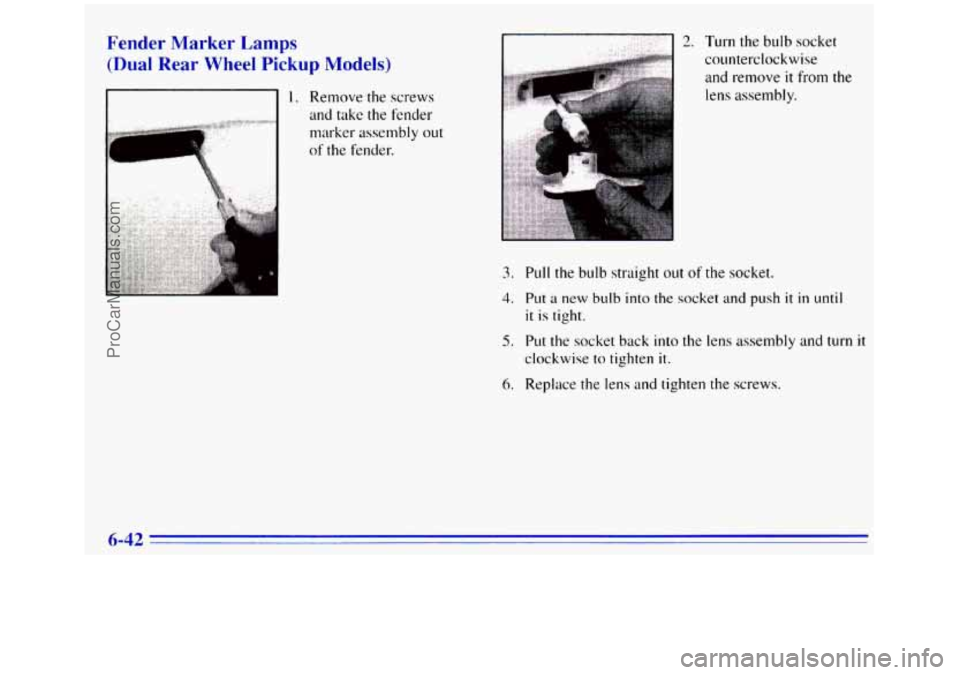
Fender Marker Lamps
(Dual Rear Wheel Pickup Models)
2. Turn the bulb socket
counterclockwise
and remove
it from the
lens assembly.
3. Pull the bulb straight out of the socket.
4. Put a new bulb into the socket and push it in until
it is tight.
5. Put the socket back into the lens assembly and turn it
clockwise to tighten it.
6. Replace the lens and tighten the screws.
6-42
ProCarManuals.com
Page 300 of 404
How to Check
Use a good quality pocket-type gage to check tire
pressure.
You can’t tell if your tires are properly inflated
simply by looking at them. Radial tires may
look
properly inflated even when they’re underinflated.
Be sure
to put the valve caps back on the valve
stems. They help prevent leaks
by keeping out dirt
.and moisture.
Tire Inspection and Rotation
Tires should be inspected every 6,000 to 8,000 miles
(10 000 to 13 000 km) for any signs of unusual wear. If
unusual wear
is present, rotate your tires as soon as
possible and check wheel alignment. Also check for
damaged tires or wheels. See “When It’s Time for New
Tires” and ‘‘Wheel Replacement” later
in this section for
more information.
If your vehicle has dual rear wheels,
also see “Dual ‘Tire Operation” later
in this section.
I
FRT FRT
I
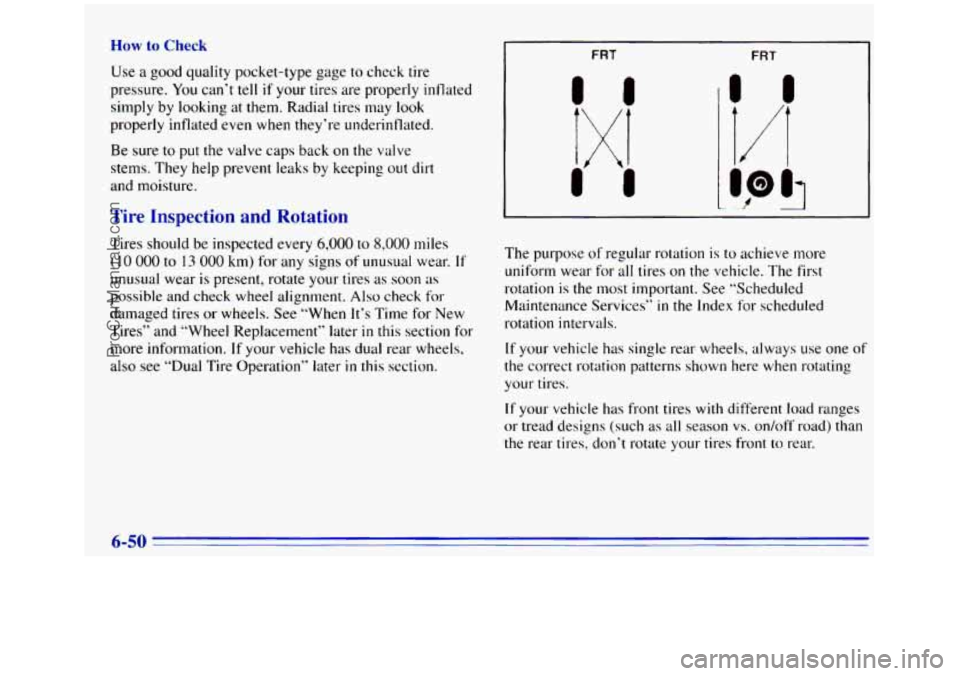
The purpose of regular rotation is to achieve more
uniform wear for all tires on the vehicle. The first
rotation
is the most important. See “Scheduled
Maintenance Services”
in the Index for scheduled
rotation intervals.
If
your vehicle has single rear wheels, always use one of
the correct rotation patterns
shown here when rotating
your tires.
If your vehicle has front [Ires with different load ranges
or tread designs (such as all season vs. on/off road) than
the rear tires, don’t rotate your tires front to rear.
6-50
ProCarManuals.com
Page 301 of 404
rTl
II
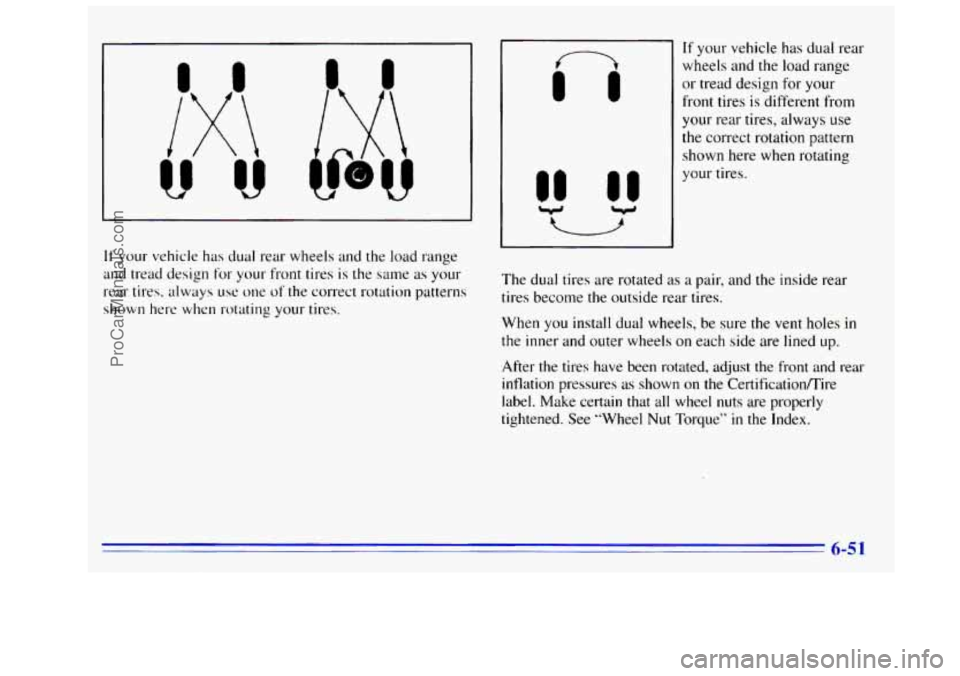
If your vehicle has dual rear wheels and the load range
and tread design for your front tires is the same as your
rear tires. always
use one of the correct rotation patterns
shown here when rotating your tires.
11 If your vehicle has dual rear
Q
wheels and the load range
or tread design for
your
~ front tires is different from
your rear tires, always use
the correct rotation pattern shown here when rotating
your tires.
The dual tires are rotated
as a pair, and the inside rear
tires become the outside rear tires.
When
you install dual wheels, be sure the vent holes in
the inner and outer wheels on each side are lined up.
After the tires have been rotated, adjust the front and rear
inflation pressures as shown on the Certificatiomire
label. Make certain that
all wheel nuts are properly
tightened. See “Wheel
Nut Torque” in the Index.
ProCarManuals.com
Page 302 of 404
When It’s Time for New Tires
Rust or dirt on
a wheel, or on the parts to which
it
is fastened, can make- wheel nuts become loose
.after
a time. The wheel could come off and cause
an accident. When you change
a wheel, remove
any rust or dirt from places where the wheel
attaches to the vehicle. In an emergency, you can
use a cloth or a paper towel to do this; but be
sure to use
a scraper or wire brush later, if you
need to, to get all the rust or dirt
off. (See
“Changing a Flat Tire” in the Index.) One
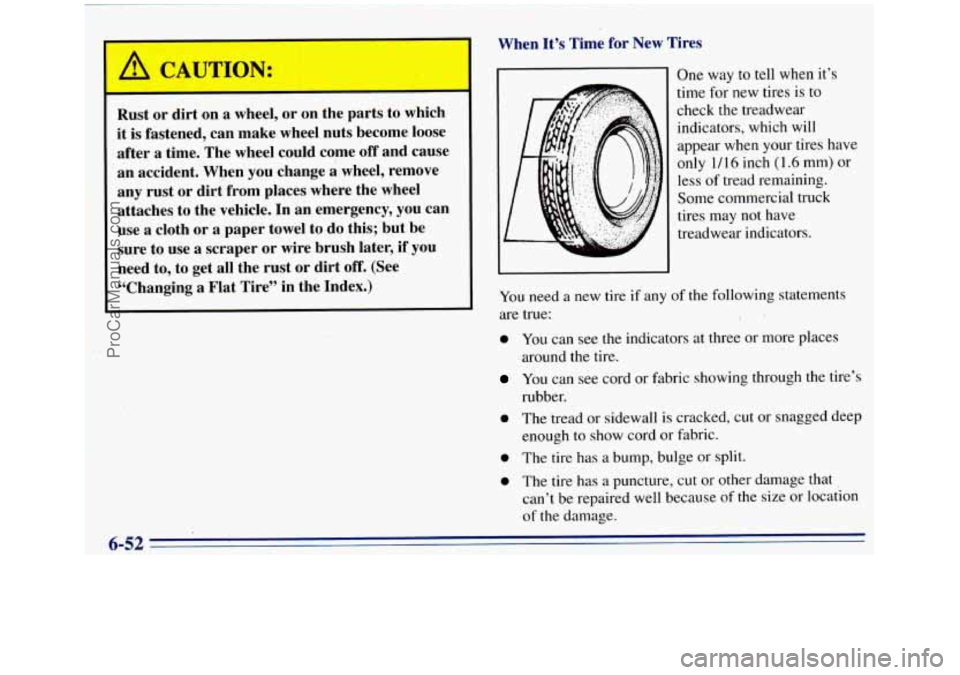
way to tell when it’s
time for new tires is
to
check the treadwear
indicators, which will
appear when your tires have
only
1/16 inch (1.6 mm) or
less
of tread remaining.
Some commercial truck
tires may not have
treadwear indicators.
Its
You need a new tire if any of the following statemen
are true:
0 You’can see the indicators at three or more places
around the tire.
You can see cord or fabric showing through the tire’s
rubber.
0 The tread or sidewall is cracked, cut or snagged deep
enough to show cord or fabric.
0 The tire has a bump, bulge or split.
0 The tire has a puncture, cut or other damage that ,
can’t be repaired well because of the size or location
of the damage.
ProCarManuals.com
Page 303 of 404
Dual Tire Operation
When the vehicle is new, or whenever a wheel, wheel
bolt or wheel nut is replaced, check the wheel nut torque
after
100, 1,000 and 6,000 miles ( 160, I 600 and IO 000
km) of driving. For proper torque, see "Wheel Nut
Torque" in the Index.
The outer tire on a dual wheel setup generally wears
faster than the inner tire. Your tires will wear more
evenly and last longer
if you rotate the tires periodically.
If you're going to be doing a lot of driving on
high-crown roads,
you can reduce tire wear by adding
5 psi (35 kPa) to the tire pressure in the outer tires. Be
sure to return to the recommended pressures when no
longer driving under those conditions. See "Changing
a
Flat Tire" in the Index for more information.
A CAUTION:
I
If you operate your vehicle with a tire that is
badly underinflated, the tire can overheat. An
overheated tire can lose air suddenly or catch fire.
You or others could be injured. Be sure
all tires
(including the spare, if any) are properly inflated.
Buying New Tires
To find out what kind and size of tires you need, look at
the Certificntion/Tire label.
Tlze tires installed
on your vehicle when it was new had
a Tire Performance Criteria Specification (TPC Spec)
number
on each tire's sidewall. When you get new tires,
get ones
with that same TPC Spec number. That way
your vehicle
will continue to have tires that are designed
to give proper endurance, handling, speed rating,
traction, ride and other things during normal service
on
your vehicle. If your tires have an all-season tread
design,
the TPC number will be followed by an "MS"
(for mud and snow).
If you ever replace your tires with those not having a
TPC
Spec number, make sure they are the same size,
load range, speed rating and construction type
(bias,
bias-belted or radial) as your original tires.
6-53
ProCarManuals.com
Page 304 of 404
-
A CAUTION:
Mixing tires could cause you to lose control while
driving.
If you mix tires of different sizes or types
(radial and bias-belted tires), the vehicle may not
handle properly, and you could have a crash.
Using tires of different sizes may also cause
damage to your vehicle.
Be sure to use the same
size and type tires on all wheels.
Uniform Tire Quality Grading
The following information relates to the system
developed by the United States National Highway
Traffic Safety Administration, which grades tires
by
treadwear, traction and temperature performance.
(This applies only to vehicles sold in the United States.)
The grades are molded on the sidewalls of most
passenger car tires. The Uniform Tire Quality Grading
system does
not apply to deep tread, winter-type snow
tires, space-saver or temporary
use spare tires, tires with
nominal rim diameters
of IO to 12 inches (25 to 30 cm),
or to some limited-production tires. While
the tires available on General Motors passenger
cars and light trucks may vary with respect to these
grades,
they must also conform to Federal safety
requirements and additional General Motors Tire
Performance Criteria (TPC) standards.
Treadwear
The treadwear grade is a comparative rating based on
the wear rate of the tire when tested under controlled
conditions on
a specified government test course. For
example. a tire graded 150 would wear one and a half
(1 1/2) times as well on the government course as a tire
upon the actual conditions of their use, however, and
may depart significantly from
the norm due to variations
in driving habits, service practices and differences in
road characteristics and climate.
E at-aded 100. The relative performance of tires depends
Traction -- A, B, C
The traction grades, from highest to lowest, are A, B, and
C, and they represent
the tire’s ability to stop on wet
pavement as measured under controlled conditions on
specified government test surfaces
of asphalt and concrete.
A tire marked C may have poor traction performance.
Warning: The traction grade assigned
to this, tire is based
on braking (straightahead) traction tests and does not
include cornering (turning) traction.
6-54
ProCarManuals.com