ignition GMC SIERRA 1997 User Guide
[x] Cancel search | Manufacturer: GMC, Model Year: 1997, Model line: SIERRA, Model: GMC SIERRA 1997Pages: 436, PDF Size: 23.38 MB
Page 87 of 436
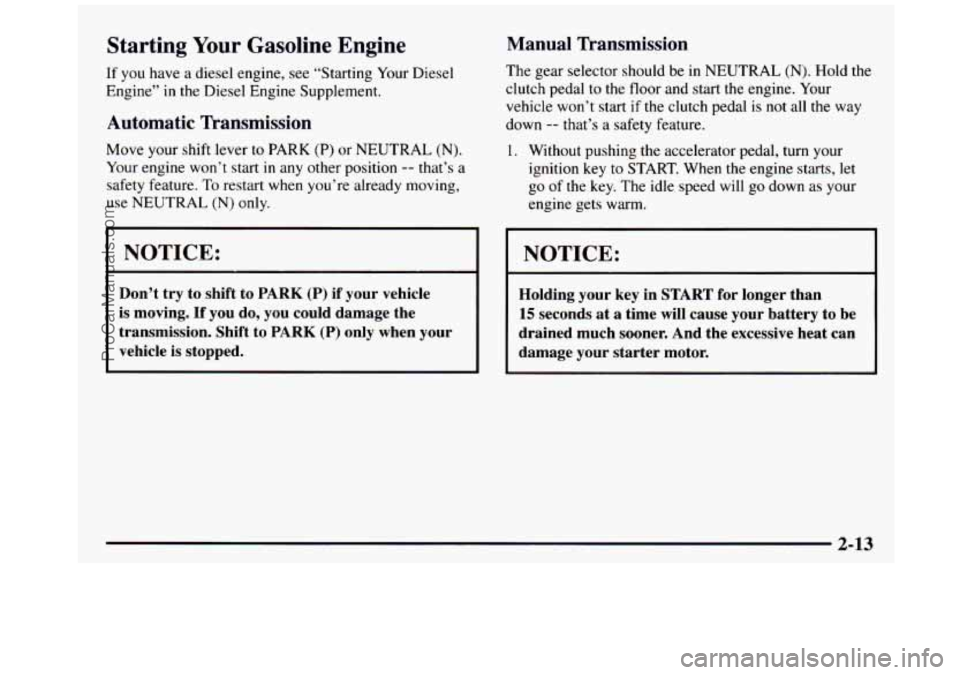
Starting Your Gasoline Engine
If you have a diesel engine, see “Starting Your Diesel
Engine”
in the Diesel Engine Supplement.
Automatic Transmission
Move your shift lever to PARK (P) or NEUTRAL (N).
Your engine won’t start in any other position -- that’s a
safety feature. To restart when you’re already moving,
use NEUTRAL
(N) only.
Manual Transmission
The gear selector should be in NEUTRAL (N). Hold the
clutch pedal to the floor and start the engine. Your
vehicle won’t start
if the clutch pedal is not all the way
down -- that’s a safety feature.
1. Without pushing the accelerator pedal, turn your
ignition key to START. When the engine starts, let
go of the key. The idle speed will go down as your
engine gets warm.
NOTICE:
NOTICE:
I I I I
Don’t try to shift to PARK (P) if your vehicle
is moving.
If you do, you could damage the Holding your key in START
for longer than
damage your starter motor.
vehicle is stopped. drained
much sooner. And the excessive heat can
transmission. Shift
to PARK
(P) only when your
15 seconds at a time will cause your battery to be
ProCarManuals.com
Page 90 of 436
If your vehcle is equipped with an automatic transmission,
it now features an electronic shift position indicator within
the instrument cluster. This display must be powered
anytime the
shift lever is capable of being moved out of
PARK (P). This means that if your key is in OFF, rather
than
LOCK, there will be a small current drain on your
battery which could discharge your battery over
a period
of time. If you have to leave your key in the
ignition
in OFF for an extended period, it is recommended
that you disconnect the battery cable from the battery to
prevent discharging your battery.
PARK
(P): This locks your rear wheels. It’s the best
position to use when you start your engine because your
vehicle can’t move easily.
It is dangerous to get out of your vehicle if the
shift lever is not fully in PARK
(P) with the
parking brake firmly set. Your vehicle can roll.
CAUTION: (Continued)
I
Don’t leave your vehicle when the engine is
running unless you have to. If you have left the
engine running, the vehicle can move suddenly.
You or others could be injured. To be sure your
vehicle won’t move, even when you’re on fairly
level ground,
always set your parking brake and
move the shift lever to PARK
(P).
If you have four-wheel drive, your vehicle
will be free to roll -- even if your shift lever
is in PARK
(P) -- if your transfer case is in
NEUTRAL
(N). So, be sure the transfer case is in
a drive gear, two-wheel high
(2H) or four-wheel
high
(4H) or four-wheel low (4L) -- not in
NEUTRAL
(N). See “Shifting Into PARK (P)” in
the Index.
If you’re pulling a trailer, see “Towing
a Trailer” in the Index.
2-16
ProCarManuals.com
Page 99 of 436
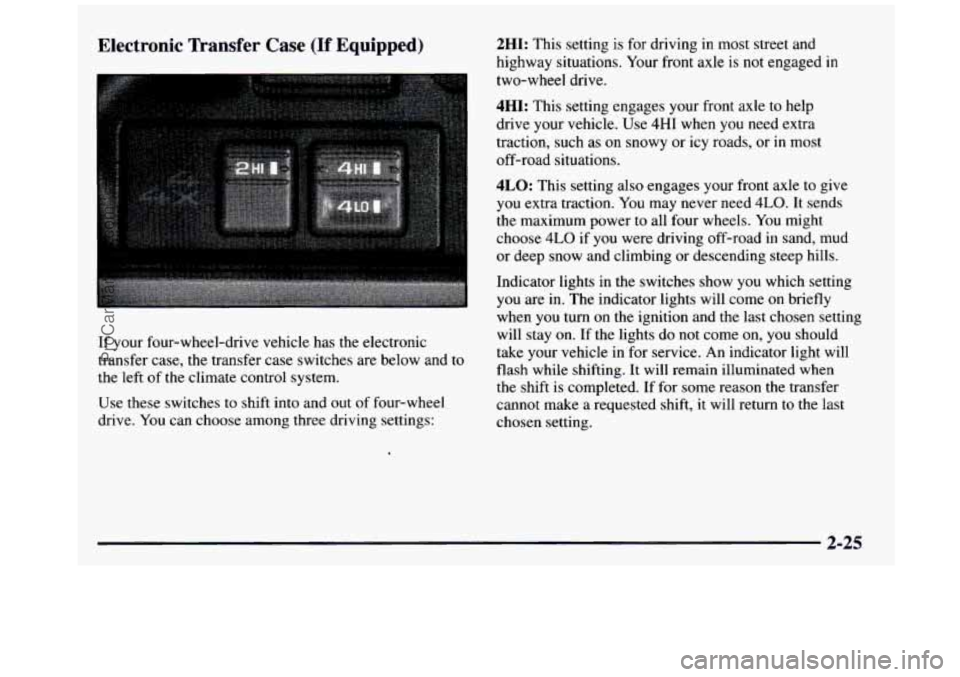
Electronic Transfer Case (If Equipped)
If your four-wheel-drive vehicle has the electronic
transfer case, the transfer case switches are below and
to
the left of the climate control system.
Use these switches to shift into and out
of four-wheel
drive. You can choose among three driving settings:
.
2HI: This setting is for driving in most street and
highway situations. Your front axle is not engaged
in
two-wheel drive.
4HI: This setting engages your front axle to help
drive your vehicle. Use
4HI when you need extra
traction, such as
on snowy or icy roads, or in most
off-road situations.
4LO: This setting also engages your front axle to give
you extra traction. You may never need
4LO. It sends
the maximum power to all four wheels. You might
choose
4LO if you were driving off-road in sand, mud
or deep snow and climbing or descending steep hills.
Indicator lights in the switches show you which setting
you are in. The indicator lights will come
on briefly
when you turn on the ignition and the last chosen setting
will stay on. If the lights do not come on, you should
take your vehicle in for service. An indicator light will
flash while shifting. It
will remain illuminated when
the shift is completed. If for some reason the transfer
cannot make a requested shift,
it will return to the last
chosen setting.
ProCarManuals.com
Page 101 of 436
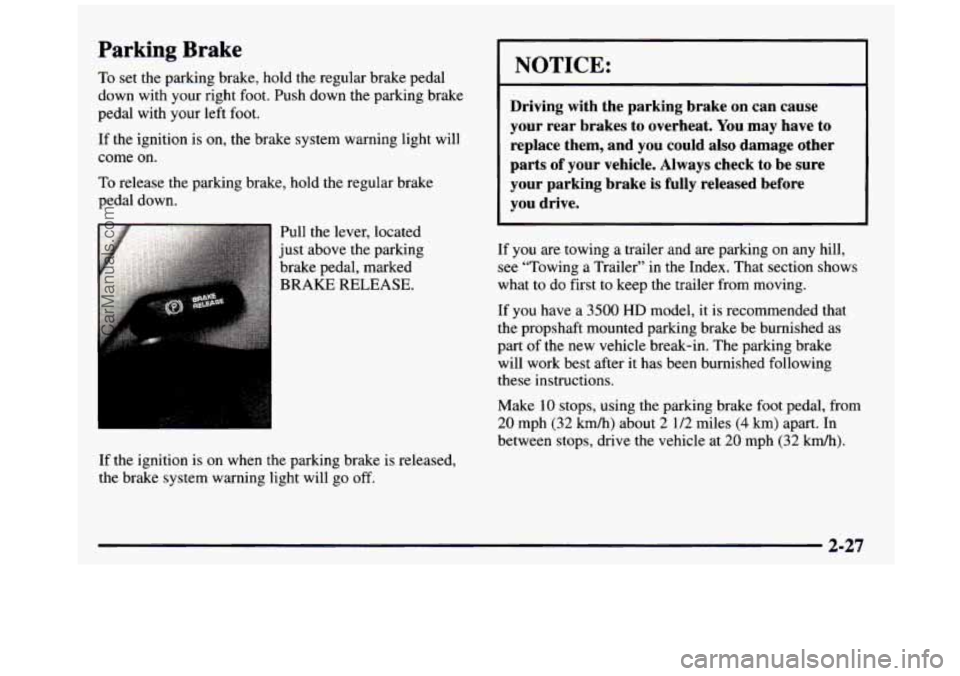
Parking Brake
To set the parking brake, hold the regular brake pedal
down with your right foot. Push down the parking brake
pedal with your left foot.
If the ignition is on, the brake system warning light will
come on.
To release the parking brake, hold the regular brake
pedal down.
If the ignition is on when the parking brake is released,
the brake system warning light will go
off.
I NOTICE:
I
Driving with the parking brake on can cause
your rear brakes to overheat. You may have to replace them, and you could also damage other
parts
of your vehicle. Always check to be sure
your parking brake is fully released before
you drive.
If you are towing a trailer and are parking on any hill,
see “Towing
a Trailer’’ in the Index. That section shows
what to do first to keep the trailer from moving.
If you have
a 3500 HD model, it is recommended that
the propshaft mounted parking brake be burnished as
part of the new vehicle break-in. The parking brake
will work best after
it has been burnished following
these instructions.
Make
10 stops, using the parking brake foot pedal, from
20 mph (32 kmh) about 2 112 miles (4 km) apart. In
between stops, drive the vehicle at
20 mph (32 kmk).
2-27
ProCarManuals.com
Page 103 of 436
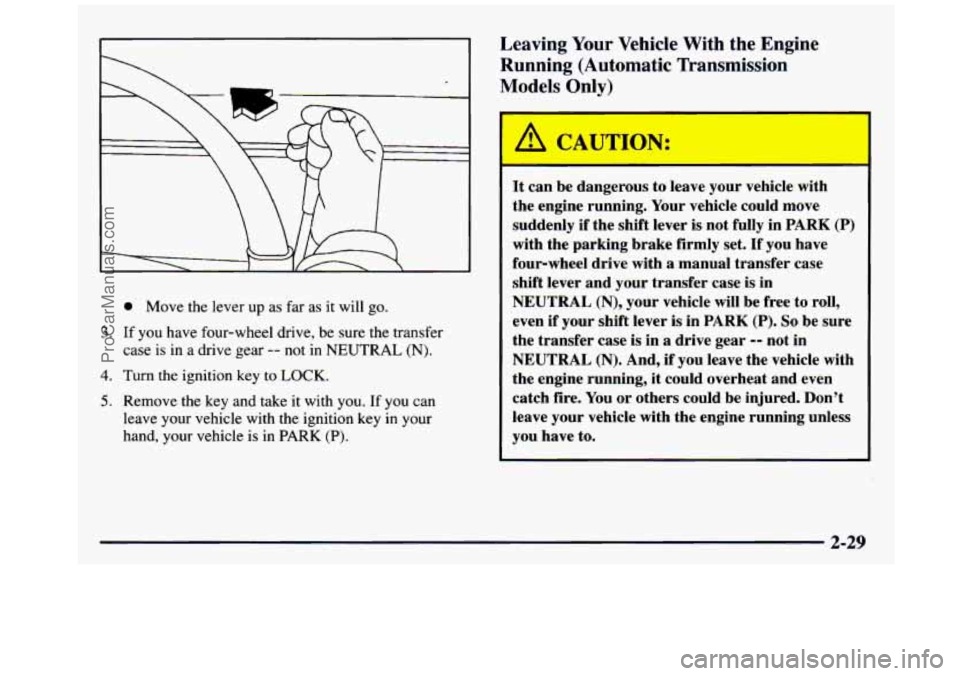
0 Move the lever up as far as it will go.
3. If you have four-wheel drive, be sure the transfer
case is in a drive gear
-- not in NEUTRAL (N).
4. Turn the ignition key to LOCK.
5. Remove the key and take it with you. If you can
leave your vehicle with the ignition key in your
hand, your vehicle
is in PARK (P).
Leaving Your Vehicle With the Engine
Running (Automatic Transmission
Models Only)
It can be dangerous to leave your vehicle with
the engine running. Your vehicle could move
suddenly if the shift lever is not fully in PARK (P)
with the parking brake firmly set.
If you have
four-wheel drive with
a manual transfer case
shift lever and your transfer case is in
NEUTRAL
(N), your vehicle will be free to roll,
even if your shift lever is in PARK
(P). So be sure
the transfer case is in
a drive gear -- not in
NEUTRAL
(N). And, if you leave the vehicle with
the engine running, it could overheat and even
catch fire.
You or others could be injured. Don’t
leave your vehicle with the engine running unless
you have
to.
ProCarManuals.com
Page 104 of 436
If you have to leave your vehicle with the engine
running, be sure your vehicle is in PARK (P) and the
parking brake is firmly set before you leave
it. After you
move the shift lever into PARK (P), hold the regular
brake pedal down. Then,
see if you can move the shift
lever away from PARK (P) without first pulling it
toward
you. If you can, it means that the shift lever
wasn’t fully locked into PARK
(P).
Torque Lock (Automatic Transmission)
If you are parking on a hill and you don’t shift your
transmission into PARK (P) properly, the weight of the
vehicle may put
too much force on the parking pawl in
the transmission. You may find
it difficult to pull the
shift lever out of PARK (P). This is called “torque lock.”
To prevent torque lock, set the parking brake and then
shift into PARK (P) properly before you leave the
driver’s seat.
To find out how, see “Shifting Into
PARK (P)” in the Index.
When you are ready
to drive, move the shift lever out of
PARK (P)
before you release the parking brake.
If torque lock does occur, you may need to have another
vehicle push yours a little uphill
to take some of the
pressure from the parking pawl in the transmission,
so
you can pull the shift lever out of PARK (P).
Shifting Out of PARK (P)
(Automatic Transmission)
Your vehicle has a brake-transmission shift interlock
system. You have
to fully apply your regular brakes
before you can shift from PARK (P) when the ignition
is in RUN. See “Automatic Transmission” in the Index.
If you cannot shift out of PARK (P), ease pressure on
the shift lever and push the shift lever all the way up
into PARK (P) as you maintain brake application. Then,
move the shift lever to any gear you want.
If you ever hold the brake pedal down but still can’t
shift out
of PARK (P), try this:
1. Turn the key to OFF,
2. Apply and hold the brake until the end of Step 4.
3. Shift to NEUTRAL (N).
4. Start the vehicle and shift to the drive gear you want.
5. Have the brake-transmission shift interlock system
fixed as soon as you can.
2-30
ProCarManuals.com
Page 108 of 436
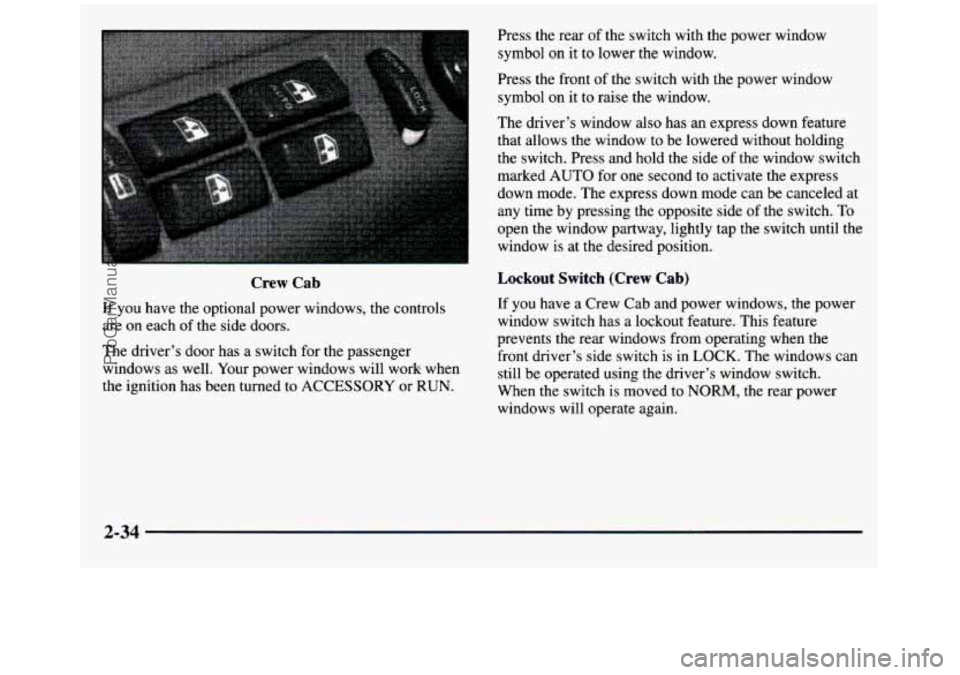
Crew Cab
If you have the optional power windows, the controls
are on each
of the side doors.
The driver’s door has a switch for the passenger
windows as well. Your power windows will work when
the ignition has been turned to ACCESSORY or RUN. Press the rear
of the switch with the power window
symbol on it to lower the window.
Press the front of the switch with the power window
symbol on it to raise the window.
The driver’s window also has
an express down feature
that allows the window to be lowered without holding
the switch. Press and hold the side of the window switch
marked AUTO
for one second to activate the express
down mode. The express down mode can be canceled at
any time by pressing the opposite side of the switch. To
open the window partway, lightly tap the switch until the
window is at the desired position.
Lockout Switch (Crew Cab)
If you have a Crew Cab and power windows, the power
window switch has a lockout feature. This feature
prevents the rear windows from operating when the
front driver’s side switch is
in LOCK. The windows can
still be operated using the driver’s window switch.
When the switch is moved to
NORM, the rear power
windows will operate again.
2-34
ProCarManuals.com
Page 116 of 436
Increasing Speed While Using Cruise Control
There are two ways to go to a higher speed:
Use the accelerator pedal to get to the higher speed.
Press the button at the end of the lever, then release
the button and the accelerator pedal. You’ll now
cruise at the higher speed.
Move the cruise switch from ON to R/A. Hold it
there until you get up to the speed you want, and
then release
the switch. (To increase your speed in
very small amounts, move the switch to
R/A for less
than half a second. Each time you do this, your
vehicle will go about
1 mph (I .6 km/h) faster.)
Reducing Speed While Using Cruise Control
There are two ways to reduce your speed while using
cruise control:
Press in the button at the end of the lever until you
reach the lower speed you want, then release
it.
To slow down in very small amounts, press the
button for less than half a second. Each time you do
this, you’ll go
1 mph (1.6 km/hl slower.
Passing Another Vehicle While Using Cruise Control
Use the accelerator pedal to increase your speed. When
you take your foot off
the pedal, your vehicle will slow
down to the cruise control speed you set earlier.
Using Cruise Control on Hills
How well your cruise control will work on hills depends
upon your speed, load
and the steepness of the hills.
When going up steep hills, you may have to step on the
accelerator pedal to maintain your speed.
If the steepness
of the hill causes the vehicle speed to drop more than
15 mph (24 km/h) below the set speed, your cruise control
will automatically disengage. When going downhill, you
may have to brake or
shift to a lower gear to keep your
speed down.
Of course, applying the brake takes you out
of cruise control. Many drivers find this to
be too much
trouble and don’t use cruise control on steep hills.
Ending Cruise Control
There are two ways to turn off the cruise control:
0 Step lightly on the brake pedal or
0 Move the cruise switch to OFF.
Erasing Speed Memory
When you turn off the cruise control or the ignition,
your cruise control set speed memory
is erased.
2-42
ProCarManuals.com
Page 118 of 436
Headlamps On Reminder
A buzzer will sound when your headlamps are turned
on and the key is turned to the
OFF, LOCK or
ACCESSORY position. If
you need to use your
headlamps when the key is turned to
OFF, LOCK or
ACCESSORY, the buzzer can be turned
off by turning
the thumb wheel next to the parking lampheadlamp
knob all the way down.
Daytime Running Lamps
Daytime Running Lamps (DRL) can make it easier for
others to see the front
of your vehicle during the
day. DRL can be helpful in many different driving
conditions, but they can be especially helpful
in the
short periods after dawn and before sunset.
The DRL system will make your headlamps come
on at
a reduced brightness when:
the ignition is on,
When the DRL are on, only your headlamps will be on.
The taillamps, sidemarker and other lamps won’t be on.
Your instrument panel won’t be
lit up either.
When it begins to get dark, your DRL indicator light
is a
reminder to turn your headlamp switch on. The other
lamps that come on with your headlamps will also
come
on.
When you turn off the headlamp switch, the regular
lamps will go off, and your headlamps will change to
the reduced brightness
of DRL.
To idle your vehicle with the DRL off, set the parking
brake. The DRL will stay off until you release the
parking brake.
As with any vehicle, you should turn on the regular
headlamp system when you need it.
the headlamp switch is off and
the parking brake is released.
2-44
ProCarManuals.com
Page 123 of 436
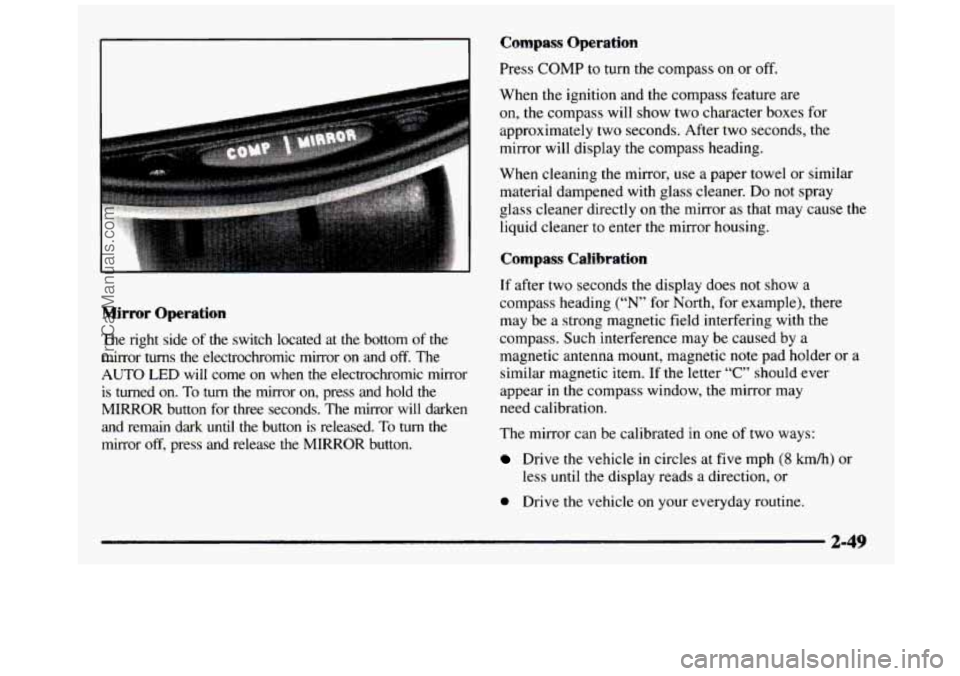
Mirror Operation
The right side of the switch located at the bottom of the mirror
turns the electrochromic mirror on and off. The
AUTO LED will come on when the electrochromic mirror
is turned
on. To turn the mirror on, press and hold the
MIRROR button for three seconds. The mirror will darken and remain dark
until the button is released. To turn the
mirror
off, press and release the MIRROR button.
Compass Operation
Press COMP to turn the compass on or off.
When the ignition and the compass feature are
on, the compass will show two character boxes for
approximately two seconds. After two seconds, the
mirror will display the compass heading.
When cleaning the mirror, use a paper towel
or similar
material dampened with glass cleaner.
Do not spray
glass cleaner directly on .the mirror as that may cause the
liquid cleaner to enter the mirror housing.
Compass Calibration
If after two seconds the display does not show a
compass heading (“N’ for North, for example), there
may be a strong magnetic field interfering with the
compass. Such interference may be caused by a
magnetic antenna mount, magnetic note pad holder
or a
similar magnetic item. If the letter “C” should ever
appear
in the compass window, the mirror may
need calibration.
The mirror can be calibrated
in one of two ways:
Drive the vehicle in circles at five mph (8 km/h) or
less
until the display reads a direction, or
0 Drive the vehicle on your everyday routine.
ProCarManuals.com