parking brake GMC SIERRA 1997 User Guide
[x] Cancel search | Manufacturer: GMC, Model Year: 1997, Model line: SIERRA, Model: GMC SIERRA 1997Pages: 436, PDF Size: 23.38 MB
Page 107 of 436
A CAUTION:
It can be dangerous to get out of your vehicle if
the shift lever
is not fully in PARK (P) with the
parking brake firmly set. Your vehicle can roll.
Don’t leave your vehicle when the engine is
running unless you have to.
If you’ve left the
engine running, the vehicle can move suddenly.
You or others could be injured. To be sure your
vehicle won’t move, even when you’re
on fairly
level ground, always set your parking brake and
move the shift lever to
PARK (P).
If you have four-wheel drive and your transfer case is in
NEUTRAL (N), your vehicle will be free to roll, even if
your shift lever is in PARK (P).
So, be sure the transfer
case
is in a drive gear -- not in NEUTRAL (N). Always
set your parking brake. Follow the proper steps
to be
sure your vehicle won’t move. See “Shifting Into
PARK
(P)” in the Index.
If you’re pulling a trailer,
see “Towing a Trailer” in
the Index.
Windows
Manual Windows
Turn the hand crank on each door to raise or lower
manual windows.
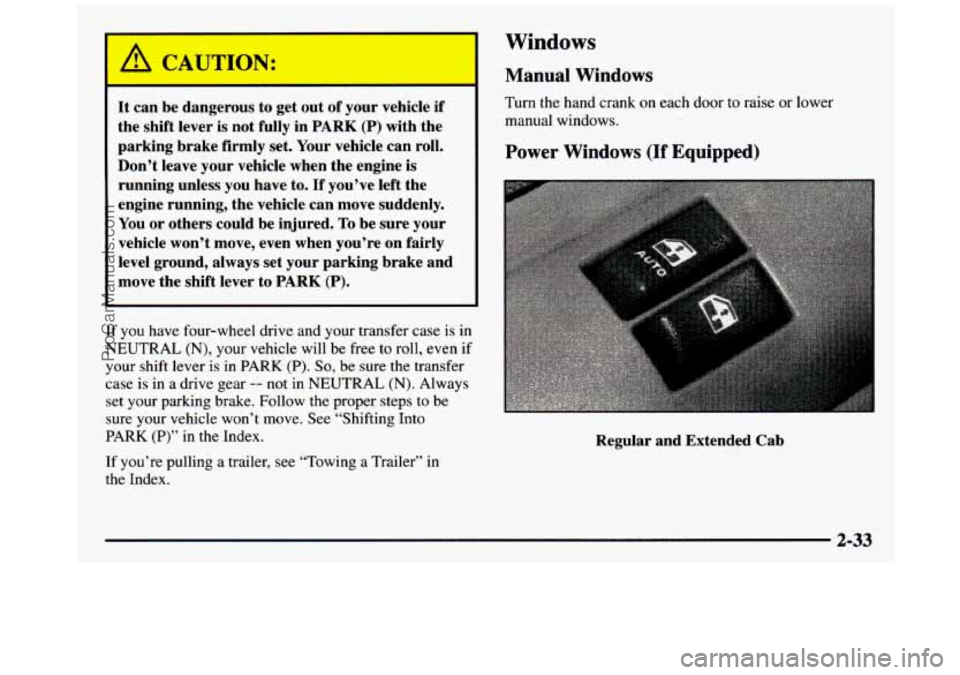
Power Windows (If Equipped)
Regular and Extended Cab
2-33
ProCarManuals.com
Page 118 of 436
Headlamps On Reminder
A buzzer will sound when your headlamps are turned
on and the key is turned to the
OFF, LOCK or
ACCESSORY position. If
you need to use your
headlamps when the key is turned to
OFF, LOCK or
ACCESSORY, the buzzer can be turned
off by turning
the thumb wheel next to the parking lampheadlamp
knob all the way down.
Daytime Running Lamps
Daytime Running Lamps (DRL) can make it easier for
others to see the front
of your vehicle during the
day. DRL can be helpful in many different driving
conditions, but they can be especially helpful
in the
short periods after dawn and before sunset.
The DRL system will make your headlamps come
on at
a reduced brightness when:
the ignition is on,
When the DRL are on, only your headlamps will be on.
The taillamps, sidemarker and other lamps won’t be on.
Your instrument panel won’t be
lit up either.
When it begins to get dark, your DRL indicator light
is a
reminder to turn your headlamp switch on. The other
lamps that come on with your headlamps will also
come
on.
When you turn off the headlamp switch, the regular
lamps will go off, and your headlamps will change to
the reduced brightness
of DRL.
To idle your vehicle with the DRL off, set the parking
brake. The DRL will stay off until you release the
parking brake.
As with any vehicle, you should turn on the regular
headlamp system when you need it.
the headlamp switch is off and
the parking brake is released.
2-44
ProCarManuals.com
Page 137 of 436
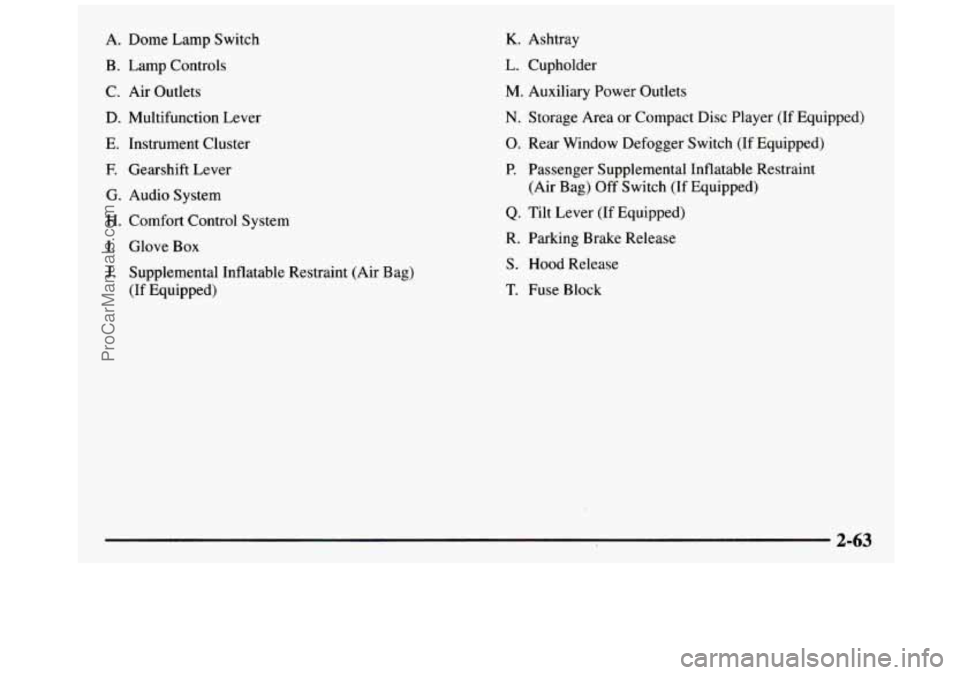
A. Dome Lamp Switch
B. Lamp Controls
C. Air Outlets
D. Multifunction Lever
E. Instrument Cluster
E Gearshift Lever
G. Audio System
H. Comfort Control System
I. Glove Box
J. Supplemental Inflatable Restraint (Air Bag)
(If Equipped)
K. Ashtray
L. Cupholder
M. Auxiliary Power Outlets
N. Storage Area or Compact Disc Player (If Equipped)
0. Rear Window Defogger Switch (If Equipped)
P. Passenger Supplemental Inflatable Restraint
Q. Tilt Lever (If Equipped)
R. Parking Brake Release
S. Hood Release
T. Fuse Block (Air Bag)
Off Switch (If Equipped)
2-63
--
ProCarManuals.com
Page 145 of 436
Brake System Warning Light
Your vehicle’s hydraulic brake system is divided into
two parts. If
one part isn’t working, the other part can
still work and stop you. For good braking, though,
you
need both parts working well.
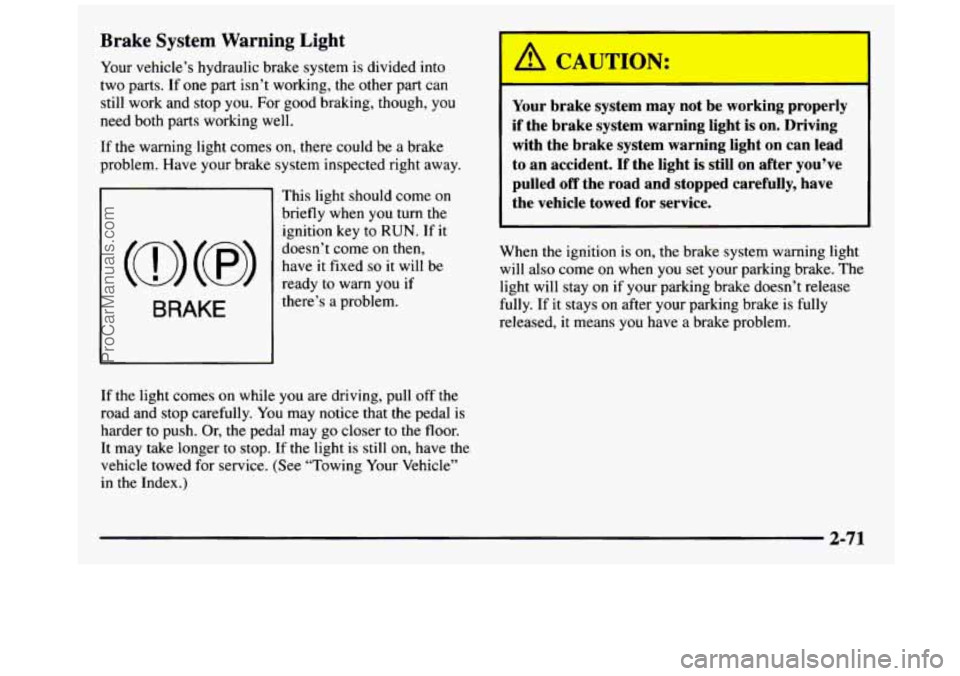
If the warning light comes on, there could be a brake
problem. Have your brake system inspected right away.
This light should come on
briefly when
you turn the
ignition key to
RUN. If it
doesn’t come on then,
have it fixed so it will be
ready to warn
you if
there’s
a problem.
I
Your brake system may not be working properly
if the brake system warning light is on. Driving
with the brake system warning light
on can lead
to an accident. If the light is still on after you’ve
pulled
off the road and stopped carefully, have
the vehicle towed for service.
When the ignition is on, the brake system warning light
will also come
on when you set your parking brake. The
light will stay on
if your parking brake doesn’t release
fully. If it stays on after your parking brake is fully
released,
it means you have a brake problem.
If the light comes on while you are driving, pull off
the
road and stop carefully. You may notice that the pedal is
harder to push. Or, the pedal may go closer to the floor.
It may take longer
to stop. If the light is still on, have the
vehicle towed for service. (See “Towing Your Vehicle”
in the Index.)
2-71
ProCarManuals.com
Page 187 of 436
Remember: Anti-lock doesn’t change the time you need
to get your foot up to the brake pedal or always decrease
stopping distance. If you get too close to the vehicle in
front of you, you won’t have time to apply your brakes
if that vehicle suddenly slows or stops. Always leave
enough room up ahead
to stop, even though you have
anti-lock brakes.
Using Anti-Lock
Don’t pump the brakes. Just hold the brake pedal down
and let anti-lock work for you. You may feel the brakes
vibrate, or you may notice some noise, but this is normal.
On vehicles
with four-wheel drive, your anti-lock brakes
work at all times
-- whether you are in two-wheel drive
or four-wheel drive.
Braking in Emergencies
With anti-lock, you can steer and brake at the same
time. In many emergencies, steering can help you more
than even the very best braking.
Steering
Power Steering
If you lose power steering assist because the engine
stops or the system is not functioning, you can steer but
it will take much more effort.
Variable Effort Steering
This system varies the amount of steering effort
proportionate
to your vehicle speed. Steering is easier
at lower speeds for maneuvering and parking ease. As
your vehicle speed increases, the steering effort also
increases.
At highway speeds, the amount of steering
effort is increased for vehicle control and stability.
Steering Tips
Driving on Curves
It’s important to take curves at a reasonable speed.
A lot of the “driver lost control” accidents mentioned on
the news happen on curves. Here’s
why:
Experienced driver or beginner, each of us is subject to
the same laws of physics when driving on curves. The
traction of the tires against the road surface makes
it
possible for the vehicle to change its path when you turn
the front wheels. If there’s no traction, inertia will keep
the vehicle going in the same direction.
If you’ve ever
tried to steer a vehicle on wet ice, you’ll understand this.
The traction you can get
in a curve depends on the
condition of your tires and the road surface, the angle
at
which the curve is banked, and your speed. While you’re
in a curve, speed is the one factor you can control.
ProCarManuals.com
Page 198 of 436
0
0
0
0
Ease up on your speed as you approach the top of
the hill.
Attach a flag
to the vehicle to make you more visible
to approaching traffic on trails or hills.
Sound the horn as you approach the top of
the hill to
let opposing traffic know you’re there.
Use your headlamps even during the day. They make
you more visible
to oncoming traffic.
J
Driving to the top (crest) of a hill at full speed can
cause an accident. There could be a drop-off,
embankment,
cliff, or even another vehicle. You
could be seriously injured or killed.
As you near
the top
of a hill, slow down and stay alert.
@ What should I do if my vehicle stalls, or is about
A: If this happens, there are some things you should
to stall, and I can’t make it up the hill?
do, and there are some things you must not do.
First, here’s what you
should do:
Push the brake pedal to stop the vehicle and keep it
from rolling backwards. Also, apply
the parking brake.
0 If your engine is still running, shift the transmission
to REVERSE
(R), release the parking brake, and
slowly back down the
hill in REVERSE (R).
If your engine has stopped running, you’ll need to
restart it.
With the brake pedal depressed and the
parking brake still applied, shift the transmission
to
PARK (P) (or, shift to NEUTRAL (N) if your
vehicle has a manual transmission) and restart
the
engine. Then, shift to REVERSE (R), release the
parking brake,
and slowly back down the hill as
straight as possible in REVERSE
(R).
4-20
ProCarManuals.com
Page 199 of 436
0 As you are backing down the hill, put your left hand
on the steering wheel at the 12 o’clock position. This
way, you’ll be able to
tell if your wheels are straight
and maneuver as you back down. It’s best that you
back down the
hill with your wheels straight rather
than
in the left or right direction. Turning the wheel
too far to the left or right will increase the possibility
of a rollover.
Here are some things you
must not do if you stall, or are
about to stall, when going up a hill.
0 Never attempt to prevent a stall by shifting into
NEUTRAL
(N) (or depressing the clutch, if you
have a manual transmission) to “rev-up” the engine
and regain forward momentum. This won’t work.
Your vehicle will roll backwards very quickly and
you could
go out of control.
Instead, apply the regular brake to stop the
vehicle. Then apply
the parking brake. Shift to
REVERSE (R), release the parking brake, and
slowly back straight down.
0 Never attempt to turn around if you are about to stall
when going up a hill. If the hill is steep enough
to
stall your vehicle, it’s steep enough to cause you to
roll over if you turn around.
If you can’t make it up
the hill, you must back straight down the hill.
@ Suppose, after stalling, I try to back down the hill
and decide
I just can’t do it. What should I do?
A: Set the parking brake, put your transmission in
PARK (P) (or the manual transmission in FIRST (1))
and turn off the engine. Leave the vehicle and go get
some help. Exit on the uphill side and stay clear
of
the path the vehicle would take if it rolled downhill.
Do not shift the transfer case to NEUTRAL (N)
when you leave the vehicle. Leave it in I ne gel
Shifting the transfer case to NEUTR
I (N) can
cause your vehicle to roll even if the transmission
is in PARK (P) (or, if you have the manual
transmission, even if you’re in gear). This is
because the
NEUTRAL (N) position on the
transfer case overrides the transmission.
If you
are going to leave your vehicle, set the parking
brake and shift the transmission to
PARK (P)
(or, put your manual transmission in FIRST (1)).
But do not shift the transfer case to the
NEUTRAL
(N) position. Leave the transfer case
in the
2 Wheel, 4 High or 4 Low position.
4-21
ProCarManuals.com
Page 201 of 436
Am I likely to stall when going downhill?
A: It’s much more likely to happen going uphill. But if
it happens going downhill, here’s what to do.
Stop your vehicle by applying the regular brakes.
Apply the parking brake.
Shift to PARK (P) (or to NEUTRAL (N) with the manual
transmission) and, while still braking, restart
the engine.
Shift back to a low gear, release the parking brake,
and drive straight down.
e If the engine won’t start, get out and get help.
Driving Across an Incline
Sooner or later, an off-road trail will probably go across
the incline of a hill. If this happens, you have to decide
whether to try to drive across the incl.ine. Here are some
things to consider:
A hill that can be driven straight up or down may
be too steep to drive across. When you go straight
up or down
a hill, the length of the wheel base (the
distance from the front wheels to the rear wheels)
reduces
the likelihood the vehicle will tumble end
over end. But when you drive across an incline, the
much more narrow track width (the distance between
the left and right wheels) may not prevent the vehicle
from tilting and rolling over. Also, driving across
an
e
e
incline puts more weight on the downhill wheels.
This could cause a downhill slide or
a rollover.
Surface conditions can be a problem
when you drive
across
a hill. Loose gravel, muddy spots, or even wet
grass can cause your tires
to slip sideways, downhill.
If the vehicle slips sideways, it can hit something
that will trip it (a rock, a rut, etc.) and roll over.
Hidden obstacles can make the steepness of
the
incline even worse. If you drive across a rock with
the uphill wheels, or if the downhill wheels drop into
a
rut or depression, your vehicle can tilt even more.
For reasons like these, you need to decide carefully
whether
to try to drive across an incline. Just because the
trail
goes across the incline doesn’t mean you have to
drive it. The last vehicle to
try it might have rolled over.
Driving across an incline that’s too steep will
make your vehicle roll over.
You could be
seriously injured or killed.
If you have any doubt
about the steepness
of the incline, don’t drive
across it. Find another route instead.
ProCarManuals.com
Page 234 of 436
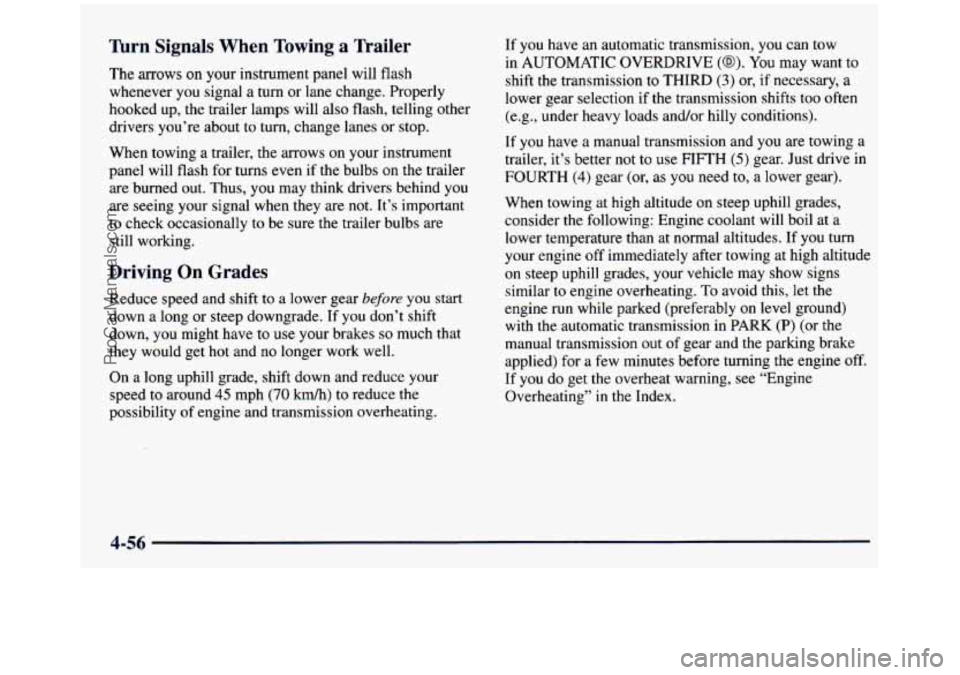
Turn Signals When Towing a Trailer
The arrows on your instrument panel will flash
whenever you signal a turn or lane change. Properly
hooked up, the trailer lamps will also flash, telling other
drivers you’re about to turn, change lanes or stop.
When towing a trailer, the arrows on your instrument
panel will flash for turns even if the bulbs
on the trailer
are burned out. Thus, you may think drivers behind you
are seeing your signal when they are not. It’s important
to check occasionally to be sure the trailer bulbs are
still working.
Driving On Grades
Reduce speed and shift to a lower gear before you start
down a long or steep downgrade. If you don’t shift
down,
you might have to use your brakes so much that
they would get hot and no longer work well.
On
a long uphill grade, shift down and reduce your
speed
to around 45 mph (70 km/h) to reduce the
possibility of engine and transmission overheating. If you have an automatic transmission, you can tow
in
AUTOMATIC OVERDRIVE (a). You
may want to
shift the transmission to THIRD
(3) or, if necessary, a
lower gear selection if the transmission shifts too often
(e.g., under heavy loads and/or hilly conditions).
If you have a manual transmission and you are towing a
trailer, it’s better not to use
FIFTH (5) gear. Just drive in
FOURTH
(4) gear (or, as you need to, a lower gear).
When towing at high altitude on steep uphill grades,
consider the following: Engine coolant will boil at a
lower temperature than at normal altitudes. If
you turn
your engine off immediately after towing at high altitude
on steep uphill grades, your vehicle may show signs
similar to engine overheating.
To avoid this, let the
engine run while parked (preferably on level ground)
with the automatic transmission in
PARK (P) (or the
manual transmission out of gear and the parking brake
applied) for a few minutes before turning the engine
off.
If you do get the overheat warning, see “Engine
Overheating”
in the Index.
4-56
ProCarManuals.com
Page 235 of 436
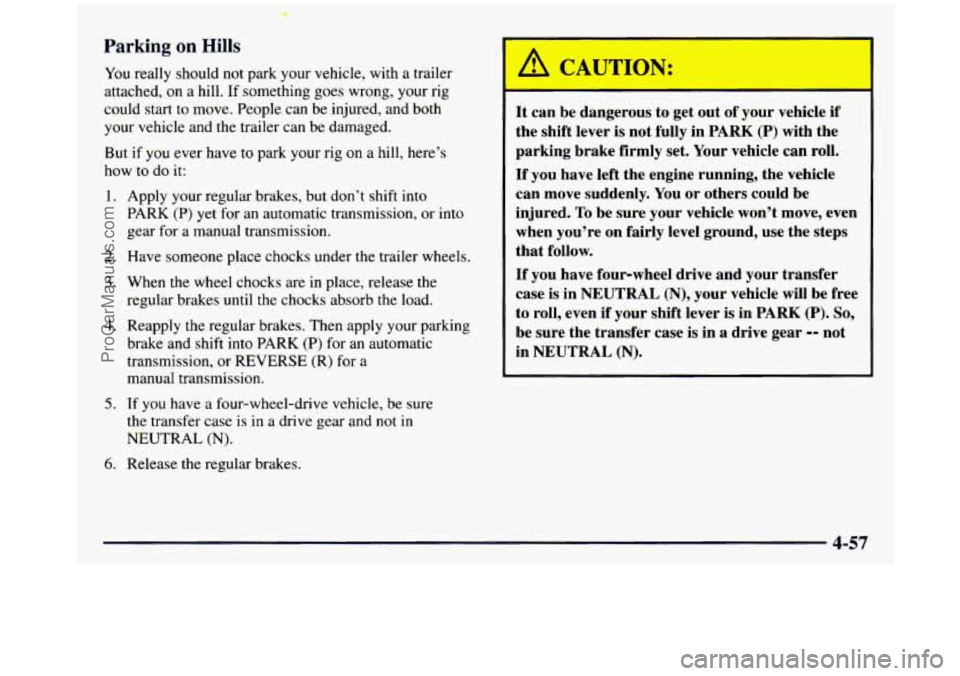
Parking on Hills
You really should not park your vehicle, with a trailer
attached, on a hill.
If something goes wrong, your rig
could start to move. People can be injured, and both
your vehicle and
the trailer can be damaged.
But
if you ever have to park your rig on a hill, here's
how to do
it:
1. Apply your regular brakes, but don't shift into
PARK
(P) yet for an automatic transmission, or into
gear for a manual transmission.
2. Have someone place chocks under the trailer wheels.
3. When the wheel chocks are in place, release the
regular brakes until the chocks absorb
the load.
4. Reapply the regular brakes. Then apply your parking
brake and shift
into PARK (P) for an automatic
transmission, or
REVERSE (R) for a
manual transmission.
5. If you have a four-wheel-drive vehicle, be sure
the transfer case is
in a drive gear and not in
NEUTRAL
(N).
6. Release the regular brakes.
c
It can be dangerous to get out of your vehicle if
the shift lever
is not fully in PARK (P) with the
parking brake
firmly set. Your vehicle can roll.
If you have left the engine running, the vehicle
can move suddenly. You or others could be
injured.
To be sure your vehicle won't move, even
when you're on fairly level ground, use the steps
that follow.
If you have four-wheel drive and your transfer
case
is in NEUTRAL (N), your vehicle will be free
to roll, even if your shift lever
is in PARK (P). So,
be sure the transfer case is in a drive gear -- not
in
NEUTRAL (N).
ProCarManuals.com