ABS GMC SIERRA 1997 Owners Manual
[x] Cancel search | Manufacturer: GMC, Model Year: 1997, Model line: SIERRA, Model: GMC SIERRA 1997Pages: 436, PDF Size: 23.38 MB
Page 134 of 436
Rear Ashtray (If Equipped)
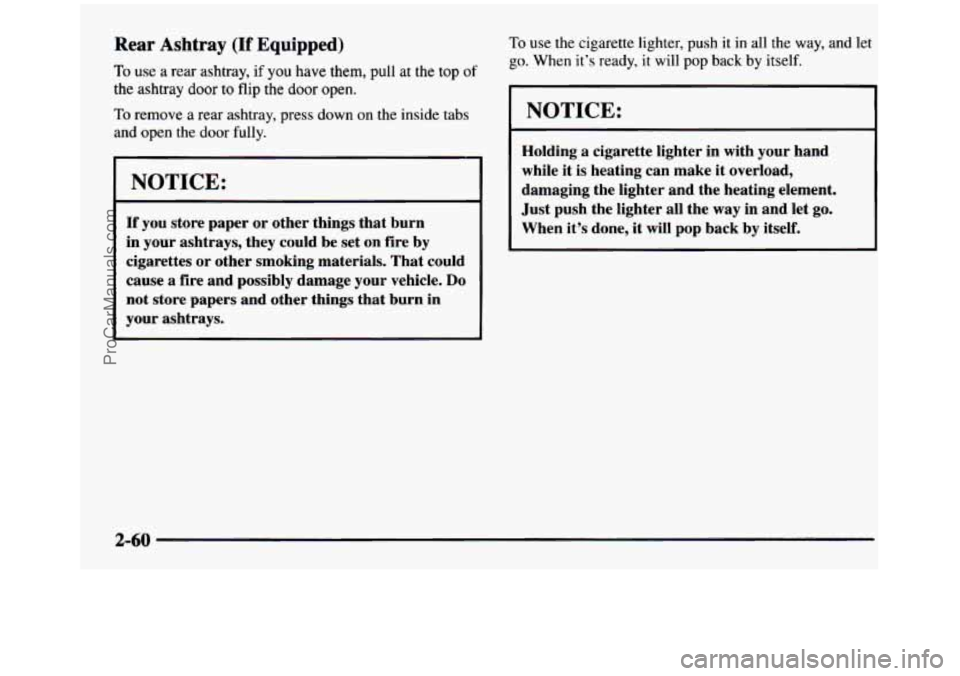
To use a rear ashtray, if you have them, pull at the top of
the ashtray door to flip the door open.
To remove a rear ashtray, press down on the inside tabs
and open the door fully.
NOTICE:
If you store paper or other things that burn
in your ashtrays, they could be set on fire by
cigarettes
or other smoking materials. That could
cause a fire and possibly damage your vehicle.
Do
not store papers and other things that burn in
your ashtrays.
To use the cigarette lighter, push it in all the way, and let
go. When it’s ready, it will pop back by itself.
NOTICE:
Holding a cigarette lighter in with your hand
while it is heating can make it overload,
damaging the lighter and the heating element.
Just push the lighter all the way
in and let go.
When it’s done, it will
pop back by itself.
2-60
ProCarManuals.com
Page 185 of 436
Avoid needless heavy braking. Some people drive
in spurts -- heavy acceleration followed by heavy
braking
-- rather than keeping pace with traffic. This
is a mistake. Your brakes may not have time to cool
between hard stops. Your brakes will wear out much
faster if
you do a lot of heavy braking. If you keep pace
with the traffic and allow realistic following distances,
you will eliminate a lot of unnecessary braking. That
means better braking and longer brake life.
If your engine ever stops while you’re driving, brake
normally but don’t pump your brakes. If you
do, the
pedal may get harder to push down.
If your engine
stops, you will still have some power brake assist.
But
you will use it when you brake. Once the power assist is
used up, it may take longer to stop and the brake pedal
will be harder to push.
Anti-Lock Brakes (ABS)
Your vehicle has anti-lock brakes (ABS). ABS is an
advanced electronic braking
system that will help
prevent a braking skid.
When you start your engine and begin to drive away,
your anti-lock brake system will check itself. You may
hear a momentary motor or clicking noise while this test
is going on. This is normal.
ANTI -
LOCK
If there’s a problem with the
anti-lock brake system, this
warning light will stay on.
See “Anti-Lock Brake
System Warning Light”
in the Index.
4-7
ProCarManuals.com
Page 186 of 436
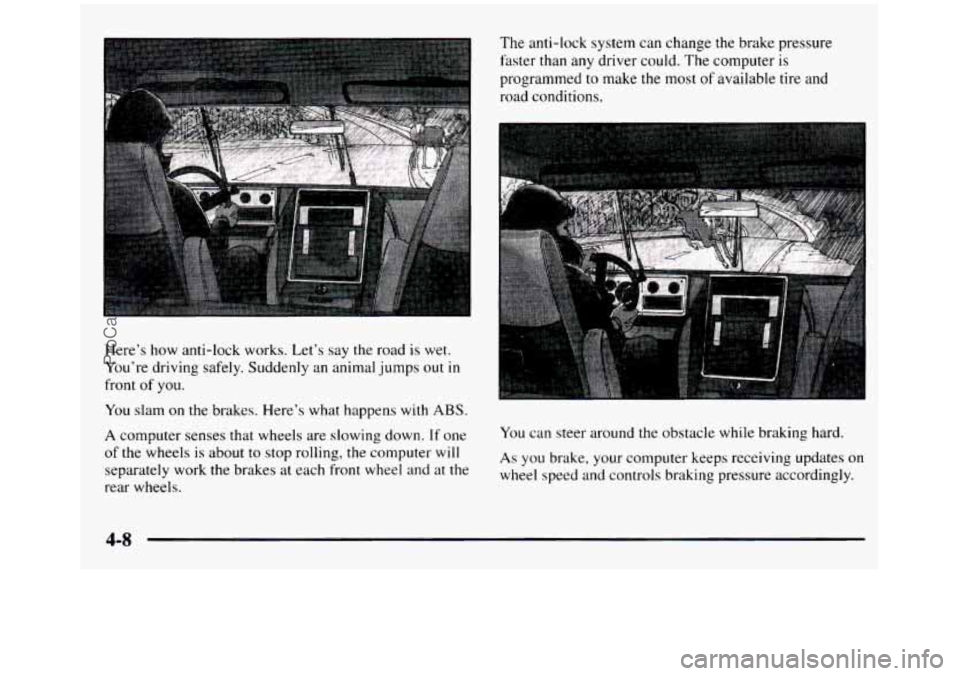
Here’s how anti-lock works. Let’s say the road is wet.
You’re driving safely. Suddenly an animal jumps out
in
front of you.
You slam on the brakes. Here’s what happens with ABS.
A computer senses that wheels are slowing down. If one
of the wheels is about
to stop rolling, the computer will
separately work the brakes at each front wheel
and at the
rear wheels. The anti-lock system can change the brake pressure
faster than any driver could. The computer is
programmed to make the most
of available tire and
road conditions.
You can steer around the obstacle while braking hard.
As you brake, your computer keeps receiving updates on
wheel speed and controls braking pressure accordingly.
4-8
ProCarManuals.com
Page 192 of 436
If your vehicle starts to slide, ease your foot off the
accelerator pedal and quickly steer the way
you want the
vehicle to go. If you start steering quickly enough, your
vehicle may straighten out. Always be ready for
a
second skid if it occurs.
Of course, traction is reduced when water, snow, ice,
gravel or other material is on the road. For safety, you’ll
want to slow down and adjust your driving to these
conditions.
It is important to slow down on slippery
surfaces because stopping distance will be longer and
vehicle control more limited.
While driving on a surface with reduced traction, try
your best to avoid sudden steering, acceleration or
braking (including engine braking by shifting to a lower
gear). Any sudden changes could cause the tires to slide.
You may not realize the surface is slippery until your
vehicle is skidding.
Learn to recognize warning
clues
-- such as enough water, ice or packed snow on
the road to make a “mirrored surface”
-- and slow
down when you have any doubt.
Remember: Any anti-lock brake system (ABS) helps
avoid only the braking skid.
Driving Guidelines
Off-Road Driving with Your
Four-Wheel-Drive Vehicle
This off-road guide is for vehicles that have
four-wheel drive.
Also, see “Anti-Lock Brakes” in the Index.
If your vehicle doesn’t have four-wheel drive, you
shouldn’t drive off-road unless you’re
on a level,
solid surface.
Off-road dnving can be great fun. But
it does have
some definite hazards. The greatest of these is the
terrain itself.
“Off-roading” means you’ve left the great North
American road system behind. Traffic lanes aren’t
marked. Curves aren’t banked. There are no road signs.
Surfaces can be slippery, rough, uphill
or downhill. In
short, you’ve gone right back to nature.
Off-road driving involves some new skills. And that’s
why it’s very important that you read this guide. You’ll \
find many driving tips and suggestions. These will help
make your off-road driving safer and more enjoyable.
4-14
1
ProCarManuals.com
Page 225 of 436
a If you have an automatic transmission, you can tow
in OVERDRIVE (@). You may want to shift the
transmission to THIRD
(3) or, if necessary, a lower
gear selection if the transmission shifts too often
(e.g., under heavy loads and/or hilly conditions). If
you have a manual transmission and you are towing
a trailer, it’s better not to use FIFTH (5) gear. Just
drive in
FOURTH (4) gear (or, as you need to,
a lower gear).
Three important considerations have to do with weight:
the weight of the trailer,
the weight of the trailer tongue
and the weight on your vehicle’s tires.
Weight of the Trailer
How heavy can a trailer safely be?
It depends on how you plan to use your rig. For example,
speed, altitude, road grades, outside temperature and
how much your vehicle is used to pull a trailer are all
important. And, it can also depend
on any special
equipment that you have on your vehicle. Use
one of the following charts to determine how much
your vehicle can weigh, based upon your vehicle model
and options.
Maximum trailer weight is calculated assuming the
driver and one passenger are in the tow vehicle and it
has all
the required trailering equipment. The weight of
additional optional equipment, passengers and cargo in
the tow vehicle must be subtracted from the maximum
trailer weight.
Above the
2,000 lbs. (908 kg) trailer rating, the engine
oil cooler is required
on C/K-1500 and C/K-2500
models with gas engines. Refer to the Trailering Guide
for oil cooler recommendations.
Above the
5,000 lbs. (2 270 kg) trailer rating, heavy-duty
or gas shock absorbers are required on
C- 1500 models,
and heavy-duty shock absorbers or the off-road chassis
package are required on
K- 1500 models.
4-47
ProCarManuals.com
Page 235 of 436
Parking on Hills
You really should not park your vehicle, with a trailer
attached, on a hill.
If something goes wrong, your rig
could start to move. People can be injured, and both
your vehicle and
the trailer can be damaged.
But
if you ever have to park your rig on a hill, here's
how to do
it:
1. Apply your regular brakes, but don't shift into
PARK
(P) yet for an automatic transmission, or into
gear for a manual transmission.
2. Have someone place chocks under the trailer wheels.
3. When the wheel chocks are in place, release the
regular brakes until the chocks absorb
the load.
4. Reapply the regular brakes. Then apply your parking
brake and shift
into PARK (P) for an automatic
transmission, or
REVERSE (R) for a
manual transmission.
5. If you have a four-wheel-drive vehicle, be sure
the transfer case is
in a drive gear and not in
NEUTRAL
(N).
6. Release the regular brakes.
c
It can be dangerous to get out of your vehicle if
the shift lever
is not fully in PARK (P) with the
parking brake
firmly set. Your vehicle can roll.
If you have left the engine running, the vehicle
can move suddenly. You or others could be
injured.
To be sure your vehicle won't move, even
when you're on fairly level ground, use the steps
that follow.
If you have four-wheel drive and your transfer
case
is in NEUTRAL (N), your vehicle will be free
to roll, even if your shift lever
is in PARK (P). So,
be sure the transfer case is in a drive gear -- not
in
NEUTRAL (N).
ProCarManuals.com
Page 267 of 436
Removing the Flat Tire and Installing
the
Spare Tire
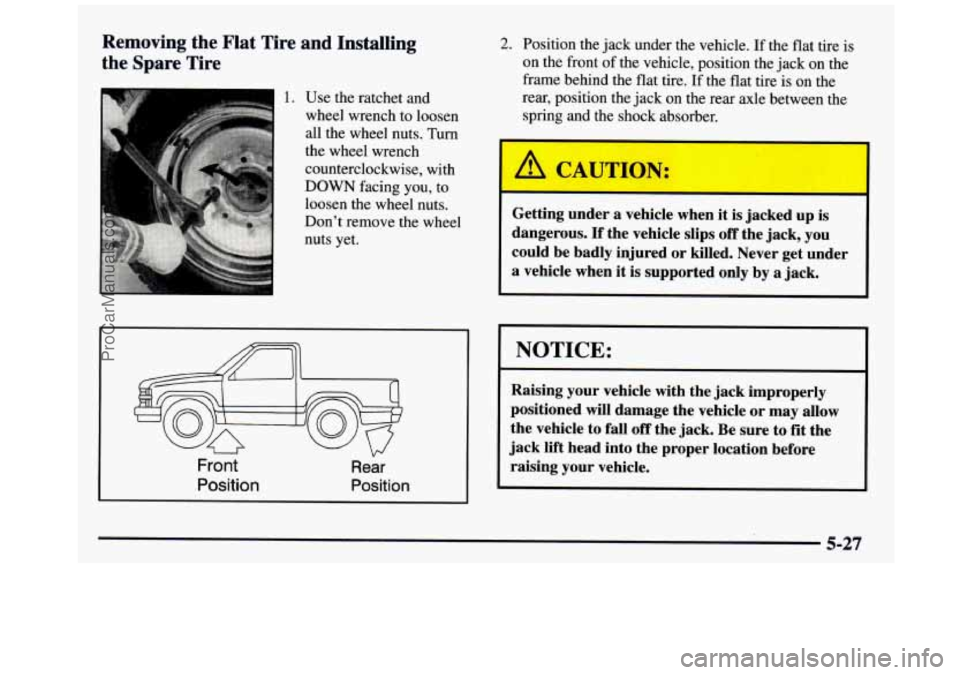
1 1. Use the ratchet and
wheel wrench to loosen
all the wheel nuts. Turn
the wheel wrench
counterclockwise, with
DOWN facing you, to
loosen the wheel nuts.
Don’t remove the wheel
nuts yet.
3
Front
Position
Rear
Position
2. Position the jack under the vehicle. If the flat tire is
on the front of the vehicle, position the jack on the
frame behind the flat tire. If the flat tire is on the
rear, position the jack on the rear axle between the
spring and the shock absorber.
I-
AC
Getting under a vehicle when it is jacked up is
dangerous. If the vehicle slips off the jack, you
could be badly injured or killed. Never get under
a vehicle when it is supported only by a jack.
NOTICE:
Raising your vehicle with the jack improperly
positioned will damage the vehicle or may allow
the vehicle to
fall off the jack. Be sure to fit the
jack lift head into the proper location before
raising your vehicle.
5-27
ProCarManuals.com
Page 349 of 436
FuseKircuit Breaker
15
16
17
18
19
20
21
22
23
24
A
B
Usage
DRL Relay, Fog Lamp Relay
Front and Rear Turn Signals,
Back-up Lamps, BTSI Solenoid
Radio (Ignition)
LCWALNCM, ABS, Cruise Control
Radio (Battery)
PRNDL, Automatic Transmission, Speedometer, Check Gages
Warning Light
Variable Effort Steering
Not Used
Not Used
Front Axle, 4WD Indicator Lamp,
TP2 Relay (Gasoline Engine)
Power Door Lock, Six-Way Power
Seat, Keyless Entry Module
Power Windows
Underhood Fusemelay Center
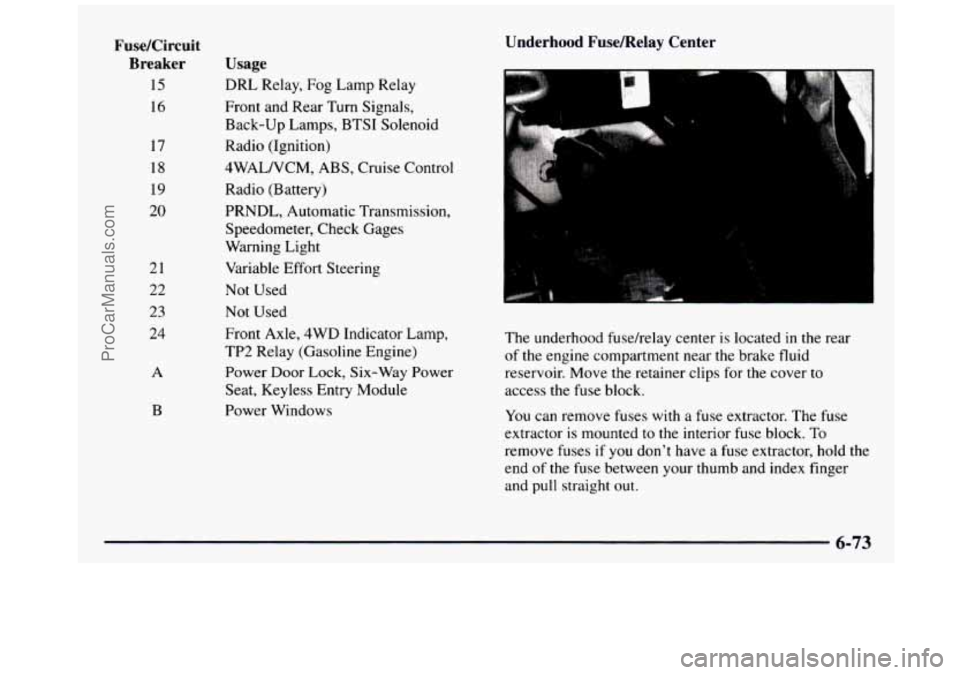
The underhood fusehelay center is located in the rear
of the engine compartment near the brake fluid
reservoir. Move the retainer clips for the cover to
access the fuse block.
You can remove fuses with
a fuse extractor. The fuse
extractor
is mounted to the interior fuse block. To
remove fuses
if you don’t have a fuse extractor, hold the
end of the fuse between your thumb and index finger
and
pull straight out.
ProCarManuals.com
Page 350 of 436
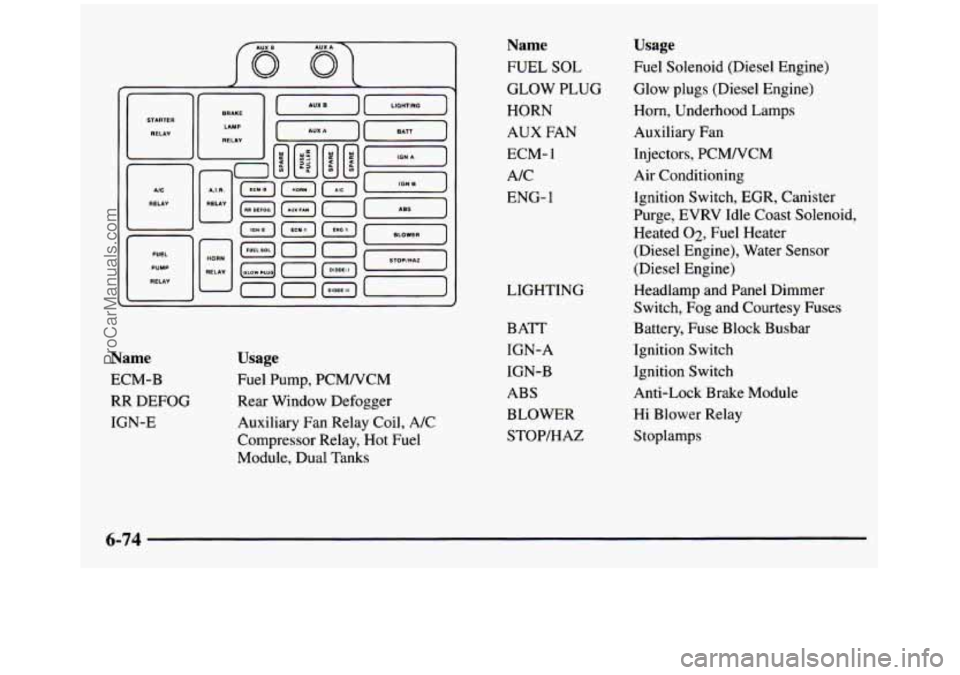
Name
ECM-B
RR DEFOG IGN-E
Usage
Fuel Pump, PCMNCM
Rear Window Defogger
Auxiliary Fan Relay Coil,
A/C
Compressor Relay, Hot Fuel
Module, Dual Tanks
Name
FUEL SOL
GLOW PLUG
HORN
AUX FAN
ECM-
1
NC
ENG-
1
LIGHTING
BATT
IGN-A
IGN-B ABS
BLOWER STOP/HAZ
Usage
Fuel Solenoid (Diesel Engine)
Glow plugs (Diesel Engine)
Horn, Underhood Lamps
Auxiliary Fan
Injectors,
PCMNCM
Air Conditioning
lgnition Switch,
EGR, Canister
Purge,
EVRV Idle Coast Solenoid,
Heated
02, Fuel Heater
(Diesel Engine), Water Sensor
(Diesel Engine)
Headlamp and Panel Dimmer
Switch,
Fog and Courtesy Fuses
Battery, Fuse Block Busbar
Ignition Switch
Ignition Switch
Anti-Lock Brake Module
Hi Blower Relay
Stoplamps
6-74
ProCarManuals.com