lights GMC SIERRA 1997 Owners Manual
[x] Cancel search | Manufacturer: GMC, Model Year: 1997, Model line: SIERRA, Model: GMC SIERRA 1997Pages: 436, PDF Size: 23.38 MB
Page 7 of 436
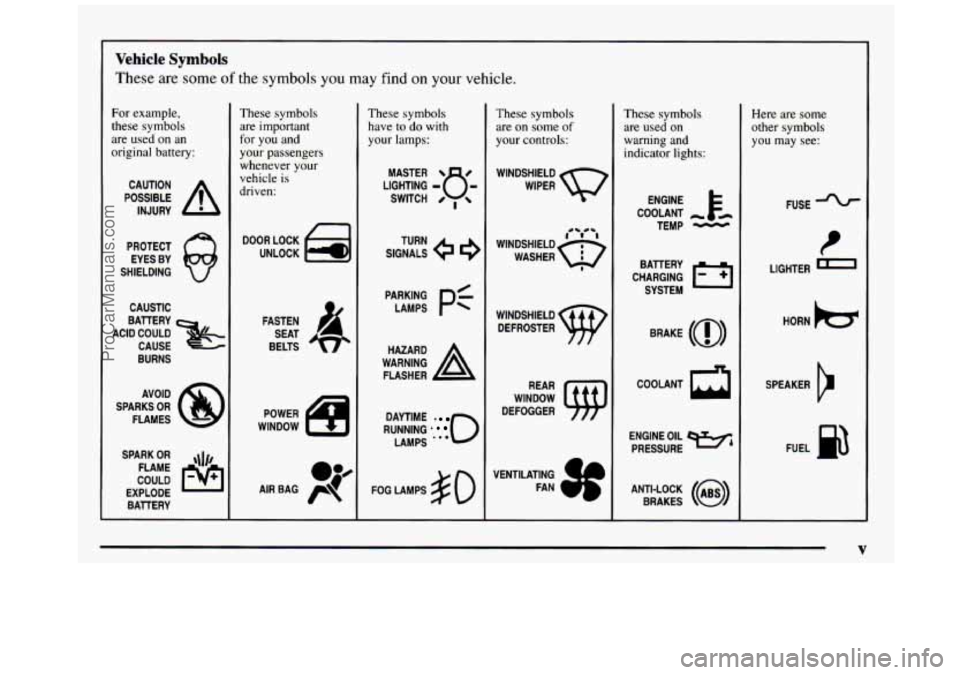
Vehicle Symbols
These are some of the symbols you may find on your vehicle.
For example,
these symbols
are used on an
original battery:
POSSIBLE A
CAUTION
INJURY
PROTECT EYES BY
SHIELDING
Q
CAUSTIC
ACID COULD BAllERY
CAUSE
BURNS
SPARK
OR qJ/,
COULD FLAME
EXPLODE BAllERY
These symbols
are important
for you and
your passengers
whenever your
vehicle is
driven:
DOOR LOCK
UNLOCK
FASTEN SEAT
BELTS
POWER
WINDOW
These symbols have to
do with
your lamps:
SIGNALS e
TURN
WARNING
A
HAZARD
FLASHER
RUNNING
* 0
DAYTIME -
LAMPS **'
FOG LAMPS $0
These symbols
are on
some of
your controls:
WINDSHIELD
WIPER
WINDSHIELD DEFROSTER
WINDOW
DEFOGGER
VENTILATING FAN
c
These symbols
are used on
warning and
indicator lights:
COOLANT -
TEMP -
CHARGING I-1
BAllERY
SYSTEM
BRAKE
(a)
COOLANT a
ENGINE OIL e,
PRESSURE
ANTI-LOCK
(@)
BRAKES
Here are some
other symbols you may see:
FUSE
LIGHTER
e
HORN )cr
SPEAKER
b
FUEL la
V
ProCarManuals.com
Page 75 of 436
Section 2 Features and Controls
-
Here you can learn about the many standard and optional features on your vehicle, and information on starting,
shifting and braking. Also explained
are the instrument panel and the warning systems that tell you if everything is
working properly
-- and what to do if you have a problem.
2- 1
2-3
2-4
2-5
2-7 2-9
2- 10
2-11
2- 13
2- 14
2- 15
2- 19
2-22
2-22
2-27
2-28
2-30
Keys
Tailgate
Third Door
Door Locks
Keyless Entry System
Theft
New Vehicle “Break-In” Ignition Positions
Starting Your Gasoline Engine
Engine Coolant Heater
Automatic Transmission Operation
Manual Transmission Operation
Locking Rear Axle
Four-wheel Drive
Parking Brake
Shifting Into PARK
(P) (Automatic
Transmission Models Only)
Shifting Out
of PARK (P)
(Automatic Transmission) 2-3
1
2-3 1
2-32
2-32
2-33
2-36
2-36
2-43 2-48
2-52
2-59
2-6
1
2-62
2-64 2-66 Parking
Your Vehicle (Manual
Transmission Models Only)
Parking Over Things That Burn
Engine Exhaust
Running Your Engine While You’re Parked
(Automatic Transmission)
Windows
Tilt Wheel
Turn SignalAUultifunction Lever
Lamps
Mirrors Storage Compartments
Ashtrays and Cigarette Lighter
Sun Visors
Instrument Panel
Instrument Panel Cluster
Warning Lights, Gages and Indicators
ProCarManuals.com
Page 99 of 436
Electronic Transfer Case (If Equipped)
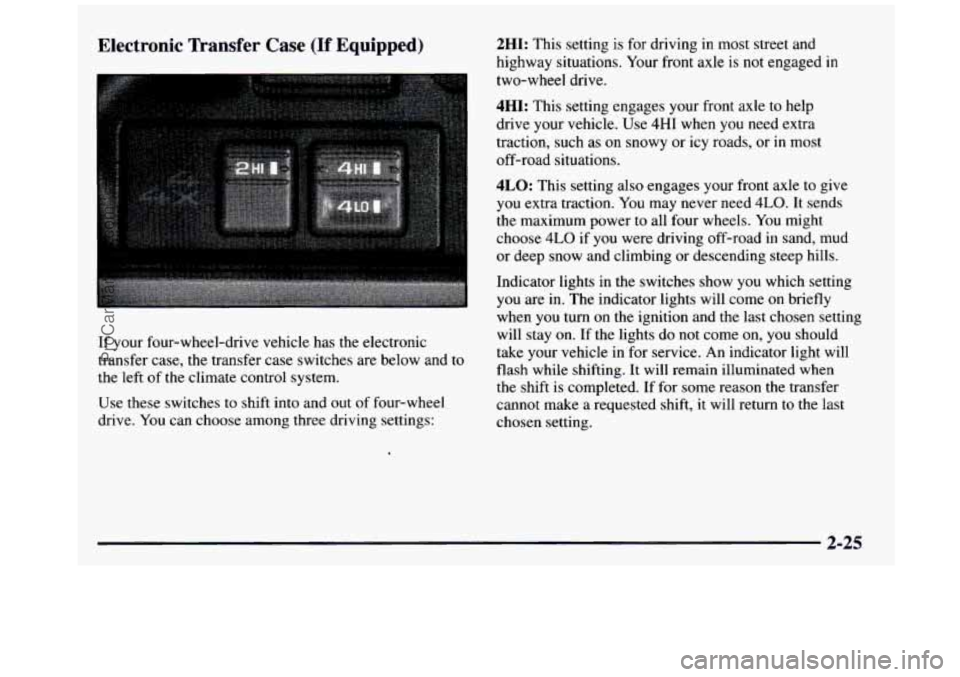
If your four-wheel-drive vehicle has the electronic
transfer case, the transfer case switches are below and
to
the left of the climate control system.
Use these switches to shift into and out
of four-wheel
drive. You can choose among three driving settings:
.
2HI: This setting is for driving in most street and
highway situations. Your front axle is not engaged
in
two-wheel drive.
4HI: This setting engages your front axle to help
drive your vehicle. Use
4HI when you need extra
traction, such as
on snowy or icy roads, or in most
off-road situations.
4LO: This setting also engages your front axle to give
you extra traction. You may never need
4LO. It sends
the maximum power to all four wheels. You might
choose
4LO if you were driving off-road in sand, mud
or deep snow and climbing or descending steep hills.
Indicator lights in the switches show you which setting
you are in. The indicator lights will come
on briefly
when you turn on the ignition and the last chosen setting
will stay on. If the lights do not come on, you should
take your vehicle in for service. An indicator light will
flash while shifting. It
will remain illuminated when
the shift is completed. If for some reason the transfer
cannot make a requested shift,
it will return to the last
chosen setting.
ProCarManuals.com
Page 117 of 436
Lamps Taillamps,
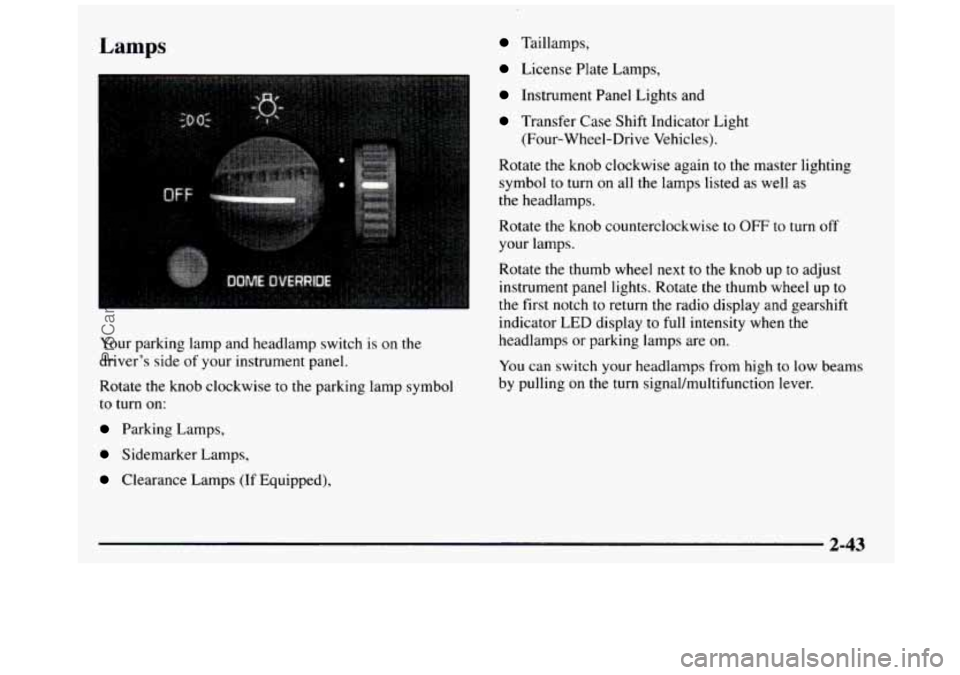
Your parking lamp and headlamp switch is
on the
driver’s side of your instrument panel.
Rotate the knob clockwise to the parking lamp symbol
to turn on:
Parking Lamps,
Sidemarker Lamps,
Clearance Lamps (If Equipped),
License Plate Lamps,
Instrument Panel Lights and
Transfer Case Shift Indicator Light
(Four-Wheel-Drive Vehicles).
Rotate the knob clockwise again to the master lighting
symbol to turn on all the lamps listed as well
as
the headlamps.
Rotate the knob counterclockwise to
OFF to turn off
your lamps.
Rotate the thumb
wheel next to the knob up to adjust
instrument panel lights.
Rotate the thumb wheel up to
the first notch to return the radio display and gearshift
indicator LED display
to full intensity when the
headlamps or parking lamps are on.
You can switch your headlamps from high to low beams
by pulling on the turn signal/multifunction lever.
2-43
ProCarManuals.com
Page 120 of 436
Interior Lamps
Instrument Panel Intensity Control
The instrument panel intensity control is located to the
right of the headlamp switch.
Rotate the thumb wheel up to adjust instrument panel
lights. Rotate the thumb wheel up to the first notch to
return the radio display and gearshift indicator
LED
display to full intensity when the headlamps or parking
lamps are on. To turn on the dome lamps (with the
vehicle doors closed) rotate the thumb wheel up to the
second notch position.
Illuminated Entry
Your vehicle is equipped with an illuminated entry feature.
When the doors are opened, the dome lamps will come
on
if the dome lamp button is out. When all the doors
are closed, or the dome lamp button is pressed in, the
lamps will stay on for a short period
of time and will
then
go out.
Front Reading Lamps (If Equipped)
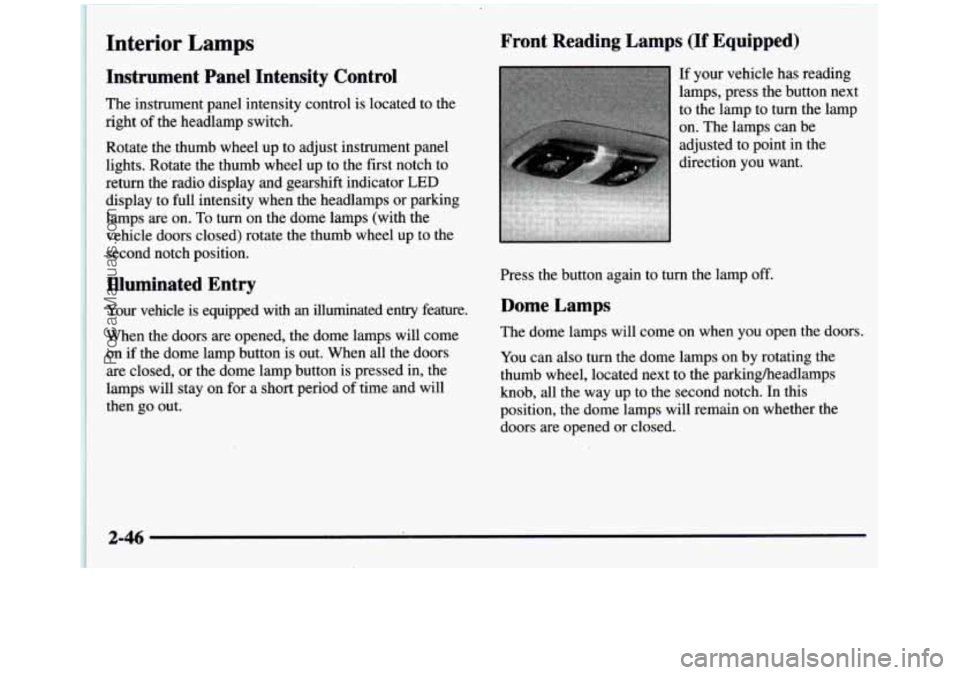
If your vehicle has reading
lamps, press the button next
to the lamp to turn the lamp
on. The lamps can be
adjusted to point in the
direction you want.
Press the button again to turn the lamp off.
Dome Lamps
The dome lamps will come on when you open the doors.
You can also turn the dome lamps on by rotating the
thumb wheel, located next to the parkingheadlamps
knob, all the way up to the second notch. In this
position, the dome lamps will remain on whether the doors are opened or closed.
2-46
ProCarManuals.com
Page 122 of 436
Mirrors
Inside Daymight Rearview Mirror
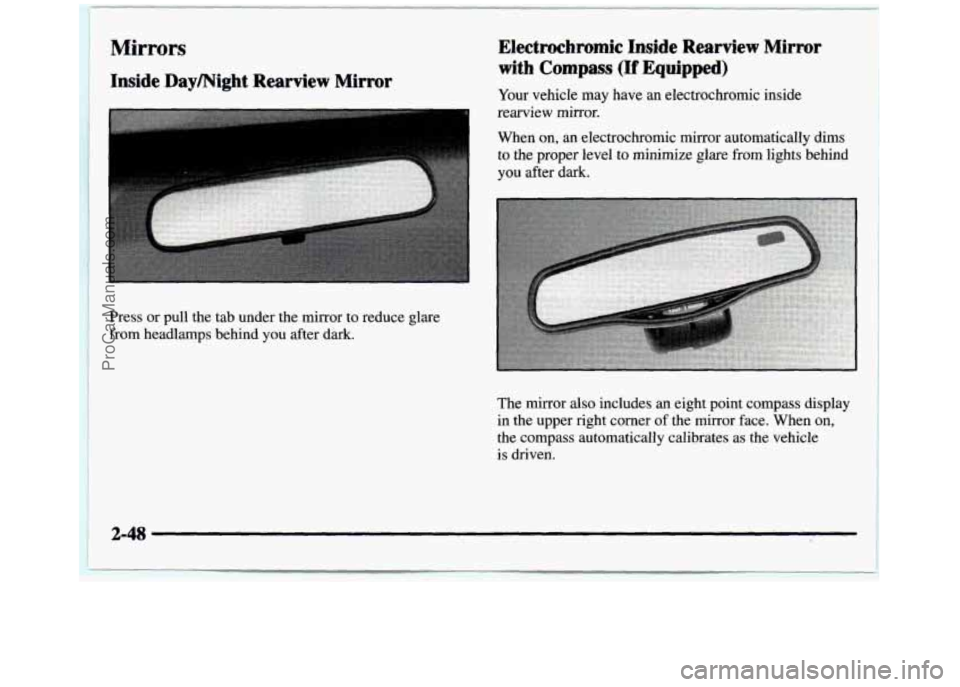
Press or pull the tab under the mirror to reduce glare
from headlamps behind you after dark.
Electrochromic Inside Rearview Mirror
with Compass (If Equipped)
Your vehicle may have an electrochromic inside
rearview mirror.
When on, an electrochromic mirror automatically dims to the proper level to minimize glare from lights behind
you after dark.
The mirror also includes
an eight point compass display
in the upper right corner of the mirror face. When
on,
the compass automatically calibrates as the vehicle
is driven'.
ProCarManuals.com
Page 140 of 436
Warning Lights, Gages and Indicators
This part describes the warning lights and gages that
may be on your vehicle. The pictures will help you
locate them.
Warning lights and gages can signal that something is wrong before it becomes serious enough to cause an
expensive repair or replacement. Paying attention to
your warning lights and gages could also save you or
others from injury.
Warning lights come on when there may be or is a
problem with one of your vehicle’s functions.
As you
will see in the details on the next few pages, some
warning lights come on briefly when you start the
engine just to let
you know they’re working. If you are
familiar with this section, you should not be alarmed
when this happens. Gages can
indicate when there may
be or is a problem
with one of your vehicle’s functions. Often gages and
warning lights work together to let you know when
there’s a problem with your vehicle.
When one
of the warning lights comes on and stays on
when you are driving, or when one of the gages shows
there may
be a problem, check the section that tells you
what to
do about it. Please follow this manual’s advice.
Waiting to do repairs can be costly
-- and even
dangerous.
So please get to know your warning lights
and gages. They’re a big help.
2-66
ProCarManuals.com
Page 196 of 436
When you drive over obstacles or rough terrain, keep a
firm grip
on the steering wheel. Ruts, troughs or other
surface features can jerk the wheel
out of your hands if
you’re not prepared.
When you drive over bumps, rocks, or other obstacles,
your wheels can leave the ground. If this happens, even
with one or two wheels, you can’t control
the vehicle as
well or at all.
Because you will be
on an unpaved surface, it’s
especially important to avoid sudden acceleration,
sudden turns or sudden braking.
Driving on Off-Road Hills
Off-road driving often takes you up, down or across a
hill. Driving safely on hills requires good judgment and
an understanding
of what your vehicle can and can’t do.
There are some hills that simply can’t be driven, no
matter how well built the vehicle.
In
a way, off-road driving requires a different kind of
alertness from driving on paved roads and highways.
There are no road signs, posted speed limits or signal
lights.
You have to use your own good judgment about
what
is safe and what isn’t.
Drinking and driving can be very dangerous on any
road. And this is certainly true for off-road driving. At
the very time you need special alertness and driving
skills, your reflexes, perceptions and judgment can be
affected by even a small amount
of alcohol. You could
have a serious
-- or even fatal -- accident if you drink
and drive or ride with
a driver who has been drinking.
See “Drunken Driving” in the Index.
1
Many hills are simply too steep for any vehicle.
If you drive up them, you will stall. If you drive
down them,
you can’t control your speed. If you
drive across them, you will roll over. You could be
seriously injured or killed. If you have any doubt
about the steepness, don’t drive the hill.
4-18
ProCarManuals.com
Page 206 of 436
Night Vision
No one can see as well at night as in the daytime. But as
we get older these differences increase. A 50-year-old
driver may require at least twice as much light to see the
same thing at night as
a 20-year-old.
What you do in the daytime can also affect your night
vision. For example, if you spend the day in bright
sunshine you are wise to wear sunglasses. Your eyes
will have less trouble adjusting to night. But if you’re
driving, don’t wear sunglasses at night. They may cut
down on glare from headlamps, but they also make a lot
of things invisible.
You can be temporarily blinded by approaching
headlamps.
It can take a second or two, or even several
seconds, for your eyes
to readjust to the dark. When
you
are faced with severe glare (as from a driver who
doesn’t lower the high beams, or a vehicle with
misaimed headlamps), slow down
a little. Avoid
staring directly into the approaching headlamps. Keep your windshield and all the glass on your vehicle
clean
-- inside and out. Glare at night is made much
worse by dirt on the glass.
Even the inside of the glass
can build up a film caused by dust. Dirty glass makes lights dazzle and flash more than clean glass would,
making the pupils of your eyes contract repeatedly.
Remember that your headlamps light up far less of a
roadway when you
are in a turn or curve. Keep your
eyes moving; that way, it’s easier
to pick out dimly
lighted objects. Just as your headlamps should be
checked regularly for proper aim,
so should your eyes
be examined regularly. Some drivers suffer from night
blindness
-- the inability to see in dim light -- and
aren’t even aware
of it.
4-28
ProCarManuals.com
Page 428 of 436
Labels Certification
................................. 4-4 1
Certificationflire ............................. 4-4 1
Service Parts Identification ..................... 6-69
Vehicle Identification Number
................... 6-69
Lamps
........................................ 2-43
Cargo
...................................... 2-47
Cleaning
.................................... 6-64
Dome
...................................... 2-46
Interior
..................................... 2-46
On Reminder
................................ 2-44
Latches, Seatback
................................ 1-6
Leaving Your Vehicle
............................. 2-6
Leaving Your Vehicle with the Engine Running
....... 2-29
Lighter
....................................... 2-59
Lights Air Bag Off
............................ 1-57. 2-68
Anti-Lock Brake System Warning
............ 2-72. 4-7
Charging System
............................. 2-69
Daytime Running Lamps Indicator
............... 2-77
Safety Belt Reminder
..................... 1 - 10, 2-67
Service Engine Soon
.......................... 2-73
Shift
.................................. 2-22. 2-76
Loading Information. Truck-Camper
............... 4-43
Loading Your Vehicle for Off-Road Driving
.......... 4- I5
LockoutSwitch ................................ 2-34
Locks
Cylinders
................................... 7-46
Air Bag Readiness
....................... 1-25. 2-67
Brake System Warning
......................... 2-71
Check Gages
................................ 2-77
Loading Your Vehicle
........................... 4-41 Door
........................................ 2-5
Ignition Transmission Lock Check
............... 7-48
Key Lock Cylinders Service
.................... 7-46
PowerDoor
.................................. 2-6
Rear Door Security
............................. 2-6
Lubricants and Fluids
............................ 7-51
Lubrication Service. Body
........................ 7-47
Lumbar Controls
................................ 1-4
Maintenance. Normal Replacement Parts
........... 6-77
Maintenance Record
............................ 7-54
Maintenance Schedule
............................ 7-1
Long Trip/Highway Definition
................... 7-6
Owner Checks and Services
..................... 7-45
Periodic Maintenance Inspections
................ 7-49
Recommended Fluids and Lubricants
............. 7-51
Scheduled Maintenance Services
.................. 7-4
Long Trip/Highway Intervals
..................... 7-6
Short Trip/City Definition
....................... 7-5
Short Trip/City Intervals ........................ 7-5
Maintenance. Underbody
......................... 6-67
Maintenance When Trailer Towing
................. 4-58
Malfunction Indicator Lamp
...................... 2-73
Manual Front Seat
............................... 1-2
ManualMirror
................................. 2-51
Manual Transmission Check
...................................... 7-46
Fluid
....................................... 6-25
Shifting
................................ 2- 19. 2-20
Starting Your Engine
.......................... 2-13
Manualwindows
............................... 2-33
Memo Pad Holder
......................... 2-56. 2-58
9-6
ProCarManuals.com