four wheel drive GMC SIERRA 1998 User Guide
[x] Cancel search | Manufacturer: GMC, Model Year: 1998, Model line: SIERRA, Model: GMC SIERRA 1998Pages: 452, PDF Size: 23.65 MB
Page 113 of 452
Shifting Out of PARK (P)
(Automatic Transmission)
Your vehicle has a brake-transmission shift interlock
system. You have to fully apply your regular brakes
before you can shift from PARK
(P) when the ignition is
in
RUN. See “Automatic Transmission” in the Index.
If you cannot shift out of PARK
(P), ease pressure on
the shift lever and push the shift lever all the way up
into PARK
(P) as you maintain brake application. Then,
move the shift lever
to any gear you want.
If you ever hold the brake pedal down but still can’t
shift
out of PARK (P), try this:
1. Turn the key to OFF.
2. Apply and hold the brake until the end of Step 4.
3. Shift to NEUTRAL (N).
4. Start the vehicle and shift to the drive gear you want.
5. Have the brake-transmission shift interlock system
fixed as
soon as you can.
Parking Your Vehicle
(Manual Transmission Models
Only)
Before you get out of your vehicle, put your manual
transmission in REVERSE
(R), turn off the engine, and
firmly apply the parking brake.
If you have four-wheel drive, be sure your transfer case
is in a drive gear. Your vehicle could roll if it isn’t.
If
you are parking on a hill, or if you are pulling a
trailer, see “Towing a Trailer” in
the Index.
2-29
ProCarManuals.com
Page 115 of 452
Running Your Engine While You’re
Parked (Automatic
1 ~ ission) an
It’s better not to park with the engme rblllling. But if
ever you have to, here are some things to know.
c
A A AUTION: -1
i Idling the engine with the air system control off
could allow dangerous exhaust into your vehicle
(see the earlier Caution under “Engine Exhaust”).
Also, idling in a closed-in place can let deadly
carbon monoxide
(CO) into your vehicle even if
the fan switch is at the highest setting. One place
this can happen is a garage. Exhaust
-- with
CO -- can come in easily. NEVER park in a
garage with the engine running.
Another closed-in place can be a blizzard. (See
“Blizzard” in the Index.)
4 CAUT- IN: -
It can be dangerous to get out of your vehicle if
the shift lever is not fully in
PARK (P) with the
parking brake firmly set. Your vehicle can
roll.
Don’t leave your vehicle when the engine is
running unless you have to. If you’ve left the
engine running, the vehicle can move suddenly.
You or others could be injured.
To be sure your
vehicle won’t move, even when you’re on fairly
level ground, always set your parking brake and
move the shift lever to
PARK (P).
If you have four-wheel drive and your transfer case is in
NEUTRAL (N), your vehicle will be free to roll, even if
your shift lever is in PARK (P). So. be sure the transfer
case is in a drive gear -- not in NEUTRAL (N). Always
set your parking brake. Follow the proper steps to be
sure your vehicle won’t move.
See ”Shifting Into
PARK
(P)” in the Index.
If you’re pulling a trailer. see “Towing a Trailer” in
the Index.
2-31
ProCarManuals.com
Page 126 of 452
Clearance Lamps (If Equipped)
Taillamps License Plate Lamps
Instrument Panel Lights
Transfer Case Shift Indicator Light (Four-Wheel-Drive Vehicles)
Rotate the knob to the right again to the master
lighting symbol
to turn on all the lamps listed as
well as the headlamps.
Rotate the knob to the left,
to OFF, to turn off
your lamps.
Rotate the thumb wheel next to
the knob up to adjust
instrument panel lights. Rotate the thumb wheel
up to
the first notch to return the radio display and gearshift
indicator
LED display to full intensity when the
headlamps or parking lamps are on.
You can switch your headlamps from high
to low beams
by pulling on the turn signal/multifunction lever.
Headlamps On Reminder
A buzzer will sound when your headlamps are turned on
and the key
is turned to the OFF, LOCK or
ACCESSORY position.
If you need to use your
headlamps when the key is turned to OFF-
LOCK or ACCESSORY, the
buzzer can be turned off by turning
the thumb wheel next
to the parking lamp/headlamp
knob all the way down.
Daytime Running Lamps
Daytime Running Lamps (DRL) can make it easier for
others to see the front of your vehicle during the day.
DRL can be helpful
in many different driving
conditions, but they can be especially helpful
in the
short periods after dawn and before sunset.
The DRL system
will make your headlamps come on at
a reduced brightness when:
0 the ignition is on,
0 the headlamp switch is off and
the parking brake is released.
When the DRL are on, only your headlamps will be on.
The taillamps, sidemarker and other lamps won’t
be on.
Your instrument panel won’t be lit
up either.
When it begins to get dark, your DRL indicator light is a
reminder to turn your headlamp switch on. The other lamps
that come
on with your headlanips will also come on.
When you
turn off the headlamp switch, the regular
lamps will
go off, and your headlamps will change to
the reduced brightness of DRL.
2-42
ProCarManuals.com
Page 189 of 452
Section 4 Yoiir Driving and the Road
Here you’ll find information about driving on different kinds of roads and in varying weather conditions. We’ve also
included many other useful tips on driving.
4-
2
4- 2
4-5
4-6
4- 8
4-1
1
4-1 1
4- 13
4- 14
4-27
4-28
Defensive Driving Drunken Driving
Control of a Vehicle
Braking
Steering
Off-Road Recovery Passing
Loss of Control
Off-Road Driving with Your
Four-Wheel-Drive Vehicle
Driving at Night
Driving
in Rain and on Wet Roads 4-3
1
4-32
4-33
4-33
4-34
4-36 4-4
1
4-42
4-47
4-47
4-48 City Driving
Freeway Driving
Before Leaving
on a Long Trip
Highway Hypnosis
Hill and Mountain Roads
Winter Driving Recreational Vehicle Towing
Loading Your Vehicle
Camper Wiring Harness
(If Equipped)
Pickup Conversion
to Chassis Cab
Towing a Trailer
4-1
ProCarManuals.com
Page 196 of 452
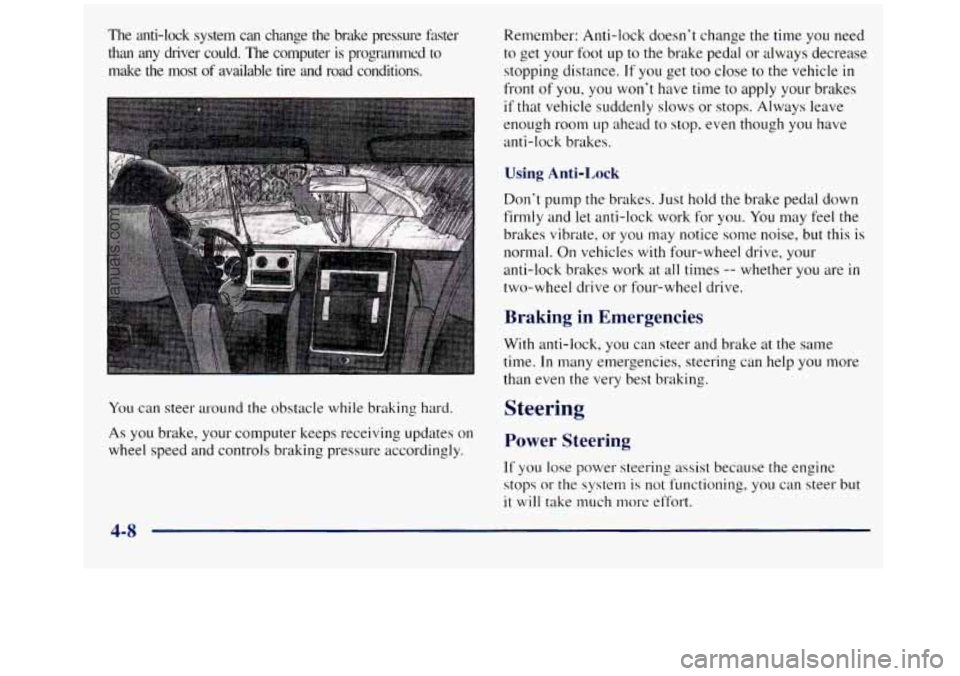
The anti-lock system can change the brlzke pressure faster
than any driver could. The computer is programmed
to
make the most of available tire and road conditions.
You can steer around the obstacle while braking hard.
As you brake, your computer keeps receiving updates on
wheel speed and controls braking pressure accordingly. Remember: Anti-lock doesn’t change the
time you need
to get your foot
up to the brake pedal or always decrease
stopping distance.
If you get too close to the vehicle in
front of you, you won’t have time to apply your brakes
if that vehicle. suddenly slows or stops. Always leave
enough room
up ahead to stop, even though you have
anti-lock brakes.
Using Anti-Lock
Don’t pump the brakes. Just hold the brake pedal down
firmly and let anti-lock work for you.
You may feel the
brakes vibrate, or you may notice some noise, but this is
normal. On vehicles
with four-wheel drive, your
anti-lock brakes work at all times
-- whether you are in
two-wheel drive or four-wheel drive.
Braking in Emergencies
With anti-lock, you can steer and brake at the same
time. In many emergencies, steering can help you more
than even the very best braking.
Steering
Power Steering
If you lose power steering assist because the engine
stops
or the system is not functioning, you can steer but
it will take much more effort.
4-8
ProCarManuals.com
Page 202 of 452
Off-Road Driving with Your
Four-Wheel-Drive
Vehicle
This off-road guide is for vehicles that have
four-wheel drive.
Also, see “Anti-Lock Brakes“
in the Index.
If your vehicle doesn’t have four-wheel drive, you
shouldn’t drive off-road unless you’re on a level,
solid surface.
Off-road driving can be great fun. But
it does have some
definite hazards. The greatest of these is the terrain itself.
“Off-roading” means you’ve left
the great North
American road system behind. Traffic lanes aren’t
marked. Curves aren’t banked. There are
no road signs.
Surfaces can be slippery, rough, uphill or downhill.
In
short, you’ve gone right back to nature.
Off-road driving involves some new skills. And that’s
why it’s very important that you read this guide. You’ll
find many driving tips and suggestions. These
will help
make your off-road driving safer and more enjoyable.
Before You Go Off-Roading
There are some things to do before you go out. For
example, be
sure to have all necessary maintenance and
service work done. Check
to make sure all underbody
shields
(if so equipped) are properly attached. Be sure
you read
all the information about your
four-wheel-drive vehicle
in this manual. Is there enough
firel‘?
Is the spare tire fully inflated? Are the fluid levels
up where
they should be‘? What are the local laws that
apply to off-roading where you’ll be driving?
If you
don’t know, you should check
with law enforcement
people
in the area. Will you be on someone’s private
land?
If so, be sure to get the necessary permission.
Loading Your Vehicle for Off-Road Driving
There are some important things to remember about
how to load your vehicle.
0 The heaviest things should be on the load floor and
forward of your rear axle. Put heavier items
as far
forward
as you can.
Be sure the load is secured properly, so driving on
the off-road terrain doesn’t toss things around.
4-14
ProCarManuals.com
Page 229 of 452
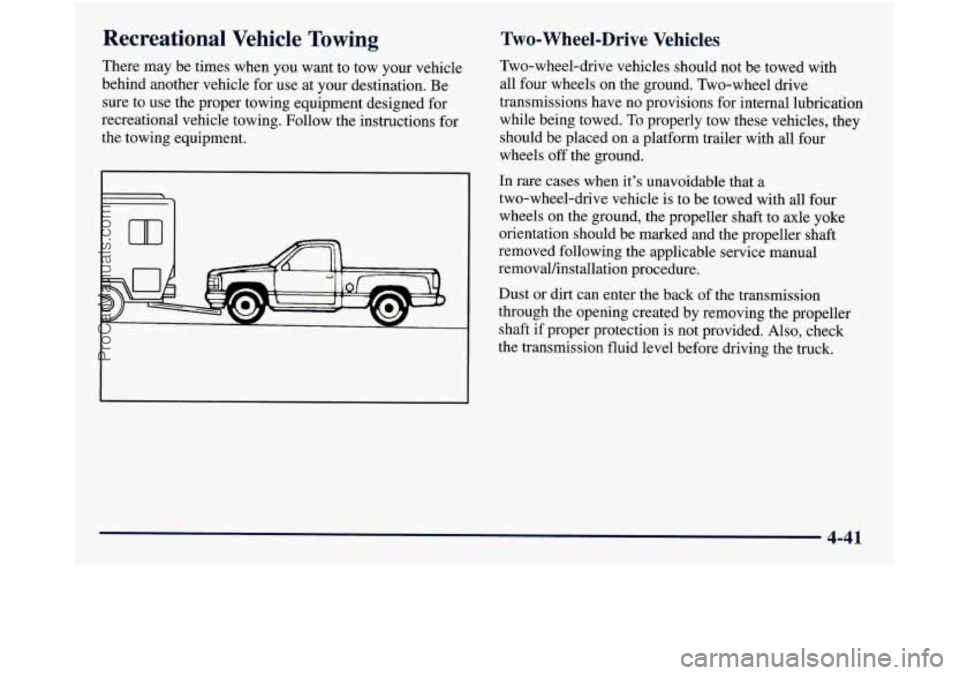
Recreational Vehicle Towing
There may be times when you want to tow your vehicle
behind another vehicle for use at your destination. Be
sure to use the proper towing equipment designed for
recreational vehicle towing. Follow the instructions for
the towing equipment.
I
I1
c
Two-Wheel-Drive Vehicles
Two-wheel-drive vehicles should not be towed with
all four wheels on the ground. Two-wheel drive
transmissions have no provisions for internal lubrication
while being towed. To properly tow these vehicles, they
should be placed on a platform trailer with all four
wheels off the ground.
In
rare cases when it's unavoidable that a
two-wheel-drive vehicle is to be towed with all 'four
wheels on the ground, the propeller shaft to axle yoke
orientation should be marked and the propeller shaft
removed following the applicable service manual
removal/installation procedure.
Dust or dirt can enter the back of the transmission
through the opening created by removing the propeller
shaft if proper protection is not provided. Also, check
the transmission fluid level before driving the truck.
4-41
ProCarManuals.com
Page 230 of 452
Four-Wheel-Drive Vehicles
(Manual Transfer Case Only)
‘A
-
Shifting the transfer case into NEUTRAL (N) can
cause your vehicle to roll even if the transmission
is in
PARK (P), for an automatic transmission, or
if your vehicle is in gear, for
a manual
transmission.
You or others could be injured.
Make sure the parking brake is firmly set before
you shift the transfer case into NEUTRAL (N).
Use the following procedure to correctly tow your
vehicle on all four wheels:
1.
2.
3.
4.
5.
6.
Firmly set the parking brake.
Place the transmission in
PARK (P) or a manual
transmission in FIRST
(1).
Securely attach the vehicle being towed to the
tow vehicle.
With the engine running, shift the transfer case to
NEUTRAL
(N). See “Four-wheel Drive” in the
Index for the proper procedure to select the neutral
position for your vehicle.
Release the parking brake only after the vehicle
being towed is firmly attached to the towing vehicle.
Turn the ignition to
OFF, The OFF position unlocks the
steering column and reduces battery
drain. Unlocking
the steering column will allow the proper movement
of
the front wheels and tires during towing.
4-42
ProCarManuals.com
Page 246 of 452
Driving On Grades
Reduce speed and shift to a lower gear before you start
down a long or steep downgrade. If
you don’t shift
down,
you might have to use your brakes so much that
they would
get hot and no longer work well.
On a long uphill grade, shift down and reduce your
speed
to around 45 mph (70 kdh) to reduce the
possibility
of engine and transmission overheating.
If you have an automatic transmission, you can tow in
AUTOMATIC OVERDRIVE
(@). You may want to
shift the transmission
to THIRD (3) or, if necessary, a
lower gear selection
if the transmission shifts too often
(e.g., under heavy loads and/or hilly conditions).
If
you have a manual transmission and you are towing a
trailer, it’s better not to
use FIFTH (5) gear. Just drive in
FOURTH
(4) gear (or, as you need to, a lower gear).
When towing at high altitude
on steep uphill grades,
consider the following: Engine coolant
will boil at a
lower temperature than at normal altitudes. If you turn
your engine off immediately after towing
at high altitude
on steep uphill grades, your vehicle may show signs
similar to engine overheating. To avoid this, let the
engine run while parked (preferably on level ground) with
the automatic transmission in
PARK (P) (or the
manual transmission out of gear and the parking brake
applied) for a few minutes before turning the engine
off.
If you do get the overheat warning, see “Engine
Overheating’’ in
the Index.
Parking on Hills
You really should not park your vehicle, with a trailer
attached, on a
hill. If something goes wrong, your rig
could start to move. People can be injured, and both
your vehicle and the trailer can be damaged.
But
if you ever have to park your rig on a hill, here’s
how to do it:
1.
2.
3.
4.
Apply your regular brakes, but don’t shift into
PARK
(P) yet for an automatic transmission, or into
gear for a manual transmission.
Have someone place chocks under the trailer wheels.
When the wheel chocks are
in place, release the
regular brakes until the chocks absorb the load.
Reapply the regular brakes. Then apply your parking brake and
shift into PARK (P) for an automatic
transmission, or REVERSE (R)
for a manual
transmission.
4-58
ProCarManuals.com
Page 247 of 452
5. If you have a four-wheel-drive vehicle,
be sure the transfer case is in
a drive gear and not
in
NEUTRAL (N).
6. Release the regular brakes.
-
/r CAUTIOIA:
It can be dangerous to get out of your vehicle if
the shift lever is not fully in
PARK (P) with the
parking brake firmly set. Your vehicle can roll.
If you have left the engine running, the vehicle
can move suddenly. You or others could be
injured.
To be sure your vehicle won’t move, even
when you’re on fairly level ground, use the steps
that follow.
If you have four-wheel drive and your transfer
case is in
NEUTRAL (N), your vehicle will be free
to
roll, even if your shift lever is in PARK (P). So,
be sure the transfer case is in a drive gear -- not
in
NEUTRAL (N).
When You Are Ready to Leave After
Parking
on a Hill
1. Apply your regular brakes and hold the pedal down
while you:
Start your engine;
Shift into a gear; and
Release the parking brake.
2. Let up on the brake pedal.
3. Drive slowly
until the trailer is clear of the chocks.
4. Stop and have someone pick up and store the chocks.
Maintenance When Trailer Towing
Your vehicle will need service more often when you’re
pulling
a trailer. See the Maintenance Schedule for more
on this. Things that are especially important
in trailer
operation are automatic transmission fluid (don’t
overfill), engine
oil, axle lubricant, belt, cooling system
and brake adjustment. Each of these is covered in this
manual, and the Index will help you find them quickly.
If you’re trailering, it’s a good idea to review these
sections before
you start your trip.
Check periodically
to see that all hitch nuts and bolts
are tight.
ProCarManuals.com