four wheel drive GMC SIERRA 1998 Owner's Manual
[x] Cancel search | Manufacturer: GMC, Model Year: 1998, Model line: SIERRA, Model: GMC SIERRA 1998Pages: 452, PDF Size: 23.65 MB
Page 250 of 452
To engage a PTO:
1. Hold the clutch pedal down.
2. Set the parking brake.
3. Shift the transmission into NEUTRAL (N).
4. Engage the PTO.
NOTICE:
Using a PTO for more than four hours without
driving your vehicle can damage the transfer case
or transmission. If using a
PTO for more than
four hours without driving your vehicle, drive
your vehicle for a while to allow the transfer case
and transmission to cool.
If you are going to drive the vehicle, shift the
transfer case into the range you want
(if you have
four-wheel drive). Then shift
the transmission into
the gear you want, apply the regular brakes and
release the parking brake.
5. Release the clutch (and the regular brakes) as you
normally would. When
you release the clutch, the
PTO will start.
To engage a PTO while the vehicle is moving:
1. Hold the clutch pedal down.
2. Shift the transmission into NEUTRAL (N).
3. Engage the PTO.
4. Shift the transmission into the gear you want.
5. Release the clutch as you normally would. When you
release the clutch, the
PTO will start.
Using a Transfer Case Mounted Power
Take-Off (Manual Transmission)
1.
2.
3.
4.
5.
6.
Hold the clutch pedal down.
Set the parking brake.
Shift
the transfer case into NEUTRAL (N).
If the vehicle will remain in the same place, shift the
transmission into
the highest gear.
Engage the PTO.
If you are going to drive the vehicle, shift the
transmission into the gear you want. Then shift the
transfer case into the range you want, apply the
regular brakes and release the parking brake.
Release the clutch (and the regular brakes) as
you
normally would. When you release the clutch, the
PTO will start.
4-62
ProCarManuals.com
Page 256 of 452
2. Get the vehicles close enough so the jumper cables
can reach, but be sure the vehicles aren’t touching
each other. If they are, it could cause a ground
connection
you don’t want. You wouldn’t be able
to start your vehicle, and the bad grounding could
damage the electrical systems.
To avoid the possibility
of the vehicles rolling, set
the parking brake firmly on both vehicles involved
in the jump start procedure. Put an automatic
transmission in
PARK (P) or a manual transmission
in NEUTRAL (N).
If you have a four-wheel-drive
vehicle, be sure the transfer case is not in
NEUTRAL
(N).
3. Turn off the ignition on both vehicles. Unplug
unnecessary accessories plugged into the cigarette
lighter or accessory power outlets. Turn
off all lamps
that aren’t needed as well as radios. This will avoid
sparks and help save both batteries. In addition, it
could save your radio!
I NOTICE:
If you leave your radio on, it could be badly
damaged. The repairs wouldn’t be covered by
your warranty.
4. Open the hoods and locate the batteries. Find the
positive
(+) and negative (-) terminals on each battery.
If your vehicle has air conditioning, the auxiliary
electric fan under the hood can start up even
when the engine is not running and can injure
you. Keep hands, clothing and tools
away from
any underhood electric fan.
5-4
t
ProCarManuals.com
Page 260 of 452
11. Try to start the vehicle with the dead battery.
If it won’t start after
a few tries, it probably
needs service.
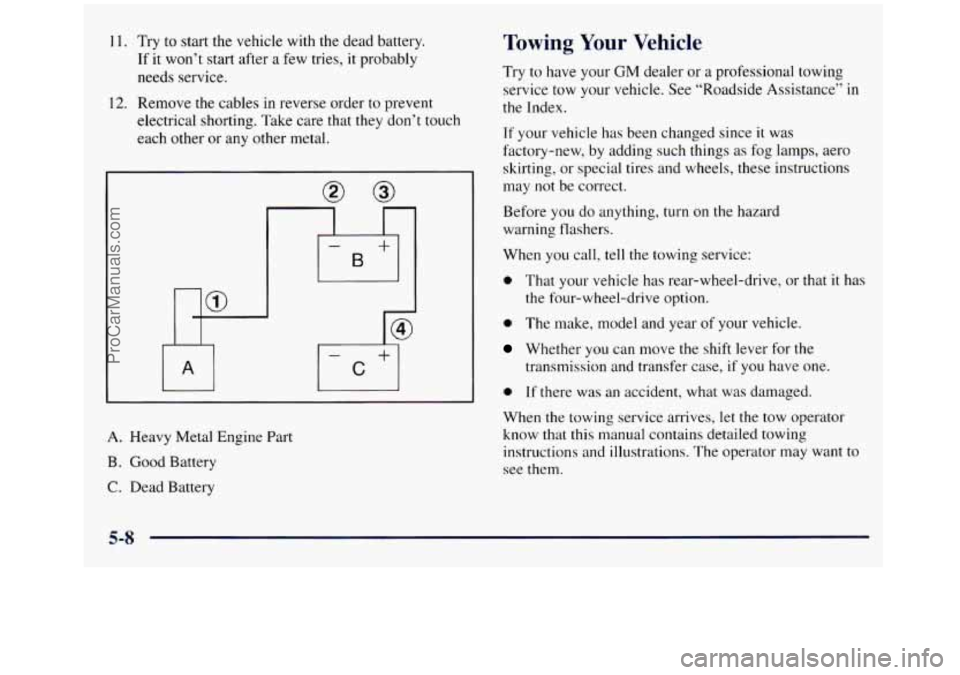
12. Remove the cables in reverse order to prevent
electrical shorting. Take care that they don’t touch
each other or any other metal.
A. Heavy Metal Engine Part
B. Good Battery
C. Dead Battery
Towing Your Vehicle
Try to have your GM dealer or a professional towing
service tow your vehicle. See “Roadside Assistance’’
in
the Index.
If your vehicle has been changed since it was
factory-new, by adding such things
as fog lamps, aero
skirting, or special tires and wheels, these instructions
may not be correct.
Before you do anything, turn on the hazard
warning flashers.
When you call, tell the towing service:
0 That your vehicle has rear-wheel-drive, or that it has
the four-wheel-drive option.
0 The make, model and year of your vehicle.
Whether you can move the shift lever for the
0 If there was an accident, what was damaged.
When
the towing service arrives, let the tow operator
know that this manual contains detailed towing
instructions and illustrations. The operator may want to
see
them.
transmission and transfer case, if you have one.
5-8
ProCarManuals.com
Page 262 of 452
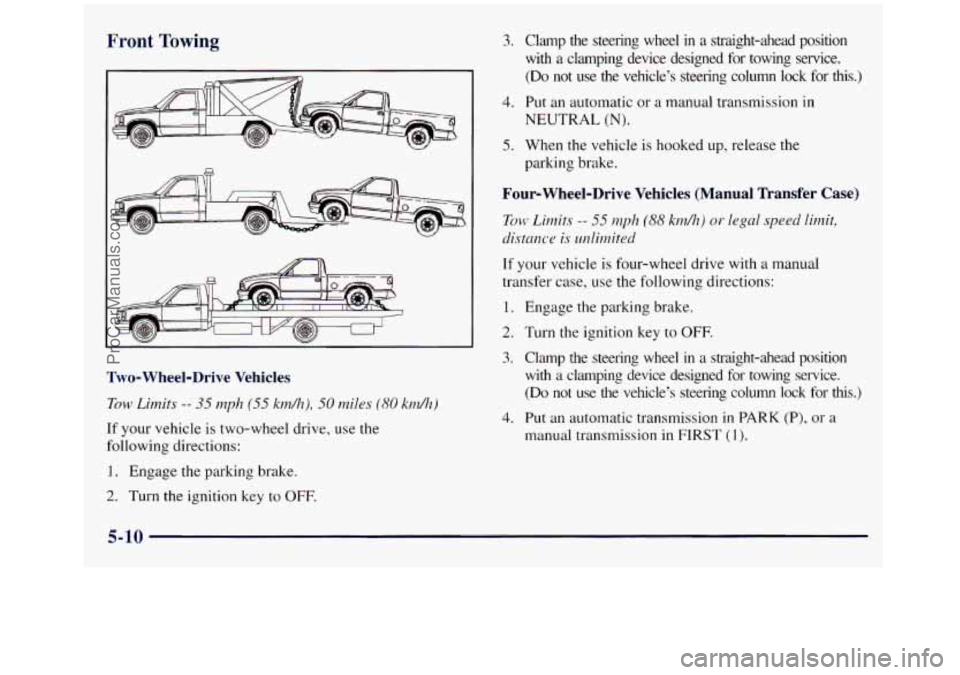
Front Towing
Two- Wheel-Drive Vehicles
Tow Lirnits -- 35 nzph (55 kdh), 50 miles (80 kr.n/h)
If your vehicle is two-wheel drive, use the
following directions:
I. Engage the parking brake.
2. Turn the ignition key to OFF.
3. Clamp the steering wheel in a straight-ahead position
with a clamping device designed for towing service.
(Do not use the vehicle’s steering column lock for this.)
4. Put an automatic or a manual transmission in
NEUTRAL (N).
5. When the vehicle is hooked up, release the
parking brake.
Four-Wheel-Drive Vehicles (Manual Transfer Case)
Tow Lirnits -- 55 rnph (88 knzdh) or legtrl speed limit,
distance
is unlimited
If your vehicle is four-wheel drive with a manual
transfer case, use the following directions:
1. Engage the parking brake.
2. Turn the ignition key to OFF.
3. Clamp the steering wheel in a straight-ahead position
with
a clamping device designed for towing service.
(Do not use the vehicle’s steering column lock for this.)
4. Put an automatic transmission in PARK (P), or a
manual transmission
in FIRST (1).
5-10
ProCarManuals.com
Page 263 of 452
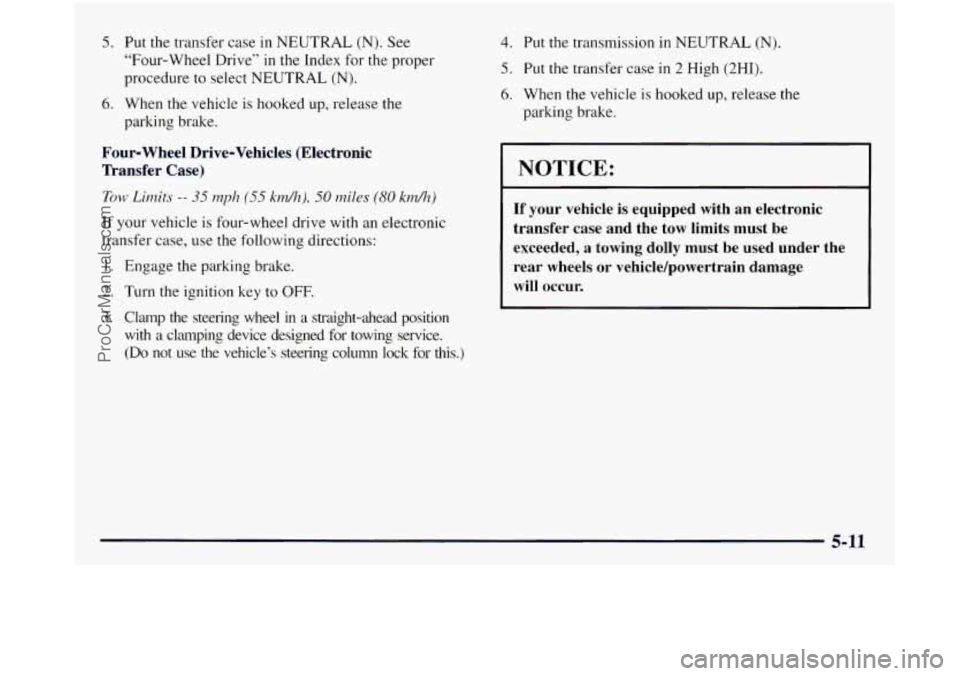
5. Put the transfer case in NEUTRAL (N). See
“Four-wheel Drive” in the Index
for the proper
procedure to select NEUTRAL
(N).
6. When the vehicle is hooked up, release the
parking brake.
4. Put the transmission in NEUTRAL (N).
5. Put the transfer case in 2 High (2HI).
6. When the vehicle is hooked up, release the
parking brake.
Four- Wheel Drive-Vehicles (Electronic
Transfer Case)
Tow Limits -- 35 mph (55 krdh), 50 miles (80 krn/l1)
If your vehicle is four-wheel drive with an electronic
transfer case, use the following directions:
1. Engage the parking brake.
2. Turn the ignition key to OFF.
3. Clamp the steering wheel in a straight-ahead position
with a clamping device designed for towing service.
(Do not use the vehicle’s steering column lock for this.)
NOTICE:
If your vehicle is equipped with an electronic
transfer case and the tow limits must be
exceeded, a towing dolly must be used under the rear wheels or vehicle/powertrain damage
will occur.
5-11
ProCarManuals.com
Page 264 of 452
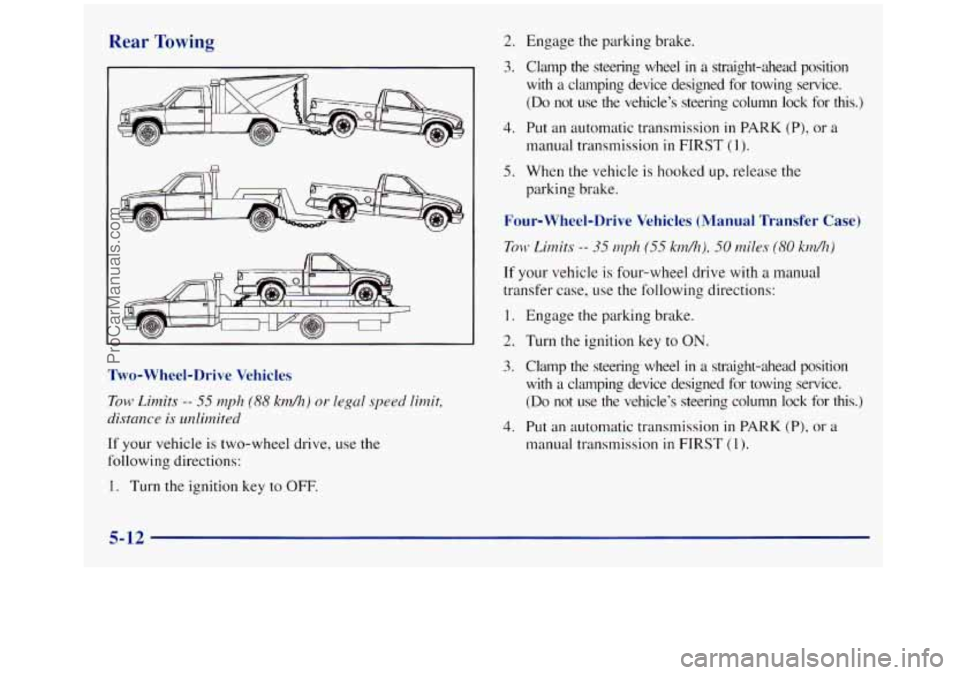
Rear Towing
Two-Wheel-Drive Vehicles
Tow Limits -- 55 ~zph (88 krdh) or legal speed limit,
distmce is ditnited
If your vehicle is two-wheel drive, use the
following directions:
1. Turn the ignition key to OFF.
2.
3.
4.
5.
Engage the parking brake.
Clamp the steering wheel in a straight-ahedd position
with a clamping device designed for towing service.
(Do not use the vehicle’s steering column lock for this.)
Put an automatic transmission
in PARK (P), or a
manual transmission in FIRST (1).
When the vehicle is hooked up, release the
parking brake.
Four-Wheel-Drive Vehicles (Manual Transfer Case)
If your vehicle is four-wheel drive with a manual
transfer case, use the following directions:
1.
2.
3.
4.
Engage the parking brake.
Turn the ignition
key to ON.
Clamp the steering wheel in a straight-ahead position
with a clamping device designed for towing service.
(Do not use the vehicle’s steering column lock for this.)
Put an automatic transmission
in PARK (P), or a
manual transmission in FIRST (1).
5-12
ProCarManuals.com
Page 265 of 452
5. Put the transfer case in NEUTRAL (N). See
“Four-Wheel Drive’’
in the Index for the proper
procedure to select NEUTRAL
(N).
6. When the vehicle is hooked up. release the
parking brake.
7. Turn the ignition key to OFF.
Four- Wheel-Drive Vehicles (Electronic
Transfer Case)
Eml Limits -- 35 mph (55 km/JZ), 50 milc?s (80 kndh)
If your vehicle is four-wheel drive with an electronic
transfer case, use the following directions:
I. Engage the parking brake.
2. Turn the ignition key to ON.
3. Clamp the steering wheel in a straight-ahead position
with
a clamping device designed for towing service.
(Do not use the vehicle’s steering column lock for this.)
4. Put the transmission in NEUTRAL (N).
5. Put the transfer case in 2 High (2HI).
6. When the vehicle is hooked up, release the
parking brake.
7. Turn the ignition key to OFF.
NOTICE:
If your vehicle is equipped with four-wheel drive
and the towing limits must be exceeded, a towing
dolly must be used under the front wheels or
vehicle/powertrain damage will occur.
I NOTICE:
Towing pickup models from the rear while loaded
with heavy cargo may cause the frame side rails
to flex sufficiently to allow the pickup box to
contact the cab and could cause damage to the
cab and/or box.
Engine Overheating (Gasoline Engine)
You will find a coolant temperature gage on your
vehicle’s instrument panel. See “Engine Coolant
Temperature Gage”
in the Index.
If your vehicle has a diesel engine, see “Engine
Overheating”
in the Diesel Engine Supplement.
5-13
ProCarManuals.com
Page 276 of 452
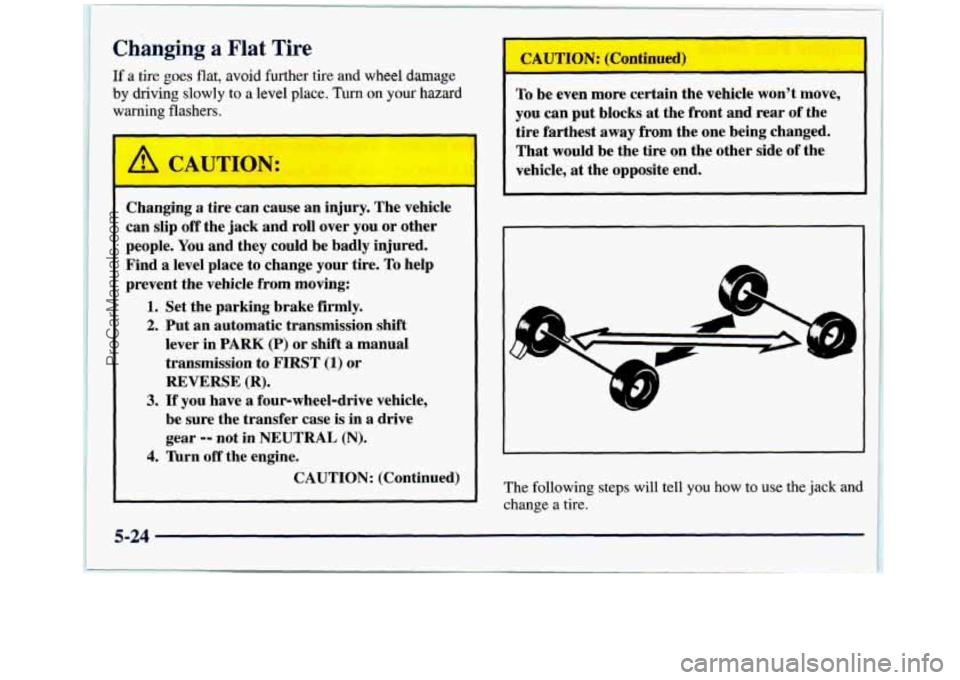
Changing a Flat Tire
If a tire goes flat, avoid further tire and wheel damage
by driving slowly to a level place. Turn on your hazard
warning flashers.
Changing a tire can cause an injury. The vehicle
can slip off the jack and roll over you or other
people. You and they could be badly injured.
Find
a level place to change your tire. To help
prevent the vehicle from moving:
1. Set the parking brake firmly.
2. Put an automatic transmission shift
lever in PARK
(P) or shift a manual
transmission to FIRST
(1) or
REVERSE (R).
3. If you have a four-wheel-drive vehicle,
be sure the transfer case is in a drive
gear
-- not in NEUTRAL (N).
4. nrn off the engine.
CAUTION: (Continued)
To be even more certain the vehicle won’t move,
you can put blocks
at the front and rear of the
tire farthest away from the one being changed.
That would be the tire on the other side of the
vehicle.
at the opposite end.
V
The following steps will tell you how to use the jack and
change a tire.
ProCarManuals.com
Page 289 of 452
NOTICE:
Spinning your wheels can destroy parts of your
vehicle as well as the tires. If you spin the wheels
too fast while shifting your transmission back
and forth,
you can destroy your transmission. I
For information about using tire chains on your vehicle,
see “Tire Chains”
in the Index.
Rocking Your Vehicle To Get It Out
First, turn your steering wheel left and right. That will
clear the area around your front wheels. If
you have a
four-wheel drive vehicle, shift into
4HI. Then shift back
and forth between
REVERSE (R) and a forward gear
(or with a manual transmission, between FIRST
(1) or
SECOND (2) and REVERSE (R)), spinning the wheels
as little as possible. Release the accelerator pedal while
you shift, and press lightly on the accelerator pedal
when the transmission is
in gear. If that doesn’t get
you out after a few tries, you may need to be towed out.
Or,
you can use your recovery hooks if your vehicle has
them.
If you do need to be towed out, see “Towing
Your Vehicle”
in the Index.
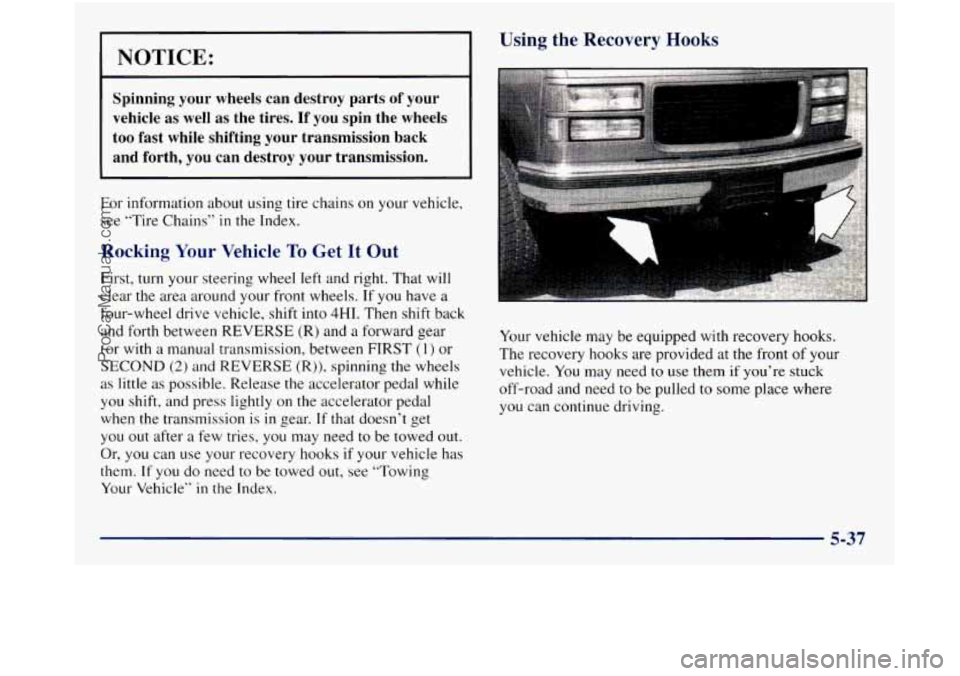
Using the Recovery Hooks
Your vehicle may be equipped with recovery hooks.
The recovery hooks are provided
at the front of your
vehicle.
You may need to use them if you’re stuck
off-road and need to be pulled to some place where
you can continue driving.
5-37
ProCarManuals.com
Page 291 of 452
Section 6 Service and Appearance Care
Here you will find information about the care of your vehicle. This section begins with service and fuel information,
and then it shows how to check important fluid and lubricant levels. There is also technical information about your
vehicle, and
a part devoted to its appearance care.
6-2
6-3
6-5
6-6
6- 8
6-9
6- 13
6- 14
6-18
6-2
I
6-24
6- 25
6-26
6-26
6-28 6-32
6-32 Service
Fuel (Gasoline Engine)
Fuels
in Foreign Countries (Gasoline Engines)
Filling Your Tank (Gasoline Engine)
Filling a Portable Fuel Container
Checking Things Under the Hood
Noise Control System
Engine Oil (Gasoline Engine)
Air Cleaner Filter (Gasoline Engine)
Automatic Transmission Fluid
Manual Transmission Fluid
Hydraulic Clutch
Rear Axle
Four-wheel Drive
Engine Coolant Radiator Pressure Cap (Gasoline Engine)
Thermostat
, 6-33
6-3 3
6-35
6-39
6-39
6-50
6-5
1
6-6 1
6-62
6-65 6-69
6-70
6-70
' 6-76
6-77 6-79 Power
Steering Fluid
Windshield Washer Fluid
Brakes
Battery
Bulb Replacement
Windshield Wiper Blade Replacement
Tires
Appearance Care
Cleaning the Inside
of Your Vehicle
Cleaning the Outside of Your Vehicle
Appearance Care Materials Chart
Vehicle Identification Number (VIN)
Electrical System Replacement
Bulbs
Capacities and Specifications
Air Conditioning Refrigerants
6-1
ProCarManuals.com