steering wheel GMC SIERRA 2003 Owner's Guide
[x] Cancel search | Manufacturer: GMC, Model Year: 2003, Model line: SIERRA, Model: GMC SIERRA 2003Pages: 408, PDF Size: 2.58 MB
Page 243 of 408

Rocking Your Vehicle To Get It Out
First, turn your steering wheel left and right. That will
clear the area around your front wheels. Then shift back
and forth between REVERSE (R) and a forward gear,
spinning the wheels as little as possible. Release
the accelerator pedal while you shift, and press lightly
on the accelerator pedal when the transmission is
in gear. By slowly spinning your wheels in the forward
and reverse directions, you will cause a rocking
motion that may free your vehicle. If that doesn’t get
you out after a few tries, you may need to be towed out.
Or, you can use your recovery hooks if your vehicle
has them. If you do need to be towed out, seeTowing
Your Vehicle on page 4-46.
Using the Recovery Hooks
Your vehicle is equipped with recovery hooks. The
hooks are provided at the front of your vehicle. You may
need to use them if you’re stuck off-road and need to
be pulled to some place where you can continue driving.
4-45
2003 - Sierra Denali
Page 256 of 408

Driving with a Trailer
Towing a trailer requires a certain amount of experience.
Before setting out for the open road, you’ll want to get
to know your rig. Acquaint yourself with the feel of
handling and braking with the added weight of the trailer.
And always keep in mind that the vehicle you are
driving is now a good deal longer and not nearly as
responsive as your vehicle is by itself.
Before you start, check the trailer hitch and platform
(and attachments), safety chains, electrical connector,
lamps, tires and mirror adjustment. If the trailer has
electric brakes, start your vehicle and trailer moving and
then apply the trailer brake controller by hand to be
sure the brakes are working. This lets you check your
electrical connection at the same time.
During your trip, check occasionally to be sure that the
load is secure, and that the lamps and any trailer
brakes are still working.
While towing a trailer or when exposed to long periods
of sunshine, theoor of the truck bed may become
very warm. Avoid putting items in the truck bed
that might be affected by high ambient temperatures.
Following Distance
Stay at least twice as far behind the vehicle ahead as
you would when driving your vehicle without a trailer.
This can help you avoid situations that require
heavy braking and sudden turns.
Passing
You’ll need more passing distance up ahead when
you’re towing a trailer. And, because you’re a good deal
longer, you’ll need to go much farther beyond the
passed vehicle before you can return to your lane.
Backing Up
Hold the bottom of the steering wheel with one hand.
Then, to move the trailer to the left, just move that hand
to the left. To move the trailer to the right, move your
hand to the right. Always back up slowly and, if possible,
have someone guide you.
Your vehicle is equipped with four-wheel steering and if
you use it while backing your trailer the same rules
apply. However, with four-wheel steering your rig will
respond more quickly and it may take additional practice
to get used to backing up with four-wheel steering.
4-58
2003 - Sierra Denali
Page 261 of 408

Service............................................................5-3
Doing Your Own Service Work.........................5-3
Adding Equipment to the Outside of
Your Vehicle..............................................5-4
Fuel................................................................5-4
Gasoline Octane............................................5-4
Gasoline Specifications....................................5-5
California Fuel...............................................5-5
Additives.......................................................5-6
Fuels in Foreign Countries...............................5-6
Filling Your Tank............................................5-7
Filling a Portable Fuel Container.......................5-9
Checking Things Under
the Hood....................................................5-10
Hood Release..............................................5-10
Engine Compartment Overview.......................5-12
Engine Oil...................................................5-13
Engine Air Cleaner/Filter................................5-18
Automatic Transmission Fluid.........................5-20
Engine Coolant.............................................5-23
Coolant Surge Tank Pressure Cap..................5-26
Engine Overheating.......................................5-26
Cooling System............................................5-29Engine Fan Noise.........................................5-34
Power Steering Fluid.....................................5-34
Windshield Washer Fluid................................5-35
Brakes........................................................5-36
Battery........................................................5-39
Jump Starting...............................................5-40
All-Wheel Drive..............................................5-45
Rear Axle.......................................................5-46
Front Axle......................................................5-47
Bulb Replacement..........................................5-48
Halogen Bulbs..............................................5-48
Headlamps..................................................5-48
Front Turn Signal, Sidemarker and
Daytime Running Lamps.............................5-49
Roof Marker Lamps......................................5-51
Center High-Mounted Stoplamp (CHMSL)
and Cargo Lamp.......................................5-52
Pickup Box Identification and Fender
Marker Lamps...........................................5-54
Taillamps.....................................................5-54
Replacement Bulbs.......................................5-55
Windshield Wiper Blade Replacement
..............5-56
Section 5 Service and Appearance Care
5-1
2003 - Sierra Denali
Page 270 of 408
Checking Things Under
the Hood
{CAUTION:
Things that burn can get on hot engine parts
and start afire. These include liquids like fuel,
oil, coolant, brakefluid, windshield washer and
otherfluids, and plastic or rubber. You or
others could be burned. Be careful not to drop
or spill things that will burn onto a hot engine.
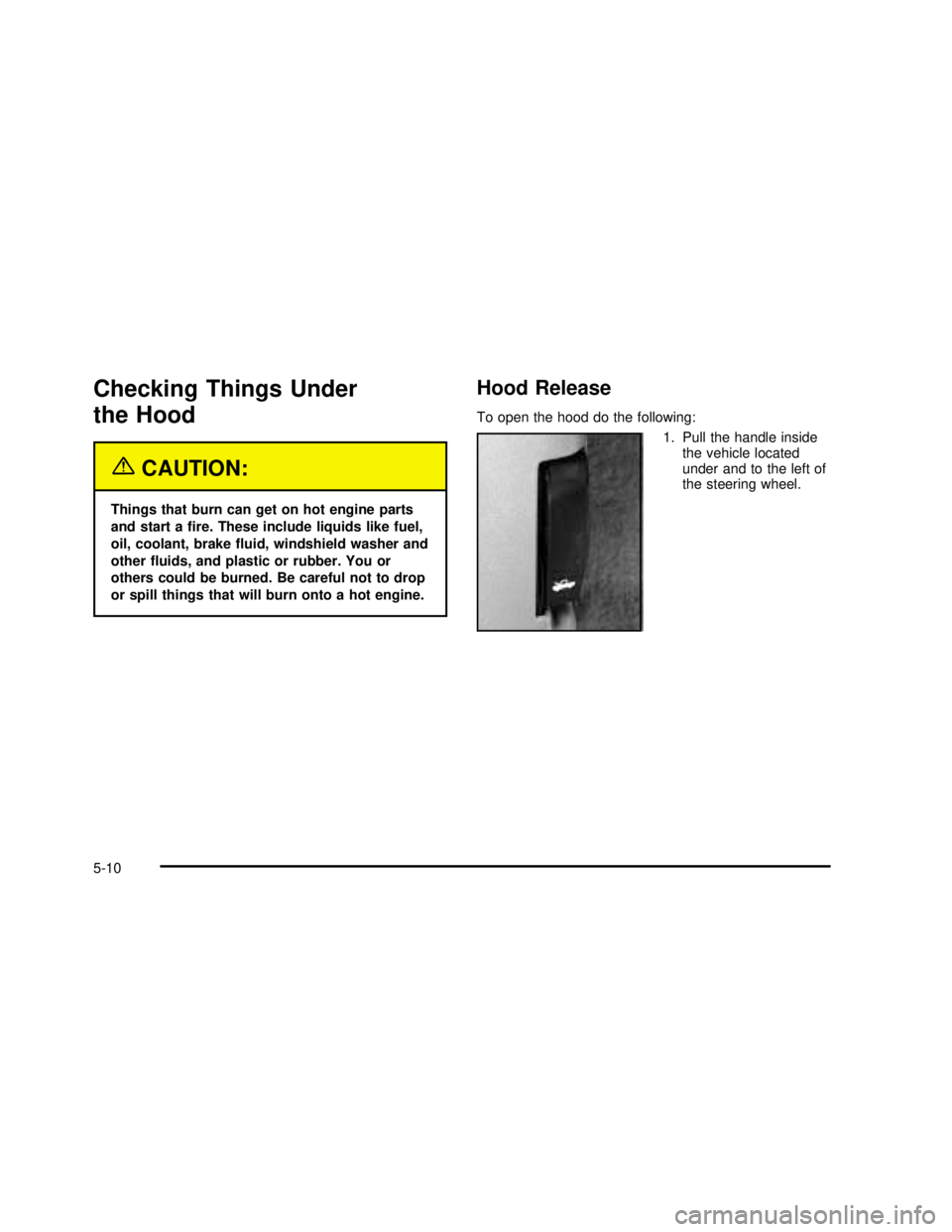
Hood Release
To open the hood do the following:
1. Pull the handle inside
the vehicle located
under and to the left of
the steering wheel.
5-10
2003 - Sierra Denali
Page 324 of 408
Tire Chains
{CAUTION:
Don’t use tire chains. There’s not enough
clearance. Tire chains used on a vehicle without
the proper amount of clearance can cause
damage to the brakes, suspension or other
vehicle parts. The area damaged by the tire
chains could cause you to lose control of your
vehicle and you or others may be injured in a
crash. Use another type of traction device only
if its manufacturer recommends it for use on
your vehicle and tire size combination and road
conditions. Follow that manufacturer’s
instructions. To help avoid damage to your
vehicle, drive slowly, readjust or remove the
device if it’s contacting your vehicle, and don’t
spin your wheels. If you dofind traction devices
that willfit, install them on the rear tires.
If a Tire Goes Flat
It’s unusual for a tire to“blowout”while you’re driving,
especially if you maintain your tires properly. If air goes
out of a tire, it’s much more likely to leak out slowly.
But if you should ever have a“blowout”, here are a few
tips about what to expect and what to do:
If a front tire fails, theflat tire will create a drag that
pulls the vehicle toward that side. Take your foot off the
accelerator pedal and grip the steering wheelfirmly.
Steer to maintain lane position, and then gently brake to
a stop well out of the traffic lane.
A rear blowout, particularly on a curve, acts much like a
skid and may require the same correction you’d use
in a skid. In any rear blowout, remove your foot from the
accelerator pedal. Get the vehicle under control by
steering the way you want the vehicle to go. It may be
very bumpy and noisy, but you can still steer. Gently
brake to a stop—well off the road if possible.
If a tire goesflat, the next part shows how to use your
jacking equipment to change aflat tire safely.
5-64
2003 - Sierra Denali
Page 361 of 408

Maintenance Schedule......................................6-2
Introduction...................................................6-2
Your Vehicle and the Environment....................6-2
Maintenance Requirements..............................6-2
How This Section is Organized.........................6-3
Part A: Scheduled Maintenance Services...........6-4
Using Your Maintenance Schedule....................6-4
Scheduled Maintenance...................................6-5
Part B: Owner Checks and Services................6-10
At Each Fuel Fill..........................................6-10
At Least Once a Month.................................6-10
At Least Twice a Year...................................6-10At Least Once a Year
...................................6-11
Part C: Periodic Maintenance Inspections
.........6-14
Steering and Suspension Inspection
................6-14
Exhaust System Inspection
............................6-14
Fuel System Inspection
..................................6-14
Engine Cooling System Inspection
...................6-14
Transfer Case and Front Axle (All-Wheel
Drive) Inspection
.......................................6-15
Brake System Inspection
................................6-15
Part D: Recommended Fluids and Lubricants
. . . .6-15
Part E: Maintenance Record
...........................6-17
Section 6 Maintenance Schedule
6-1
2003 - Sierra Denali
Page 375 of 408

Transfer Case and Front Axle
(All-Wheel Drive) Inspection
Every 12 months, or at engine oil change intervals,
check front axle and transfer case and add lubricant
when necessary. Auid loss could indicate a problem.
Check and have it repaired, if needed. Check vent
hose at transfer case for kinks and proper installation.
Brake System Inspection
Inspect the complete system. Inspect brake lines and
hoses for proper hook-up, binding, leaks, cracks,
chang, etc. Inspect disc brake pads for wear and rotors
for surface condition. Inspect other brake parts,
including calipers, parking brake, etc. You may need to
have your brakes inspected more often if your driving
habits or conditions result in frequent braking.
Part D: Recommended Fluids and
Lubricants
Fluids and lubricants identied below by name, part
number or specication may be obtained from your
dealer.
Usage Fluid/Lubricant
Engine OilEngine oil with the American
Petroleum Institute Certied for
Gasoline Engines starburst symbol
of the proper viscosity. To determine
the preferred viscosity for your
vehicle’s engine, seeEngine Oil on
page 5-13.
Engine Coolant50/50 mixture of clean, drinkable
water and use only
DEX-COOL
®Coolant. SeeEngine
Coolant on page 5-23.
Hydraulic Brake
SystemDelco Supreme 11 Brake Fluid or
equivalent DOT-3 brakeuid.
Windshield
Washer SolventGM Optikleen
®Washer Solvent or
equivalent.
Power Steering
SystemGM Power Steering Fluid (GM Part
No. U.S. 1052884, in Canada
993294, or equivalent).
Automatic
TransmissionDEXRON
®-III Automatic
Transmission Fluid.
6-15
2003 - Sierra Denali
Page 391 of 408

A
Accessory Power Outlets.................................3-16
Adding Washer Fluid.......................................5-35
Additional Program Information........................... 7-8
Additives, Fuel................................................. 5-6
Add-On Electrical Equipment............................5-91
Add-On Equipment..........................................4-50
Adjusting the Speakers (Balance/Fade)..............3-60
After Off-Road Driving.....................................4-30
Air Bag
Off Light.....................................................3-28
Passenger Status Indicator...........................3-31
Readiness Light..........................................3-27
Air Bag Systems.............................................1-55
Adding Equipment to Your Air Bag-Equipped
Vehicle...................................................1-71
Air Bag Off Switch.......................................1-61
How Does an Air Bag Restrain?....................1-59
Passenger Sensing System...........................1-66
Servicing Your Air Bag-Equipped Vehicle.........1-70
What Makes an Air Bag Inflate?....................1-59
What Will You See After an Air Bag Inflates?......1-59
When Should an Air Bag Inflate?...................1-58
Where Are the Air Bags?
..............................1-57
Air Cleaner/Filter, Engine
.................................5-18
Air Conditioning
..............................................3-21
All Overseas Locations
...................................... 7-4
All-Wheel Drive
...............................................5-45
All-Wheel Drive (AWD) System
.........................2-21AM ...............................................................3-76
Antenna, Fixed Mast.......................................3-78
Antenna, XM™ Satellite Radio Antenna System.....3-78
Anti-lock Brake System..................................... 4-6
Anti-Lock Brake, System Warning Light..............3-35
Appearance Care............................................5-82
Care of Safety Belts....................................5-84
Chemical Paint Spotting...............................5-88
Cleaning the Inside of Your Vehicle................5-83
Cleaning the Outside of Your Vehicle..............5-85
Finish Damage............................................5-87
GM Vehicle Care/Appearance Materials..........5-88
Sheet Metal Damage...................................5-87
Underbody Maintenance...............................5-87
Weatherstrips..............................................5-85
Approaching a Hill..........................................4-23
Ashtrays........................................................3-17
Audio System(s).............................................3-56
Audio Steering Wheel Controls......................3-76
Care of Your Cassette Tape Player................3-77
Care of Your CD Player...............................3-78
Care of Your CDs ........................................3-78
CD Changer
...............................................3-73
Fixed Mast Antenna
.....................................3-78
Navigation/Radio System
..............................3-70
Radio with Cassette and CD
.........................3-57
Rear Seat Audio (RSA)
................................3-71
Setting the Time
..........................................3-57
Theft-Deterrent Feature
................................3-75
Understanding Radio Reception
.....................3-76
1
2003 - Sierra Denali
Page 397 of 408

H
Hazard Warning Flashers................................... 3-4
Head Restraints............................................... 1-5
Headlamp High/Low Beam Changer.................... 3-6
Headlamps....................................................5-48
Bulb Replacement.......................................5-48
Front Turn Signal, Sidemarker and Daytime
Running Lamps........................................5-49
Halogen Bulbs............................................5-48
Pickup Box Identification and Fender
Marker Lamps.........................................5-54
Roof Marker Lamps.....................................5-51
Heated Seats................................................... 1-3
Heating.........................................................3-22
Highway Hypnosis...........................................4-38
Hill and Mountain Roads..................................4-38
Hitches..........................................................4-57
HomeLink
®Transmitter, Programming................2-35
HomeLink®Transmitter....................................2-35
Hood
Checking Things Under................................5-10
Release.....................................................5-10
Horn ............................................................... 3-5
How to Add Coolant to the Coolant Surge Tank......5-30
How to Add Fluid............................................5-22
How to Check........................................5-20, 5-57
How to Check Lubricant...................................5-46
How to Check Power Steering Fluid..................5-35How to Inspect...............................................5-18
How to Use This Manual...................................... ii
How to Wear Safety Belts Properly...................1-12
Hydroplaning..................................................4-33
I
If No Steam Is Coming From Your Engine..........5-28
If Steam Is Coming From Your Engine...............5-27
If the Light is Flashing.....................................3-38
If the Light Is On Steady.................................3-38
If You Are Stuck in Sand, Mud, Ice or Snow.......4-44
If You Do Decide To Pull A Trailer.....................4-53
If You’re Caught in a Blizzard...........................4-42
Ignition Positions.............................................2-16
Ignition Transmission Lock Check......................6-13
Illuminated Visor Vanity Mirrors.........................2-13
Infants and Young Children, Restraints...............1-31
Inflation -- Tire Pressure..................................5-57
Inspection
Brake System
.............................................6-15
Engine Cooling System
................................6-14
Exhaust System
..........................................6-14
Fuel System
...............................................6-14
Part C - Periodic Maintenance
.......................6-14
Steering and Suspension
..............................6-14
Transfer Case and Front Axle
(All-Wheel Drive)
......................................6-15
7
2003 - Sierra Denali
Page 399 of 408

M
Maintenance, Normal Replacement Parts..........5-100
Maintenance Schedule
At Each Fuel Fill.........................................6-10
At Least Once a Month................................6-10
At Least Once a Year..................................6-11
At Least Twice a Year..................................6-10
Brake System Inspection..............................6-15
Engine Cooling System Inspection.................6-14
Exhaust System Inspection...........................6-14
Fuel System Inspection................................6-14
How This Section is Organized....................... 6-3
Introduction.................................................. 6-2
Maintenance Requirements............................. 6-2
Part A - Scheduled Maintenance Services......... 6-4
Part B - Owner Checks and Services.............6-10
Part C - Periodic Maintenance Inspections......6-14
PartD-Recommended Fluids and Lubricants....6-15
PartE-Maintenance Record........................6-17
Scheduled Maintenance................................. 6-5
Steering and Suspension Inspection...............6-14
Transfer Case and Front Axle (All-Wheel
Drive) Inspection......................................6-15
Using Your................................................... 6-4
Your Vehicle and the Environment................... 6-2
Maintenance When Trailer Towing.....................4-60Making Turns.................................................4-59
Malfunction Indicator Light................................3-37
Manual Selectable Ride..................................... 4-9
Matching Transmitter(s) to Your Vehicle............... 2-5
Memory Seat.................................................2-41
Message
DIC Warnings and Messages........................3-51
Mexico, Central America and Caribbean Islands/
Countries (Except Puerto Rico and U.S. Virgin
Islands)....................................................... 7-4
Mirrors
Automatic Dimming Rearview with OnStar
®,
Compass and Temperature Display.............2-28
Outside Automatic Dimming Mirror.................2-32
Outside Convex Mirror.................................2-32
Outside Curb View Assist Mirrors...................2-32
Outside Heated Mirrors................................2-32
Outside Power Foldaway Mirrors....................2-31
Outside Power Mirrors..................................2-31
MyGMLink.com
................................................ 7-3
N
Navigation/Radio System
..................................3-70
New Vehicle Break-In
......................................2-15
Normal Maintenance Replacement Parts
...........5-100
9
2003 - Sierra Denali