Index GMC SIERRA 2003 Owner's Manual
[x] Cancel search | Manufacturer: GMC, Model Year: 2003, Model line: SIERRA, Model: GMC SIERRA 2003Pages: 408, PDF Size: 2.58 MB
Page 1 of 408

Seats and Restraint Systems........................... 1-1
Front Seats
............................................... 1-2
Rear Seats
............................................... 1-6
Safety Belts
.............................................. 1-7
Child Restraints
.......................................1-29
Air Bag Systems
......................................1-55
Restraint System Check
............................1-71
Features and Controls..................................... 2-1
Keys
........................................................ 2-2
Doors and Locks
....................................... 2-6
Windows
.................................................2-11
Theft-Deterrent Systems
............................2-13
Starting and Operating Your Vehicle
...........2-15
Mirrors
....................................................2-28
OnStar
®System
......................................2-33
HomeLink®Transmitter
.............................2-35
Storage Areas
.........................................2-39
Vehicle Personalization
.............................2-41
Instrument Panel............................................. 3-1
Instrument Panel Overview
.......................... 3-2
Climate Controls
......................................3-18
Warning Lights, Gages and Indicators
.........3-24
Driver Information Center (DIC)
..................3-42
Audio System(s)
.......................................3-56Driving Your Vehicle....................................... 4-1
Your Driving, the Road, and Your Vehicle
..... 4-2
Towing
...................................................4-46
Service and Appearance Care.......................... 5-1
Service
..................................................... 5-3
Fuel
......................................................... 5-4
Checking Things Under
the Hood
.............................................5-10
All-Wheel Drive
........................................5-45
Rear Axle
...............................................5-46
Front Axle
...............................................5-47
Bulb Replacement
....................................5-48
Windshield Wiper Blade Replacement
.........5-56
Tires
......................................................5-56
Appearance Care
.....................................5-82
Vehicle Identication
.................................5-90
Electrical System
......................................5-91
Capacities and Specications
.....................5-99
Normal Maintenance Replacement Parts
....5-100
Maintenance Schedule..................................... 6-1
Maintenance Schedule
................................ 6-2
Customer Assistance Information.................... 7-1
Customer Assistance Information
.................. 7-2
Reporting Safety Defects
............................ 7-8
Index................................................................ 1
2003 GMC Sierra Denali Owner ManualM
2003 - Sierra Denali Owner Manual
Page 2 of 408

GENERAL MOTORS, GM, the GM Emblem, GMC, the
GMC Truck Emblem and the name SIERRA DENALI
are registered trademarks of General Motors
Corporation.
This manual includes the latest information at the time it
was printed. We reserve the right to make changes
after that time without further notice. For vehicles first
sold in Canada, substitute the name″General Motors of
Canada Limited″for GMC whenever it appears in this
manual.
Please keep this manual in your vehicle, so it will be
there if you ever need it when you’re on the road. If you
sell the vehicle, please leave this manual in it so the
new owner can use it.
Litho in U.S.A.
Part No. S2315 B First Edition©
Copyright General Motors Corporation 06/24/02
All Rights Reserved
Canadian Owners
You can obtain a French copy of this manual from your
dealer or from:
Helm, Incorporated
P.O. Box 07130
Detroit, MI 48207
How to Use This Manual
Many people read their owner’s manual from beginning
to end when they first receive their new vehicle. If
you do this, it will help you learn about the features and
controls for your vehicle. In this manual, you’ll find
that pictures and words work together to explain things.
Index
A good place to look for what you need is the Index in
back of the manual. It’s an alphabetical list of what’s
in the manual, and the page number where you’ll find it.
ii
2003 - Sierra Denali
Page 18 of 408
Q:If I’m a good driver, and I never drive far from
home, why should I wear safety belts?
A:You may be an excellent driver, but if you’re in an
accident–even one that isn’t your fault–you and
your passengers can be hurt. Being a good
driver doesn’t protect you from things beyond your
control, such as bad drivers.
Most accidents occur within 25 miles (40 km) of
home. And the greatest number of serious injuries
and deaths occur at speeds of less than 40 mph
(65 km/h).
Safety belts are for everyone.
How to Wear Safety Belts Properly
This part is only for people of adult size.
Be aware that there are special things to know about
safety belts and children. And there are different
rules for smaller children and babies. If a child will be
riding in your vehicle, seeOlder Children on page 1-29
orInfants and Young Children on page 1-31. Follow
those rules for everyone’s protection.
First, you’ll want to know which restraint systems your
vehicle has.
We’ll start with the driver position.
Driver Position
This part describes the driver’s restraint system.
Lap-Shoulder Belt
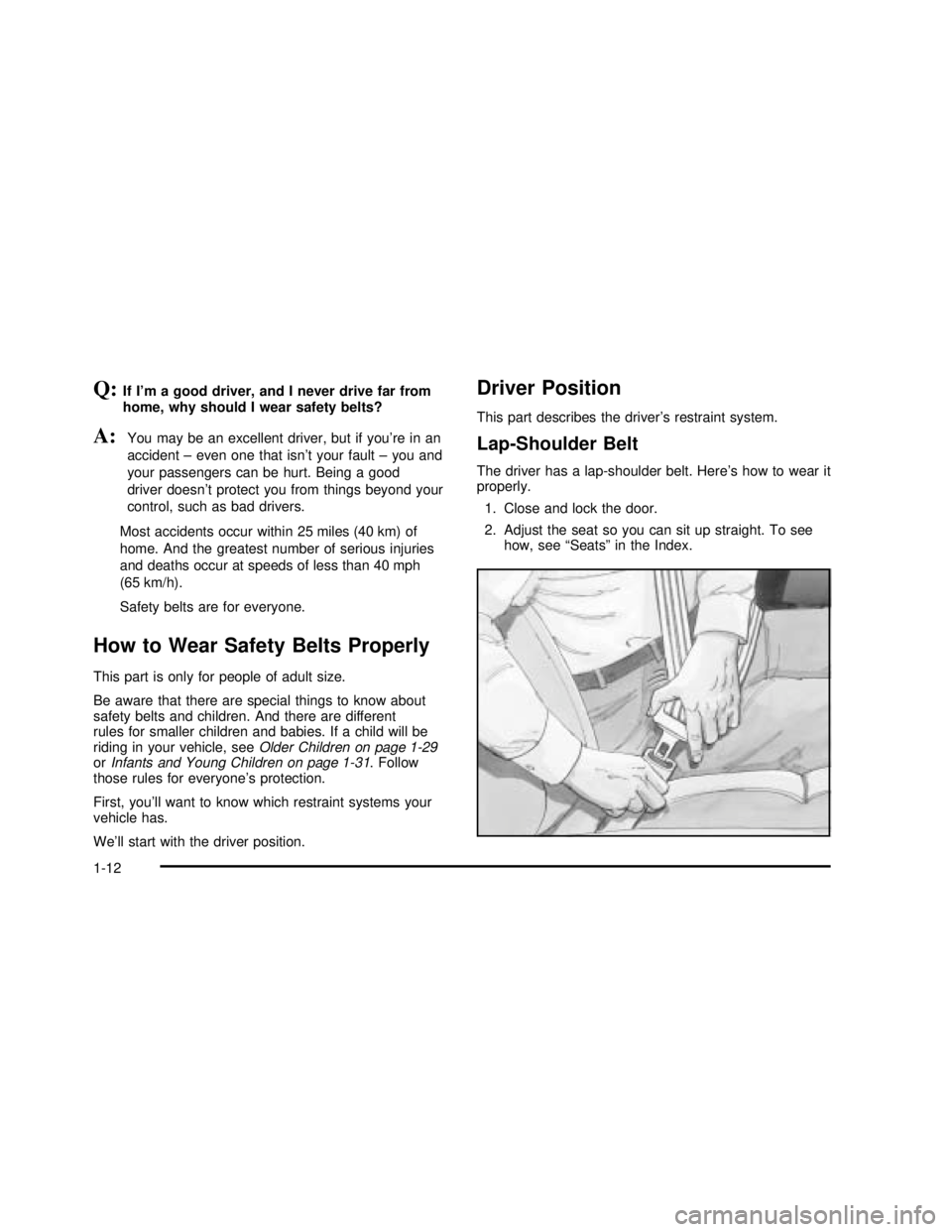
The driver has a lap-shoulder belt. Here’s how to wear it
properly.
1. Close and lock the door.
2. Adjust the seat so you can sit up straight. To see
how, see“Seats”in the Index.
1-12
2003 - Sierra Denali
Page 50 of 408
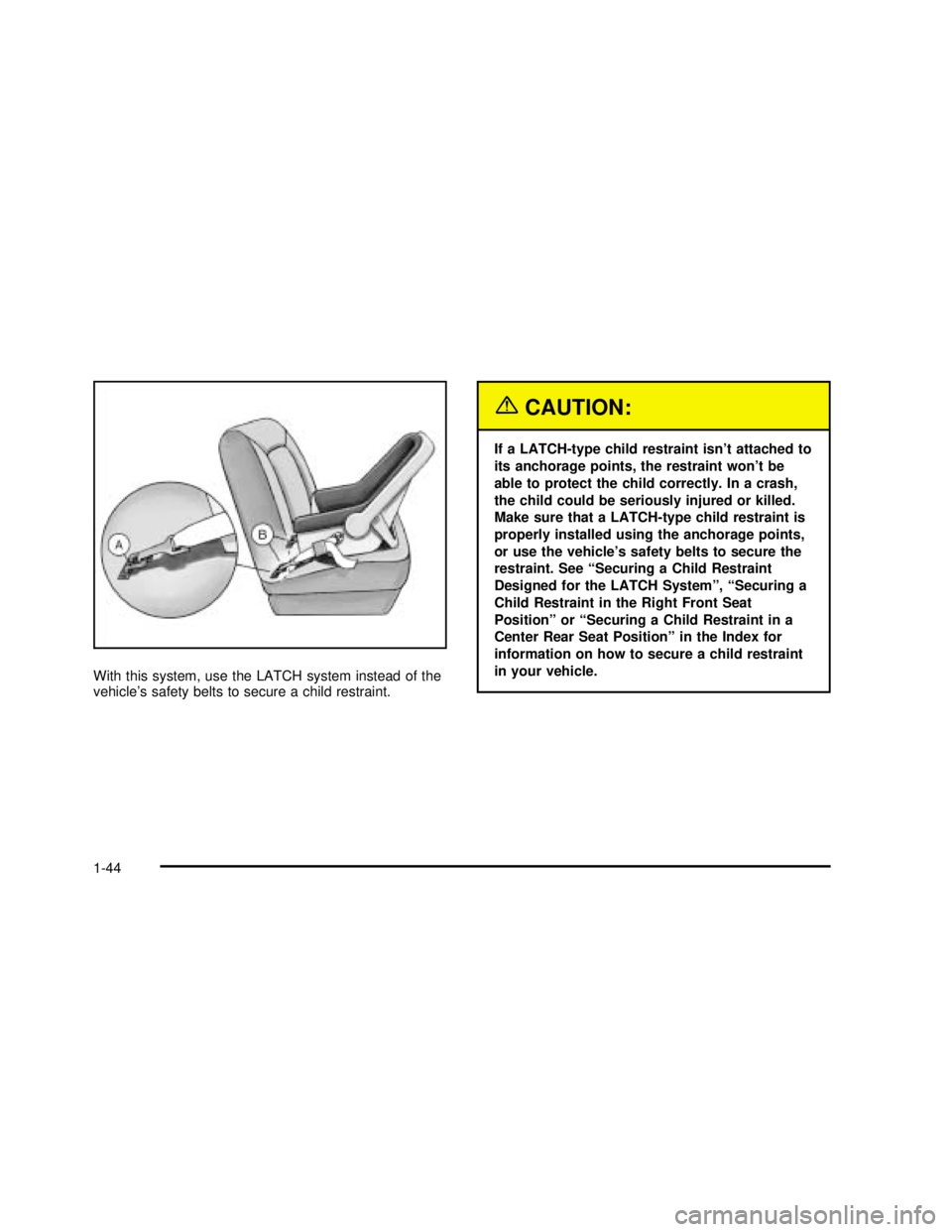
With this system, use the LATCH system instead of the
vehicle’s safety belts to secure a child restraint.
{CAUTION:
If a LATCH-type child restraint isn’t attached to
its anchorage points, the restraint won’t be
able to protect the child correctly. In a crash,
the child could be seriously injured or killed.
Make sure that a LATCH-type child restraint is
properly installed using the anchorage points,
or use the vehicle’s safety belts to secure the
restraint. See “Securing a Child Restraint
Designed for the LATCH System”, “Securing a
Child Restraint in the Right Front Seat
Position” or “Securing a Child Restraint in a
Center Rear Seat Position” in the Index for
information on how to secure a child restraint
in your vehicle.
1-44
2003 - Sierra Denali
Page 56 of 408

Never put a rear facing child restraint in the right front
passenger seat unless the air bag is off. Here’s why:
{CAUTION:
A child in a rear-facing child restraint can be
seriously injured or killed if the right front
passenger’s air bag inflates. This is because
the back of the rear-facing child restraint
would be very close to the inflating air bag. Be
sure to turn off the air bag before using a
rear-facing child restraint in the right front seat
position. If a forward-facing child restraint is
suitable for your child, always move the
passenger seat as far back as it will go.
Although a rear seat is a safer place, you can secure a
forward-facing child restraint in the right front seat.
{CAUTION:
If the air bag readiness light in the instrument
panel cluster ever comes on when you have
turned off the air bag, it means that something
may be wrong with the air bag system. The
right front passenger’s air bag could inflate
even though the switch is off. If this ever
happens, have the vehicle serviced promptly.
Until you have the vehicle serviced, don’t let
anyone whom the national government has
identified as a member of a passenger air bag
risk group sit in the right front passenger’s
position (for example, don’t secure a
rear-facing child restraint in your vehicle).
See″Air Bag Off Switch″in the Index.
In addition to the AIR BAG OFF switch, your vehicle
may have the passenger sensing system. See
Passenger Sensing System on page 1-66and
Passenger Air Bag Status Indicator on page 3-31for
more on this, including important safety information.
The passenger sensing system is designed to turn off
the right front passenger’s frontal air bag when a
rear facing child restraint is in the right front seat.
1-50
2003 - Sierra Denali
Page 57 of 408

In addition to the passenger sensing system, you may
use the AIR BAG OFF switch located on the instrument
panel to turn the air bag off. Never put a rear facing
child restraint in the right front passenger seat unless the
air bag is off. Here’s why.
{CAUTION:
A child in a rear-facing child restraint can be
seriously injured or killed if the right front
passenger’s air bag inflates. This is because the
back of the rear facing child restraint would be
very close to the inflating air bag. Be sure the air
bag is off before using a rear-facing child
restraint in the right front seat position.
Even though the passenger sensing system is
designed to turn off the passenger’s frontal air
bag if the system detects a rear-facing child
restraint, no system is fail-safe, and no one can
guarantee that an air bag will not deploy under
some unusual circumstance, even though it is
turned off. General Motors therefore
recommends that rear-facing child restraints be
secured in the rear seat whenever possible,
even if the air bag is off.You’ll be using the lap-shoulder belt. SeeTop Strap on
page 1-39if the child restraint has one. Be sure to
follow the instructions that came with the child restraint.
Secure the child in the child restraint when and as
the instructions say.
1. Your vehicle has a right front passenger’s air bag.
If you are using a rear-facing child restraint in this
seat, make sure the air bag is turned off. See
Air Bag Off Switch on page 1-61andPassenger
Sensing System on page 1-66. Always move
the seat as far back as it will go before securing the
child restraint in this seat. See“Seats”in the
Index.
When either the passenger sensing system and/or
the AIR BAG OFF switch has turned off the right
front passenger’s frontal air bag, the off indicator in
the passenger air bag status indicator on the
rearview mirror will light and stay lit when you turn
the ignition to RUN or START.
1-51
2003 - Sierra Denali
Page 58 of 408
{CAUTION:
If the air bag readiness light in the instrument
panel cluster ever comes on when you have
turned off the air bag, it means that something
may be wrong with the air bag system. The
right front passenger’s air bag could inflate
even though the switch is off. If this ever
happens, have the vehicle serviced promptly.
Until you have the vehicle serviced, don’t let
anyone whom the national government has
identified as a member of a passenger air bag
risk group sit in the right front passenger’s
position (for example, don’t secure a
rear-facing child restraint in your vehicle).
See″Air Bag Off Switch″in the Index.
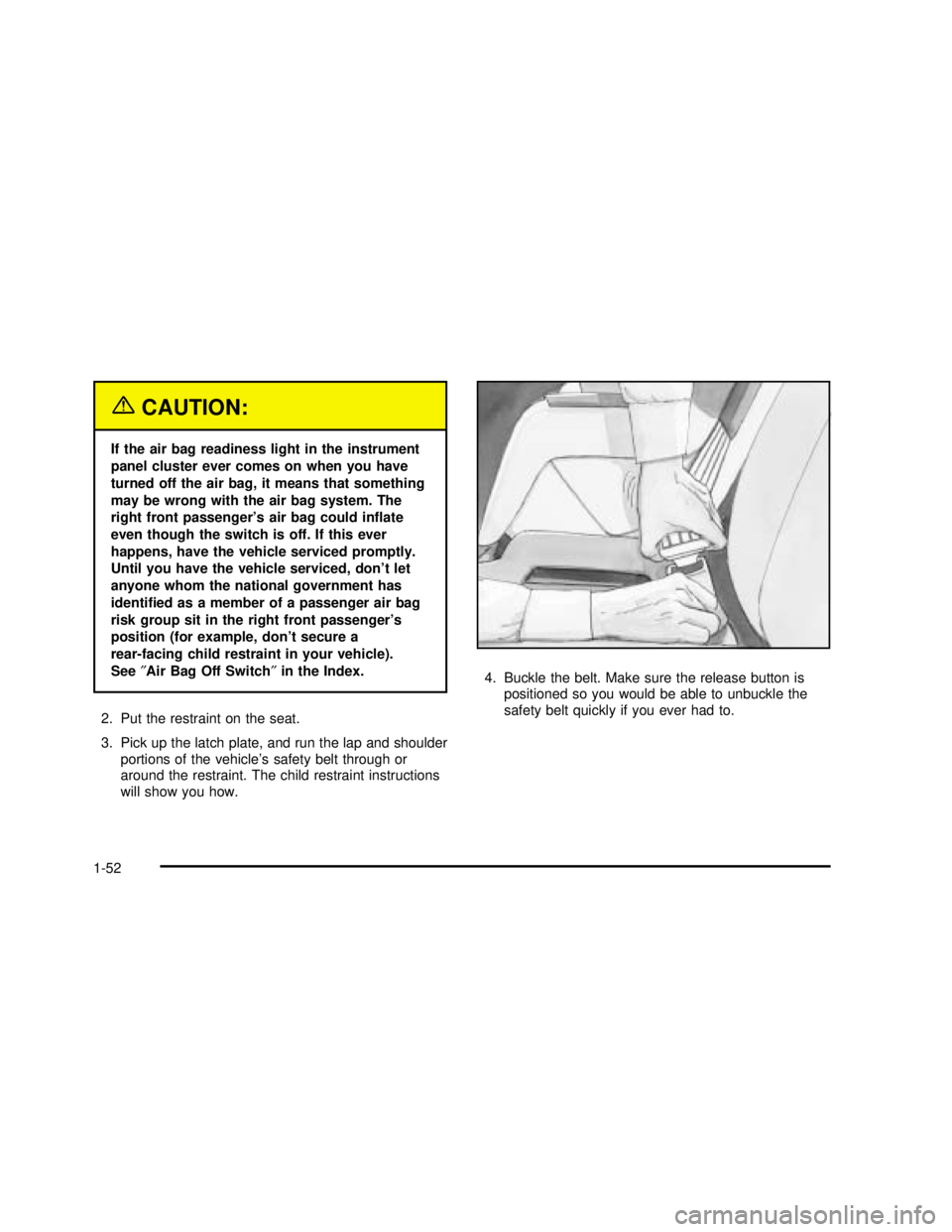
2. Put the restraint on the seat.
3. Pick up the latch plate, and run the lap and shoulder
portions of the vehicle’s safety belt through or
around the restraint. The child restraint instructions
will show you how.4. Buckle the belt. Make sure the release button is
positioned so you would be able to unbuckle the
safety belt quickly if you ever had to.
1-52
2003 - Sierra Denali
Page 61 of 408

{CAUTION:
If the right front passenger’s air bag is turned
off for a person who isn’t in a risk group
identified by the national government, that
person won’t have the extra protection of an
air bag. In a crash, the air bag wouldn’t be able
to inflate and help protect the person sitting
there. Don’t turn off the passenger’s air bag
unless the person sitting there is in a risk
group. See “Air Bag Off Switch” in the Index.
Air Bag Systems
This part explains the air bag system.
Your vehicle has air bags–one air bag for the driver
and another air bag for the right front passenger.
Frontal air bags are designed to help reduce the risk of
injury from the force of an inflating frontal air bag.
But these air bags must inflate very quickly to do their
job and comply with federal regulations.
Here are the most important things to know about the
air bag systems:
{CAUTION:
You can be severely injured or killed in a crash
if you aren’t wearing your safety belt — even if
you have air bags. Wearing your safety belt
during a crash helps reduce your chance of
hitting things inside the vehicle or being
ejected from it. Air bags are designed to work
with safety belts, but don’t replace them. Air
bags are designed to deploy only in moderate
to severe frontal and near frontal crashes.
They aren’t designed to inflate at all in rollover,
rear or low-speed frontal crashes, or in many
side crashes. And, for some unrestrained
occupants, air bags may provide less
protection in frontal crashes than more
forceful air bags have provided in the past.
Everyone in your vehicle should wear a safety
belt properly — whether or not there’s an air
bag for that person.
1-55
2003 - Sierra Denali
Page 64 of 408

{CAUTION:
If something is between an occupant and an
air bag, the bag might not inflate properly or it
might force the object into that person causing
severe injury or even death. The path of an
inflating air bag must be kept clear. Don’t put
anything between an occupant and an air bag,
and don’t attach or put anything on the
steering wheel hub or on or near any other air
bag covering.
When Should an Air Bag Inflate?
An air bag is designed to inflate in a moderate to severe
frontal, or near-frontal crash. The air bag will inflate
only if the impact speed is above the system’s designed
“threshold level.”
In addition, your vehicle has“dual stage”frontal air
bags, which adjust the amount of restraint according to
crash severity. For moderate frontal impacts, these
air bags inflate at a level less than full deployment.For more severe frontal impacts, full deployment occurs.
If the front of your vehicle goes straight into a wall
that doesn’t move or deform, the threshold level for the
reduced deployment is about 10 to 16 mph
(16 to 25 km/h), and the threshold level for a full
deployment is about 20 to 25 mph (32 to 40 km/h).
The threshold level can vary, however, with specific
vehicle design, so that it can be somewhat above
or below this range.
If your vehicle strikes something that will move or
deform, such as a parked car, the threshold level will be
higher. The air bag is not designed to inflate in
rollovers, rear impacts, or in many side impacts because
inflation would not help the occupant.
In any particular crash, no one can say whether an air
bag should have inflated simply because of the damage
to a vehicle or because of what the repair costs were.
Inflation is determined by the angle of the impact
and how quickly the vehicle slows down in frontal or
near-frontal impacts.
The air bag system is designed to work properly under
a wide range of conditions, including off-road usage.
Observe safe driving speeds, especially on rough
terrain. As always, wear your safety belt. See“Off-Road
Driving”in the Index for more tips on off-road driving.
1-58
2003 - Sierra Denali
Page 69 of 408

Infant. An infant (less than 1 year old)
must ride in the front seat because:
•
my vehicle has no rear seat;
•my vehicle has a rear seat too small to
accommodate a rear-facing infant seat; or
•the infant has a medical condition which, according
to the infant’s physician, makes it necessary for the
infant to ride in the front seat so that the driver
can constantly monitor the child’s condition.
Child age 1 to 12. A child age 1 to 12 must
ride in the front seat because:
•
my vehicle has no rear seat;
•although children ages 1 to 12 ride in the rear
seat(s) whenever possible, children ages 1 to 12
sometimes must ride in the front because no space
is available in the rear seat(s) of my vehicle; or
•the child has a medical condition which, according
to the child’s physician, makes it necessary for the
child to ride in the front seat so that the driver
can constantly monitor the child’s condition.
Medical Condition. A passenger has a
medical condition which, according to his
or her physician:
•
causes the passenger air bag to pose a special risk
for the passenger; and
•makes the potential harm from the passenger air
bag in a crash greater than the potential harm
from turning off the air bag and allowing the
passenger, even if belted, to hit the dashboard or
windshield in a crash.
{CAUTION:
If the right front passenger’s air bag is turned
off for a person who isn’t in a risk group
identied by the national government, that
person won’t have the extra protection of an
air bag. In a crash, the air bag wouldn’t be able
to inate and help protect the person sitting
there. Don’t turn off the passenger’s air bag
unless the person sitting there is in a risk
group. See″Air Bag Off Switch″in the Index
for more on this, including important safety
information.
1-63
2003 - Sierra Denali