Rear axle GMC SIERRA 2004 User Guide
[x] Cancel search | Manufacturer: GMC, Model Year: 2004, Model line: SIERRA, Model: GMC SIERRA 2004Pages: 588, PDF Size: 3.74 MB
Page 362 of 588
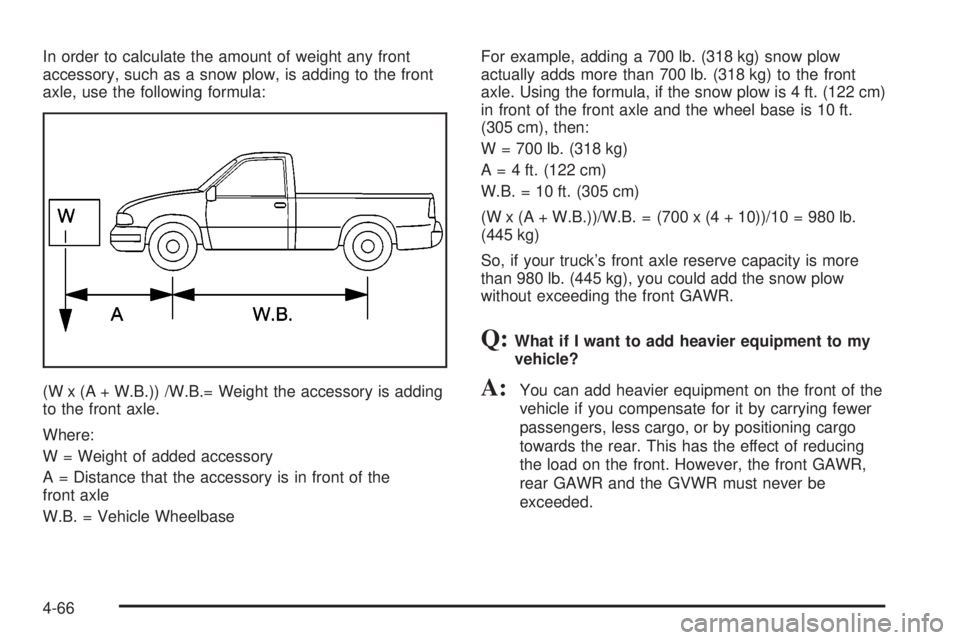
In order to calculate the amount of weight any front
accessory, such as a snow plow, is adding to the front
axle, use the following formula:
(W x (A + W.B.)) /W.B.= Weight the accessory is adding
to the front axle.
Where:
W = Weight of added accessory
A = Distance that the accessory is in front of the
front axle
W.B. = Vehicle WheelbaseFor example, adding a 700 lb. (318 kg) snow plow
actually adds more than 700 lb. (318 kg) to the front
axle. Using the formula, if the snow plow is 4 ft. (122 cm)
in front of the front axle and the wheel base is 10 ft.
(305 cm), then:
W = 700 lb. (318 kg)
A = 4 ft. (122 cm)
W.B. = 10 ft. (305 cm)
(W x (A + W.B.))/W.B. = (700 x (4 + 10))/10 = 980 lb.
(445 kg)
So, if your truck's front axle reserve capacity is more
than 980 lb. (445 kg), you could add the snow plow
without exceeding the front GAWR.
Q:What if I want to add heavier equipment to my
vehicle?
A:You can add heavier equipment on the front of the
vehicle if you compensate for it by carrying fewer
passengers, less cargo, or by positioning cargo
towards the rear. This has the effect of reducing
the load on the front. However, the front GAWR,
rear GAWR and the GVWR must never be
exceeded.
4-66
Page 363 of 588
{CAUTION:
On some vehicles equipped with certain front
mounted equipment, such as a snow plow, it
may be possible to load the front axle to the
front GAWR but not have enough weight on
the rear axle to have proper braking
performance. If your brakes can not work
properly, you could have a crash. To help your
brakes work properly when a snow plow is
installed, always follow the snow plow
manufacturer or installer's recommendation for
rear ballast to ensure a proper front and rear
weight distribution ratio, even though the
actual front weight may be less than the front
GAWR, and the total vehicle weight is less
than the GVWR. Maintaining a proper front and
rear weight distribution ratio is necessary to
provide proper braking performance.
Q:What is total vehicle reserve capacity?
A:This is the difference between your GVWR and
the weight of your truck with full fuel and
passengers. It is the amount of weight you can
add to your vehicle before reaching your GVWR.
Keep in mind that reserve capacity numbers
are intended as a guide when selecting the amount
of equipment or cargo your truck can carry. If
you are unsure of your truck's front, rear or total
weight, go to a weigh station and weigh your
vehicle. Your dealer can also help you with this.
The total vehicle reserve capacity for your vehicle
can be found in the lower right corner of the
Certi®cation/Tire label as shown previously.
See your dealer for additional advice and information
about using a snow plow on your vehicle. Also,
see
Loading Your Vehicle on page 4-57.
4-67
Page 365 of 588
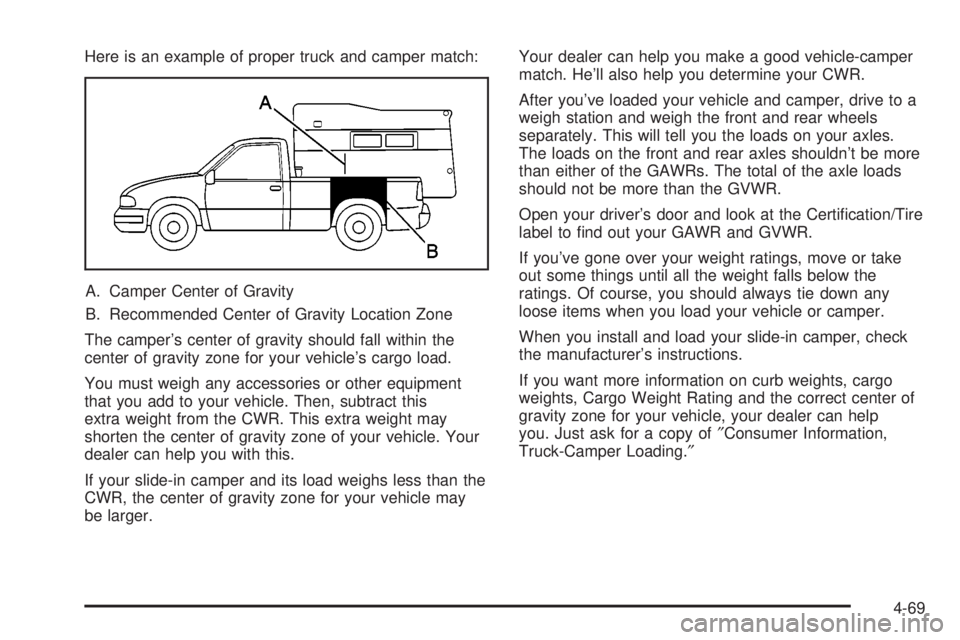
Here is an example of proper truck and camper match:
A. Camper Center of Gravity
B. Recommended Center of Gravity Location Zone
The camper's center of gravity should fall within the
center of gravity zone for your vehicle's cargo load.
You must weigh any accessories or other equipment
that you add to your vehicle. Then, subtract this
extra weight from the CWR. This extra weight may
shorten the center of gravity zone of your vehicle. Your
dealer can help you with this.
If your slide-in camper and its load weighs less than the
CWR, the center of gravity zone for your vehicle may
be larger.Your dealer can help you make a good vehicle-camper
match. He'll also help you determine your CWR.
After you've loaded your vehicle and camper, drive to a
weigh station and weigh the front and rear wheels
separately. This will tell you the loads on your axles.
The loads on the front and rear axles shouldn't be more
than either of the GAWRs. The total of the axle loads
should not be more than the GVWR.
Open your driver's door and look at the Certi®cation/Tire
label to ®nd out your GAWR and GVWR.
If you've gone over your weight ratings, move or take
out some things until all the weight falls below the
ratings. Of course, you should always tie down any
loose items when you load your vehicle or camper.
When you install and load your slide-in camper, check
the manufacturer's instructions.
If you want more information on curb weights, cargo
weights, Cargo Weight Rating and the correct center of
gravity zone for your vehicle, your dealer can help
you. Just ask for a copy of²Consumer Information,
Truck-Camper Loading.²
4-69
Page 380 of 588
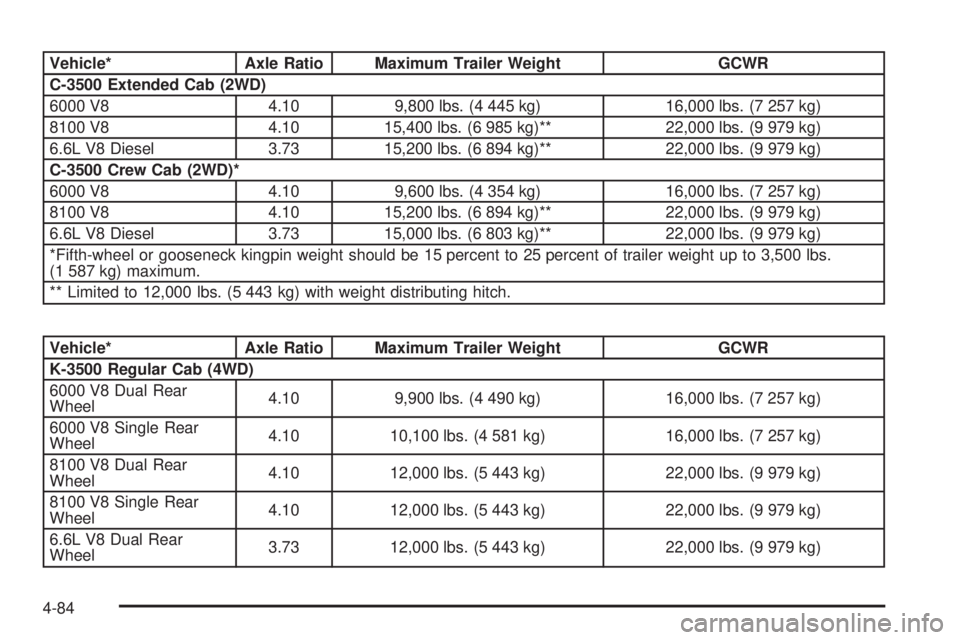
Vehicle* Axle Ratio Maximum Trailer Weight GCWR
C-3500 Extended Cab (2WD)
6000 V8 4.10 9,800 lbs. (4 445 kg) 16,000 lbs. (7 257 kg)
8100 V8 4.10 15,400 lbs. (6 985 kg)** 22,000 lbs. (9 979 kg)
6.6L V8 Diesel 3.73 15,200 lbs. (6 894 kg)** 22,000 lbs. (9 979 kg)
C-3500 Crew Cab (2WD)*
6000 V8 4.10 9,600 lbs. (4 354 kg) 16,000 lbs. (7 257 kg)
8100 V8 4.10 15,200 lbs. (6 894 kg)** 22,000 lbs. (9 979 kg)
6.6L V8 Diesel 3.73 15,000 lbs. (6 803 kg)** 22,000 lbs. (9 979 kg)
*Fifth-wheel or gooseneck kingpin weight should be 15 percent to 25 percent of trailer weight up to 3,500 lbs.
(1 587 kg) maximum.
** Limited to 12,000 lbs. (5 443 kg) with weight distributing hitch.
Vehicle* Axle Ratio Maximum Trailer Weight GCWR
K-3500 Regular Cab (4WD)
6000 V8 Dual Rear
Wheel4.10 9,900 lbs. (4 490 kg) 16,000 lbs. (7 257 kg)
6000 V8 Single Rear
Wheel4.10 10,100 lbs. (4 581 kg) 16,000 lbs. (7 257 kg)
8100 V8 Dual Rear
Wheel4.10 12,000 lbs. (5 443 kg) 22,000 lbs. (9 979 kg)
8100 V8 Single Rear
Wheel4.10 12,000 lbs. (5 443 kg) 22,000 lbs. (9 979 kg)
6.6L V8 Dual Rear
Wheel3.73 12,000 lbs. (5 443 kg) 22,000 lbs. (9 979 kg)
4-84
Page 381 of 588
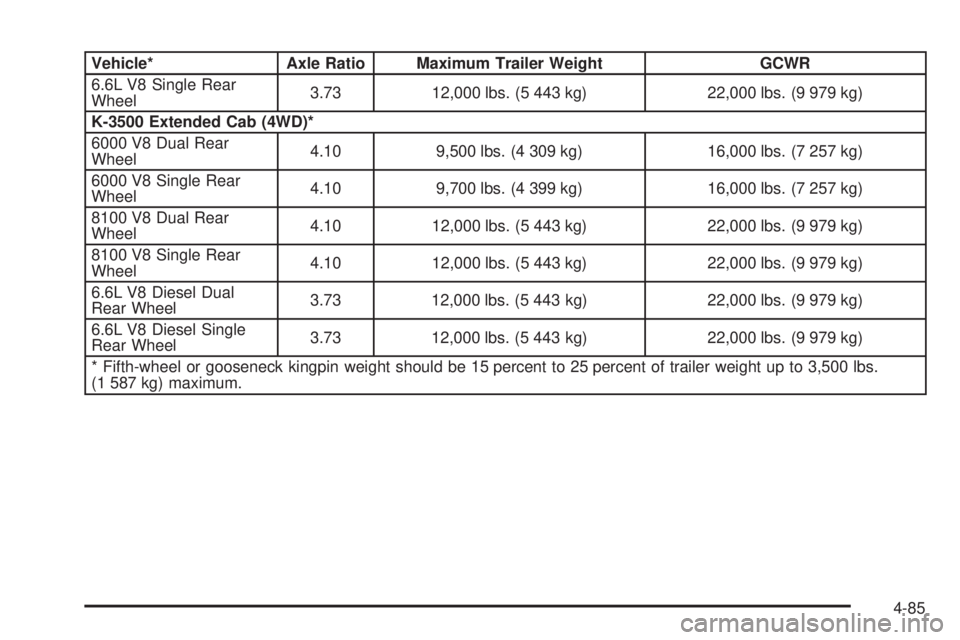
Vehicle* Axle Ratio Maximum Trailer Weight GCWR
6.6L V8 Single Rear
Wheel3.73 12,000 lbs. (5 443 kg) 22,000 lbs. (9 979 kg)
K-3500 Extended Cab (4WD)*
6000 V8 Dual Rear
Wheel4.10 9,500 lbs. (4 309 kg) 16,000 lbs. (7 257 kg)
6000 V8 Single Rear
Wheel4.10 9,700 lbs. (4 399 kg) 16,000 lbs. (7 257 kg)
8100 V8 Dual Rear
Wheel4.10 12,000 lbs. (5 443 kg) 22,000 lbs. (9 979 kg)
8100 V8 Single Rear
Wheel4.10 12,000 lbs. (5 443 kg) 22,000 lbs. (9 979 kg)
6.6L V8 Diesel Dual
Rear Wheel3.73 12,000 lbs. (5 443 kg) 22,000 lbs. (9 979 kg)
6.6L V8 Diesel Single
Rear Wheel3.73 12,000 lbs. (5 443 kg) 22,000 lbs. (9 979 kg)
* Fifth-wheel or gooseneck kingpin weight should be 15 percent to 25 percent of trailer weight up to 3,500 lbs.
(1 587 kg) maximum.
4-85
Page 382 of 588
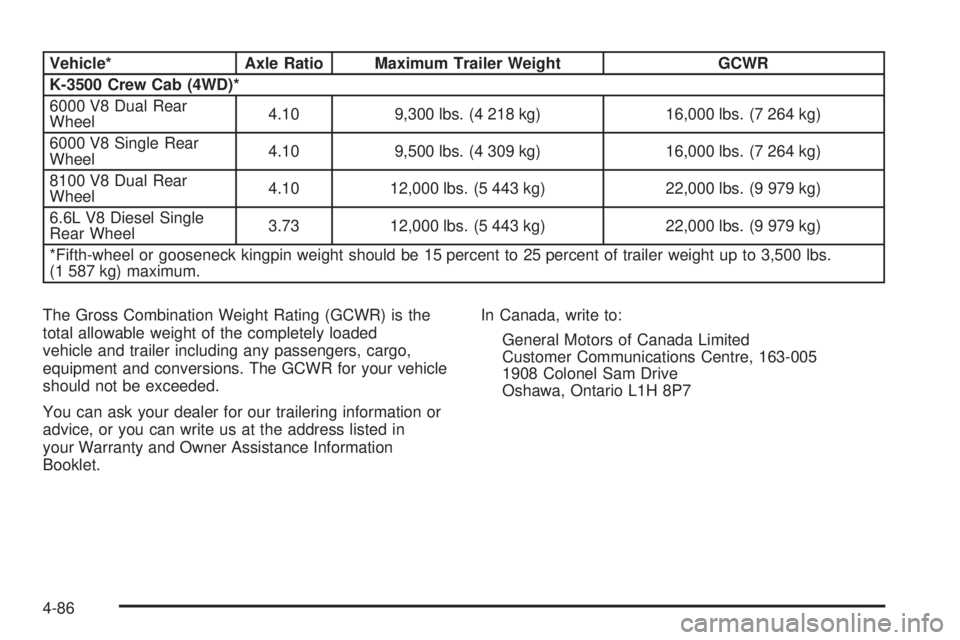
Vehicle* Axle Ratio Maximum Trailer Weight GCWR
K-3500 Crew Cab (4WD)*
6000 V8 Dual Rear
Wheel4.10 9,300 lbs. (4 218 kg) 16,000 lbs. (7 264 kg)
6000 V8 Single Rear
Wheel4.10 9,500 lbs. (4 309 kg) 16,000 lbs. (7 264 kg)
8100 V8 Dual Rear
Wheel4.10 12,000 lbs. (5 443 kg) 22,000 lbs. (9 979 kg)
6.6L V8 Diesel Single
Rear Wheel3.73 12,000 lbs. (5 443 kg) 22,000 lbs. (9 979 kg)
*Fifth-wheel or gooseneck kingpin weight should be 15 percent to 25 percent of trailer weight up to 3,500 lbs.
(1 587 kg) maximum.
The Gross Combination Weight Rating (GCWR) is the
total allowable weight of the completely loaded
vehicle and trailer including any passengers, cargo,
equipment and conversions. The GCWR for your vehicle
should not be exceeded.
You can ask your dealer for our trailering information or
advice, or you can write us at the address listed in
your Warranty and Owner Assistance Information
Booklet.In Canada, write to:
General Motors of Canada Limited
Customer Communications Centre, 163-005
1908 Colonel Sam Drive
Oshawa, Ontario L1H 8P7
4-86
Page 384 of 588
Fifth wheel or gooseneck kingpin weight should be 15 to
25 percent of the trailer weight up to the maximum
amount speci®ed in the trailering chart for your vehicle.
See ªWeight of theTrailerº, and ªFifth-Wheel and
Gooseneck Traileringº in this section.
Do not exceed the maximum allowable tongue weight
for your vehicle. Choose the shortest hitch extension
that will position the hitch ball closest to the vehicle. This
will help reduce the effect of trailer tongue weight on
the rear axle.
After you have loaded the trailer, weigh the trailer and
then the tongue separately, to see if the weights
are proper. If they are not, you may be able to get them
right by moving some items around in the trailer.Total Weight on Your Vehicle's Tires
Be sure your vehicle's tires are in¯ated to the upper limit
for cold tires. You'll ®nd these numbers on the
Certi®cation label at the rear edge of the driver's door or
see Loading Your Vehicle for more information. Then
be sure you don't go over the GVW limit for your vehicle,
or the GAWR, including the weight of the trailer
tongue. If you use a weight distributing hitch, make sure
you don't go over the rear axle limit before you apply
the weight distribution spring bars.
Hitches
It's important to have the correct hitch equipment.
Crosswinds, large trucks going by and rough roads are
a few reasons why you'll need the right hitch.
4-88
Page 386 of 588
Fifth Wheel and Gooseneck Trailering
Fifth wheel and gooseneck trailers can be used with
many pickup models. These trailers place a larger
percentage of the weight (kingpin weight) on the tow
vehicle than conventional trailers. Make sure this weight
does not cause the vehicle to exceed GAWR or GVWR.
Fifth wheel or gooseneck kingpin weight should be 15 to
25 percent of the trailer weight up to the maximum
amount speci®ed in the trailering chart for your vehicle.
See ªWeight of the Trailerº in this section for more
information.
The hitch should be located in the pickup bed so that
it's centerline is over or slightly in front of the rear axle.
Take care that it is not so far forward that it will
contact the back of the cab in sharp turns. This is
especially important for short box pickups. Trailer pin
box extensions and sliding ®fth wheel hitch assemblies
can help this condition. There should be at least six
inches of clearance between the top of the pickup box
and the bottom of the trailer shelf that extends over
the box.
Make sure the hitch is attached to the tow vehicle frame
rails. Do not use the pickup box for support.
Safety Chains
You should always attach chains between your vehicle
and your trailer. Cross the safety chains under the
tongue of the trailer to help prevent the tongue from
contacting the road if it becomes separated from
the hitch. Instructions about safety chains may be
provided by the hitch manufacturer or by the trailer
manufacturer. If you are towing a trailer up to 5,000 lbs.
(2 271 kg) with a factory-installed step bumper, you
may attach the safety chains to the attaching points on
the bumper. If you are towing a trailer up to your
vehicle's trailer rating limit you may attach the safety
chains to the attaching point on the hitch platform. If you
are towing with an aftermarket hitch follow the trailer
or hitch manufacturer's recommendation for attaching
safety chains. Always leave just enough slack so
you can turn with your rig. Never allow safety chains to
drag on the ground.
4-90
Page 391 of 588
When You Are Ready to Leave After
Parking on a Hill
1. Apply your regular brakes and hold the pedal down
while you:
·Start your engine
·Shift into a gear
·Release the parking brake
2. Let up on the brake pedal.
3. Drive slowly until the trailer is clear of the chocks.
4. Stop and have someone pick up and store the
chocks.
Maintenance When Trailer Towing
Your vehicle will need service more often when you're
pulling a trailer. SeeScheduled Maintenance on
page 6-4for more information. Things that are especially
important in trailer operation are automatic transmission
¯uid (don't over®ll), engine oil, axle lubricant, belt,
cooling system and brake system. Each of these is
covered in this manual, and the Index will help you ®nd
them quickly. If you're trailering, it's a good idea to
review these sections before you start your trip.
Check periodically to see that all hitch nuts and bolts
are tight.
Trailer Wiring Harness
Your vehicle is equipped with one of the following wiring
harnesses for towing a trailer or hauling a slide-in
camper.
Basic Trailer Wiring
All regular, extended cab crew cab pickups have a
six-wire trailer towing harness.
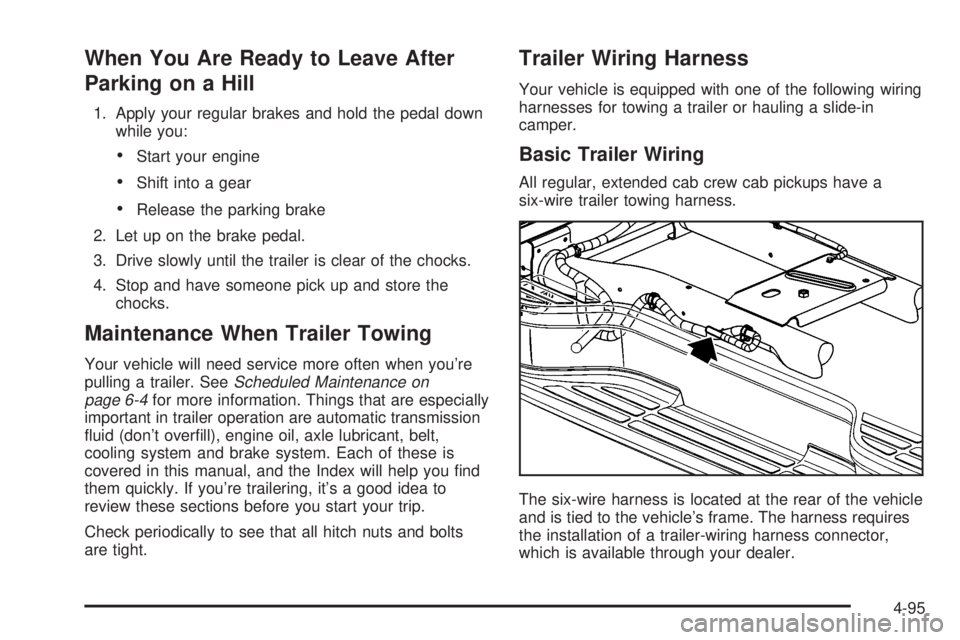
The six-wire harness is located at the rear of the vehicle
and is tied to the vehicle's frame. The harness requires
the installation of a trailer-wiring harness connector,
which is available through your dealer.
4-95
Page 401 of 588
Service............................................................5-3
Doing Your Own Service Work.........................5-3
Adding Equipment to the Outside of Your
Vehicle......................................................5-4
Fuel................................................................5-4
Gasoline Octane............................................5-4
Gasoline Speci®cations....................................5-5
California Fuel...............................................5-5
Additives.......................................................5-6
Fuels in Foreign Countries...............................5-6
Filling Your Tank............................................5-7
Filling a Portable Fuel Container.......................5-9
Checking Things Under the Hood....................5-10
Hood Release..............................................5-10
Engine Compartment Overview.......................5-12
Engine Oil...................................................5-18
Engine Air Cleaner/Filter................................5-23
Automatic Transmission Fluid (Except Allison
Transmission
ž) ..........................................5-25
Automatic Transmission Fluid (Allison
Transmission
ž) ..........................................5-28
Manual Transmission Fluid.............................5-31
Hydraulic Clutch...........................................5-32
Engine Coolant.............................................5-33
Coolant Surge Tank Pressure Cap..................5-36
Engine Overheating.......................................5-36Cooling System............................................5-39
Engine Fan Noise.........................................5-44
Power Steering Fluid.....................................5-45
Windshield Washer Fluid................................5-46
Brakes........................................................5-48
Battery........................................................5-52
Jump Starting...............................................5-53
Rear Axle.......................................................5-59
Four-Wheel Drive............................................5-60
Noise Control System.....................................5-62
Tampering with Noise Control System
Prohibited.................................................5-62
Bulb Replacement..........................................5-64
Halogen Bulbs..............................................5-64
Headlamps..................................................5-64
Front Turn Signal, Sidemarker and Daytime
Running Lamps.........................................5-66
Roof Marker Lamps......................................5-67
Center High-Mounted Stoplamp (CHMSL) and
Cargo Lamp.............................................5-69
Pickup Box Identi®cation and Fender Marker
Lamps.....................................................5-70
Taillamps.....................................................5-71
Replacement Bulbs.......................................5-74
Section 5 Service and Appearance Care
5-1